J7W1

Contents
Description
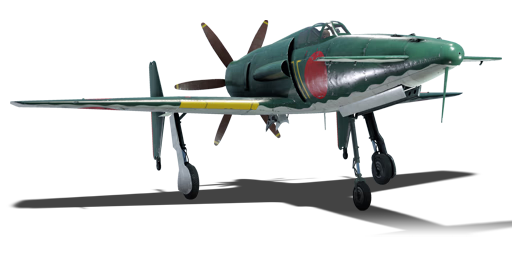
The J7W1 Shinden is a rank Japanese fighter with a battle rating of (AB), (RB), and (SB). It was introduced in Update 1.43.
The J7W1 Shinden is a bomber interceptor designed to make quick work of raiding bomber aircraft. It has exceptional performance at altitude, more than exceptional armament and a decent climb rate. The J7W1 is however, not particularly fast except at very high altitudes, and thus in most relevant situations in War Thunder, is a subpar brick of a plane at best which climbs okay-ish and handles amazingly in dives, but that's literally it. It cannot run from anything, nor can it hide, nor can it hope to turn against anything that is not a bomber.
General info
Flight performance
The J7W1 Shinden has a maximum speed of 892 km/h (558 mph/485 kt) IAS (this is Vne speed - the absolute maximum speed). In a dive from service ceiling, a speed of mach 0.9 has been recorded and is sustained until IAS speed limit is reached. The aircraft can handle a max load of 11G and compresses rudder, pitch and roll at extremely high IAS speed in order of descending effect.
| Characteristics | Max Speed (km/h at 8,500 m) |
Max altitude (meters) |
Turn time (seconds) |
Rate of climb (meters/second) |
Take-off run (meters) | |||
|---|---|---|---|---|---|---|---|---|
| AB | RB | AB | RB | AB | RB | |||
| Stock | 723 | 703 | 31.5 | 32.2 | 15.3 | 15.3 | 650 | |
| Upgraded | 779 | 750 | 28.6 | 30.0 | 23.0 | 18.6 | ||
Details
| Features | ||||
|---|---|---|---|---|
| Combat flaps | Take-off flaps | Landing flaps | Air brakes | Arrestor gear |
| ✓ | ✓ | ✓ | X | X |
| Limits | ||||||
|---|---|---|---|---|---|---|
| Wings (km/h) | Gear (km/h) | Flaps (km/h) | Max Static G | |||
| Combat | Take-off | Landing | + | - | ||
| 498 | 469 | 320 | ~8 | ~6 | ||
| Optimal velocities (km/h) | |||
|---|---|---|---|
| Ailerons | Rudder | Elevators | Radiator |
| < 563 | < 560 | < 560 | > 314 |
| Compressor (RB/SB) | ||
|---|---|---|
| Setting 1 | ||
| Optimal altitude | 100% Engine power | WEP Engine power |
| 8,400 m | 1,660 hp | 1,942 hp |


Survivability and armour
- 70 mm Bulletproof glass - Armoured windscreen
- 16 mm Steel plate in the nose, in front of ammo boxes and pilot
The J7W1 is protected by armour glass (70 mm) in front of pilot and steel armour plate (16 mm) in front of pilot in between guns. It is very prone to fires, and which are difficult to extinguish. Engine snipes are common, due to the position of the engine. Wing tip damage can increase the likelyhood of unrecoverable flat spins.
Modifications and economy
Armaments
Offensive armament
The J7W1 is armed with:
- 4 x 30 mm Type 5 navy cannons, nose-mounted (60 rpg = 240 total)
- Muzzle velocities
- Shells: HEF-T, PT, P: 910 m/s
- Shells: HEF-I, HEF: 720 m/s
- Tracer: 910 m/s
- All other belts: Mixed shell velocities, see above.
Suspended armament
The J7W1 can be outfitted with the following ordnance:
- Without load
- 2 x 60 kg Navy Type 97 Number 6 bombs (120 kg total)
- 4 x 60 kg Navy Type 97 Number 6 bombs (240 kg total)
Usage in battles
The Shinden is a high-altitude specialist with (sadly) not much role in War Thunder's current state. There are no objectives in any game mode up at the high altitudes where the thing shines, while its high BR of 6.0 means that it doesn't often face the 4-engine bombers it was designed to counter, but instead literal swarms of Ju-288Cs, which are nearly as fast as or faster in most normal combat altitudes than you and have more reliable defensive firepower than your offensive firepower. It does not climb that spectacularly, particularly because the engine only has one supercharger gear setting for high altitude. It dives amazingly when it is able to get the drop on an opponent - unlike literally every other Japanese fighter, it does not compress very much at higher speeds. But, it turns like a bus and thus can only strictly do "Boom & Zoom" type attacks, then running like hell and hoping the foe can't catch you if you missed your shots. The roll and rudder are responsive at high speeds, enabling you to line up your shots very well, though. The guns are devastating when they do work, obliterating single-engine fighters, but sadly they spark without seeming to do much damage more often than not, especially versus the bombers it is meant to kill. This plane only might have some degree of use in Combined Ground Battles solely as an anti-CAS plane, due to the lack of red markers enabling it to surprise people more often with its insane dive speeds.
Manual Engine Control
| MEC elements | ||||||
|---|---|---|---|---|---|---|
| Mixer | Pitch | Radiator | Supercharger | Turbocharger | ||
| Oil | Water | Type | ||||
| Controllable | Controllable Auto control available |
Not controllable Not auto controlled |
Controllable Auto control available |
Combined | Not controllable 1 gear |
Not controllable |
Pros and cons
Pros:
- Pilot has some protection in the back from the engine.
- Competitive high speed turn rate
- Good roll rate
- Amazing pitch response
- 4 x 30 mm cannons make for some great offensive firepower, but they have sparking issues.
- Great high speed and handling and dive.
- Since the engine and propeller are located in the rear, it is not likely to take damage or catch fire from shots landing at its front.
Cons:
- Slow sustained turn rate.
- High speed rudder suffers some compression, though less than many other Japanese aircraft at the tier
- Pilot more exposed at the front.
- Since the engine is located in the rear, it is especially vulnerable to enemies behind it.
- Shots to the front may damage its "tail" flaps.
- Fuel tanks are easily flammable and do not self seal fully.
History
The J7W1 Shinden (震電, "Magnificent Lightning") was an Imperial Japanese fighter of WWII that was built near the end of the war in an attempted response to the American B-29 Superfortress bombers. The aircraft used a canard wing formation, (canard wing formation refers to how the main wings are mounted at the rear of the fuselage and smaller wings are placed at the front. Similar to the Curtiss-Wright XP-55 Ascender.) Like the Ascender, the J7W1 was never put into mass-production and was abandoned while still in the prototype stage.[1]
Developed with the intention of intercepting heavy bombers, it was given 4 nose-mounted 30 mm cannons.
Development of the aircraft began in 1944, but shortages of manufacturing supplies continued to delay its development and testing and the first prototype wasn't completed until April 1945. The Navy placed high hopes in the new model and it was originally hoped that the Kyushu's Zasshonokuma factory and Nakajima's Handa plant would be able to produce over a thousand of the aircraft by 1947.
The prototype first flew on 3 August 1945 from Itazuke Air Base. The plane flew a total of three times, each time as a test flight before it was grounded permanently due to the Japanese surrender and end of the war.
Various parts of the Shinden survived the end of the war and its fuselage can be seen at the National Air and Space Museum in Washington DC.[2]
Media
- Skins
 Market
 Market
- Videos
See also
- Aircraft of comparable role, configuration and era
External links
- [Profile] J7W1 Shinden - The magnificent lightning
- [Forum] Aircraft Datasheet
- [Wikipedia] Kyushu J7W
References
| Kyūshū Aircraft Co. Ltd. (九州飛行機株式会社) | |
|---|---|
| Fighters | J7W1 |
| Previously known as Watanabe Iron Works Co. Ltd. (渡辺鉄工株式会社) prior to 1943 before being split into Kyūshū Aircraft & Kyūshū Weapons. | |
| Japan fighters | |
|---|---|
| Navy | |
| Carrier-based fighter | |
| A5M | A5M4 · Hagiri's A5M4 |
| A6M | A6M2 mod. 11 · A6M2 · A6M3 · A6M3 mod. 22 · A6M3 mod. 22Ko · A6M5 · A6M5 Ko · A6M5 otsu · A6M5 Hei · A6M6c |
| A7He | A7He1* |
| A7M | A7M1 (NK9H) · A7M2 |
| Land-based Fighter | |
| J2M | J2M2 · J2M3 · J2M4 Kai · J2M5 · J2M5 (30 mm) |
| J6K | J6K1 |
| J7W | J7W1 |
| N1K-J | N1K1-Ja · N1K2-J · N1K2-Ja |
| Fighter seaplane | |
| N1K | N1K1 |
| A6M-N | A6M2-N |
| Army | |
| Ki-10 | Ki-10-I · Ki-10-I C · Ki-10-II · Ki-10-II C |
| Ki-27 | Ki-27 otsu · Ki-27 otsu Tachiarai |
| Ki-43 | Ki-43-I · Ki-43-II · Ki-43-III otsu |
| Ki-44 | Ki-44-I · Ki-44-I 34 · Ki-44-II otsu · Ki-44-II hei |
| Ki-61 | Ki-61-I ko · Ki-61-I otsu · Ki-61-I hei · Tada's Ki-61-I hei · Ki-61-I tei · Ki-61-II Otsu Kai |
| Ki-84 | Ki-84 ko · Ki-84 otsu · Ki-84 hei |
| Ki-87 | Ki-87 |
| Ki-94 | Ki-94-II |
| Ki-100 | Ki-100 · Ki-100-II |
| Other countries | ▅F4U-1A · ▅P-51C-11-NT · ▅Bf 109 E-7 · ▅Fw 190 A-5 |
| *Imported designation of the He 112 (A6M was in development - A7M would take A7 designation after the cancelation of the A7He) | |