Difference between pages "J21A-1" and "Pz.Bef.Wg.IV J"
(→Description) |
(Undo revision 190924 by U165520049 (talk)) |
||
| Line 1: | Line 1: | ||
{{About | {{About | ||
| − | | about = | + | | about = German medium tank '''{{PAGENAME}}''' |
| usage = other versions | | usage = other versions | ||
| − | | link = | + | | link = Pz.IV (Family) |
}} | }} | ||
{{Specs-Card | {{Specs-Card | ||
| − | |code= | + | |code=germ_panzerbefelhswagen_IV_ausf_J |
| − | |images={{Specs-Card-Image|GarageImage_{{PAGENAME}}.jpg}} | + | |images={{Specs-Card-Image|GarageImage_{{PAGENAME}}.jpg|ArtImage_{{PAGENAME}}.png|ArtImage2_{{PAGENAME}}.png}} |
| − | | | ||
}} | }} | ||
== Description == | == Description == | ||
| − | <!-- ''In the description, the first part should be about the history of | + | <!-- ''In the description, the first part should be about the history of the creation and combat usage of the vehicle, as well as its key features. In the second part, tell the reader about the ground vehicle in the game. Insert a screenshot of the vehicle, so that if the novice player does not remember the vehicle by name, he will immediately understand what kind of vehicle the article is talking about.'' --> |
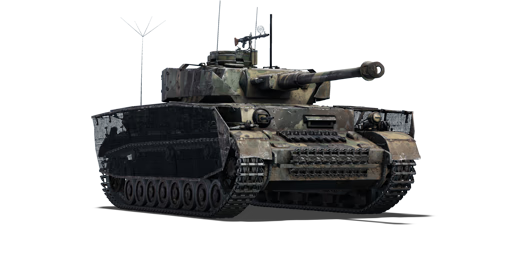
| − | The ''' | + | The '''Panzerbefehlswagen IV Ausführung J (Pz.Bef.Wg.IV J)''' ([[Abbreviations#.28DE.29_Sd.Kfz._Index|Sd.Kfz. Index:]] '''Sd.Kfz. 161/2''') was a special command version of the ninth variant of the [[Pz.IV (Family)|Panzerkampfwagen IV medium tank family]]. The Panzer IV J command variant was produced after March 1944. This variant was modified by removing 15 rounds of 75 mm main gun ammunition and installing a new radio system, which included cables, transformers, and junction boxes. A GG400 auxiliary power generator was also installed. The Fu 8 (medium wave receiver) and Fu 5 (ultra-short-wave receiver) were the new radio sets. A Sternantenne D (Star aerial) for the Fu 8 was installed on the rear of the hull, while the conventional 2-meter antenna for the Fu 5 was installed on the roof of the turret in place of the Nahverteidigungswaffe grenade launcher. There was also a T.S.R.1 observation periscope and an SF14Z periscope scissor attached. The SF14Z could be installed inside the cupola, where the commander could see the battlefield through the open hatch. The T.S.R.1 was a long stick periscope located on the turret roof near the commander's cupola that could be extended via a pivoting support. Only 17 Pz.Bef.Wg.IV J tanks were manufactured from scratch, while the remaining 88 were modified from pre-existing [[Pz.IV J|Panzer IV J]] tanks. |
| − | + | Introduced in [[Update 1.43]], the Pz.Bef.Wg.IV J variant is a special modification from the original Panzer IV J variant. To compensate for the Panzer IV J variant's missing 5 mm Schürzen side skirts, steel mashes known as Thoma-Schürzen were fitted in their place. While the steel mashes may protect the player from the occasional early HEAT ammunition, particularly from the [[M4A3 (105)]] from specific angles, they should not be relied on to exchange fire with adversaries. The original single-speed electric power drive for the turret traverse remains unavailable, and the turret traverse must be hand-cranked by a two-gear manual traverse. The three radio antennae serve no purpose in the game and are merely aesthetic decorations. Overall, it is a medium tank with a playstyle comparable to the Panzer IV J that should be played cautiously. | |
== General info == | == General info == | ||
| − | === | + | === Survivability and armour === |
| − | {{Specs- | + | {{Specs-Tank-Armour}} |
| − | <!-- ''Describe | + | <!-- ''Describe armour protection. Note the most well protected and key weak areas. Appreciate the layout of modules as well as the number and location of crew members. Is the level of armour protection sufficient, is the placement of modules helpful for survival in combat? If necessary use a visual template to indicate the most secure and weak zones of the armour.'' --> |
| − | + | '''Armour type:''' | |
| + | |||
| + | * Rolled homogeneous armour | ||
| + | * Cast homogeneous armour (Gun mantlet, Cupola) | ||
| − | {| class="wikitable" | + | {| class="wikitable" |
| − | |||
| − | |||
| − | |||
| − | |||
| − | |||
| − | |||
|- | |- | ||
| − | ! | + | ! Armour !! Front (Slope angle) !! Sides !! Rear !! Roof |
|- | |- | ||
| − | + | | Hull || 80 mm (11°) ''Front plate'' <br> 20 mm (72°) ''Front glacis'' <br> 80 mm (12-64°) ''Lower glacis'' || 30 mm || 30 mm (4-15°) || 26 mm ''Front'' <br> 10 mm ''Rear and hatches'' | |
| − | | | ||
|- | |- | ||
| − | + | | Turret || 50 mm (11°) ''Turret front'' <br> 50 mm (7-29°) ''Gun mantlet'' || 30 (23-26°) + 5 (0-1°) mm || 30 (15-17°) + 5 mm || 16 mm ''Front'' <br> 10 mm ''Rear'' | |
| − | | | ||
|- | |- | ||
| + | | Cupola || 95 mm || 95 mm || 95 mm || 10 mm | ||
|} | |} | ||
| + | '''Notes:''' | ||
| + | |||
| + | * Suspension wheels are 15 mm thick while tracks are 20 mm thick. | ||
| + | * The hull and turret sides are protected by an extra 5 mm thick plate to provide protection against HEAT and HE rounds. | ||
| + | * Belly armour is 10 mm thick. | ||
| + | * Barrel shroud around gun barrel is 20 mm thick. | ||
| + | * [[Add-on Armor|Add-on Armour]] gives an additional 15 mm of armour can be added to the front facing surfaces. | ||
| − | + | The Pz.Bfw IV is vulnerable to most front shot engagement, especially so if no serious attempt is made in compound angling. The front plate in its unsloped format is an enticing target, but beware to not hit the front sloping glacis right in front of it as that area has a tendency to bounce everything. Also, avoid hitting straight into the ball machine gun and driver's port in the front as these also have a tendency to nullify an armour-piercing shot. When using APHE rounds, simply hit centre mass of the front plate and let the post-penetration effect do the rest. | |
| − | + | ||
| − | + | In the case of a vehicle with a gun simply unable to penetrate this front plate, aim towards the turret that still retains a 50 mm front plate. Even the weaker non-autocannon armaments can penetrate through this front plate and incapacitate the turret crew. Aim for the turret left side (right side when shooting it) to knock out the gunner and deny their firepower, then chip away at weak spots until the threat is destroyed. | |
| − | |||
| − | |||
| − | |||
| − | |||
| − | |||
| − | |||
| − | |||
| − | + | Alternatively, aim at the Panzer IV from its long vulnerable sides in cases where its slow turret traverse cannot keep up with a flanking manoeuvre or catching it in an ambush. The interior is fully stocked with ammo racks even when the user is taking a minimum load. Moreover, the fuel tank resides at the very bottom of the centre of the tank, so a penetrating shot with APHE will either detonate the ammunition, set the tank on fire, or knock out a good portion of the crew, if not fully destroy the tank with all three effects. | |
| − | |||
| − | |||
| − | |||
| − | |||
| − | |||
| − | |||
| − | |||
| − | |||
| − | |||
| − | |||
| − | |||
| − | |||
| − | |||
| − | + | In every case scenario, it is to the benefit of the surviving player to fire the first shot against the Pz.Bfw IV above all else, as it would deny the Pz.Bfw IV even a chance to use its high-penetrating 75 mm gun. | |
| − | |||
| − | |||
| − | |||
| − | |||
| − | |||
| − | |||
| − | |||
| − | |||
| − | === | + | === Mobility === |
| − | + | {{Specs-Tank-Mobility}} | |
| − | {{Specs- | + | <!-- ''Write about the mobility of the ground vehicle. Estimate the specific power and manoeuvrability, as well as the maximum speed forwards and backwards.'' --> |
| − | <!-- '' | ||
| − | + | {{tankMobility|abMinHp=465|rbMinHp=265|AoAweight=0.4}} | |
| − | |||
| − | |||
| − | |||
| − | |||
=== Modifications and economy === | === Modifications and economy === | ||
| Line 91: | Line 60: | ||
== Armaments == | == Armaments == | ||
| − | {{Specs- | + | {{Specs-Tank-Armaments}} |
| − | === | + | === Main armament === |
| − | {{Specs- | + | {{Specs-Tank-Weapon|1}} |
| − | <!-- '' | + | <!-- ''Give the reader information about the characteristics of the main gun. Assess its effectiveness in a battle based on the reloading speed, ballistics and the power of shells. Do not forget about the flexibility of the fire, that is how quickly the cannon can be aimed at the target, open fire on it and aim at another enemy. Add a link to the main article on the gun: <code><nowiki>{{main|Name of the weapon}}</nowiki></code>. Describe in general terms the ammunition available for the main gun. Give advice on how to use them and how to fill the ammunition storage.'' --> |
| − | {{main| | + | {{main|KwK40 L48 (75 mm)}} |
| − | + | {| class="wikitable" style="text-align:center" width="100%" | |
| + | |- | ||
| + | ! colspan="5" | [[KwK40 L48 (75 mm)|75 mm KwK40 L48]] || colspan="5" | Turret rotation speed (°/s) || colspan="4" | Reloading rate (seconds) | ||
| + | |- | ||
| + | ! Mode !! Capacity !! Vertical !! Horizontal !! Stabilizer | ||
| + | ! Stock !! Upgraded !! Full !! Expert !! Aced | ||
| + | ! Stock !! Full !! Expert !! Aced | ||
| + | |- | ||
| + | ! ''Arcade'' | ||
| + | | rowspan="2" | 87 || rowspan="2" | -10°/+20° || rowspan="2" | ±180° || rowspan="2" | N/A || 9.5 || 13.2 || 16.0 || 17.7 || 18.8 || rowspan="2" | 7.67 || rowspan="2" | 6.79 || rowspan="2" | 6.25 || rowspan="2" | 5.90 | ||
| + | |- | ||
| + | ! ''Realistic'' | ||
| + | | 5.9 || 7.0 || 8.5 || 9.4 || 10.0 | ||
| + | |- | ||
| + | |} | ||
| − | + | ==== Ammunition ==== | |
| − | |||
| − | |||
| − | + | *'''PzGr 39''' - {{Annotation|APCBC|Armour Piercing Ballistic Cap}} shell - This is the main ammo type, always use this if confident it can penetrate enemy armour. It deals the most damage because of its explosive filler. | |
| + | *'''Hl.Gr 38B''' - {{Annotation|HEAT|High Explosive Anti-Tank}} shell - it is recommended to completely avoid this kind of shell as its performance is vastly inferior in all aspects compared to APCBC or APCR ammo used by this tank. | ||
| + | *'''PzGr 40''' - {{Annotation|APCR|Armour Piercing Composite Rigid}} shell - This type of ammo should be used only if there is trouble penetrating the opponent, or trying to hit a fast moving tank at some distance. However, its damaging potential is much lower because it has no explosive filler to further enhance damage after the penetration. | ||
| + | *'''Sprgr. 34''' - {{Annotation|HE|High Explosive}} shell - Carry only very few of these. They are useless against anything other than unarmoured AA vehicles, to which it is lethal. | ||
| + | * '''K.Gr.Rot Nb.''' - Smoke shells are useful to blind enemy vehicles that block your advance while being being too remote for you to disable. | ||
| − | + | {{:KwK40 L48 (75 mm)/Ammunition|PzGr 39, Hl.Gr 38B, PzGr 40, Sprgr. 34, K.Gr.Rot Nb.}} | |
| − | == | + | ==== [[Ammo racks]] ==== |
| − | <!-- '' | + | <!-- '''Last updated: 1.101.1.16''' --> |
| + | {| class="wikitable" style="text-align:center" | ||
| + | |- | ||
| + | ! Full<br>ammo | ||
| + | ! 1st<br>rack empty | ||
| + | ! 2nd<br>rack empty | ||
| + | ! 3rd<br>rack empty | ||
| + | ! 4th<br>rack empty | ||
| + | ! 5th<br>rack empty | ||
| + | ! 6th<br>rack empty | ||
| + | ! 7th<br>rack empty | ||
| + | ! 8th<br>rack empty | ||
| + | ! 9th<br>rack empty | ||
| + | ! 10th<br>rack empty | ||
| + | ! 11th<br>rack empty | ||
| + | ! Visual<br>discrepancy | ||
| + | |- | ||
| + | | '''87''' || 84 ''(+3)'' || 82 ''(+5)'' || 80 ''(+7)'' || 72 ''(+15)'' || 63 ''(+24)'' || 54 ''(+33)'' || 46 ''(+41)'' || 38 ''(+49)'' || 30 ''(+57)'' || 24 ''(+63)'' || 1 ''(+86)'' || No | ||
| + | |- | ||
| + | |} | ||
| + | [[File:Ammoracks_Pz.IV_H.png|right|thumb|x250px|[[Ammo racks]] of the Pz.IV H (identical)]] | ||
| + | '''Notes''': | ||
| − | + | * As they are modeled by sets of 2, shells disappear from the rack only after you fire both shells in the set. | |
| + | * Sides empty: 30 ''(+57)'' shells. | ||
| − | + | === Machine guns === | |
| + | {{Specs-Tank-Weapon|2}} | ||
| + | {{Specs-Tank-Weapon|3}} | ||
| + | <!-- ''Offensive and anti-aircraft machine guns not only allow you to fight some aircraft but also are effective against lightly armoured vehicles. Evaluate machine guns and give recommendations on its use.'' --> | ||
| + | {{main|MG34 (7.92 mm)}} | ||
| − | + | {| class="wikitable" style="text-align:center" width="50%" | |
| − | |||
| − | |||
| − | |||
| − | |||
| − | |||
| − | |||
| − | {| class="wikitable" style="text-align:center" | ||
|- | |- | ||
| − | ! colspan="7 | + | ! colspan="5" | [[MG34 (7.92 mm)|7.92 mm MG34]] |
|- | |- | ||
| − | ! | + | ! Mount !! Capacity (Belt) !! Fire rate !! Vertical !! Horizontal |
| − | ! | ||
| − | ! | ||
| − | ! | ||
| − | ! | ||
|- | |- | ||
| − | + | | Coaxial || 3,150 (150) || 900 || N/A || N/A | |
|- | |- | ||
| − | | | + | | Pintle || 2,100 (150) || 900 || -10°/+20° || ±180° |
|- | |- | ||
|} | |} | ||
| − | == | + | == Usage in battles == |
| − | <!-- '' | + | <!-- ''Describe the tactics of playing in the vehicle, the features of using vehicles in the team and advice on tactics. Refrain from creating a "guide" - do not impose a single point of view but instead give the reader food for thought. Describe the most dangerous enemies and give recommendations on fighting them. If necessary, note the specifics of the game in different modes (AB, RB, SB).'' --> |
| + | Like the Panzer IV J, the Pz.Bfw. IV suffers compared to its other variants due to its slow, manual turret traverse rate. This causes the Pz.Bfw IV to lose flexibility in reacting to close encounters without turning the entire hull around. As such, it is recommended not to use the Pz.Bfw IV as a front-line assaulter in combat. | ||
| + | |||
| + | Tactics-wise, the Pz.Bfw IV is perfect for sniping and ambushes, where the slower turret traverse rate affects its combat performance less. Attack from a distance, especially while that enemy is focused on other allies in the team. Ambushes can also work in close-range events when watching corners, street intersections, and checkpoints, but be wary of any enemies trying to outmanoeuvre the Pz.Bfw IV as it would require drastic action with the slow turret rate. Try not to engage the enemy in a straight-up front confrontation as most enemies would be able to easily cleave through the front armour and end the vehicle. | ||
| + | |||
| + | Although most tanks in Rank III can destroy the {{PAGENAME}} pretty quickly, the tanks the {{PAGENAME}} need to avoid in open combat (if possible) are [[KV-2 (1939)|KV-2s]], [[SU-152|SU-152s]], [[T-34-85 (D-5T)|T-34-85(D-5T)s]], [[M4A3E2|M4A3E2 Jumbos]]. | ||
| − | ''' | + | * For KV-2s, if it's looking at the {{PAGENAME}} (And hopefully reloading), shoot at the flat of the turret below the mantlet. It's flat, relatively thin armour, and the 75 mm shell should go right through and take out everyone and everything in the turret. From the side, shoot it in the side of the hull (At a 90-degree angle for best effects) to ignite the fuel tanks and maybe even detonate the ammo. Shooting the turret isn't recommended unless for knocking out the gunner or the breech, as there are a lot of crew members in there, and the shells in the turret rarely ignite. Trying to destroy it that way will take time. |
| − | * | + | * For SU-152s, shoot to the right of the gun, above the driver's viewport, and it will wreck everything inside. If that's an option, try to get around it. It is a casemate after all. Once the tank is on its side, shoot it in the crew compartment to obliterate it. |
| − | |||
| − | |||
| − | |||
| − | |||
| − | |||
| − | |||
| − | ''' | + | * For T-34-85(D-5T)s, it is imperative that the {{PAGENAME}} gets the first shot off, as their 85 mm will go through the {{PAGENAME}} 85 ways from Sunday, and nuke the entire tank interior. Don't shoot the turret unless there is no other option, as it's incredibly prone to ricochet shells. Instead, shoot the hull centre. Pay close attention not to hit the driver's hatch as it's actually more armoured than the glacis itself. |
| − | * | + | * M4A3E2 Jumbo's will give the {{PAGENAME}} the hardest time, as their frontal armour is nigh impenetrable, aside from the machine gun port. It's a small, unreliable target, but it's the only chance of penetrating the Jumbo from the front. If lucky, and catch a Jumbo on its side, shoot it in its hull. As its Turret side (and rear!) armour is still thick enough to block the 75 mm shots. Also, keep in mind, that if the Jumbo is showing its side while angling toward the {{PAGENAME}}, that the side armour behind its tracks is very thinly armoured. Try shooting there if possible. |
| − | |||
| − | |||
| − | |||
| − | |||
| − | |||
| − | == | + | === Pros and cons === |
| − | <!-- '' | + | <!-- ''Summarise and briefly evaluate the vehicle in terms of its characteristics and combat effectiveness. Mark its pros and cons in a bulleted list. Try not to use more than 6 points for each of the characteristics. Avoid using categorical definitions such as "bad", "good" and the like - use substitutions with softer forms such as "inadequate" and "effective".'' --> |
| − | |||
| − | + | '''Pros:''' | |
| − | + | * The KwK40 L/48 cannon provides enough muzzle velocity to penetrate most contemporary enemies at far range | |
| + | * PzGr 40 (APCR) offers great penetration in case PzGr 39 (APCBC) fails | ||
| + | * Heavily sloped area in front of the front flat plate has a tendency to bounce most shots aimed towards it | ||
| + | * Turrets and side have Schürzen (Spaced Armour), which can offer some protection from HEAT or HE rounds | ||
| + | * Good acceleration from a stop | ||
| + | * Satisfactory performance over cross-country and road terrains | ||
| + | * 5 crew members are present in the tank. (Commander, gunner, driver, loader, machinegunner) | ||
| − | + | '''Cons:''' | |
| − | + | * Poor turret traverse rate can be fatal in certain situations | |
| − | + | * Box armour structure has no benefits from sloping except for a section in the front | |
| + | * Generally, most AP rounds will effortlessly penetrate the Panzer IV, weaker rounds can also easily hit at weak points | ||
| + | * Lacks a large gun mantlet for turret protection | ||
| + | * Armour protection is poor, able to be penetrated by all the tanks it encounters even frontally | ||
| + | * Generally outperformed by vehicles it faces and fights with | ||
| − | + | == History == | |
| + | <!-- ''Describe the history of the creation and combat usage of the vehicle in more detail than in the introduction. If the historical reference turns out to be too long, take it to a separate article, taking a link to the article about the vehicle and adding a block "/History" (example: <nowiki>https://wiki.warthunder.com/(Vehicle-name)/History</nowiki>) and add a link to it here using the <code>main</code> template. Be sure to reference text and sources by using <code><nowiki><ref></ref></nowiki></code>, as well as adding them at the end of the article with <code><nowiki><references /></nowiki></code>. This section may also include the vehicle's dev blog entry (if applicable) and the in-game encyclopedia description (under <code><nowiki>=== In-game description ===</nowiki></code>, also if applicable).'' --> | ||
| + | The '''Panzerbefehlswagen IV''' is a command tank variant of the Panzer IV. While nearly the same exterior wise, the inside has been refitted with new equipment to enhance communication, thus fighting is not its purpose role. About 105 Panzerbefehlswagen IV were made during the war, with 17 from the [[Pz.IV J|Panzer IV Ausf. J]] variant and the rest from refurbished chassis adapted to the role. | ||
| − | + | The conversion allowed the tank to mount additional radio sets for communicating with the tank, infantry, and even aircraft units, or back to headquarters. The loader of the tank doubled as a radio operator as well to maintain all the radios in the tank. As well as the radios, mounting racks, transformers, junction boxes, antennas, and an auxiliary electrical engineer are also installed into the tank. This new equipment takes up space in the tank and so the ammunition stowage is reduced from the usual 87 rounds to 72 rounds, but this is mitigated by the fact that it should not be the front-line weapon against the enemy. | |
| − | + | Other than that, the tank is nearly the same as the original Panzer IV tank. The tank featured a 75 mm KwK40 main gun with a coaxial MG34 machine gun. The tank had about 80 mm of armour on the front hull, plus additional armour in the form of Schürzen side skirts. Unlike the [[Pz.IV H|Ausf. H]] variant, this variant had the skirts made from wire-meshes rather than metal plates to decrease weight, yet keep the same protection against HEAT rounds. | |
| − | + | {{break}} | |
| + | {{Navigation-Start|{{Annotation|Archive of the in-game description|An archive of the historical description of the vehicle that was presented in-game prior to Update 1.55 'Royal Armour'}}}} | ||
| + | {{Navigation-First-Simple-Line}} | ||
| + | Commander vehicles for the commanders of medium tank battalions were built based on the standard Pz.IV Ausf.J tank equipped with additional radio stations. There were two varieties, the Sd.Kfz.267 and Sd.Kfz.268, which had different numbers of radio stations. The commander tanks were equipped with Fu 5, Fu 7, and Fu 8 radio stations. The tanks were used in battles on the Eastern and Western Fronts in 1944-1945. 97 tanks were produced between March and September of 1944. | ||
| + | {{Navigation-End}} | ||
== Media == | == Media == | ||
| Line 185: | Line 194: | ||
;Skins | ;Skins | ||
| − | * [https://live.warthunder.com/feed/camouflages/?vehicle= | + | * [https://live.warthunder.com/feed/camouflages/?vehicle=germ_panzerbefelhswagen_IV_ausf_J Skins and camouflages for the {{PAGENAME}} from live.warthunder.com.] |
| + | |||
| + | ;Sights | ||
| − | + | * [https://live.warthunder.com/post/675135/en/ RideR2's Realistic gunsight (TZF4a, TZF 5a/b/d/e/f/f2, TZF 9b/b1/c/d, TZF 12/a) for Pzkpfw II, Pzkpfw III, Pzkpfw IV, Pzkpfw V, Pzkpfw VI] | |
| − | |||
| − | |||
| − | |||
| − | |||
| − | |||
| − | |||
| − | |||
| − | |||
| − | |||
| − | |||
;Videos | ;Videos | ||
| − | {{Youtube-gallery| | + | {{Youtube-gallery|aiYBpRJtIA0|'''Pz.Bef.Wg.IV J - Unenjoyable Premium Tank''' - ''Napalmratte''}} |
== See also == | == See also == | ||
<!-- ''Links to the articles on the War Thunder Wiki that you think will be useful for the reader, for example:'' | <!-- ''Links to the articles on the War Thunder Wiki that you think will be useful for the reader, for example:'' | ||
| − | * ''reference to the series of the | + | * ''reference to the series of the vehicles;'' |
* ''links to approximate analogues of other nations and research trees.'' --> | * ''links to approximate analogues of other nations and research trees.'' --> | ||
| − | ; | + | ;Other command vehicles |
| − | * [[ | + | * [[Pz.Bef.Wg.VI P]] |
| + | * [[Bfw. Jagdpanther]] | ||
| − | + | == External links == | |
| + | ''Paste links to sources and external resources, such as:'' | ||
| − | |||
| − | |||
| − | |||
| − | |||
* ''topic on the official game forum;'' | * ''topic on the official game forum;'' | ||
| − | * ''other literature.'' | + | * ''other literature.'' |
| − | |||
| − | |||
| − | |||
| − | {{ | + | {{Germany medium tanks}} |
| − | {{ | + | {{Germany premium ground vehicles}} |
Latest revision as of 19:32, 12 August 2024
| This page is about the German medium tank Pz.Bef.Wg.IV J. For other versions, see Pz.IV (Family). |


Contents
Description
The Panzerbefehlswagen IV Ausführung J (Pz.Bef.Wg.IV J) (Sd.Kfz. Index: Sd.Kfz. 161/2) was a special command version of the ninth variant of the Panzerkampfwagen IV medium tank family. The Panzer IV J command variant was produced after March 1944. This variant was modified by removing 15 rounds of 75 mm main gun ammunition and installing a new radio system, which included cables, transformers, and junction boxes. A GG400 auxiliary power generator was also installed. The Fu 8 (medium wave receiver) and Fu 5 (ultra-short-wave receiver) were the new radio sets. A Sternantenne D (Star aerial) for the Fu 8 was installed on the rear of the hull, while the conventional 2-meter antenna for the Fu 5 was installed on the roof of the turret in place of the Nahverteidigungswaffe grenade launcher. There was also a T.S.R.1 observation periscope and an SF14Z periscope scissor attached. The SF14Z could be installed inside the cupola, where the commander could see the battlefield through the open hatch. The T.S.R.1 was a long stick periscope located on the turret roof near the commander's cupola that could be extended via a pivoting support. Only 17 Pz.Bef.Wg.IV J tanks were manufactured from scratch, while the remaining 88 were modified from pre-existing Panzer IV J tanks.
Introduced in Update 1.43, the Pz.Bef.Wg.IV J variant is a special modification from the original Panzer IV J variant. To compensate for the Panzer IV J variant's missing 5 mm Schürzen side skirts, steel mashes known as Thoma-Schürzen were fitted in their place. While the steel mashes may protect the player from the occasional early HEAT ammunition, particularly from the M4A3 (105) from specific angles, they should not be relied on to exchange fire with adversaries. The original single-speed electric power drive for the turret traverse remains unavailable, and the turret traverse must be hand-cranked by a two-gear manual traverse. The three radio antennae serve no purpose in the game and are merely aesthetic decorations. Overall, it is a medium tank with a playstyle comparable to the Panzer IV J that should be played cautiously.
General info
Survivability and armour
Armour type:
- Rolled homogeneous armour
- Cast homogeneous armour (Gun mantlet, Cupola)
| Armour | Front (Slope angle) | Sides | Rear | Roof |
|---|---|---|---|---|
| Hull | 80 mm (11°) Front plate 20 mm (72°) Front glacis 80 mm (12-64°) Lower glacis |
30 mm | 30 mm (4-15°) | 26 mm Front 10 mm Rear and hatches |
| Turret | 50 mm (11°) Turret front 50 mm (7-29°) Gun mantlet |
30 (23-26°) + 5 (0-1°) mm | 30 (15-17°) + 5 mm | 16 mm Front 10 mm Rear |
| Cupola | 95 mm | 95 mm | 95 mm | 10 mm |
Notes:
- Suspension wheels are 15 mm thick while tracks are 20 mm thick.
- The hull and turret sides are protected by an extra 5 mm thick plate to provide protection against HEAT and HE rounds.
- Belly armour is 10 mm thick.
- Barrel shroud around gun barrel is 20 mm thick.
- Add-on Armour gives an additional 15 mm of armour can be added to the front facing surfaces.
The Pz.Bfw IV is vulnerable to most front shot engagement, especially so if no serious attempt is made in compound angling. The front plate in its unsloped format is an enticing target, but beware to not hit the front sloping glacis right in front of it as that area has a tendency to bounce everything. Also, avoid hitting straight into the ball machine gun and driver's port in the front as these also have a tendency to nullify an armour-piercing shot. When using APHE rounds, simply hit centre mass of the front plate and let the post-penetration effect do the rest.
In the case of a vehicle with a gun simply unable to penetrate this front plate, aim towards the turret that still retains a 50 mm front plate. Even the weaker non-autocannon armaments can penetrate through this front plate and incapacitate the turret crew. Aim for the turret left side (right side when shooting it) to knock out the gunner and deny their firepower, then chip away at weak spots until the threat is destroyed.
Alternatively, aim at the Panzer IV from its long vulnerable sides in cases where its slow turret traverse cannot keep up with a flanking manoeuvre or catching it in an ambush. The interior is fully stocked with ammo racks even when the user is taking a minimum load. Moreover, the fuel tank resides at the very bottom of the centre of the tank, so a penetrating shot with APHE will either detonate the ammunition, set the tank on fire, or knock out a good portion of the crew, if not fully destroy the tank with all three effects.
In every case scenario, it is to the benefit of the surviving player to fire the first shot against the Pz.Bfw IV above all else, as it would deny the Pz.Bfw IV even a chance to use its high-penetrating 75 mm gun.
Mobility
| Game Mode | Max Speed (km/h) | Weight (tons) | Engine power (horsepower) | Power-to-weight ratio (hp/ton) | ||||
|---|---|---|---|---|---|---|---|---|
| Forward | Reverse | Stock | AoA | Stock | Upgraded | Stock | Upgraded | |
| Arcade | -0.4 | 0.4 | 465 | -1162.5 | __.__ | |||
| Realistic | 265 | -662.5 | __.__ | |||||
Modifications and economy
Armaments
Main armament
| 75 mm KwK40 L48 | Turret rotation speed (°/s) | Reloading rate (seconds) | |||||||||||
|---|---|---|---|---|---|---|---|---|---|---|---|---|---|
| Mode | Capacity | Vertical | Horizontal | Stabilizer | Stock | Upgraded | Full | Expert | Aced | Stock | Full | Expert | Aced |
| Arcade | 87 | -10°/+20° | ±180° | N/A | 9.5 | 13.2 | 16.0 | 17.7 | 18.8 | 7.67 | 6.79 | 6.25 | 5.90 |
| Realistic | 5.9 | 7.0 | 8.5 | 9.4 | 10.0 | ||||||||
Ammunition
- PzGr 39 - APCBC shell - This is the main ammo type, always use this if confident it can penetrate enemy armour. It deals the most damage because of its explosive filler.
- Hl.Gr 38B - HEAT shell - it is recommended to completely avoid this kind of shell as its performance is vastly inferior in all aspects compared to APCBC or APCR ammo used by this tank.
- PzGr 40 - APCR shell - This type of ammo should be used only if there is trouble penetrating the opponent, or trying to hit a fast moving tank at some distance. However, its damaging potential is much lower because it has no explosive filler to further enhance damage after the penetration.
- Sprgr. 34 - HE shell - Carry only very few of these. They are useless against anything other than unarmoured AA vehicles, to which it is lethal.
- K.Gr.Rot Nb. - Smoke shells are useful to blind enemy vehicles that block your advance while being being too remote for you to disable.
| Penetration statistics | |||||||
|---|---|---|---|---|---|---|---|
| Ammunition | Type of warhead |
Penetration @ 0° Angle of Attack (mm) | |||||
| 10 m | 100 m | 500 m | 1,000 m | 1,500 m | 2,000 m | ||
| PzGr 39 | APCBC | 145 | 143 | 130 | 116 | 104 | 93 |
| Hl.Gr 38B | HEAT | 80 | 80 | 80 | 80 | 80 | 80 |
| PzGr 40 | APCR | 182 | 177 | 159 | 140 | 122 | 107 |
| Sprgr. 34 | HE | 10 | 10 | 10 | 10 | 10 | 10 |
| Shell details | ||||||||||||
|---|---|---|---|---|---|---|---|---|---|---|---|---|
| Ammunition | Type of warhead |
Velocity (m/s) |
Projectile mass (kg) |
Fuse delay (m) |
Fuse sensitivity (mm) |
Explosive mass (TNT equivalent) (g) |
Ricochet | |||||
| 0% | 50% | 100% | ||||||||||
| PzGr 39 | APCBC | 770 | 6.8 | 1.2 | 14 | 28.9 | 48° | 63° | 71° | |||
| Hl.Gr 38B | HEAT | 450 | 4.4 | 0.05 | 0.1 | 872.1 | 62° | 69° | 73° | |||
| PzGr 40 | APCR | 990 | 4.1 | - | - | - | 66° | 70° | 72° | |||
| Sprgr. 34 | HE | 550 | 5.74 | 0 | 0.1 | 686 | 79° | 80° | 81° | |||
| Smoke shell characteristics | ||||||
|---|---|---|---|---|---|---|
| Ammunition | Velocity (m/s) |
Projectile mass (kg) |
Screen radius (m) |
Screen deploy time (s) |
Screen hold time (s) |
Explosive mass (TNT equivalent) (g) |
| K.Gr.Rot Nb. | 540 | 6.2 | 13 | 5 | 20 | 50 |
Ammo racks
| Full ammo |
1st rack empty |
2nd rack empty |
3rd rack empty |
4th rack empty |
5th rack empty |
6th rack empty |
7th rack empty |
8th rack empty |
9th rack empty |
10th rack empty |
11th rack empty |
Visual discrepancy |
|---|---|---|---|---|---|---|---|---|---|---|---|---|
| 87 | 84 (+3) | 82 (+5) | 80 (+7) | 72 (+15) | 63 (+24) | 54 (+33) | 46 (+41) | 38 (+49) | 30 (+57) | 24 (+63) | 1 (+86) | No |

Notes:
- As they are modeled by sets of 2, shells disappear from the rack only after you fire both shells in the set.
- Sides empty: 30 (+57) shells.
Machine guns
| 7.92 mm MG34 | ||||
|---|---|---|---|---|
| Mount | Capacity (Belt) | Fire rate | Vertical | Horizontal |
| Coaxial | 3,150 (150) | 900 | N/A | N/A |
| Pintle | 2,100 (150) | 900 | -10°/+20° | ±180° |
Usage in battles
Like the Panzer IV J, the Pz.Bfw. IV suffers compared to its other variants due to its slow, manual turret traverse rate. This causes the Pz.Bfw IV to lose flexibility in reacting to close encounters without turning the entire hull around. As such, it is recommended not to use the Pz.Bfw IV as a front-line assaulter in combat.
Tactics-wise, the Pz.Bfw IV is perfect for sniping and ambushes, where the slower turret traverse rate affects its combat performance less. Attack from a distance, especially while that enemy is focused on other allies in the team. Ambushes can also work in close-range events when watching corners, street intersections, and checkpoints, but be wary of any enemies trying to outmanoeuvre the Pz.Bfw IV as it would require drastic action with the slow turret rate. Try not to engage the enemy in a straight-up front confrontation as most enemies would be able to easily cleave through the front armour and end the vehicle.
Although most tanks in Rank III can destroy the Pz.Bef.Wg.IV J pretty quickly, the tanks the Pz.Bef.Wg.IV J need to avoid in open combat (if possible) are KV-2s, SU-152s, T-34-85(D-5T)s, M4A3E2 Jumbos.
- For KV-2s, if it's looking at the Pz.Bef.Wg.IV J (And hopefully reloading), shoot at the flat of the turret below the mantlet. It's flat, relatively thin armour, and the 75 mm shell should go right through and take out everyone and everything in the turret. From the side, shoot it in the side of the hull (At a 90-degree angle for best effects) to ignite the fuel tanks and maybe even detonate the ammo. Shooting the turret isn't recommended unless for knocking out the gunner or the breech, as there are a lot of crew members in there, and the shells in the turret rarely ignite. Trying to destroy it that way will take time.
- For SU-152s, shoot to the right of the gun, above the driver's viewport, and it will wreck everything inside. If that's an option, try to get around it. It is a casemate after all. Once the tank is on its side, shoot it in the crew compartment to obliterate it.
- For T-34-85(D-5T)s, it is imperative that the Pz.Bef.Wg.IV J gets the first shot off, as their 85 mm will go through the Pz.Bef.Wg.IV J 85 ways from Sunday, and nuke the entire tank interior. Don't shoot the turret unless there is no other option, as it's incredibly prone to ricochet shells. Instead, shoot the hull centre. Pay close attention not to hit the driver's hatch as it's actually more armoured than the glacis itself.
- M4A3E2 Jumbo's will give the Pz.Bef.Wg.IV J the hardest time, as their frontal armour is nigh impenetrable, aside from the machine gun port. It's a small, unreliable target, but it's the only chance of penetrating the Jumbo from the front. If lucky, and catch a Jumbo on its side, shoot it in its hull. As its Turret side (and rear!) armour is still thick enough to block the 75 mm shots. Also, keep in mind, that if the Jumbo is showing its side while angling toward the Pz.Bef.Wg.IV J, that the side armour behind its tracks is very thinly armoured. Try shooting there if possible.
Pros and cons
Pros:
- The KwK40 L/48 cannon provides enough muzzle velocity to penetrate most contemporary enemies at far range
- PzGr 40 (APCR) offers great penetration in case PzGr 39 (APCBC) fails
- Heavily sloped area in front of the front flat plate has a tendency to bounce most shots aimed towards it
- Turrets and side have Schürzen (Spaced Armour), which can offer some protection from HEAT or HE rounds
- Good acceleration from a stop
- Satisfactory performance over cross-country and road terrains
- 5 crew members are present in the tank. (Commander, gunner, driver, loader, machinegunner)
Cons:
- Poor turret traverse rate can be fatal in certain situations
- Box armour structure has no benefits from sloping except for a section in the front
- Generally, most AP rounds will effortlessly penetrate the Panzer IV, weaker rounds can also easily hit at weak points
- Lacks a large gun mantlet for turret protection
- Armour protection is poor, able to be penetrated by all the tanks it encounters even frontally
- Generally outperformed by vehicles it faces and fights with
History
The Panzerbefehlswagen IV is a command tank variant of the Panzer IV. While nearly the same exterior wise, the inside has been refitted with new equipment to enhance communication, thus fighting is not its purpose role. About 105 Panzerbefehlswagen IV were made during the war, with 17 from the Panzer IV Ausf. J variant and the rest from refurbished chassis adapted to the role.
The conversion allowed the tank to mount additional radio sets for communicating with the tank, infantry, and even aircraft units, or back to headquarters. The loader of the tank doubled as a radio operator as well to maintain all the radios in the tank. As well as the radios, mounting racks, transformers, junction boxes, antennas, and an auxiliary electrical engineer are also installed into the tank. This new equipment takes up space in the tank and so the ammunition stowage is reduced from the usual 87 rounds to 72 rounds, but this is mitigated by the fact that it should not be the front-line weapon against the enemy.
Other than that, the tank is nearly the same as the original Panzer IV tank. The tank featured a 75 mm KwK40 main gun with a coaxial MG34 machine gun. The tank had about 80 mm of armour on the front hull, plus additional armour in the form of Schürzen side skirts. Unlike the Ausf. H variant, this variant had the skirts made from wire-meshes rather than metal plates to decrease weight, yet keep the same protection against HEAT rounds.
| Archive of the in-game description | |
|---|---|
|
Commander vehicles for the commanders of medium tank battalions were built based on the standard Pz.IV Ausf.J tank equipped with additional radio stations. There were two varieties, the Sd.Kfz.267 and Sd.Kfz.268, which had different numbers of radio stations. The commander tanks were equipped with Fu 5, Fu 7, and Fu 8 radio stations. The tanks were used in battles on the Eastern and Western Fronts in 1944-1945. 97 tanks were produced between March and September of 1944. | |
Media
- Skins
- Sights
- Videos
See also
- Other command vehicles
External links
Paste links to sources and external resources, such as:
- topic on the official game forum;
- other literature.
| Germany medium tanks | |
|---|---|
| Pz.III | Pz.III B · Pz.III E · Pz.III F · Pz.III J · Pz.III J1 · Pz.III J1 TD · Pz.III L · Pz.III M · Pz.III N |
| Pz.IV | Pz.IV C · Pz.IV E · Pz.IV F1 · Pz.IV F2 · Pz.IV G · Pz.IV H · Pz.IV J · Pz.Bef.Wg.IV J |
| Pz.V | VK 3002 (M) · Panther A · Panther D · Panther F · Panther G · Ersatz M10 · Panther II |
| M48 upgrades | M48A2 G A2 · M48 Super |
| Leopard 1 | Leopard I · Leopard A1A1 · Leopard A1A1 (L/44) · Leopard 1A5 · C2A1 · Turm III |
| Leopard 2 | PT-16/T14 mod. · Leopard 2K · Leopard 2AV |
| Leopard 2A4 · Leopard 2 (PzBtl 123) · Leopard 2A4M · Leopard 2 PL · Leopard 2A5 · Leopard 2 PSO · Leopard 2A6 · Leopard 2A7V | |
| Trophies | ▀M4 748 (a) · ▀T 34 747 (r) |
| Other | Nb.Fz. · KPz-70 |
| USA | mKPz M47 G · M48A2 C |
| USSR | ◊T-72M1 |
| Germany premium ground vehicles | |
|---|---|
| Light tanks | Pz.II C (DAK) · Pz.Sfl.Ic · Pz.Sp.Wg.P204(f) KwK · Sd.Kfz. 140/1 · Sd.Kfz.234/1 · Ru 251 · SPz 12-3 LGS · TAM 2IP |
| Medium tanks | Nb.Fz. · Pz.III N · Pz.Bef.Wg.IV J · ▀M4 748 (a) · ▀T 34 747 (r) · Ersatz M10 |
| mKPz M47 G · Turm III · Leopard A1A1 (L/44) · Leopard 2 (PzBtl 123) · Leopard 2A4M | |
| Heavy tanks | ▀Pz.Kpfw. Churchill · ▀KV-IB · ▀KW I C 756 (r) · ▀KW II 754 (r) |
| VK 45.01 (P) · ␠Tiger · Pz.Bef.Wg.VI P · Tiger II (H) Sla.16 | |
| Tank destroyers | Sd.Kfz.234/3 · Sd.Kfz.234/4 · Sd.Kfz.251/10 · Sd.Kfz.251/22 · 15 cm Pz.W.42 |
| Brummbär · Panzer IV/70(A) · VFW · Bfw. Jagdpanther G1 · Elefant · 38 cm Sturmmörser | |