Ki-108 Kai


Contents
Description
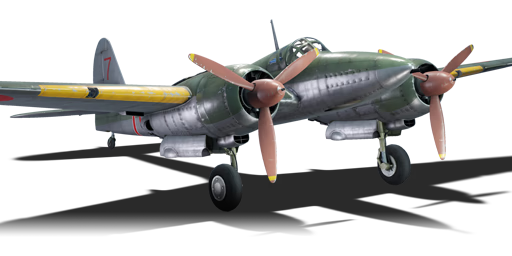
The Ki-108 Kai was a Japanese twin-engine heavy fighter/interceptor prototype developed from the Ki-96 and Ki-102 models. It was designed to counter the high-altitude American bombers such as the B-29 Superfortress. It had a pressurized cockpit, a 37 mm nose cannon and two 20 mm chin cannons. It was powered by two Mitsubishi Ha-112-II Ru turbosupercharged radial engines. Only four Ki-108s were built and none saw combat before the end of the war.
It was introduced in Update 1.77 "Advancing Storm". The Ki-108 is a formidable heavy fighter that boasts strong armament, respectable climb performance, and reasonable manoeuvrability. Its main drawback is its vulnerable engines that can be crippled by enemy fire. The optimal strategy for this plane is to intercept bombers from the front or side and evade their rear gunners. The plane can also handle fighters that are lower than it, but it should not challenge them on equal footing, as it lacks dogfighting and escape capabilities. The plane should climb to the side of the map and have friendly cover above it. If the plane faces enemy fighters at high altitude without allies, it should be cautious and strike when they are unsuspecting.
General info
Flight performance
| Characteristics | Max Speed (km/h at 8,000 m) |
Max altitude (metres) |
Turn time (seconds) |
Rate of climb (metres/second) |
Take-off run (metres) | |||
|---|---|---|---|---|---|---|---|---|
| AB | RB | AB | RB | AB | RB | |||
| Stock | 597 | 580 | 22.1 | 22.9 | 8.4 | 8.4 | 600 | |
| Upgraded | 649 | 622 | 20.4 | 21.0 | 16.9 | 12.1 | ||
Details
| Features | ||||
|---|---|---|---|---|
| Combat flaps | Take-off flaps | Landing flaps | Air brakes | Arrestor gear |
| ✓ | ✓ | ✓ | X | X |
| Limits | ||||||
|---|---|---|---|---|---|---|
| Wings (km/h) | Gear (km/h) | Flaps (km/h) | Max Static G | |||
| Combat | Take-off | Landing | + | - | ||
| 762 | 437 | 408 | 260 | ~10 | ~7 | |
| Optimal velocities (km/h) | |||
|---|---|---|---|
| Ailerons | Rudder | Elevators | Radiator |
| < 360 | < 400 | < 400 | > 312 |
Survivability and armour
- 12 mm Steel - Pilot's headrest
- 12 mm Steel - Pilot's backrest
Modifications and economy
Armaments
Offensive armament
The Ki-108 Kai is armed with:
- 1 x 37 mm Ho-204 cannon, nose-mounted (35 rpg)
- 2 x 20 mm Ho-5 cannons, chin-mounted (200 rpg = 400 total)
Usage in battles
The Ki-108's assets are its excellent guns (especially the 37 mm Ho-204 with its quick rate of fire; the 20 mm are unimpressive but will give you a chance to finish a wounded enemy), its climbing speed, and its fairly good manoeuvrability for a plane with so much firepower. Its main weakness is its engine vulnerability. Use the climb rate and speed to engage bombers from the front or front-side, down or cripple, disengage to reload, climb back and repeat. Do not engage bombers from behind as even a B-18A or B-34 has a good chance of crippling you with its tail gunners. Fighters climbing towards you are reasonably easy prey, but try to avoid confrontations where you do not have an altitude advantage, as your dogfighting ability is low and your escape speed is unimpressive if you don't start with a strong advantage.
In Air AB, it's best to side climb, as even when fully upgraded, the Ki-108 will not outclimb aircraft such as the Bf 109 F-4. The Ki-108 performs best when there are teammates above you to provide you with cover - if you find yourself alone at high altitude against single-engine enemy fighters, you'll have to be very wary of them and take them out when they least expect it - a Ki-108 probably won't beat something like a Bf 109 F-4 in a 1 v 1 engagement unless it comes in with an element of surprise or a significant altitude or speed advantage.
Overall, a fantastic interceptor at its battle rating, good enough to regularly score Survivor awards.
Manual Engine Control
| MEC elements | ||||||
|---|---|---|---|---|---|---|
| Mixer | Pitch | Radiator | Supercharger | Turbocharger | ||
| Oil | Water | Type | ||||
| Controllable | Controllable Auto control available |
Controllable Not auto controlled |
Controllable Not auto controlled |
Separate | Not controllable 1 gear |
Not controllable |
Pros and cons
Pros:
- Powerful armaments
- Decent climb rate
Cons:
- Serious overheating issues even without WEP
- The 37 mm are inaccurate even once upgraded
- Low ammo counts; require trigger discipline
- Poor roll rates at low and high speeds
- Highly flammable
- Absolutely awful cockpit visibility
History
Development of the Ki-108 began in April 1943 after Kawasaki wanted to fulfil a standing requirement with the Japanese Army for a heavy interceptor that initially began with the Ki-45 heavy fighter series. The Ki-108's design was derived mostly from the previous Ki-102 project and took some elements of the Ki-96 as well, effectively combining the two designs into one. After the first B-29 Superfortress bombers made their appearance over the Japanese home islands, the need for such a high-altitude interceptor became even more emphasized. Two Ki-102 otsu airframes were taken from the assembly line in 1944 to produce the initial Ki-108 prototypes. Compared to the Ki-102, which was intended as a low-altitude attack aircraft, the Ki-108 was an interceptor meant for high altitude operations. To allow for this, the Ki-108's cockpit had to be significantly reduced in size and was to be hermetically sealed. This effectively turned the Ki-108 into a single-seater, reduced weight and decreased the strain on the engines all at the same time, which allowed for better performance at higher altitudes.
The two initial prototypes were completed in July and August 1944, respectively. An improved version of the Ki-108 was designed based around the Ki-102 Hei, featuring a wider wingspan and a longer fuselage, in an effort to improve high-altitude handling. Two examples of the Ki-108 Kai variant were built and subsequently tested in 1945. However, the worsening war situation for Japan prematurely concluded testing of the type and both versions never left prototype stage, yet alone seeing combat. A total of four Ki-108s were manufactured between 1944 - 1945.
- From Devblog
Media
- Skins
See also
External links
- [Devblog] Kawasaki Ki-108: The Final Dragon Slayer
- Military Factory - Kawasaki Ki-108
- Official data sheet - more details about the performance
| Kawasaki Aircraft Industries (川崎航空機工業株式会社) | |
|---|---|
| Biplane Fighters | Ki-10-I · Ki-10-I C · Ki-10-II · Ki-10-II C |
| Fighters | Ki-61-I ko · Ki-61-I otsu · Ki-61-I hei · Tada's Ki-61-I hei · Ki-61-I tei · Ki-61-II Otsu Kai |
| Ki-100 · Ki-100-II | |
| Interceptors | Ki-45 ko · Ki-45 otsu · Ki-45 hei · Ki-45 tei |
| Ki-96 | |
| Ki-102 otsu | |
| Ki-108 Kai | |
| Bombers | Ki-32 |
| Ki-48-II otsu | |
| Captured | ␗Ki-45 hei/tei · ␗Ki-61-I otsu · ▃Ki-61-Ib |
| See also | Kawasaki Shipyard Co. |
| Japan twin-engine fighters and strike aircraft | |
|---|---|
| Navy | |
| Land-based Fighter | |
| J1N | J1N1 |
| J5N | J5N1 |
| Army | |
| Ki-45 | Ki-45 ko · Ki-45 otsu · Ki-45 hei · Ki-45 tei |
| Ki-83 | Ki-83 |
| Ki-96 | Ki-96 |
| Ki-102 | Ki-102 otsu |
| Ki-108 | Ki-108 Kai |
| Ki-109 | Ki-109 |