Difference between pages "Tu-2S-59" and "Elefant"
U110560869 (talk | contribs) (→Specific enemies worth noting) (Tag: Visual edit) |
(Undo revision 193772 by U145582178 (talk)) |
||
| Line 1: | Line 1: | ||
| − | |||
| − | |||
| − | |||
| − | |||
| − | |||
{{Specs-Card | {{Specs-Card | ||
| − | |code= | + | |code=germ_panzerjager_tiger_P_elefant |
| − | |images={{Specs-Card-Image|GarageImage_{{PAGENAME}}.jpg}} | + | |images={{Specs-Card-Image|GarageImage_{{PAGENAME}}.jpg|ArtImage_{{PAGENAME}}.jpg}} |
| + | |market=id50181_elefant_germany | ||
}} | }} | ||
== Description == | == Description == | ||
| − | <!-- ''In the description, the first part should be about the history of | + | <!-- ''In the description, the first part should be about the history of the creation and combat usage of the vehicle, as well as its key features. In the second part, tell the reader about the ground vehicle in the game. Insert a screenshot of the vehicle, so that if the novice player does not remember the vehicle by name, he will immediately understand what kind of vehicle the article is talking about.'' --> |
| − | + | At the conclusion of the Battle of Kursk, the German experience with the [[Ferdinand]] had been disappointing due to the constraints the large and heavy vehicle imposed, as well as desired improvements that needed to be implemented to the design. Recalled back to the factories in January 1944, the Ferdinand underwent design improvements such as the inclusion of a bow machine gun, a commander's cupola, application of ''zimmerit'' and other changes to the armour profile for better blast and shrapnel protection of the engines. These modifications were completed and began to be sent back into combat as early as February. By May 1944, an order was made by German Army High Command that the Ferdinand was to assume the new name "Elefant". The Elefant continued to see use, notably in the Italian Theatre and the Eastern Front, all the way until the Battle of Berlin in 1945. | |
| − | The | + | The '''{{Specs|name}}''' ([[Abbreviations#.28DE.29_Sd.Kfz._Index|Sd.Kfz. index:]] '''Sd.Kfz. 184''') was introduced during [[Update "Wind of Change"]] as reward for [[Battle Pass: Season VII, "Armoured Elephant"]]. Aside from the addition of the machine gun and cupola, the vehicle is functionally the same as the standard Ferdinand, boasting the long 88 mm PaK 43 cannon to penetrate all types of armour and an impressive 200 mm frontal plate for protection. However, the Elefant is big, heavy, and slow, so being outnumbered by the enemy can quickly lead to a lucky few of them to outflank and destroy the Elefant through its very long side profile, where the armour is thin, or the protruding casemate structure, where the ammunition is stored. However, players maximizing the Elefant's long-range capabilities can quickly lock down a sector of the map from anyone who dares roll into the 88 mm's sight. |
| − | + | == General info == | |
| + | === Survivability and armour === | ||
| + | {{Specs-Tank-Armour}} | ||
| + | <!-- ''Describe armour protection. Note the most well protected and key weak areas. Appreciate the layout of modules as well as the number and location of crew members. Is the level of armour protection sufficient, is the placement of modules helpful for survival in combat? If necessary use a visual template to indicate the most secure and weak zones of the armour.'' --> | ||
| + | ''Describe armour protection. Note the most well protected and key weak areas. Appreciate the layout of modules as well as the number and location of crew members. Is the level of armour protection sufficient, is the placement of modules helpful for survival in combat? If necessary use a visual template to indicate the most secure and weak zones of the armour.'' | ||
| − | + | '''Armour type:''' <!-- The types of armour present on the vehicle and their general locations --> | |
| − | + | <!-- Example: * Rolled homogeneous armour (Front, Side, Rear, Hull roof) | |
| − | + | * Cast homogeneous armour (Turret, Transmission area) --> | |
| − | <!-- | ||
| − | {| class="wikitable" | + | {| class="wikitable" |
| − | ! | + | |- |
| − | ! | + | ! Armour !! Front (Slope angle) !! Sides !! Rear !! Roof |
| − | ! | ||
| − | ! | ||
| − | ! | ||
| − | ! | ||
|- | |- | ||
| − | + | | Hull || ___ mm || ___ mm ''Top'' <br> ___ mm ''Bottom'' || ___ mm || ___ - ___ mm | |
|- | |- | ||
| − | + | | Turret || ___ - ___ mm ''Turret front'' <br> ___ mm ''Gun mantlet'' || ___ - ___ mm || ___ - ___ mm || ___ - ___ mm | |
| − | | | ||
|- | |- | ||
| − | + | | Cupola || ___ mm || ___ mm || ___ mm || ___ mm | |
| − | | | ||
|- | |- | ||
|} | |} | ||
| − | ==== | + | '''Notes:''' <!-- Any additional notes which the user needs to be aware of --> |
| − | {| class="wikitable" style="text-align:center" width=" | + | <!-- Example: * Suspension wheels are 20 mm thick, tracks are 30 mm thick, and torsion bars are 60 mm thick. --> |
| + | |||
| + | === Mobility === | ||
| + | {{Specs-Tank-Mobility}} | ||
| + | <!-- ''Write about the mobility of the ground vehicle. Estimate the specific power and manoeuvrability, as well as the maximum speed forwards and backwards.'' --> | ||
| + | |||
| + | {{tankMobility|abMinHp=888|rbMinHp=553}} | ||
| + | |||
| + | === Modifications and economy === | ||
| + | {{Specs-Economy}} | ||
| + | |||
| + | == Armaments == | ||
| + | {{Specs-Tank-Armaments}} | ||
| + | === Main armament === | ||
| + | {{Specs-Tank-Weapon|1}} | ||
| + | <!-- ''Give the reader information about the characteristics of the main gun. Assess its effectiveness in a battle based on the reloading speed, ballistics and the power of shells. Do not forget about the flexibility of the fire, that is how quickly the cannon can be aimed at the target, open fire on it and aim at another enemy. Add a link to the main article on the gun: <code><nowiki>{{main|Name of the weapon}}</nowiki></code>. Describe in general terms the ammunition available for the main gun. Give advice on how to use them and how to fill the ammunition storage.'' --> | ||
| + | {{main|PaK43 (88 mm)}} | ||
| + | |||
| + | {| class="wikitable" style="text-align:center" width="100%" | ||
| + | |- | ||
| + | ! colspan="5" | [[PaK43 (88 mm)|88 mm PaK43]] || colspan="5" | Turret rotation speed (°/s) || colspan="4" | Reloading rate (seconds) | ||
|- | |- | ||
| − | ! | + | ! Mode !! Capacity !! Vertical !! Horizontal !! Stabilizer |
| + | ! Stock !! Upgraded !! Full !! Expert !! Aced | ||
| + | ! Stock !! Full !! Expert !! Aced | ||
|- | |- | ||
| − | ! | + | ! ''Arcade'' |
| + | | rowspan="2" | 38 || rowspan="2" | -8°/+14° || rowspan="2" | ±14° || rowspan="2" | N/A || 7.0 || 9.7 || 11.8 || 13.1 || 13.9 || rowspan="2" | 8.71 || rowspan="2" | 7.70 || rowspan="2" | 7.10 || rowspan="2" | 6.70 | ||
|- | |- | ||
| − | | | + | ! ''Realistic'' |
| + | | 4.8 || 5.6 || 6.8 || 7.5 || 8.0 | ||
|- | |- | ||
|} | |} | ||
| − | {| | + | ==== Ammunition ==== |
| − | | | + | {{:PaK43 (88 mm)/Ammunition|PzGr 39/43, PzGr 40/43, Hl.Gr 39, Sprgr.43}} |
| − | + | ||
| − | | | + | ==== [[Ammo racks]] ==== |
| − | + | [[File:Ammoracks_Ferdinand.png|right|thumb|x250px|[[Ammo racks]] of the [[Ferdinand]] (identical)]] | |
| − | ! | + | <!-- '''Last updated: 2.17.0.69''' --> |
| − | + | {| class="wikitable" style="text-align:center" | |
| − | |||
|- | |- | ||
| − | ! | + | ! Full<br>ammo |
| + | ! 1st<br>rack empty | ||
| + | ! 2nd<br>rack empty | ||
| + | ! 3rd<br>rack empty | ||
| + | ! 4th<br>rack empty | ||
| + | ! Visual<br>discrepancy | ||
|- | |- | ||
| − | | | + | | '''38''' || 27 ''(+11)'' || 15 ''(+23)'' || 8 ''(+30)'' || 1 ''(+37)'' || No |
|- | |- | ||
|} | |} | ||
| − | {| class="wikitable" style="text-align:center" | + | === Machine guns === |
| + | {{Specs-Tank-Weapon|2}} | ||
| + | <!-- ''Offensive and anti-aircraft machine guns not only allow you to fight some aircraft but also are effective against lightly armoured vehicles. Evaluate machine guns and give recommendations on its use.'' --> | ||
| + | {{main|MG34 (7.92 mm)}} | ||
| + | |||
| + | {| class="wikitable" style="text-align:center" width="50%" | ||
|- | |- | ||
| − | ! colspan=" | + | ! colspan="5" | [[MG34 (7.92 mm)|7.92 mm MG34]] |
|- | |- | ||
| − | ! | + | ! Mount !! Capacity (Belt) !! Fire rate !! Vertical !! Horizontal |
|- | |- | ||
| − | | | + | | Hull || 600 (150) || 900 || -5°/+10° || -10°/+5° |
|- | |- | ||
|} | |} | ||
| − | |||
| − | |||
| − | |||
| − | |||
| − | |||
| − | |||
| − | |||
| − | |||
| − | |||
| − | |||
| − | |||
| − | |||
| − | |||
| − | |||
| − | |||
| − | |||
| − | |||
| − | |||
| − | |||
| − | |||
| − | |||
| − | |||
| − | |||
| − | |||
| − | |||
| − | |||
| − | |||
| − | |||
| − | |||
| − | |||
| − | |||
| − | |||
| − | |||
| − | |||
| − | |||
| − | |||
| − | |||
| − | |||
| − | |||
| − | |||
| − | |||
| − | |||
| − | |||
| − | |||
| − | |||
| − | |||
| − | |||
| − | |||
| − | |||
| − | |||
| − | |||
| − | |||
== Usage in battles == | == Usage in battles == | ||
| − | <!-- ''Describe the tactics of playing in the | + | <!-- ''Describe the tactics of playing in the vehicle, the features of using vehicles in the team and advice on tactics. Refrain from creating a "guide" - do not impose a single point of view but instead give the reader food for thought. Describe the most dangerous enemies and give recommendations on fighting them. If necessary, note the specifics of the game in different modes (AB, RB, SB).'' --> |
| − | + | The Elefant's natural role is as a long-range sniper thanks to its excellent firing range and frontal armour of more than 200 mm. Due to the frontal armour, this tank destroyer should always face the enemy to make use of it. Even though the Elefant is a heavy tank destroyer, it can rapidly drive backwards, which allows it to reposition more quickly than Soviet tank destroyers like the the SU-152 and the ISU-152. | |
| − | |||
| − | |||
| − | |||
| − | |||
| − | |||
| − | |||
| − | + | In a team, the Elefant acts as a heavy sniper, taking out enemies from afar while being almost immune to any tank shells. However, don't get too close to frontlines, since an enemy tank could slip through and flank the Elefant, which would put it in real danger. | |
| − | + | Another possibility is as a frontline brawler once most of the enemies have been cleared out. While it is not recommended, with flanking support of allies, the Elefant can venture further into enemy lines and take out everything that comes your way, but still watching for light tanks that will try to exploit the limited gun traverse to hit from the sides. | |
| − | |||
| − | + | The most dangerous enemies of the Elefant are medium tanks and light tanks which can slip behind the Elefant since the back armour is weak. The Elefant has bad manoeuvrability and turning around is very slow. | |
| − | |||
| − | + | IS-2 heavy tanks are a real threat to Elefant, as well as TDs of the same rank when firing sideways. Always face your armour frontally and take cover when possible. | |
| − | |||
| − | |||
| − | |||
| − | |||
| − | |||
| − | |||
| − | |||
| − | |||
| − | |||
| − | |||
| − | |||
| − | |||
| − | |||
| − | |||
| − | |||
| − | |||
| − | |||
| − | |||
| − | |||
| − | |||
| − | |||
| − | |||
| − | |||
| − | |||
| − | |||
| − | |||
| − | |||
| − | |||
=== Pros and cons === | === Pros and cons === | ||
| − | <!-- ''Summarise and briefly evaluate the vehicle in terms of its characteristics and combat effectiveness. Mark its pros and cons in | + | <!-- ''Summarise and briefly evaluate the vehicle in terms of its characteristics and combat effectiveness. Mark its pros and cons in a bulleted list. Try not to use more than 6 points for each of the characteristics. Avoid using categorical definitions such as "bad", "good" and the like - use substitutions with softer forms such as "inadequate" and "effective".'' --> |
| + | ''Summarise and briefly evaluate the vehicle in terms of its characteristics and combat effectiveness. Mark its pros and cons in a bulleted list. Try not to use more than 6 points for each of the characteristics. Avoid using categorical definitions such as "bad", "good" and the like - use substitutions with softer forms such as "inadequate" and "effective".'' | ||
'''Pros:''' | '''Pros:''' | ||
| − | * | + | * Long 88 mm gun with high penetration |
| − | * | + | * Good frontal armour |
| − | * | + | * Good forward and reverse speed |
| − | + | * Defensive MG, great for taking out open-topped vehicles | |
| − | |||
| − | * | ||
| − | |||
| − | |||
| − | |||
| − | |||
| − | |||
| − | |||
| − | |||
| − | |||
| − | |||
'''Cons:''' | '''Cons:''' | ||
| − | * | + | * Casemate layout means, if the tracks are both disabled, or your driver is knocked out, or the engine is disabled, you're easily flanked and destroyed |
| − | + | * Weak side armour | |
| − | + | * Defensive MG has a limited traverse: it can only target enemies in the front | |
| − | + | * Rifle-calibre MG is only useful for taking out open-topped vehicles or pinging targets | |
| − | |||
| − | * | ||
| − | * | ||
| − | * | ||
== History == | == History == | ||
| − | <!-- ''Describe the history of the creation and combat usage of the | + | <!-- ''Describe the history of the creation and combat usage of the vehicle in more detail than in the introduction. If the historical reference turns out to be too long, take it to a separate article, taking a link to the article about the vehicle and adding a block "/History" (example: <nowiki>https://wiki.warthunder.com/(Vehicle-name)/History</nowiki>) and add a link to it here using the <code>main</code> template. Be sure to reference text and sources by using <code><nowiki><ref></ref></nowiki></code>, as well as adding them at the end of the article with <code><nowiki><references /></nowiki></code>. This section may also include the vehicle's dev blog entry (if applicable) and the in-game encyclopedia description (under <code><nowiki>=== In-game description ===</nowiki></code>, also if applicable).'' --> |
| + | The history of the Elefant begins with the program to develop the Tiger 1, both Porsche and Henschel would compete and submit designs for trials, where eventually one would be chosen for production. Porsche's design was the infamous [[VK 45.01 (P)]], a design riddled with mechanical issues apparent even during the trials, while Henschel's design was the VK 45.01 (H) which would ultimately end up being chosen and would enter production as the Tiger H1. | ||
| − | + | Ferdinand Porsche, the founder of the company Porsche was far too confident in his VK design, so much so that even before the trials for the Tiger had begun he had created 90 VK hulls. It was decided that these would not go to waste, and a majority were turned into the casemate assault gun known as the Ferdinand, which would mount the long 88. cm gun eventually seen in vehicles such as the Tiger II (H), Nashorn or Jagdpanther; while 1 of the VK hulls would become the Panzerbefehlswagen VI (P). | |
| − | |||
| − | The | + | The Ferdinand tank destroyer would first see service during Operation Citadel, specifically during the battle of Kursk to mixed results. The aforementioned mechanical problems would plague it during the battle; however when used in its intended role, the Ferdinand would be quite successful. |
| − | + | Following the battle, the remaining Ferdinands would be sent back to Germany for repairs and modifications. Here is where the Elefant was born. Additional frontal armor, a hull mounted machine gun for self-defense purposes and a commander's cupola taken from a StuG III G would be the new additions to the vehicle, before it was sent to Italy, with disastrous results. | |
| − | + | Little is known about the Elefant's service following this, however at least two individuals survived to take part in the Battle of Berlin, but their ultimate fate remains unknown. | |
| − | + | One Elefant remains, formerly part of an exhibit in the Bovington Tank Museum it is now in storage in Fort Lee VA. | |
| − | + | == Media == | |
| + | <!-- ''Excellent additions to the article would be video guides, screenshots from the game, and photos.'' --> | ||
| − | + | ;Skins | |
| − | + | * [https://live.warthunder.com/feed/camouflages/?vehicle=germ_panzerjager_tiger_P_elefant Skins and camouflages for the {{PAGENAME}} from live.warthunder.com.] | |
| − | + | ;Videos | |
| − | + | {{Youtube-gallery|5E2X7q_tIgM|'''The Shooting Range #306''' - ''Pages of History'' section at 03:52 discusses the {{PAGENAME}}.|IfxpIFoBLoc|'''Battle Pass: Armoured Elephant''' discusses the {{PAGENAME}} at 02:35 - ''War Thunder Official Channel''}} | |
| − | |||
| − | |||
| − | {{Youtube-gallery| | ||
== See also == | == See also == | ||
| − | ''Links to the articles on the War Thunder Wiki that you think will be useful for the reader, for example:'' | + | <!-- ''Links to the articles on the War Thunder Wiki that you think will be useful for the reader, for example:'' |
| + | * ''reference to the series of the vehicles;'' | ||
| + | * ''links to approximate analogues of other nations and research trees.'' --> | ||
| − | * | + | * [[Ferdinand]] |
| − | |||
== External links == | == External links == | ||
| − | ''Paste links to sources and external resources, such as:'' | + | <!-- ''Paste links to sources and external resources, such as:'' |
| + | * ''topic on the official game forum;'' | ||
| + | * ''other literature.'' --> | ||
| − | * | + | * [[wt:en/news/7659-development-battle-pass-vehicles-spg-elefant-en|[Devblog] Battle Pass vehicles: SPG Elefant]] |
| − | |||
| − | |||
| − | {{ | + | {{Germany tank destroyers}} |
| − | {{ | + | {{Germany premium ground vehicles}} |
Latest revision as of 15:37, 21 October 2024


Contents
Description
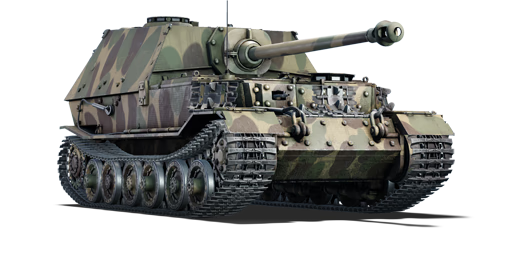
At the conclusion of the Battle of Kursk, the German experience with the Ferdinand had been disappointing due to the constraints the large and heavy vehicle imposed, as well as desired improvements that needed to be implemented to the design. Recalled back to the factories in January 1944, the Ferdinand underwent design improvements such as the inclusion of a bow machine gun, a commander's cupola, application of zimmerit and other changes to the armour profile for better blast and shrapnel protection of the engines. These modifications were completed and began to be sent back into combat as early as February. By May 1944, an order was made by German Army High Command that the Ferdinand was to assume the new name "Elefant". The Elefant continued to see use, notably in the Italian Theatre and the Eastern Front, all the way until the Battle of Berlin in 1945.
The Panzerjäger Tiger (P) Elefant (Sd.Kfz. index: Sd.Kfz. 184) was introduced during Update "Wind of Change" as reward for Battle Pass: Season VII, "Armoured Elephant". Aside from the addition of the machine gun and cupola, the vehicle is functionally the same as the standard Ferdinand, boasting the long 88 mm PaK 43 cannon to penetrate all types of armour and an impressive 200 mm frontal plate for protection. However, the Elefant is big, heavy, and slow, so being outnumbered by the enemy can quickly lead to a lucky few of them to outflank and destroy the Elefant through its very long side profile, where the armour is thin, or the protruding casemate structure, where the ammunition is stored. However, players maximizing the Elefant's long-range capabilities can quickly lock down a sector of the map from anyone who dares roll into the 88 mm's sight.
General info
Survivability and armour
Describe armour protection. Note the most well protected and key weak areas. Appreciate the layout of modules as well as the number and location of crew members. Is the level of armour protection sufficient, is the placement of modules helpful for survival in combat? If necessary use a visual template to indicate the most secure and weak zones of the armour.
Armour type:
| Armour | Front (Slope angle) | Sides | Rear | Roof |
|---|---|---|---|---|
| Hull | ___ mm | ___ mm Top ___ mm Bottom |
___ mm | ___ - ___ mm |
| Turret | ___ - ___ mm Turret front ___ mm Gun mantlet |
___ - ___ mm | ___ - ___ mm | ___ - ___ mm |
| Cupola | ___ mm | ___ mm | ___ mm | ___ mm |
Notes:
Mobility
| Game Mode | Max Speed (km/h) | Weight (tons) | Engine power (horsepower) | Power-to-weight ratio (hp/ton) | |||
|---|---|---|---|---|---|---|---|
| Forward | Reverse | Stock | Upgraded | Stock | Upgraded | ||
| Arcade | Expression error: Unexpected * operator. | 888 | Expression error: Unexpected round operator. | __.__ | |||
| Realistic | 553 | Expression error: Unexpected round operator. | __.__ | ||||
Modifications and economy
Armaments
Main armament
| 88 mm PaK43 | Turret rotation speed (°/s) | Reloading rate (seconds) | |||||||||||
|---|---|---|---|---|---|---|---|---|---|---|---|---|---|
| Mode | Capacity | Vertical | Horizontal | Stabilizer | Stock | Upgraded | Full | Expert | Aced | Stock | Full | Expert | Aced |
| Arcade | 38 | -8°/+14° | ±14° | N/A | 7.0 | 9.7 | 11.8 | 13.1 | 13.9 | 8.71 | 7.70 | 7.10 | 6.70 |
| Realistic | 4.8 | 5.6 | 6.8 | 7.5 | 8.0 | ||||||||
Ammunition
| Penetration statistics | |||||||
|---|---|---|---|---|---|---|---|
| Ammunition | Type of warhead |
Penetration @ 0° Angle of Attack (mm) | |||||
| 10 m | 100 m | 500 m | 1,000 m | 1,500 m | 2,000 m | ||
| PzGr 39/43 | APCBC | 237 | 234 | 222 | 207 | 193 | 180 |
| PzGr 40/43 | APCR | 279 | 273 | 252 | 227 | 205 | 185 |
| Hl.Gr 39 | HEAT | 110 | 110 | 110 | 110 | 110 | 110 |
| Sprgr.43 | HE | 19 | 19 | 17 | 16 | 14 | 14 |
| Shell details | ||||||||||||
|---|---|---|---|---|---|---|---|---|---|---|---|---|
| Ammunition | Type of warhead |
Velocity (m/s) |
Projectile mass (kg) |
Fuse delay (m) |
Fuse sensitivity (mm) |
Explosive mass (TNT equivalent) (g) |
Ricochet | |||||
| 0% | 50% | 100% | ||||||||||
| PzGr 39/43 | APCBC | 1,000 | 10.16 | 1.2 | 14 | 108.8 | 48° | 63° | 71° | |||
| PzGr 40/43 | APCR | 1,130 | 7.3 | - | - | - | 66° | 70° | 72° | |||
| Hl.Gr 39 | HEAT | 600 | 7.64 | 0 | 0.3 | 1,100 | 62° | 69° | 73° | |||
| Sprgr.43 | HE | 820 | 9.4 | 0.2 | 0.1 | 1,000 | 79° | 80° | 81° | |||
Ammo racks

| Full ammo |
1st rack empty |
2nd rack empty |
3rd rack empty |
4th rack empty |
Visual discrepancy |
|---|---|---|---|---|---|
| 38 | 27 (+11) | 15 (+23) | 8 (+30) | 1 (+37) | No |
Machine guns
| 7.92 mm MG34 | ||||
|---|---|---|---|---|
| Mount | Capacity (Belt) | Fire rate | Vertical | Horizontal |
| Hull | 600 (150) | 900 | -5°/+10° | -10°/+5° |
Usage in battles
The Elefant's natural role is as a long-range sniper thanks to its excellent firing range and frontal armour of more than 200 mm. Due to the frontal armour, this tank destroyer should always face the enemy to make use of it. Even though the Elefant is a heavy tank destroyer, it can rapidly drive backwards, which allows it to reposition more quickly than Soviet tank destroyers like the the SU-152 and the ISU-152.
In a team, the Elefant acts as a heavy sniper, taking out enemies from afar while being almost immune to any tank shells. However, don't get too close to frontlines, since an enemy tank could slip through and flank the Elefant, which would put it in real danger.
Another possibility is as a frontline brawler once most of the enemies have been cleared out. While it is not recommended, with flanking support of allies, the Elefant can venture further into enemy lines and take out everything that comes your way, but still watching for light tanks that will try to exploit the limited gun traverse to hit from the sides.
The most dangerous enemies of the Elefant are medium tanks and light tanks which can slip behind the Elefant since the back armour is weak. The Elefant has bad manoeuvrability and turning around is very slow.
IS-2 heavy tanks are a real threat to Elefant, as well as TDs of the same rank when firing sideways. Always face your armour frontally and take cover when possible.
Pros and cons
Summarise and briefly evaluate the vehicle in terms of its characteristics and combat effectiveness. Mark its pros and cons in a bulleted list. Try not to use more than 6 points for each of the characteristics. Avoid using categorical definitions such as "bad", "good" and the like - use substitutions with softer forms such as "inadequate" and "effective".
Pros:
- Long 88 mm gun with high penetration
- Good frontal armour
- Good forward and reverse speed
- Defensive MG, great for taking out open-topped vehicles
Cons:
- Casemate layout means, if the tracks are both disabled, or your driver is knocked out, or the engine is disabled, you're easily flanked and destroyed
- Weak side armour
- Defensive MG has a limited traverse: it can only target enemies in the front
- Rifle-calibre MG is only useful for taking out open-topped vehicles or pinging targets
History
The history of the Elefant begins with the program to develop the Tiger 1, both Porsche and Henschel would compete and submit designs for trials, where eventually one would be chosen for production. Porsche's design was the infamous VK 45.01 (P), a design riddled with mechanical issues apparent even during the trials, while Henschel's design was the VK 45.01 (H) which would ultimately end up being chosen and would enter production as the Tiger H1.
Ferdinand Porsche, the founder of the company Porsche was far too confident in his VK design, so much so that even before the trials for the Tiger had begun he had created 90 VK hulls. It was decided that these would not go to waste, and a majority were turned into the casemate assault gun known as the Ferdinand, which would mount the long 88. cm gun eventually seen in vehicles such as the Tiger II (H), Nashorn or Jagdpanther; while 1 of the VK hulls would become the Panzerbefehlswagen VI (P).
The Ferdinand tank destroyer would first see service during Operation Citadel, specifically during the battle of Kursk to mixed results. The aforementioned mechanical problems would plague it during the battle; however when used in its intended role, the Ferdinand would be quite successful.
Following the battle, the remaining Ferdinands would be sent back to Germany for repairs and modifications. Here is where the Elefant was born. Additional frontal armor, a hull mounted machine gun for self-defense purposes and a commander's cupola taken from a StuG III G would be the new additions to the vehicle, before it was sent to Italy, with disastrous results.
Little is known about the Elefant's service following this, however at least two individuals survived to take part in the Battle of Berlin, but their ultimate fate remains unknown.
One Elefant remains, formerly part of an exhibit in the Bovington Tank Museum it is now in storage in Fort Lee VA.
Media
- Skins
- Videos
See also
External links
| Germany tank destroyers | |
|---|---|
| Pz. I Derivatives | Panzerjäger I |
| Pz. II Derivatives | 15cm sIG 33 B Sfl |
| Pz. 38(t) Derivatives | Marder III · Marder III H · Jagdpanzer 38(t) |
| Pz. III Derivatives | StuG III A · StuG III F · StuG III G · StuH 42 G |
| Pz. IV Derivatives | Jagdpanzer IV · Panzer IV/70(A) · Panzer IV/70(V) · Dicker Max · Nashorn · Brummbär · VFW |
| Pz. V Derivatives | Jagdpanther G1 · Bfw. Jagdpanther G1 |
| Pz. VI Derivatives | Sturer Emil · Elefant · Ferdinand · 38 cm Sturmmörser · Jagdtiger |
| Wheeled/Half-track | 8,8 cm Flak 37 Sfl. · Sd.Kfz.251/9 · Sd.Kfz.251/10 · Sd.Kfz.251/22 · Sd.Kfz.234/3 · Sd.Kfz.234/4 · 15 cm Pz.W.42 |
| ATGM Carrier | RakJPz 2 · RakJPz 2 (HOT) · Wiesel 1A2 |
| Other | Waffenträger · M109G · JPz 4-5 · Raketenautomat · VT1-2 |
| Germany premium ground vehicles | |
|---|---|
| Light tanks | Pz.II C (DAK) · Pz.Sfl.Ic · Pz.Sp.Wg.P204(f) KwK · Sd.Kfz. 140/1 · Sd.Kfz.234/1 · Ru 251 · SPz 12-3 LGS · TAM 2IP |
| Medium tanks | Nb.Fz. · Pz.III N · Pz.Bef.Wg.IV J · ▀M4 748 (a) · ▀T 34 747 (r) · Ersatz M10 |
| mKPz M47 G · Turm III · Leopard A1A1 (L/44) · Leopard 2 (PzBtl 123) · Leopard 2A4M | |
| Heavy tanks | ▀Pz.Kpfw. Churchill · ▀KV-IB · ▀KW I C 756 (r) · ▀KW II 754 (r) |
| VK 45.01 (P) · ␠Tiger · Pz.Bef.Wg.VI P · Tiger II (H) Sla.16 | |
| Tank destroyers | Sd.Kfz.234/3 · Sd.Kfz.234/4 · Sd.Kfz.251/10 · Sd.Kfz.251/22 · 15 cm Pz.W.42 |
| Brummbär · Panzer IV/70(A) · VFW · Bfw. Jagdpanther G1 · Elefant · 38 cm Sturmmörser | |