Difference between pages "Category:Game modes" and "USS Cowell"
(→Singleplayer) (Tag: Visual edit) |
U105837429 (talk | contribs) m (Availabilty) |
||
| Line 1: | Line 1: | ||
| − | {{ | + | {{Specs-Card |
| + | |code=us_destroyer_fletcher_cowell | ||
| + | |images={{Specs-Card-Image|GarageImage_{{PAGENAME}}.jpg}} | ||
| + | }} | ||
| − | + | == Description == | |
| + | <!-- ''In the first part of the description, cover the history of the ship's creation and military application. In the second part, tell the reader about using this ship in the game. Add a screenshot: if a beginner player has a hard time remembering vehicles by name, a picture will help them identify the ship in question.'' --> | ||
| + | The '''{{Specs|name}}''' is a member of the [[Fletcher (Family)|Fletcher-class]] destroyers, the first generation of destroyers developed by the U.S. after the disintegration of the Washington and London Naval Treaties during World War II. The Fletcher class was meant to be larger and carry more armament due to dissatisfaction with earlier destroyer classes. Cowell was named for US Navy officer John G. Cowell. She was laid down on 7th September 1942 and commissioned on 23rd August 1943. She spent her entire WWII career in the Pacific, participating in carrier screen force, escort duties, and anti-aircraft duty. On 13th October 1944, during the Battle of Leyte, she provided light, power, and pumping facilities to two torpedoed cruisers: USS Canberra and USS Houston. Cowell escorted the crippled ships to safety and then returned back to screen the carrier force once again. During the Battle of Okinawa, she was on radar picket duty which brought her a Presidential Unit Citation. On 22nd July 1946, she was placed into reserve and later reactivated for the Korean War. She escorted Iowa-class battleship USS Missouri to bombard North Korean positions around Wonsan harbour. For her WWII and Korean War service, she received a total of thirteen battle stars. After the war, she spent the remainder of her US Navy career exercising until she was decommissioned on 17th August 1971 and sold to the Argentinian Navy as ARA Almirante Stormi. She was sold for scrap in 1982. | ||
| − | + | USS Cowell was introduced in [[Update 1.77 "Advancing Storm"]], initially purchasable as a [[wt:en/news/5547-fleet-development-uss-cowell-dd-547-vulture-hunter-en|pre-order pack]] in the Gaijin store to access the [[wt:en/news/5585-final-fleet-testing-before-beginning-cbt-en|Naval Closed Beta Test]]. A Fletcher-class destroyer in the United States line, the Cowell is in the same class-line as the family ship [[USS Fletcher]]. The first statistical difference between the Fletcher and the Cowell is the armament, with the Cowell having four more turrets of 40 mm Bofors autocannons, and having one more additional turret of 20 mm autocannons. | |
| − | |||
| − | |||
| − | |||
| − | |||
| − | + | USS Cowell was removed from the store in [[wt:en/news/6694-shop-may-sale-in-war-thunder-en|May 2020]]. It was still available on the PlayStation Store until [[wt:/en/news/6907-special-8th-anniversary-of-war-thunder-en|War Thunder's 8th anniversary sale]] when it was removed from sale. The ship was temporarily made available for purchase in-game with GE ({{GE}}) for the annual "US Navy Birthday" mini events in [[wt:en/news/6894-birthday-of-the-united-states-navy-en|2020]], [[wt:en/news/7372-special-us-navy-day-en|2021]], [[wt:en/news/7903-special-us-navy-birthday-en|2022]], [[wt:en/news/8514-special-us-navy-birthday-a-decal-and-the-uss-cowell-to-celebrate-en|2023]] and [[wt:en/news/9124-shop-special-a-decal-uss-cowell-and-uss-des-moines-for-the-us-navys-birthday-en|2024]]. | |
| − | |||
| − | |||
| − | ''' | + | == General info == |
| − | + | === Survivability and armour === | |
| − | + | {{Specs-Fleet-Armour}} | |
| − | + | <!-- ''Talk about the vehicle's armour. Note the most well-defended and most vulnerable zones, e.g. the ammo magazine. Evaluate the composition of components and assemblies responsible for movement and manoeuvrability. Evaluate the survivability of the primary and secondary armaments separately. Don't forget to mention the size of the crew, which plays an important role in fleet mechanics. Save tips on preserving survivability for the "Usage in battles" section. If necessary, use a graphical template to show the most well-protected or most vulnerable points in the armour.'' --> | |
| + | The Cowell is very strong and powerful against smaller vessels, however, should you be able to live long enough, a torpedo hitting the ship basically anywhere will guarantee a kill. Try using islands and cover to your advantage when attacking a Cowell using a plane or PT boat to hide from the arcs of the Bofors. | ||
| − | + | For destroyers, aim underneath the front turret with an AP shell. You will have a chance of detonating the ammunition stowage for the front guns which will normally kill the whole ship. | |
| − | |||
| − | |||
| − | ''' | + | '''Armour type:''' |
| − | |||
| − | |||
| − | + | * Antifragmentation armour | |
| + | * Cast homogeneous armour | ||
| + | * Hardened armour | ||
| − | ---- | + | {| class="wikitable" |
| − | + | |- | |
| − | ''' | + | ! Armour !! Bow (Slope angle) !! Sides !! Stern !! Deck |
| − | - | + | |- |
| + | | Hull || N/A || 13 mm (0-24°) || N/A || 13 mm (88-89°) | ||
| + | |- | ||
| + | ! Armour !! Front !! Sides !! Rear !! Roof | ||
| + | |- | ||
| + | | Turrets || 3.2 mm ''Front'' <br> 15 mm ''Gun mantlet'' || 3.2 mm || 3.2 mm || 3.2 mm | ||
| + | |- | ||
| + | |} | ||
| + | '''Notes:''' | ||
| − | + | * The radar atop the bridge is covered with an antifragmentation armour with 19 mm thickness. | |
| − | + | * Gun shields around the 20 mm Oerlikon autocannons are 12.7 mm thick. | |
| − | + | === Mobility === | |
| − | + | {{Specs-Fleet-Mobility}} | |
| − | + | <!-- ''Write about the ship's mobility. Evaluate its power and manoeuvrability, rudder rerouting speed, stopping speed at full tilt, with its maximum forward and reverse speed.'' --> | |
| − | + | Reaching a flank speed of {{Annotation|35 kn|65 km/h,40 mph}}, USS Cowell is slower than the [[Porter (Family)|Porter-class]] such as the [[USS Moffett]], placing it slightly above average speed for American destroyers. This speed will allow Cowell to quickly get underway to important locations and USS Cowell takes 34 seconds to halt, and 30 seconds to accelerate to flank speed. She is also responsive to the captain's rudder commands, taking around 2 seconds to come full over. Speed falls to around {{Annotation|24 kn|45 km/h,28 mph}} in a sustained turn, leaving USS Cowell vulnerable to enemy fire and continuous turns are to be avoided. | |
| − | |||
| − | + | {{NavalMobility}} | |
| − | + | === Modifications and economy === | |
| + | {{Specs-Economy}} | ||
| − | + | == Armament == | |
| + | {{Specs-Fleet-Armaments}} | ||
| + | === Primary armament === | ||
| + | {{Specs-Fleet-Primary}} | ||
| + | <!-- ''Provide information about the characteristics of the primary armament. Evaluate their efficacy in battle based on their reload speed, ballistics and the capacity of their shells. Add a link to the main article about the weapon: <code><nowiki>{{main|Weapon name (calibre)}}</nowiki></code>. Broadly describe the ammunition available for the primary armament, and provide recommendations on how to use it and which ammunition to choose.'' --> | ||
| + | {{main|5 inch/38 Mk.12 (127 mm)}} | ||
| − | + | {| class="wikitable" style="text-align:center" | |
| + | |- | ||
| + | ! colspan="6" | [[5/38 Mark 12 Dual Purpose (127 mm)|127 mm 5/38 Mark 12 Dual Purpose gun]] (x5) | ||
| + | |- | ||
| + | ! colspan="6" | Turrets (Bow to stern) | ||
| + | |- | ||
| + | ! || Turret 1 || Turret 2 || Turret 3 || Turret 4 || Turret 5 | ||
| + | |- | ||
| + | ! scope="row" | Vertical guidance | ||
| + | | -10°/+85° || -10°/+85° || -10°/+85° || -10°/+85° || -10°/+85° | ||
| + | |- | ||
| + | ! scope="row" | Horizontal guidance | ||
| + | | ±150° || ±150° || ±143° || ±150° || ±150° | ||
| + | |- | ||
| + | ! scope="row" | Ammo capacity | ||
| + | | colspan="6" | 1,800 | ||
| + | |- | ||
| + | ! scope="row" | Rounds per turret | ||
| + | | colspan="6" | 360 | ||
| + | |- | ||
| + | |} | ||
| − | : | + | ==== Ammunition ==== |
| + | {{:5 inch/38 Mk.12 (127 mm)/Ammunition|5 inch AAC Mk.34, 5 inch Common Mk.32, 5 inch SP Common Mk.46, 5 inch AAVT Mk.31}} | ||
| − | + | === Secondary armament === | |
| + | {{Specs-Fleet-Secondary}} | ||
| + | <!-- ''Some ships are fitted with weapons of various calibres. Secondary armaments are defined as weapons chosen with the control <code>Select secondary weapon</code>. Evaluate the secondary armaments and give advice on how to use them. Describe the ammunition available for the secondary armament. Provide recommendations on how to use them and which ammunition to choose. Remember that any anti-air armament, even heavy calibre weapons, belong in the next section. If there is no secondary armament, remove this section.'' --> | ||
| + | {{main|Bofors L/60 Mark 1 (40 mm)}} | ||
| − | : | + | {| class="wikitable" style="text-align:center" |
| + | |- | ||
| + | ! colspan="6" | [[Bofors L/60 Mark 1 (40 mm)|40 mm Bofors L/60 Mark 1]] (x10) | ||
| + | |- | ||
| + | ! colspan="6" | Turrets (Bow to stern) | ||
| + | |- | ||
| + | ! || Front port turret (x2) || Front starboard turret (x2) || Middle port turret (x2) || Middle starboard turret (x2) || Rear turret (x2) | ||
| + | |- | ||
| + | ! scope="row" | Vertical guidance | ||
| + | | -15°/+88° || -15°/+88° || -10°/+88° || -10°/+88° || -15°/+88° | ||
| + | |- | ||
| + | ! scope="row" | Horizontal guidance | ||
| + | | -150°/+90° || -90°/+150° || -180°/+20° || -20°/+180° || ±180° | ||
| + | |- | ||
| + | ! scope="row" | Ammo capacity | ||
| + | | colspan="6" | 20,000 | ||
| + | |- | ||
| + | ! scope="row" | Rounds per turret | ||
| + | | colspan="6" | 4,000 | ||
| + | |- | ||
| + | |} | ||
| − | + | ====Ammunition==== | |
| − | : | + | * '''Universal:''' {{Annotation|AP-T|Armour-piercing tracer}}{{-}}{{Annotation|HEFI-T|High-explosive fragmentation incendiary tracer}} |
| + | * '''40 mm HE clips:''' {{Annotation|HEFI-T|High-explosive fragmentation incendiary tracer}}{{-}}{{Annotation|HEFI-T|High-explosive fragmentation incendiary tracer}}{{-}}{{Annotation|HEFI-T|High-explosive fragmentation incendiary tracer}}{{-}}{{Annotation|AP-T|Armour-piercing tracer}} | ||
| + | * '''40 mm AP clips:''' {{Annotation|AP-T|Armour-piercing tracer}}{{-}}{{Annotation|AP-T|Armour-piercing tracer}}{{-}}{{Annotation|AP-T|Armour-piercing tracer}}{{-}}{{Annotation|HEFI-T|High-explosive fragmentation incendiary tracer}} | ||
| − | + | {{:Bofors L/60 Mark 1 (40 mm)/Ammunition|HEFI-T, AP-T}} | |
| − | |||
| − | + | === Anti-aircraft armament === | |
| + | {{Specs-Fleet-AA}} | ||
| + | <!-- ''An important part of the ship's armament responsible for air defence. Anti-aircraft armament is defined by the weapon chosen with the control <code>Select anti-aircraft weapons</code>. Talk about the ship's anti-air cannons and machine guns, the number of guns and their positions, their effective range, and about their overall effectiveness – including against surface targets. If there are no anti-aircraft armaments, remove this section.'' --> | ||
| + | {{main|20 mm/70 Oerlikon Mk.II (20 mm)}} | ||
| − | + | {| class="wikitable" style="text-align:center" | |
| + | |- | ||
| + | ! colspan="8" | [[Oerlikon Mk.II (20 mm)|20 mm Oerlikon Mk.II]] (x7) | ||
| + | |- | ||
| + | ! colspan="8" | Turrets (Bow to stern) | ||
| + | |- | ||
| + | ! || Front port turret || Middle port turret || Front starboard turret || Middle starboard turret || Rear port turret || Rear starboard turret || Rear stern turret | ||
| + | |- | ||
| + | ! scope="row" | Vertical guidance | ||
| + | | -80°/+65° || ±100° || -65°/+80° || ±100° || colspan="3" | ±180° | ||
| + | |- | ||
| + | ! scope="row" | Horizontal guidance | ||
| + | | colspan="7" | -4°/+50° | ||
| + | |- | ||
| + | ! scope="row" | Ammo capacity | ||
| + | | colspan="7" | 16,800 | ||
| + | |- | ||
| + | ! scope="row" | Rounds per turret | ||
| + | | colspan="7" | 2,400 | ||
| + | |- | ||
| + | |} | ||
| − | + | === Additional armament === | |
| − | + | {{Specs-Fleet-Additional}} | |
| − | + | <!-- ''Describe the available additional armaments of the ship: depth charges, mines, torpedoes. Talk about their positions, available ammunition and launch features such as dead zones of torpedoes. If there is no additional armament, remove this section.'' --> | |
| − | + | {{main|Mk.15 (533 mm)|Mk.6 mortar depth charge}} | |
| − | |||
| − | |||
| − | |||
| − | + | {| class="wikitable" style="text-align:center" | |
| − | + | ! colspan="9" | 533 mm steam turbined Mk.15 torpedo | |
| + | |- | ||
| + | ! # on ship !! Mass (kg) !! Maximum speed <br> in water (km/h) !! Travel distance (km) !! Depth stroke (m) !! Arming<br>distance (m) !! Explosive type !! Explosive mass (kg) | ||
| + | |- | ||
| + | | 10 || 1,288 || 49 || 13.7 || 0.5 || 15 || TNT || 374 | ||
| + | |- | ||
| + | |} | ||
| − | == | + | == Usage in battles == |
| − | + | <!-- ''Describe the technique of using this ship, the characteristics of her use in a team and tips on strategy. Abstain from writing an entire guide – don't try to provide a single point of view, but give the reader food for thought. Talk about the most dangerous opponents for this vehicle and provide recommendations on fighting them. If necessary, note the specifics of playing with this vehicle in various modes (AB, RB, SB).'' --> | |
| + | As a destroyer, the Cowell stands above the PT boats in the previous ranks. | ||
| − | + | The Cowell is a powerful American destroyer that is very versatile. There can be 3 main jobs for the Cowell to do: | |
| − | |||
| − | |||
| − | |||
| − | |||
| − | |||
| − | |||
| − | |||
| − | |||
| − | |||
| − | |||
| − | |||
| − | |||
| − | + | *'''1. Gunfighter''' | |
| − | + | With its fast firing armament, it is definitely capable of fighting other destroyers. Load APHE for your main guns and you can start firing against enemy ships from mid to long range. Try disabling the enemies' engine room or gun turrets to prevent them from escaping or fighting back effectively. You also have ten torpedoes so you can use them in any tricky situation. Should you be outmatched, try turning away and using a smoke screen to conceal yourself. | |
| − | |||
| − | + | *'''2. Anti Air Ship''' | |
| − | + | The Cowell has lots of anti-air weaponry. The deadliest will be your ten Bofors and five 127mm cannons. Let your AI gunners shoot from long distance using radio fuse HE shells. Once enemy aircraft come close enough you should either take control of the Bofors or the main guns themselves to deal with enemies. As always, lead your target and take into account your ship's momentum if you need to. The ship can fire all of its anti-aircraft guns when the enemy is directly above the ship. Try turning to the side to allow more guns to fire if the enemy is coming from an angle. The radio-fuse shells will make quick work of any enemy aircraft or at least critically damage them to the point that they will not be able to make their attack run, while the Bofors will chew down many smaller planes. | |
| − | |||
| − | |||
| − | |||
| − | |||
| − | |||
| + | *'''3. Light Craft Hunter''' | ||
| − | + | The Bofors also allow the Cowell to hunt PT boats and other small craft very well. From longer distances, use HE or Radio HE shells to try to hit enemy PT boats and deal splash damage to them. Once you move in closer, take command of your Bofors, load their Universal or HE belts, and slice the PT boats to ribbons. For larger gunboats, using your main guns are still an option. Since you are a destroyer, you are armoured enough to be immune to most of their small cannon and machine gun fire. Your main threat at this point is torpedo boats. Try targetting any PT boats that are heading in your direction. PT boats such as the [[LS 3]] and [[G-5]] are dangerous since they are small, fast and can carry 2 torpedoes. Be sure you make your course erratic and hard to hit, and always be ready to change course in the event that you detect an incoming torpedo. Keep in mind, if a torpedo hits: game over. | |
| − | + | In terms of opposition: | |
| − | |||
| − | -- | + | * [[BTD-1]]: This plane can carry 2 torpedoes which can kill you very quickly, or can attack you from high altitude with a 1,000 lb bomb. Try prioritizing these aircraft to shoot down first. |
| + | * [[SKR-1]]: This patrol ship can shoot very rapidly and deal a lot of damage to your ship. Try engaging it from long range where your shells will have the advantage. | ||
| + | * Light cruisers: Light cruisers will have better guns that are capable of beating you in a straight up gun duel. Try avoiding them or disabling their vital parts, or requesting help. | ||
| + | * PT boats: Certain PT boats who penetrate your line of defences might pose a danger by launching off torpedoes. Use your Bofors to try to mow down any PT boat that gets too close and always be manoeuvring to dodge | ||
| − | === | + | === Pros and cons === |
| − | + | <!-- ''Summarise and briefly evaluate the vehicle in terms of its characteristics and combat effectiveness. Mark its pros and cons in the bulleted list. Try not to use more than 6 points for each of the characteristics. Avoid using categorical definitions such as "bad", "good" and the like - use substitutions with softer forms such as "inadequate" and "effective".'' --> | |
| − | |||
| − | + | '''Pros:''' | |
| − | + | *Equipped with 5 fast-firing turrets | |
| + | *Lots of Bofors to allow you to deal with air and PT boat threats | ||
| + | *Very effective at anti-air due to radio fuse shells and Bofors | ||
| + | *Has ten torpedoes | ||
| + | *Premium economy gain | ||
| − | + | '''Cons:''' | |
| − | |||
| − | |||
| − | |||
| − | |||
| − | |||
| − | |||
| − | |||
| − | |||
| − | |||
| − | |||
| − | |||
| − | [[ | + | *Very vulnerable ammunition rack beneath the front turrets. |
| + | |||
| + | == History == | ||
| + | <!-- ''Describe the history of the creation and combat usage of the ship in more detail than in the introduction. If the historical reference turns out to be too long, take it to a separate article, taking a link to the article about the ship and adding a block "/History" (example: <nowiki>https://wiki.warthunder.com/(Ship-name)/History</nowiki>) and add a link to it here using the <code>main</code> template. Be sure to reference text and sources by using <code><nowiki><ref></ref></nowiki></code>, as well as adding them at the end of the article with <code><nowiki><references /></nowiki></code>. This section may also include the ship's dev blog entry (if applicable) and the in-game encyclopedia description (under <code><nowiki>=== In-game description ===</nowiki></code>, also if applicable).'' --> | ||
| + | [[File:USS Cowell (DD-547).jpg|thumb|450x450px|USS Cowell underway, 1951.]] | ||
| + | USS Cowell was a ship of the [[Fletcher (Family)|Fletcher-class]], built for the American navy during the Second World War. Being extremely numerous in number, the Fletcher class served in all theatres of war and contributed vitally to the war effort. Cowell was commissioned in August of 1943 and served in the Pacific theatre, where she would participate in numerous campaigns such as the Marinanas and Okinawa campaigns. She later served in the Korean war, and was eventually sold to the Argentinian navy in the early 1970s. She was eventually scrapped in 1982, after accruing 13 battle stars during her American service. | ||
| + | |||
| + | === Design and construction === | ||
| + | The Fletcher-class destroyers were conceived as a 2,100 ton class destroyer following the Benson and Gleaves class destroyers, which were rather inadequate compared to the destroyers of other nations. As a result, the plans were drawn up for the new class, which would carry an additional 5-inch gun and more torpedoes. The design was approved on 27 January 1940 by the Secretary of the Navy, Charles Edison, with construction plans expanded after the Battle of France in Europe when Congress passed the Two-Ocean Navy Act on July 19th, allowing for the construction of 115 destroyers. The Fletcher-class destroyers began construction in October 1941, with eleven shipyards involved in their production. By the war's end, 175 Fletcher-class destroyers were produced. | ||
| + | |||
| + | The USS Cowell was laid down in September of 1942 and completed by August of 1943, and then commissioned into service with the Pacific fleet. She displaced 2050 tons and had a crew complement of 273 officers and men. The ship carried a main armament of five 5-inch (127 mm) guns in single mounts, along with 10 Bofors guns and 7 Oerlikon autocannons for anti-aircraft defence. The ship carried ten 21-inch (533 mm) torpedoes in two quintuple mounts, as well as anti-submarine equipment. Equipped with engines delivering 60000 shp, the ship was capable of making 35 knots (65 km/h). | ||
| + | |||
| + | === Operational history === | ||
| + | After her commissioning, USS Cowell was sent to the Pacific theatre where she joined the Fast Carrier Task Force (TF 58) as they launched airstrikes on various targets. In this capacity, she served during the invasions of the Gilbert Islands, Kwajelein, Ebeye, Eniwetok, and Truk. After a brief replenishment at Pearl Harbour, Cowell returned to action and participated in the Battle of the Philippine Sea as well as the Battle of Leyte Gulf. In March of 1945, she participated in the invasion of Okinawa, where she shot down numerous enemy aircraft on the duty that would earn her a Presidential Unit Citation. After the end of hostilities, Cowell returned to the United States and was placed into reserve. | ||
| + | |||
| + | In 1951, the ship was recommissioned to serve in the Korean War, and escorted the Battleship Missouri as she bombarded North Korean positions. After the end of hostilities, she embarked on a long around-the-world cruise, passing through the Indian ocean, Suez Canal and Mediterranean sea before arriving at Norfolk again in 1954. She later participated in fleet exercises in the Pacific, where she escorted aircraft carriers and some of the first new American guided-missile cruisers. She was decommissioned in 1971 and subsequently handed over to Argentina, who operated her as ARA Almirante Storni for another decade until her decommissioning and subsequent scrapping in 1982. | ||
| + | |||
| + | === [[wt:en/news/5547-fleet-development-uss-cowell-dd-547-vulture-hunter-en|Devblog]] === | ||
| + | The USS Cowell was laid down on 7 September 1942, completed on 18 March and commissioned into service on 23 August 1943. She was the second ship, specifically, the second destroyer in the U.S. Navy to be named after her namesake, John G. Cowell. The individual after she was named after was an officer on board the U.S. sailing frigate USS Essex, that was severely wounded during a battle against a pair of British ships in the South Atlantic during The War of 1812. Despite losing a leg, Cowell refused to be carried to the lower decks for medical treatment, instead choosing to remain on his station and continue to motivate his fellow crewmen throughout the battle. Several weeks after the battle, Cowell died to his wounds and received an honorary burial for his courage in the principal church of Valparaíso, a rare honour for a foreigner. As for the destroyer USS Cowell, she was mostly employed as a carrier screener and anti-aircraft destroyer early on in her service career and later on as a radar picket. She took part in several major operations in the Pacific theatre, most notably on Okinawa, where she distinguished herself by shooting down several japanese regular and kamikaze aircraft and aiding damaged ships by providing covering fire and assisting in damage control. USS Cowell arrived to her homeport of San Diego on 17 November 1945 and was decommissioned from active service on 22 July 1946. Throughout the postwar period until 1951, Cowell was part of the U.S. Navy reserve. She was recommissioned into active service in September 1951 and participated in the Korean War as well as various exercises in the Pacific, Atlantic and Mediterranean. | ||
| + | |||
| + | In August 1971, the ship was ultimately decommissioned from U.S. service and was sold to the Argentinian navy, where she received her new name - Almirante Storni. She served under the Argentinian banner until 1982, when she was finally decommissioned from service for good. Shortly after, she was taken apart for scrap. | ||
| + | |||
| + | == Media == | ||
| + | <!-- ''Excellent additions to the article would be video guides, screenshots from the game, and photos.'' --> | ||
| + | |||
| + | ;Skins | ||
| + | |||
| + | * [https://live.warthunder.com/feed/camouflages/?vehicle=us_destroyer_fletcher_cowell Skins and camouflages for the {{PAGENAME}} from live.warthunder.com.] | ||
| + | |||
| + | ;Videos | ||
| + | {{Youtube-gallery|zCiYZGT9Ipc|'''The Shooting Range #102''' - ''Pages of History'' section at 04:56 discusses the Cowell (DD-547).|xcZUL5_9HhM|'''Premium Destroyer Comparison''' - ''Napalmratte''}} | ||
| + | |||
| + | == See also == | ||
| + | <!--''Links to articles on the War Thunder Wiki that you think will be useful for the reader, for example:'' | ||
| + | * ''reference to the series of the ship;'' | ||
| + | * ''links to approximate analogues of other nations and research trees.''--> | ||
| + | |||
| + | ;Related development | ||
| + | * [[Fletcher (Family)]] | ||
| + | |||
| + | ;Other vehicles of similar configuration and role | ||
| + | * [[USS Aylwin]] | ||
| + | * [[Harukaze|JDS Harukaze]] | ||
| + | |||
| + | == External links == | ||
| + | <!-- ''Paste links to sources and external resources, such as:'' | ||
| + | * ''topic on the official game forum;'' | ||
| + | * ''other literature.'' --> | ||
| + | |||
| + | * [[wt:en/news/5547-fleet-development-uss-cowell-dd-547-vulture-hunter-en|[Fleet] USS Cowell (DD-547): Vulture Hunter]] | ||
| + | |||
| + | === References === | ||
| + | |||
| + | * Destroyer History Foundation. (2000). USS Cowell (DD-547), Fletcher-class destroyer in World War II. Retrieved January 26, 2021, from <nowiki>https://destroyerhistory.org/fletcherclass/usscowell/</nowiki> | ||
| + | * Helgason, G. (1995). USS Cowell. Retrieved January 26, 2021, from <nowiki>https://uboat.net/allies/warships/ship/1917.html</nowiki> | ||
| + | |||
| + | {{ShipManufacturer Bethlehem Steel}} | ||
| + | {{USA destroyers}} | ||
| + | {{USA premium ships}} | ||
Latest revision as of 16:48, 11 October 2024

Contents
Description
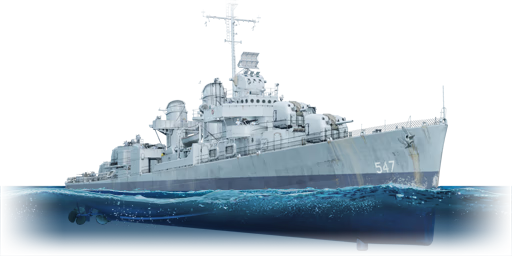
The Fletcher-class, USS Cowell (DD-547), 1943 is a member of the Fletcher-class destroyers, the first generation of destroyers developed by the U.S. after the disintegration of the Washington and London Naval Treaties during World War II. The Fletcher class was meant to be larger and carry more armament due to dissatisfaction with earlier destroyer classes. Cowell was named for US Navy officer John G. Cowell. She was laid down on 7th September 1942 and commissioned on 23rd August 1943. She spent her entire WWII career in the Pacific, participating in carrier screen force, escort duties, and anti-aircraft duty. On 13th October 1944, during the Battle of Leyte, she provided light, power, and pumping facilities to two torpedoed cruisers: USS Canberra and USS Houston. Cowell escorted the crippled ships to safety and then returned back to screen the carrier force once again. During the Battle of Okinawa, she was on radar picket duty which brought her a Presidential Unit Citation. On 22nd July 1946, she was placed into reserve and later reactivated for the Korean War. She escorted Iowa-class battleship USS Missouri to bombard North Korean positions around Wonsan harbour. For her WWII and Korean War service, she received a total of thirteen battle stars. After the war, she spent the remainder of her US Navy career exercising until she was decommissioned on 17th August 1971 and sold to the Argentinian Navy as ARA Almirante Stormi. She was sold for scrap in 1982.
USS Cowell was introduced in Update 1.77 "Advancing Storm", initially purchasable as a pre-order pack in the Gaijin store to access the Naval Closed Beta Test. A Fletcher-class destroyer in the United States line, the Cowell is in the same class-line as the family ship USS Fletcher. The first statistical difference between the Fletcher and the Cowell is the armament, with the Cowell having four more turrets of 40 mm Bofors autocannons, and having one more additional turret of 20 mm autocannons.
USS Cowell was removed from the store in May 2020. It was still available on the PlayStation Store until War Thunder's 8th anniversary sale when it was removed from sale. The ship was temporarily made available for purchase in-game with GE ( ) for the annual "US Navy Birthday" mini events in 2020, 2021, 2022, 2023 and 2024.
General info
Survivability and armour
The Cowell is very strong and powerful against smaller vessels, however, should you be able to live long enough, a torpedo hitting the ship basically anywhere will guarantee a kill. Try using islands and cover to your advantage when attacking a Cowell using a plane or PT boat to hide from the arcs of the Bofors.
For destroyers, aim underneath the front turret with an AP shell. You will have a chance of detonating the ammunition stowage for the front guns which will normally kill the whole ship.
Armour type:
- Antifragmentation armour
- Cast homogeneous armour
- Hardened armour
| Armour | Bow (Slope angle) | Sides | Stern | Deck |
|---|---|---|---|---|
| Hull | N/A | 13 mm (0-24°) | N/A | 13 mm (88-89°) |
| Armour | Front | Sides | Rear | Roof |
| Turrets | 3.2 mm Front 15 mm Gun mantlet |
3.2 mm | 3.2 mm | 3.2 mm |
Notes:
- The radar atop the bridge is covered with an antifragmentation armour with 19 mm thickness.
- Gun shields around the 20 mm Oerlikon autocannons are 12.7 mm thick.
Mobility
Reaching a flank speed of 35 kn, USS Cowell is slower than the Porter-class such as the USS Moffett, placing it slightly above average speed for American destroyers. This speed will allow Cowell to quickly get underway to important locations and USS Cowell takes 34 seconds to halt, and 30 seconds to accelerate to flank speed. She is also responsive to the captain's rudder commands, taking around 2 seconds to come full over. Speed falls to around 24 kn in a sustained turn, leaving USS Cowell vulnerable to enemy fire and continuous turns are to be avoided.
| Mobility Characteristics | |||
|---|---|---|---|
| Game Mode | Upgrade Status | Maximum Speed (km/h) | |
| Forward | Reverse | ||
| AB | |||
| Upgraded | |||
| RB/SB | |||
| Upgraded | |||
Modifications and economy
Armament
Primary armament
| 127 mm 5/38 Mark 12 Dual Purpose gun (x5) | ||||||
|---|---|---|---|---|---|---|
| Turrets (Bow to stern) | ||||||
| Turret 1 | Turret 2 | Turret 3 | Turret 4 | Turret 5 | ||
| Vertical guidance | -10°/+85° | -10°/+85° | -10°/+85° | -10°/+85° | -10°/+85° | |
| Horizontal guidance | ±150° | ±150° | ±143° | ±150° | ±150° | |
| Ammo capacity | 1,800 | |||||
| Rounds per turret | 360 | |||||
Ammunition
| Penetration statistics | |||||||
|---|---|---|---|---|---|---|---|
| Ammunition | Type of warhead |
Penetration @ 0° Angle of Attack (mm) | |||||
| 1,000 m | 2,500 m | 5,000 m | 7,500 m | 10,000 m | 15,000 m | ||
| AAC Mk.34 | HE | 36 | 36 | 36 | 36 | 36 | 36 |
| Common Mk.32 | Common | 124 | 103 | 77 | 58 | 46 | 37 |
| SP Common Mk.46 | SP Common | 150 | 125 | 93 | 71 | 56 | 45 |
| AAVT Mk.31 | HE-VT | 36 | 36 | 36 | 36 | 36 | 36 |
| Shell details | ||||||||||||
|---|---|---|---|---|---|---|---|---|---|---|---|---|
| Ammunition | Type of warhead |
Velocity (m/s) |
Projectile mass (kg) |
Fuse delay (s) |
Fuse sensitivity (mm) |
Explosive mass (TNT equivalent) (g) |
Ricochet | |||||
| 0% | 50% | 100% | ||||||||||
| AAC Mk.34 | HE | 792 | 25 | 0 | 0.1 | 3,220 | 79° | 80° | 81° | |||
| Common Mk.32 | Common | 792 | 24.49 | 0.01 | 6 | 1,150 | 47° | 60° | 65° | |||
| SP Common Mk.46 | SP Common | 792 | 25 | 0.01 | 6 | 906.5 | 48° | 63° | 71° | |||
| Proximity-fused shell details | ||||||||||||
|---|---|---|---|---|---|---|---|---|---|---|---|---|
| Ammunition | Type of warhead |
Velocity (m/s) |
Projectile mass (kg) |
Fuse delay (s) |
Fuse sensitivity (mm) |
Arming distance (m) |
Trigger radius (m) |
Explosive mass (TNT equivalent) (g) |
Ricochet | |||
| 0% | 50% | 100% | ||||||||||
| AAVT Mk.31 | HE-VT | 792 | 25 | 0 | 0.1 | 457 | 23 | 3,220 | 79° | 80° | 81° | |
Secondary armament
| 40 mm Bofors L/60 Mark 1 (x10) | ||||||
|---|---|---|---|---|---|---|
| Turrets (Bow to stern) | ||||||
| Front port turret (x2) | Front starboard turret (x2) | Middle port turret (x2) | Middle starboard turret (x2) | Rear turret (x2) | ||
| Vertical guidance | -15°/+88° | -15°/+88° | -10°/+88° | -10°/+88° | -15°/+88° | |
| Horizontal guidance | -150°/+90° | -90°/+150° | -180°/+20° | -20°/+180° | ±180° | |
| Ammo capacity | 20,000 | |||||
| Rounds per turret | 4,000 | |||||
Ammunition
- Universal: AP-T · HEFI-T
- 40 mm HE clips: HEFI-T · HEFI-T · HEFI-T · AP-T
- 40 mm AP clips: AP-T · AP-T · AP-T · HEFI-T
| Penetration statistics | |||||||
|---|---|---|---|---|---|---|---|
| Ammunition | Penetration @ 0° Angle of Attack (mm) | ||||||
| 10 m | 100 m | 500 m | 1,000 m | 1,500 m | 2,000 m | ||
| HEFI-T | 3 | 3 | 3 | 3 | 3 | 3 | |
| AP-T | 81 | 78 | 68 | 58 | 49 | 41 | |
| Shell details | ||||||||||||
|---|---|---|---|---|---|---|---|---|---|---|---|---|
| Ammunition | Velocity (m/s) |
Projectile mass (kg) |
Fuse delay (m) |
Fuse sensitivity (mm) |
Explosive mass (TNT equivalent) (g) |
Ricochet | ||||||
| 0% | 50% | 100% | ||||||||||
| HEFI-T | 874 | 0.9 | 0 | 0.1 | 67.13 | 79° | 80° | 81° | ||||
| AP-T | 874 | 0.89 | - | - | - | 47° | 60° | 65° | ||||
Anti-aircraft armament
| 20 mm Oerlikon Mk.II (x7) | |||||||
|---|---|---|---|---|---|---|---|
| Turrets (Bow to stern) | |||||||
| Front port turret | Middle port turret | Front starboard turret | Middle starboard turret | Rear port turret | Rear starboard turret | Rear stern turret | |
| Vertical guidance | -80°/+65° | ±100° | -65°/+80° | ±100° | ±180° | ||
| Horizontal guidance | -4°/+50° | ||||||
| Ammo capacity | 16,800 | ||||||
| Rounds per turret | 2,400 | ||||||
Additional armament
| 533 mm steam turbined Mk.15 torpedo | ||||||||
|---|---|---|---|---|---|---|---|---|
| # on ship | Mass (kg) | Maximum speed in water (km/h) |
Travel distance (km) | Depth stroke (m) | Arming distance (m) |
Explosive type | Explosive mass (kg) | |
| 10 | 1,288 | 49 | 13.7 | 0.5 | 15 | TNT | 374 | |
Usage in battles
As a destroyer, the Cowell stands above the PT boats in the previous ranks.
The Cowell is a powerful American destroyer that is very versatile. There can be 3 main jobs for the Cowell to do:
- 1. Gunfighter
With its fast firing armament, it is definitely capable of fighting other destroyers. Load APHE for your main guns and you can start firing against enemy ships from mid to long range. Try disabling the enemies' engine room or gun turrets to prevent them from escaping or fighting back effectively. You also have ten torpedoes so you can use them in any tricky situation. Should you be outmatched, try turning away and using a smoke screen to conceal yourself.
- 2. Anti Air Ship
The Cowell has lots of anti-air weaponry. The deadliest will be your ten Bofors and five 127mm cannons. Let your AI gunners shoot from long distance using radio fuse HE shells. Once enemy aircraft come close enough you should either take control of the Bofors or the main guns themselves to deal with enemies. As always, lead your target and take into account your ship's momentum if you need to. The ship can fire all of its anti-aircraft guns when the enemy is directly above the ship. Try turning to the side to allow more guns to fire if the enemy is coming from an angle. The radio-fuse shells will make quick work of any enemy aircraft or at least critically damage them to the point that they will not be able to make their attack run, while the Bofors will chew down many smaller planes.
- 3. Light Craft Hunter
The Bofors also allow the Cowell to hunt PT boats and other small craft very well. From longer distances, use HE or Radio HE shells to try to hit enemy PT boats and deal splash damage to them. Once you move in closer, take command of your Bofors, load their Universal or HE belts, and slice the PT boats to ribbons. For larger gunboats, using your main guns are still an option. Since you are a destroyer, you are armoured enough to be immune to most of their small cannon and machine gun fire. Your main threat at this point is torpedo boats. Try targetting any PT boats that are heading in your direction. PT boats such as the LS 3 and G-5 are dangerous since they are small, fast and can carry 2 torpedoes. Be sure you make your course erratic and hard to hit, and always be ready to change course in the event that you detect an incoming torpedo. Keep in mind, if a torpedo hits: game over.
In terms of opposition:
- BTD-1: This plane can carry 2 torpedoes which can kill you very quickly, or can attack you from high altitude with a 1,000 lb bomb. Try prioritizing these aircraft to shoot down first.
- SKR-1: This patrol ship can shoot very rapidly and deal a lot of damage to your ship. Try engaging it from long range where your shells will have the advantage.
- Light cruisers: Light cruisers will have better guns that are capable of beating you in a straight up gun duel. Try avoiding them or disabling their vital parts, or requesting help.
- PT boats: Certain PT boats who penetrate your line of defences might pose a danger by launching off torpedoes. Use your Bofors to try to mow down any PT boat that gets too close and always be manoeuvring to dodge
Pros and cons
Pros:
- Equipped with 5 fast-firing turrets
- Lots of Bofors to allow you to deal with air and PT boat threats
- Very effective at anti-air due to radio fuse shells and Bofors
- Has ten torpedoes
- Premium economy gain
Cons:
- Very vulnerable ammunition rack beneath the front turrets.
History
.jpg)
USS Cowell was a ship of the Fletcher-class, built for the American navy during the Second World War. Being extremely numerous in number, the Fletcher class served in all theatres of war and contributed vitally to the war effort. Cowell was commissioned in August of 1943 and served in the Pacific theatre, where she would participate in numerous campaigns such as the Marinanas and Okinawa campaigns. She later served in the Korean war, and was eventually sold to the Argentinian navy in the early 1970s. She was eventually scrapped in 1982, after accruing 13 battle stars during her American service.
Design and construction
The Fletcher-class destroyers were conceived as a 2,100 ton class destroyer following the Benson and Gleaves class destroyers, which were rather inadequate compared to the destroyers of other nations. As a result, the plans were drawn up for the new class, which would carry an additional 5-inch gun and more torpedoes. The design was approved on 27 January 1940 by the Secretary of the Navy, Charles Edison, with construction plans expanded after the Battle of France in Europe when Congress passed the Two-Ocean Navy Act on July 19th, allowing for the construction of 115 destroyers. The Fletcher-class destroyers began construction in October 1941, with eleven shipyards involved in their production. By the war's end, 175 Fletcher-class destroyers were produced.
The USS Cowell was laid down in September of 1942 and completed by August of 1943, and then commissioned into service with the Pacific fleet. She displaced 2050 tons and had a crew complement of 273 officers and men. The ship carried a main armament of five 5-inch (127 mm) guns in single mounts, along with 10 Bofors guns and 7 Oerlikon autocannons for anti-aircraft defence. The ship carried ten 21-inch (533 mm) torpedoes in two quintuple mounts, as well as anti-submarine equipment. Equipped with engines delivering 60000 shp, the ship was capable of making 35 knots (65 km/h).
Operational history
After her commissioning, USS Cowell was sent to the Pacific theatre where she joined the Fast Carrier Task Force (TF 58) as they launched airstrikes on various targets. In this capacity, she served during the invasions of the Gilbert Islands, Kwajelein, Ebeye, Eniwetok, and Truk. After a brief replenishment at Pearl Harbour, Cowell returned to action and participated in the Battle of the Philippine Sea as well as the Battle of Leyte Gulf. In March of 1945, she participated in the invasion of Okinawa, where she shot down numerous enemy aircraft on the duty that would earn her a Presidential Unit Citation. After the end of hostilities, Cowell returned to the United States and was placed into reserve.
In 1951, the ship was recommissioned to serve in the Korean War, and escorted the Battleship Missouri as she bombarded North Korean positions. After the end of hostilities, she embarked on a long around-the-world cruise, passing through the Indian ocean, Suez Canal and Mediterranean sea before arriving at Norfolk again in 1954. She later participated in fleet exercises in the Pacific, where she escorted aircraft carriers and some of the first new American guided-missile cruisers. She was decommissioned in 1971 and subsequently handed over to Argentina, who operated her as ARA Almirante Storni for another decade until her decommissioning and subsequent scrapping in 1982.
Devblog
The USS Cowell was laid down on 7 September 1942, completed on 18 March and commissioned into service on 23 August 1943. She was the second ship, specifically, the second destroyer in the U.S. Navy to be named after her namesake, John G. Cowell. The individual after she was named after was an officer on board the U.S. sailing frigate USS Essex, that was severely wounded during a battle against a pair of British ships in the South Atlantic during The War of 1812. Despite losing a leg, Cowell refused to be carried to the lower decks for medical treatment, instead choosing to remain on his station and continue to motivate his fellow crewmen throughout the battle. Several weeks after the battle, Cowell died to his wounds and received an honorary burial for his courage in the principal church of Valparaíso, a rare honour for a foreigner. As for the destroyer USS Cowell, she was mostly employed as a carrier screener and anti-aircraft destroyer early on in her service career and later on as a radar picket. She took part in several major operations in the Pacific theatre, most notably on Okinawa, where she distinguished herself by shooting down several japanese regular and kamikaze aircraft and aiding damaged ships by providing covering fire and assisting in damage control. USS Cowell arrived to her homeport of San Diego on 17 November 1945 and was decommissioned from active service on 22 July 1946. Throughout the postwar period until 1951, Cowell was part of the U.S. Navy reserve. She was recommissioned into active service in September 1951 and participated in the Korean War as well as various exercises in the Pacific, Atlantic and Mediterranean.
In August 1971, the ship was ultimately decommissioned from U.S. service and was sold to the Argentinian navy, where she received her new name - Almirante Storni. She served under the Argentinian banner until 1982, when she was finally decommissioned from service for good. Shortly after, she was taken apart for scrap.
Media
- Skins
- Videos
See also
- Related development
- Other vehicles of similar configuration and role
External links
References
- Destroyer History Foundation. (2000). USS Cowell (DD-547), Fletcher-class destroyer in World War II. Retrieved January 26, 2021, from https://destroyerhistory.org/fletcherclass/usscowell/
- Helgason, G. (1995). USS Cowell. Retrieved January 26, 2021, from https://uboat.net/allies/warships/ship/1917.html
| Bethlehem Steel Corporation | |
|---|---|
| Gun Destroyers (DD) | |
| Porter-class | USS Phelps · USS Moffett |
| Fletcher-class | USS Cowell |
| Destroyer Leaders (DL) | |
| Mitscher-class | USS Wilkinson |
| Cruiser, Light (CL) | |
| Omaha-class | USS Raleigh · USS Detroit |
| Heavy Cruisers (CA) | |
| Northampton-class | USS Northampton |
| Portland-class | USS Portland |
| Baltimore-class | USS Baltimore · USS Pittsburgh |
| Des Moines-class | USS Des Moines |
| USA destroyers | |
|---|---|
| Clemson-class | USS Welborn C. Wood · USS Barker · USS Litchfield |
| Farragut-class | USS Aylwin |
| Bagley-class | USS Bagley |
| Porter-class | USS Porter · USS Phelps · USS Moffett |
| Somers-class | USS Somers · USS Davis |
| Fletcher-class | USS Fletcher · USS Bennion · USS Cowell |
| Allen M. Sumner-class | USS Sumner |
| Gearing-class | USS Gearing · USS Frank Knox |
| Mitscher-class | USS Mitscher · USS Wilkinson |
| USA premium ships | |
|---|---|
| Motor torpedo boats | PT-3 · PT-109 · PT-174 · Thunderbolt (PT-556) · PT-658 · PT-811 |
| Motor gun boats | LCM(6) Zippo · USS Douglas · USS Flagstaff |
| Sub-chasers | Carmi (PC-466) |
| Destroyers | USS Welborn C. Wood · USS Wilkinson · USS Bennion · USS Cowell · USS Davis · USS Moffett · USS Phelps · USS Frank Knox |
| Light cruisers | USS Detroit · USS Helena |
| Heavy cruisers | USS Des Moines |
| Battleships | USS Arkansas |
Pages in category "Game modes"
The following 2 pages are in this category, out of 2 total.