USS Detroit
| This page is about the American light cruiser USS Detroit. For other Omaha-class cruisers, see Omaha (Family). |

Contents
Description
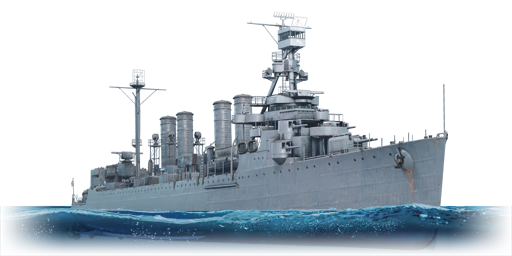
The Omaha-class, USS Detroit (CL-8), 1942 was laid down in November 1920, and commissioned in July of 1923 as the 5th of 10 Omaha-class light cruisers. Her original design as a "Scout Cruiser" gave her class a unique armament with forward-facing casemate guns as part of her main battery. She would go on to serve in WW2, the only theater she saw action in being in the Aleutians, bombarding Attu and assisting in the landings. She did however, notably, bring 8 metric tons of gold and 12 metric tons of silver from the submarine USS Trout (which had evacuated it from Corredigor in the Philippines) to the US Treasury in San Francisco. She would serve uneventfully through the rest of WW2, and be sold for scrap in 1946.
Introduced during Update "Red Skies", USS Detroit was a reward for Battle Pass: Season IV, "Fearless Voltigeur". Compared to her sister ship USS Trenton, Detroit is in her 1942 refit, notably gaining access to an anti-aircraft battery of 20 mm Oerlikons in addition to the 1.1-inch, giving a large boost to the anti-aircraft capabilities. The Omaha-class has a distinct advantage when approaching the enemy bow in: the unique casemate design allows for 4-6 of the 6-inch guns to be brought to bear whilst also lowering the silhouette of the ship.
General info
Survivability and armour
Talk about the vehicle's armour. Note the most well-defended and most vulnerable zones, e.g. the ammo magazine. Evaluate the composition of components and assemblies responsible for movement and manoeuvrability. Evaluate the survivability of the primary and secondary armaments separately. Don't forget to mention the size of the crew, which plays an important role in fleet mechanics. Save tips on preserving survivability for the "Usage in battles" section. If necessary, use a graphical template to show the most well-protected or most vulnerable points in the armour.
Mobility
Write about the ship's mobility. Evaluate its power and manoeuvrability, rudder rerouting speed, stopping speed at full tilt, with its maximum forward and reverse speed.
| Mobility Characteristics | |||
|---|---|---|---|
| Game Mode | Upgrade Status | Maximum Speed (km/h) | |
| Forward | Reverse | ||
| AB | |||
| Upgraded | |||
| RB/SB | |||
| Upgraded | |||
Modifications and economy
Armament
Primary armament
The one saving grace of this ship is its 6 inch artillery. Powerful enough to obliterate most destroyers in a few well placed hits, it unfortunately has a poor reload rate, and an even worse traverse rate. This vessel is essentially a support ship for more powerful ships in its BR range.
| Penetration statistics | |||||||
|---|---|---|---|---|---|---|---|
| Ammunition | Type of warhead |
Penetration @ 0° Angle of Attack (mm) | |||||
| 1,000 m | 2,500 m | 5,000 m | 7,500 m | 10,000 m | 15,000 m | ||
| Mk.34 HC | HE | 49 | 49 | 49 | 49 | 49 | 49 |
| Mk.27 SC | SP Common | 210 | 179 | 138 | 107 | 85 | 60 |
| Shell details | ||||||||||||
|---|---|---|---|---|---|---|---|---|---|---|---|---|
| Ammunition | Type of warhead |
Velocity (m/s) |
Projectile mass (kg) |
Fuse delay (s) |
Fuse sensitivity (mm) |
Explosive mass (TNT equivalent) (g) |
Ricochet | |||||
| 0% | 50% | 100% | ||||||||||
| Mk.34 HC | HE | 914 | 47.6 | 0 | 0.1 | 5,880 | 79° | 80° | 81° | |||
| Mk.27 SC | SP Common | 914 | 47.62 | 0.01 | 7 | 977.06 | 48° | 63° | 71° | |||
Secondary armament
The 3 inch (76 mm) cannons do have HE-VT shells, meaning that they can ward off planes and ships, but only at close range.
| Penetration statistics | |||||||
|---|---|---|---|---|---|---|---|
| Ammunition | Type of warhead |
Penetration @ 0° Angle of Attack (mm) | |||||
| 100 m | 1,000 m | 2,000 m | 3,000 m | 4,000 m | 5,000 m | ||
| HC Mk.27 | HE | 8 | 8 | 8 | 8 | 8 | 8 |
| AP Mk.29 | APCBC | 111 | 90 | 71 | 56 | 44 | 36 |
| AA Mk.31 | HE-VT | 7 | 7 | 7 | 7 | 7 | 7 |
| Shell details | ||||||||||||
|---|---|---|---|---|---|---|---|---|---|---|---|---|
| Ammunition | Type of warhead |
Velocity (m/s) |
Projectile mass (kg) |
Fuse delay (s) |
Fuse sensitivity (mm) |
Explosive mass (TNT equivalent) (g) |
Ricochet | |||||
| 0% | 50% | 100% | ||||||||||
| HC Mk.27 | HE | 823 | 5.9 | 0 | 0.1 | 500 | 79° | 80° | 81° | |||
| AP Mk.29 | APCBC | 823 | 5.9 | 0.01 | 4 | 133.28 | 48° | 63° | 71° | |||
| Proximity-fused shell details | ||||||||||||
|---|---|---|---|---|---|---|---|---|---|---|---|---|
| Ammunition | Type of warhead |
Velocity (m/s) |
Projectile mass (kg) |
Fuse delay (m) |
Fuse sensitivity (mm) |
Arming distance (m) |
Trigger radius (m) |
Explosive mass (TNT equivalent) (g) |
Ricochet | |||
| 0% | 50% | 100% | ||||||||||
| AA Mk.31 | HE-VT | 823 | 5.85 | 0 | 0.1 | 548 | 15 | 352.8 | 79° | 80° | 81° | |
Anti-aircraft armament
The Detroit is equipped with one Chicago Piano mount and eight single-mount Oerlikon cannons. This provides some decent AA cover at close range, though it certainly isn't winning any awards for defensive firepower. It is better to simply stay close to AA ships and destroyers for some extra protection.
Additional armament
The ship has a pair of torpedo launchers, but their poor placement and poor torpedoes makes them a poor choice to use.
Scout plane
Located on the stern are two catapults with one SOC-1 scout plane each which provide unique offensive and defensive abilities, expanding tactical options. Ship-launched scout planes fly just like regular tree units but lack munition choices and cockpit views. Alongside the typical abilities of strafing, dropping 2 x 100 lb bombs, and capping zones, the SOC-1 and other scout planes have the added ability to lay down smoke cover (up to 3 times). Captains will be wise to remember to utilise the aircraft and consider when best to use it, for example to cap a point early or late in the match, to create a smoke screen to stymie enemy bombardment and repair, to attack enemy units directly, or perhaps something completely new! With two scout planes one can risk a cap attempt at the beginning of the match, saving the second for any opportunity that presents itself.
Usage in battles
While using the USS Detroit, try to exploit its mobility advantage and flank around the map. Use cover to make up for the subpar armour of the ship. When playing this ship, make sure you avoid higher-tier cruisers like IJN Mogami, HMS London or Admiral Hipper and go for destroyers and lower-tier cruisers.
Pros and cons
Pros:
- Shell rooms are located deep beneath waterline, and rear shell room is also covered by fuel tanks
- All six forward main guns can fire towards bow direction
- Two scout seaplanes
- 76 mm guns have HE-VT shells
Cons:
- When firing on one broadside, the single-gun turrets draw ammo from shared ready racks, so they maintain fast-firing longer than the twin-gun turrets, resulting in unsynchronized firing pattern
- Poor armour
History
Describe the history of the creation and combat usage of the ship in more detail than in the introduction. If the historical reference turns out to be too long, take it to a separate article, taking a link to the article about the ship and adding a block "/History" (example: https://wiki.warthunder.com/(Ship-name)/History) and add a link to it here using the main template. Be sure to reference text and sources by using <ref></ref>, as well as adding them at the end of the article with <references />. This section may also include the ship's dev blog entry (if applicable) and the in-game encyclopedia description (under === In-game description ===, also if applicable).
Media
- Skins
- Photos

USS Detroit (CL-8) in the harbour at San Diego, California in 1935.

USS Detroit (CL-8) off Port Angeles, Washington (USA) in 1944.
_at_San_Diego_in_1935.jpg)
_off_Port_Angeles_on_April_1944_(19-N-63828).jpg)
- Videos
See also
Links to articles on the War Thunder Wiki that you think will be useful for the reader, for example:
- reference to the series of the ship;
- links to approximate analogues of other nations and research trees.
External links
| Bethlehem Steel Corporation | |
|---|---|
| Gun Destroyers (DD) | |
| Porter-class | USS Phelps · USS Moffett |
| Fletcher-class | USS Cowell |
| Destroyer Leaders (DL) | |
| Mitscher-class | USS Wilkinson |
| Cruiser, Light (CL) | |
| Omaha-class | USS Raleigh · USS Detroit |
| Heavy Cruisers (CA) | |
| Northampton-class | USS Northampton |
| Portland-class | USS Portland |
| Baltimore-class | USS Baltimore · USS Pittsburgh |
| Des Moines-class | USS Des Moines |
| USA light cruisers | |
|---|---|
| Omaha-class | USS Detroit · USS Raleigh · USS Trenton |
| Atlanta-class | USS Atlanta |
| Brooklyn-class | USS Brooklyn · USS Helena |
| Cleveland-class | USS Cleveland |
| Fargo-class | USS Fargo |
| Worcester-class | USS Roanoke |
| USA premium ships | |
|---|---|
| Motor torpedo boats | PT-3 · PT-109 · PT-174 · Thunderbolt (PT-556) · PT-658 · PT-811 |
| Motor gun boats | LCM(6) Zippo · USS Douglas · USS Flagstaff |
| Sub-chasers | Carmi (PC-466) |
| Destroyers | USS Welborn C. Wood · USS Wilkinson · USS Bennion · USS Cowell · USS Davis · USS Moffett · USS Phelps · USS Frank Knox |
| Light cruisers | USS Detroit · USS Helena |
| Heavy cruisers | USS Des Moines |
| Battleships | USS Arkansas |