Difference between pages "M.D.452 IIA" and "La-200"
(→Media: Added video) |
m |
||
| Line 1: | Line 1: | ||
| − | {{Specs-Card|code= | + | {{Specs-Card |
| − | {{ | + | |code=la_200_toriy |
| − | | | + | |images={{Specs-Card-Image|GarageImage_{{PAGENAME}}.jpg}} |
| − | | | + | |cockpit = cockpit_la_200_toriy.jpg |
| − | |||
}} | }} | ||
== Description == | == Description == | ||
<!-- ''In the description, the first part should be about the history of and the creation and combat usage of the aircraft, as well as its key features. In the second part, tell the reader about the aircraft in the game. Insert a screenshot of the vehicle, so that if the novice player does not remember the vehicle by name, he will immediately understand what kind of vehicle the article is talking about.'' --> | <!-- ''In the description, the first part should be about the history of and the creation and combat usage of the aircraft, as well as its key features. In the second part, tell the reader about the aircraft in the game. Insert a screenshot of the vehicle, so that if the novice player does not remember the vehicle by name, he will immediately understand what kind of vehicle the article is talking about.'' --> | ||
| − | + | The '''{{Specs|name}}''' was a proposed Soviet all-weather interceptor. It was designed with the intent of protecting key strategic locations and defending against potential aerial threats from rival nations. The {{Specs|name}} was developed in the late 1940s as tensions between the Soviet Union and western countries were growing. With plans to turn it into a crucial defense asset for the Soviet Union, its radar system and powerful engines were designed to allow it to successfully track and intercept enemy aircraft with ease. Even though the {{Specs|name}} won a competition against three other aircraft with comparable capabilities, the project was ultimately viewed as a failure due to the development of even more advanced aircraft, such as the Yak-120 (also known as the Yak-25), which rendered the {{Specs|name}} obsolete before it could be fully deployed and was seen as a more practical solution for the Soviet Union's defense requirements. The failure of the {{Specs|name}} demonstrated the challenges of keeping up with rapidly evolving aviation technology during that era. In the end, only one prototype was built, and it never entered full production. | |
| − | + | ||
| − | The '''{{Specs|name}}''' | + | The {{Specs|name}} was introduced in [[Update 1.77 "Advancing Storm"]]. It features promising performance characteristics, such as a top speed of more than 1,000 km/h, which allows it to outrun most aircraft at its battle rating. It works best at medium to high altitudes, where it is nearly impossible to catch and can inflict devastating strikes on unsuspecting foes via boom-and-zooming. With three N-37D cannons, the armament does not fall short either. However, one of its most unforgiving flaws is its terrible low-speed performance, which makes it difficult to manoeuvre and maintain stability when used at those speeds. |
== General info == | == General info == | ||
| − | === Flight | + | === Flight performance === |
| − | <!--Describe how the aircraft behaves in the air. Speed, manoeuvrability, acceleration and allowable loads - these are the most important characteristics of the vehicle.--> | + | {{Specs-Avia-Flight}} |
| − | + | <!-- ''Describe how the aircraft behaves in the air. Speed, manoeuvrability, acceleration and allowable loads - these are the most important characteristics of the vehicle.'' --> | |
| − | {| class="wikitable" style="text-align:center" | + | {| class="wikitable" style="text-align:center" width="70%" |
! rowspan="2" | Characteristics | ! rowspan="2" | Characteristics | ||
! colspan="2" | Max Speed<br>(km/h at 0 m - sea level) | ! colspan="2" | Max Speed<br>(km/h at 0 m - sea level) | ||
| Line 28: | Line 27: | ||
|- | |- | ||
! Stock | ! Stock | ||
| − | | | + | | 1,087 || 1,061 || rowspan="2" | {{Specs|ceiling}} || 26.9 || 27.8 || 38.7 || 37.0 || rowspan="2" | 700 |
|- | |- | ||
! Upgraded | ! Upgraded | ||
| − | | 1, | + | | 1,110 || 1,101 || 25.6 || 26.0 || 58.7 || 47.0 |
|- | |- | ||
|} | |} | ||
==== Details ==== | ==== Details ==== | ||
| − | {| class="wikitable" style="text-align:center" | + | {| class="wikitable" style="text-align:center" width="50%" |
|- | |- | ||
! colspan="6" | Features | ! colspan="6" | Features | ||
| Line 46: | Line 45: | ||
|} | |} | ||
| − | {| class="wikitable" style="text-align:center" | + | {| class="wikitable" style="text-align:center" width="50%" |
|- | |- | ||
! colspan="7" | Limits | ! colspan="7" | Limits | ||
| Line 57: | Line 56: | ||
! Combat !! Take-off !! Landing !! + !! - | ! Combat !! Take-off !! Landing !! + !! - | ||
|- | |- | ||
| − | | {{Specs|destruction|body}} || {{Specs|destruction|gear}} || | + | | {{Specs|destruction|body}} || {{Specs|destruction|gear}} || 627 || 598 || 450 || ~12 || ~6 |
|- | |- | ||
|} | |} | ||
| Line 67: | Line 66: | ||
! Ailerons !! Rudder !! Elevators !! Radiator | ! Ailerons !! Rudder !! Elevators !! Radiator | ||
|- | |- | ||
| − | | < | + | | < 600 || < 700 || < 750 || N/A |
|- | |- | ||
|} | |} | ||
| Line 80: | Line 79: | ||
! colspan="2" | Empty mass || colspan="2" | Wing loading (full fuel) | ! colspan="2" | Empty mass || colspan="2" | Wing loading (full fuel) | ||
|- | |- | ||
| − | | colspan="2" | | + | | colspan="2" | Klimov VK-1 || 2 |
| − | | colspan="2" | | + | | colspan="2" | 7,700 kg || colspan="2" | 257 kg/m<sup>2</sup> |
|- | |- | ||
! colspan="3" | Engine characteristics | ! colspan="3" | Engine characteristics | ||
| Line 87: | Line 86: | ||
|- | |- | ||
! Weight (each) || colspan="2" | Type | ! Weight (each) || colspan="2" | Type | ||
| − | ! | + | ! 9m fuel || 20m fuel || 31m fuel |
|- | |- | ||
| − | | | + | | 892 kg || colspan="2" | Centrifugal-flow turbojet |
| − | | | + | | 8,456 kg || 9,363 kg || 10,269 kg || 12,500 kg |
|- | |- | ||
! colspan="3" | {{Annotation|Maximum engine thrust @ 0 m (RB / SB)|The maximum thrust produced by each engine, while mounted in the aircraft. NOTE: Thrust varies significantly depending on speed & altitude.}} | ! colspan="3" | {{Annotation|Maximum engine thrust @ 0 m (RB / SB)|The maximum thrust produced by each engine, while mounted in the aircraft. NOTE: Thrust varies significantly depending on speed & altitude.}} | ||
! colspan="4" | Thrust to weight ratio @ 0 m (100%) | ! colspan="4" | Thrust to weight ratio @ 0 m (100%) | ||
|- | |- | ||
| − | ! Condition || 100% || WEP | + | ! Condition || 100% (front / rear) || WEP |
| − | ! | + | ! 9m fuel || 20m fuel || 31m fuel || MTOW |
|- | |- | ||
| − | | ''Stationary'' || 2, | + | | ''Stationary'' || 2,430 / 2,520 kgf || N/A |
| − | | 0. | + | | 0.59 || 0.53 || 0.48 || 0.40 |
|- | |- | ||
| − | | ''Optimal'' || 2, | + | | ''Optimal'' || 2,430 / 2,520 kgf<br />(0 km/h) || N/A |
| − | | 0. | + | | 0.59 || 0.53 || 0.48 || 0.40 |
|- | |- | ||
|} | |} | ||
=== Survivability and armour === | === Survivability and armour === | ||
| − | + | {{Specs-Avia-Armour}} | |
| + | ''Examine the survivability of the aircraft. Note how vulnerable the structure is and how secure the pilot is, whether the fuel tanks are armoured, etc. Describe the armour, if there is any, and also mention the vulnerability of other critical aircraft systems.'' | ||
| − | + | === Modifications and economy === | |
| + | {{Specs-Economy}} | ||
== Armaments == | == Armaments == | ||
| + | {{Specs-Avia-Armaments}} | ||
=== Offensive armament === | === Offensive armament === | ||
| + | {{Specs-Avia-Offensive}} | ||
<!-- ''Describe the offensive armament of the aircraft, if any. Describe how effective the cannons and machine guns are in a battle, and also what belts or drums are better to use. If there is no offensive weaponry, delete this subsection.'' --> | <!-- ''Describe the offensive armament of the aircraft, if any. Describe how effective the cannons and machine guns are in a battle, and also what belts or drums are better to use. If there is no offensive weaponry, delete this subsection.'' --> | ||
| − | {{main| | + | {{main|N-37D (37 mm)}} |
The '''''{{PAGENAME}}''''' is armed with: | The '''''{{PAGENAME}}''''' is armed with: | ||
| − | * | + | * 3 x 37 mm N-37D cannons, chin-mounted (50 rpg = 150 total) |
| − | |||
| − | |||
| − | |||
| − | |||
== Usage in battles == | == Usage in battles == | ||
| − | <!--Describe the tactics of playing in | + | <!-- ''Describe the tactics of playing in the aircraft, the features of using aircraft in a team and advice on tactics. Refrain from creating a "guide" - do not impose a single point of view, but instead, give the reader food for thought. Examine the most dangerous enemies and give recommendations on fighting them. If necessary, note the specifics of the game in different modes (AB, RB, SB).'' --> |
| − | The | + | Speed is your greatest advantage. The La-200 can outrun every jet at its BR and even some jets at higher BRs. At the beginning of a match try to gather speed as soon as possible. In a game, if you accelerate up to about 1,000 km/h no one will catch you even if they dive on you. You can use your speed to zoom climb and surprise any climbing (or unsuspecting) players. Remember that other fighters will be more manoeuvrable and that you can't afford taking any hits (top speed drops horribly if you get hit). Always make sure that you have enough energy to run away from the enemy if you miss. And you will miss a lot, the 37 mm cannons are hard to lead and quite inaccurate, so it is not recommended to use them at long distances. They are, however, extremely effective when they hit (one shot is almost always enough) so it's possible to get many kills without landing. |
| − | + | ===Radars=== | |
| + | {{main|Toriy}} | ||
| + | The La-200 is equipped with a [[Toriy]] search radar, located in the radome in the centre of the air intake. | ||
| − | |||
| − | |||
| − | |||
{| class="wikitable" style="text-align:center" | {| class="wikitable" style="text-align:center" | ||
| + | ! colspan="4" | [[Toriy]] - Target Detection Radar | ||
|- | |- | ||
| − | ! | + | ! {{Annotation|Maximum<br/>Detection<br/>Range|The maximum possible range at which a target can be detected}} |
| − | + | ! {{Annotation|Guaranteed<br/>Detection<br/>Range|The range, below which, detection of a target is practically guaranteed}} | |
| − | + | ! {{Annotation|Max Azimuth<br/>Scan Angle|How far to each side the radar can scan (widest search mode)}} | |
| − | + | ! {{Annotation|Max Elevation<br/>Scan Angle|How far up and down the radar can scan (widest search mode)}} | |
| − | |||
| − | |||
| − | |||
| − | |||
| − | |||
| − | |||
| − | |||
| − | |||
| − | |||
| − | |||
| − | |} | ||
| − | |||
| − | |||
| − | {| | ||
| − | |||
| − | ! | ||
| − | |||
| − | |||
| − | |||
| − | |||
| − | |||
| − | |||
| − | |||
| − | |||
| − | |||
| − | |||
| − | |||
| − | |||
| − | |||
| − | |||
| − | |||
| − | |||
| − | |||
| − | |||
| − | |||
| − | |||
|- | |- | ||
| − | | | + | | 15,000 m || 12,000 m || ±30° || ±32° |
| − | | | ||
| − | | | ||
| − | | | ||
| − | | | ||
|- | |- | ||
|} | |} | ||
=== Pros and cons === | === Pros and cons === | ||
| − | <!--Summarise and briefly evaluate the vehicle in terms of its characteristics and combat effectiveness. Mark its pros and cons in the bulleted list. Try not to use more than 6 points for each of the characteristics. Avoid using categorical definitions such as "bad", "good" and the like - use substitutions with softer forms such as "inadequate" and "effective".--> | + | <!-- ''Summarise and briefly evaluate the vehicle in terms of its characteristics and combat effectiveness. Mark its pros and cons in the bulleted list. Try not to use more than 6 points for each of the characteristics. Avoid using categorical definitions such as "bad", "good" and the like - use substitutions with softer forms such as "inadequate" and "effective".'' --> |
'''Pros:''' | '''Pros:''' | ||
| − | * Good | + | * Extremely high top speed for its battle rating, able to break the sound barrier in a dive |
| − | * | + | * Insane roll rate for Soviet standards, specially at high speeds |
| − | + | * Good acceleration up to 800 km/h | |
| − | * | + | * Good climb rate and acceleration provides great zoom climb capability |
| − | * | + | * Hard-hitting guns with decent rate of fire |
| − | * | + | * Second pilot takes over if the first one is knocked out |
| − | * | + | * Effective airbrake |
| − | * | + | * Combat flaps help turn |
| − | * | + | * Has access to a target detection radar with decent range |
| + | * Able to return to the airfield on one engine | ||
'''Cons:''' | '''Cons:''' | ||
| − | * | + | * Horrible low speed performance |
| − | + | * Elevator locks up at high speeds, can lead to a crash if you're not careful | |
| − | * | + | * Guns have some noticeable dispersion |
| − | * | + | * Guns have relatively low ammo count (50 shells for each gun, 150 total) |
| − | * | + | * Huge target with no armour |
| − | + | * No payload (no access to bombs/rockets) | |
| − | * | ||
| − | * | ||
== History == | == History == | ||
| − | ''Describe the history of the creation and combat usage of the aircraft in more detail than in the introduction. If the historical reference turns out to be too long, take it to a separate article, taking a link to the article about the vehicle and adding a block "/ History" (example: <nowiki>https://wiki.warthunder.com/(Vehicle-name)/History</nowiki>) and add a link to it here using the <code>main</code> template. Be sure to reference text and sources by using <code><nowiki><ref></ref></nowiki></code>, as well as adding them at the end of the article with <code><nowiki><references /></nowiki></code>. This section may also include the vehicle's dev blog entry (if applicable) and the in-game encyclopedia description (under <code><nowiki>=== In-game description ===</nowiki></code>, also if applicable).'' | + | <!-- ''Describe the history of the creation and combat usage of the aircraft in more detail than in the introduction. If the historical reference turns out to be too long, take it to a separate article, taking a link to the article about the vehicle and adding a block "/History" (example: <nowiki>https://wiki.warthunder.com/(Vehicle-name)/History</nowiki>) and add a link to it here using the <code>main</code> template. Be sure to reference text and sources by using <code><nowiki><ref></ref></nowiki></code>, as well as adding them at the end of the article with <code><nowiki><references /></nowiki></code>. This section may also include the vehicle's dev blog entry (if applicable) and the in-game encyclopedia description (under <code><nowiki>=== In-game description ===</nowiki></code>, also if applicable).'' --> |
| + | |||
| + | In 1948, Soviet high command issued a requirement for a two man, all-weather, twin -engined jet interceptor that would be capable of carrying a new type of radar system called "Toriy" (Thorium). All three Soviet design bureaus (Lavochkin, MiG, and Sukhoi) developed a prototype for testing. | ||
| + | |||
| + | Lavochkin's design, the La-200, had a long fuselage to accommodate its two turbojet engines, swept wings, and a large cockpit for two men. The La-200 took its maiden flight on September 9th, 1949. It was the only aircraft of the three designs to pass initial trials. | ||
| + | |||
| + | By the early 1950s, the La-200 was ready to enter production under the official designation La-17. However, due to the appearance of the Yak-120 (later known as Yak-25), which surpassed the La-200's performance in testing, the La-200 order was cancelled in favor of the Yakovlev design. | ||
| + | |||
| + | Only a single prototype of the La-200 was ever built, and it was modified several times during development to improve performance, correct flaws, and test other radar systems. | ||
| + | |||
| + | ''- From [[wt:en/news/5319-development-la-200-the-high-speed-kite-en|Devblog]]'' | ||
== Media == | == Media == | ||
| − | <!--Excellent additions to the article would be video guides, screenshots from the game, and photos.--> | + | <!-- ''Excellent additions to the article would be video guides, screenshots from the game, and photos.'' --> |
| − | {{Youtube-gallery|bZvHRgBda9s|'''La-200 vs M.D.452 IIA''' - ''War Thunder''| | + | |
| + | ;Skins | ||
| + | |||
| + | * [https://live.warthunder.com/feed/camouflages/?vehicle=la_200_toriy Skins and camouflages for the {{PAGENAME}} from live.warthunder.com.] | ||
| + | |||
| + | ;Videos | ||
| + | {{Youtube-gallery|bZvHRgBda9s|'''La-200 vs M.D.452 IIA''' - ''War Thunder Official Channel''|9VBAWLdfLcw|'''The Shooting Range #90''' - ''Pages of History'' section at 04:03 discusses the La-200.|t3xD7JpnHeI|'''Best aircraft for Boom & Zoom''' discusses the {{PAGENAME}} at 5:21 - ''War Thunder Official Channel''}} | ||
== See also == | == See also == | ||
| Line 225: | Line 199: | ||
== External links == | == External links == | ||
| − | ''Paste links to sources and external resources, such as:'' | + | <!-- ''Paste links to sources and external resources, such as:'' |
| + | * ''topic on the official game forum;'' | ||
| + | * ''other literature.'' --> | ||
| − | * | + | * [[wt:en/news/5319-development-la-200-the-high-speed-kite-en|[Devblog] La-200: The High-Speed Kite]] |
| − | * | + | * [https://old-forum.warthunder.com/index.php?/topic/402782-la-200-toriy/ Official data sheet - more details about the performance] |
| − | |||
| − | {{AirManufacturer | + | {{AirManufacturer Lavochkin}} |
| − | {{ | + | {{USSR jet aircraft}} |
Latest revision as of 23:07, 6 April 2024

Contents
Description
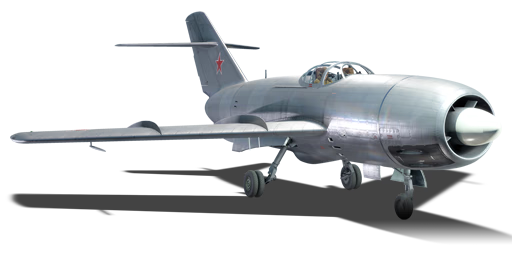
The La-200 was a proposed Soviet all-weather interceptor. It was designed with the intent of protecting key strategic locations and defending against potential aerial threats from rival nations. The La-200 was developed in the late 1940s as tensions between the Soviet Union and western countries were growing. With plans to turn it into a crucial defense asset for the Soviet Union, its radar system and powerful engines were designed to allow it to successfully track and intercept enemy aircraft with ease. Even though the La-200 won a competition against three other aircraft with comparable capabilities, the project was ultimately viewed as a failure due to the development of even more advanced aircraft, such as the Yak-120 (also known as the Yak-25), which rendered the La-200 obsolete before it could be fully deployed and was seen as a more practical solution for the Soviet Union's defense requirements. The failure of the La-200 demonstrated the challenges of keeping up with rapidly evolving aviation technology during that era. In the end, only one prototype was built, and it never entered full production.
The La-200 was introduced in Update 1.77 "Advancing Storm". It features promising performance characteristics, such as a top speed of more than 1,000 km/h, which allows it to outrun most aircraft at its battle rating. It works best at medium to high altitudes, where it is nearly impossible to catch and can inflict devastating strikes on unsuspecting foes via boom-and-zooming. With three N-37D cannons, the armament does not fall short either. However, one of its most unforgiving flaws is its terrible low-speed performance, which makes it difficult to manoeuvre and maintain stability when used at those speeds.
General info
Flight performance
| Characteristics | Max Speed (km/h at 0 m - sea level) |
Max altitude (metres) |
Turn time (seconds) |
Rate of climb (metres/second) |
Take-off run (metres) | |||
|---|---|---|---|---|---|---|---|---|
| AB | RB | AB | RB | AB | RB | |||
| Stock | 1,087 | 1,061 | 26.9 | 27.8 | 38.7 | 37.0 | 700 | |
| Upgraded | 1,110 | 1,101 | 25.6 | 26.0 | 58.7 | 47.0 | ||
Details
| Features | |||||
|---|---|---|---|---|---|
| Combat flaps | Take-off flaps | Landing flaps | Air brakes | Arrestor gear | Drogue chute |
| ✓ | ✓ | ✓ | ✓ | X | X |
| Limits | ||||||
|---|---|---|---|---|---|---|
| Wings (km/h) | Gear (km/h) | Flaps (km/h) | Max Static G | |||
| Combat | Take-off | Landing | + | - | ||
| 627 | 598 | 450 | ~12 | ~6 | ||
| Optimal velocities (km/h) | |||
|---|---|---|---|
| Ailerons | Rudder | Elevators | Radiator |
| < 600 | < 700 | < 750 | N/A |
Engine performance
| Engine | Aircraft mass | |||||
|---|---|---|---|---|---|---|
| Engine name | Number | Empty mass | Wing loading (full fuel) | |||
| Klimov VK-1 | 2 | 7,700 kg | 257 kg/m2 | |||
| Engine characteristics | Mass with fuel (no weapons load) | Max Takeoff Weight | ||||
| Weight (each) | Type | 9m fuel | 20m fuel | 31m fuel | ||
| 892 kg | Centrifugal-flow turbojet | 8,456 kg | 9,363 kg | 10,269 kg | 12,500 kg | |
| Maximum engine thrust @ 0 m (RB / SB) | Thrust to weight ratio @ 0 m (100%) | |||||
| Condition | 100% (front / rear) | WEP | 9m fuel | 20m fuel | 31m fuel | MTOW |
| Stationary | 2,430 / 2,520 kgf | N/A | 0.59 | 0.53 | 0.48 | 0.40 |
| Optimal | 2,430 / 2,520 kgf (0 km/h) |
N/A | 0.59 | 0.53 | 0.48 | 0.40 |
Survivability and armour
Examine the survivability of the aircraft. Note how vulnerable the structure is and how secure the pilot is, whether the fuel tanks are armoured, etc. Describe the armour, if there is any, and also mention the vulnerability of other critical aircraft systems.
Modifications and economy
Armaments
Offensive armament
The La-200 is armed with:
- 3 x 37 mm N-37D cannons, chin-mounted (50 rpg = 150 total)
Usage in battles
Speed is your greatest advantage. The La-200 can outrun every jet at its BR and even some jets at higher BRs. At the beginning of a match try to gather speed as soon as possible. In a game, if you accelerate up to about 1,000 km/h no one will catch you even if they dive on you. You can use your speed to zoom climb and surprise any climbing (or unsuspecting) players. Remember that other fighters will be more manoeuvrable and that you can't afford taking any hits (top speed drops horribly if you get hit). Always make sure that you have enough energy to run away from the enemy if you miss. And you will miss a lot, the 37 mm cannons are hard to lead and quite inaccurate, so it is not recommended to use them at long distances. They are, however, extremely effective when they hit (one shot is almost always enough) so it's possible to get many kills without landing.
Radars
The La-200 is equipped with a Toriy search radar, located in the radome in the centre of the air intake.
| Toriy - Target Detection Radar | |||
|---|---|---|---|
| Maximum Detection Range |
Guaranteed Detection Range |
Max Azimuth Scan Angle |
Max Elevation Scan Angle |
| 15,000 m | 12,000 m | ±30° | ±32° |
Pros and cons
Pros:
- Extremely high top speed for its battle rating, able to break the sound barrier in a dive
- Insane roll rate for Soviet standards, specially at high speeds
- Good acceleration up to 800 km/h
- Good climb rate and acceleration provides great zoom climb capability
- Hard-hitting guns with decent rate of fire
- Second pilot takes over if the first one is knocked out
- Effective airbrake
- Combat flaps help turn
- Has access to a target detection radar with decent range
- Able to return to the airfield on one engine
Cons:
- Horrible low speed performance
- Elevator locks up at high speeds, can lead to a crash if you're not careful
- Guns have some noticeable dispersion
- Guns have relatively low ammo count (50 shells for each gun, 150 total)
- Huge target with no armour
- No payload (no access to bombs/rockets)
History
In 1948, Soviet high command issued a requirement for a two man, all-weather, twin -engined jet interceptor that would be capable of carrying a new type of radar system called "Toriy" (Thorium). All three Soviet design bureaus (Lavochkin, MiG, and Sukhoi) developed a prototype for testing.
Lavochkin's design, the La-200, had a long fuselage to accommodate its two turbojet engines, swept wings, and a large cockpit for two men. The La-200 took its maiden flight on September 9th, 1949. It was the only aircraft of the three designs to pass initial trials.
By the early 1950s, the La-200 was ready to enter production under the official designation La-17. However, due to the appearance of the Yak-120 (later known as Yak-25), which surpassed the La-200's performance in testing, the La-200 order was cancelled in favor of the Yakovlev design.
Only a single prototype of the La-200 was ever built, and it was modified several times during development to improve performance, correct flaws, and test other radar systems.
- From Devblog
Media
- Skins
- Videos
See also
Links to the articles on the War Thunder Wiki that you think will be useful for the reader, for example:
- reference to the series of the aircraft;
- links to approximate analogues of other nations and research trees.
External links
| Lavochkin Design Bureau (Лавочкинa Опытное конструкторское бюро) | |
|---|---|
| LaGG-3* | I-301 · LaGG-3-4 · LaGG-3-8 · LaGG-3-11 · LaGG-3-23 · LaGG-3-34 · LaGG-3-35 · LaGG-3-66 |
| La-5/7 | La-5 · La-5F · La-5FN · La-7 · Dolgushin's La-7 · La-7B-20 |
| La-9/11 | La-9 · La-11 |
| Jet Fighters | La-15 · La-174 · La-200 |
| Export | ␗La-9 · ␗La-11 |
| Captured | ▀La-5FN |
| *Lavochkin-Gorbunov-Gudkov (Лавочкин-Горбунов-Гудков), head designer V. P. Gorbunov | |
| USSR jet aircraft | |
|---|---|
| Bereznyak-Isayev | BI |
| Yakovlev | Yak-15 · Yak-15P · Yak-17 · Yak-23 · Yak-28B · Yak-30D · Yak-38 · Yak-38M · Yak-141 |
| Mikoyan-Gurevich | MiG-9 · MiG-9 (l) · MiG-15 · MiG-15bis · MiG-15bis ISh · MiG-17 · MiG-17AS · MiG-19PT |
| MiG-21F-13 · MiG-21PFM · MiG-21S (R-13-300) · MiG-21SMT · MiG-21bis | |
| MiG-23M · MiG-23ML · MiG-23MLD · MiG-27M · MiG-27K | |
| MiG-29 · MiG-29SMT | |
| Lavochkin | La-174 · La-15 · La-200 |
| Sukhoi | Su-9 · Su-11 |
| Su-7B · Su-7BKL · Su-7BMK · Su-17M2 · Su-17M4 · Su-22M3 | |
| Su-24M | |
| Su-25 · Su-25BM · Su-25K · Su-25T · Su-25SM3 · Su-39 | |
| Su-27 · Su-27SM | |
| Su-34 | |
| Ilyushin | IL-28 · IL-28Sh |
| Tupolev | Tu-14T |