Difference between pages "DT (7.62 mm)" and "BESA (7.92 mm)"
(→Vehicles equipped with this weapon) |
(→Vehicles equipped with this weapon: Added TOG II) |
||
| Line 1: | Line 1: | ||
| − | [[File: | + | [[File:BESA.png|thumb|500px|The BESA inside of the Centurion Mk 1 turret]] |
| + | |||
== Description == | == Description == | ||
<!-- ''Write an introduction to the article in 2-3 small paragraphs. Briefly tell us about the history of the development and combat using the weaponry and also about its features. Compile a list of air, ground, or naval vehicles that feature this weapon system in the game.'' --> | <!-- ''Write an introduction to the article in 2-3 small paragraphs. Briefly tell us about the history of the development and combat using the weaponry and also about its features. Compile a list of air, ground, or naval vehicles that feature this weapon system in the game.'' --> | ||
| − | + | The '''BESA machine gun''' is a British 7.92 mm machine gun, it is a license-built variant of the Czechoslovakian ZB-53 machine gun. The BESA was the British Army's standard tank-mounted machine gun from the start of WW2 until the 1950s, being withdrawn from service in the late 1960s. As such in the game it is by far the most ubiquitous machine gun in the British ground forces tree, featuring as the co-axial or commander weapon for most tanks from rank I to rank IV. Being only a 7.92 mm machine gun, it is largely ineffective against all but the most weakly armoured, or open cabin, vehicles. | |
| − | The ''' | ||
=== Vehicles equipped with this weapon === | === Vehicles equipped with this weapon === | ||
<!-- ''List out vehicles that are equipped with the weapon.'' --> | <!-- ''List out vehicles that are equipped with the weapon.'' --> | ||
| + | The BESA machine gun is fitted as the co-axial (and sometimes commander's) weapon on nearly every British tank from rank I to rank IV. | ||
| + | |||
| + | The [[Light AA Mk I]] is the only British tank to use the weapon as its primary armament. | ||
{{Navigation-Start|Vehicles equipped with this weapon}} | {{Navigation-Start|Vehicles equipped with this weapon}} | ||
{{Navigation-First-Line|'''Light tanks'''}} | {{Navigation-First-Line|'''Light tanks'''}} | ||
| − | {{Navigation-Line| | + | {{Navigation-Line|AEC}}{{Specs-Link|uk_armored_car_aec_mk_2}} |
| − | {{Navigation-Line| | + | {{Navigation-Line|Crusader}}{{Specs-Link|uk_crusader_mk_2_the_saint}}{{-}}{{Specs-Link|uk_crusader_mk_2}}{{-}}{{Specs-Link|uk_crusader_mk_3}}{{-}}{{Specs-Link|fr_crusader_mk_2}} |
| − | {{Navigation-Line| | + | {{Navigation-Line|Daimler}}{{Specs-Link|uk_daimler_mk_2}} |
| − | {{Navigation-Line| | + | {{Navigation-Line|SARC}}{{Specs-Link|uk_marmon_herrington_mk_6_2pdr}}{{-}}{{Specs-Link|uk_marmon_herrington_mk_6_6pdr}} |
| + | {{Navigation-Line|Tetrarch}}{{Specs-Link|uk_a17_mk_1_tetrarch}} | ||
{{Navigation-First-Line|'''Medium tanks'''}} | {{Navigation-First-Line|'''Medium tanks'''}} | ||
| − | {{Navigation-Line| | + | {{Navigation-Line|Centurion}}{{Specs-Link|uk_centurion_mk_1}}{{-}}{{Specs-Link|uk_centurion_mk_2}}{{-}}{{Specs-Link|uk_centurion_mk_3}}{{-}}{{Specs-Link|sw_strv_81_rb52}}{{-}}{{Specs-Link|uk_centurion_mk_3_ss11}} |
| − | {{ | + | {{Navigation-Line|Comet}}{{Specs-Link|uk_a_34_comet}}{{-}}{{Specs-Link|uk_a_34_comet_iron_duke}}{{-}}{{Specs-Link|sw_a_34_comet}} |
| − | {{Navigation-Line| | + | {{Navigation-Line|Cromwell}}{{Specs-Link|uk_a27m_cromwell_1}}{{-}}{{Specs-Link|uk_a27m_cromwell_5_rp3}}{{-}}{{Specs-Link|uk_a27m_cromwell_5}} |
| − | + | {{Navigation-Line|Valentine}}{{Specs-Link|uk_valentine_mk_1}}{{-}}{{Specs-Link|uk_valentine_mk_11}} | |
| − | {{Navigation-Line| | ||
| − | |||
{{Navigation-First-Line|'''Heavy tanks'''}} | {{Navigation-First-Line|'''Heavy tanks'''}} | ||
| − | {{Navigation-Line| | + | {{Navigation-Line|Caernarvon}}{{Specs-Link|uk_fv221_caernarvon}} |
| − | {{Navigation-Line| | + | {{Navigation-Line|Churchill}}{{Specs-Link|uk_a_22_mk_1_churchill_1941}}{{-}}{{Specs-Link|uk_a_22b_mk_3_churchill_1942}}{{-}}{{Specs-Link|germ_infanterie_kampfpanzer_churchill}}{{-}}{{Specs-Link|uk_a_22f_mk_7_churchill_1944}}{{-}}{{Specs-Link|uk_a_22f_mk_7_churchill_crocodile}}{{-}}{{Specs-Link|uk_churchill_na75}}{{-}}{{Specs-Link|uk_a_43_black_prince}} |
| − | {{ | + | {{Navigation-Line|Excelsior}}{{Specs-Link|uk_a_33_excelsior}} |
| − | {{Navigation-Line| | + | {{Navigation-Line|Matilda}}{{Specs-Link|uk_a_12_mk_2_matilda_2}}{{-}}{{Specs-Link|uk_matilda_hedgehog}} |
| − | {{Navigation-Line| | + | {{Navigation-Line|TOG}}{{Specs-Link|uk_tog_2}} |
| − | {{Navigation-First-Line|'''Tank destroyers'''}}{{Specs-Link| | + | {{Navigation-First-Line|'''Tank destroyers'''}}{{Specs-Link|uk_a39_tortoise}} |
| + | |||
| + | {{Navigation-First-Line|'''SPAA'''}}{{Specs-Link|uk_vickers_mk_6_aa_mk_1}} | ||
{{Navigation-End}} | {{Navigation-End}} | ||
== General info == | == General info == | ||
| − | <!--''Tell us about the tactical and technical characteristics of the cannon or machine gun.''--> | + | <!-- ''Tell us about the tactical and technical characteristics of the cannon or machine gun.'' --> |
| − | + | The BESA machine gun performs slightly better than other British co-axial machine guns, with the same rate of fire as guns like the [[L3A1 (7.62 mm)]] and [[L8A1 (7.62 mm)]], but marginally better penetration. | |
| − | + | === Available ammunition === | |
| + | <!-- ''Describe the shells that are available for the weapon and their features and purpose. If it concerns autocannons or machine guns, write about different ammo belts and what is inside (which types of shells).'' --> | ||
| + | When fitted as a secondary machine gun (usually co-axially) the BESA can only be equipped with one ammo belt consisting of two Armour-Piercing Incendiary (AP-I) bullets, followed by one Armour-Piercing Tracer (AP-T) bullet. Neither bullet has much penetration (up to 13 mm). | ||
| − | + | * '''Default:''' {{Annotation|AP-I|Armour-piercing incendiary}}{{-}}{{Annotation|AP-I|Armour-piercing incendiary}}{{-}}{{Annotation|AP-T|Armour-piercing tracer}} | |
| − | '' | + | |
| + | When fitted as the primary armament on the [[Light AA Mk I]] the BESA gains several different belts. These are: | ||
| + | |||
| + | * '''Default:''' {{Annotation|Ball|Omni-purpose}}{{-}}{{Annotation|T|Tracer}}{{-}}{{Annotation|IT|Incendiary tracer}} | ||
| + | * '''Universal:''' {{Annotation|AP|Armour-piercing}}{{-}}{{Annotation|T|Tracer}}{{-}}{{Annotation|IT|Incendiary tracer}}{{-}}{{Annotation|Ball|Omni-purpose}} | ||
| + | * '''API-T:''' {{Annotation|IT|Incendiary tracer}}{{-}}{{Annotation|IT|Incendiary tracer}}{{-}}{{Annotation|AP|Armour-piercing}}{{-}}{{Annotation|T|Tracer}} | ||
| + | * '''AP-T:''' {{Annotation|AP|Armour-piercing}}{{-}}{{Annotation|AP|Armour-piercing}}{{-}}{{Annotation|IT|Incendiary tracer}}{{-}}{{Annotation|T|Tracer}} | ||
| + | |||
| + | {{:{{PAGENAME}}/Ammunition|AP-I, AP-T, T, Ball, IT, AP}} | ||
=== Comparison with analogues === | === Comparison with analogues === | ||
| − | ''Give a comparative description of cannons/machine guns that have firepower equal to this weapon.'' | + | <!-- ''Give a comparative description of cannons/machine guns that have firepower equal to this weapon.'' --> |
| + | The BESA performs favourably to the [[L3A1 (7.62 mm)|L3A1]], [[L8A1 (7.62 mm)|L8A1]], and [[L8A2 (7.62 mm)|L8A2]] found on later British tanks. It has the same rate of fire as these weapons but better penetration. It has slightly lower rate of fire than the [[L37A1 (7.62 mm)|L37A1]] and [[L37A2 (7.62 mm)|L37A2]], but slightly higher penetration. | ||
== Usage in battles == | == Usage in battles == | ||
| − | <!--''Describe the cannon/machine gun in the game - its distinctive features, tactics of usage against notable opponents. Please don't write a "guide" - do not impose a single point of view, but give the reader food for thought.''--> | + | <!-- ''Describe the cannon/machine gun in the game - its distinctive features, tactics of usage against notable opponents. Please don't write a "guide" - do not impose a single point of view, but give the reader food for thought.'' --> |
| − | + | Due to the low penetration this weapon it is largely ineffective against enemy armour (although you may be able to penetrate some vehicles with extremely thin armour). The gun is primarily useful for killing exposed crew members in open-topped vehicles and SPAA, which can be fairly common at some places in the wide range of battle ratings this gun is found at. Another function for this gun is rangefinding, as well as marking enemy vehicles and obscuring the view of enemy players (shooting at their gun sight). You can use the gun against aircraft, though it does minimal damage and is usually co-axially mounted, it largely an afterthought rather than an effective AA solution. | |
| − | |||
| − | |||
=== Pros and cons === | === Pros and cons === | ||
| − | <!--''Summarise and briefly evaluate the weaponry in terms of its characteristics and combat effectiveness. Mark pros and cons as a list.''--> | + | <!-- ''Summarise and briefly evaluate the weaponry in terms of its characteristics and combat effectiveness. Mark pros and cons as a list.'' --> |
'''Pros:''' | '''Pros:''' | ||
| − | * | + | |
| − | * | + | * Better penetration than other co-axial machine guns found on British tanks |
| + | * Decent rate of fire | ||
| + | * No particularity weak cartridges in ammo belt unlike other co-axial machine guns | ||
'''Cons:''' | '''Cons:''' | ||
| − | * | + | |
| − | + | * Low penetration | |
| + | * Low damage | ||
| + | * Lower rate of fire than [[L37A1 (7.62 mm)|L37A1]] and [[L37A2 (7.62 mm)|L37A2]] | ||
== History == | == History == | ||
| − | <!--''Examine the history of the creation and combat usage of the weapon in more detail than in the introduction. If the historical reference turns out to be too long, take it to a separate article, taking a link to the article about the weapon and adding a block "/History" (example: <nowiki>https://wiki.warthunder.com/(Weapon-name)/History</nowiki>) and add a link to it here using the <code>main</code> template. Be sure to reference text and sources by using <code><nowiki><ref></ref></nowiki></code>, as well as adding them at the end of the article with <code><nowiki><references /></nowiki></code>.''--> | + | <!-- ''Examine the history of the creation and combat usage of the weapon in more detail than in the introduction. If the historical reference turns out to be too long, take it to a separate article, taking a link to the article about the weapon and adding a block "/History" (example: <nowiki>https://wiki.warthunder.com/(Weapon-name)/History</nowiki>) and add a link to it here using the <code>main</code> template. Be sure to reference text and sources by using <code><nowiki><ref></ref></nowiki></code>, as well as adding them at the end of the article with <code><nowiki><references /></nowiki></code>.'' --> |
| − | + | The BESA machine gun it is a license-built variant of the Czechoslovakian ZB-53 machine gun. The British War Office ordered the weapon in 1938, and production began in 1939. In the UK the gun was produced by the Birmingham Small Arms Company, the initialism of which (BSA) gave the gun its name. The ZB-53 had been designed to use the German 7.92 × 57 mm Mauser round, and the British originally intended to modify it in order to use the same .303 (7.7 mm) ammunition as other British rifles and machine guns; however it was later decided that converting the gun would take more time and effort than maintaining the original calibre and procuring the 7.92 mm ammunition. A side effect of this was that the British were able to utilise captured German 7.92 mm ammunition. | |
| − | + | From 1939 the BESA machine gun became the standard British machine gun for tanks and other armoured vehicles (hence the widespread presence in the British tank tree), replacing the [[Vickers (7.7 mm)|Vickers machine gun]]. In June 1940 the improved BESA Mk II became available, featuring a selector to allow the operator to choose between a higher rate of fire for close combat or focused targets and a lower rate of fire for long-range combat or area targets. Several further versions of the BESA were produced up until 1966. The early models of the BESA were deemed obsolete in 1951, with later model guns remaining in service until the late 1960s. | |
| − | |||
| − | |||
| − | |||
| − | |||
| − | |||
| − | |||
| − | |||
== Media == | == Media == | ||
| Line 81: | Line 91: | ||
;Images | ;Images | ||
| − | <gallery mode="packed-hover" | + | <gallery mode="packed-hover" heights="200"> |
| − | File:Weapon | + | File:Weapon BESA 7.92mm.jpg|<small>BESA machine guns on the Light AA Mk I</small> |
</gallery> | </gallery> | ||
== See also == | == See also == | ||
''Links to the articles on the War Thunder Wiki that you think will be useful for the reader, for example:'' | ''Links to the articles on the War Thunder Wiki that you think will be useful for the reader, for example:'' | ||
| + | |||
* ''reference to the article about the variant of the cannon/machine gun;'' | * ''reference to the article about the variant of the cannon/machine gun;'' | ||
* ''references to approximate analogues by other nations and research trees.'' | * ''references to approximate analogues by other nations and research trees.'' | ||
== External links == | == External links == | ||
| − | <!--''Paste links to sources and external resources, such as:'' | + | <!-- ''Paste links to sources and external resources, such as:'' |
* ''topic on the official game forum;'' | * ''topic on the official game forum;'' | ||
| − | * ''other literature.''--> | + | * ''other literature.'' --> |
| − | |||
| − | |||
| − | |||
| − | |||
| − | |||
| − | |||
| − | * | + | * [[wikipedia:Besa_machine_gun|[Wikipedia] Besa machine gun]] |
| − | |||
| − | |||
| − | |||
| − | |||
| − | |||
| − | |||
| − | |||
| − | |||
| + | {{Britain and USA anti-aircraft guns}} | ||
{{Tank machine guns}} | {{Tank machine guns}} | ||
[[Category:Tank machine guns]] | [[Category:Tank machine guns]] | ||
| + | [[Category:Anti-aircraft guns]] | ||
Latest revision as of 00:08, 10 December 2023

Contents
Description
The BESA machine gun is a British 7.92 mm machine gun, it is a license-built variant of the Czechoslovakian ZB-53 machine gun. The BESA was the British Army's standard tank-mounted machine gun from the start of WW2 until the 1950s, being withdrawn from service in the late 1960s. As such in the game it is by far the most ubiquitous machine gun in the British ground forces tree, featuring as the co-axial or commander weapon for most tanks from rank I to rank IV. Being only a 7.92 mm machine gun, it is largely ineffective against all but the most weakly armoured, or open cabin, vehicles.
Vehicles equipped with this weapon
The BESA machine gun is fitted as the co-axial (and sometimes commander's) weapon on nearly every British tank from rank I to rank IV.
The Light AA Mk I is the only British tank to use the weapon as its primary armament.
| Vehicles equipped with this weapon | |
|---|---|
| Light tanks | |
| AEC | AEC Mk II |
| Crusader | Crusader "The Saint" · Crusader II · Crusader III · ▄Crusader Mk.II |
| Daimler | Daimler Mk II |
| SARC | SARC MkVI (2pdr) · SARC MkVI (6pdr) |
| Tetrarch | Tetrarch I |
| Medium tanks | |
| Centurion | Centurion Mk 1 · Centurion Mk.2 · Centurion Mk 3 · Strv 81 (RB 52) · ▄Strv 81 (RB 52) |
| Comet | Comet I · Comet I "Iron Duke IV" · ▄Comet I |
| Cromwell | Cromwell I · Cromwell V (RP-3) · Cromwell V |
| Valentine | Valentine I · Valentine XI |
| Heavy tanks | |
| Caernarvon | Caernarvon |
| Churchill | Churchill I · Churchill III · ▀Pz.Kpfw. Churchill · Churchill VII · Churchill Crocodile · Churchill NA75 · Black Prince |
| Excelsior | Excelsior |
| Matilda | Matilda III · Matilda Hedgehog |
| TOG | TOG II |
| Tank destroyers | Tortoise |
| SPAA | Light AA Mk I |
General info
The BESA machine gun performs slightly better than other British co-axial machine guns, with the same rate of fire as guns like the L3A1 (7.62 mm) and L8A1 (7.62 mm), but marginally better penetration.
Available ammunition
When fitted as a secondary machine gun (usually co-axially) the BESA can only be equipped with one ammo belt consisting of two Armour-Piercing Incendiary (AP-I) bullets, followed by one Armour-Piercing Tracer (AP-T) bullet. Neither bullet has much penetration (up to 13 mm).
- Default: AP-I · AP-I · AP-T
When fitted as the primary armament on the Light AA Mk I the BESA gains several different belts. These are:
- Default: Ball · T · IT
- Universal: AP · T · IT · Ball
- API-T: IT · IT · AP · T
- AP-T: AP · AP · IT · T
| Penetration statistics | |||||||
|---|---|---|---|---|---|---|---|
| Ammunition | Penetration @ 0° Angle of Attack (mm) | ||||||
| 10 m | 100 m | 500 m | 1,000 m | 1,500 m | 2,000 m | ||
| AP-I | 8 | 8 | 6 | 3 | 2 | 0 | |
| AP-T | 9 | 8 | 6 | 3 | 0 | 0 | |
| T | 5 | 4 | 2 | 1 | 0 | 0 | |
| Ball | 5 | 4 | 2 | 1 | 0 | 0 | |
| IT | 3 | 3 | 3 | 3 | 3 | 3 | |
| AP | 13 | 12 | 7 | 3 | 2 | 0 | |
| Shell details | ||||||||||||
|---|---|---|---|---|---|---|---|---|---|---|---|---|
| Ammunition | Velocity (m/s) |
Projectile mass (kg) |
Fuse delay (m) |
Fuse sensitivity (mm) |
Explosive mass (TNT equivalent) (g) |
Ricochet | ||||||
| 0% | 50% | 100% | ||||||||||
| AP-I | 905 | 0.01 | - | - | - | 47° | 56° | 65° | ||||
| AP-T | 905 | 0.01 | - | - | - | 47° | 56° | 65° | ||||
| T | 847 | 0.01 | - | - | - | 47° | 56° | 65° | ||||
| Ball | 847 | 0.01 | - | - | - | 47° | 56° | 65° | ||||
| IT | 771 | 0.01 | 0 | 3 | 0 | 47° | 56° | 65° | ||||
| AP | 783 | 0.01 | - | - | - | 47° | 56° | 65° | ||||
Comparison with analogues
The BESA performs favourably to the L3A1, L8A1, and L8A2 found on later British tanks. It has the same rate of fire as these weapons but better penetration. It has slightly lower rate of fire than the L37A1 and L37A2, but slightly higher penetration.
Usage in battles
Due to the low penetration this weapon it is largely ineffective against enemy armour (although you may be able to penetrate some vehicles with extremely thin armour). The gun is primarily useful for killing exposed crew members in open-topped vehicles and SPAA, which can be fairly common at some places in the wide range of battle ratings this gun is found at. Another function for this gun is rangefinding, as well as marking enemy vehicles and obscuring the view of enemy players (shooting at their gun sight). You can use the gun against aircraft, though it does minimal damage and is usually co-axially mounted, it largely an afterthought rather than an effective AA solution.
Pros and cons
Pros:
- Better penetration than other co-axial machine guns found on British tanks
- Decent rate of fire
- No particularity weak cartridges in ammo belt unlike other co-axial machine guns
Cons:
History
The BESA machine gun it is a license-built variant of the Czechoslovakian ZB-53 machine gun. The British War Office ordered the weapon in 1938, and production began in 1939. In the UK the gun was produced by the Birmingham Small Arms Company, the initialism of which (BSA) gave the gun its name. The ZB-53 had been designed to use the German 7.92 × 57 mm Mauser round, and the British originally intended to modify it in order to use the same .303 (7.7 mm) ammunition as other British rifles and machine guns; however it was later decided that converting the gun would take more time and effort than maintaining the original calibre and procuring the 7.92 mm ammunition. A side effect of this was that the British were able to utilise captured German 7.92 mm ammunition.
From 1939 the BESA machine gun became the standard British machine gun for tanks and other armoured vehicles (hence the widespread presence in the British tank tree), replacing the Vickers machine gun. In June 1940 the improved BESA Mk II became available, featuring a selector to allow the operator to choose between a higher rate of fire for close combat or focused targets and a lower rate of fire for long-range combat or area targets. Several further versions of the BESA were produced up until 1966. The early models of the BESA were deemed obsolete in 1951, with later model guns remaining in service until the late 1960s.
Media
- Images
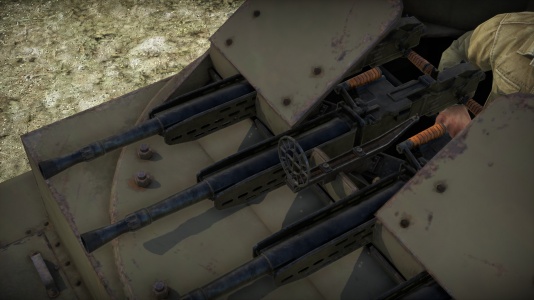
BESA machine guns on the Light AA Mk I

See also
Links to the articles on the War Thunder Wiki that you think will be useful for the reader, for example:
- reference to the article about the variant of the cannon/machine gun;
- references to approximate analogues by other nations and research trees.
External links
| Britain and USA anti-aircraft guns | |
|---|---|
| 7.92 mm | BESA |
| 12.7 mm | M2HB |
| 20 mm | GAI C01 · M168 · Oerlikon Mk.II · Polsten |
| 25 mm | GAU-12U |
| 30 mm | HSS 831L |
| 35 mm | GA-35 |
| 37 mm | M1A2 |
| 40 mm | Bofors L/60 · Dual Automatic Gun M2 · M266 |
| Foreign: | |
| 23 mm | ZU-23 (USSR) |
| 35 mm | Oerlikon KDA (Swiss) |
| Tank machine guns | |
|---|---|
| USA | |
| 7.62 mm | M37 · M60D · M73 · M240 · M1919A4 · Mk.52 |
| 12.7 mm | FN M3P · M2HB · M80 · M85 |
| Germany | |
| 5.56 mm | MG4 |
| 7.62 mm | C6 · MG3A1 |
| 7.92 mm | MG13 Dreyse · MG34 · MG37(t) · MG42 |
| 12.7 mm | S.MG.50 |
| USSR | |
| 7.62 mm | DT · PKMB · PKT · PKTM · RP-46 · SGMT |
| 12.7 mm | DK · DShK · 6P49 · NSVT |
| 14.5 mm | KPVT |
| Britain | |
| 7.62 mm | Browning MG4 · L3A1 · L8A1 · L8A2 · L37A1 · L37A2 · L94A1 |
| 7.7 mm | Vickers |
| 7.92 mm | BESA |
| 12.7 mm | L21A1 |
| Japan | |
| 6.5 mm | Type 91 |
| 7.62 mm | Type 74 |
| 7.7 mm | Type 97 |
| 12.7 mm | Type 60 (B) |
| China | |
| 5.8 mm | QJT |
| 7.62 mm | Type 55 · Type 59 · Type 86 |
| 12.7 mm | QJC88A · Type 54 |
| 14.5 mm | QJG02 |
| Italy | |
| 7.62 mm | Beretta MG42/59 · FN MAG 60-40 |
| 8 mm | 34/40M · Breda Mod. 38 |
| 13.2 mm | Breda Model 31 |
| France | |
| 7.5 mm | AAT-52 · MAC 31 |
| 7.62 mm | A-A-F1N |
| 8 mm | Hotchkiss Mle 1914 |
| Sweden | |
| 6.5 mm | ksp m/14-29 |
| 7.62 mm | ksp 39 C · ksp 58 · ksp 94 |
| 8 mm | ksp m/36 · ksp m/39B |
| 12.7 mm | ksp 88 |