F-86F-25
| This page is about the American jet fighter F-86F-25. For other variants, see F-86 (Family). |

Contents
Description
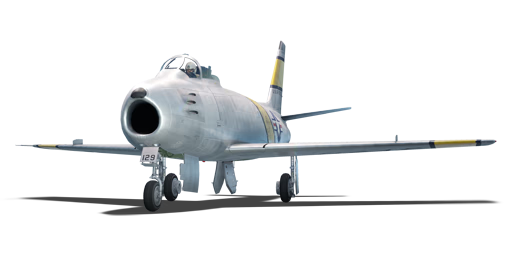
The F-86F-25 Sabre is a rank American jet fighter with a battle rating of (AB), (RB), and (SB). It was introduced in Update 1.35.
General info
Flight performance
| Characteristics | Max Speed (km/h at 0 m - sea level) |
Max altitude (metres) |
Turn time (seconds) |
Rate of climb (metres/second) |
Take-off run (metres) | |||
|---|---|---|---|---|---|---|---|---|
| AB | RB | AB | RB | AB | RB | |||
| Stock | 1,095 | 1,089 | 24.7 | 25.9 | 38.8 | 35.9 | 750 | |
| Upgraded | 1,115 | 1,106 | 23.6 | 24.0 | 56.5 | 46.7 | ||
Details
| Features | |||||
|---|---|---|---|---|---|
| Combat flaps | Take-off flaps | Landing flaps | Air brakes | Arrestor gear | Drogue chute |
| ✓ | ✓ | ✓ | ✓ | X | X |
| Limits | ||||||
|---|---|---|---|---|---|---|
| Wings (km/h) | Gear (km/h) | Flaps (km/h) | Max Static G | |||
| Combat | Take-off | Landing | + | - | ||
| 590 | 550 | 350 | ~11 | ~6 | ||
| Optimal velocities (km/h) | |||
|---|---|---|---|
| Ailerons | Rudder | Elevators | Radiator |
| < 850 | < 600 | < 650 | N/A |
Engine performance
| Engine | Aircraft mass | |||||
|---|---|---|---|---|---|---|
| Engine name | Number | Empty mass | Wing loading (full fuel) | |||
| General Electric J47-GE-27 | 1 | 5,430 kg | 239 kg/m2 | |||
| Engine characteristics | Mass with fuel (no weapons load) | Max Takeoff Weight | ||||
| Weight (each) | Type | 7m fuel | 20m fuel | 26m fuel | ||
| 1,150 kg | Axial-flow turbojet | 5,787 kg | 6,429 kg | 6,726 kg | 9,530 kg | |
| Maximum engine thrust @ 0 m (RB / SB) | Thrust to weight ratio @ 0 m (100%) | |||||
| Condition | 100% | WEP | 7m fuel | 20m fuel | 26m fuel | MTOW |
| Stationary | 2,626 kgf | N/A | 0.45 | 0.41 | 0.39 | 0.28 |
| Optimal | 2,626 kgf (0 km/h) |
N/A | 0.45 | 0.41 | 0.39 | 0.28 |
Survivability and armour
- 6.35 mm steel - in front of cockpit
- 12.7 mm steel - behind pilot
- 38 mm steel - armoured windscreen
- 20 mm steel pilot's headrest
Modifications and economy
Armaments
Offensive armament
The F-86F-25 is armed with:
- 6 x 12.7 mm M3 Browning machine guns, nose-mounted (300 rpg = 1,800 total)
Suspended armament
The F-86F-25 can be outfitted with the following ordnance:
- Without load
- 16 x HVAR rockets
- 2 x 1,000 lb AN-M65A1 Fin M129 bombs (2,000 lb total)
Usage in battles

The F-86 F-25 differs greatly from its A-5 predecessor as it no longer has leading edge slats on the wings which increase low speed manoeuvrability. This was removed from the F model Sabres as North American Aviation (the maker of the Sabre) saw that low speed dogfights were a rare occasion (although a slatted wing made a comeback in the -40 block). A more powerful engine was also installed inside the F-86 giving it a better rate of climb, acceleration and top speed. In the F model the biggest difference between was the addition of the "all flying tail" which allowed for high speed manoeuvring. Where the Sabre excels is in high-speed manoeuvring. Its main opponent—the MiG-15bis—doesn't have an 'all flying tail,' so its control surfaces lock up at speeds exceeding 500 mph (800 kph). Inexperienced pilots new to the aircraft must be careful of the Sabre's manoeuvrability, as it's quite easy to pull too many Gs and tear off the wings. Once the new engine is installed, the Sabre gets a much-improved rate of climb. Although not quite capable of out-climbing the MiG-15bis, the Sabre can handily out-climb (and out-dive) the MiG-15.
Radars
The F-86F-25 is equipped with an AN/APG-30 rangefinding radar, located in the nose of the aircraft. It will automatically detect other planes within the scanning area and display the range to the closest target. It is linked with a gyro gunsight and can help with aiming at close range.
| AN/APG-30 - Rangefinding radar | |||
|---|---|---|---|
| Maximum Detection Range |
Guaranteed Detection Range |
Max Azimuth Scan Angle |
Max Elevation Scan Angle |
| 2,750 m | 300 m | ±9° | ±9° |
Pros and cons
Pros:
- High roll rate
- Good performance below 8 km altitude
- Nose mounted weaponry
- Good zooming ability
- Very good diving acceleration
- Very effective aerodynamic brake
- Very good manoeuvrability at high speeds and in horizontal
Cons:
- Moderate acceleration
- Poor climb rate in a sustained climb
- Poor manoeuvrability at low speeds and in vertical
History
The F-86 is considered one of the best fighter jets of the Korean War. It is the most-produced Western fighter, with almost 10,000 aircraft produced by the US, Australia, Canada (as the re-engined CL-13), Italy, and Japan.
The F-86 was developed by North American Aviation, the creator of the venerable P-51 Mustang. The XP-86 prototype was created to meet the USAF requirement for a high-altitude escort fighter. It was derived from the Navy's FJ-1 Fury, a transitional fighter jet that borrowed the wings, tail surfaces and canopy from the P-51D. The XP-86 was under threat of cancellation because the XP-80 and XP-84 had similar performance characteristics and were farther ahead in development. However, North American designers made a radical change to the design and replaced the straight wing with a swept wing, which was shown by seized German research to greatly reduce drag and increase performance at high speed. The resulting performance boost was so significant that the swept-wing prototype of the XP-86 was supposedly able break the sound barrier in a dive a few days before Chuck Yeager made his official attempt.
The F-86F is a further development of the F-86E, which introduced a full power-operated control system and the all-flying tail, in which the entire horizontal stabilizer moves to significantly increase the aircraft's maneuverability at high speed. The F-86F is fitted with the uprated J47-GE-27 engine. The leading edge slats featured on earlier Sabre models were removed in later production versions of the F-86F in favor of more space for fuel. Some of the earlier F-86F models had the static leading edge slats retrofitted. It also carried over the capability to carry tactical nuclear weapons from the F-86E.
Media
Excellent additions to the article would be video guides, screenshots from the game, and photos.
See also
- Related development
- Canadair Sabre (those Sabres manufactured with the designator "CL")
- North American F-86D Sabre
- North American F-100 Super Sabre
- North American FJ-4 Fury
- Aircraft of comparable role, configuration and era
- Dassault Super Mystère
- Grumman F-9 Cougar
- Hawker Hunter
- Lavochkin La-15
- Mikoyan-Gurevich MiG-15
- Mikoyan-Gurevich MiG-17
- Saab J29 Tunnan
External links
| North American Aviation | |
|---|---|
| Fighters | |
| P-51A | P-51 · P-51A |
| P-51C | P-51C-10 |
| P-51D | P-51D-5 · P-51D-10 · P-51D-20-NA · P-51D-30 |
| P-51H | P-51H-5-NA |
| Twin-engine fighters | F-82E |
| Jet fighters | F-86A-5 · F-86F-2 · F-86F-25 · F-86F-35 · F-100D |
| Strike aircraft | A-36 · PBJ-1H · PBJ-1J |
| FJ-4B · FJ-4B VMF-232 | |
| Bombers | B-25J-1 · B-25J-20 |
| Export/Licence | ▂B-25J-30 · ␗B-25J-30 |
| ▄Mustang Mk IA · F-6C-10-NA · ␗P-51C-11-NT · ␗P-51D-20 · J26 David · J26 · P-51D-20-NA · ␗P-51K | |
| F-86F-30 ▅ · ␗F-86F-30 · F-86F-40 ▅ · F-86F-40 JASDF▅ · ␗F-86F-40 | |
| ◄F-86K · ▄F-86K (Italy) · ▄F-86K (France) | |
| ␗F-100A · ▄F-100D · ␗F-100F | |
| Captured | ▅P-51C-11-NT |
| Canadair Limited license-built the F-86 as the CL-13 for use in Canada and export to Europe. | |
| Fiat license-built the F-86K for the Italian Air Force though another 120 NAA built F-86Ks were also sold to the Italians. | |
| See Also | Mitsubishi Heavy Industries · Canadair Limited · Fiat Aviation |
| USA jet aircraft | |
|---|---|
| Fighters | |
| F9F | F9F-2 · F9F-5 · F9F-8 |
| F-80 | F-80A-5 · F-80C-10 |
| F-84 | F-84B-26 · F-84F · F-84G-21-RE |
| F-86 | F-86A-5 · F-86F-25 · F-86F-2 · F-86F-35 |
| F-89 | F-89B · F-89D |
| F-100 | F-100D |
| F-104 | F-104A · F-104C |
| F-4 | F-4C Phantom II · F-4E Phantom II · F-4J Phantom II · F-4S Phantom II |
| F-5 | F-5A · F-5C · F-5E · F-20A |
| F-8 | F8U-2 · F-8E |
| F-14 | F-14A Early · ▄F-14A IRIAF · F-14B |
| F-15 | F-15A · F-15C MSIP II · F-15E |
| F-16 | F-16A · F-16A ADF · F-16C |
| Other | P-59A · F2H-2 · F3D-1 · F3H-2 · F4D-1 · F11F-1 |
| Strike Aircraft | |
| FJ-4 | FJ-4B · FJ-4B VMF-232 |
| A-4 | A-4B · A-4E Early |
| A-7 | A-7D · A-7E · A-7K |
| AV-8 | AV-8A · AV-8C · AV-8B Plus · AV-8B (NA) |
| A-10 | A-10A · A-10A Late · A-10C |
| F-111 | F-111A · F-111F |
| Other | A-6E TRAM · F-105D · F-117 |
| Bombers | |
| B-57 | B-57A · B-57B |