Akebono

Contents
Description
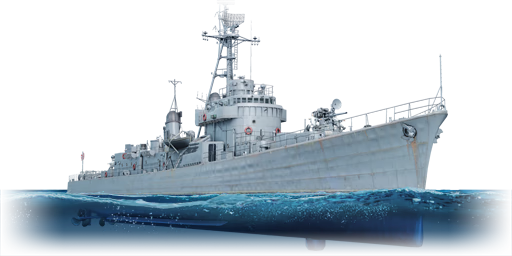
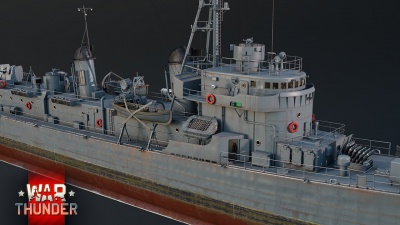
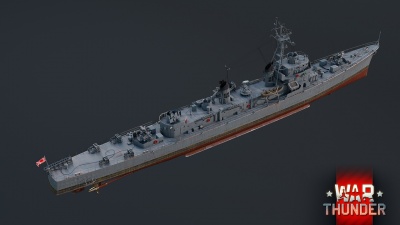
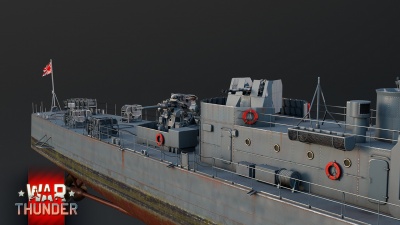
The Akebono-class, Akebono (DE-201) is a premium rank Japanese gunboat
with a battle rating of (AB), (RB), and (SB). It was introduced in Update "Raining Fire".
General info
Survivability and armour
Talk about the vehicle's armour. Note the most well-defended and most vulnerable zones, e.g. the ammo magazine. Evaluate the composition of components and assemblies responsible for movement and manoeuvrability. Evaluate the survivability of the primary and secondary armaments separately. Don't forget to mention the size of the crew, which plays an important role in fleet mechanics. Save tips on preserving survivability for the "Usage in battles" section. If necessary, use a graphical template to show the most well-protected or most vulnerable points in the armour.
Mobility
Write about the ship's mobility. Evaluate its power and manoeuvrability, rudder rerouting speed, stopping speed at full tilt, with its maximum forward and reverse speed.
| Mobility Characteristics | |||
|---|---|---|---|
| Game Mode | Upgrade Status | Maximum Speed (km/h) | |
| Forward | Reverse | ||
| AB | |||
| Upgraded | |||
| RB/SB | |||
| Upgraded | |||
Modifications and economy
Armament
Primary armament
Provide information about the characteristics of the primary armament. Evaluate their efficacy in battle based on their reload speed, ballistics and the capacity of their shells. Add a link to the main article about the weapon: {{main|Weapon name (calibre)}}. Broadly describe the ammunition available for the primary armament, and provide recommendations on how to use it and which ammunition to choose.
Secondary armament
Some ships are fitted with weapons of various calibres. Secondary armaments are defined as weapons chosen with the control Select secondary weapon. Evaluate the secondary armaments and give advice on how to use them. Describe the ammunition available for the secondary armament. Provide recommendations on how to use them and which ammunition to choose. Remember that any anti-air armament, even heavy calibre weapons, belong in the next section. If there is no secondary armament, remove this section.
Special armament
Depth charges, mines, rocket launchers and missiles are also effective in skilled hands and can take an off-guard opponent by surprise. Evaluate the ammunition of this type of armament and rate its performance in combat. If there are no special armaments, remove this section.
Additional armament
Describe the available additional armaments of the ship: depth charges, mines, torpedoes. Talk about their positions, available ammunition and launch features such as dead zones of torpedoes.
If there is no additional armament, remove this section.
Usage in battles
Describe the technique of using this ship, the characteristics of her use in a team and tips on strategy. Abstain from writing an entire guide – don't try to provide a single point of view, but give the reader food for thought. Talk about the most dangerous opponents for this vehicle and provide recommendations on fighting them. If necessary, note the specifics of playing with this vehicle in various modes (AB, RB, SB).
Modules
| Tier | Seakeeping | Unsinkability | Firepower | |||
|---|---|---|---|---|---|---|
| I | Dry-Docking | Tool Set | 76 mm APHE | 40 mm HE clips | ||
| II | Rudder Replacement | Fire Protection System | Smokescreen | 76 mm HE-VT | 40 mm AP clips | Auxiliary Armament Targeting |
| III | Propeller Replacement | Shrapnel Protection | Ventilation | Improved Rangefinder | Depth Charges | Primary Armament Targeting |
| IV | Engine Maintenance | New Pumps | Ammo Wetting | Bomb mortar | ||
| This is a premium vehicle: all modifications are unlocked on purchase | ||||||
Pros and cons
Summarise and briefly evaluate the vehicle in terms of its characteristics and combat effectiveness. Mark its pros and cons in the bulleted list. Try not to use more than 6 points for each of the characteristics. Avoid using categorical definitions such as "bad", "good" and the like - use substitutions with softer forms such as "inadequate" and "effective".
Pros:
Cons:
History
Devblog
Following the end of WWII, Japan was prohibited from having its own military. However, with the advent of the Cold War in the years following the end of WWII, Japan was once again permitted to raise a small force for self-defense purposes. As a result, the Japanese Maritime Self-Defense Force (JMSDF) was formed in 1954.
However, the newly formed Navy needed new ships to be able to conduct its tasks effectively and to gain experience for the construction of subsequent ships in the future. As a result, already in 1953 plans were being laid down for the construction of three new destroyer escorts, with two seperate designs differing primarily in the propulsion system used. Akebono, as the single ship of the batch to use traditional steam propulsion, was laid down in December 1954 and was commissioned in March 1956, becoming among the first domestically produced Japanese military vessels to enter service after WWII.
Akebono served for 20 years with the JMSDF before being decommissioned in 1976. In 1981, the ship was taken apart from scrap and officially stricken from the naval register in 1986.
Media
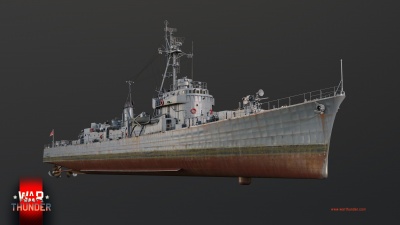
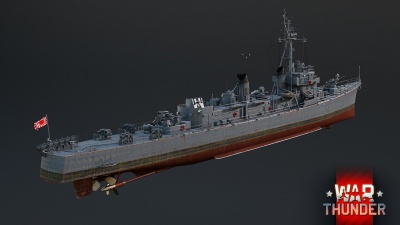
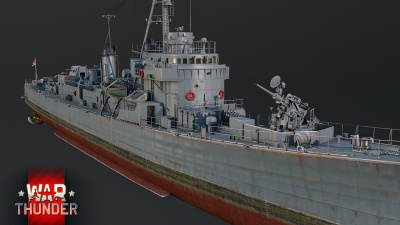
- Akebono Devblog Images


See also
Links to articles on the War Thunder Wiki that you think will be useful for the reader, for example:
- reference to the series of the ship;
- links to approximate analogues of other nations and research trees.
External links
| Japan boats | |
|---|---|
| Motor torpedo boats | Type T-1 · Type T-14 · Type T-14 (mod. 1) · Type T-38 · Type T-51a · Type T-51b |
| PT-802 · PT-808 · PT-15 | |
| Motor gun boats | Ha-Go (mod. 1) · Type 4 (mod. 2) · Type 4 (Mod 4) |
| Asagao (YTE-01) · PG 02 | |
| Armoured gun boats | Soukou-Tei · Soukou-Tei No.4 |
| Gunboats | Chidori |
| Japan premium ships | |
|---|---|
| Motor torpedo boats | Type T-14 (mod. 1) · Type T-51a |
| Motor gun boats | Type 4 (Mod 4) · PG 02 |
| Sub-chasers | Type K-8 No.13 |
| Frigates | Akebono |
| Destroyers | IJN Satsuki · IJN Nenohi · IJN Hayanami · IJN Kiyoshimo · IJN Yuudachi · JDS Yūgure (DD-184) |
| Light cruisers | IJN Yubari · IJN Mikuma |
| Heavy cruisers | IJN Myoko |
| Battleships | IJN Yamashiro |