LCS(L)(3)
| This page is about the American motor gun boat LCS(L)(3). For other versions, see Landing Craft Support (Family). |
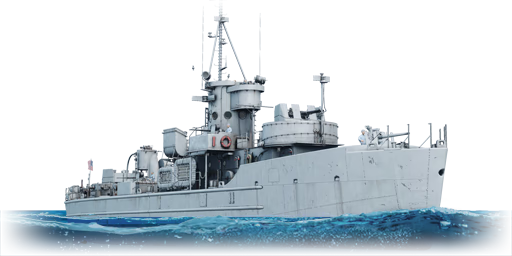
(3).jpg)
Contents
Description
The Landing Craft Support (Large) (Mark 3) (or "LCS(L)(3)" for short) is a class of 130 amphibious warfare vessel built for the US Navy in 1944. Being based on a hull of the Landing Craft Infantry (LCI) ships, the LCS(L)(3) is designed to quickly fill the gap of a fire support vessel to cover various landing operations across the Pacific theatre, with each ship can be built from ground up in as little as 10 days. The LCS(L)(3) were deployed in various island-hopping campaigns during the closing stages of the Pacific war, and would later be transferred to various allies of the United States after the war, such as Italy and Japan.
Introduced in Update 1.79 "Project X" as part of the fleet closed beta test. The LCS(L)(3) is a rather polarizing coastal vessel. Initially being one of, if not, the most powerful coastal vessel in the entire game during its introduction. It is now a shadow of its former self due to the introduction of detailed damage model and bluewater vessels. Compared to other coastal vessel with "simple" damage model, the LCS is quite a tough nut to crack, especially if the enemy does not have any autocannons at their disposal. However, the LCS' survivability is a far cry from any vessel with "detailed" damage model, such as its "predecessor" the USS Candid, as it is incapable of taking hits from any autocannons, let alone destroyer-calibre guns. The craft's large size and slow speed also means that it is nearly impossible to avoid any incoming fire. However, given the right time and circumstance, the LCS can still perform well against lesser coastal vessel, with a good assortments of Bofors and Oerlikon autocannons to deal with various torpedo boats.
General info
Survivability and armour
Although the LCS has a sizable crew count of 73, it is still a fragile boat due to it only having "simple" damage model with four sections of the hull being assigned as a crew module. This means should one of these section being damaged, the LCS will lose a significant amount of crews in the process.
The only "redeeming" quality of the LCS is that it is a steel-hulled boat with 8 mm of hull thickness. This allows it to take some hits from machine guns with minimal damage, though any guns larger than 20 mm will have no trouble shredding its hull into pieces.
Mobility
The LCS' mobility is simply awful. With a top speed of just 39 (AB)/29 (RB) and sluggish turn rate, you won't be able to avoid any incoming fire. This means torpedoes and bombs are a huge threat to your survival.
| Mobility Characteristics | |||
|---|---|---|---|
| Game Mode | Upgrade Status | Maximum Speed (km/h) | |
| Forward | Reverse | ||
| AB | |||
| Upgraded | |||
| RB/SB | |||
| Upgraded | |||
Modifications and economy
Armament
Primary armament
The LCS(L)(3) gets access to four 40 mm Bofors guns in two twin mounts. These weapons are extremely potent anti-aircraft and anti-coastal-ship guns due to their accuracy and punching power. Though these weapons fire slower than the 20 mm Oerlikon or 12.7 mm AN/M2, they more than make up for it due to their hard-hitting 40 mm shells. These guns are capable of shredding aircraft and small boats from ranges of 2.5 km away, though effectiveness will drop off after that range due to the large bullet drop. The guns fire from 4-round clips that reload continuously, meaning that they are capable of continuous fire. However, note that they will eventually jam after firing too long.
- Universal: AP-T · HEFI-T
- 40 mm HE clips: HEFI-T · HEFI-T · HEFI-T · AP-T
- 40 mm AP clips: AP-T · AP-T · AP-T · HEFI-T
| Penetration statistics | |||||||
|---|---|---|---|---|---|---|---|
| Ammunition | Penetration @ 0° Angle of Attack (mm) | ||||||
| 10 m | 100 m | 500 m | 1,000 m | 1,500 m | 2,000 m | ||
| HEFI-T | 3 | 3 | 3 | 3 | 3 | 3 | |
| AP-T | 81 | 78 | 68 | 58 | 49 | 41 | |
| Shell details | ||||||||||||
|---|---|---|---|---|---|---|---|---|---|---|---|---|
| Ammunition | Velocity (m/s) |
Projectile mass (kg) |
Fuse delay (m) |
Fuse sensitivity (mm) |
Explosive mass (TNT equivalent) (g) |
Ricochet | ||||||
| 0% | 50% | 100% | ||||||||||
| HEFI-T | 874 | 0.9 | 0 | 0.1 | 67.13 | 79° | 80° | 81° | ||||
| AP-T | 874 | 0.89 | - | - | - | 47° | 60° | 65° | ||||
Secondary armament
The LCS(L)(3) has access to a single 76 mm Mk 10 gun as its secondary armament. The Mk 10 gun is a decent secondary armament, being capable of crippling or outright destroying many coastal ships with a single hit. However, this gun is a early version and lacks the full automatic fire of later American 76 mm cannons. The gun gets access to three shells - HE, AP and HE-VT. Of these shells, the HE shell is almost always the best choice, packing the largest punch against enemy boats. Despite this, it is wise to bring a bit of the other shells, for use against aircraft and armoured vessels.
| Penetration statistics | |||||||
|---|---|---|---|---|---|---|---|
| Ammunition | Type of warhead |
Penetration @ 0° Angle of Attack (mm) | |||||
| 100 m | 1,000 m | 2,000 m | 3,000 m | 4,000 m | 5,000 m | ||
| HC Mk.27 | HE | 8 | 8 | 8 | 8 | 8 | 8 |
| AP Mk.29 | APCBC | 111 | 90 | 71 | 56 | 44 | 36 |
| AA Mk.31 | HE-VT | 7 | 7 | 7 | 7 | 7 | 7 |
| Shell details | ||||||||||||
|---|---|---|---|---|---|---|---|---|---|---|---|---|
| Ammunition | Type of warhead |
Velocity (m/s) |
Projectile mass (kg) |
Fuse delay (s) |
Fuse sensitivity (mm) |
Explosive mass (TNT equivalent) (g) |
Ricochet | |||||
| 0% | 50% | 100% | ||||||||||
| HC Mk.27 | HE | 823 | 5.9 | 0 | 0.1 | 500 | 79° | 80° | 81° | |||
| AP Mk.29 | APCBC | 823 | 5.9 | 0.01 | 4 | 133.28 | 48° | 63° | 71° | |||
| Proximity-fused shell details | ||||||||||||
|---|---|---|---|---|---|---|---|---|---|---|---|---|
| Ammunition | Type of warhead |
Velocity (m/s) |
Projectile mass (kg) |
Fuse delay (m) |
Fuse sensitivity (mm) |
Arming distance (m) |
Trigger radius (m) |
Explosive mass (TNT equivalent) (g) |
Ricochet | |||
| 0% | 50% | 100% | ||||||||||
| AA Mk.31 | HE-VT | 823 | 5.85 | 0 | 0.1 | 548 | 15 | 352.8 | 79° | 80° | 81° | |
Anti-aircraft armament
The LCS(L)(3) has access to four dual 20 mm Oerlikon cannons. The 20 mm Oerlikon Cannon was the standard light anti-aircraft gun for several nations, including the United States, and replaced the prior AN/M2 Browning machine gun. This weapon is an effective short-range AA gun, and has great firing angles. The guns fire from a drum magazine that will need to be reloaded. Because of the magazine design, the gun will not jam with continuous fire.
Usage in battles
Describe the technique of using this ship, the characteristics of her use in a team and tips on strategy. Abstain from writing an entire guide – don't try to provide a single point of view, but give the reader food for thought. Talk about the most dangerous opponents for this vehicle and provide recommendations on fighting them. If necessary, note the specifics of playing with this vehicle in various modes (AB, RB, SB).
Pros and cons
Pros:
- Two twin mounted 40 mm guns can decimate small vessels and torpedo boats
- Secondary 76 mm gun has VT-fuse shell. If you use it correctly, you could counter enemy bombers trying to drop torpedoes
- Decent crew count, able to resist small vessels
Cons:
- Insufficient firepower to deal with any vessel with detailed damage model
- Only having simple damage model despite its BR; extremely vulnerable to large calibre cannons or any autocannons
- Awfully slow and sluggish, torpedo and bomber is a large threat
- Will be frequently matched against early destroyer or frigates that can easily destroy you in a few hits
History
During World War II, the American military took a big gamble on landing naval infantry and armour – the Americans used the strategy of quickly capturing coastline using landing ships in all three theaters of war. The landing ships and boats themselves had light armaments and could not fully cover their marines during landings, so the question arose about the creation of a small manoeuvrable gunboat with enough firepower to support naval landings against enemy infantry, lightly armoured fortifications and fire positions. The LCI (Landing Craft Infantry) designs were used as a basis, with the addition of a 76 mm gun with an armour screen, two twin 40 mm cannons and four twin 20 mm machine guns. The powertrain remained the same as on the LCI – two sets of four engines with 225 hp each, with a total power output of 1800 hp. The artillery ship's maximum speed was 16 knots. The gunboat was designated LCS (L) – Landing Craft Support (Large). It took just 10 days to prepare such a ship from the landing platform. It could escort its landing party and support it with fire along the coast, and work as an anti-aircraft vessel or provide a smokescreen for the actions of larger ships. The LCS gunboat's baptism of fire was in the battle for Okinawa. It was later used in operations on the Pacific Ocean. After the end of World War II, the US used these ships in the Korean War and Vietnam, and provided them to allies.
- From Devblog
Media
- Skins
See also
External links
| Albina Engine and Machine Works Inc. | |
|---|---|
| Landing Craft | |
| LCS(L)(3) | LCS(L)(3)* |
| * Undefined hull number | |
| USA boats | |
|---|---|
| Motor torpedo boats | PT-3 · PT-6 · PT-20 · PT-71 · PT-103 · PT-109 · PT-174 |
| PT-200 · PT-314 · Thunderbolt (PT-556) · PT-565 · PT-658 · PT-810 · PT-811 · PT-812 | |
| Motor gun boats | Kim Qui · LCS(L)(3) · PT-59 · PTF-7 · USS Candid · USS Asheville · USS Douglas · USS Flagstaff · USS Tucumcari · USS Cyclone |
| Armoured gun boats | LCM(6) Zippo |