LCS(L)(3)
| This page is about the American motor gun boat LCS(L)(3). For other versions, see Landing Craft Support (Family). |
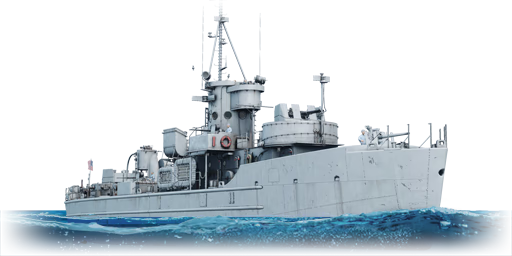
(3).jpg)
Contents
Description
The Landing Craft Support (Large) (Mark 3) is a rank American motor gun boat with a battle rating of (AB), (RB), and (SB). It was introduced in Update 1.79 "Project X" as part of the fleet closed beta test.
General info
Survivability and armour
Talk about the vehicle's armour. Note the most well-defended and most vulnerable zones, e.g. the ammo magazine. Evaluate the composition of components and assemblies responsible for movement and manoeuvrability. Evaluate the survivability of the primary and secondary armaments separately. Don't forget to mention the size of the crew, which plays an important role in fleet mechanics. Save tips on preserving survivability for the "Usage in battles" section. If necessary, use a graphical template to show the most well-protected or most vulnerable points in the armour.
Mobility
Write about the ship's mobility. Evaluate its power and manoeuvrability, rudder rerouting speed, stopping speed at full tilt, with its maximum forward and reverse speed.
| Mobility Characteristics | |||
|---|---|---|---|
| Game Mode | Upgrade Status | Maximum Speed (km/h) | |
| Forward | Reverse | ||
| AB | |||
| Upgraded | |||
| RB/SB | |||
| Upgraded | |||
Modifications and economy
Armament
Primary armament
The LCS(L)(3) gets access to four 40 mm Bofors guns in two twin mounts. These weapons are extremely potent anti-aircraft and anti-coastal-ship guns due to their accuracy and punching power. Though these weapons fire slower than the 20 mm Oerlikon or 12.7 mm AN/M2, they more than make up for it due to their hard-hitting 40 mm shells. These guns are capable of shredding aircraft and small boats from ranges of 2.5 km away, though effectiveness will drop off after that range due to the large bullet drop. The guns fire from 4-round clips that reload continuously, meaning that they are capable of continuous fire. However, note that they will eventually jam after firing too long.
- Universal: AP-T · HEFI-T
- 40 mm HE clips: HEFI-T · HEFI-T · HEFI-T · AP-T
- 40 mm AP clips: AP-T · AP-T · AP-T · HEFI-T
| Penetration statistics | |||||||
|---|---|---|---|---|---|---|---|
| Ammunition | Penetration @ 0° Angle of Attack (mm) | ||||||
| 10 m | 100 m | 500 m | 1,000 m | 1,500 m | 2,000 m | ||
| HEFI-T | 3 | 3 | 3 | 3 | 3 | 3 | |
| AP-T | 81 | 78 | 68 | 58 | 49 | 41 | |
| Shell details | ||||||||||||
|---|---|---|---|---|---|---|---|---|---|---|---|---|
| Ammunition | Velocity (m/s) |
Projectile mass (kg) |
Fuse delay (m) |
Fuse sensitivity (mm) |
Explosive mass (TNT equivalent) (g) |
Ricochet | ||||||
| 0% | 50% | 100% | ||||||||||
| HEFI-T | 874 | 0.9 | 0 | 0.1 | 67.13 | 79° | 80° | 81° | ||||
| AP-T | 874 | 0.89 | - | - | - | 47° | 60° | 65° | ||||
Secondary armament
The LCS(L)(3) has access to a single 76 mm Mk 10 gun as its secondary armament. The Mk 10 gun is a decent secondary armament, being capable of crippling or outright destroying many coastal ships with a single hit. However, this gun is a early version and lacks the full automatic fire of later American 76 mm cannons. The gun gets access to three shells - HE, AP and HE-VT. Of these shells, the HE shell is almost always the best choice, packing the largest punch against enemy boats. Despite this, it is wise to bring a bit of the other shells, for use against aircraft and armoured vessels.
| Penetration statistics | |||||||
|---|---|---|---|---|---|---|---|
| Ammunition | Type of warhead |
Penetration @ 0° Angle of Attack (mm) | |||||
| 100 m | 1,000 m | 2,000 m | 3,000 m | 4,000 m | 5,000 m | ||
| HC Mk.27 | HE | 8 | 8 | 8 | 8 | 8 | 8 |
| AP Mk.29 | APCBC | 111 | 90 | 71 | 56 | 44 | 36 |
| AA Mk.31 | HE-VT | 7 | 7 | 7 | 7 | 7 | 7 |
| Shell details | ||||||||||||
|---|---|---|---|---|---|---|---|---|---|---|---|---|
| Ammunition | Type of warhead |
Velocity (m/s) |
Projectile mass (kg) |
Fuse delay (s) |
Fuse sensitivity (mm) |
Explosive mass (TNT equivalent) (g) |
Ricochet | |||||
| 0% | 50% | 100% | ||||||||||
| HC Mk.27 | HE | 823 | 5.9 | 0 | 0.1 | 500 | 79° | 80° | 81° | |||
| AP Mk.29 | APCBC | 823 | 5.9 | 0.01 | 4 | 133.28 | 48° | 63° | 71° | |||
| Proximity-fused shell details | ||||||||||||
|---|---|---|---|---|---|---|---|---|---|---|---|---|
| Ammunition | Type of warhead |
Velocity (m/s) |
Projectile mass (kg) |
Fuse delay (m) |
Fuse sensitivity (mm) |
Arming distance (m) |
Trigger radius (m) |
Explosive mass (TNT equivalent) (g) |
Ricochet | |||
| 0% | 50% | 100% | ||||||||||
| AA Mk.31 | HE-VT | 823 | 5.85 | 0 | 0.1 | 548 | 15 | 352.8 | 79° | 80° | 81° | |
Anti-aircraft armament
The LCS(L)(3) has access to four dual 20 mm Oerlikon cannons. The 20 mm Oerlikon Cannon was the standard light anti-aircraft gun for several nations, including the United States, and replaced the prior AN/M2 Browning machine gun. This weapon is an effective short-range AA gun, and has great firing angles. The guns fire from a drum magazine that will need to be reloaded. Because of the magazine design, the gun will not jam with continuous fire.
Usage in battles
Describe the technique of using this ship, the characteristics of her use in a team and tips on strategy. Abstain from writing an entire guide – don't try to provide a single point of view, but give the reader food for thought. Talk about the most dangerous opponents for this vehicle and provide recommendations on fighting them. If necessary, note the specifics of playing with this vehicle in various modes (AB, RB, SB).
Pros and cons
Pros:
- Two twin mounted 40 mm guns can decimate small vessels and torpedo boats
- Secondary 76 mm gun has VT-fuse shell. If you use it correctly, you could counter enemy bombers trying to drop torpedoes
- Decent crew count, able to resist small vessels
- Does not hull break
Cons:
- Rather sluggish, the slowest boat in its rank, on par with SF40, torpedo and bomber is a large threat
- Wooden structure, very vulnerable to fire, the crew get knocked out quickly if you are on fire
History
During World War II, the American military took a big gamble on landing naval infantry and armour – the Americans used the strategy of quickly capturing coastline using landing ships in all three theaters of war. The landing ships and boats themselves had light armaments and could not fully cover their marines during landings, so the question arose about the creation of a small manoeuvrable gunboat with enough firepower to support naval landings against enemy infantry, lightly armoured fortifications and fire positions. The LCI (Landing Craft Infantry) designs were used as a basis, with the addition of a 76 mm gun with an armour screen, two twin 40 mm cannons and four twin 20 mm machine guns. The powertrain remained the same as on the LCI – two sets of four engines with 225 hp each, with a total power output of 1800 hp. The artillery ship's maximum speed was 16 knots. The gunboat was designated LCS (L) – Landing Craft Support (Large). It took just 10 days to prepare such a ship from the landing platform. It could escort its landing party and support it with fire along the coast, and work as an anti-aircraft vessel or provide a smokescreen for the actions of larger ships. The LCS gunboat's baptism of fire was in the battle for Okinawa. It was later used in operations on the Pacific Ocean. After the end of World War II, the US used these ships in the Korean War and Vietnam, and provided them to allies.
- From Devblog
Media
- Skins
See also
Links to articles on the War Thunder Wiki that you think will be useful for the reader, for example:
- reference to the series of the ship;
- links to approximate analogues of other nations and research trees.
External links
| Albina Engine and Machine Works Inc. | |
|---|---|
| Landing Craft | |
| LCS(L)(3) | LCS(L)(3)* |
| * Undefined hull number | |
| USA boats | |
|---|---|
| Motor torpedo boats | PT-3 · PT-6 · PT-20 · PT-71 · PT-103 · PT-109 · PT-174 |
| PT-200 · PT-314 · Thunderbolt (PT-556) · PT-565 · PT-658 · PT-810 · PT-811 · PT-812 | |
| Motor gun boats | Kim Qui · LCS(L)(3) · PT-59 · PTF-7 · USS Candid · USS Asheville · USS Douglas · USS Flagstaff · USS Tucumcari · USS Cyclone |
| Armoured gun boats | LCM(6) Zippo |