Ratel 90
| This page is about the British light tank Ratel 90. For other versions, see Ratel (Family). |


Contents
Description
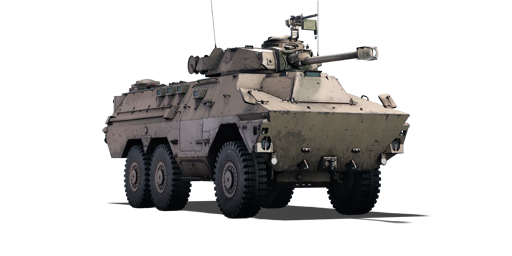
The Ratel 90 is a rank British light tank with a battle rating of (AB), (RB), and (SB). It was introduced in Update "Ixwa Strike".
The Ratel 90 is an IFV designed to provide fire support for the Mechanized South African Battalions in combat. It was modified to this duty with the identical turret found on the Eland 90 Mk.7.
With a needed playstyle keen to recon and opportunistic target eliminations by flanking, the Ratel 90 is currently the fastest vehicle available for the British tree at the rank.
Unfortunately, the vehicle is fast not because of a good engine, but instead because of the cutback of any armour. Players accustomed to holding off some shells in similar ranked vehicles as the Tortoise will have troubles surviving in this IFV. So instead it shall be played similarly to the Charioteer, now with more cooperative abilities as the scouting.
General info
Survivability and armour
Armour type:
- Rolled homogeneous armour (hull, turret, cupola)
- Cast homogeneous armour (gun mantlet)
- Wheel (tires, suspension rods)
- Bulletproof glass (driver windows)
| Armour | Front (Slope angle) | Sides | Rear | Roof |
|---|---|---|---|---|
| Hull | 15 mm (30°) Front plate 10 mm (75°) Upper Glacis 20 mm (30°) Lower plate |
8 mm (26°) Top 10 mm (2-27°) Bottom |
10 mm (0-43°) | 6 mm |
| Turret | 12 mm (30°) Turret front 12 mm (8°) Gun mantlet |
10 mm (17-21°) | 10 mm (16°) | 10 mm (16°) Front part 10 mm Rear part 8 mm Gunner hatch |
| Cupola | 8-10 mm (spherical) | 8 mm (46-85°) Hatch | ||
Notes:
- Wheels and suspension are 10 mm thick.
- Belly is 8 mm thick.
Mobility
| Game Mode | Max Speed (km/h) | Weight (tons) | Engine power (horsepower) | Power-to-weight ratio (hp/ton) | |||
|---|---|---|---|---|---|---|---|
| Forward | Reverse | Stock | Upgraded | Stock | Upgraded | ||
| Arcade | Expression error: Unexpected * operator. | 437 | Expression error: Unexpected round operator. | __.__ | |||
| Realistic | 249 | Expression error: Unexpected round operator. | __.__ | ||||
Modifications and economy
Armaments
Main armament
The Ratel 90 uses the GT-2, a licensed copy of the French 90 mm DEFA F1 low pressure cannon. The Ratel 90 comes with a stock OCC 60-62 HEATFS ammunition, capable of penetrating most tanks at its BR at any distance. Since the OCC 60-62 is a HEATFS shell, most of the damage will be spalling, meaning that the commander must know the opposing vehicle's crew layout and take out the most critical parts and crew members.
| 90 mm GT-2 | Turret rotation speed (°/s) | Reloading rate (seconds) | |||||||||||
|---|---|---|---|---|---|---|---|---|---|---|---|---|---|
| Mode | Capacity | Vertical | Horizontal | Stabilizer | Stock | Upgraded | Full | Expert | Aced | Stock | Full | Expert | Aced |
| Arcade | 53 | -8°/+15° | ±180° | N/A | 22.7 | 31.4 | 38.1 | 42.1 | 44.8 | 8.71 | 7.70 | 7.10 | 6.70 |
| Realistic | 14.2 | 16.7 | 20.2 | 22.4 | 23.8 | ||||||||
Ammunition
| Penetration statistics | |||||||
|---|---|---|---|---|---|---|---|
| Ammunition | Type of warhead |
Penetration @ 0° Angle of Attack (mm) | |||||
| 10 m | 100 m | 500 m | 1,000 m | 1,500 m | 2,000 m | ||
| OCC 60-62 | HEATFS | 350 | 350 | 350 | 350 | 350 | 350 |
| OE 90 F1 | HE | 13 | 13 | 13 | 13 | 13 | 13 |
| Shell details | ||||||||||||
|---|---|---|---|---|---|---|---|---|---|---|---|---|
| Ammunition | Type of warhead |
Velocity (m/s) |
Projectile mass (kg) |
Fuse delay (m) |
Fuse sensitivity (mm) |
Explosive mass (TNT equivalent) (g) |
Ricochet | |||||
| 0% | 50% | 100% | ||||||||||
| OCC 60-62 | HEATFS | 800 | 3.65 | 0.05 | 0.1 | 877.7 | 65° | 72° | 77° | |||
| OE 90 F1 | HE | 640 | 5.27 | 0.2 | 0.1 | 945 | 79° | 80° | 81° | |||
| Smoke shell characteristics | ||||||
|---|---|---|---|---|---|---|
| Ammunition | Velocity (m/s) |
Projectile mass (kg) |
Screen radius (m) |
Screen deploy time (s) |
Screen hold time (s) |
Explosive mass (TNT equivalent) (g) |
| OFUM PH90-F2 | 640 | 5.4 | 9 | 5 | 20 | 50 |
Ammo racks

| Full ammo |
1st rack empty |
2nd rack empty |
3rd rack empty |
4th rack empty |
5th rack empty |
6th rack empty |
7th rack empty |
8th rack empty |
Visual discrepancy |
|---|---|---|---|---|---|---|---|---|---|
| 53 | 51 (+2) | 47 (+6) | 41 (+12) | 35 (+18) | 23 (+30) | 11 (+42) | 6 (+47) | 1 (+52) | No |
Notes:
- Shells are modeled individually and disappear after having been shot or loaded.
- Racks 7 and 8 are first stage ammo racks. They total 10 shells and get filled first when loading up the tank.
- These racks are also emptied early: the rack depletion order at full capacity is: 7 - 8 - 1 - 2 etc. until 6.
- Simply not firing when the gun is loaded will move ammo from racks 1 to 6 into racks 8 then 7. Firing will interrupt the restocking of the ready racks.
- Turret empty: 35 (+18) shells
Machine guns
| 7.62 mm Browning MG4 | ||||
|---|---|---|---|---|
| Mount | Capacity (Belt) | Fire rate | Vertical | Horizontal |
| Coaxial | 3,750 (250) | 500 | N/A | N/A |
| Pintle | 2,000 (250) | 500 | -10°/+3° | ±120° |
Usage in battles
The Ratel 90 is a vehicle that should be used primarily in a support or defensive role. In the support role, it is recommended that you stick with your teammates, specifically behind them. Focus on scouting targets for your team. You should stay behind your teammates due to the vehicle's lack of armour, ineffective even against small arms. In the defensive role, you chose a firing spot and cover a certain line of sight with a cover nearby, peaking out only to fire. In both roles, you should make extensive use of your binoculars to scan for and scout targets.
Pros and cons
Pros:
- Great penetration and adequate ballistics; currently the first accessible vehicle in the British ranks with HEAT rounds
- Adequate mobility once fully upgraded (on roads and optimal terrains)
- Scouting, smoke grenades and smoke shells provide great supporting abilities
- Large vehicle size helps with the 90 mm gun recoil
- The large size of the vehicle paired with plenty of empty space gives it extremely high survivability in some scenarios
Cons:
- Gun is not stabilized, the vehicle needs to stop to fire accurately; HEAT requires a very precise firing
- Huge size, hard to conceal and difficult to manoeuvre in close quarters
- Very unreliable armour and only 3 crew members; easily destroyed on all angles even with 12.7 mm MG
- Despite good top-speed, acceleration is not great on rough terrain; low power-to-weight ratio (14 HP/t)
- Wheeled configuration and underpowered engine struggles on deep sand and snow
History

The Ratel 90 was based on the Ratel 20 but with significant changes. The main feature of the Ratel 90 is a Denel DT-2 90 mm low velocity gun in the turret from the Eland 90 armoured car. Additionally, the hull roof was reinforced and the amount of troop hatches on top was reduced from four to two. Space for one of the passengers was removed to provide space for more 90 mm ammunition.
The Ratel 90 was designed to be used in the infantry support role but during the South African Border War they were forced into the anti-tank role. Against the initial T-34-85 tanks used by the FAPLA, the Ratel 90 proved to be a very deadly adversary. But once the FAPLA began receiving newer Soviet and Cuban T-54, T-55, and T-62 tanks, the Ratel 90 was forced to use its high mobility to outmanoeuvre the enemy tanks. Once the Ratel 90 was on the flank, they had to fire multiple 90 mm HEAT rounds into the enemy tanks, often aiming for weak points such as the engine and turret ring.
Operators
- South Africa
- Morrocco
- Ghana
- Rwanda
- Djibouti
- Central African Republic (CAR)
Devblog
.jpg)
In the late 1960s, the South African military began changing its doctrine towards highly mobile warfare, embodied by small mechanized infantry units. The change in doctrine was necessitated when the military realized that heavy armour faced extreme difficulties operating in rural areas of the country. As a result, the army needed a new ICVnot only to ferry troops into battle but also to actively support them in the field. To that extent, a basic requirement for an ICV was formulated and a number of both domestic and well as foreign designs were evaluated.
The domestic Springfield-Büssing company developed a promising six-wheel ICVprototype, called the Buffel, constructed on the basis of a MAN truck. The further developed Buffel prototype was eventually selected for procurement and entered service with the military as the 'Ratel'. Production of the Ratel began in the mid 1970s, after a limited initial batch of production vehicles successfully underwent testing. Being a family of fighting vehicles, the Ratel came in various modifications, including the base model armed with a 20 mm cannon, two mortar versions, a close fire support variant armed with a 90 mm gun, as well as a command and ATGM carrier modifications.
Ratels served in numerous conflicts since their first introduction in the mid 1970s, with nearly all of its active service taking place on the African continent. The Ratel 90 saw its first combat use in 1980 during the South African Border War, where Ratel 90 anti-tank teams came face to face with T-54/55s on multiple occasions. By the end of production in 1993, some 1304 Ratels were produced across all variants. Due to its simplistic design and perfect fit for the dry climate of sub-Saharan Africa, the Ratel proved at home in the Middle East and north-west Africa. As a result, around a dozen more nations, excluding South Africa, still operate the Ratel ICV.
Media
- Skins
- Images


See also
- Related service history
- Similar playstyle
External links
| Sandock-Austral | |
|---|---|
| Ratel | Ratel 90 · Ratel 20 · ZT3A2 |
| Eland | Eland 90 Mk.7 |
| Britain light tanks | |
|---|---|
| A13 | A13 Mk I · A13 Mk I (3rd R.T.R.) · A13 Mk II · A13 Mk II 1939 |
| A15 | Crusader II · Crusader "The Saint" · Crusader III |
| A17 | Tetrarch I |
| IFV | Warrior · Desert Warrior (Kuwait) |
| Wheeled | Daimler Mk II · AEC Mk II · Fox · Vickers Mk.11 |
| Other | VFM5 |
| South Africa | |
| SARC | SARC MkIVa · SARC MkVI (2pdr) · SARC MkVI (6pdr) |
| Ratel | Ratel 90 · Ratel 20 |
| Rooikat | Rooikat Mk.1D · Rooikat 105 · Rooikat MTTD |
| Other | Concept 3 · Eland 90 Mk.7 |
| USA | Stuart I · Stuart III |