STB-2


Contents
Description
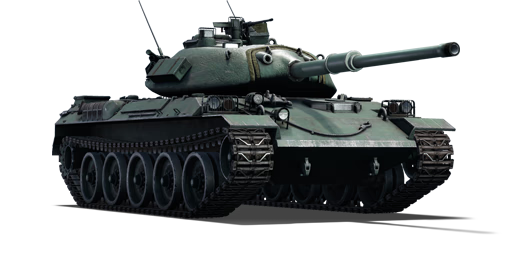
The STB-2 is a rank Japanese medium tank with a battle rating of (AB), (RB), and (SB). It was introduced in Update 1.65 "Way of the Samurai" along with the initial Japanese Ground Forces tree. The prototype of the Type 74, the STB-1 presents many features that would be in the final design.
The STB-1 is the second researchable tank in Japan's Ground Forces Rank V. Despite having considerable more armour than its comparable counterparts the Leopard 1 and AMX-30, as well as comparable mobility, it is not recommended as a front-line tank. Instead, a cautious hit-and-run tactic like the Leopards should always be employed. Using the tank's hydropneumatic suspension correctly can help with the tank's depression, and in some cases, aid in survivability. Do note that the L7 on this tank reloads significantly longer than other L7-equipped tanks.
The STB-1 is unique in being one of the only Japanese tanks that can take a hit, like the Type 4 Chi-To Late and Ho-Ri Production. It has thick frontal hull armour that can bounce shots effectively, but should not be relied on. The tank is quite fast and is further aided by the Hydropneumatic suspension, which allows this tank to manoeuvre the battlefield much like a Leopard, however the abundance of larger, more open maps at higher ranks means that getting from point A to B - and not getting shot - is not a simple as it sounds.
General info
Survivability and armour
| Armour | Front | Sides | Rear | Roof |
|---|---|---|---|---|
| Hull | 40-80 mm (64-73°) Front glacis 100 (26°), 80 mm (58-66°)Lower glacis |
35-40 mm (44°) Top 40 mm (0-55°) Bottom |
25 mm (1-46°) | 20 mm |
| Turret | 132 mm (12-66°) Turret front 100-200 mm (1-66°) Gun mantlet |
132 mm (1-54°) 75 mm (26-61°) Rear |
40 mm (1-64°) 40 mm (36-82°) Turret underside |
67 mm Front 20 mm Rear |
| Armour | Sides | Roof | ||
| Cupola | 30 mm | 30 mm |
Notes:
- Suspension wheels and tracks are 20 mm thick.
- Driver's vision port on the front glacis are only 50 mm thick.
- Hull roof is rated to be 54 mm effective against HE.
Mobility
| Game Mode | Max Speed (km/h) | Weight (tons) | Engine power (horsepower) | Power-to-weight ratio (hp/ton) | |||
|---|---|---|---|---|---|---|---|
| Forward | Reverse | Stock | Upgraded | Stock | Upgraded | ||
| Arcade | Expression error: Unexpected * operator. | 1,162 | Expression error: Unexpected round operator. | __.__ | |||
| Realistic | 663 | Expression error: Unexpected round operator. | __.__ | ||||
Modifications and economy
Armaments
Main armament
| 105 mm L7A3 | Turret rotation speed (°/s) | Reloading rate (seconds) | |||||||||||
|---|---|---|---|---|---|---|---|---|---|---|---|---|---|
| Mode | Capacity | Vertical | Horizontal | Stabilizer | Stock | Upgraded | Full | Expert | Aced | Stock | Full | Expert | Aced |
| Arcade | 50 | -6°/+9° | ±180° | Two-plane | 22.8 | 31.6 | 38.4 | 42.5 | 45.2 | 10.80 | 9.55 | 8.80 | 8.30 |
| Realistic | 14.3 | 16.8 | 20.4 | 22.6 | 24.0 | ||||||||
Ammunition
| Penetration statistics | |||||||
|---|---|---|---|---|---|---|---|
| Ammunition | Type of warhead |
Penetration @ 0° Angle of Attack (mm) | |||||
| 10 m | 100 m | 500 m | 1,000 m | 1,500 m | 2,000 m | ||
| M392A2 | APDS | 303 | 302 | 296 | 277 | 257 | 252 |
| Type 75 | HESH | 127 | 127 | 127 | 127 | 127 | 127 |
| Shell details | |||||||||
|---|---|---|---|---|---|---|---|---|---|
| Ammunition | Type of warhead |
Velocity (m/s) |
Projectile Mass (kg) |
Fuse delay (m) |
Fuse sensitivity (mm) |
Explosive Mass (TNT equivalent) (g) |
Ricochet | ||
| 0% | 50% | 100% | |||||||
| M392A2 | APDS | 1,478 | 4 | N/A | N/A | N/A | 75° | 78° | 80° |
| Type 75 | HESH | 760 | 10.8 | 0.05 | 0.1 | 3,890 | 73° | 77° | 80° |
| Smoke shell characteristics | ||||||
|---|---|---|---|---|---|---|
| Ammunition | Velocity (m/s) |
Projectile Mass (kg) |
Screen radius (m) |
Screen deploy time (s) |
Screen hold time (s) |
Explosive Mass (TNT equivalent) (g) |
| M416 | 730 | 11.4 | 20 | 5 | 25 | 50 |
Ammo racks

| Full ammo |
1st rack empty |
2nd rack empty |
3rd rack empty |
4th rack empty |
Visual discrepancy |
|---|---|---|---|---|---|
| 50 | 44 (+6) | 16 (+34) | 10 (+40) | 1 (+49) | No |
Notes:
- Hull floor empty: 16 (+34) shells
- Shells are modeled individually and disappear after having been shot or loaded.
- Racks 3 and 4 are first stage ammo racks. They total 15 shells and get filled first when loading up the tank.
- These racks are also emptied early: the rack depletion order at full capacity is: 3 - 4 - 1 - 2.
- Simply not firing when the gun is loaded will move ammunition from rack 1 then 2 into ready rack 4 then 3. Firing will interrupt the restocking of the ready racks.
Machine guns
| 12.7 mm M2HB | ||||
|---|---|---|---|---|
| Mount | Capacity (Belt) | Fire rate | Vertical | Horizontal |
| Pintle | 660 (200) | 577 | -10°/+40° | ±180° |
| 7.62 mm M1919A4 | ||||
|---|---|---|---|---|
| Mount | Capacity (Belt) | Fire rate | Vertical | Horizontal |
| Coaxial | 4,500 (250) | 500 | N/A | N/A |
Usage in battles
The STB-1 can be compared to the Leopard I or even a stock Leopard A1A1, but has its own capabilities in its own right. The STB-1 allows for both a more held down playstyle or aggressive playstyle versus the Leopard I due to its hydropneumatic suspension and two-plane stabilizer. Together with the power of the engine outfitted on the STB-1, allows it to speedily move to a nice sniper spot or hull-down position and fire at targets before they realize a tank could be there.
The STB-1 possesses a pretty nice angled upper front plate, but do keep in mind that the STB-1 wasn't designed to take a punch, only to deal a punch, so even with the good angle you shouldn't rely too heavily on it, as shells can penetrate it and won't always bounce off. Do keep this fully in mind especially when taking more shells with the vehicle, as the fuel tank next to the driver will be filled with extra shells, which can blow up the whole tank if a shell does eventually penetrate.
With the addition of a 12.7 mm machine gun, the STB-1 can make short work of ZSU's or light tanks alike if the heat of the battle doesn't allow for the main gun or in-case of more important targets requiring the main gun's firepower.
With only 2 shells to choose from being APDS & HESH, APDS can be used for long-distance engagements and HESH can deal with light to medium armoured vehicles with overpressure damage, this can be done at a long range once the laser rangefinder has been unlocked as well. But due to the low velocity of the HESH round it has to be fired at a stationary target at long range to effectively hit.
Pros and cons
Pros:
- 105 mm L7 cannon found on other NATO tanks
- 12.7 mm Browning M2HB machine gun
- Two-plane stabilizer that allows it to fire on the move
- Highly mobile, comparable to the German Leopard I
- More armour than the German Leopard (around 100 mm hull and turret)
- Armour may bounce APHE shells
- Low profile
- Utilization of hydropneumatic suspension allows for various offensive and defensive options
- Laser rangefinder
Cons:
- Poor gun elevation angle
- Reload and top speed slower than Leopard
- Other areas are lightly armoured, vulnerable to high penetrating SPAA
- Engine can be vulnerable to some aircraft with powerful guns
History
The prototype for the Type 74. Known in Japanese as 74式戦車の試作車STB-1 (ななよんしきせんしゃのしさくしゃSTB-1). Created in September 1969 along with STB-2 in the STT program. Due to issues with cost effectiveness these two prototypes were not considered for the replacement of the Type 61. In a bid to reduce costs STB-3, STB-4, STB-5 and STB-6 were produced between April 1970 to December 1971. The final judgement for the STT program was held in November 1973 which lead the line to be completed in 1974. And, production started the following year in 1975 for the Type 74.
Media
- Skins
- Videos
See also
- Type 74 - (Production version)
- Type 74 (F) - (Variant allowing to equip a mine-roller)
- Type 74 (G) - (Improved (改) variant with thermal and armor skirts)
- Other vehicles of similar configuration and role
External links
| Japan medium tanks | |
|---|---|
| Type 97 | Chi-Ha · Chi-Ha Kai · Chi-Ha Kai TD · Chi-Ha Short Gun |
| Type 1 | Chi-He · Chi-He (5th Regiment) · Ho-I |
| Type 3 | Chi-Nu · Chi-Nu II |
| Type 4 | Chi-To · Chi-To Late |
| Type 5 | Chi-Ri II |
| Type 61 MBT | ST-A1* · ST-A2* · ST-A3* · Type 61 |
| Type 74 MBT | ST-B2* · Type 74 (C) · Type 74 (E) · Type 74 (F) · Type 74 (G) |
| Type 90 MBT | Type 90 · Type 90 (B) · Type 90 (B) "Fuji" |
| Type 10 MBT | TKX (P)* · TKX* · Type 10 |
| Other | Ka-Chi |
| USA | ▅M4A3 (76) W · ▅M47 |
| *Prototype | |