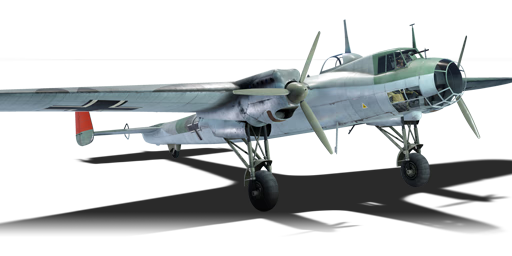
Do 17 E-1
| This page is about the German bomber Do 17 E-1. For other versions, see Do 17 (Family). |


Contents
Description
The Do 17 E-1 is a rank German bomber with a battle rating of (AB), (RB), and (SB). It was introduced in Update 1.51 "Cold Steel".
General info
Flight performance
| Characteristics | Max Speed (km/h at 0 m - sea level) |
Max altitude (metres) |
Turn time (seconds) |
Rate of climb (metres/second) |
Take-off run (metres) | |||
|---|---|---|---|---|---|---|---|---|
| AB | RB | AB | RB | AB | RB | |||
| Stock | 336 | 324 | 35.3 | 38.0 | 0.9 | 0.9 | 350 | |
| Upgraded | 379 | 357 | 31.2 | 33.0 | 9.9 | 4.8 | ||
Details
| Features | ||||
|---|---|---|---|---|
| Combat flaps | Take-off flaps | Landing flaps | Air brakes | Arrestor gear |
| ✓ | ✓ | ✓ | X | X |
| Limits | ||||||
|---|---|---|---|---|---|---|
| Wings (km/h) | Gear (km/h) | Flaps (km/h) | Max Static G | |||
| Combat | Take-off | Landing | + | - | ||
| 498 | 469 | 320 | ~7 | ~3 | ||
| Optimal velocities (km/h) | |||
|---|---|---|---|
| Ailerons | Rudder | Elevators | Radiator |
| < 290 | < 300 | < 300 | > 280 |
| Compressor (RB/SB) | ||
|---|---|---|
| Setting 1 | ||
| Optimal altitude | 100% Engine power | WEP Engine power |
| 3,050 m | 585 hp | 749 hp |
Survivability and armour
The Do 17 E-1 does not have any armour. There are 2 fuel tanks, with 1 close to each wingroot.
Modifications and economy
Armaments
Offensive armament
The Do 17 E-1 is armed with:
- 1 x 7.92 mm MG 15 machine gun, nose-mounted (375 rpg)
Suspended armament
The Do 17 E-1 can be outfitted with the following ordnance:
- 10 x 50 kg SC50JA bombs (500 kg total)
- 2 x 250 kg SC250JA bombs (500 kg total)
- 2 x Flam C 250 incendiary bombs
Defensive armament
The Do 17 E-1 is defended by:
- 1 x 7.92 mm MG 15 machine gun, dorsal turret (750 rpg)
- 1 x 7.92 mm MG 15 machine gun, ventral turret (375 rpg)
Usage in battles
The Do 17 E-1 can be used in two distinct methods. The pilot can dive to low altitude to reach higher speeds and use the 10 x 50 kg bombs to eliminate ground targets or it can be used as a support bomber flying behind other heavy bombers and finishing bases. This approach is dangerous and less rewarding because you are slow as you climb and fighters can easily pick you off.
Bombers capable of attacking with machine guns or cannon pods (e.g. B-25s or Ju 87s) can constitute early threats and any climbing fighters will easily out turn you and pick off your engines or control surfaces.
Manual Engine Control
| MEC elements | ||||||
|---|---|---|---|---|---|---|
| Mixer | Pitch | Radiator | Supercharger | Turbocharger | ||
| Oil | Water | Type | ||||
| Not controllable | Not controllable Not auto controlled |
Not controllable Not auto controlled |
Controllable Auto control available |
Separate | Not controllable 1 gear |
Not controllable |
Pros and cons
Pros:
- Does not frequently meet fighters armed with cannons or HMGs
- Decent payload for its rank
- Has a very short takeoff run
- Is one of the few German bombers with a machine gun armament
- Has great manoeuvrability, compared to other bombers of its rank
- Has both a dorsal and ventral gunner
Cons:
- Slow compared to other bombers, formations are difficult to maintain
- Big target
- Like most German bombers of its rank, lacks defence against any fighter
- Cannot fly with only one engine, it will be able to maintain speed and altitude only for a short time
- Light defensive armament can only protect from 4 to 8 o'clock high and vertically below
History
The Dornier 17 was a bomber operated by the German Luftwaffe and produced by Dornier Flugzeugwerke. Designed as a twin-engine fast bomber (Schnellbomber) as soon as 1933, its role was to perform bombing runs and then evade opposing aircraft by relying on its speed. The opposition at the time was mostly biplanes and early monoplane fighters. The initial variant of the bomber, the Do 17 E-1 variant entered production at the end of 1936. The E-1 had a low bomb load due to its small internal bomb bay and to the parasitic drag created by externally-mounted bombs. 328 Do 17 E were produced, they were operated by the Luftwaffe and the Yugoslav Air Force which had purchased 36 planes. When WW2 broke out, the Do 17 was along the He 111 one of the main bombers used by the Luftwaffe. It was used as a frontline bomber to support advancing troops, bomb enemy positions and airfields and as a reconnaissance aircraft to spot enemy columns and movements.
The Do 17 E-1 was the first Do 17 to see combat in the Spanish Civil War in 1937, in the ranks of the Condor Legion. The E-1 saw further action during the Anschluss, the Sudeten crisis and the Invasion of Poland in the ranks of the Luftwaffe. The E-1 was then converted to or replaced by more modern variants before the Invasion of France and the Low Countries.
Media
- Skins
See also
Links to the articles on the War Thunder Wiki that you think will be useful for the reader, for example:
- reference to the series of the aircraft;
- links to approximate analogues of other nations and research trees.
External links
Paste links to sources and external resources, such as:
- topic on the official game forum;
- other literature.
| Dornier Aircraft Corporation (Dornier Flugzeugwerke) | |
|---|---|
| Fighters | Do 17 Z-7 |
| Do 217 J-1 · Do 217 J-2 · Do 217 N-1 · Do 217 N-2 | |
| Do 335 A-0 · Do 335 A-1 · Do 335 B-2 | |
| Bombers | Do 17 E-1 · Do 17 Z-2 |
| Do 217 E-2 · Do 217 E-4 · Do 217 K-1 · Do 217 M-1 | |
| Jet Aircraft | Alpha Jet A** |
| Helicopters | ◄UH-1D* |
| *Licensed | |
| **Jointly manufactured with Dassault Aviation | |
| Germany bombers | |
|---|---|
| Arado | Ar 196 A-3 |
| Blohm & Voss | BV 138 C-1 · BV 238 |
| Dornier | Do 17 E-1 · Do 17 Z-2 · Do 217 E-2 · Do 217 E-4 · Do 217 K-1 · Do 217 M-1 |
| Focke-Wulf | Fw 189 A-1 · Fw 200 C-1 |
| Henschel | Hs 123 A-1 |
| Heinkel | He 111 H-3 · He 111 H-6 · He 111 H-16 · He 115 C-1 · He 177 A-3 · He 177 A-5 |
| Junkers | Ju 87 B-2 · Ju 87 R-2 · Ju 87 R-2 Libya · Ju 87 D-3 · Ju 87 D-5 · Ju 88 A-1 · Ju 88 A-4 · Ju 188 A-2 · Ju 288 C |
| Messerschmitt | Me 264 |
| Savoia-Marchetti | ▀S.M.79 serie 1 · ▀S.M.79 B · ▀S.M.79 serie 4 · ▀S.M.79 serie 8 |
| ▀S.M.79 AS · ▀S.M.79 bis/N · ▀S.M.79 bis/T.M | |
| Trophies | ▀Wellington Mk Ic |