USS Fargo

Contents
Description
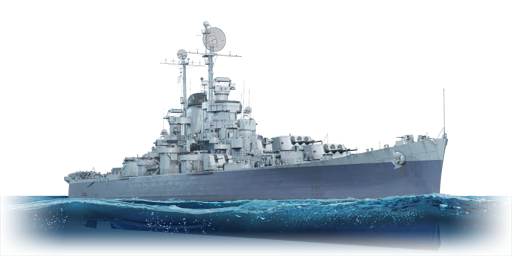
The Fargo-class, USS Fargo (CL-106), 1946 is a rank American light cruiser with a battle rating of (AB), (RB), and (SB). It was introduced in Update "Fire and Ice".
The Fargo-class light cruisers were the final class of light cruisers built for the US Navy in WW2. USS Fargo is the latest light cruiser in the American tree, both in launch date and refit, and is very similar to the preceding USS Cleveland, with similar armour, mobility and firepower. The major difference between the two classes is a simplified funnel and superstructure structure on the Fargo, providing better lines of fire for the secondary and anti-aircraft battery.
General info
Survivability and armour
The Fargo class, as a later evolution of the Cleveland-class light cruiser, has a very similar armour layout to the earlier USS Cleveland. USS Fargo is well armoured for a light cruiser, with a 5-inch plate angled at 7° to increase effectiveness. This plate, though thin, covers the area from the waterline to the top of the machinery spaces and is resistant to 6-inch fire at typical engagement ranges, and is almost immune to 5-inch fire from nearly all ranges. Below the waterline this drops to a 3.25-inch plate, with fuel tanks behind to absorb any shells which manage to pierce the armour below the waterline.
USS Fargo has no access to torpedo protection; this leaves her only torpedo protection as internal bulkheads and the fuel tanks lining the sides of the ship. It is recommended to attempt to avoid torpedoes at all costs, though if a hit is inevitable it is preferable to take the hit amidships, where the fuel tanks have the most coverage.
The armoured deck covering the machinery spaces and citadel has a thickness of 2 inches, as well as the sides of the citadel below the waterline. The turrets are well armoured for a light cruiser, with a face of 6.5 inches angled at 27° making it effective against 6-inch and lower calibre guns, with the possibility of deflecting some 8-inch shells at long ranges. The sides and top of the turrets have 3 inches of armour, and the rear only 1.5 inches. It is recommended to keep the rear of the turrets hidden, as even the 40 mm Bofors can penetrate the rear at close ranges. The turret barbettes have 6 inches of armour, and these lead all the way down to the magazines.
The magazines are placed far down in the ship well below the waterline, above fuel tanks in the bow and between them in the stern. These are very unlikely to be hit by enemy shells in these positions, but captains should be vigilant in preventing a torpedo strike in these two areas, as any torpedo hit will easily be fatal to the ship, especially in the bow with no fuel tanks to cushion the blast on either side.
Mobility
Write about the ship's mobility. Evaluate its power and manoeuvrability, rudder rerouting speed, stopping speed at full tilt, with its maximum forward and reverse speed.
| Mobility Characteristics | |||
|---|---|---|---|
| Game Mode | Upgrade Status | Maximum Speed (km/h) | |
| Forward | Reverse | ||
| AB | |||
| Upgraded | |||
| RB/SB | |||
| Upgraded | |||
Modifications and economy
Armament
Primary armament
USS Fargo has 12 x 6-inch guns in her main battery, split into 4 x triple turrets, mounted 2 fore and 2 aft. The gun mounts have a horizontal targeting speed of 10° per second, very quick for a cruiser and better even than some destroyers. This gives Fargo quick reaction times against unexpected threats and allows her to perform well in close quarters engagements. The reload time, as with other American 6-inch armed ships like the preceding USS Cleveland is excellent at 6 seconds on an ace crew. This is a fast reload for a cruiser and allows Fargo to quickly send large quantities of shells downrange from her main battery.
USS Fargo has access to 4 types of shells: the Mk.34 HC, Mk. 35 AP, Mk.34 HC (base fuze) and Mk.34 HC-VT. It notably has no access to SAP unlike other cruisers of her rank.
The Mk.34 HC serves as the stock round for the USS Fargo, and the high filler of 5.88 kg TNTe will do appreciable damage, especially in the high quantities the fast fire rate and plentiful guns allow. This shell will easily dispatch destroyers and lightly armoured light cruisers, but begins to have a more difficult time against late war light cruisers with improved armour and of course, heavy cruisers and battleships. Against capital ships the shell will be ineffective, but capable of destroying AA and secondary mounts and setting fire to the superstructure. The Mk.34 HC (base fuze) and Mk.34 HC-VT are the same shell with different fuses, hence the names.
The Mk.34 HC (base fuze) has the fuse at the end of the shell instead of in the nose, which allows it to penetrate into the armour before exploding. This gives it a small amount of extra penetration with the same filler. The Mk.34 HC-VT has a proximity fuse, allowing it to detonate when close to enemy aircraft and serve as long range AA fire to supplement the AA battery. This is the primary HE round recommended for use, as it functions identically to the normal Mk.34 shell while being able to destroy aircraft, and the slight extra penetration of the base fuse shell is not typically helpful.
The final shell is the Mk.35 AP, the primary shell for use against more heavily armoured targets like the Prinz Eugen which are commonly seen. The shell has good penetration, but is slightly lacking in filler for its calibre. This is made up for with the heavy volumes of fire the quick reload rate allows, and captains can expect quick damage to internal components and crew, oftentimes leaving enemy captains with little or no time to retaliate if caught off guard. It is recommended to aim for magazines if possible due to the low quantities of filler in the shells, though it's not a major concern with the fire rate possible.
| Penetration statistics | |||||||
|---|---|---|---|---|---|---|---|
| Ammunition | Type of warhead |
Penetration @ 0° Angle of Attack (mm) | |||||
| 1,000 m | 2,500 m | 5,000 m | 7,500 m | 10,000 m | 15,000 m | ||
| Mk.34 HC | HE | 49 | 49 | 49 | 49 | 49 | 49 |
| Mk.35 AP | APCBC | 266 | 230 | 182 | 146 | 120 | 96 |
| Mk.34 HC (base fuse) | HE | 80 | 68 | 53 | 49 | 49 | 49 |
| Mk.34 HC-VT | HE-VT | 49 | 49 | 49 | 49 | 49 | 49 |
| Shell details | |||||||||
|---|---|---|---|---|---|---|---|---|---|
| Ammunition | Type of warhead |
Velocity (m/s) |
Projectile mass (kg) |
Fuse delay (s) |
Fuse sensitivity (mm) |
Explosive mass (TNT equivalent) (g) |
Ricochet | ||
| 0% | 50% | 100% | |||||||
| Mk.34 HC | HE | 812 | 47.6 | 0 | 0.1 | 5,880 | 79° | 80° | 81° |
| Mk.35 AP | APCBC | 762 | 58.9 | 0.03 | 7 | 866.32 | 48° | 63° | 71° |
| Mk.34 HC (base fuse) | HE | 812 | 47.6 | 0.03 | 10 | 5,880 | 79° | 80° | 81° |
| Proximity-fused shell details | |||||||||||
|---|---|---|---|---|---|---|---|---|---|---|---|
| Ammunition | Type of warhead |
Velocity (m/s) |
Projectile mass (kg) |
Fuse delay (m) |
Fuse sensitivity (mm) |
Arming distance (m) |
Trigger radius (m) |
Explosive mass (TNT equivalent) (g) |
Ricochet | ||
| 0% | 50% | 100% | |||||||||
| Mk.34 HC-VT | HE-VT | 812 | 47.6 | 0 | 0.1 | 874 | 23 | 5,880 | 79° | 80° | 81° |
Secondary armament
| Penetration statistics | |||||||
|---|---|---|---|---|---|---|---|
| Ammunition | Type of warhead |
Penetration @ 0° Angle of Attack (mm) | |||||
| 1,000 m | 2,500 m | 5,000 m | 7,500 m | 10,000 m | 15,000 m | ||
| AAC Mk.34 | HE | 36 | 36 | 36 | 36 | 36 | 36 |
| AAVT Mk.31 | HE-VT | 36 | 36 | 36 | 36 | 36 | 36 |
| SP Common Mk.46 | SP Common | 150 | 125 | 93 | 71 | 56 | 45 |
| Shell details | |||||||||
|---|---|---|---|---|---|---|---|---|---|
| Ammunition | Type of warhead |
Velocity (m/s) |
Projectile mass (kg) |
Fuse delay (s) |
Fuse sensitivity (mm) |
Explosive mass (TNT equivalent) (g) |
Ricochet | ||
| 0% | 50% | 100% | |||||||
| AAC Mk.34 | HE | 792 | 25 | 0 | 0.1 | 3,220 | 79° | 80° | 81° |
| SP Common Mk.46 | SP Common | 792 | 25 | 0.01 | 6 | 906.5 | 48° | 63° | 71° |
| Proximity-fused shell details | |||||||||||
|---|---|---|---|---|---|---|---|---|---|---|---|
| Ammunition | Type of warhead |
Velocity (m/s) |
Projectile mass (kg) |
Fuse delay (m) |
Fuse sensitivity (mm) |
Arming distance (m) |
Trigger radius (m) |
Explosive mass (TNT equivalent) (g) |
Ricochet | ||
| 0% | 50% | 100% | |||||||||
| AAVT Mk.31 | HE-VT | 792 | 25 | 0 | 0.1 | 457 | 23 | 3,220 | 79° | 80° | 81° |
Anti-aircraft armament
An important part of the ship's armament responsible for air defence. Anti-aircraft armament is defined by the weapon chosen with the control Select anti-aircraft weapons. Talk about the ship's anti-air cannons and machine guns, the number of guns and their positions, their effective range, and about their overall effectiveness – including against surface targets. If there are no anti-aircraft armaments, remove this section.
Scout plane
Usage in battles
Describe the technique of using this ship, the characteristics of her use in a team and tips on strategy. Abstain from writing an entire guide – don't try to provide a single point of view, but give the reader food for thought. Talk about the most dangerous opponents for this vehicle and provide recommendations on fighting them. If necessary, note the specifics of playing with this vehicle in various modes (AB, RB, SB).
Pros and cons
Summarise and briefly evaluate the vehicle in terms of its characteristics and combat effectiveness. Mark its pros and cons in the bulleted list. Try not to use more than 6 points for each of the characteristics. Avoid using categorical definitions such as "bad", "good" and the like - use substitutions with softer forms such as "inadequate" and "effective".
Pros:
Cons:
History
Describe the history of the creation and combat usage of the ship in more detail than in the introduction. If the historical reference turns out to be too long, take it to a separate article, taking a link to the article about the ship and adding a block "/History" (example: https://wiki.warthunder.com/(Ship-name)/History) and add a link to it here using the main template. Be sure to reference text and sources by using <ref></ref>, as well as adding them at the end of the article with <references />. This section may also include the ship's dev blog entry (if applicable) and the in-game encyclopedia description (under === In-game description ===, also if applicable).
Media
Excellent additions to the article would be video guides, screenshots from the game, and photos.
See also
Links to articles on the War Thunder Wiki that you think will be useful for the reader, for example:
- reference to the series of the ship;
- links to approximate analogues of other nations and research trees.
External links
Paste links to sources and external resources, such as:
- topic on the official game forum;
- other literature.
| USA light cruisers | |
|---|---|
| Omaha-class | USS Detroit · USS Raleigh · USS Trenton |
| Atlanta-class | USS Atlanta |
| Brooklyn-class | USS Brooklyn · USS Helena |
| Cleveland-class | USS Cleveland |
| Fargo-class | USS Fargo |
| Worcester-class | USS Roanoke |