Difference between revisions of "PT-314"
(Updated format) |
|||
| Line 5: | Line 5: | ||
== Description == | == Description == | ||
| − | <!--''In the first part of the description, cover the history of the | + | <!-- ''In the first part of the description, cover the history of the ship's creation and military application. In the second part, tell the reader about using this ship in the game. Add a screenshot: if a beginner player has a hard time remembering vehicles by name, a picture will help them identify the ship in question.'' --> |
| − | + | The '''{{Specs|name}}''' is a rank {{Specs|rank}} American motor torpedo boat {{Battle-rating}}. It was introduced in [[Update 1.79 "Project X"]] as part of the fleet closed beta test. | |
| − | |||
| − | The '''{{Specs|name}}''' is a rank {{Specs|rank}} American motor torpedo boat {{Battle-rating | ||
== General info == | == General info == | ||
=== Survivability and armour === | === Survivability and armour === | ||
{{Specs-Fleet-Armour}} | {{Specs-Fleet-Armour}} | ||
| − | ''Talk about the vehicle's armour. Note the most well-defended and most vulnerable zones, e.g. the ammo magazine. Evaluate the composition of components and assemblies responsible for movement and manoeuvrability. Evaluate the survivability of the primary and secondary | + | ''Talk about the vehicle's armour. Note the most well-defended and most vulnerable zones, e.g. the ammo magazine. Evaluate the composition of components and assemblies responsible for movement and manoeuvrability. Evaluate the survivability of the primary and secondary armaments separately. Don't forget to mention the size of the crew, which plays an important role in fleet mechanics. Save tips on preserving survivability for the "Usage in battles" section. If necessary, use a graphical template to show the most well-protected or most vulnerable points in the armour.'' |
| − | |||
| − | |||
=== Mobility === | === Mobility === | ||
{{Specs-Fleet-Mobility}} | {{Specs-Fleet-Mobility}} | ||
| − | ''Write about the | + | ''Write about the ship's mobility. Evaluate its power and manoeuvrability, rudder rerouting speed, stopping speed at full tilt, with its maximum forward and reverse speed.'' |
| + | |||
| + | {{NavalMobility}} | ||
=== Modifications and economy === | === Modifications and economy === | ||
| Line 29: | Line 27: | ||
{{Specs-Fleet-Primary}} | {{Specs-Fleet-Primary}} | ||
{{main|Bofors L/60 Mark 3 (40 mm)|AN-M4 (37 mm)}} | {{main|Bofors L/60 Mark 3 (40 mm)|AN-M4 (37 mm)}} | ||
| − | |||
| − | ''Broadly describe the ammunition available for the primary armament, and provide recommendations on how to use it and which ammunition to choose.'' | + | ''Provide information about the characteristics of the primary armament. Evaluate their efficacy in battle based on their reload speed, ballistics and the capacity of their shells. Add a link to the main article about the weapon: <code><nowiki>{{main|Weapon name (calibre)}}</nowiki></code>. Broadly describe the ammunition available for the primary armament, and provide recommendations on how to use it and which ammunition to choose.'' |
=== Secondary armament === | === Secondary armament === | ||
{{Specs-Fleet-Secondary}} | {{Specs-Fleet-Secondary}} | ||
| − | {{main|Oerlikon Mk.II (20 mm)}} | + | {{main|20 mm/70 Oerlikon Mk.II (20 mm)}} |
| − | ''Some ships are fitted with weapons of various calibres. Secondary | + | |
| + | ''Some ships are fitted with weapons of various calibres. Secondary armaments are defined as weapons chosen with the control <code>Select secondary weapon</code>. Evaluate the secondary armaments and give advice on how to use them. Describe the ammunition available for the secondary armament. Provide recommendations on how to use them and which ammunition to choose. Remember that any anti-air armament, even heavy calibre weapons, belong in the next section. If there is no secondary armament, remove this section.'' | ||
=== Anti-aircraft armament === | === Anti-aircraft armament === | ||
{{Specs-Fleet-AA}} | {{Specs-Fleet-AA}} | ||
{{main|AN-M2 (12.7 mm)}} | {{main|AN-M2 (12.7 mm)}} | ||
| − | |||
| − | + | ''An important part of the ship's armament responsible for air defence. Anti-aircraft armament is defined by the weapon chosen with the control <code>Select anti-aircraft weapons</code>. Talk about the ship's anti-air cannons and machine guns, the number of guns and their positions, their effective range, and about their overall effectiveness – including against surface targets. If there are no anti-aircraft armaments, remove this section.'' | |
| − | |||
| − | '' | ||
=== Additional armament === | === Additional armament === | ||
{{Specs-Fleet-Additional}} | {{Specs-Fleet-Additional}} | ||
| − | + | {{main|Mk.13 (569 mm)}} | |
| − | ''If there is no additional armament, remove this section.'' | + | ''Describe the available additional armaments of the ship: depth charges, mines, torpedoes. Talk about their positions, available ammunition and launch features such as dead zones of torpedoes. If there is no additional armament, remove this section.'' |
== Usage in battles == | == Usage in battles == | ||
| − | ''Describe the technique of using this ship, the characteristics of her use in a team and tips on strategy. Abstain from writing an entire guide – | + | ''Describe the technique of using this ship, the characteristics of her use in a team and tips on strategy. Abstain from writing an entire guide – don't try to provide a single point of view, but give the reader food for thought. Talk about the most dangerous opponents for this vehicle and provide recommendations on fighting them. If necessary, note the specifics of playing with this vehicle in various modes (AB, RB, SB).'' |
| − | |||
| − | |||
| − | |||
| − | |||
| − | |||
| − | |||
| − | |||
| − | |||
| − | |||
| − | |||
| − | |||
| − | |||
| − | |||
| − | |||
| − | |||
| − | |||
| − | |||
| − | |||
| − | |||
| − | |||
| − | |||
| − | |||
| − | |||
| − | |||
| − | |||
| − | |||
| − | |||
| − | |||
| − | |||
| − | |||
| − | |||
| − | |||
| − | |||
| − | |||
| − | |||
| − | |||
| − | |||
| − | |||
| − | |||
| − | |||
| − | |||
=== Pros and cons === | === Pros and cons === | ||
| − | <!-- | + | <!-- ''Summarise and briefly evaluate the vehicle in terms of its characteristics and combat effectiveness. Mark its pros and cons in the bulleted list. Try not to use more than 6 points for each of the characteristics. Avoid using categorical definitions such as "bad", "good" and the like - use substitutions with softer forms such as "inadequate" and "effective".'' --> |
'''Pros:''' | '''Pros:''' | ||
| Line 110: | Line 64: | ||
* Guns are awkwardly placed around the hull | * Guns are awkwardly placed around the hull | ||
| − | * Thin armour means it's easily shredded even by the | + | * Thin armour means it's easily shredded even by the lightest caliber machine guns |
== History == | == History == | ||
| − | <!-- ''Describe the history of the creation and combat usage of the ship in more detail than in the introduction. If the historical reference turns out to be too | + | <!-- ''Describe the history of the creation and combat usage of the ship in more detail than in the introduction. If the historical reference turns out to be too long, take it to a separate article, taking a link to the article about the ship and adding a block "/History" (example: <nowiki>https://wiki.warthunder.com/(Ship-name)/History</nowiki>) and add a link to it here using the <code>main</code> template. Be sure to reference text and sources by using <code><nowiki><ref></ref></nowiki></code>, as well as adding them at the end of the article with <code><nowiki><references /></nowiki></code>. This section may also include the ship's dev blog entry (if applicable) and the in-game encyclopedia description (under <code><nowiki>=== In-game description ===</nowiki></code>, also if applicable).'' --> |
| − | PT-314 was laid down on | + | PT-314 was laid down on 11 December 1942 and launched on 20 February 1943. PT-314 was in service from 11 March 1943 until sold on 23 June 1948. PT-314 served in MTB RON 5 in the South Pacific under Lt John W. Ewell. <ref>Steve Laroe, US PT Boats List: Squadron List, http://www.hazegray.org/</ref> |
PT-314 was the lead boat in a class of 54 (314-367) built for the US Navy in 1943. | PT-314 was the lead boat in a class of 54 (314-367) built for the US Navy in 1943. | ||
== Media == | == Media == | ||
| − | '' | + | ''Excellent additions to the article would be video guides, screenshots from the game, and photos.'' |
== See also == | == See also == | ||
| − | ''Links to | + | ''Links to articles on the War Thunder Wiki that you think will be useful for the reader, for example:'' |
| − | |||
* ''reference to the series of the ship;'' | * ''reference to the series of the ship;'' | ||
* ''links to approximate analogues of other nations and research trees.'' | * ''links to approximate analogues of other nations and research trees.'' | ||
Revision as of 12:04, 15 January 2021

Contents
Description
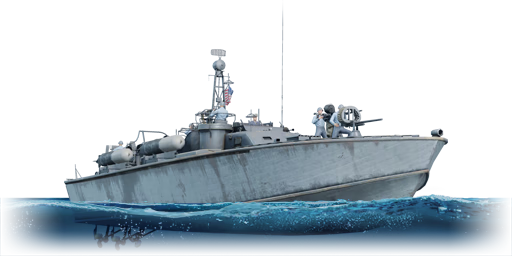
The Elco 80 ft PT-314 is a rank American motor torpedo boat with a battle rating of (AB), (RB), and (SB). It was introduced in Update 1.79 "Project X" as part of the fleet closed beta test.
General info
Survivability and armour
Talk about the vehicle's armour. Note the most well-defended and most vulnerable zones, e.g. the ammo magazine. Evaluate the composition of components and assemblies responsible for movement and manoeuvrability. Evaluate the survivability of the primary and secondary armaments separately. Don't forget to mention the size of the crew, which plays an important role in fleet mechanics. Save tips on preserving survivability for the "Usage in battles" section. If necessary, use a graphical template to show the most well-protected or most vulnerable points in the armour.
Mobility
Write about the ship's mobility. Evaluate its power and manoeuvrability, rudder rerouting speed, stopping speed at full tilt, with its maximum forward and reverse speed.
| Mobility Characteristics | |||
|---|---|---|---|
| Game Mode | Upgrade Status | Maximum Speed (km/h) | |
| Forward | Reverse | ||
| AB | |||
| Upgraded | |||
| RB/SB | |||
| Upgraded | |||
Modifications and economy
Armament
Primary armament
Provide information about the characteristics of the primary armament. Evaluate their efficacy in battle based on their reload speed, ballistics and the capacity of their shells. Add a link to the main article about the weapon: {{main|Weapon name (calibre)}}. Broadly describe the ammunition available for the primary armament, and provide recommendations on how to use it and which ammunition to choose.
Secondary armament
Some ships are fitted with weapons of various calibres. Secondary armaments are defined as weapons chosen with the control Select secondary weapon. Evaluate the secondary armaments and give advice on how to use them. Describe the ammunition available for the secondary armament. Provide recommendations on how to use them and which ammunition to choose. Remember that any anti-air armament, even heavy calibre weapons, belong in the next section. If there is no secondary armament, remove this section.
Anti-aircraft armament
An important part of the ship's armament responsible for air defence. Anti-aircraft armament is defined by the weapon chosen with the control Select anti-aircraft weapons. Talk about the ship's anti-air cannons and machine guns, the number of guns and their positions, their effective range, and about their overall effectiveness – including against surface targets. If there are no anti-aircraft armaments, remove this section.
Additional armament
Describe the available additional armaments of the ship: depth charges, mines, torpedoes. Talk about their positions, available ammunition and launch features such as dead zones of torpedoes. If there is no additional armament, remove this section.
Usage in battles
Describe the technique of using this ship, the characteristics of her use in a team and tips on strategy. Abstain from writing an entire guide – don't try to provide a single point of view, but give the reader food for thought. Talk about the most dangerous opponents for this vehicle and provide recommendations on fighting them. If necessary, note the specifics of playing with this vehicle in various modes (AB, RB, SB).
Pros and cons
Pros:
- Good firepower, can effectively engage both air and other sea targets
- Good mobility, with great top speed
- Armour is thin enough not to set off HE fuzes
- Relatively small target
Cons:
- Guns are awkwardly placed around the hull
- Thin armour means it's easily shredded even by the lightest caliber machine guns
History
PT-314 was laid down on 11 December 1942 and launched on 20 February 1943. PT-314 was in service from 11 March 1943 until sold on 23 June 1948. PT-314 served in MTB RON 5 in the South Pacific under Lt John W. Ewell. [1]
PT-314 was the lead boat in a class of 54 (314-367) built for the US Navy in 1943.
Media
Excellent additions to the article would be video guides, screenshots from the game, and photos.
See also
Links to articles on the War Thunder Wiki that you think will be useful for the reader, for example:
- reference to the series of the ship;
- links to approximate analogues of other nations and research trees.
External links
References
- ↑ Steve Laroe, US PT Boats List: Squadron List, http://www.hazegray.org/
| Electric Launch Company (Elco) Ships | |
|---|---|
| Patrol Torpedo Boats (PT) | |
| 77' PT | PT-20 · PT-59 |
| 80' PT | PT-103 · PT-109 · PT-174 · PT-314 · Thunderbolt (PT-556) · PT-565 |
| USA boats | |
|---|---|
| Motor torpedo boats | PT-3 · PT-6 · PT-20 · PT-71 · PT-103 · PT-109 · PT-174 |
| PT-200 · PT-314 · Thunderbolt (PT-556) · PT-565 · PT-658 · PT-810 · PT-811 · PT-812 | |
| Motor gun boats | Kim Qui · LCS(L)(3) · PT-59 · PTF-7 · USS Candid · USS Asheville · USS Douglas · USS Flagstaff · USS Tucumcari · USS Cyclone |
| Armoured gun boats | LCM(6) Zippo |