Difference between revisions of "T-26 (1st Gv.T.Br.)"
(Edited previous copy-paste information and rewrote and added to all information sections.) (Tag: Visual edit) |
(Edits) |
||
| Line 144: | Line 144: | ||
A recommended strategy for the T-26 (1st Gv.T.Br) is to play in the support role, flanking the battlefield and finding a good position to support teammates from. The 45 mm cannon is able to deal a fair amount of damage to enemy vehicles from most ranges and its fast reload allowing for quick adjustment of aim between shots. With its short hull and gun depression of -6°, the T-26 (1st Gv.T.Br) can position hull-down behind hills which can prevent enemy fire from hitting the center of the vehicle. | A recommended strategy for the T-26 (1st Gv.T.Br) is to play in the support role, flanking the battlefield and finding a good position to support teammates from. The 45 mm cannon is able to deal a fair amount of damage to enemy vehicles from most ranges and its fast reload allowing for quick adjustment of aim between shots. With its short hull and gun depression of -6°, the T-26 (1st Gv.T.Br) can position hull-down behind hills which can prevent enemy fire from hitting the center of the vehicle. | ||
| − | The T-26 (1st Gv.T.Br) is also usable at closer ranges and can brawl with enemy vehicles, however the thin armour on the may leave vital modules of your vehicle at risk of taking damage from many weapons, even heavy machine guns. The mobility of the T-26 (1st Gv.T.Br) is also lesser than many of its counterparts which could potentially put it at risk in a brawling scenario, especially if enemy vehicles are able to | + | The T-26 (1st Gv.T.Br) is also usable at closer ranges and can brawl with enemy vehicles, however the thin armour on the may leave vital modules of your vehicle at risk of taking damage from many weapons, even heavy machine guns. The mobility of the T-26 (1st Gv.T.Br) is also lesser than many of its counterparts which could potentially put it at risk in a brawling scenario, especially if enemy vehicles are able to manoeuvre behind the tank. |
The T-26 (1st Gv.T.Br)'s relatively low engine power means that it will often arrive to the battlefield after the fighting has already begun. Although usually a disadvantage, teammates will have spread out and identified many enemy targets for the T-26 (1st Gv.T.Br) to shoot at. Upon reaching capture points, it is recommended to be on the lookout for enemy vehicles that may be in the point or watching over it from a distance. | The T-26 (1st Gv.T.Br)'s relatively low engine power means that it will often arrive to the battlefield after the fighting has already begun. Although usually a disadvantage, teammates will have spread out and identified many enemy targets for the T-26 (1st Gv.T.Br) to shoot at. Upon reaching capture points, it is recommended to be on the lookout for enemy vehicles that may be in the point or watching over it from a distance. | ||
Latest revision as of 16:22, 23 February 2024
| This page is about the Soviet light tank T-26 (1st Gv.T.Br.). For other versions, see T-26 (Family). |
.jpg)
Contents
Description
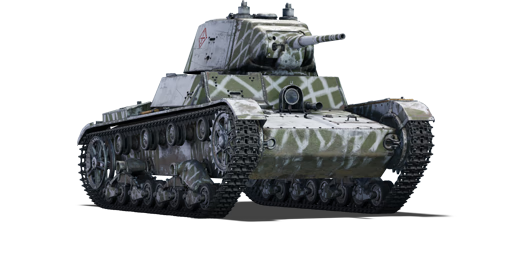
The T-26 mod. 1939 (1st Gv.T.Br.) is a premium rank Soviet light tank with a battle rating of (AB), (RB), and (SB). It was introduced in Update 1.41.27.
The T-26 (1st Gv.T.Br) is a premium version of the T-26 and is identical to it mechanically. Cosmetically, this vehicle features the unique winter camouflage of a T-26 of the 1st Guards Tank Brigade during the Battle of Moscow.
General info
Survivability and armour

The armor of the T-26 (1st Gv.T.Br) is flat and relatively thin on all sides of the vehicle. It is not recommended to expose yourself to enemy fire because there are a variety of weapons that are able to destroy the vehicle. Tank cannons, autocannons, heavy machine guns, high-explosive munitions and artillery are all threats to the vehicle. If the hull is penetrated by an enemy vehicle using armor-piercing, high explosive (APHE) ammunition, the entire crew could be knocked out in one shot due to the confined fighting compartment. It is recommended for players to be wary of aircraft as they will usually carry a combination of powerful weapons and can attack from unexpected positions.
Although the armor of the T-26 (1st Gv.T.Br) is thin, enemy rounds could strike trickier components such as the road wheels, gun mantlet, or the hull's significantly angled front glacis. Highly angled armor has the potential of deflecting incoming rounds and preventing significant damage to the modules behind it. It is not recommended to rely on these relatively small sections of armor to protect the vehicle.
Armour type:
- Rolled homogeneous armour
| Armour | Front | Sides | Rear | Roof |
|---|---|---|---|---|
| Hull | 15 mm (22°) Front plate 7 mm (64-80°) Front glacis 15 mm (6-52°) Lower glacis |
15 mm (21-23°) Top 15 mm Bottom |
15 mm Top 15 mm (12°) Bottom |
10 mm Hull 6 mm Rear |
| Turret | 15 mm (13-15°) Turret front 15 mm (5-44°) Gun mantlet |
15 mm (17-19°) | 15 mm (17°) | 10 mm |
Notes
- Suspension wheel are 10 mm thick while tracks are 15 mm thick.
- Belly armour is 6 mm thick
Mobility
While being a light tank, the T-26 (1st Gv.T.Br)'s mobility is similar to a medium tank. Its top speed is low for a light tank, and combined with its relatively low power to weight ratio, the vehicle has poor acceleration on most surfaces. The T-26 (1st Gv.T.Br)'s narrow tracks reduce its off-road mobility in muddy, sandy or snowy maps compared to vehicles with access to wide tracks like the Pz.III E. It can reach around 30 km/h but only on hard, flat surface, after a long, uninterrupted acceleration period. Speed will drop significantly if encountering obstactles such as walls and trees. To turn this vehicle while in a stopped position, it may be necessary to accelerate forward or backwards before attempting to turn because of the relatively slow hull traverse.
Reverse speed is also relatively poor at -4 km/h. It is recommended to visually clear areas before entering them as the T-26 (1st Gv.T.Br) may not be able to reverse out of danger quickly enough to avoid destruction.
Overall, the T-26 (1st Gv.T.Br) will eventually take the player where they want to be, provided that they are patient and mindful about the route they are taking.
| Game Mode | Max Speed (km/h) | Weight (tons) | Engine power (horsepower) | Power-to-weight ratio (hp/ton) | |||
|---|---|---|---|---|---|---|---|
| Forward | Reverse | Stock | Upgraded | Stock | Upgraded | ||
| Arcade | Expression error: Unexpected * operator. | 141 | Expression error: Unexpected round operator. | __.__ | |||
| Realistic | 80 | Expression error: Unexpected round operator. | __.__ | ||||
Modifications and economy
Armaments
Main armament

The 45 mm 20-K is a gun that will be familiar to players around Rank I of the Soviet tech tree. With decent velocity and power, this weapon is an excellent all-rounder gun against most targets the T-26 (1st Gv.T.Br) will face.
The APHEBC round has a decent amount of HE filler, meaning penetrating shells will do a decent amount of damage, sometimes even knocking the target out with a single shot. It is recommended to bring around 10-15 BR-240SP shells for heavier targets. These pure armor piercing rounds will be able to more easily penetrate vehicles with thicker armor. At longer ranges, shells will begin to lose penetration and accuracy due to their relatively small caliber. This may prevent the gun from defeating vehicles with a moderate amount of armor.
A significant advantage of the 45 mm 20-K cannon is its quick reloading rate. This can be very useful in dealing with larger targets that may not be destroyed in one, two, or even three rounds. Its reloading rate allows for quick follow-up shots to ensure destruction of the enemy.
| 45 mm 20-K | Turret rotation speed (°/s) | Reloading rate (seconds) | |||||||||||
|---|---|---|---|---|---|---|---|---|---|---|---|---|---|
| Mode | Capacity | Vertical | Horizontal | Stabilizer | Stock | Upgraded | Full | Expert | Aced | Stock | Full | Expert | Aced |
| Arcade | 205 | -6°/+22° | ±180° | N/A | 15.23 | 21.08 | 25.60 | 28.31 | 30.12 | 3.77 | 3.34 | 3.07 | 2.90 |
| Realistic | 9.52 | 11.20 | 13.60 | 15.04 | 16.00 | ||||||||
Ammunition
| Penetration statistics | |||||||
|---|---|---|---|---|---|---|---|
| Ammunition | Type of warhead |
Penetration @ 0° Angle of Attack (mm) | |||||
| 10 m | 100 m | 500 m | 1,000 m | 1,500 m | 2,000 m | ||
| BR-240 | APHEBC | 70 | 67 | 58 | 47 | 39 | 32 |
| BR-240SP | APBC | 73 | 70 | 60 | 50 | 41 | 34 |
| Shell details | ||||||||||||
|---|---|---|---|---|---|---|---|---|---|---|---|---|
| Ammunition | Type of warhead |
Velocity (m/s) |
Projectile mass (kg) |
Fuse delay (m) |
Fuse sensitivity (mm) |
Explosive mass (TNT equivalent) (g) |
Ricochet | |||||
| 0% | 50% | 100% | ||||||||||
| BR-240 | APHEBC | 760 | 1.43 | 1.2 | 9 | 29.26 | 48° | 63° | 71° | |||
| BR-240SP | APBC | 757 | 1.43 | - | - | - | 47° | 60° | 65° | |||
Ammo racks

| Full ammo |
1st rack empty |
2nd rack empty |
3rd rack empty |
4th rack empty |
5th rack empty |
6th rack empty |
7th rack empty |
|---|---|---|---|---|---|---|---|
| 205 | 202 (+3) | 197 (+8) | 187 (+18) | 177 (+28) | 167 (+38) | 157 (+48) | 139 (+66) |
| 8th rack empty |
9th rack empty |
10th rack empty |
11th rack empty |
12th rack empty |
13th rack empty |
Visual discrepancy |
|
| 121 (+84) | 103 (+102) | 79 (+126) | 61 (+144) | 29 (+176) | 1 (+204) | No |
Note:
- Turret empty: 157 (+48) shells.
Machine guns
| 7.62 mm DT | ||||
|---|---|---|---|---|
| Mount | Capacity (Belt) | Fire rate | Vertical | Horizontal |
| Coaxial | 1,890 (63) | 600 | N/A | N/A |
The 7.62 mm DT machine gun is mounted coaxially, located in the turret alongside the main cannon. This weapon can be used against unarmored targets such as trucks and other vehicles with exposed crewmembers. Due to its traverse and small caliber, this machine gun will not be very effective against enemy aircraft and ground vehicles with enclosed armor.
Usage in battles

A recommended strategy for the T-26 (1st Gv.T.Br) is to play in the support role, flanking the battlefield and finding a good position to support teammates from. The 45 mm cannon is able to deal a fair amount of damage to enemy vehicles from most ranges and its fast reload allowing for quick adjustment of aim between shots. With its short hull and gun depression of -6°, the T-26 (1st Gv.T.Br) can position hull-down behind hills which can prevent enemy fire from hitting the center of the vehicle.
The T-26 (1st Gv.T.Br) is also usable at closer ranges and can brawl with enemy vehicles, however the thin armour on the may leave vital modules of your vehicle at risk of taking damage from many weapons, even heavy machine guns. The mobility of the T-26 (1st Gv.T.Br) is also lesser than many of its counterparts which could potentially put it at risk in a brawling scenario, especially if enemy vehicles are able to manoeuvre behind the tank.
The T-26 (1st Gv.T.Br)'s relatively low engine power means that it will often arrive to the battlefield after the fighting has already begun. Although usually a disadvantage, teammates will have spread out and identified many enemy targets for the T-26 (1st Gv.T.Br) to shoot at. Upon reaching capture points, it is recommended to be on the lookout for enemy vehicles that may be in the point or watching over it from a distance.
In any situation, it is highly advised to be the vehicle that engages first as the T-26 (1st Gv.T.Br)'s firepower is greater than its survivability.
Pros and cons
Pros:
- Beginner-friendly main gun with decent performance and accuracy at most ranges
- Good ammunition choices with high penetration and high-explosive filler
- Fast reloading rate allows for quick follow-up shots
- Massive ammo capacity
- Premium bonuses for researching other vehicles
Cons:
- Low survivability with thin armor and tightly packed crew
- Poor overall mobility due to relatively low engine power
- Slow reverse speed
- Suggish hull traverse
- Ammunition storage located inside the turret may detonate when hit
History
Combat usage
A Soviet derivative of the British Vickers 6-ton light tank, the T-26 first saw combat in the Spanish Civil War where it showed its superiority over tanks fielded by Italy and Germany during that period. The T-26 then saw combat against the Japanese in the Soviet-Japanese border conflicts at Lake Khasan and Khalkhin Gol, which exposed some design defects of the vehicle such as poor armour welding and the disadvantages of riveted construction (the rivet could break off if impacted and could harm the crew inside). After that, the T-26 saw service in the Invasion of Poland and the Winter War against Finland.
The Winter War effectively showed the Soviets that the T-26 was obsolete, as the 37 mm guns and anti-tank rifles and Finnish had could easily penetrate the light armour of the T-26. When World War II for the Soviet Union finally broke out in Operation Barbarossa, the T-26 proved inferior to the German's Panzer IIIs and Panzer IVs. Air supremacy established by the Luftwaffe also ensured that many tanks were lost in the opening stages of the engagement.
At this point, T-26s were breaking down often and the lack of spare parts made repairs diffiucult, resulting in many lightly-damaged units being knocked out for being unrepairable. The T-26 was gradually phased from service by the new, venerable T-34 medium tanks in 1941 which itself caused some of the previously dominant German tank designs to become obsolete.
The T-26 would still see service during the rest of the war as a second-line unit, fighting during the Battle of Moscow in 1941, the Battle of Stalingrad in 1942, and the Invasion of Manchuria in 1945. Some T-26 saw action with the 1st Guards Tank Brigade (1st Gv.T.Br.), but these were quickly replaced by T-34s as they became available.
Media
- Skins
- Images
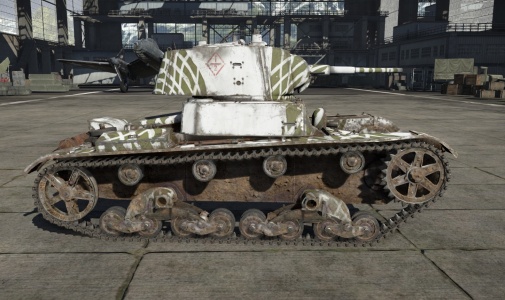
Right side of the T-26, which shows the insignia of the 1st Guards Tank Brigade
_Side.jpg)
See also
- Related development
- Other vehicles of similar configuration and role
Vehicles with similar weapon systems
External links
Paste links to sources and external resources, such as:
- topic on the official game forum;
- other literature.
| Experimental Design and Mechanical Engineering Department | |
|---|---|
| Light Tanks | |
| T-26 | T-26 · T-26 (1st Gv.T.Br.) · T-26E · T-26-4 |
| T-50 | T-50 · T-126 |
| Heavy Tanks | T-35 |
| Tank Destroyers | SU-5-1 · SU-100Y |
| Export | |
| T-26 | ␗T-26 · T-26 No.531 |
| See Also | Omsk Transport Engineering Plant |
| USSR light tanks | |
|---|---|
| T-26 | T-26 · T-26 (1st Gv.T.Br.) · T-26-4 · T-26E |
| BT | BT-5 · RBT-5 · BT-7 · BT-7 TD · BT-7M · BT-7A (F-32) |
| T-50 | T-126 · T-50 |
| T-70 | T-70 · T-80 |
| PT-76 | PT-76B · PT-76-57 · Object 906 |
| BMP | BMP-1 · BMP-2 · BMP-2M · BMP-3 |
| BMD | BMD-4 |
| 2S25 | 2S25 · 2S25M |
| Wheeled | BA-11 · BTR-80A |
| Other | T-60 · Object 685 · 2S38 |
| China | ▂Type 62 |
| USSR premium ground vehicles | |
|---|---|
| Light tanks | BA-11 · RBT-5 · BT-7A (F-32) · T-26 (1st Gv.T.Br.) · T-26E · T-126 · PT-76-57 · 2S38 |
| Medium tanks | T-34 (Prototype) · T-34 (1st Gv.T.Br.) · T-34E · T-34-57 (1943) · T-34-85E · T-34-100 · T-44-122 · TO-55 · T-55AM-1 · T-72AV (TURMS-T) · T-80UD · Т-80U-Е1 |
| ▂M3 Medium · ▂M4A2 · ▂T-III · ▂T-V · ▂МК-IX "Valentine" | |
| Heavy tanks | SMK · T-35 · ▂MK-II "Matilda" · KV-1E · KV-2 (1940) · KV-2 (ZiS-6) · KV-122 · KV-220 · IS-2 "Revenge" · Object 248 · IS-6 · T-10A |
| Tank destroyers | BM-8-24 · BM-13N · BM-31-12 |
| SU-57 · SU-76D · SU-76M (5th Gv.Kav.Corps) · SU-85A · SU-100Y · SU-122P · Object 120 | |
| SPAA | ▂Phòng không T-34 · ZUT-37 |