Difference between revisions of "Ostwind"
m (Minor updates) (Tag: Visual edit) |
m (Minor updates) (Tag: Visual edit) |
||
| Line 11: | Line 11: | ||
== Description == | == Description == | ||
<!-- ''In the description, the first part should be about the history of the creation and combat usage of the vehicle, as well as its key features. In the second part, tell the reader about the ground vehicle in the game. Insert a screenshot of the vehicle, so that if the novice player does not remember the vehicle by name, he will immediately understand what kind of vehicle the article is talking about.'' --> | <!-- ''In the description, the first part should be about the history of the creation and combat usage of the vehicle, as well as its key features. In the second part, tell the reader about the ground vehicle in the game. Insert a screenshot of the vehicle, so that if the novice player does not remember the vehicle by name, he will immediately understand what kind of vehicle the article is talking about.'' --> | ||
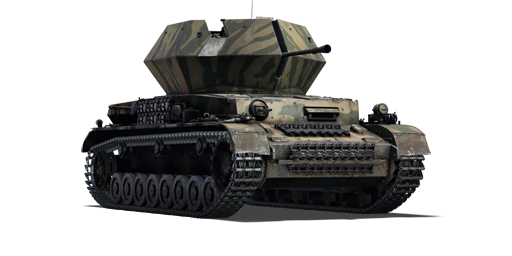
| − | The '''Flakpanzer IV "Ostwind"''' ([[Abbreviations#.28DE.29_Sd.Kfz._Index|Sd.Kfz. Index:]] '''Sd.Kfz. 161/3''') is the second variant of the [[ | + | The '''Flakpanzer IV "Ostwind"''' ([[Abbreviations#.28DE.29_Sd.Kfz._Index|Sd.Kfz. Index:]] '''Sd.Kfz. 161/3''') is the second variant of the [[Flakpanzer IV (Disambiguation)|Flakpanzer IV self-propelled anti-aircraft vehicle family]]. It was created in 1944 as a replacement for the previous variant, the [[Wirbelwind|Flakpanzer IV "Wirbelwind"]]. The same Panzer IV medium tank chassis was used, but this time with an open-top, hexagonal turret housing a 37 mm Flugzeugabwehrkanone 43. This platform is highly effective against lightly armoured vehicles and minor fortifications in addition to its intended role as an anti-aircraft weapon. A closed-top design would have been preferable, but due to the heavy smoke generated by the main armament, this was not possible. |
Introduced in [[Update 1.43]], the Flakpanzer IV "Ostwind" has both advantages and disadvantages. Its main strengths are its long engagement range, destructive ammunition, and its short reload time. Its drawbacks include an average fire rate and inadequate crew protection. It is best used in anti-aircraft roles, waiting for enemy aircraft to approach before unleashing a barrage of shells in that direction. Long-range firing in the hope of a lucky hit is both a waste of ammunition and a good way to broadcast the current position to enemy ground and air units. Always stay close to cover and away from the main fighting zones. | Introduced in [[Update 1.43]], the Flakpanzer IV "Ostwind" has both advantages and disadvantages. Its main strengths are its long engagement range, destructive ammunition, and its short reload time. Its drawbacks include an average fire rate and inadequate crew protection. It is best used in anti-aircraft roles, waiting for enemy aircraft to approach before unleashing a barrage of shells in that direction. Long-range firing in the hope of a lucky hit is both a waste of ammunition and a good way to broadcast the current position to enemy ground and air units. Always stay close to cover and away from the main fighting zones. | ||
Revision as of 14:55, 20 November 2023
| This page is about the German SPAA Ostwind. For the twin-barelled version, see Ostwind II. |

Contents
Description
The Flakpanzer IV "Ostwind" (Sd.Kfz. Index: Sd.Kfz. 161/3) is the second variant of the Flakpanzer IV self-propelled anti-aircraft vehicle family. It was created in 1944 as a replacement for the previous variant, the Flakpanzer IV "Wirbelwind". The same Panzer IV medium tank chassis was used, but this time with an open-top, hexagonal turret housing a 37 mm Flugzeugabwehrkanone 43. This platform is highly effective against lightly armoured vehicles and minor fortifications in addition to its intended role as an anti-aircraft weapon. A closed-top design would have been preferable, but due to the heavy smoke generated by the main armament, this was not possible.
Introduced in Update 1.43, the Flakpanzer IV "Ostwind" has both advantages and disadvantages. Its main strengths are its long engagement range, destructive ammunition, and its short reload time. Its drawbacks include an average fire rate and inadequate crew protection. It is best used in anti-aircraft roles, waiting for enemy aircraft to approach before unleashing a barrage of shells in that direction. Long-range firing in the hope of a lucky hit is both a waste of ammunition and a good way to broadcast the current position to enemy ground and air units. Always stay close to cover and away from the main fighting zones.
General info
Survivability and armour
The Ostwind is lightly-armoured, as most anti-air vehicles are, but is also unexpectedly survivable. With 5 crew members and a fairly spacious crew compartment, it is not uncommon for the vehicle to survive a direct hit from a shell, even one containing explosive filler. A center-mass shot to the hull will often only hit the ammunition storage, and there is a good chance that the ammo will not detonate in these situations.
However, this does not mean that the Ostwind is incredibly well-protected by any stretch of the imagination. It is still only a lightly armoured SPAA, and enemy tanks will have absolutely no trouble destroying it. Usually, a well-placed shot can at least cripple the Ostwind's ability to move or fire. Also note that the Ostwind's turret is completely exposed, making the three crew members within very vulnerable to strafing attacks by enemy aircraft.
Armour type:
- Rolled homogeneous armour
| Armour | Front (Slope angle) | Sides | Rear | Roof |
|---|---|---|---|---|
| Hull | 80 mm (10°) Upper plate 20 mm (72°) Middle glacis 80 mm (14°) Lower plate |
30 mm | 20 mm | 10 mm |
| Turret | 25 mm (50°) | 25 mm (50°) | 25 mm (50°) |
Notes:
- Suspension wheels and torsion bars are 15 mm thick, while tracks are 20 mm thick.
Mobility
| Game Mode | Max Speed (km/h) | Weight (tons) | Engine power (horsepower) | Power-to-weight ratio (hp/ton) | |||
|---|---|---|---|---|---|---|---|
| Forward | Reverse | Stock | Upgraded | Stock | Upgraded | ||
| Arcade | Expression error: Unexpected * operator. | 426 | Expression error: Unexpected round operator. | __.__ | |||
| Realistic | 265 | Expression error: Unexpected round operator. | __.__ | ||||
Modifications and economy
Armaments
Main armament
| 37 mm FlaK43 | Turret rotation speed (°/s) | Reloading rate (seconds) | ||||||||||||
|---|---|---|---|---|---|---|---|---|---|---|---|---|---|---|
| Mode | Capacity (Belt) | Fire rate | Vertical | Horizontal | Stabilizer | Stock | Upgraded | Full | Expert | Aced | Stock | Full | Expert | Aced |
| Arcade | 1,000 (8) | 250 | -10°/+87° | ±180° | N/A | 30.82 | 42.66 | 51.80 | 57.28 | 60.94 | 0.31 | 0.28 | 0.25 | 0.24 |
| Realistic | 20.83 | 24.50 | 29.75 | 32.90 | 35.00 | |||||||||
Ammunition
- Default: APHE · FI-T
- Sprgr. 18: FI-T
- PzGr: APHE
- M.Gr.18: HEI-T
| Penetration statistics | |||||||
|---|---|---|---|---|---|---|---|
| Ammunition | Penetration @ 0° Angle of Attack (mm) | ||||||
| 10 m | 100 m | 500 m | 1,000 m | 1,500 m | 2,000 m | ||
| FI-T | 7 | 7 | 5 | 4 | 3 | 3 | |
| APHE | 49 | 46 | 33 | 22 | 14 | 10 | |
| HEI-T | 7 | 7 | 6 | 4 | 4 | 4 | |
| Shell details | ||||||||||||
|---|---|---|---|---|---|---|---|---|---|---|---|---|
| Ammunition | Velocity (m/s) |
Projectile mass (kg) |
Fuse delay (m) |
Fuse sensitivity (mm) |
Explosive mass (TNT equivalent) (g) |
Ricochet | ||||||
| 0% | 50% | 100% | ||||||||||
| FI-T | 820 | 0.62 | 0.1 | 0.1 | 49.3 | 79° | 80° | 81° | ||||
| APHE | 770 | 0.69 | 1.2 | 9 | 22.1 | 47° | 60° | 65° | ||||
| HEI-T | 914 | 0.55 | 0.1 | 0.1 | 108 | 79° | 80° | 81° | ||||
Ammo racks

| Full ammo |
1st rack empty |
2nd rack empty |
3rd rack empty |
4th rack empty |
5th rack empty |
6th rack empty |
Visual discrepancy |
|---|---|---|---|---|---|---|---|
| 125 | 93 (+32) | 62 (+63) | 31 (+94) | 6 (+119) | 1 (+124) | 0 (+125) | No |
Usage in battles
The Ostwind is best played in an anti-aircraft role. When this playstyle is used, it is recommended (as it is recommended for any anti-air vehicle) to fire only when there is a good chance of hitting enemy aircraft. Firing at long ranges with the hopes of getting a lucky hit is both a waste of ammunition and a good way to broadcast your position to enemy ground and air units. Also, try to stay near cover--next to buildings or under trees and shrubbery--since the Ostwind's open turret makes its crew quite vulnerable to strafing attacks.
In a pinch, the Ostwind can be used to attack light and medium ground targets. This is often not the Ostwind's most effective use, but it is possible to destroy such enemy vehicles using the PzGr round, especially when firing at their sides or rear. Still, keep in mind that the Ostwind is itself lightly armoured, and quite easy to disable or destroy. If this vehicle is to be used in an anti-ground role, then it is best to avoid being detected by the enemy whenever possible. Also note that against heavier tanks such as the KV-1, the PzGr round will likely not be able to penetrate from any angle. Disabling an enemy tank's components such as cannon barrel and tracks is vital to prolong an Ostwind's life during an encounter. However, an Ostwind will oftentimes be completely disabled before it is able to destroy all offensive armaments of a tank, so a much more neutral playing style should be used when playing the Ostwind in order to not be caught in the middle of the match.
Pros and cons
Pros:
- Never need to reload
- Very little lead required to hit enemy aircraft
- Reasonable rate of fire for the calibre (37 mm)
- A single hit often cripples or completely destroys an enemy aircraft
- Very effective against light tanks
- Rather difficult to kill with one shot
- Turret is better armoured than the Wirbelwind
Cons:
- Based on the chassis of a Pz.IV tank: the armour and the mobility are lacking
- A viewing port in the turret allows enemies to kill the gunner with machine gun fire
- Open turret; susceptible to aerial gunfire or blast overpressure
- Significantly hard to hit and kill an enemy aircraft with the 37 mm cannon
- PzGr APHE belt with highest penetration values almost never penetrates armoured vehicles (aside from light and open-topped vehicles)
- Can get overwhelmed if there are several planes with its low rate of fire
- Once the cannon has overheated, cooling takes time and hinders combat performance
History
From 1943 onward Germany began to place more and more emphasis on self-propelled anti-aircraft guns (SPAAGs). This was because the Luftwaffe had lost their aerial supremacy they had maintained early in the war, as the Allied powers were able to completely outpace the German industry in terms of aircraft production. This lead to designs such as the 3.7 cm Flak auf Fahrgestell Panzerkampfwagen IV (sf) "Möbelwagen", which was succeeded by the Flakpanzer IV Wirbelwind - which was based on the Panzer IV chassis.
Designed in 1944, the Flakpanzer IV Ostwind (East Wind) was another Panzer IV based SPAAG, and it was designed to replace the earlier Wirbelwind. An unmodified Panzerkampfwagen IV chassis was used with the turret removed and replaced by a new open-topped hexagonal turret. The turret was open-topped to ventilate the large quantities of smoke generated by the gun, which would otherwise enter the enclosed crew compartment and cause harm to the crew. The armament of the Ostwind was a 3.7 cm Flak 43 anti-aircraft gun. The 37 mm gun was not only effective against aircraft, but also against lightly armoured vehicles and light fortifications. Compared to the Wirbelwind, the Ostwind had a slightly better protected turret and a more powerful armament. The Flak 43 was simply more powerful than the 2 cm Flak 38 guns of the Wirbelwind.
The Wehrmacht ordered 100 Flakpanzer IV Ostwinds in August 1944, but only 44 vehicles were completed between December 1944 and March 1945. 37 of the vehicles were converted from already existing PzKpfw IV tanks, and 7 were purpose-built. All conversions and constructions were carried out at Ostbau Werke in Sagan, Silesia (now in Poland).
| Archive of the in-game description | |
|---|---|
|
A development of the Wirbelwind project. The goal of the Ostwind project was to increase the unit's firepower, protection, and effective range. For this purpose, a 3.7 cm FlaK 43 anti-air gun was installed on it, and its turret's armour was increased to 25 mm. The first prototype was completed in September, 1944. In the same month, on the 23rd, it was used in combat operations on the Eastern Front. Between 1944 and 1945 Ostbau-Sagan released 43 mounts. They were more effective than their predecessors had been. | |
Media
- Skins
- Videos
See also
- Related development
External links
Paste links to sources and external resources, such as:
- topic on the official game forum;
- other literature.
| Germany anti-aircraft vehicles | |
|---|---|
| Wheeled | Sd.Kfz.222 |
| Half-track | Sd.Kfz.251/21 · Sd.Kfz. 6/2 |
| Flakpanzer IV | Wirbelwind · Ostwind · Ostwind II · Kugelblitz · Zerstörer 45 |
| Other Flakpanzers | Flakpanzer I · Flakpanzer 38 · Flakpanzer 341 |
| Wiesel AWC | Wiesel 1A4 · Ozelot |
| Radar SPAAG | Gepard · Gepard 1A2 |
| Missile SPAA | FlaRakPz 1 · FlaRakRad |