Difference between revisions of "Yenot"
(Updated format) |
(→Armament: All armament info.) (Tag: Visual edit) |
||
| Line 31: | Line 31: | ||
{{main|100 mm/56 B-34 (100 mm)}} | {{main|100 mm/56 B-34 (100 mm)}} | ||
| − | + | The Pr. 50 gets access to three 100 mm B-34 naval cannons which are quite effective against enemy vessels. The weapons fire 15 rounds per minute, which is relatively good for a wepaon of its size, but suffers from a slow traverse rate similar to other Soviet naval cannons. The Pr. 50 gets access to three shells: a standard HE shell, a HE-TF time fuze shell or a HE-VT proximity fuzed shell. Of these, the HE shell is ideal against naval targets while the HE-VT is the most effective against aerial targets. | |
=== Secondary armament === | === Secondary armament === | ||
| Line 38: | Line 38: | ||
{{main|V-11 (37 mm)}} | {{main|V-11 (37 mm)}} | ||
| − | + | The Pr. 50 carries two dual 37 mm 70-K mounts for anti-aircraft defence. The 70-K is the standard Soviet anti-aircraft gun and serves as a reliable counterpart to the 40 mm Bofors gun used by the allied nations. This gun is extremely similar to the Bofors as it features a similar design, and fires continuously rather than needing to reload. The guns will eventually jam, but the time it takes to jam the weapons is very long so jamming is not a great issue. The weapon gets access to three belts - default, AP and HE. The HE belt is usually the best belt as it is the most effective against enemy aircraft. | |
=== Additional armament === | === Additional armament === | ||
| Line 45: | Line 45: | ||
{{main|53-38 (533 mm)|MBU-600 mortar|BB-1 depth charge}} | {{main|53-38 (533 mm)|MBU-600 mortar|BB-1 depth charge}} | ||
| − | + | The Pr. 50 gets access to two 533 mm 53-38 torpedoes. The 53-38 torpedo is also found on most Soviet WWII-era destroyers, and is relatively mediocre as far as torpedoes go. In terms of damage-dealing capabilities, the torpedo is decidedly mediocre, having more explosive filler (300 kg of TNT) than the American torpedoes but less than the British and Japanese ones. However, the main drawback of the torpedo is its range - without the “torpedo mode” modification, the 53-38s are restricted to a range of just 4 kilometres, meaning that they are tied for the shortest-range large-ship mounted torpedoes along with the Italian destroyer torpedoes. The torpedo mode modification is necessary for hitting longer-ranged targets, but reduces the torpedo’s speed to just 56 km/h. In general, these torpedoes are a potent weapon against enemy bluewater ships if you can get close enough to fire them. On the Pr. 50, these may be used as a close-in backup weapon against ships that outgun you. | |
== Usage in battles == | == Usage in battles == | ||
Revision as of 18:42, 31 May 2021

Contents
Description
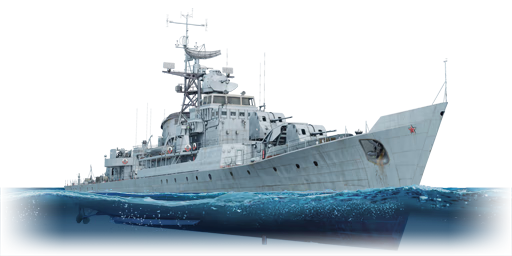
The Pr.50, SKR Yenot is a rank Soviet frigate with a battle rating of (AB), (RB), and (SB). It was introduced in Update "Raining Fire".
General info
Survivability and armour
Talk about the vehicle's armour. Note the most well-defended and most vulnerable zones, e.g. the ammo magazine. Evaluate the composition of components and assemblies responsible for movement and manoeuvrability. Evaluate the survivability of the primary and secondary armaments separately. Don't forget to mention the size of the crew, which plays an important role in fleet mechanics. Save tips on preserving survivability for the "Usage in battles" section. If necessary, use a graphical template to show the most well-protected or most vulnerable points in the armour.
Mobility
Write about the ship's mobility. Evaluate its power and manoeuvrability, rudder rerouting speed, stopping speed at full tilt, with its maximum forward and reverse speed.
| Mobility Characteristics | |||
|---|---|---|---|
| Game Mode | Upgrade Status | Maximum Speed (km/h) | |
| Forward | Reverse | ||
| AB | |||
| Upgraded | |||
| RB/SB | |||
| Upgraded | |||
Modifications and economy
Armament
Primary armament
The Pr. 50 gets access to three 100 mm B-34 naval cannons which are quite effective against enemy vessels. The weapons fire 15 rounds per minute, which is relatively good for a wepaon of its size, but suffers from a slow traverse rate similar to other Soviet naval cannons. The Pr. 50 gets access to three shells: a standard HE shell, a HE-TF time fuze shell or a HE-VT proximity fuzed shell. Of these, the HE shell is ideal against naval targets while the HE-VT is the most effective against aerial targets.
Secondary armament
The Pr. 50 carries two dual 37 mm 70-K mounts for anti-aircraft defence. The 70-K is the standard Soviet anti-aircraft gun and serves as a reliable counterpart to the 40 mm Bofors gun used by the allied nations. This gun is extremely similar to the Bofors as it features a similar design, and fires continuously rather than needing to reload. The guns will eventually jam, but the time it takes to jam the weapons is very long so jamming is not a great issue. The weapon gets access to three belts - default, AP and HE. The HE belt is usually the best belt as it is the most effective against enemy aircraft.
Additional armament
The Pr. 50 gets access to two 533 mm 53-38 torpedoes. The 53-38 torpedo is also found on most Soviet WWII-era destroyers, and is relatively mediocre as far as torpedoes go. In terms of damage-dealing capabilities, the torpedo is decidedly mediocre, having more explosive filler (300 kg of TNT) than the American torpedoes but less than the British and Japanese ones. However, the main drawback of the torpedo is its range - without the “torpedo mode” modification, the 53-38s are restricted to a range of just 4 kilometres, meaning that they are tied for the shortest-range large-ship mounted torpedoes along with the Italian destroyer torpedoes. The torpedo mode modification is necessary for hitting longer-ranged targets, but reduces the torpedo’s speed to just 56 km/h. In general, these torpedoes are a potent weapon against enemy bluewater ships if you can get close enough to fire them. On the Pr. 50, these may be used as a close-in backup weapon against ships that outgun you.
Usage in battles
Describe the technique of using this ship, the characteristics of her use in a team and tips on strategy. Abstain from writing an entire guide – don't try to provide a single point of view, but give the reader food for thought. Talk about the most dangerous opponents for this vehicle and provide recommendations on fighting them. If necessary, note the specifics of playing with this vehicle in various modes (AB, RB, SB).
Pros and cons
Summarise and briefly evaluate the vehicle in terms of its characteristics and combat effectiveness. Mark its pros and cons in the bulleted list. Try not to use more than 6 points for each of the characteristics. Avoid using categorical definitions such as "bad", "good" and the like - use substitutions with softer forms such as "inadequate" and "effective".
Pros:
Cons:
History
Describe the history of the creation and combat usage of the ship in more detail than in the introduction. If the historical reference turns out to be too long, take it to a separate article, taking a link to the article about the ship and adding a block "/History" (example: https://wiki.warthunder.com/(Ship-name)/History) and add a link to it here using the main template. Be sure to reference text and sources by using <ref></ref>, as well as adding them at the end of the article with <references />. This section may also include the ship's dev blog entry (if applicable) and the in-game encyclopedia description (under === In-game description ===, also if applicable).
Media
Excellent additions to the article would be video guides, screenshots from the game, and photos.
See also
Links to articles on the War Thunder Wiki that you think will be useful for the reader, for example:
- reference to the series of the ship;
- links to approximate analogues of other nations and research trees.
External links
Paste links to sources and external resources, such as:
- topic on the official game forum;
- encyclopedia page on the ship;
- other literature.
| USSR frigates | |
|---|---|
| Pr. 50 | Rosomacha · Yenot |
| Pr. 159 | SKR-1 |
| Pr. 35 | SKR-7 |
| Pr. 1331M | MPK Pr.1331M |