Difference between revisions of "F-14B"
m (→Pros and cons) (Tag: Visual edit) |
m (→Pros and cons) (Tag: Visual edit) |
||
| Line 225: | Line 225: | ||
* Lots of flares | * Lots of flares | ||
| − | * Has access to AIM-54C Phoenix ARH | + | * Has access to AIM-54C Phoenix ARH missiles |
* Has access to AIM-9L, all-aspects IR-guided missiles | * Has access to AIM-9L, all-aspects IR-guided missiles | ||
* Substantial upgrade to thrust and climb rate | * Substantial upgrade to thrust and climb rate | ||
Revision as of 11:54, 17 June 2023
| This page is about the American jet fighter F-14B. For the other version, see F-14A Early. |

Contents
Description
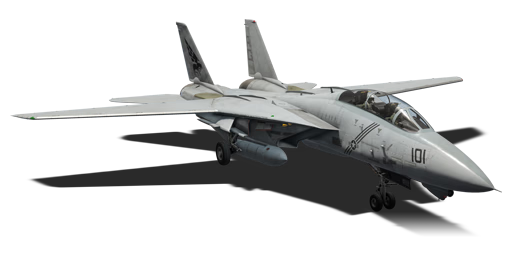
The F-14B Tomcat is a rank American jet fighter with a battle rating of (AB), (RB), and (SB). It was introduced in Update "La Royale".
General info
Flight performance
Describe how the aircraft behaves in the air. Speed, manoeuvrability, acceleration and allowable loads - these are the most important characteristics of the vehicle.
| Characteristics | Max speed (km/h at 10,668 m) |
Max altitude (metres) |
Turn time (seconds) |
Rate of climb (metres/second) |
Take-off run (metres) | |||
|---|---|---|---|---|---|---|---|---|
| AB | RB | AB | RB | AB | RB | |||
| Stock | 2,191 | 2,181 | 24.4 | 24.5 | 195.5 | 188.7 | 750 | |
| Upgraded | 2,238 | 2,215 | 23.6 | 24.0 | 256.6 | 224.8 | ||
Details
| Features | |||||
|---|---|---|---|---|---|
| Combat flaps | Take-off flaps | Landing flaps | Air brakes | Arrestor gear | Drogue chute |
| ✓ | ✓ | ✓ | ✓ | ✓ | X |
| Limits | ||||||
|---|---|---|---|---|---|---|
| Wings (km/h) | Gear (km/h) | Flaps (km/h) | Max Static G | |||
| Combat | Take-off | Landing | + | - | ||
| 1,555 | 1,200 | 873 | 416 | ~__ | ~__ | |
| Optimal velocities (km/h) | |||
|---|---|---|---|
| Ailerons | Rudder | Elevators | Radiator |
| < ___ | < ___ | < ___ | - |
Engine performance
| Engine | Aircraft mass | |||||
|---|---|---|---|---|---|---|
| Engine name | Number | Basic mass | Wing loading (full fuel) | |||
| General Electric F110-GE-400 | 2 | 1,897 kg | ___ kg/m2 | |||
| Engine characteristics | Mass with fuel (no weapons load) | Max Gross Weight | ||||
| Weight (each) | Type | _m fuel | __m fuel | __m fuel | ||
| ___ kg | ___ | _,___ kg | _,___ kg | _,___ kg | _,___ kg | |
| Maximum engine thrust @ 0 m (RB/SB) | Thrust to weight ratio @ 0 m (___%/WEP) | |||||
| Condition | 100% | ___%/WEP | _m fuel | __m fuel | __m fuel | MGW |
| Stationary | ___ kgf | ___ kgf | _.__ | _.__ | _.__ | _.__ |
| Optimal | ___ kgf (_ km/h) |
___ kgf (_ km/h) |
_.__ | _.__ | _.__ | _.__ |
Survivability and armour
Examine the survivability of the aircraft. Note how vulnerable the structure is and how secure the pilot is, whether the fuel tanks are armoured, etc. Describe the armour, if there is any, and also mention the vulnerability of other critical aircraft systems.
Modifications and economy
Armaments
Offensive armament
The F-14B is armed with:
- A choice between two presets:
- 1 x 20 mm M61A1 cannon, cheek-mounted (676 rpg)
- 1 x 20 mm M61A1 cannon + 60 x countermeasures
Suspended armament
The F-14B can be outfitted with the following ordnance presets:
- Without load
- 2 x AIM-9L Sidewinder missiles
- 4 x AIM-9L Sidewinder missiles
- 4 x AIM-9L Sidewinder missiles + 640 x countermeasures
- 6 x AIM-7M Sparrow missiles
- 6 x AIM-54A Phoenix missiles
- 6 x AIM-54C Phoenix missiles
- 14 x 500 lb LDGP Mk 82 bombs (7,000 lb total)
- 14 x 500 lb Mk 82 AIR bombs (7,000 lb total)
- 4 x 1,000 lb LDGP Mk 83 bombs (4,000 lb total)
- 4 x 1,000 lb Mk 83 AIR bombs (4,000 lb total)
- 4 x 2,000 lb LDGP Mk 84 bombs (8,000 lb total)
- 2 x 957 kg GBU-10 Paveway II bombs (1,914 kg total)
- 4 x 277 kg GBU-12 Paveway II bombs (1,108 kg total)
- 4 x 1,092 lb GBU-16 Paveway II bombs (4,368 lb total)
- 2 x 2,000 lb GBU-24 Paveway III bombs (4,000 lb total)
- 16 x Zuni Mk32 Mod 0 ATAP rockets
Custom loadout options
| 1 | 2 | 3 | 4 | 5 | 6 |  | |
|---|---|---|---|---|---|---|---|
| 500 lb LDGP Mk 82 bombs | 8¶ | 6 | |||||
| 500 lb Mk 82 AIR bombs | 8¶ | 6 | |||||
| 1,000 lb LDGP Mk 83 bombs | 2¶ | 2 | |||||
| 1,000 lb Mk 83 AIR bombs | 2¶ | 2 | |||||
| 2,000 lb LDGP Mk 84 bombs | 2¶ | 2 | |||||
| 957 kg GBU-10 Paveway II bombs | 2†‡¶ | ||||||
| 277 kg GBU-12 Paveway II bombs | 2† | † | |||||
| 1,092 lb GBU-16 Paveway II bombs | 2† | 2† | |||||
| 2,000 lb GBU-24 Paveway III bombs | 1†‡¶ | 1† | |||||
| Zuni Mk32 Mod 0 ATAP rockets | 8 | 8 | |||||
| AIM-7M Sparrow missiles | 1 | 2 | 1‡, 2¶ | 1 | |||
| AIM-9L Sidewinder missiles | 1* | 1* | 1* | 1* | |||
| AIM-54A Phoenix missiles | 1 | 2¶ | 2 | 1 | |||
| AIM-54C Phoenix missiles | 1 | 2¶ | 2 | 1 | |||
| Countermeasures | 160* | 160* | 160* | 160* | |||
| LANTIRN targeting pod | 1† | ||||||
| * AIM-9L missiles can be equipped with countermeasures on the same hardpoint †LANTIRN targeting pod must be equipped when carrying guided bombs ‡Single AIM-7M missile on hardpoint 4 cannot be equipped with GBU-10 or GBU-24 bombs on hardpoint 3 ¶ Dual AIM-7M missiles on hardpoint 4 cannot be equipped with marked options on hardpoint 3 | |||||||
Usage in battles
Describe the tactics of playing in the aircraft, the features of using aircraft in a team and advice on tactics. Refrain from creating a "guide" - do not impose a single point of view, but instead, give the reader food for thought. Examine the most dangerous enemies and give recommendations on fighting them. If necessary, note the specifics of the game in different modes (AB, RB, SB).
Pros and cons
Pros:
- Lots of flares
- Has access to AIM-54C Phoenix ARH missiles
- Has access to AIM-9L, all-aspects IR-guided missiles
- Substantial upgrade to thrust and climb rate
- Can be used for air-to-air combat and CAS with its guided bombs
- Great at one circle and two circle dogfights
- Equiped with tcs, great for simulator battles
Cons:
- Heavy plane
- Very hot engines attract IR-guided missiles
History
F-14B Upgrade Program
During the mid-1980s, the United States Navy (USN) made a momentous decision to enhance the F-14 airframe by introducing a remarkable new variant of the aircraft. Originally designated as the F-14A+, this exceptional aircraft would eventually earn the prestigious moniker of the F-14B. The USN's comprehensive modernization program aimed to bring the F-14 airframe up to date with the latest technological advancements. One of the key aspects of this program was the incorporation of numerous electronic upgrades. The F-14B underwent a significant avionics overhaul, introducing advanced systems that improved the aircraft's capabilities in various areas. These upgrades included enhanced RWR systems, improved target detection and tracking capabilities (introduction of the Television Camera System) and upgraded communication systems to ensure seamless integration with other elements of the modern battlefield. In addition to these upgrades, the F-14B also received a major boost in terms of its powerplant. The outdated engines of the original F-14A model were replaced with the more advanced F110-GE-400 engines. These engines provided increased thrust and improved fuel efficiency, resulting in enhanced performance and greater operational flexibility for the aircraft. The F-110 engines also offered improved reliability and reduced maintenance requirements, which were crucial factors in ensuring the overall effectiveness and availability of the F-14B.
Devblog
As part of the further upgrade of the Grumman F-14A carrier-based fighters, the aircraft were equipped with new General Electric F110-GE-400 turbojet engines with an afterburner, which significantly increased thrust, while reducing specific fuel consumption. The aircraft also received updated electronic equipment, as well as, unlike early production versions, the TISEO (Target Identification System, Electro Optical) optical target identification system. Initially, the updated Tomcats received the designation F-14A +.
This configuration was applied both to newly manufactured fighters, as well as to those already in service as an upgrade pack. In 1992, the designation was changed to F-14B in order to unify it with other military equipment in service. Subsequently, the F-14B were further upgraded in 1998 under the SLEP program. These jet fighters were in service with the US Navy aviation until 2006.
Media
Excellent additions to the article would be video guides, screenshots from the game, and photos.
See also
- Related development
External links
| USA jet aircraft | |
|---|---|
| Fighters | |
| F9F | F9F-2 · F9F-5 · F9F-8 |
| F-80 | F-80A-5 · F-80C-10 |
| F-84 | F-84B-26 · F-84F · F-84G-21-RE |
| F-86 | F-86A-5 · F-86F-25 · F-86F-2 · F-86F-35 |
| F-89 | F-89B · F-89D |
| F-100 | F-100D |
| F-104 | F-104A · F-104C |
| F-4 | F-4C Phantom II · F-4E Phantom II · F-4J Phantom II · F-4S Phantom II |
| F-5 | F-5A · F-5C · F-5E · F-20A |
| F-8 | F8U-2 · F-8E |
| F-14 | F-14A Early · ▄F-14A IRIAF · F-14B |
| F-15 | F-15A · F-15C MSIP II · F-15E |
| F-16 | F-16A · F-16A ADF · F-16C |
| Other | P-59A · F2H-2 · F3D-1 · F3H-2 · F4D-1 · F11F-1 |
| Strike Aircraft | |
| FJ-4 | FJ-4B · FJ-4B VMF-232 |
| A-4 | A-4B · A-4E Early |
| A-7 | A-7D · A-7E · A-7K |
| AV-8 | AV-8A · AV-8C · AV-8B Plus · AV-8B (NA) |
| A-10 | A-10A · A-10A Late · A-10C |
| F-111 | F-111A · F-111F |
| Other | A-6E TRAM · F-105D · F-117 |
| Bombers | |
| B-57 | B-57A · B-57B |