Difference between revisions of "ORP Garland"
(→Ammunition: Converted to transclusion) |
m (→Description) |
||
| Line 7: | Line 7: | ||
== Description == | == Description == | ||
<!-- ''In the first part of the description, cover the history of the ship's creation and military application. In the second part, tell the reader about using this ship in the game. Add a screenshot: if a beginner player has a hard time remembering vehicles by name, a picture will help them identify the ship in question.'' --> | <!-- ''In the first part of the description, cover the history of the ship's creation and military application. In the second part, tell the reader about using this ship in the game. Add a screenshot: if a beginner player has a hard time remembering vehicles by name, a picture will help them identify the ship in question.'' --> | ||
| − | The '''{{Specs|name}}''' is a | + | The '''{{Specs|name}}''' is a British-built G-class destroyer loaned to the Polish Navy in 1940, under the designation of ORP Garland. She operated as part of convoy escorts for almost the entirety of the Second World War and visited most of the war theatres. |
| − | + | She was introduced during [[Update "New Power"]] as a reward for [[Battle Pass: Season I]]. Ex-HMS Garland performs very similar to the playstyle of the sister ship already in the regular tree, the destroyer [[G-class (H89)|HMS Grafton (H89)]]. While, at the same time, having some pros and cons on her own. Such as the increased variety of secondary armaments that reinforce the support role of this class. Unfortunately, some drawbacks in mobility are present, as well as reductions in the main armament to increase the auxiliary armament. | |
| − | |||
| − | |||
| − | |||
| − | Unfortunately, some drawbacks in mobility are present, as well as reductions in the main armament to increase the auxiliary armament. | ||
== General info == | == General info == | ||
Revision as of 20:43, 4 November 2023


Contents
Description
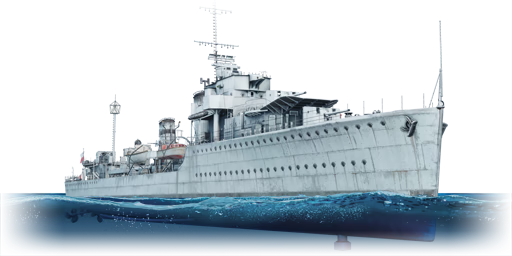
The G-class, ORP Garland (H37), 1942 is a British-built G-class destroyer loaned to the Polish Navy in 1940, under the designation of ORP Garland. She operated as part of convoy escorts for almost the entirety of the Second World War and visited most of the war theatres.
She was introduced during Update "New Power" as a reward for Battle Pass: Season I. Ex-HMS Garland performs very similar to the playstyle of the sister ship already in the regular tree, the destroyer HMS Grafton (H89). While, at the same time, having some pros and cons on her own. Such as the increased variety of secondary armaments that reinforce the support role of this class. Unfortunately, some drawbacks in mobility are present, as well as reductions in the main armament to increase the auxiliary armament.
General info
The Garland (H37) appears more aggressive than the escort destroyers Town (L45) and the Hunt (Family), this is thanks to her long and taller hull with a raked type of bow that provides increased sea-worthiness and enhanced cruising speed - at least before armaments refits. The destroyer can be differentiated from the similar G-class (H89) because of the Polish naval ensign with a horizontal bicoloured red and white, located in the stern of the ship. Another way to differentiate between the two is the Garland's light grey hull painting and the olive-green coloured upper decks. The Grafton's hull will be painted black with maroon red upper decks, though these colour schemes might vary in arctic scenarios. Garland's second funnel top is lower, a stern-located 120 mm cannon and one set of quadruple torpedo tubes is also missing.
Knowing this armament layout and visual differences should help to recognise these destroyers, since the ORP Garland lacks the destroyer vs. destroyer armaments of the HMS Grafton, and HMS Grafton lacks the support armament of the ORP Garland.
Survivability and armour
Talk about the vehicle's armour. Note the most well-defended and most vulnerable zones, e.g. the ammo magazine. Evaluate the composition of components and assemblies responsible for movement and manoeuvrability. Evaluate the survivability of the primary and secondary armaments separately. Don't forget to mention the size of the crew, which plays an important role in fleet mechanics. Save tips on preserving survivability for the "Usage in battles" section. If necessary, use a graphical template to show the most well-protected or most vulnerable points in the armour.
Mobility
Write about the ship's mobility. Evaluate its power and manoeuvrability, rudder rerouting speed, stopping speed at full tilt, with its maximum forward and reverse speed.
| Mobility Characteristics | |||
|---|---|---|---|
| Game Mode | Upgrade Status | Maximum Speed (km/h) | |
| Forward | Reverse | ||
| AB | |||
| Upgraded | |||
| RB/SB | |||
| Upgraded | |||
Modifications and economy
Armament
Primary armament
Provide information about the characteristics of the primary armament. Evaluate their efficacy in battle based on their reload speed, ballistics and the capacity of their shells. Add a link to the main article about the weapon: {{main|Weapon name (calibre)}}. Broadly describe the ammunition available for the primary armament, and provide recommendations on how to use it and which ammunition to choose.
| Penetration statistics | |||||||
|---|---|---|---|---|---|---|---|
| Ammunition | Type of warhead |
Penetration @ 0° Angle of Attack (mm) | |||||
| 1,000 m | 2,500 m | 5,000 m | 7,500 m | 10,000 m | 15,000 m | ||
| HE Mk.VIIA | HE | 35 | 35 | 35 | 35 | 35 | 35 |
| SAP Mk.VA | SAP | 116 | 92 | 63 | 44 | 33 | 29 |
| HE-TF Mk.VIIA | HE-TF | 35 | 35 | 35 | 35 | 35 | 35 |
| HE-VT Mk.VIIA | HE-VT | 35 | 35 | 35 | 35 | 35 | 35 |
| Shell details | ||||||||||||
|---|---|---|---|---|---|---|---|---|---|---|---|---|
| Ammunition | Type of warhead |
Velocity (m/s) |
Projectile mass (kg) |
Fuse delay (s) |
Fuse sensitivity (mm) |
Explosive mass (TNT equivalent) (g) |
Ricochet | |||||
| 0% | 50% | 100% | ||||||||||
| HE Mk.VIIA | HE | 808 | 22.68 | 0 | 0.1 | 3,000 | 79° | 80° | 81° | |||
| SAP Mk.VA | SAP | 808 | 22.68 | 0.015 | 5 | 900 | 47° | 60° | 65° | |||
| HE-TF Mk.VIIA | HE-TF | 808 | 22.68 | 0 | 0.1 | 3,000 | 79° | 80° | 81° | |||
| Proximity-fused shell details | ||||||||||||
|---|---|---|---|---|---|---|---|---|---|---|---|---|
| Ammunition | Type of warhead |
Velocity (m/s) |
Projectile mass (kg) |
Fuse delay (m) |
Fuse sensitivity (mm) |
Arming distance (m) |
Trigger radius (m) |
Explosive mass (TNT equivalent) (g) |
Ricochet | |||
| 0% | 50% | 100% | ||||||||||
| HE-VT Mk.VIIA | HE-VT | 808 | 22.68 | 0 | 0.1 | 244 | 23 | 3,000 | 79° | 80° | 81° | |
Secondary armament
Some ships are fitted with weapons of various calibres. Secondary armaments are defined as weapons chosen with the control Select secondary weapon. Evaluate the secondary armaments and give advice on how to use them. Describe the ammunition available for the secondary armament. Provide recommendations on how to use them and which ammunition to choose. Remember that any anti-air armament, even heavy calibre weapons, belong in the next section. If there is no secondary armament, remove this section.
| Penetration statistics | |||||||
|---|---|---|---|---|---|---|---|
| Ammunition | Type of warhead |
Penetration @ 0° Angle of Attack (mm) | |||||
| 100 m | 1,000 m | 2,000 m | 3,000 m | 4,000 m | 5,000 m | ||
| HE shell | HE | 6 | 6 | 6 | 6 | 6 | 6 |
| Mk.I shrapnel | Shrapnel* | 5 | 5 | 5 | 5 | 5 | 5 |
| Shell details | ||||||||||||
|---|---|---|---|---|---|---|---|---|---|---|---|---|
| Ammunition | Type of warhead |
Velocity (m/s) |
Projectile mass (kg) |
Fuse delay (m) |
Fuse sensitivity (mm) |
Explosive mass (TNT equivalent) (g) |
Ricochet | |||||
| 0% | 50% | 100% | ||||||||||
| HE shell | HE | 762 | 7.26 | 0 | 0.1 | 320 | 79° | 80° | 81° | |||
| Mk.I shrapnel | Shrapnel* | 617 | 7.94 | 0 | 0.1 | 180 | 62° | 69° | 73° | |||
Anti-aircraft armament
An important part of the ship's armament responsible for air defence. Anti-aircraft armament is defined by the weapon chosen with the control Select anti-aircraft weapons. Talk about the ship's anti-air cannons and machine guns, the number of guns and their positions, their effective range, and about their overall effectiveness – including against surface targets. If there are no anti-aircraft armaments, remove this section.
Additional armament
Describe the available additional armaments of the ship: depth charges, mines, torpedoes. Talk about their positions, available ammunition and launch features such as dead zones of torpedoes. If there is no additional armament, remove this section.
Usage in battles
Describe the technique of using this ship, the characteristics of her use in a team and tips on strategy. Abstain from writing an entire guide – don't try to provide a single point of view, but give the reader food for thought. Talk about the most dangerous opponents for this vehicle and provide recommendations on fighting them. If necessary, note the specifics of playing with this vehicle in various modes (AB, RB, SB).
Pros and cons
Pros:
- Large medium to short range anti-air firepower
- Dual-purpose main calibre guns, also with readiness of SAP rounds
- 8 x long-range torpedoes
Cons:
- Limited firepower with only 3 main calibre guns
- Inadequate crew size: out-classed when duelling late rank I and rank II destroyers
- Top speed is more similar to escort destroyers than combat-capable Fleet destroyers.
History
Describe the history of the creation and combat usage of the ship in more detail than in the introduction. If the historical reference turns out to be too long, take it to a separate article, taking a link to the article about the ship and adding a block "/History" (example: https://wiki.warthunder.com/(Ship-name)/History) and add a link to it here using the main template. Be sure to reference text and sources by using <ref></ref>, as well as adding them at the end of the article with <references />. This section may also include the ship's dev blog entry (if applicable) and the in-game encyclopedia description (under === In-game description ===, also if applicable)
Media
- Skins
- Images
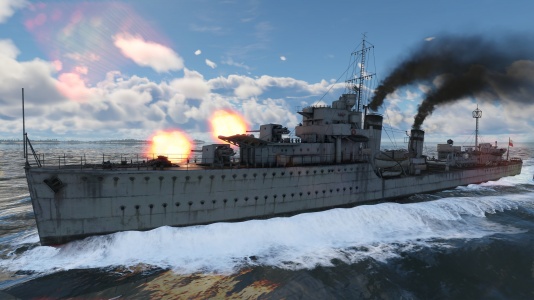
Garland devblog image

See also
Links to articles on the War Thunder Wiki that you think will be useful for the reader, for example:
- reference to the series of the ship;
- links to approximate analogues of other nations and research trees.
External links
Paste links to sources and external resources, such as:
- topic on the official game forum;
- other literature.
| Fairfield Shipbuilding and Engineering Company | |
|---|---|
| Destroyers | |
| G-class | ORP Garland |
| K-class | HMS Kelvin |
| Battle-class | HMS Cadiz |
| Hunt-class | La Combattante* |
| Light Cruisers | |
| Town-class | HMS Liverpool |
| Heavy Cruisers | |
| County-class | HMS Norfolk |
| Battlecruisers | |
| Renown-class | HMS Renown |
| *HMS Haldon in French service | |
| Britain destroyers | |
|---|---|
| Town-class | HMS Churchill · HMS Montgomery |
| V-class | HMS Valhalla · HMS Vega · HMS Verdun |
| G-class | HMS Grafton · ORP Garland |
| Hunt-class | HMS Calpe · HMS Brissenden |
| Tribal-class | HMCS Haida · HMS Eskimo · HMS Mohawk |
| J-class | HMS Jervis |
| K-class | HMS Kelvin |
| N-class | HMAS Nepal |
| Battle-class | HMS Armada · HMS Cadiz · HMAS Tobruk |
| Daring-class | HMS Daring · HMS Diamond · HMS Diana |
| Britain premium ships | |
|---|---|
| Motor torpedo boats | MTB-1(2) · MTB-422 · Fairmile D (5001) · HMS Gay Archer |
| Motor gun boats | MGB-75 · SGB Grey Goose |
| Gunboats | HMS Spey |
| Sub-chasers | LÉ Orla |
| Frigates | HMS Whitby |
| Destroyers | HMS Montgomery · HMS Valhalla · HMS Verdun · ORP Garland · HMS Jervis · HMCS Haida · HMS Mohawk · HMS Cadiz · HMS Diamond |
| Light cruisers | HMS Belfast |
| Battleships | HMS Iron Duke |