Difference between revisions of "USS Gearing"
(Added history, historical images and external links) (Tag: Visual edit) |
m (→Media) (Tag: Visual edit) |
||
| Line 90: | Line 90: | ||
File:USS Gearing (DD-710) underway in 1964.jpg|By U.S. Department of Defense - U.S. Navy All Hands magazine July 1964, p. 1., Public Domain, https://commons.wikimedia.org/w/index.php?curid=33846478 | File:USS Gearing (DD-710) underway in 1964.jpg|By U.S. Department of Defense - U.S. Navy All Hands magazine July 1964, p. 1., Public Domain, https://commons.wikimedia.org/w/index.php?curid=33846478 | ||
File:USS Gearing (DD-710) in heavy seas c1958.jpg|By USN - U.S. Navy All Hands magazine June 1958, p. 34., Public Domain, https://commons.wikimedia.org/w/index.php?curid=32551738 | File:USS Gearing (DD-710) in heavy seas c1958.jpg|By USN - U.S. Navy All Hands magazine June 1958, p. 34., Public Domain, https://commons.wikimedia.org/w/index.php?curid=32551738 | ||
| − | |||
</gallery> | </gallery> | ||
Revision as of 20:33, 19 June 2022

Contents
Description
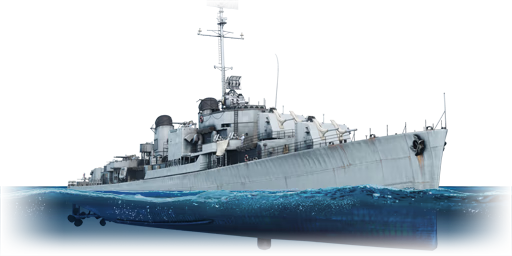
The Gearing-class, USS Gearing (DD-710), 1945 is a rank American destroyer with a battle rating of (AB), (RB), and (SB). It was introduced in Update "Danger Zone".
General info
Survivability and armour
Talk about the vehicle's armour. Note the most well-defended and most vulnerable zones, e.g. the ammo magazine. Evaluate the composition of components and assemblies responsible for movement and manoeuvrability. Evaluate the survivability of the primary and secondary armaments separately. Don't forget to mention the size of the crew, which plays an important role in fleet mechanics. Save tips on preserving survivability for the "Usage in battles" section. If necessary, use a graphical template to show the most well-protected or most vulnerable points in the armour.
Mobility
Write about the ship's mobility. Evaluate its power and manoeuvrability, rudder rerouting speed, stopping speed at full tilt, with its maximum forward and reverse speed.
| Mobility Characteristics | |||
|---|---|---|---|
| Game Mode | Upgrade Status | Maximum Speed (km/h) | |
| Forward | Reverse | ||
| AB | |||
| Upgraded | |||
| RB/SB | |||
| Upgraded | |||
Modifications and economy
Armament
Primary armament
Provide information about the characteristics of the primary armament. Evaluate their efficacy in battle based on their reload speed, ballistics and the capacity of their shells. Add a link to the main article about the weapon: {{main|Weapon name (calibre)}}. Broadly describe the ammunition available for the primary armament, and provide recommendations on how to use it and which ammunition to choose.
Secondary armament
Some ships are fitted with weapons of various calibres. Secondary armaments are defined as weapons chosen with the control Select secondary weapon. Evaluate the secondary armaments and give advice on how to use them. Describe the ammunition available for the secondary armament. Provide recommendations on how to use them and which ammunition to choose. Remember that any anti-air armament, even heavy calibre weapons, belong in the next section. If there is no secondary armament, remove this section.
Anti-aircraft armament
An important part of the ship's armament responsible for air defence. Anti-aircraft armament is defined by the weapon chosen with the control Select anti-aircraft weapons. Talk about the ship's anti-air cannons and machine guns, the number of guns and their positions, their effective range, and about their overall effectiveness – including against surface targets. If there are no anti-aircraft armaments, remove this section.
Additional armament
Describe the available additional armaments of the ship: depth charges, mines, torpedoes. Talk about their positions, available ammunition and launch features such as dead zones of torpedoes. If there is no additional armament, remove this section.
Usage in battles
Describe the technique of using this ship, the characteristics of her use in a team and tips on strategy. Abstain from writing an entire guide – don't try to provide a single point of view, but give the reader food for thought. Talk about the most dangerous opponents for this vehicle and provide recommendations on fighting them. If necessary, note the specifics of playing with this vehicle in various modes (AB, RB, SB).
Pros and cons
Summarise and briefly evaluate the vehicle in terms of its characteristics and combat effectiveness. Mark its pros and cons in the bulleted list. Try not to use more than 6 points for each of the characteristics. Avoid using categorical definitions such as "bad", "good" and the like - use substitutions with softer forms such as "inadequate" and "effective".
Pros:
Cons:
History
Design and Construction
Design work of the Gearing class started with the preceding Sumner class, which were themselves a modified Fletcher incorperating the new twin high angle twin mounts for the 5"/38 calbre guns. The Gearing design mainly evolves from the Sumner by increasing the length of the hull by 4.3 metres, allowing greater fuel storage and therefore increased range. The higher beam to length ratio also increased the top speed, most of the ships in the class achieving 36 knots. USS Gearing herself was commissioned on May 3rd 1945.
FRAM I Upgrades
During the 1960s, USS Gearing recieved the Fleet Rehabilitation and Modernization (FRAM) 1 upgrades. This converted the Gearing from a primarily anti aircraft destroyer into a dedicated anti submarine warfare destroyer. Modifications include the new advanced sonar, the ASROC anti-submarine torpedo launcher (also capable of launching nuclear depth charges), the Mk.44 torpedo and the DASH anti-submarine helicopter which had a range of 35km as well as the hangar and facilities needed to maintain it.
Service History
USS Gearing was comissoned a few months before the end of WW2 and trained crews for other destroyers until early October of 1945. Her immediate postwar career was spent in peacetime operations on the Atlantic side of the Americas before sailing into the Mediterranean in 1947 until 1948. Gearing would then operate around the Caribbean before taking part in Operation Frostbite, sailing into the Arctic to test and develop cold water techniques and equipment before returning to operate in the Caribbean and Mediterranean until 1961 when she took part in the negotiations for the Santa Maria hijacking. In the following year, Gearing would take part in the blockade of Cuba before moving on to operate in the Atlantic when diplomatic negotiation ended the crisis. After recieving the FRAM I upgrades she would continue her normal operations.
Gearing would be decomissioned in 1973 and then sold for scrap the following year.
Media

By U.S. Department of Defense - U.S. Navy All Hands magazine July 1964, p. 1., Public Domain, https://commons.wikimedia.org/w/index.php?curid=33846478

By USN - U.S. Navy All Hands magazine June 1958, p. 34., Public Domain, https://commons.wikimedia.org/w/index.php?curid=32551738
_underway_in_1964.jpg)
_in_heavy_seas_c1958.jpg)
See also
External links
- https://www.usnfleet.us/gearing-class
- https://youtu.be/MSTfyQ7p3hE
- https://www.history.navy.mil/research/histories/ship-histories/danfs/g/gearing.html
| Federal Shipbuilding and Drydock Company | |
|---|---|
| Gun Destroyers (DD) | |
| Somers-class | USS Somers |
| Fletcher-class | USS Fletcher |
| Allen M. Sumner-class | USS Sumner |
| Gearing-class | USS Gearing |
| Cruiser, Light (CL) | |
| Atlanta-class | USS Atlanta |
| USA destroyers | |
|---|---|
| Clemson-class | USS Welborn C. Wood · USS Barker · USS Litchfield |
| Farragut-class | USS Aylwin |
| Bagley-class | USS Bagley |
| Porter-class | USS Porter · USS Phelps · USS Moffett |
| Somers-class | USS Somers · USS Davis |
| Fletcher-class | USS Fletcher · USS Bennion · USS Cowell |
| Allen M. Sumner-class | USS Sumner |
| Gearing-class | USS Gearing · USS Frank Knox |
| Mitscher-class | USS Mitscher · USS Wilkinson |