Difference between revisions of "LeO 451 late"
(→Offensive armament: Updated) |
m (Preemptively Linking Art) |
||
| Line 1: | Line 1: | ||
{{Specs-Card | {{Specs-Card | ||
|code=leo_451_late | |code=leo_451_late | ||
| − | |images={{Specs-Card-Image|GarageImage_{{PAGENAME}}.jpg}} | + | |images={{Specs-Card-Image|GarageImage_{{PAGENAME}}.jpg|ArtImage_{{PAGENAME}}.png}} |
}} | }} | ||
Revision as of 02:38, 13 September 2021


Contents
Description
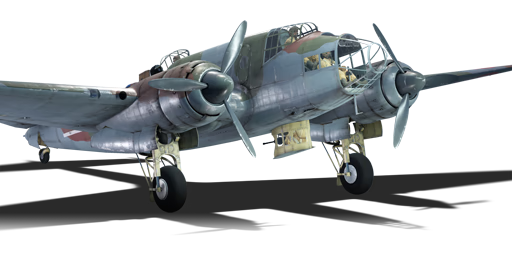
The LeO 451 late is a rank French bomber with a battle rating of (AB), (RB), and (SB). It was introduced in Update 1.79 "Project X".
General info
Flight performance
| Characteristics | Max Speed (km/h at 6,250 m) |
Max altitude (metres) |
Turn time (seconds) |
Rate of climb (metres/second) |
Take-off run (metres) | |||
|---|---|---|---|---|---|---|---|---|
| AB | RB | AB | RB | AB | RB | |||
| Stock | 466 | 451 | 31.3 | 32.2 | 3.1 | 3.1 | 550 | |
| Upgraded | 517 | 490 | 28.8 | 30.0 | 9.6 | 5.8 | ||
Details
| Features | ||||
|---|---|---|---|---|
| Combat flaps | Take-off flaps | Landing flaps | Air brakes | Arrestor gear |
| ✓ | ✓ | ✓ | X | X |
| Limits | ||||||
|---|---|---|---|---|---|---|
| Wings (km/h) | Gear (km/h) | Flaps (km/h) | Max Static G | |||
| Combat | Take-off | Landing | + | - | ||
| 385 | 366 | 270 | ~7 | ~5 | ||
| Optimal velocities (km/h) | |||
|---|---|---|---|
| Ailerons | Rudder | Elevators | Radiator |
| < 315 | < 310 | < 350 | > 340 |
Survivability and armour
- 12 mm behind the pilot
- 12 mm behind the dorsal gunner
- Self-sealing fuel tanks (2 in each wing)

Modifications and economy
Armaments
Offensive armament
The LeO 451 late is armed with:
- 1 x 7.5 mm MAC 1934 machine gun, nose-mounted (300 rpg)
Suspended armament
The LeO 451 late can be outfitted with the following ordnance:
- 16 x 50 kg G.A. MMN. 50 bombs (800 kg total)
- 7 x 100 kg No.1 bombs (700 kg total)
- 6 x 200 kg No.1 bombs + 1 x 100 kg No.1 bomb (1,300 kg total)
- 2 x 500 kg No.2 bombs + 4 x 200 kg No.1 bombs + 1 x 100 kg No.1 bomb (1,900 kg total)
Defensive armament
The LeO 451 late is defended by:
- 1 x 20 mm Hispano 404 cannon (120 rpg) + 2 x 7.5 mm MAC 1934 machine guns (750 rpg = 1,500 total), dorsal turret
- 1 x 7.5 mm MAC 1934 machine gun, ventral turret (500 rpg)
Usage in battles
The Leo 451 can be used as more than just a bomber. Due to the size of the aircraft, it is able to manoeuvre more like a heavy fighter allowing it to fight against other twin-engine aircraft or anything heavier. Unfortunately, the lack of proper offensive armament means that scoring hits will do little other than damage fuel and oil tank in most cases. In any kind of aerial combat, the dorsal gunner is one of the best options for scoring solid hits, especially when flying under other aircraft and firing upwards into them. Flying this close to get a shot comes with risks as flying in front of the enemies guns will also paint a target on your aircraft. For defending from fighters a good tactic is to gain some altitude so that when an enemy appears you can accelerate into a dive. A fast aircraft makes it much harder for fighters to close the distance giving the dorsal gunner and opportunity to do his job. While diving to make an aircraft fast can be a good thing, it is important to not go too fast as the wings are not invincible and will potentially rip off. Turning in this aircraft is relatively effective for a plane its size, though unfortunately, it does not handle like a sports car. Factors such as an empty bomb bay will increase its manoeuvrability to something closer to a heavy fighter.
When it comes to the ground attack role, the bombs are a gimmie, for destroying tanks and pillboxes, though, if lucky enough an entire armoured column may be destroyed. On the other hand, the nose gun can be used to attack lightly armoured ground targets such as trucks or anti-aircraft guns, while the 20 mm dorsal gun can be used to take out armoured cars.
Manual Engine Control
| MEC elements | ||||||
|---|---|---|---|---|---|---|
| Mixer | Pitch | Radiator | Supercharger | Turbocharger | ||
| Oil | Water | Type | ||||
| Controllable | Controllable Not auto controlled |
Controllable Not auto controlled |
Controllable Not auto controlled |
Separate | Not controllable 1 gear |
Not controllable |
Pros and cons
Pros:
- Dorsal gunner has large ammunition pool
- Comes included with an offensive armament
- Very manoeuvrable after the payload has been released
- Accelerates very fast in a dive
- Abilities allow for it to multifunction as a bomber, heavy fighter and attacker
- Powerful dorsal turret
Cons:
- Dorsal gunners main gun runs out of ammunition before the coaxial 7.5 mm machine gun
- Offensive armament is insufficient for most engagements
- Prone to engine fires
- Aircraft does not excel in any particular role
- Many blind spots for gunners
History

Development of the LeO 451 began in the early 1930s, after the newly formed Armée de l'air issued the so called Plan I, intended to increase the number of modern military aircraft available to the French Air Force. As part of this plan, the young Air Force was keen on expanding and developing their strategic bombing branch. However, as the already available bombers, such as the Farman F.221, were considered unsuitable for the needs of the Air Force, a set of specifications was issued for the development of a brand new bomber. Among other aircraft manufacturers, Lioré et Olivier (which would be nationalized as part of SNCASE) also submitted their LeO 45 design. Being a long-time supplier to the French Air Force, Lioré et Olivier had a reputation of building reliable and effective bombers dating back to WW1. Thanks to this, the further development of the LeO 45 was approved. The first prototype (LeO 45-01), powered by a pair of Hispano-Suiza engines, took flight on 16 January 1937. Despite showing some minor issues, the LeO 45 prototype displayed excellent performance. A second prototype, equipped with a pair of Gnome-Rhone engines was also constructed and subsequently designated LeO 451-01. Testing of the 451 prototype began in October 1938.
However, due to various production issues associated with the Gnome-Rhone engine, production of the LeO 451 was delayed, beginning only in late 1938. Although the Armée de l'air only fielded a handful of operational LeO 451 bombers at the outbreak of WW2, their number would rise up prior to the Invasion of France in May 1940. During this chapter of WW2, the LeO 451 saw wide use against both advancing German forces on the east and Italian forces on the south. While the aircraft suffered great losses at the hands of Luftwaffe's superior fighters and the Wehrmacht's relentless anti-air guns, it fared a lot better on the southern front against Italian forces. Nonetheless, the LeO 451 did eventually retire in September 1957 as the final pre-war French aircraft to leave active duty.
- From Devblog
Media
Excellent additions to the article would be video guides, screenshots from the game, and photos.
See also
- LeO 451 early - Early variant of the LeO 451
External links
| Lioré et Olivier (SNCASE) | |
|---|---|
| Bombers | LeO 451 early · LeO 451 late |
| France bombers | |
|---|---|
| Farman | F.222.2 · N.C.223.3 |
| Latécoère | Late 298D |
| Potez | Potez 633 |
| Liore et Olivier | LeO 451 early · LeO 451 late |
| Bloch | M.B.174A-3 · M.B.162 · M.B.175T |
| American | V-156-F · Martin 167-A3 · ▄A-35B · ▄SB2C-5 · B-26C · ▄PBY-5A Late · ▄PB4Y-2 |
| British | Lancaster MR.7 |