Difference between revisions of "YAH-64"
m (Minor edits for the names of the companies in the description) (Tag: Visual edit) |
m (→Survivability and armour) |
||
| (11 intermediate revisions by 5 users not shown) | |||
| Line 11: | Line 11: | ||
== Description == | == Description == | ||
<!-- ''In the description, the first part should be about the history of and the creation and combat usage of the helicopter, as well as its key features. In the second part, tell the reader about the helicopter in the game. Insert a screenshot of the vehicle, so that if the novice player does not remember the vehicle by name, he will immediately understand what kind of vehicle the article is talking about.'' --> | <!-- ''In the description, the first part should be about the history of and the creation and combat usage of the helicopter, as well as its key features. In the second part, tell the reader about the helicopter in the game. Insert a screenshot of the vehicle, so that if the novice player does not remember the vehicle by name, he will immediately understand what kind of vehicle the article is talking about.'' --> | ||
| − | Following the cancellation of the Lockheed AH-56 Cheyenne | + | Following the cancellation of the Lockheed AH-56 Cheyenne on August 9, 1972, as a result of its huge airframe and poor all-weather performance, the US Army launched the Advanced Attack Helicopter (AAH) program. Drawing from the experience of the Vietnam War, an attack helicopter was requested with a lower minimum top speed of 269 km/h, a twin-engine configuration for better survivability, heavier weaponry, and a longer combat radius than the [[AH-1 (Family)|AH-1 Cobra]] already in service. Bell, the Boeing Vertol/Grumman group, Hughes, Lockheed Martin, and Sikorsky all submitted proposals for the new AAH program. In July 1973, the US Department of Defense chose Bell and Hughes as the final candidates, and both companies were instructed to construct their prototype helicopters for flight testing. Hughes' prototype '''YAH-64''' first flew on September 30, 1975, whereas Bell's prototype YAH-63 first flew on October 1, 1975. In 1976, the YAH-64 was chosen, primarily due to its more damage-tolerant four-blade main rotor and more stable landing gear layout. Initially, the US Army intended that the new helicopter would be armed with a 30 mm cannon and 16 TOW ATGMs. However, as the still-in-development air-to-ground missile (AGM-114) Hellfire promised better range and lethality than the TOW ATGM, the anti-tank missile armament specification was later changed to 16 AGM-114 Hellfires, which became the mainstay of the US Army attack helicopter anti-armour weaponry. |
| − | Introduced in | + | Introduced in [[Update "Direct Hit"]], the YAH-64 is a two-seat, twin-engine ground attack helicopter with the gunner (front) and pilot (rear) sitting in tandem, similar to the AH-1 Cobra. Equipped with a thermal imaging device and armed with the AGM-114B Hellfires as its primary anti-armour weapon, it can easily spot targets from a long distance and engage targets as far away as 8 km using semi-active laser homing (SALH), which is significantly beyond the range of most SPAA vehicles, with the exception of some radar-guided SAM missiles. Players can also choose to equip Hydra-70 M247 rockets for light anti-armour purposes, which is made easier by the installation of a ballistic computer on board. As an early prototype of the iconic AH-64 Apache attack helicopter, the YAH-64 lacks IRCM and flare/chaff countermeasures. It also lacks any air-to-air missiles, limiting its capacity to engage air targets effectively. |
== General info == | == General info == | ||
| Line 38: | Line 38: | ||
=== Survivability and armour === | === Survivability and armour === | ||
{{Specs-Heli-Armour}} | {{Specs-Heli-Armour}} | ||
| − | <!-- ''Examine the survivability of the helicopter. Note how vulnerable the structure is and how secure the pilot is, whether the fuel tanks are armoured, etc. Describe the armour, if there is any, and also mention the vulnerability of other critical systems.'' --> | + | <!-- ''Examine the survivability of the helicopter. Note how vulnerable the structure is and how secure the pilot is, whether the fuel tanks are armoured, etc. Describe the armour, if there is any, and also mention the vulnerability of other critical systems.'' -->[[File:YAH-64 bulletproof glass.png|thumb|'''Red areas''' represent the '''bulletproof glass''' (likely around the rear seat where the pilot is located, with around 22 mm of thickness). |
| − | '' | + | |
| + | '''Green areas''' indicate the '''armor sheets''' (surrounding both the pilot and co-pilot/gunner, made of Kevlar and about 20 mm thick).]] | ||
| + | The YAH-64 features bulletproof glass around the pilot's cockpit in the rear seat, with a thickness of about 22 mm. Both the pilot and the co-pilot/gunner (CPG) have layers of Kevlar armor around their seats, with a thickness of 20 mm. However, if someone decides to fly aggressively in this helicopter, the CPG is most likely to be the first to get injured or knocked out. This is because the gunner's position lacks the same bulletproof glass protection as the pilot’s, though the gunner's canopy can sometimes stop 12.7 mm rounds, such as those fired from German tanks. | ||
=== Modifications and economy === | === Modifications and economy === | ||
| Line 67: | Line 69: | ||
{{Specs-Heli-Suspended}} | {{Specs-Heli-Suspended}} | ||
<!-- ''Describe the helicopter's suspended armament: additional cannons under the winglets, any bombs, and rockets. Since any helicopter is essentially only a platform for suspended weaponry, this section is significant and deserves your special attention. If there is no suspended weaponry remove this subsection.'' --> | <!-- ''Describe the helicopter's suspended armament: additional cannons under the winglets, any bombs, and rockets. Since any helicopter is essentially only a platform for suspended weaponry, this section is significant and deserves your special attention. If there is no suspended weaponry remove this subsection.'' --> | ||
| − | |||
| − | The '''''{{PAGENAME}}''''' can be outfitted with the following ordnance | + | The '''''{{PAGENAME}}''''' can be outfitted with the following ordnance: |
| − | |||
| − | |||
| − | |||
| − | |||
| − | |||
| − | |||
{| class="wikitable" style="text-align:center" width="100%" | {| class="wikitable" style="text-align:center" width="100%" | ||
|- | |- | ||
| Line 82: | Line 77: | ||
| rowspan="3" width="20%" | <div class="ttx-image">[[File:Hardpoints_{{PAGENAME}}.png]]</div> | | rowspan="3" width="20%" | <div class="ttx-image">[[File:Hardpoints_{{PAGENAME}}.png]]</div> | ||
|- | |- | ||
| − | ! Hydra-70 M247 rockets | + | ! [[Hydra-70 M247]] rockets |
| 19 || 19 || 19 || 19 | | 19 || 19 || 19 || 19 | ||
|- | |- | ||
| − | ! AGM-114B Hellfire missiles | + | ! [[AGM-114B Hellfire]] missiles |
| 2, 4 || 2, 4 || 2, 4 || 2, 4 | | 2, 4 || 2, 4 || 2, 4 || 2, 4 | ||
|- | |- | ||
|} | |} | ||
| + | |||
| + | {{Navigation-Start|Default weapon presets}} | ||
| + | {{Navigation-First-Simple-Line}} | ||
| + | |||
| + | * Without load | ||
| + | * 76 x Hydra-70 M247 rockets | ||
| + | * 8 x AGM-114B Hellfire missiles | ||
| + | * 16 x AGM-114B Hellfire missiles | ||
| + | {{Navigation-End}} | ||
== Usage in battles == | == Usage in battles == | ||
| Line 146: | Line 150: | ||
* ''other literature.'' | * ''other literature.'' | ||
| + | {{AirManufacturer Hughes}} | ||
{{USA helicopters}} | {{USA helicopters}} | ||
{{Squadron helicopters}} | {{Squadron helicopters}} | ||
Latest revision as of 03:58, 7 November 2024
| This page is about the American attack helicopter YAH-64. For other versions, see AH-64 (Family). |

Contents
Description
Following the cancellation of the Lockheed AH-56 Cheyenne on August 9, 1972, as a result of its huge airframe and poor all-weather performance, the US Army launched the Advanced Attack Helicopter (AAH) program. Drawing from the experience of the Vietnam War, an attack helicopter was requested with a lower minimum top speed of 269 km/h, a twin-engine configuration for better survivability, heavier weaponry, and a longer combat radius than the AH-1 Cobra already in service. Bell, the Boeing Vertol/Grumman group, Hughes, Lockheed Martin, and Sikorsky all submitted proposals for the new AAH program. In July 1973, the US Department of Defense chose Bell and Hughes as the final candidates, and both companies were instructed to construct their prototype helicopters for flight testing. Hughes' prototype YAH-64 first flew on September 30, 1975, whereas Bell's prototype YAH-63 first flew on October 1, 1975. In 1976, the YAH-64 was chosen, primarily due to its more damage-tolerant four-blade main rotor and more stable landing gear layout. Initially, the US Army intended that the new helicopter would be armed with a 30 mm cannon and 16 TOW ATGMs. However, as the still-in-development air-to-ground missile (AGM-114) Hellfire promised better range and lethality than the TOW ATGM, the anti-tank missile armament specification was later changed to 16 AGM-114 Hellfires, which became the mainstay of the US Army attack helicopter anti-armour weaponry.
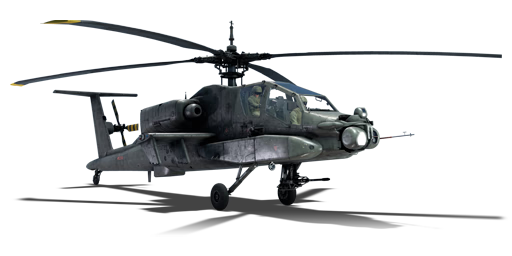
Introduced in Update "Direct Hit", the YAH-64 is a two-seat, twin-engine ground attack helicopter with the gunner (front) and pilot (rear) sitting in tandem, similar to the AH-1 Cobra. Equipped with a thermal imaging device and armed with the AGM-114B Hellfires as its primary anti-armour weapon, it can easily spot targets from a long distance and engage targets as far away as 8 km using semi-active laser homing (SALH), which is significantly beyond the range of most SPAA vehicles, with the exception of some radar-guided SAM missiles. Players can also choose to equip Hydra-70 M247 rockets for light anti-armour purposes, which is made easier by the installation of a ballistic computer on board. As an early prototype of the iconic AH-64 Apache attack helicopter, the YAH-64 lacks IRCM and flare/chaff countermeasures. It also lacks any air-to-air missiles, limiting its capacity to engage air targets effectively.
General info
Flight performance
| Characteristics | Max Speed (km/h at 1,000 m) |
Max altitude (metres) | |
|---|---|---|---|
| AB | RB | ||
| Stock | 278 | 262 | |
| Upgraded | 321 | 300 | |
Survivability and armour

The YAH-64 features bulletproof glass around the pilot's cockpit in the rear seat, with a thickness of about 22 mm. Both the pilot and the co-pilot/gunner (CPG) have layers of Kevlar armor around their seats, with a thickness of 20 mm. However, if someone decides to fly aggressively in this helicopter, the CPG is most likely to be the first to get injured or knocked out. This is because the gunner's position lacks the same bulletproof glass protection as the pilot’s, though the gunner's canopy can sometimes stop 12.7 mm rounds, such as those fired from German tanks.
Modifications and economy
Armaments
| Ballistic Computer | ||
|---|---|---|
| CCIP (Guns) | CCIP (Rockets) | CCIP (Bombs) |
 |
|

|
Offensive armament
The YAH-64 is armed with:
- 1 x 30 mm M230E-1 cannon, chin turret (1,200 rpg)
Suspended armament
The YAH-64 can be outfitted with the following ordnance:
| 1 | 2 | 3 | 4 |  | |
|---|---|---|---|---|---|
| Hydra-70 M247 rockets | 19 | 19 | 19 | 19 | |
| AGM-114B Hellfire missiles | 2, 4 | 2, 4 | 2, 4 | 2, 4 |
| Default weapon presets | |
|---|---|
| |
Usage in battles
Describe the tactics of playing in a helicopter, the features of using the helicopter in a team and advice on tactics. Refrain from creating a "guide" - do not impose a single point of view, but instead, give the reader food for thought. Examine the most dangerous enemies and give recommendations on fighting them. If necessary, note the specifics of the game in different modes (AB, RB, SB).
Pros and cons
Pros:
- Activation of 3rd person lock by changing MFD on the pilot's view
- Amazing 30 mm cannon, can easily take out most tanks, and when locked can take out jets and helicopters too
- Can carry up to 16 Hellfire air-to-ground missiles
- Can use ballistic computer to dramatically increase the effectiveness of Hydra rockets
- Can lock targets for 30 mm cannon to automatically track
- Excellent thermals
- Well armoured for a helicopter, can take 2-3 critical hits to take it down, may survive hits from SAMs
Cons:
- Not equipped with air-to-air missiles
- Does not have as many armament options as the regular AH-64
- The 30 mm cannon is relatively inaccurate
- Lack of IRCM and countermeasures
History
Describe the history of the creation and combat usage of the helicopter in more detail than in the introduction. If the historical reference turns out to be too long, take it to a separate article, taking a link to the article about the vehicle and adding a block "/History" (example: https://wiki.warthunder.com/(Vehicle-name)/History) and add a link to it here using the main template. Be sure to reference text and sources by using <ref></ref>, as well as adding them at the end of the article with <references />. This section may also include the vehicle's dev blog entry (if applicable) and the in-game encyclopedia description (under === In-game description ===, also if applicable).
Media
- Skins
- Videos
See also
Links to the articles on the War Thunder Wiki that you think will be useful for the reader, for example:
- reference to the series of the helicopter;
- links to approximate analogues of other nations and research trees.
External links
Paste links to sources and external resources, such as:
- topic on the official game forum;
- other literature.
| Hughes Helicopters, Inc. | |
|---|---|
| Helicopters | |
| Attack | YAH-64 |
| The Hughes Helicopters, Inc. was sold to McDonnell Douglas in 1984 to form the subsidiary McDonnell Douglas Helicopter Systems and later MD Helicopters. | |
| USA helicopters | |
|---|---|
| Attack | |
| Black Hawk | MH-60L DAP |
| Choctaw | H-34 |
| Cobra | AH-1F · AH-1G · AH-1Z |
| SuperCobra | AH-1W |
| Kiowa | OH-58D |
| Little Bird | AH-6M |
| Apache | YAH-64 · AH-64A · ▃AH-64A Peten · AH-64A (GR) · AH-64D |
| Utility | |
| Huey | UH-1B · UH-1C · UH-1C XM-30 |
| Squadron helicopters | |
|---|---|
| USA | YAH-64 |
| Britain | Superhind |