Difference between revisions of "Ju 88 C-6"
(Edits) (Tag: Visual edit) |
U178117757 (talk | contribs) m (→Flight performance: AB and RB stock performance) (Tag: Visual edit) |
||
| Line 29: | Line 29: | ||
|- | |- | ||
! Stock | ! Stock | ||
| − | | | + | | 466 || 450 || rowspan="2" | {{Specs|ceiling}} || 30.6 || 32.0 || 5.0 || 5.0 || rowspan="2" | 730 |
|- | |- | ||
! Upgraded | ! Upgraded | ||
Latest revision as of 01:45, 1 September 2024
| This page is about the German twin-engine fighter Ju 88 C-6. For other versions, see Ju 88 (Family). |

Contents
Description
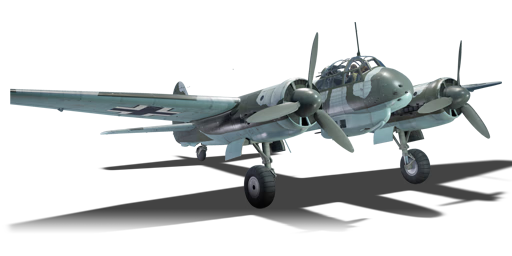
The Ju 88 C-6 is a rank German twin-engine fighter with a battle rating of (AB), (RB), and (SB). It was introduced in Update 1.65 "Way of the Samurai".
General info
Flight performance
| Characteristics | Max Speed (km/h at 5,600 m) |
Max altitude (metres) |
Turn time (seconds) |
Rate of climb (metres/second) |
Take-off run (metres) | |||
|---|---|---|---|---|---|---|---|---|
| AB | RB | AB | RB | AB | RB | |||
| Stock | 466 | 450 | 30.6 | 32.0 | 5.0 | 5.0 | 730 | |
| Upgraded | 514 | 490 | 27.6 | 29.0 | 10.9 | 7.6 | ||
Details
| Features | ||||
|---|---|---|---|---|
| Combat flaps | Take-off flaps | Landing flaps | Air brakes | Arrestor gear |
| ✓ | ✓ | ✓ | X | X |
| Limits | ||||||
|---|---|---|---|---|---|---|
| Wings (km/h) | Gear (km/h) | Flaps (km/h) | Max Static G | |||
| Combat | Take-off | Landing | + | - | ||
| 675 | 457 | 428 | 280 | ~12 | ~7 | |
| Optimal velocities (km/h) | |||
|---|---|---|---|
| Ailerons | Rudder | Elevators | Radiator |
| < 350 | < 360 | < 370 | > 331 |
Survivability and armour
- 12 mm steel - nose bulkhead in front of cockpit
- 12 mm steel - below / behind belly gunner
- 12 mm steel - pilot's seat
- 20 mm steel - bulkhead behind cockpit
- 60 mm bulletproof glass - armoured windscreen
- 58 mm bulletproof glass - cockpit sides
- 60 mm bulletproof glass - top gunner
- Self-sealing fuel tanks (4 in each wing)
Modifications and economy
Armaments
Offensive armament
The Ju 88 C-6 is armed with:
- 1 x 20 mm MG FF/M cannon, nose-mounted (120 rpg)
- 2 x 20 mm MG FF/M cannons, chin-mounted (120 rpg = 240 total)
- 3 x 7.92 mm MG 17 machine guns, nose-mounted (1,000 rpg top/left + 800 rpg right = 2,800 total)
Suspended armament
The Ju 88 C-6 can be outfitted with the following ordnance:
- Without load
- 10 x 50 kg SC50JA bombs (500 kg total)
Defensive armament
The Ju 88 C-6 is defended by:
- 2 x 7.92 mm MG 81 machine guns, dorsal turret (1,000 rpg = 2,000 total)
- 2 x 7.92 mm MG 81 machine guns, ventral turret (1,800 + 900 = 2,700 total)
Usage in battles
Bombers are often the main target for Ju 88 pilots. They can be easily caught and disposed of with the powerful cannons. Luckily, many bombers at this BR have only light machine guns as defensive armament, making them easy targets and not particularly threatening. However, there are some exceptions.
Beaufort Mk VIII - The Beaufort is fast and has a powerful twin .50 cal turret at the back. This can engage you at long range and cause serious damage to your aircraft. Try to approach it from underneath or in a head on, a blind spot for the defensive .50 cal turret.
B-34 - Same as the Beaufort, it has a powerful turret with twin .50 cals. Approaching from behind is very dangerous. This aircraft also has good offensive armament, so approaching from the front is dangerous too. The best option is to hit it from underneath.
Manual Engine Control
| MEC elements | ||||||
|---|---|---|---|---|---|---|
| Mixer | Pitch | Radiator | Supercharger | Turbocharger | ||
| Oil | Water | Type | ||||
| Not controllable | Controllable Auto control available |
Controllable Not auto controlled |
Controllable Not auto controlled |
Separate | Not controllable 1 gear |
Not controllable |
Pros and cons
Pros:
- 3 x 20 mm MG FF/M cannons with Minengeschoß rounds that will make short work of any air target
- All offensive armament is centre-mounted, making them extremely deadly
- Decent defensive armament of 7.92 mm with good coverage
- Internal bomb bay, meaning the bombload affects weight, but not drag
- Good climb rate
- Durable airframe
- Manoeuvrable for a heavy fighter/bomber
- Ability to perform multiple roles such as a bomber, ground attacker, and heavy fighter
- Gets the attacker spawn in AB
Cons:
- Guns are sighted to aim below the nose tip of the plane, making it very awkward to aim in a dogfight
- Single-seat fighters are much more manoeuvrable
- Slow plane that presents itself as a large target
- Cannons fire with sluggish muzzle velocity and rate of fire
- Relatively low wing rip speed somewhat limits effectiveness at diving
- Engines are easily damaged, and the Ju 88 C-6 has a hard time flying with just one engine
- Prone to fires
- Locks up in dives, making it hard to pull out when getting near wing rip speed
- Although it can perform different roles, it excels at none of them
- No airbrakes, unlike the bomber variants of Ju 88 series
History
Born as a bomber quickly and Ju 88 is the most important forces during the second world war the German air force, well done to include tactical, anti-ship, remote surveillance, water and even the night air, a series of tasks, with excellent performance and is almost omnipotent domestic for Ju 88 did as a day of heavy fighter used.
After the Ju 88 was put into production, the Luftwaffe, which was still fascinated by the ejector aircraft, immediately thought of the possibility of developing the Ju 88 C into a day fighter. Under this idea, several Ju 88 C with specially enhanced forward firing firepower were produced for demonstration. Satisfied with the results of the early tests, the RLM ordered a small field test, and on 21 February 1940 KG30 received a batch of Ju 88 C-2s to form an additional squadron of evicters.
In the report submitted to the RLM, the performance and role of Ju 88 C were fully affirmed. The squadron leader pointed out that its excellent handling, long range and ability to attack under bad weather conditions were fully competent for the role positioning of the evictor, which was enough to pose a serious threat to enemy bombers. It was suggested that Ju 88 C be put into formal production and used on a large scale. However, in response to the opening of the British night bombing, the squadron was adapted into a night fighting unit.
After a long wait, the opportunity finally came. Although the British decimated the French Navy in Operation Crossbow to save her from falling into German hands, the U-boat pack can now launch a crushing battle from the west coast of France, and they will be more deadly than their predecessors in the last Great war. For the first two years of the war, the Air Force used the Fw 200 to support U-boat operations, but with the escalation of war intensity, the firepower and mobility of the Fw 200 were insufficient, and the range of the Bf 110 and Fw 190 was insufficient to support deep ocean operations, so the Luftwaffe began to use the Ju 88 C-6.
After a series of complicated preparation and reorganization, the Fifth KG40 Brigade using Ju 88 C-6 was formally established in July 1942. Compared with the previous Ju 88 C-2, the C-6 changed the engine to improve the speed and maneuverability, and the forward fire and self-defense firepower were also further improved. Perfect for deep ocean hunting Allied anti-submarine aircraft and bombers.
Over a period of two years, the battalion achieved a total of 109 confirmed and 3 probable victories, at the cost of 91 Ju 88s lost in action, 30 lost to mechanical problems, bad weather or unknown causes, 222 killed or missing, 58 killed in accidents, 7 captured, 51 wounded, and more than 100 wounded. These results were pitiful compared with those of the single-engine fighter units, especially on the Eastern Front, and were almost forgotten after the war, but the battalion was originally set up to support U-boat operations and did its best to do so.
Media
- Skins
- Videos
See also
Links to the articles on the War Thunder Wiki that you think will be useful for the reader, for example:
- reference to the series of the aircraft;
- links to approximate analogues of other nations and research trees.
External links
| Junkers Aircraft and Motor Works (Junkers Flugzeug- und Motorenwerke Aktiengesellschaft) | |
|---|---|
| Fighters | Ju 88 C-6 · Ju 388 J |
| Strike Aircraft | |
| Ju 87 | Ju 87 G-1 · Ju 87 G-2 |
| Bombers | Ju 88 A-1 · Ju 88 A-4 · Ju 188 A-2 · Ju 288 C |
| Ju 87 | Ju 87 B-2 · Ju 87 D-3 · Ju 87 D-5 · Ju 87 R-2 · Ju 87 R-2 Libya |
| Export | ▄Ju 87 D-3 · ▄Ju 87 R-2 · ▄Ju 88 A-4 |
| Germany twin-engine fighters | |
|---|---|
| Messerschmitt | Bf 109 Z-1 |
| Me 410 A-1/U2 · Me 410 B-1/U2 | |
| Dornier | Do 17 Z-7 · Do 217 J-1 · Do 217 J-2 · Do 217 N-1 · Do 217 N-2 |
| Focke-Wulf | Ta 154 A-1 |
| Junkers | Ju 88 C-6 · Ju 388 J |