Difference between revisions of "Beaufighter Mk VIc"
(→See also) |
m (very small edit because there was an error in the torpedo type) (Tag: Visual edit) |
||
| (21 intermediate revisions by 9 users not shown) | |||
| Line 1: | Line 1: | ||
| + | {{Specs-Card|code=beaufighter_mk6c}} | ||
{{About | {{About | ||
| − | | about = British | + | | about = British twin-engine fighter '''{{PAGENAME}}''' |
| + | | and | ||
| usage = other versions | | usage = other versions | ||
| − | | link = Beaufighter | + | | link-1 = Beaufighter Mk X |
| − | + | | link-2 = Beaufighter Mk 21 | |
| − | |||
| − | |||
| − | |||
}} | }} | ||
== Description == | == Description == | ||
<!-- ''In the description, the first part should be about the history of and the creation and combat usage of the aircraft, as well as its key features. In the second part, tell the reader about the aircraft in the game. Insert a screenshot of the vehicle, so that if the novice player does not remember the vehicle by name, he will immediately understand what kind of vehicle the article is talking about.'' --> | <!-- ''In the description, the first part should be about the history of and the creation and combat usage of the aircraft, as well as its key features. In the second part, tell the reader about the aircraft in the game. Insert a screenshot of the vehicle, so that if the novice player does not remember the vehicle by name, he will immediately understand what kind of vehicle the article is talking about.'' --> | ||
| − | The '''{{Specs|name}}''' is a rank {{Specs|rank}} British | + | [[File:GarageImage_{{PAGENAME}}.jpg|420px|thumb|left]] |
| + | {{break}} | ||
| + | The '''{{Specs|name}}''' is a rank {{Specs|rank}} British twin-engine fighter {{Battle-rating}}. This aircraft has been in the game since the start of the Open Beta Test prior to Update 1.27. | ||
| − | The Beaufighter Mk | + | The Beaufighter Mk 6 is one of the best early-tiered heavy fighters. When its engines and survivability are fully upgraded, it is truly a bomber killer to behold, capable of bringing down any rank 1, 2 or 3 planes with ease. Unfortunately, there are several drawbacks to the amazing power of the 4 x Hispano 20mm cannons. You will normally spawn quite high, so use that to your advantage when attacking enemy planes. The recommended speed of this plane is only around 500 km/h (310 mph). Any higher results in severe and poor handling, making the heavy armament useless if your quarry turns. Therefore, the Beaufighter is not suited for BnZ, but better for head-on and tail-end combat. If you are caught by any single-engine fighter, try to dive and climb. If that does not work, resort to the turret or turning. The high fire rate of the turret makes it especially effective for pilot sniping if you are accurate enough. |
== General info == | == General info == | ||
| − | === Flight | + | === Flight Performance === |
| − | + | The Beaufighter Mk 6c is very stable because of its large size and 2 engines. It reaches speeds of 516 k/h in AB and 498 k/h in RB so it has a considerable amount of speed considering its size. Same as for its speed, it is rather maneuverable if you use the flaps correctly and you do not stall. Stalling is a rather large issue in this plane because of it's ok climb rate, an enemy fighter will often out turn you and once it's behind you, you can only rely on your gunner. The Mk 6c hold one Mk12 torpedo | |
| − | |||
| − | The Beaufighter Mk | ||
| − | {| class="wikitable" style="text-align:center" | + | {| class="wikitable" style="text-align:center" |
| − | ! | + | |- |
| + | ! colspan="8" | Characteristics | ||
| + | |- | ||
| + | ! colspan="8" | ''Stock'' | ||
| + | |- | ||
! colspan="2" | Max Speed<br>(km/h at 5,000 m) | ! colspan="2" | Max Speed<br>(km/h at 5,000 m) | ||
| − | ! rowspan="2" | Max altitude<br>( | + | ! rowspan="2" | Max altitude<br>(meters) |
! colspan="2" | Turn time<br>(seconds) | ! colspan="2" | Turn time<br>(seconds) | ||
| − | ! colspan="2" | Rate of climb<br>( | + | ! colspan="2" | Rate of climb<br>(meters/second) |
| − | ! rowspan="2" | Take-off run<br>( | + | ! rowspan="2" | Take-off run<br>(meters) |
| + | |- | ||
| + | ! AB | ||
| + | ! RB | ||
| + | ! AB | ||
| + | ! RB | ||
| + | ! AB | ||
| + | ! RB | ||
| + | |- | ||
| + | | 516 || 498 || {{Specs|ceiling}} || 24.8 || 25.7 || 7.3 || 7.3 || 371 | ||
| + | |- | ||
| + | ! colspan="8" | ''Upgraded'' | ||
|- | |- | ||
| − | ! | + | ! colspan="2" | Max Speed<br>(km/h at 5,000 m) |
| + | ! rowspan="2" | Max altitude<br>(meters) | ||
| + | ! colspan="2" | Turn time<br>(seconds) | ||
| + | ! colspan="2" | Rate of climb<br>(meters/second) | ||
| + | ! rowspan="2" | Take-off run<br>(meters) | ||
|- | |- | ||
| − | ! | + | ! AB |
| − | + | ! RB | |
| + | ! AB | ||
| + | ! RB | ||
| + | ! AB | ||
| + | ! RB | ||
|- | |- | ||
| − | + | | 558 || 536 || {{Specs|ceiling}} || 22.7 || 23.7 || 14.4 || 10.5 || 371 | |
| − | | 558 || 536 || 22.7 || 23.7 || 14.4 || 10.5 | ||
|- | |- | ||
|} | |} | ||
| − | ==== Details ==== | + | ====Details==== |
| − | {| class="wikitable" style="text-align:center | + | {| class="wikitable" style="text-align:center" |
|- | |- | ||
! colspan="5" | Features | ! colspan="5" | Features | ||
|- | |- | ||
| − | ! Combat flaps | + | ! Combat flaps |
| + | ! Take-off flaps | ||
| + | ! Landing flaps | ||
| + | ! Air brakes | ||
| + | ! Arrestor gear | ||
|- | |- | ||
| ✓ || ✓ || ✓ || X || X <!-- ✓ --> | | ✓ || ✓ || ✓ || X || X <!-- ✓ --> | ||
| Line 50: | Line 75: | ||
|} | |} | ||
| − | {| class="wikitable" style="text-align:center | + | {| class="wikitable" style="text-align:center" |
|- | |- | ||
| − | ! colspan=" | + | ! colspan="5" | Limits |
|- | |- | ||
| − | ! rowspan="2" | | + | ! rowspan="2" | Wing-break speed<br>(km/h) |
| − | ! rowspan="2" | Gear (km/h) | + | ! rowspan="2" | Gear limit<br>(km/h) |
| − | ! | + | ! rowspan="2" | Combat flaps<br>(km/h) |
! colspan="2" | Max Static G | ! colspan="2" | Max Static G | ||
|- | |- | ||
| − | + | ! + | |
| + | ! - | ||
|- | |- | ||
| − | | | + | | {{Specs|destruction|constructions}} || {{Specs|destruction|chassis}} || 440 || ~8 || ~4 |
|- | |- | ||
|} | |} | ||
| Line 67: | Line 93: | ||
{| class="wikitable" style="text-align:center" | {| class="wikitable" style="text-align:center" | ||
|- | |- | ||
| − | ! colspan="4" | Optimal velocities | + | ! colspan="4" | Optimal velocities |
|- | |- | ||
| − | ! Ailerons | + | ! Ailerons<br>(km/h) |
| + | ! Rudder<br>(km/h) | ||
| + | ! Elevators<br>(km/h) | ||
| + | ! Radiator<br>(km/h) | ||
|- | |- | ||
| < 330 || < 390 || < 410 || > 310 | | < 330 || < 390 || < 410 || > 310 | ||
| + | |- | ||
| + | |} | ||
| + | |||
| + | {| class="wikitable" style="text-align:center" | ||
| + | |- | ||
| + | ! colspan="3" | Compressor (RB/SB) | ||
| + | |- | ||
| + | ! colspan="3" | Setting 1 | ||
| + | |- | ||
| + | ! Optimal altitude | ||
| + | ! 100% Engine power | ||
| + | ! WEP Engine power | ||
| + | |- | ||
| + | | 1,447 m || 1,400 hp || 1,568 hp | ||
| + | |- | ||
| + | ! colspan="3" | Setting 2 | ||
| + | |- | ||
| + | ! Optimal altitude | ||
| + | ! 100% Engine power | ||
| + | ! WEP Engine power | ||
| + | |- | ||
| + | | 4,310 m || 1,300 hp || 1,456 hp | ||
|- | |- | ||
|} | |} | ||
=== Survivability and armour === | === Survivability and armour === | ||
| − | |||
<!-- ''Examine the survivability of the aircraft. Note how vulnerable the structure is and how secure the pilot is, whether the fuel tanks are armoured, etc. Describe the armour, if there is any, and also mention the vulnerability of other critical aircraft systems.'' --> | <!-- ''Examine the survivability of the aircraft. Note how vulnerable the structure is and how secure the pilot is, whether the fuel tanks are armoured, etc. Describe the armour, if there is any, and also mention the vulnerability of other critical aircraft systems.'' --> | ||
| Line 83: | Line 133: | ||
* 25 mm Steel plate in the fuselage. | * 25 mm Steel plate in the fuselage. | ||
* 1 mm Steel plate behind the engines. | * 1 mm Steel plate behind the engines. | ||
| − | |||
| − | |||
| − | |||
== Armaments == | == Armaments == | ||
| − | |||
=== Offensive armament === | === Offensive armament === | ||
| − | |||
<!-- ''Describe the offensive armament of the aircraft, if any. Describe how effective the cannons and machine guns are in a battle, and also what belts or drums are better to use. If there is no offensive weaponry, delete this subsection.'' --> | <!-- ''Describe the offensive armament of the aircraft, if any. Describe how effective the cannons and machine guns are in a battle, and also what belts or drums are better to use. If there is no offensive weaponry, delete this subsection.'' --> | ||
{{main|Hispano Mk.I (20 mm)}} | {{main|Hispano Mk.I (20 mm)}} | ||
| Line 99: | Line 144: | ||
=== Suspended armament === | === Suspended armament === | ||
| − | |||
<!-- ''Describe the aircraft's suspended armament: additional cannons under the wings, bombs, rockets and torpedoes. This section is especially important for bombers and attackers. If there is no suspended weaponry remove this subsection.'' --> | <!-- ''Describe the aircraft's suspended armament: additional cannons under the wings, bombs, rockets and torpedoes. This section is especially important for bombers and attackers. If there is no suspended weaponry remove this subsection.'' --> | ||
| − | {{main| | + | {{main|Mark XII}} |
The '''''{{PAGENAME}}''''' can be outfitted with the following ordnance: | The '''''{{PAGENAME}}''''' can be outfitted with the following ordnance: | ||
* Without load | * Without load | ||
| − | * 1 x | + | * 1 x 18 inch Mark XII torpedo |
| − | |||
| − | |||
=== Defensive armament === | === Defensive armament === | ||
| − | |||
<!-- ''Defensive armament with turret machine guns or cannons, crewed by gunners. Examine the number of gunners and what belts or drums are better to use. If defensive weaponry is not available, remove this subsection.'' --> | <!-- ''Defensive armament with turret machine guns or cannons, crewed by gunners. Examine the number of gunners and what belts or drums are better to use. If defensive weaponry is not available, remove this subsection.'' --> | ||
{{main|Vickers K (7.7 mm)}} | {{main|Vickers K (7.7 mm)}} | ||
| Line 120: | Line 161: | ||
== Usage in battles == | == Usage in battles == | ||
| − | + | ''Describe the tactics of playing in an aircraft, the features of using vehicles in a team and advice on tactics. Refrain from creating a "guide" - do not impose a single point of view, but instead, give the reader food for thought. Examine the most dangerous enemies and give recommendations on fighting them. If necessary, note the specifics of the game in different modes (AB, RB, SB).'' | |
| − | |||
| − | |||
| − | |||
| − | |||
| − | |||
| − | |||
| − | |||
| − | |||
| − | === Manual Engine Control === | + | ===Manual Engine Control=== |
{| class="wikitable" style="text-align:center" | {| class="wikitable" style="text-align:center" | ||
|- | |- | ||
| Line 141: | Line 174: | ||
! rowspan="2" | Turbocharger | ! rowspan="2" | Turbocharger | ||
|- | |- | ||
| − | ! Oil | + | ! Oil |
| + | ! Water | ||
| + | ! Type | ||
|- | |- | ||
| − | | Not controllable || Controllable<br>Not auto controlled || Not controllable<br>Not auto controlled || Controllable<br>Not auto controlled || Combined || Controllable<br>2 gears || Not controllable | + | | Not controllable || rowspan="2" | Controllable<br>Not auto controlled || rowspan="2" | Not controllable<br>Not auto controlled || rowspan="2" | Controllable<br>Not auto controlled || rowspan="2" | Combined || rowspan="2" | Controllable<br>2 gears || rowspan="2" | Not controllable |
| + | |- | ||
| + | |} | ||
| + | |||
| + | ===Modules=== | ||
| + | {| class="wikitable" | ||
| + | ! colspan="1" | Tier | ||
| + | ! colspan="2" | Flight performance | ||
| + | ! colspan="1" | Survivability | ||
| + | ! colspan="2" | Weaponry | ||
| + | |- | ||
| + | | I | ||
| + | | Fuselage repair | ||
| + | | Radiator | ||
| + | | | ||
| + | | Turret 7 mm | ||
| + | | | ||
| + | |- | ||
| + | | II | ||
| + | | | ||
| + | | Compressor | ||
| + | | Airframe | ||
| + | | New 7 mm MGs (turret) | ||
| + | | TSC mk.II | ||
| + | |- | ||
| + | | III | ||
| + | | Wings repair | ||
| + | | Engine | ||
| + | | | ||
| + | | Offensive 20 mm | ||
| + | | | ||
| + | |- | ||
| + | | IV | ||
| + | | | ||
| + | | Engine injection | ||
| + | | Cover | ||
| + | | New 20 mm cannons | ||
| + | | | ||
|- | |- | ||
|} | |} | ||
| Line 152: | Line 224: | ||
'''Pros:''' | '''Pros:''' | ||
| − | * 4 x 20 mm cannons | + | * 4 x 20 mm cannons can take down any plane in no time (when aimed properly) |
* Good turn time for a heavy fighter | * Good turn time for a heavy fighter | ||
| − | * | + | * Can take a few hits |
| + | * Has a defensive turret | ||
'''Cons:''' | '''Cons:''' | ||
* Poor acceleration and top speed in level flight | * Poor acceleration and top speed in level flight | ||
| − | * | + | * Not the best turning and climbing abilities |
| − | * Cannons jam quickly | + | * Can't carry bombs, only torpedoes |
| − | + | * Only has cannons, so the reload time for all the main guns is 40 seconds | |
| + | * Cannons also jam quickly unless upgraded | ||
| + | * Cannons are highly inaccurate unless upgraded | ||
== History == | == History == | ||
| − | + | ''Describe the history of the creation and combat usage of the aircraft in more detail than in the introduction. If the historical reference turns out to be too long, take it to a separate article, taking a link to the article about the vehicle and adding a block "/ History" (example: <nowiki>https://wiki.warthunder.com/(Vehicle-name)/History</nowiki>) and add a link to it here using the <code>main</code> template. Be sure to reference text and sources by using <code><nowiki><ref></ref></nowiki></code>, as well as adding them at the end of the article with <code><nowiki><references /></nowiki></code>. This section may also include the vehicle's dev blog entry (if applicable) and the in-game encyclopedia description (under <code><nowiki>=== Encyclopedia Info ===</nowiki></code>, also if applicable).'' | |
| + | |||
| + | A total of 5,928 Beaufighters were built. | ||
| − | + | === In-game description === | |
| − | + | "As Britain geared up for war in the late 1930s, it became apparent that the RAF lacked modern fighters, particularly any long range aircraft or night fighters. Bristol had already began work on the Beaufort, itself developed from their earlier Blenheim design, and decided that to develop a long range fighter in as short a time period as possible, it would be quicker to develop an existing design than start a new one. The wings and tail were taken from the Beaufort and, with a new fuselage and two Bristol Hercules engines, the Beaufighter was born. | |
| − | |||
| − | As Britain geared up for war in the late 1930s, it became apparent that the RAF lacked modern fighters, particularly any long range aircraft or night fighters. Bristol had already began work on the Beaufort, itself developed from their earlier Blenheim design, and decided that to develop a long range fighter in as short a time period as possible, it would be quicker to develop an existing design than start a new one. The wings and tail were taken from the Beaufort and, with a new fuselage and two Bristol Hercules engines, the Beaufighter was born. | ||
For use in the maritime theatre, some modifications were designed to patrol coastal areas and escort vessels. The designations of these variants ended with the letter C to indicate that they were used by the Coastal Command. The first modification for Coastal Command appeared in 1940 and had the designation Beaufighter Mk IC; this design included the addition of a maritime radio and navigation equipment. The next model designed for Coastal Command operations was the Mk VIC. After the various interim models had been powered mainly by the Rolls Royce Merlin, the Mk VI returned to the original Bristol Hercules engines. This powerful engine allowed the options of replacing the wing mounted guns with extra fuel tanks for longer range and the addition of bombs or rockets. By the end of 1942, most of the Beaufighter Mk.VICs had been modified to carry torpedoes, and in April 1943 they made their first torpedo attack, sinking two merchant ships off of the Norwegian coast. | For use in the maritime theatre, some modifications were designed to patrol coastal areas and escort vessels. The designations of these variants ended with the letter C to indicate that they were used by the Coastal Command. The first modification for Coastal Command appeared in 1940 and had the designation Beaufighter Mk IC; this design included the addition of a maritime radio and navigation equipment. The next model designed for Coastal Command operations was the Mk VIC. After the various interim models had been powered mainly by the Rolls Royce Merlin, the Mk VI returned to the original Bristol Hercules engines. This powerful engine allowed the options of replacing the wing mounted guns with extra fuel tanks for longer range and the addition of bombs or rockets. By the end of 1942, most of the Beaufighter Mk.VICs had been modified to carry torpedoes, and in April 1943 they made their first torpedo attack, sinking two merchant ships off of the Norwegian coast. | ||
| − | A total of 5,928 Beaufighters were built. | + | A total of 5,928 Beaufighters were built." |
| − | |||
== Media == | == Media == | ||
| − | <!-- | + | <!--Excellent additions to the article would be video guides, screenshots from the game, and photos.--> |
| + | {{Youtube-gallery|dYdJqnO5Cs4|'''The Shooting Range #9''' - ''Metal Beasts'' section at 06:20 discusses the Bristol Beaufighter.}} | ||
| − | + | == See also == | |
| − | + | ''Links to the articles on the War Thunder Wiki that you think will be useful for the reader, for example:'' | |
| − | |||
| − | |||
| − | |||
| − | |||
| − | |||
* ''reference to the series of the aircraft;'' | * ''reference to the series of the aircraft;'' | ||
| − | * ''links to approximate analogues of other nations and research trees.'' | + | * ''links to approximate analogues of other nations and research trees.'' |
| − | |||
| − | |||
| − | |||
| − | |||
| − | |||
| − | |||
| − | |||
| − | |||
| − | |||
| − | |||
| − | |||
| − | |||
== External links == | == External links == | ||
''Paste links to sources and external resources, such as:'' | ''Paste links to sources and external resources, such as:'' | ||
| + | |||
* ''topic on the official game forum;'' | * ''topic on the official game forum;'' | ||
| + | * ''encyclopedia page on the aircraft;'' | ||
* ''other literature.'' | * ''other literature.'' | ||
{{AirManufacturer Bristol}} | {{AirManufacturer Bristol}} | ||
| − | {{Britain strike | + | {{Britain strike and twin-engine fighters}} |
Revision as of 12:07, 19 June 2020
Contents
| This page is about the British twin-engine fighter Beaufighter Mk VIc. For other versions, see Beaufighter Mk X and Beaufighter Mk 21. |
Description

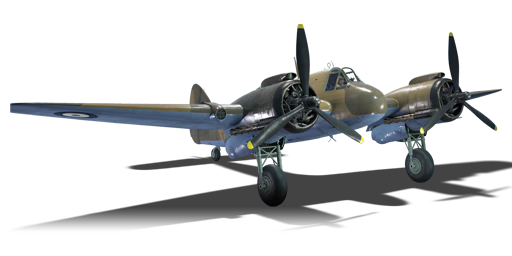
The Beaufighter Mk VIc is a rank British twin-engine fighter
with a battle rating of (AB), (RB), and (SB). This aircraft has been in the game since the start of the Open Beta Test prior to Update 1.27.
The Beaufighter Mk 6 is one of the best early-tiered heavy fighters. When its engines and survivability are fully upgraded, it is truly a bomber killer to behold, capable of bringing down any rank 1, 2 or 3 planes with ease. Unfortunately, there are several drawbacks to the amazing power of the 4 x Hispano 20mm cannons. You will normally spawn quite high, so use that to your advantage when attacking enemy planes. The recommended speed of this plane is only around 500 km/h (310 mph). Any higher results in severe and poor handling, making the heavy armament useless if your quarry turns. Therefore, the Beaufighter is not suited for BnZ, but better for head-on and tail-end combat. If you are caught by any single-engine fighter, try to dive and climb. If that does not work, resort to the turret or turning. The high fire rate of the turret makes it especially effective for pilot sniping if you are accurate enough.
General info
Flight Performance
The Beaufighter Mk 6c is very stable because of its large size and 2 engines. It reaches speeds of 516 k/h in AB and 498 k/h in RB so it has a considerable amount of speed considering its size. Same as for its speed, it is rather maneuverable if you use the flaps correctly and you do not stall. Stalling is a rather large issue in this plane because of it's ok climb rate, an enemy fighter will often out turn you and once it's behind you, you can only rely on your gunner. The Mk 6c hold one Mk12 torpedo
| Characteristics | |||||||
|---|---|---|---|---|---|---|---|
| Stock | |||||||
| Max Speed (km/h at 5,000 m) |
Max altitude (meters) |
Turn time (seconds) |
Rate of climb (meters/second) |
Take-off run (meters) | |||
| AB | RB | AB | RB | AB | RB | ||
| 516 | 498 | 24.8 | 25.7 | 7.3 | 7.3 | 371 | |
| Upgraded | |||||||
| Max Speed (km/h at 5,000 m) |
Max altitude (meters) |
Turn time (seconds) |
Rate of climb (meters/second) |
Take-off run (meters) | |||
| AB | RB | AB | RB | AB | RB | ||
| 558 | 536 | 22.7 | 23.7 | 14.4 | 10.5 | 371 | |
Details
| Features | ||||
|---|---|---|---|---|
| Combat flaps | Take-off flaps | Landing flaps | Air brakes | Arrestor gear |
| ✓ | ✓ | ✓ | X | X |
| Limits | ||||
|---|---|---|---|---|
| Wing-break speed (km/h) |
Gear limit (km/h) |
Combat flaps (km/h) |
Max Static G | |
| + | - | |||
| 440 | ~8 | ~4 | ||
| Optimal velocities | |||
|---|---|---|---|
| Ailerons (km/h) |
Rudder (km/h) |
Elevators (km/h) |
Radiator (km/h) |
| < 330 | < 390 | < 410 | > 310 |
| Compressor (RB/SB) | ||
|---|---|---|
| Setting 1 | ||
| Optimal altitude | 100% Engine power | WEP Engine power |
| 1,447 m | 1,400 hp | 1,568 hp |
| Setting 2 | ||
| Optimal altitude | 100% Engine power | WEP Engine power |
| 4,310 m | 1,300 hp | 1,456 hp |
Survivability and armour
- 38 mm Bulletproof glass in cockpit front.
- 25 mm Steel plate in the nose.
- 25 mm Steel plate in the fuselage.
- 1 mm Steel plate behind the engines.
Armaments
Offensive armament
The Beaufighter Mk VIc is armed with:
- 4 x 20 mm Hispano Mk.I cannons, chin-mounted (240 rpg = 960 total)
Suspended armament
The Beaufighter Mk VIc can be outfitted with the following ordnance:
- Without load
- 1 x 18 inch Mark XII torpedo
Defensive armament
The Beaufighter Mk VIc is defended by:
- 1 x 7.7 mm Vickers K machine gun, dorsal turret (1,000 rpg)
Usage in battles
Describe the tactics of playing in an aircraft, the features of using vehicles in a team and advice on tactics. Refrain from creating a "guide" - do not impose a single point of view, but instead, give the reader food for thought. Examine the most dangerous enemies and give recommendations on fighting them. If necessary, note the specifics of the game in different modes (AB, RB, SB).
Manual Engine Control
| MEC elements | ||||||
|---|---|---|---|---|---|---|
| Mixer | Pitch | Radiator | Supercharger | Turbocharger | ||
| Oil | Water | Type | ||||
| Not controllable | Controllable Not auto controlled |
Not controllable Not auto controlled |
Controllable Not auto controlled |
Combined | Controllable 2 gears |
Not controllable |
Modules
| Tier | Flight performance | Survivability | Weaponry | ||
|---|---|---|---|---|---|
| I | Fuselage repair | Radiator | Turret 7 mm | ||
| II | Compressor | Airframe | New 7 mm MGs (turret) | TSC mk.II | |
| III | Wings repair | Engine | Offensive 20 mm | ||
| IV | Engine injection | Cover | New 20 mm cannons | ||
Pros and cons
Pros:
- 4 x 20 mm cannons can take down any plane in no time (when aimed properly)
- Good turn time for a heavy fighter
- Can take a few hits
- Has a defensive turret
Cons:
- Poor acceleration and top speed in level flight
- Not the best turning and climbing abilities
- Can't carry bombs, only torpedoes
- Only has cannons, so the reload time for all the main guns is 40 seconds
- Cannons also jam quickly unless upgraded
- Cannons are highly inaccurate unless upgraded
History
Describe the history of the creation and combat usage of the aircraft in more detail than in the introduction. If the historical reference turns out to be too long, take it to a separate article, taking a link to the article about the vehicle and adding a block "/ History" (example: https://wiki.warthunder.com/(Vehicle-name)/History) and add a link to it here using the main template. Be sure to reference text and sources by using <ref></ref>, as well as adding them at the end of the article with <references />. This section may also include the vehicle's dev blog entry (if applicable) and the in-game encyclopedia description (under === Encyclopedia Info ===, also if applicable).
A total of 5,928 Beaufighters were built.
In-game description
"As Britain geared up for war in the late 1930s, it became apparent that the RAF lacked modern fighters, particularly any long range aircraft or night fighters. Bristol had already began work on the Beaufort, itself developed from their earlier Blenheim design, and decided that to develop a long range fighter in as short a time period as possible, it would be quicker to develop an existing design than start a new one. The wings and tail were taken from the Beaufort and, with a new fuselage and two Bristol Hercules engines, the Beaufighter was born.
For use in the maritime theatre, some modifications were designed to patrol coastal areas and escort vessels. The designations of these variants ended with the letter C to indicate that they were used by the Coastal Command. The first modification for Coastal Command appeared in 1940 and had the designation Beaufighter Mk IC; this design included the addition of a maritime radio and navigation equipment. The next model designed for Coastal Command operations was the Mk VIC. After the various interim models had been powered mainly by the Rolls Royce Merlin, the Mk VI returned to the original Bristol Hercules engines. This powerful engine allowed the options of replacing the wing mounted guns with extra fuel tanks for longer range and the addition of bombs or rockets. By the end of 1942, most of the Beaufighter Mk.VICs had been modified to carry torpedoes, and in April 1943 they made their first torpedo attack, sinking two merchant ships off of the Norwegian coast.
A total of 5,928 Beaufighters were built."
Media
See also
Links to the articles on the War Thunder Wiki that you think will be useful for the reader, for example:
- reference to the series of the aircraft;
- links to approximate analogues of other nations and research trees.
External links
Paste links to sources and external resources, such as:
- topic on the official game forum;
- encyclopedia page on the aircraft;
- other literature.
| Bristol Aeroplane Company | |
|---|---|
| Strike Aircraft | Beaufighter Mk I (40-mm) · Beaufighter Mk VIc · Beaufighter Mk X · Beaufighter Mk 21* |
| Bombers | Blenheim Mk IV · Beaufort Mk VIII* · Brigand B 1 |
| * License-produced in Australia by Department of Aircraft Production. | |
| Britain strike aircraft | |
|---|---|
| Blackburn | Firebrand TF Mk IV · Firecrest |
| Bristol | Beaufighter Mk I (40-mm) · Beaufighter Mk VIc · Beaufighter Mk X · Beaufighter Mk 21 |
| CAC | ▄Wirraway |
| Fairey | Firefly F Mk I · Firefly FR Mk V |
| de Havilland | Mosquito FB Mk VI · Mosquito FB Mk XVIII |
| Hawker | Hurricane Mk IV · Tempest Mk V (Vickers P) |
| Westland | Wyvern S4 |