Difference between revisions of "P-40F-10"
m (Reverted edits by U178117757 (talk) to last revision by U38088265) |
m (Pros/cons) (Tag: Visual edit) |
||
| (29 intermediate revisions by 14 users not shown) | |||
| Line 1: | Line 1: | ||
| − | |||
| − | |||
| − | |||
| − | |||
| − | |||
| − | |||
| − | |||
| − | |||
| − | |||
{{Specs-Card | {{Specs-Card | ||
|code=p-40f_10 | |code=p-40f_10 | ||
| − | | | + | |cockpit=332093/1100810 |
| − | | | + | }} |
| + | {{About | ||
| + | | about = American fighter '''{{PAGENAME}}''' | ||
| + | | usage = other versions | ||
| + | | link = P-40 (Family) | ||
}} | }} | ||
== Description == | == Description == | ||
<!-- ''In the description, the first part should be about the history of and the creation and combat usage of the aircraft, as well as its key features. In the second part, tell the reader about the aircraft in the game. Insert a screenshot of the vehicle, so that if the novice player does not remember the vehicle by name, he will immediately understand what kind of vehicle the article is talking about.'' --> | <!-- ''In the description, the first part should be about the history of and the creation and combat usage of the aircraft, as well as its key features. In the second part, tell the reader about the aircraft in the game. Insert a screenshot of the vehicle, so that if the novice player does not remember the vehicle by name, he will immediately understand what kind of vehicle the article is talking about.'' --> | ||
| − | + | [[File:GarageImage_{{PAGENAME}}.jpg|420px|thumb|left]] | |
| − | + | {{break}} | |
| − | The {{Specs|name}} was introduced in [[Update 1.79 "Project X"]] | + | The '''{{Specs|name}}''' is a rank {{Specs|rank}} American fighter {{Battle-rating}}. It was introduced in [[Update 1.79 "Project X"]]. |
== General info == | == General info == | ||
=== Flight performance === | === Flight performance === | ||
| − | + | ''Describe how the aircraft behaves in the air. Speed, manoeuvrability, acceleration and allowable loads - these are the most important characteristics of the vehicle.'' | |
| − | |||
| − | |||
| − | + | {| class="wikitable" style="text-align:center" | |
| − | + | |- | |
| − | + | ! colspan="8" | Characteristics | |
| − | + | |- | |
| − | + | ! colspan="8" | ''Stock'' | |
| − | + | |- | |
| − | {| class="wikitable" style="text-align:center" | + | ! colspan="2" | Max Speed<br>(km/h at 5,029 m) |
| − | ! | + | ! rowspan="2" | Max altitude<br>(meters) |
| − | ! colspan="2" | Max | ||
| − | ! rowspan="2" | Max altitude<br>( | ||
! colspan="2" | Turn time<br>(seconds) | ! colspan="2" | Turn time<br>(seconds) | ||
| − | ! colspan="2" | Rate of climb<br>( | + | ! colspan="2" | Rate of climb<br>(meters/second) |
| − | ! rowspan="2" | Take-off run<br>( | + | ! rowspan="2" | Take-off run<br>(meters) |
|- | |- | ||
! AB !! RB !! AB !! RB !! AB !! RB | ! AB !! RB !! AB !! RB !! AB !! RB | ||
|- | |- | ||
| − | + | | 588 || 569 || {{Specs|ceiling}} || 21.1 || 22.0 || 7.7 || 7.7 || 350 | |
| − | | 588 || | + | |- |
| + | ! colspan="8" | ''Upgraded'' | ||
| + | |- | ||
| + | ! colspan="2" | Max Speed<br>(km/h at 5,029 m) | ||
| + | ! rowspan="2" | Max altitude<br>(meters) | ||
| + | ! colspan="2" | Turn time<br>(seconds) | ||
| + | ! colspan="2" | Rate of climb<br>(meters/second) | ||
| + | ! rowspan="2" | Take-off run<br>(meters) | ||
| + | |- | ||
| + | ! AB !! RB !! AB !! RB !! AB !! RB | ||
|- | |- | ||
| − | + | | 646 || 615 || {{Specs|ceiling}} || 18.9 || 20.0 || 15.9 || 11.2 || 350 | |
| − | | | ||
|- | |- | ||
|} | |} | ||
==== Details ==== | ==== Details ==== | ||
| − | {| class="wikitable" style="text-align:center | + | {| class="wikitable" style="text-align:center" |
|- | |- | ||
! colspan="5" | Features | ! colspan="5" | Features | ||
| Line 61: | Line 60: | ||
|} | |} | ||
| − | {| class="wikitable" style="text-align:center | + | {| class="wikitable" style="text-align:center" |
|- | |- | ||
| − | ! colspan=" | + | ! colspan="5" | Limits |
|- | |- | ||
| − | ! rowspan="2" | | + | ! rowspan="2" | Wing-break speed<br>(km/h) |
| − | ! rowspan="2" | Gear (km/h) | + | ! rowspan="2" | Gear limit<br>(km/h) |
| − | ! | + | ! rowspan="2" | Combat flaps<br>(km/h) |
! colspan="2" | Max Static G | ! colspan="2" | Max Static G | ||
|- | |- | ||
| − | + | ! + !! - | |
|- | |- | ||
| − | | | + | | {{Specs|destruction|constructions}} || {{Specs|destruction|chassis}} || 645 || ~11 || ~5 |
|- | |- | ||
|} | |} | ||
| Line 78: | Line 77: | ||
{| class="wikitable" style="text-align:center" | {| class="wikitable" style="text-align:center" | ||
|- | |- | ||
| − | ! colspan="4" | Optimal velocities | + | ! colspan="4" | Optimal velocities |
|- | |- | ||
| − | ! Ailerons | + | ! Ailerons<br>(km/h) |
| + | ! Rudder<br>(km/h) | ||
| + | ! Elevators<br>(km/h) | ||
| + | ! Radiator<br>(km/h) | ||
|- | |- | ||
| < 420 || < 380 || < 420 || > 340 | | < 420 || < 380 || < 420 || > 340 | ||
| + | |- | ||
| + | |} | ||
| + | |||
| + | {| class="wikitable" style="text-align:center" | ||
| + | |- | ||
| + | ! colspan="3" | Compressor (RB/SB) | ||
| + | |- | ||
| + | ! colspan="3" | Setting 1 | ||
| + | |- | ||
| + | ! Optimal altitude | ||
| + | ! 100% Engine power | ||
| + | ! WEP Engine power | ||
| + | |- | ||
| + | | 3,733 m || 1,260 hp || 1,584 hp | ||
| + | |- | ||
| + | ! colspan="3" | Setting 2 | ||
| + | |- | ||
| + | ! Optimal altitude | ||
| + | ! 100% Engine power | ||
| + | ! WEP Engine power | ||
| + | |- | ||
| + | | 6,400 m || 1,175 hp || 1,477 hp | ||
|- | |- | ||
|} | |} | ||
=== Survivability and armour === | === Survivability and armour === | ||
| − | |||
<!-- ''Examine the survivability of the aircraft. Note how vulnerable the structure is and how secure the pilot is, whether the fuel tanks are armoured, etc. Describe the armour, if there is any, and also mention the vulnerability of other critical aircraft systems.'' --> | <!-- ''Examine the survivability of the aircraft. Note how vulnerable the structure is and how secure the pilot is, whether the fuel tanks are armoured, etc. Describe the armour, if there is any, and also mention the vulnerability of other critical aircraft systems.'' --> | ||
| − | |||
| − | |||
* 38 mm Bulletproof glass in front of pilot. | * 38 mm Bulletproof glass in front of pilot. | ||
* 3 mm Steel plate in front of oil cooling system. | * 3 mm Steel plate in front of oil cooling system. | ||
* 8 mm Steel plate behind the pilot. | * 8 mm Steel plate behind the pilot. | ||
| − | |||
| − | |||
| − | |||
| − | |||
| − | |||
| − | |||
| − | |||
| − | |||
| − | |||
| − | |||
| − | |||
| − | |||
| − | |||
== Armaments == | == Armaments == | ||
| − | |||
=== Offensive armament === | === Offensive armament === | ||
| − | |||
<!-- ''Describe the offensive armament of the aircraft, if any. Describe how effective the cannons and machine guns are in a battle, and also what belts or drums are better to use. If there is no offensive weaponry, delete this subsection.'' --> | <!-- ''Describe the offensive armament of the aircraft, if any. Describe how effective the cannons and machine guns are in a battle, and also what belts or drums are better to use. If there is no offensive weaponry, delete this subsection.'' --> | ||
| − | {{main|M2 | + | {{main|Browning M2 (12.7 mm)}} |
The '''''{{PAGENAME}}''''' is armed with: | The '''''{{PAGENAME}}''''' is armed with: | ||
| − | * 6 x 12.7 mm M2 | + | * 6 x 12.7 mm Browning M2 machine guns, wing-mounted (281 rpg = 1,686 total) |
=== Suspended armament === | === Suspended armament === | ||
| − | |||
<!-- ''Describe the aircraft's suspended armament: additional cannons under the wings, bombs, rockets and torpedoes. This section is especially important for bombers and attackers. If there is no suspended weaponry remove this subsection.'' --> | <!-- ''Describe the aircraft's suspended armament: additional cannons under the wings, bombs, rockets and torpedoes. This section is especially important for bombers and attackers. If there is no suspended weaponry remove this subsection.'' --> | ||
{{main|AN-M30A1 (100 lb)|AN-M64A1 (500 lb)}} | {{main|AN-M30A1 (100 lb)|AN-M64A1 (500 lb)}} | ||
| Line 133: | Line 138: | ||
== Usage in battles == | == Usage in battles == | ||
| − | <!-- ''Describe the tactics of playing in | + | <!-- ''Describe the tactics of playing in an aircraft, the features of using aircraft in a team and advice on tactics. Refrain from creating a "guide" - do not impose a single point of view, but instead, give the reader food for thought. Examine the most dangerous enemies and give recommendations on fighting them. If necessary, note the specifics of the game in different modes (AB, RB, SB).'' --> |
| − | The P-40F-10 performs similarly to the P-40E-1, although it is neither as fast (at lower altitudes) nor as good at turning. | + | The P-40F-10 performs similarly to the [[P-40E-1]], although it is neither as fast (at lower altitudes) nor as good at turning. It has exactly the same armament as the E-1 but it does excel in one thing: bomber killing and fighter bombing. |
| − | |||
| − | |||
| − | |||
| − | |||
| − | |||
| − | |||
| − | |||
| − | |||
| − | |||
| − | + | ==== Bomber hunting ==== | |
| − | + | Try to climb to around 3,000 m (10,000 ft) early game as your Warhawk does not climb amazingly fast (roughly 10'''°''' to 15'''°''' using WEP without secondary armament), but once you get up there, you can demolish anything that hovers at that altitude, which tend to be bombers as they don't like being intercepted by low flying fighters. | |
| − | |||
| − | |||
| − | |||
| − | |||
| − | |||
| − | |||
| − | |||
| − | |||
| − | |||
| − | |||
| − | |||
| − | |||
| − | |||
=== Manual Engine Control === | === Manual Engine Control === | ||
| Line 175: | Line 158: | ||
|- | |- | ||
| Controllable || Controllable<br>Auto control available || Not controllable<br>Not auto controlled || Controllable<br>Not auto controlled || Combined || Controllable<br>2 gears || Not controllable | | Controllable || Controllable<br>Auto control available || Not controllable<br>Not auto controlled || Controllable<br>Not auto controlled || Combined || Controllable<br>2 gears || Not controllable | ||
| + | |- | ||
| + | |} | ||
| + | |||
| + | === Modules === | ||
| + | {| class="wikitable" | ||
| + | ! Tier | ||
| + | ! colspan="2" | Flight performance | ||
| + | ! Survivability | ||
| + | ! colspan="2" | Weaponry | ||
| + | |- | ||
| + | | I | ||
| + | | Fuselage repair | ||
| + | | Radiator | ||
| + | | | ||
| + | | Offensive 12 mm | ||
| + | | | ||
| + | |- | ||
| + | | II | ||
| + | | | ||
| + | | Compressor | ||
| + | | Airframe | ||
| + | | | ||
| + | | FSBC mk.1 | ||
| + | |- | ||
| + | | III | ||
| + | | Wings repair | ||
| + | | Engine | ||
| + | | | ||
| + | | New 12 mm MGs | ||
| + | | | ||
| + | |- | ||
| + | | IV | ||
| + | | | ||
| + | | Engine injection | ||
| + | | Cover | ||
| + | | | ||
| + | | FMBC mk.1 | ||
|- | |- | ||
|} | |} | ||
| Line 184: | Line 204: | ||
* Good survivability | * Good survivability | ||
| − | * Can outrun most on-tier vehicles in a straight-line path | + | * Can outrun most on-tier vehicles in a straight-line path |
* Good energy retention in a dive | * Good energy retention in a dive | ||
| − | * Better performance at mid to high speeds | + | * Better performance at it's mid to high speeds |
| − | |||
'''Cons:''' | '''Cons:''' | ||
| − | * Engine | + | * Engine prone to overheating |
* Like the previous iteration of the P-40, does not do well in a turn fight | * Like the previous iteration of the P-40, does not do well in a turn fight | ||
* Sub-par climb rate | * Sub-par climb rate | ||
| − | |||
| − | |||
== History == | == History == | ||
| Line 203: | Line 220: | ||
In 1940, the American Packard Motor Car Company acquired a licence to manufacture the Rolls-Royce Merlin engine, in an effort to satisfy the growing demand of the British aviation industry. Additionally, the licence gave American engineers access to a more powerful engine at a time where similar U.S. engines were not available. Naturally, Curtiss engineers didn't waste any time outfitting the P-40 with the brand new licence-built Merlin engine, resulting in the creation of the P-40F. Besides the internal engine upgrade, some external changes were also applied to the aircraft. For instance, the tail section of the fuselage was lengthened in an effort to counter the negative effects of strong engine torque on take-off and landing experienced on earlier modifications. With the changes applied, serial production of the new P-40F was scheduled to begin in 1942. As the British and Commonwealth air forces were particularly keen on a Merlin-engined P-40 variant, they were also the first ones to receive the new P-40Fs as early as summer of the same year. | In 1940, the American Packard Motor Car Company acquired a licence to manufacture the Rolls-Royce Merlin engine, in an effort to satisfy the growing demand of the British aviation industry. Additionally, the licence gave American engineers access to a more powerful engine at a time where similar U.S. engines were not available. Naturally, Curtiss engineers didn't waste any time outfitting the P-40 with the brand new licence-built Merlin engine, resulting in the creation of the P-40F. Besides the internal engine upgrade, some external changes were also applied to the aircraft. For instance, the tail section of the fuselage was lengthened in an effort to counter the negative effects of strong engine torque on take-off and landing experienced on earlier modifications. With the changes applied, serial production of the new P-40F was scheduled to begin in 1942. As the British and Commonwealth air forces were particularly keen on a Merlin-engined P-40 variant, they were also the first ones to receive the new P-40Fs as early as summer of the same year. | ||
| − | Despite the British and Commonwealth forces receiving the P-40Fs first, the majority of the | + | Despite the British and Commonwealth forces receiving the P-40Fs first, the majority of the total 13,738 ever manufactured machines served with units of the USAAF in the Mediterranean theatre. By the end of the Mediterranean campaign in late 1943, the P-40F had successfully proven the value of the applied changes by presenting itself as a more than capable air superiority fighter, when matched up against previously superior Axis counterparts such as the Bf 109F/G and M.C. 202/205. During its service in the Mediterranean, experienced pilots, applying the right tactics showed that the Warhawk could no longer be considered the underdog, but instead an equal at very least. |
| − | Interesting: The Soviet Union received P-40 fighters under the lend-lease program; they were considered to be aircraft with medium efficiency but were quite durable. Lieutenant Alexei Khlobystov in one battle conducted two successful rams and after that encounter, the pilot and his | + | Interesting: The Soviet Union received P-40 fighters under the lend-lease program; they were considered to be aircraft with medium efficiency but were quite durable. Lieutenant Alexei Khlobystov in one battle conducted two successful rams and after that encounter, the pilot and his “Kittyhawk” returned to the airfield! |
| − | ''- From [ | + | ''- From [https://warthunder.com/en/news/5508-development-curtiss-p-40f-the-mediterranean-angel-of-death-en Devblog]'' |
== Media == | == Media == | ||
| − | <!-- | + | <!--Excellent additions to the article would be video guides, screenshots from the game, and photos.--> |
| − | + | {{Youtube-gallery|4hSjkacg4CQ|'''The Shooting Range #98''' - ''Pages of History'' section at 09:01 discusses the P-40F.}} | |
| − | |||
| − | |||
| − | |||
| − | |||
| − | |||
| − | {{Youtube-gallery | ||
== See also == | == See also == | ||
| − | <!-- ''Links to the articles on the War Thunder Wiki that you think will be useful for the reader, for example:'' | + | <!--''Links to the articles on the War Thunder Wiki that you think will be useful for the reader, for example:'' |
* ''reference to the series of the aircraft;'' | * ''reference to the series of the aircraft;'' | ||
| − | * ''links to approximate analogues of other nations and research trees.'' --> | + | * ''links to approximate analogues of other nations and research trees.''--> |
;Related development | ;Related development | ||
| Line 231: | Line 242: | ||
;Aircraft of comparable role, configuration and era | ;Aircraft of comparable role, configuration and era | ||
| + | * Bell [[P-39 (Family)|P-39]] Airacobra | ||
| + | * Dewoitine [[D.520]] | ||
| + | * Grumman [[F4F (Family)|F4F]] Wildcat | ||
* Hawker [[Hurricane (Family)|Hurricane]] | * Hawker [[Hurricane (Family)|Hurricane]] | ||
| + | * Kawasaki [[Ki-61 (Family)|Ki-61]] | ||
* Lavochkin-Gorbunov-Gudkov [[LaGG-3 (Family)|LaGG-3]] | * Lavochkin-Gorbunov-Gudkov [[LaGG-3 (Family)|LaGG-3]] | ||
* Macchi [[C.202]] | * Macchi [[C.202]] | ||
* Messerschmitt [[Bf 109 (Family)|Bf 109]] | * Messerschmitt [[Bf 109 (Family)|Bf 109]] | ||
| + | * Mikoyan-Gurevich [[MiG-3 (Family)|MiG-3]] | ||
| + | * Mitsubishi [[A6M (Family)|A6M]] Zero | ||
| + | * Supermarine [[Spitfire (Family)|Spitfire]] | ||
| + | * Yakovlev [[Yak-1]] | ||
== External links == | == External links == | ||
<!-- ''Paste links to sources and external resources, such as:'' | <!-- ''Paste links to sources and external resources, such as:'' | ||
* ''topic on the official game forum;'' | * ''topic on the official game forum;'' | ||
| + | * ''encyclopedia page on the aircraft;'' | ||
* ''other literature.'' --> | * ''other literature.'' --> | ||
| − | * [ | + | * [https://warthunder.com/en/news/5508-development-curtiss-p-40f-the-mediterranean-angel-of-death-en [Devblog<nowiki>]</nowiki> Curtiss P-40F: The Mediterranean Angel of Death] |
| − | |||
| − | |||
| − | |||
{{AirManufacturer Curtiss}} | {{AirManufacturer Curtiss}} | ||
{{USA fighters}} | {{USA fighters}} | ||
Revision as of 05:45, 16 April 2020
Contents
| This page is about the American fighter P-40F-10. For other versions, see P-40 (Family). |
Description

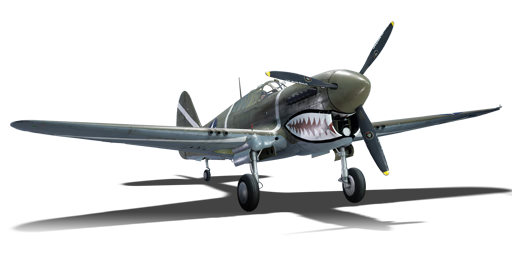
The P-40F-10 Warhawk is a rank American fighter
with a battle rating of (AB), (RB), and (SB). It was introduced in Update 1.79 "Project X".
General info
Flight performance
Describe how the aircraft behaves in the air. Speed, manoeuvrability, acceleration and allowable loads - these are the most important characteristics of the vehicle.
| Characteristics | |||||||
|---|---|---|---|---|---|---|---|
| Stock | |||||||
| Max Speed (km/h at 5,029 m) |
Max altitude (meters) |
Turn time (seconds) |
Rate of climb (meters/second) |
Take-off run (meters) | |||
| AB | RB | AB | RB | AB | RB | ||
| 588 | 569 | 21.1 | 22.0 | 7.7 | 7.7 | 350 | |
| Upgraded | |||||||
| Max Speed (km/h at 5,029 m) |
Max altitude (meters) |
Turn time (seconds) |
Rate of climb (meters/second) |
Take-off run (meters) | |||
| AB | RB | AB | RB | AB | RB | ||
| 646 | 615 | 18.9 | 20.0 | 15.9 | 11.2 | 350 | |
Details
| Features | ||||
|---|---|---|---|---|
| Combat flaps | Take-off flaps | Landing flaps | Air brakes | Arrestor gear |
| ✓ | ✓ | ✓ | X | X |
| Limits | ||||
|---|---|---|---|---|
| Wing-break speed (km/h) |
Gear limit (km/h) |
Combat flaps (km/h) |
Max Static G | |
| + | - | |||
| 645 | ~11 | ~5 | ||
| Optimal velocities | |||
|---|---|---|---|
| Ailerons (km/h) |
Rudder (km/h) |
Elevators (km/h) |
Radiator (km/h) |
| < 420 | < 380 | < 420 | > 340 |
| Compressor (RB/SB) | ||
|---|---|---|
| Setting 1 | ||
| Optimal altitude | 100% Engine power | WEP Engine power |
| 3,733 m | 1,260 hp | 1,584 hp |
| Setting 2 | ||
| Optimal altitude | 100% Engine power | WEP Engine power |
| 6,400 m | 1,175 hp | 1,477 hp |
Survivability and armour
- 38 mm Bulletproof glass in front of pilot.
- 3 mm Steel plate in front of oil cooling system.
- 8 mm Steel plate behind the pilot.
Armaments
Offensive armament
The P-40F-10 is armed with:
- 6 x 12.7 mm Browning M2 machine guns, wing-mounted (281 rpg = 1,686 total)
Suspended armament
The P-40F-10 can be outfitted with the following ordnance:
- Without load
- 2 x 100 lb AN-M30A1 bombs (200 lb total)
- 1 x 500 lb AN-M64A1 bomb (500 lb total)
- 1 x 500 lb AN-M64A1 bomb + 2 x 100 lb AN-M30A1 bombs (700 lb total)
Usage in battles
The P-40F-10 performs similarly to the P-40E-1, although it is neither as fast (at lower altitudes) nor as good at turning. It has exactly the same armament as the E-1 but it does excel in one thing: bomber killing and fighter bombing.
Bomber hunting
Try to climb to around 3,000 m (10,000 ft) early game as your Warhawk does not climb amazingly fast (roughly 10° to 15° using WEP without secondary armament), but once you get up there, you can demolish anything that hovers at that altitude, which tend to be bombers as they don't like being intercepted by low flying fighters.
Manual Engine Control
| MEC elements | ||||||
|---|---|---|---|---|---|---|
| Mixer | Pitch | Radiator | Supercharger | Turbocharger | ||
| Oil | Water | Type | ||||
| Controllable | Controllable Auto control available |
Not controllable Not auto controlled |
Controllable Not auto controlled |
Combined | Controllable 2 gears |
Not controllable |
Modules
| Tier | Flight performance | Survivability | Weaponry | ||
|---|---|---|---|---|---|
| I | Fuselage repair | Radiator | Offensive 12 mm | ||
| II | Compressor | Airframe | FSBC mk.1 | ||
| III | Wings repair | Engine | New 12 mm MGs | ||
| IV | Engine injection | Cover | FMBC mk.1 | ||
Pros and cons
Pros:
- Good survivability
- Can outrun most on-tier vehicles in a straight-line path
- Good energy retention in a dive
- Better performance at it's mid to high speeds
Cons:
- Engine prone to overheating
- Like the previous iteration of the P-40, does not do well in a turn fight
- Sub-par climb rate
History
Although early P-40s were equipped with one of the most powerful inline engines available to the American aircraft industry at the time, it quickly became apparent that even that wasn't enough. Due to its advanced and robust design, it's no secret that the P-40 was a relatively heavy aircraft for its type, resulting in power-to-weight issues which would never be fully solved. Nonetheless, Curtiss engineers continued tweaking and improving the design in all aspects, trying to lessen the drawbacks of high weight and insufficient power.
In 1940, the American Packard Motor Car Company acquired a licence to manufacture the Rolls-Royce Merlin engine, in an effort to satisfy the growing demand of the British aviation industry. Additionally, the licence gave American engineers access to a more powerful engine at a time where similar U.S. engines were not available. Naturally, Curtiss engineers didn't waste any time outfitting the P-40 with the brand new licence-built Merlin engine, resulting in the creation of the P-40F. Besides the internal engine upgrade, some external changes were also applied to the aircraft. For instance, the tail section of the fuselage was lengthened in an effort to counter the negative effects of strong engine torque on take-off and landing experienced on earlier modifications. With the changes applied, serial production of the new P-40F was scheduled to begin in 1942. As the British and Commonwealth air forces were particularly keen on a Merlin-engined P-40 variant, they were also the first ones to receive the new P-40Fs as early as summer of the same year.
Despite the British and Commonwealth forces receiving the P-40Fs first, the majority of the total 13,738 ever manufactured machines served with units of the USAAF in the Mediterranean theatre. By the end of the Mediterranean campaign in late 1943, the P-40F had successfully proven the value of the applied changes by presenting itself as a more than capable air superiority fighter, when matched up against previously superior Axis counterparts such as the Bf 109F/G and M.C. 202/205. During its service in the Mediterranean, experienced pilots, applying the right tactics showed that the Warhawk could no longer be considered the underdog, but instead an equal at very least.
Interesting: The Soviet Union received P-40 fighters under the lend-lease program; they were considered to be aircraft with medium efficiency but were quite durable. Lieutenant Alexei Khlobystov in one battle conducted two successful rams and after that encounter, the pilot and his “Kittyhawk” returned to the airfield!
- From Devblog
Media
See also
- Related development
- Curtiss P-36 Hawk
- Curtiss P-40 (Family)
- Aircraft of comparable role, configuration and era
- Bell P-39 Airacobra
- Dewoitine D.520
- Grumman F4F Wildcat
- Hawker Hurricane
- Kawasaki Ki-61
- Lavochkin-Gorbunov-Gudkov LaGG-3
- Macchi C.202
- Messerschmitt Bf 109
- Mikoyan-Gurevich MiG-3
- Mitsubishi A6M Zero
- Supermarine Spitfire
- Yakovlev Yak-1
External links
| Curtiss-Wright Corporation | |
|---|---|
| Fighters | BF2C-1 |
| P-36A · Rasmussen's P-36A · P-36C · P-36G | |
| P-40C · P-40E-1 · P-40F-10 | |
| Bombers | SB2C-1C · SB2C-4 |
| Floatplanes | SOC-1 |
| Experimental | XP-55 |
| Export | H-75A-1 · H-75A-4 · H-81A-2 · ▂P-40E-1 · ␗P-40E-1 · ▄P-40F-5 Lafayette · CW-21 · Hawk III |
| ▄SB2C-5 | |
| Captured | ▀Hawk H-75A-2 |
| USA fighters | |
|---|---|
| P-26 Peashooter | P-26A-33 · P-26A-34 · P-26A-34 M2 · P-26B-35 |
| P-36 Hawk | P-36A · Rasmussen's P-36A · P-36C · ○P-36C · P-36G |
| P-39 Airacobra | P-400 · P-39N-0 · P-39Q-5 |
| P-40 | P-40C · P-40E-1 · P-40E-1 TD · P-40F-10 |
| P-43 Lancer | P-43A-1 |
| P-47 Thunderbolt | P-47D-22-RE · P-47D-25 · P-47D-28 · P-47M-1-RE · ⋠P-47M-1-RE · P-47N-15 |
| P-51 Mustang | P-51 · P-51A (Thunder League) · P-51C-10 · P-51D-5 · P-51D-10 · P-51D-20-NA · P-51D-30 · P-51H-5-NA |
| P-63 Kingcobra | P-63A-5 · P-63A-10 · P-63C-5 · ␠Kingcobra |
| Prototypes | XP-55 |
| F2A Buffalo | F2A-1 · Thach's F2A-1 · F2A-3 |
| BF2C | BF2C-1 |
| F3F | F3F-2 · Galer's F3F-2 |
| F4F Wildcat | F4F-3 · F4F-4 |
| F4U Corsair | F4U-1A · F4U-1A (USMC) · F4U-1D · F4U-1C · F4U-4 · F4U-4B · F4U-4B VMF-214 · F2G-1 |
| F6F Hellcat | F6F-5 · F6F-5N |
| F8F Bearcat | F8F-1 · F8F-1B |
| Other countries | ▃Ki-43-II · ▃Ki-61-Ib · ▃A6M2 · ▃Bf 109 F-4 · ▃Fw 190 A-8 · ▃Spitfire LF Mk IXc |