Difference between revisions of "T-28E"
(→Description) |
m (→Ammunition: Updated shell penetration) (Tag: Visual edit) |
||
| (35 intermediate revisions by 8 users not shown) | |||
| Line 1: | Line 1: | ||
| − | + | {{Specs-Card|code=ussr_t_28E}} | |
| − | |||
| − | |||
| − | |||
| − | |||
| − | {{Specs-Card | ||
| − | |code=ussr_t_28E | ||
| − | |||
| − | }} | ||
== Description == | == Description == | ||
| − | <!-- ''In the description, the first part | + | <!--''In the description, the first part needs to be about the history of the creation and combat usage of the vehicle, as well as its key features. In the second part, tell the reader about the ground vehicle in the game. Insert the screenshot of the vehicle. If the novice player does not remember the vehicle by name, they will immediately understand what kind of vehicle it is talking about.''--> |
| − | The '''{{ | + | [[File:GarageImage_T-28E.jpg|420px|thumb|left]] |
| + | {{break}} | ||
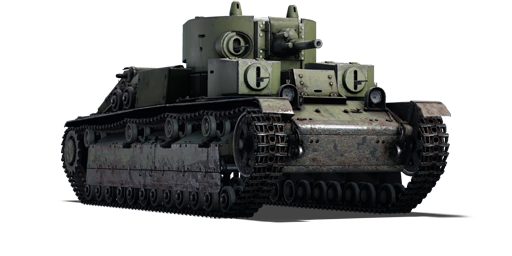
| + | The '''{{specs|name}}''' is a Rank {{specs|rank}} Soviet medium tank {{Battle-rating|1}}. It was introduced with [[Update 1.47 "Big Guns"]]. It is similar to the original [[T-28]] in all respect except the additional armour welded onto the front, side, and rear of the tank. The additional armour improves protection against enemy fire but slows down the vehicle due to increased weight. | ||
| + | |||
| + | As with all other Soviet vehicles, the letter "E" behind the tank name means "ekranami" (which means "with screens" or "applique armour" in English). In this case, the T-28 received several 30 mm and 20 mm armour plates to enhance its protection. Whole main turret and machine gun turrets are reinforced by 30 mm plates, and Driver's viewport (a big weak spot) by 20 mm and 30 mm plates. Then there are several 20 mm and 30 mm armour plates installed on the sides and rear of the vehicle. All this armour adds about 4 tons to the weight, making it slightly slower than the original T-28. However, it is still very fast and mobile. | ||
| + | |||
| + | The powerful, yet accurate gun, paired with large profile make the T-28 look ideal for long-range encounters, yet its low penetration, slow shell travel speed and no real gun depression to cover yourself behind terrain quite discourage this kind of gameplay style. But the crew/equipment spacing, its high versatility and powerful main gun make this tank quite capable in close range encounters. Hit and run tactics work pretty well (if the "run" aspect of it is ever needed). | ||
| + | |||
| + | It is good to know the characteristics of your ammo types, as all 3 can be used effectively, according to the current situation and composition of enemy tanks. ''(See more info in the "[[#Ammunition|Ammunition]]" section.)'' | ||
| + | |||
| + | If you ever find yourself against too well armoured Medium or Heavy tank, it is often better to stay and try to fight, as the large profile of your tank makes you easy to be hit while retreating. | ||
| + | |||
| + | Always aim for weak points like the driver's hatch or gunner's port. If you find yourself unable to ensure an accurate shot against such a small target, attempt to cripple the tank's offensive armament first to take some pressure off. | ||
| − | The | + | The extra armour on this tank is noticeable, especially when you angle your tank a bit, random poorly aimed shots will often be "consumed" by extra layers of armour, or machinegun turrets, or will simply ricochet off. However, this is only true when you are playing as a "top vehicle" against weaker opponents. This tank has a slightly higher BR, and when MM puts you "on the bottom", your armour will unfortunately again protect you like a paper against bullet does. Heavy tank like [[KV-1 (L-11)]] is completely immune to all types of your ammo, even from the rear. Avoid it. |
== General info == | == General info == | ||
=== Survivability and armour === | === Survivability and armour === | ||
| − | + | <!--''Describe armour protection. Note the most well protected and key weak areas. Appreciate the layout of modules as well as the number and location of crew members. Is the level of armour protection sufficient, is the placement of modules helpful for survival in combat?'' | |
| − | <!-- ''Describe armour protection. Note the most well protected and key weak areas. Appreciate the layout of modules as well as the number and location of crew members. Is the level of armour protection sufficient, is the placement of modules helpful for survival in combat? | ||
| − | |||
| − | |||
| − | |||
| + | ''If necessary use a visual template to indicate the most secure and weak zones of the armour.''--> | ||
'''Armour type:''' | '''Armour type:''' | ||
| − | * Rolled homogeneous armour | + | * Rolled homogeneous armour |
| − | * | + | * Case homogeneous armour (Gun mantlet) |
| − | |||
{| class="wikitable" | {| class="wikitable" | ||
|- | |- | ||
| Line 45: | Line 45: | ||
=== Mobility === | === Mobility === | ||
| − | + | <!--''Write about the mobility of the ground vehicle. Estimate the specific power and maneuverability as well as the maximum speed forward and backward.''--> | |
| − | <!-- ''Write about the mobility of the ground vehicle. Estimate the specific power and | + | {| class="wikitable" style="text-align:center" |
| − | + | |- | |
| − | { | + | ! colspan="3" | Mobility characteristic |
| − | + | |- | |
| − | + | ! Weight (tons) | |
| − | + | ! colspan="1" | Add-on Armor<br>weight (tons) | |
| − | === | + | ! colspan="1" | Max speed (km/h) |
| − | + | |- | |
| − | + | | rowspan="2" | 29.4 || colspan="1" rowspan="2" | N/A || colspan="1" | 39 (AB) | |
| − | + | |- | |
| − | + | |35 (RB/SB) | |
| − | + | |- | |
| − | + | ! colspan="3" | Engine power (horsepower) | |
| − | + | |- | |
| − | + | ! colspan="1" | Mode | |
| + | !Stock | ||
| + | !Upgraded | ||
| + | |- | ||
| + | |''Arcade'' | ||
| + | |697 | ||
| + | |859 | ||
| + | |- | ||
| + | |''Realistic/Simulator'' | ||
| + | |398 | ||
| + | |450 | ||
| + | |- | ||
| + | ! colspan="3" | Power-to-weight ratio (hp/ton) | ||
| + | |- | ||
| + | ! colspan="1" | Mode | ||
| + | !Stock | ||
| + | !Upgraded | ||
| + | |- | ||
| + | |''Arcade'' | ||
| + | |23.71 | ||
| + | |29.22 | ||
| + | |- | ||
| + | |''Realistic/Simulator'' | ||
| + | |13.54 | ||
| + | |15.31 | ||
| + | |- | ||
| + | |} | ||
== Armaments == | == Armaments == | ||
| − | |||
=== Main armament === | === Main armament === | ||
| − | + | <!--''Give the reader information about the characteristics of the main gun. Assess its effectiveness in a battle based on the reloading speed, ballistics and the power of shells. Do not forget about the flexibility of the fire, that is how quickly the cannon can be aimed at the target, open fire on it and aim at another enemy. Add a link to the main article on the gun: <code><nowiki>{{main|Name of the weapon}}</nowiki></code>. Describe in general terms the ammunition available for the main gun. Give advice on how to use them and how to fill the ammunition storage.''--> | |
| − | <!-- ''Give the reader information about the characteristics of the main gun. Assess its effectiveness in a battle based on the reloading speed, ballistics and the power of shells. Do not forget about the flexibility of the fire, that is how quickly the cannon can be aimed at the target, open fire on it and aim at another enemy. Add a link to the main article on the gun: <code><nowiki>{{main|Name of the weapon}}</nowiki></code>. Describe in general terms the ammunition available for the main gun. Give advice on how to use them and how to fill the ammunition storage.'' --> | ||
{{main|L-10 (76 mm)}} | {{main|L-10 (76 mm)}} | ||
| − | + | {| class="wikitable" style="text-align:center" | |
| − | + | |- | |
| − | + | ! colspan="6" | [[L-10 (76 mm)|76 mm L-10]] | |
| + | |- | ||
| + | ! colspan="3" rowspan="1" style="width:5em" |Capacity | ||
| + | ! rowspan="1" | Vertical <br> guidance | ||
| + | ! rowspan="1" | Horizontal <br> guidance | ||
| + | ! rowspan="1" | Stabilizer | ||
| + | |- | ||
| + | | colspan="3" | 69 || -5°/+25° || ±180° || N/A | ||
| + | |- | ||
| + | ! colspan="6" | Turret rotation speed (°/s) | ||
| + | |- | ||
| + | ! style="width:4em" |Mode | ||
| + | ! style="width:4em" |Stock | ||
| + | ! style="width:4em" |Upgraded | ||
| + | ! style="width:4em" |Prior + Full crew | ||
| + | ! style="width:4em" |Prior + Expert qualif. | ||
| + | ! style="width:4em" |Prior + Ace qualif. | ||
| + | |- | ||
| + | | ''Arcade'' || 8.9 || 12.4 || __.__ || __.__ || __.__ | ||
|- | |- | ||
| − | + | | ''Realistic'' || 8.9 || 10.5 || __.__ || __.__ || __.__ | |
|- | |- | ||
| − | ! | + | ! colspan="4" | Reloading rate (seconds) |
| − | |||
| − | |||
|- | |- | ||
| − | ! | + | ! colspan="1" style="width:4em" |Stock |
| − | + | ! colspan="1" style="width:4em" |Prior + Full crew | |
| + | ! colspan="1" style="width:4em" |Prior + Expert qualif. | ||
| + | ! colspan="1" style="width:4em" |Prior + Ace qualif. | ||
|- | |- | ||
| − | + | | 6.50 || 5.75 || 5.30 || 5.00 | |
| − | | | ||
|- | |- | ||
|} | |} | ||
| − | ==== Ammunition ==== | + | ===== Ammunition ===== |
| − | + | {| class="wikitable sortable" style="text-align:center" width="100%" | |
| − | + | ! colspan="8" | Penetration statistics | |
| − | + | |- | |
| − | + | ! rowspan="2" data-sort-type="text" | Ammunition | |
| − | + | ! rowspan="2" class="unsortable" | Type of <br /> warhead | |
| − | + | ! colspan="6" | '''Penetration''' '''''in mm''''' '''@ 90°''' | |
| − | + | |- | |
| − | + | ! 10m | |
| − | ==== | + | ! 100m |
| − | + | ! 500m | |
| − | + | ! 1000m | |
| − | + | ! 1500m | |
| + | ! 2000m | ||
| + | |- | ||
| + | | BR-350A || APHEBC ||67||66||59||52||46||41 | ||
| + | |- | ||
| + | | OF-350M || HE ||10||10||10||10||10||10 | ||
| + | |- | ||
| + | | SH-354T || Shrapnel || 34 || 33 || 30 || 24 || 20 || 10 | ||
| + | |- | ||
| + | |} | ||
| + | {| class="wikitable sortable" style="text-align:center" width="100%" | ||
| + | ! colspan="11" | Shell details | ||
| + | |- | ||
| + | ! rowspan="2" data-sort-type="text" | Ammunition | ||
| + | ! rowspan="2" class="unsortable" | Type of <br /> warhead | ||
| + | ! rowspan="2" |Velocity <br /> in m/s | ||
| + | ! rowspan="2" |Projectile<br />Mass in kg | ||
| + | ! rowspan="2" | ''Fuse delay'' | ||
| + | ''in m:'' | ||
| + | ! rowspan="2" | ''Fuse sensitivity'' | ||
| + | ''in mm:'' | ||
| + | ! rowspan="2" | ''Explosive Mass in g<br /> (TNT equivalent):'' | ||
| + | ! rowspan="2" | ''Normalization At 30° <br> from horizontal:'' | ||
| + | ! colspan="3" | ''Ricochet:'' | ||
| + | |- | ||
| + | ! 0% | ||
| + | ! 50% | ||
| + | ! 100% | ||
|- | |- | ||
| − | + | | BR-350A || APHEBC || 555 || 6.3 || 0.15 || 10 || 150 || +4° || 48° || 63° || 71° | |
| − | + | |- | |
| − | + | | OF-350M || HE || 560 || 6.2 || 0.05 || 0.1 || 621 || +0° || 79° || 80° ||81° | |
| − | + | |- | |
| − | + | | SH-354T || Shrapnel || 560 || 6.2 || 0.5 || 8.0 || 85 || +0° || 62° || 69° || 73° | |
| − | |||
| − | |||
| − | |||
| − | |||
|- | |- | ||
| − | | | + | |} |
| + | |||
| + | ===== [[Ammo racks|Ammo racks]] ===== | ||
| + | [[File:Ammoracks_T-28.png|right|thumbnail|x250px|[[Ammo racks|Ammo racks]] of the T-28 (identical to T-28E).]] | ||
| + | {| class="wikitable sortable" style="text-align:center" | ||
|- | |- | ||
| − | ! | + | ! class="wikitable unsortable" |Full<br /> ammo |
| − | ! | + | ! class="wikitable unsortable" |1st<br /> rack empty |
| − | ! | + | ! class="wikitable unsortable" |2nd<br /> rack empty |
| − | ! | + | ! class="wikitable unsortable" |3rd<br /> rack empty |
| − | ! | + | ! class="wikitable unsortable" |4th<br /> rack empty |
| − | ! | + | ! class="wikitable unsortable" |5th<br /> rack empty |
| − | ! | + | ! class="wikitable unsortable" |6th<br /> rack empty |
| − | ! Visual<br>discrepancy | + | ! class="wikitable unsortable" |7th<br /> rack empty |
| − | + | ! class="wikitable unsortable" |8th<br /> rack empty | |
| + | ! class="wikitable unsortable" |9th<br /> rack empty | ||
| + | ! class="wikitable unsortable" |10th<br /> rack empty | ||
| + | ! class="wikitable unsortable" |11th<br /> rack empty | ||
| + | ! class="wikitable unsortable" |12th<br /> rack empty | ||
| + | ! class="wikitable unsortable" |13th<br /> rack empty | ||
| + | ! class="wikitable unsortable" width="10%" |Recommendations | ||
| + | ! class="wikitable unsortable" |Visual<br /> discrepancy | ||
|- | |- | ||
| − | | | + | || '''69''' || 64 ''(+5)'' || 58 ''(+11)'' || 52 ''(+17)'' || 46 ''(+23)'' || 41 ''(+28)'' || 35 ''(+34)'' || 31 ''(+38)'' || 26 ''(+43)'' || 21 ''(+48)'' || 16 ''(+53)'' || 13 ''(+56)'' || 6 ''(+63)'' || 1 ''(+68)'' || style="text-align:left" | no |
| − | |||
|- | |- | ||
|} | |} | ||
| − | |||
| − | + | Turret empty: 46 ''(+23)'' | |
| − | |||
| − | |||
=== Machine guns === | === Machine guns === | ||
| − | + | <!--''Offensive and anti-aircraft machine guns not only allow you to fight some aircraft but also are effective against lightly armoured vehicles. Evaluate machine guns and give recommendations on its use.''--> | |
| − | |||
| − | <!-- ''Offensive and anti-aircraft machine guns not only allow you to fight some aircraft but also are effective against lightly armoured vehicles. Evaluate machine guns and give recommendations on its use.'' --> | ||
{{main|DT (7.62 mm)}} | {{main|DT (7.62 mm)}} | ||
| − | |||
| − | {| class="wikitable" style="text-align:center" | + | {| class="wikitable" style="text-align:center" |
| + | |- | ||
| + | ! colspan="7" | [[DT (7.62 mm)|7.62 mm DT]] | ||
| + | |- | ||
| + | ! colspan="7" | ''Coaxial mount'' | ||
|- | |- | ||
| − | ! colspan=" | + | ! colspan="4" rowspan="1" style="width:5em" |Capacity (Belt capacity) |
| + | ! rowspan="1" | Fire rate <br> (shots/minute) | ||
| + | ! rowspan="1" | Vertical <br> guidance | ||
| + | ! rowspan="1" | Horizontal <br> guidance | ||
|- | |- | ||
| − | + | | colspan="4" | 2,646 (63) || 600 || N/A || N/A | |
|- | |- | ||
| − | | | + | ! colspan="7" | ''Left turret mount'' |
|- | |- | ||
| − | | | + | ! colspan="4" rowspan="1" style="width:5em" |Capacity (Belt capacity) |
| + | ! rowspan="1" | Fire rate <br> (shots/minute) | ||
| + | ! rowspan="1" | Vertical <br> guidance | ||
| + | ! rowspan="1" | Horizontal <br> guidance | ||
|- | |- | ||
| − | | Right turret || 2,646 (63) || 600 || -5°/+28° || -33°/+145° | + | | colspan="4" | 2,646 (63) || 600 || -5°/+28° || -155°/+5° |
| + | |- | ||
| + | ! colspan="7" | ''Right turret mount'' | ||
| + | |- | ||
| + | ! colspan="4" rowspan="1" style="width:5em" |Capacity (Belt capacity) | ||
| + | ! rowspan="1" | Fire rate <br> (shots/minute) | ||
| + | ! rowspan="1" | Vertical <br> guidance | ||
| + | ! rowspan="1" | Horizontal <br> guidance | ||
| + | |- | ||
| + | | colspan="4" | 2,646 (63) || 600 || -5°/+28° || -33°/+145° | ||
|- | |- | ||
|} | |} | ||
| − | == Usage in battles == | + | == Usage in the battles == |
| − | + | ''Describe the tactics of playing in the vehicle, the features of using vehicles in the team and advice on tactics. Refrain from creating a "guide" - do not impose a single point of view but give the reader food for thought. Describe the most dangerous enemies and give recommendations on fighting them. If necessary, note the specifics of the game in different modes (AB, RB, SB).'' | |
| − | |||
| − | + | ===Modules=== | |
| − | + | {| class="wikitable" | |
| − | + | ! Tier | |
| − | + | ! colspan="2" |Mobility | |
| − | + | ! Protection | |
| − | + | ! colspan="2" |Firepower | |
| − | + | |- | |
| − | + | | I | |
| − | + | | Tracks|| | |
| − | + | | Parts | |
| − | + | | Horizontal Drive|| | |
| − | + | |- | |
| − | + | | II | |
| − | + | | Suspension||Brake System | |
| − | + | | FPE | |
| − | + | | Adjustment of Fire||BR-350A (MD-5 fuse) | |
| − | + | |- | |
| − | + | | III | |
| − | + | | Filters|| | |
| − | + | | Crew Replenishment | |
| − | + | | Elevation Mechanism|| | |
| − | + | |- | |
| − | + | | IV | |
| − | + | | Transmission||Engine | |
| − | + | | | |
| − | + | | Artillery Support|| | |
| − | + | |- | |
| − | + | |} | |
| − | |||
| − | |||
| − | |||
| − | |||
| − | |||
| − | |||
| − | |||
| − | |||
| − | |||
| − | |||
=== Pros and cons === | === Pros and cons === | ||
| − | <!-- '' | + | <!--''Summarize and briefly evaluate the vehicle in terms of its characteristics and combat effectiveness. Mark its pros and cons in a bulleted list. Do not use more than 6 points for each of the characteristics. Avoid using categorical definitions such as "bad", "good" and the like - they have a substitution in the form of softer "inadequate", "effective".''--> |
| − | |||
'''Pros:''' | '''Pros:''' | ||
* Fast and versatile for such a big medium tank | * Fast and versatile for such a big medium tank | ||
* The cannon does a lot of damage and is quite accurate | * The cannon does a lot of damage and is quite accurate | ||
| − | * BR 350A | + | * BR 350A ammo will instantly destroy most tanks around this tank's battle rating, even the [[M3_Lee|M3 Lee]] frontally |
| − | * Crew of 6 - "extra" machine gunners can replace other knocked-out | + | * Crew of 6 - "extra" machine gunners can replace other knocked-out crewmembers and keep the tank performance at its full potential |
* Machine gun turrets and complicated multilayer side armour often simply "absorb" projectiles | * Machine gun turrets and complicated multilayer side armour often simply "absorb" projectiles | ||
* Armour is good when playing as a "top tank" | * Armour is good when playing as a "top tank" | ||
| − | * It has the Shrapnel as standard ammunition, which is very effective against light tanks and | + | * It has the Shrapnel as standard ammunition, which is very effective against light tanks and AAA-s |
| − | * Total of 3 machine guns can make short work of any | + | * Total of 3! machine guns can make short work of any unarmoured AA vehicles |
'''Cons:''' | '''Cons:''' | ||
| Line 221: | Line 296: | ||
== History == | == History == | ||
| − | <!-- ''Describe the history of the creation and combat usage of the vehicle in more detail than in the introduction. If the historical reference turns out to be too | + | <!--''Describe the history of the creation and combat usage of the ground vehicle in more detail than in the introduction. If the historical reference turns out to be too big, take it to a separate article, taking a link to an article about the vehicle and adding a block "/historical reference" (example: https://wiki.warthunder.com/Name-vehicles/historical reference) and add a link to it here using the <code>main</code> template. Be sure to include links to sources at the end of the article.''--> |
===Development=== | ===Development=== | ||
Prerequisites set up in 1929 called for infantry support and breakthrough tank that are able to exploit breakthroughs and handle infantry fortifications. The development of this tank under Chief engineer S.Ginsburg may have been inspired by the British Vickers A1E1 Independent tank as the final design took some elements of it. The end result was a multi-turreted medium tank with a 76.2 mm L-10 main gun and two 7.62 mm machine gun turrets in front. The design was satisfactory that Stalin himself ordered a heavier variant of the tank that can suit the breakthrough role, which would be the [[T-35]]. The first multi-turreted was designated the '''[[T-28]]''' and was considered revolutionary for the time as it was the first medium tank of its kind and would establish the concept of such tanks. The first prototype of the T-28 was created sometime in 1931, its design was considered revolutionary for the time as it was one of the first medium tanks in the world. Production of this tank began in the Kirov Factory in Leningrad sometime in 1932, and it was accepted into service on August 11, 1933. Though in service for eight years from 1933 to 1941, only 503 units were produced. | Prerequisites set up in 1929 called for infantry support and breakthrough tank that are able to exploit breakthroughs and handle infantry fortifications. The development of this tank under Chief engineer S.Ginsburg may have been inspired by the British Vickers A1E1 Independent tank as the final design took some elements of it. The end result was a multi-turreted medium tank with a 76.2 mm L-10 main gun and two 7.62 mm machine gun turrets in front. The design was satisfactory that Stalin himself ordered a heavier variant of the tank that can suit the breakthrough role, which would be the [[T-35]]. The first multi-turreted was designated the '''[[T-28]]''' and was considered revolutionary for the time as it was the first medium tank of its kind and would establish the concept of such tanks. The first prototype of the T-28 was created sometime in 1931, its design was considered revolutionary for the time as it was one of the first medium tanks in the world. Production of this tank began in the Kirov Factory in Leningrad sometime in 1932, and it was accepted into service on August 11, 1933. Though in service for eight years from 1933 to 1941, only 503 units were produced. | ||
| Line 235: | Line 310: | ||
During the German invasion in Operation Barbarossa in mid-1941, the Soviets had about 411 T-28s in their inventory. Many were lost not due to battle, but actually from mechanical breakdowns due to lack of spare parts and low maintenance, causing them to be abandoned by the crew. The Germans were able to capture at least two of these tanks and may have used these against the Soviets as the ''T-28 746(r)''. The T-28s that were not lost during the first few months of Operation Barbarossa took part in winter defence of Leningrad and Moscow. Though still in inventory, by 1942 they were rare in Soviet service and declared obsolete as better tanks like the [[T-34 (1941)|T-34]] was taking over its role and is more heavily gunned, more armoured, and faster. The tanks still in one piece were dismantled for spare parts or sent to training facilities. | During the German invasion in Operation Barbarossa in mid-1941, the Soviets had about 411 T-28s in their inventory. Many were lost not due to battle, but actually from mechanical breakdowns due to lack of spare parts and low maintenance, causing them to be abandoned by the crew. The Germans were able to capture at least two of these tanks and may have used these against the Soviets as the ''T-28 746(r)''. The T-28s that were not lost during the first few months of Operation Barbarossa took part in winter defence of Leningrad and Moscow. Though still in inventory, by 1942 they were rare in Soviet service and declared obsolete as better tanks like the [[T-34 (1941)|T-34]] was taking over its role and is more heavily gunned, more armoured, and faster. The tanks still in one piece were dismantled for spare parts or sent to training facilities. | ||
| − | + | === In-game description === | |
| − | + | A version of the T-28 multi-turret medium tank with additional armor plating on the turret and body. Its enhanced armor was based on the experience of the Soviet-Finnish War and also had the goal of adapting outmoded tanks to meet modern conditions. | |
| − | |||
| − | A version of the T-28 multi-turret medium tank with additional | ||
| − | |||
== Media == | == Media == | ||
| − | + | ''An excellent addition to the article will be video guides, as well as screenshots from the game and photos.'' | |
| − | |||
| − | |||
| − | |||
| − | |||
| − | == | + | == Read also == |
| − | |||
| − | |||
| − | |||
| − | + | * [https://warthunder.com/en/devblog/current/748/ [Devblog<nowiki>]</nowiki> B-57B-2 and T-28E]<br /> | |
| − | + | == Sources == | |
| − | + | ''Paste links to sources and external resources, such as:'' | |
| − | |||
| − | |||
* ''topic on the official game forum;'' | * ''topic on the official game forum;'' | ||
| − | * ''other literature.'' | + | * ''other literature.'' |
| − | |||
| − | |||
| − | |||
| − | |||
{{USSR medium tanks}} | {{USSR medium tanks}} | ||
Revision as of 21:21, 16 August 2019
Contents
Description

The T-28E is a Rank Soviet medium tank
with a battle rating of (AB), (RB), and (SB). It was introduced with Update 1.47 "Big Guns". It is similar to the original T-28 in all respect except the additional armour welded onto the front, side, and rear of the tank. The additional armour improves protection against enemy fire but slows down the vehicle due to increased weight.
As with all other Soviet vehicles, the letter "E" behind the tank name means "ekranami" (which means "with screens" or "applique armour" in English). In this case, the T-28 received several 30 mm and 20 mm armour plates to enhance its protection. Whole main turret and machine gun turrets are reinforced by 30 mm plates, and Driver's viewport (a big weak spot) by 20 mm and 30 mm plates. Then there are several 20 mm and 30 mm armour plates installed on the sides and rear of the vehicle. All this armour adds about 4 tons to the weight, making it slightly slower than the original T-28. However, it is still very fast and mobile.
The powerful, yet accurate gun, paired with large profile make the T-28 look ideal for long-range encounters, yet its low penetration, slow shell travel speed and no real gun depression to cover yourself behind terrain quite discourage this kind of gameplay style. But the crew/equipment spacing, its high versatility and powerful main gun make this tank quite capable in close range encounters. Hit and run tactics work pretty well (if the "run" aspect of it is ever needed).
It is good to know the characteristics of your ammo types, as all 3 can be used effectively, according to the current situation and composition of enemy tanks. (See more info in the "Ammunition" section.)
If you ever find yourself against too well armoured Medium or Heavy tank, it is often better to stay and try to fight, as the large profile of your tank makes you easy to be hit while retreating.
Always aim for weak points like the driver's hatch or gunner's port. If you find yourself unable to ensure an accurate shot against such a small target, attempt to cripple the tank's offensive armament first to take some pressure off.
The extra armour on this tank is noticeable, especially when you angle your tank a bit, random poorly aimed shots will often be "consumed" by extra layers of armour, or machinegun turrets, or will simply ricochet off. However, this is only true when you are playing as a "top vehicle" against weaker opponents. This tank has a slightly higher BR, and when MM puts you "on the bottom", your armour will unfortunately again protect you like a paper against bullet does. Heavy tank like KV-1 (L-11) is completely immune to all types of your ammo, even from the rear. Avoid it.
General info
Survivability and armour
Armour type:
- Rolled homogeneous armour
- Case homogeneous armour (Gun mantlet)
| Armour | Front | Sides | Rear | Roof |
|---|---|---|---|---|
| Hull | 30 + 20 mm (20-22°) Driver's port 15 mm (65°) Front glacis 30 + 20 mm (23-25°) Lower glacis |
20 + 30 mm Top 20 + 10 mm Bottom |
15 mm (68°) Top 20 + 30 mm (6-37°) Bottom |
15 mm |
| Main Turret | 20 mm Turret front 20 mm (0-49°) Gun mantlet |
20 + 30 mm (0-23°) | 30 + 30 mm | 15 mm |
| Secondary Turrets | 22 + 30 mm | 20 + 15 mm | 20 + 15 mm | 10 mm |
Notes:
- Suspension wheels are 10 mm thick while tracks are 20 mm thick.
- Applique armour ranging from 20 to 30 mm in thickness cover the tank, but do not cover the entire surface area.
Mobility
| Mobility characteristic | ||
|---|---|---|
| Weight (tons) | Add-on Armor weight (tons) |
Max speed (km/h) |
| 29.4 | N/A | 39 (AB) |
| 35 (RB/SB) | ||
| Engine power (horsepower) | ||
| Mode | Stock | Upgraded |
| Arcade | 697 | 859 |
| Realistic/Simulator | 398 | 450 |
| Power-to-weight ratio (hp/ton) | ||
| Mode | Stock | Upgraded |
| Arcade | 23.71 | 29.22 |
| Realistic/Simulator | 13.54 | 15.31 |
Armaments
Main armament
| 76 mm L-10 | |||||
|---|---|---|---|---|---|
| Capacity | Vertical guidance |
Horizontal guidance |
Stabilizer | ||
| 69 | -5°/+25° | ±180° | N/A | ||
| Turret rotation speed (°/s) | |||||
| Mode | Stock | Upgraded | Prior + Full crew | Prior + Expert qualif. | Prior + Ace qualif. |
| Arcade | 8.9 | 12.4 | __.__ | __.__ | __.__ |
| Realistic | 8.9 | 10.5 | __.__ | __.__ | __.__ |
| Reloading rate (seconds) | |||||
| Stock | Prior + Full crew | Prior + Expert qualif. | Prior + Ace qualif. | ||
| 6.50 | 5.75 | 5.30 | 5.00 | ||
Ammunition
| Penetration statistics | |||||||
|---|---|---|---|---|---|---|---|
| Ammunition | Type of warhead |
Penetration in mm @ 90° | |||||
| 10m | 100m | 500m | 1000m | 1500m | 2000m | ||
| BR-350A | APHEBC | 67 | 66 | 59 | 52 | 46 | 41 |
| OF-350M | HE | 10 | 10 | 10 | 10 | 10 | 10 |
| SH-354T | Shrapnel | 34 | 33 | 30 | 24 | 20 | 10 |
| Shell details | ||||||||||
|---|---|---|---|---|---|---|---|---|---|---|
| Ammunition | Type of warhead |
Velocity in m/s |
Projectile Mass in kg |
Fuse delay
in m: |
Fuse sensitivity
in mm: |
Explosive Mass in g (TNT equivalent): |
Normalization At 30° from horizontal: |
Ricochet: | ||
| 0% | 50% | 100% | ||||||||
| BR-350A | APHEBC | 555 | 6.3 | 0.15 | 10 | 150 | +4° | 48° | 63° | 71° |
| OF-350M | HE | 560 | 6.2 | 0.05 | 0.1 | 621 | +0° | 79° | 80° | 81° |
| SH-354T | Shrapnel | 560 | 6.2 | 0.5 | 8.0 | 85 | +0° | 62° | 69° | 73° |
Ammo racks

| Full ammo |
1st rack empty |
2nd rack empty |
3rd rack empty |
4th rack empty |
5th rack empty |
6th rack empty |
7th rack empty |
8th rack empty |
9th rack empty |
10th rack empty |
11th rack empty |
12th rack empty |
13th rack empty |
Recommendations | Visual discrepancy |
|---|---|---|---|---|---|---|---|---|---|---|---|---|---|---|---|
| 69 | 64 (+5) | 58 (+11) | 52 (+17) | 46 (+23) | 41 (+28) | 35 (+34) | 31 (+38) | 26 (+43) | 21 (+48) | 16 (+53) | 13 (+56) | 6 (+63) | 1 (+68) | no |
Turret empty: 46 (+23)
Machine guns
| 7.62 mm DT | ||||||
|---|---|---|---|---|---|---|
| Coaxial mount | ||||||
| Capacity (Belt capacity) | Fire rate (shots/minute) |
Vertical guidance |
Horizontal guidance | |||
| 2,646 (63) | 600 | N/A | N/A | |||
| Left turret mount | ||||||
| Capacity (Belt capacity) | Fire rate (shots/minute) |
Vertical guidance |
Horizontal guidance | |||
| 2,646 (63) | 600 | -5°/+28° | -155°/+5° | |||
| Right turret mount | ||||||
| Capacity (Belt capacity) | Fire rate (shots/minute) |
Vertical guidance |
Horizontal guidance | |||
| 2,646 (63) | 600 | -5°/+28° | -33°/+145° | |||
Usage in the battles
Describe the tactics of playing in the vehicle, the features of using vehicles in the team and advice on tactics. Refrain from creating a "guide" - do not impose a single point of view but give the reader food for thought. Describe the most dangerous enemies and give recommendations on fighting them. If necessary, note the specifics of the game in different modes (AB, RB, SB).
Modules
| Tier | Mobility | Protection | Firepower | ||
|---|---|---|---|---|---|
| I | Tracks | Parts | Horizontal Drive | ||
| II | Suspension | Brake System | FPE | Adjustment of Fire | BR-350A (MD-5 fuse) |
| III | Filters | Crew Replenishment | Elevation Mechanism | ||
| IV | Transmission | Engine | Artillery Support | ||
Pros and cons
Pros:
- Fast and versatile for such a big medium tank
- The cannon does a lot of damage and is quite accurate
- BR 350A ammo will instantly destroy most tanks around this tank's battle rating, even the M3 Lee frontally
- Crew of 6 - "extra" machine gunners can replace other knocked-out crewmembers and keep the tank performance at its full potential
- Machine gun turrets and complicated multilayer side armour often simply "absorb" projectiles
- Armour is good when playing as a "top tank"
- It has the Shrapnel as standard ammunition, which is very effective against light tanks and AAA-s
- Total of 3! machine guns can make short work of any unarmoured AA vehicles
Cons:
- Large silhouette
- Slow reloading
- Unreliable armour - a lot of small weak spots and strong areas very close to each other
- Though not necessarily slower, it takes a slightly longer time to accelerate than the original T-28
- Poor gun depression
- Very low penetration on standard ammo, making the initial grind quite painful, AP ammo penetration isn't very good either
History
Development
Prerequisites set up in 1929 called for infantry support and breakthrough tank that are able to exploit breakthroughs and handle infantry fortifications. The development of this tank under Chief engineer S.Ginsburg may have been inspired by the British Vickers A1E1 Independent tank as the final design took some elements of it. The end result was a multi-turreted medium tank with a 76.2 mm L-10 main gun and two 7.62 mm machine gun turrets in front. The design was satisfactory that Stalin himself ordered a heavier variant of the tank that can suit the breakthrough role, which would be the T-35. The first multi-turreted was designated the T-28 and was considered revolutionary for the time as it was the first medium tank of its kind and would establish the concept of such tanks. The first prototype of the T-28 was created sometime in 1931, its design was considered revolutionary for the time as it was one of the first medium tanks in the world. Production of this tank began in the Kirov Factory in Leningrad sometime in 1932, and it was accepted into service on August 11, 1933. Though in service for eight years from 1933 to 1941, only 503 units were produced.
Design
The T-28 was relatively slow for its weight, but as an infantry tank, this disadvantage was mitigated by its role and its heavier armour. The front two turrets with machine guns are installed in front of the main turret, which was considerably higher. The main turret was a shared feature from the T-35 in order to standardize parts in production. The tank was initially to be armed with a 45 mm gun like the BT and T-26 light tanks, but the larger 76.2 mm howitzer was chosen instead for added explosive power. The turret had a turret basket and a rear-facing machine gun. A later upgrade had a commander's cupola added onto the turret plus the capability to mount another machine gun on top for anti-aircraft purposes. The tank had a crew of six (driver, two machine gunners, loader, gunner, commander) and ran on a V12 M17 air-cooled engine that can deliver 500 horsepower. Though providing enough power to propel the T-28 at a speed of about 37 km/h (22 mph), the gasoline fuel it used was flammable and rare in Soviet usage. The armour on the tank was 30 mm maximum on the front and side glacis, which was sufficient enough to stop most anti-tank armament at the time. The suspension on the tank was a bogie system with plunger springs and usually has a 20 mm thick side skirt protecting the sides. Transmission and engine compartment is at the very rear under a canopy for easy access. At its introduction in 1933, the T-28 was one of the most effective tanks in the world and had a few innovations. Other countries only had WWI-era Renaults and the Germans had no tanks of their own at its development. The T-28 was also the first to have radios and anti-aircraft gun mounts.
Combat usage
The standard organization of the T-28 tanks in 1939 was 136 T-28s and 47 BT-7 in one heavy armoured brigade. The T-28s were first deployed on the eastern borders during the border clashes with Japan in 1939. The first large scale action was in September 1939 when the Soviet Union invades Poland with its front line fleet of T-28s. Though the Polish tanks and anti-tank guns were able to take out a few T-28s, it is not known how many were lost. The next conflict the T-28 served in was the Winter War against Finland. These tanks were used against Finnish fortifications, but the conflict also showed the inadequate armour on the T-28, where Finnish anti-tank guns were able to reliably penetrate the tanks. Though over 200 T-28s were knocked out in the conflict, only 20 were totally lost due to the system of armour recovery and repairs the Soviet had and the conflict's close proximity to the Kirov Factory, some tanks were repaired more than five times and sent back to the front. The Finnish were able to capture seven of these (two in the Winter War, 5 in Continuation War)and used them against their users. The Finnish came about to nicknaming them Postivaunu ("mail coach") after an incident where a T-28 commander was captured carrying the salary and mail for the 91st Tank Battalion and Kivitalo ("stone building") for its large size. The heavy weight of the tank caused the Finnish to be unable to tow some of the knocked out T-28s for capture, so those unable to be recovered were stripped of their equipment.
After Finland, the T-28's inadequate armour was showcased to the Soviets and an attempt at up-armouring the design was made in 1940 with the welding of additional armour plating to increase the 30 mm armour to 80 mm of armour in thickness. This increase in armour made the tank now weigh 32 tons. This up armouring of the tank was designated the T-28E.
During the German invasion in Operation Barbarossa in mid-1941, the Soviets had about 411 T-28s in their inventory. Many were lost not due to battle, but actually from mechanical breakdowns due to lack of spare parts and low maintenance, causing them to be abandoned by the crew. The Germans were able to capture at least two of these tanks and may have used these against the Soviets as the T-28 746(r). The T-28s that were not lost during the first few months of Operation Barbarossa took part in winter defence of Leningrad and Moscow. Though still in inventory, by 1942 they were rare in Soviet service and declared obsolete as better tanks like the T-34 was taking over its role and is more heavily gunned, more armoured, and faster. The tanks still in one piece were dismantled for spare parts or sent to training facilities.
In-game description
A version of the T-28 multi-turret medium tank with additional armor plating on the turret and body. Its enhanced armor was based on the experience of the Soviet-Finnish War and also had the goal of adapting outmoded tanks to meet modern conditions.
Media
An excellent addition to the article will be video guides, as well as screenshots from the game and photos.
Read also
Sources
Paste links to sources and external resources, such as:
- topic on the official game forum;
- other literature.
| USSR medium tanks | |
|---|---|
| T-28 | T-28 (1938) · T-28 · T-28E |
| T-34-76 | T-34 (Prototype) · T-34 (1940) · T-34 (1941) · T-34 (1st Gv.T.Br.) · T-34 (1942) · T-34E STZ · T-34E |
| T-34-57 | T-34-57 · T-34-57 (1943) |
| T-34-85 | T-34-85 (D-5T) · T-34-85 · T-34-85E |
| T-34-100 | T-34-100 |
| T-44 | T-44 · T-44-100 · T-44-122 |
| T-54 | T-54 (1947) · T-54 (1949) · T-54 (1951) |
| T-55 | TO-55 · T-55A · T-55AM-1 · T-55AMD-1 |
| T-62 | T-62 · T-62M-1 |
| T-64 | Object 435 · T-64A (1971) · T-64B |
| T-72 | T-72A · T-72AV (TURMS-T) · T-72B · T-72B (1989) · T-72B3 · T-72M2 Moderna |
| T-80 | T-80B · T-80U · T-80UD · T-80UK · T-80UM2 · Т-80U-Е1 · T-80BVM · Object 292 |
| T-90 | Т-90А · T-90M |
| Trophies/Lend-Lease | |
| Germany | ▂T-III · ▂T-V |
| Great Britain | ▂МК-IX "Valentine" |
| USA | ▂M3 Medium · ▂M4A2 |