Difference between pages "Chieftain Mk 5" and "ADATS"
(→Main armament) (Tag: Visual edit) |
(Added About template) |
||
| Line 1: | Line 1: | ||
| − | |||
{{About | {{About | ||
| − | | about = | + | | about = American SPAA '''{{PAGENAME}}''' |
| − | | usage = | + | | usage = the British version |
| − | | link = | + | | link = ADATS (M113) |
| + | }} | ||
| + | {{Specs-Card | ||
| + | |code=us_adats_bradley | ||
| + | |images={{Specs-Card-Image|GarageImage_{{PAGENAME}}.jpg|ArtImage_{{PAGENAME}}.png}} | ||
}} | }} | ||
== Description == | == Description == | ||
| − | <!--''In the description, the first part | + | <!-- ''In the description, the first part should be about the history of the creation and combat usage of the vehicle, as well as its key features. In the second part, tell the reader about the ground vehicle in the game. Insert a screenshot of the vehicle, so that if the novice player does not remember the vehicle by name, he will immediately understand what kind of vehicle the article is talking about.'' --> |
| − | + | The '''{{Specs|name}}''' is a rank {{Specs|rank}} American self-propelled anti-air vehicle {{Battle-rating}}. It was introduced in [[Update 1.89 "Imperial Navy"]]. | |
| − | |||
| − | The '''{{Specs|name}}''' is a rank {{Specs|rank}} | ||
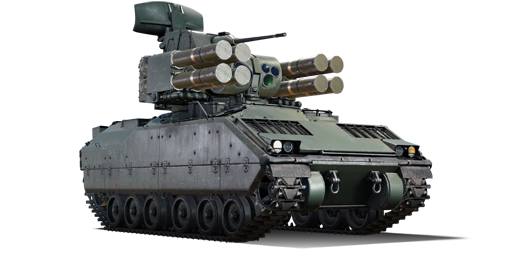
| − | The | + | The XM1069 is essentially an [[M3 Bradley]] with a heavily modified turret. The crew was moved away from the turret and controls it via interface in the back of the tank. The turret is fully automatic and now carries two enormous missile racks, a radar and the same old gun is tweaked to fire three times faster. |
| + | |||
| + | While designations for this tank go all over the place, the XM1069 can be simply called a multi-purpose tank, as it can fight fast jets and heavier tanks alike with missiles, while dealing with lightly armoured tanks and slower aircraft by using a gun and/or missiles. | ||
== General info == | == General info == | ||
=== Survivability and armour === | === Survivability and armour === | ||
| − | <!--''Describe armour protection. Note the most well protected and key weak areas. Appreciate the layout of modules as well as the number and location of crew members. Is the level of armour protection sufficient, is the placement of modules helpful for survival in combat?'' | + | {{Specs-Tank-Armour}} |
| + | <!-- ''Describe armour protection. Note the most well protected and key weak areas. Appreciate the layout of modules as well as the number and location of crew members. Is the level of armour protection sufficient, is the placement of modules helpful for survival in combat? If necessary use a visual template to indicate the most secure and weak zones of the armour.'' --> | ||
| + | The ADATS boasts the same protection as the regular [[M3 Bradley]] hull-wise, with one key difference being that the side armour is thinner by 19 mm. High-calibre machine guns such as the 20 mm on French MBTs will easily penetrate the sides and at times even the front part of the hull. It's not advisable to use the ADATS as a front-line vehicle but rather as a second-line support vehicle by setting up in keypoints around maps. | ||
| + | |||
| + | [[File:XM1069 Side-view.jpg|thumb|300px|The gap between the Loader/Gunner and the Driver visualized with a green square. Also, you can see the unmanned turret.]] | ||
| + | The XM1069 has a completely unmanned turret, meaning that any armour-piercing shells will over-penetrate with no injuries to the crew at all (be aware that explosive shells can cause the missiles to explode and instantly destroy the vehicle). However, two autocannon ammo racks are in the top of the unmanned turret and a few fragments are sufficient to detonate them and blow your whole crew up. The three crew members are situated in the hull with a massive empty space between the loader/gunner and the driver when approached from the side. Every enemy you face will most likely over-penetrate that section and do minimal damage to the vehicle itself. | ||
| + | |||
| + | Overall, the XM1069 can be quite a 'meme' vehicle as it can sometimes sustain 5-7 direct hits even centre-hull, seeing as most rounds just pierce and exit the armour without generating shrapnel, over-penetrating and forcing enemies to snipe for crew members. | ||
| − | |||
'''Armour type:''' | '''Armour type:''' | ||
| − | * | + | * Aluminium alloy 5083 (Hull front, turret) |
| − | * Rolled homogeneous armour ( | + | * Aluminium alloy 7039 (Hull sides, rear, optics, Left side hull vents) |
| + | * Rolled homogeneous armour (Applique armour, rear hatch, engine vent) | ||
| + | * Cast homogeneous armour (Gun mantlet) | ||
{| class="wikitable" | {| class="wikitable" | ||
|- | |- | ||
| − | ! Armour !! Front !! Sides !! Rear !! Roof | + | ! Armour !! Front (Slope angle) !! Sides !! Rear !! Roof |
|- | |- | ||
| − | | Hull || | + | | Hull || 25.4 mm + 6.35 mm (39-60°) ''Upper glacis'' <br> 25.4 mm (7-39°) ''Lower glacis'' || 25.4 mm + 6.35 mm <br> 5 mm ''Vents'' || 25.4 mm + 6.35 mm || 25.4 mm <br> 5 mm ''Engine vent'' |
|- | |- | ||
| − | | Turret || | + | | Turret || 12.7 mm ''Turret front'' <br> 25.4 mm ''Gun mantlet'' <br> 19 mm ''Optics housing'' || 12.7 mm || 6.35-12.7 mm || 12.7 mm |
| − | | | ||
| − | |||
| − | | | ||
| − | | | ||
|- | |- | ||
|} | |} | ||
| + | |||
'''Notes:''' | '''Notes:''' | ||
| − | * Suspension wheels and tracks are | + | * Suspension wheels are 10 mm thick, and tracks are 15 mm thick. |
| − | * | + | * Side skirts are 6 mm thick. |
| − | * | + | * Applique armour plates are 6.35 and 9 mm thick. |
| + | * There is a 6 mm internal RHA screen separating the driver from the engine and the transmission. | ||
=== Mobility === | === Mobility === | ||
| + | {{Specs-Tank-Mobility}} | ||
<!-- ''Write about the mobility of the ground vehicle. Estimate the specific power and manoeuvrability, as well as the maximum speed forwards and backwards.'' --> | <!-- ''Write about the mobility of the ground vehicle. Estimate the specific power and manoeuvrability, as well as the maximum speed forwards and backwards.'' --> | ||
| − | {{tankMobility|abMinHp= | + | |
| + | {{tankMobility|abMinHp=720|rbMinHp=448}} | ||
| + | |||
| + | === Modifications and economy === | ||
| + | {{Specs-Economy}} | ||
== Armaments == | == Armaments == | ||
| + | {{Specs-Tank-Armaments}} | ||
=== Main armament === | === Main armament === | ||
| − | <!--''Give the reader information about the characteristics of the main gun. Assess its effectiveness in a battle based on the reloading speed, ballistics and the power of shells. Do not forget about the | + | {{Specs-Tank-Weapon|2}} |
| − | {{main| | + | <!-- ''Give the reader information about the characteristics of the main gun. Assess its effectiveness in a battle based on the reloading speed, ballistics and the power of shells. Do not forget about the flexibility of the fire, that is how quickly the cannon can be aimed at the target, open fire on it and aim at another enemy. Add a link to the main article on the gun: <code><nowiki>{{main|Name of the weapon}}</nowiki></code>. Describe in general terms the ammunition available for the main gun. Give advice on how to use them and how to fill the ammunition storage.'' --> |
| + | {{main|M242 (25 mm)}} | ||
| − | + | The main armament of the XM1069 is the M242 25 mm automatic cannon, the same as found on the M3 Bradley, but enjoys a faster rate of fire (500 rounds per minute, compared to the Bradley's 201 rounds per minute). When stock, like most AA vehicles, it starts with a belt of equal parts armour-piercing and high-explosive, though it is worth mentioning the AP rounds are sabot rounds with 101 mm of penetration at 100 m against flat armour. This allows it to easily and effectively take on both air and ground threats simultaneously without needing to worry about ammunition costs. However, should you wish to use this vehicle in a dedicated anti-aircraft role, you can unlock a belt with three parts HE to one AP in Tier I modifications. This must be unlocked in order to unlock M791, the AP belt. With this belt, dealing with any and all lightly armoured vehicles and even quite a few of the MBTs is possible from the side. In regards to how much you should take, you may as well take a full ammunition load. At any range, this vehicle can and will be penetrated by any vehicle that looks in its general direction, so it's not like your armour is going to stop you from being ammo-racked by fin-stabilized sabot anyway. Also, due to the cannon's rather high rate of fire and ammunition count of 600 rounds, it's worth taking as much as you can carry. | |
| − | + | ||
| − | + | {| class="wikitable" style="text-align:center" width="100%" | |
| − | |||
| − | |||
| − | |||
| − | |||
| − | |||
| − | |||
| − | |||
| − | |||
| − | |||
| − | |||
| − | |||
| − | |||
| − | |||
| − | |||
| − | |||
| − | |||
|- | |- | ||
| − | | | + | ! colspan="6" | [[M242 (25 mm)|25 mm M242]] || colspan="5" | Turret rotation speed (°/s) || colspan="4" | Reloading rate (seconds) |
|- | |- | ||
| − | + | ! Mode !! Capacity (Belt) !! Fire rate !! Vertical !! Horizontal !! Stabilizer | |
| + | ! Stock !! Upgraded !! Full !! Expert !! Aced | ||
| + | ! Stock !! Full !! Expert !! Aced | ||
|- | |- | ||
| − | ! | + | ! ''Arcade'' |
| + | | rowspan="2" | 600 (300) || rowspan="2" | 500 || rowspan="2" | -9°/+59° || rowspan="2" | ±180° || rowspan="2" | N/A || 61.6 || 85.3 || 103.6 || 114.6 || 121.9 || rowspan="2" | 0.26 || rowspan="2" | 0.23 || rowspan="2" | 0.21 || rowspan="2" | 0.20 | ||
|- | |- | ||
| − | ! | + | ! ''Realistic'' |
| − | + | | 41.6 || 49.0 || 59.5 || 65.8 || 70.0 | |
| − | |||
| − | |||
| − | | | ||
| − | | | ||
|- | |- | ||
|} | |} | ||
| − | + | ==== Ammunition ==== | |
| − | {| | + | |
| − | + | * '''Default:''' {{Annotation|APDS|Armour-piercing discarding sabot}}{{-}}{{Annotation|HEI-T*|High-explosive incendiary tracer (self-destroying)}} | |
| − | |- | + | * '''M792:''' {{Annotation|HEI-T*|High-explosive incendiary tracer (self-destroying)}}{{-}}{{Annotation|HEI-T*|High-explosive incendiary tracer (self-destroying)}}{{-}}{{Annotation|HEI-T*|High-explosive incendiary tracer (self-destroying)}}{{-}}{{Annotation|APDS|Armour-piercing discarding sabot}} |
| − | + | * '''M791:''' {{Annotation|APDS|Armour-piercing discarding sabot}}{{-}}{{Annotation|APDS|Armour-piercing discarding sabot}}{{-}}{{Annotation|APDS|Armour-piercing discarding sabot}}{{-}}{{Annotation|HEI-T*|High-explosive incendiary tracer (self-destroying)}} | |
| − | + | ||
| − | + | {{:M242 (25 mm)/Ammunition|APDS, HEI-T*}} | |
| − | |- | + | |
| − | + | ==== [[Ammo racks]] ==== | |
| − | + | [[File:Ammoracks_{{PAGENAME}}.png|right|thumb|x250px|[[Ammo racks]] of the {{PAGENAME}}]] | |
| − | + | <!-- '''Last updated: 1.101.0.44''' --> | |
| − | + | {| class="wikitable" style="text-align:center" | |
| − | |||
| − | |||
| − | |- | ||
| − | | | ||
| − | |- | ||
| − | |||
| − | |- | ||
| − | |||
| − | |||
| − | |||
| − | |||
| − | |||
| − | |||
| − | |||
| − | |||
| − | |||
| − | |||
| − | |||
| − | |||
| − | |||
| − | ! | ||
| − | |||
| − | |||
| − | |||
| − | |||
| − | |||
| − | |||
| − | |||
| − | |||
| − | |||
| − | |||
| − | |||
| − | {| class="wikitable | ||
| − | |||
|- | |- | ||
| − | ! | + | ! Full<br>ammo |
| − | + | ! 1st<br>rack empty | |
| − | + | ! Visual<br>discrepancy | |
| − | |||
| − | |||
| − | ! | ||
| − | ! | ||
|- | |- | ||
| − | | | + | | Belts: 2 <br> Rounds: 600 || 0 ''(+2)'' <br> 0 ''(+600)'' || No |
|- | |- | ||
|} | |} | ||
| − | === | + | === Additional armament === |
| − | + | {{Specs-Tank-Weapon|1}} | |
| − | { | + | <!-- ''Some tanks are armed with several guns in one or more turrets. Evaluate the additional weaponry and give advice on its use. Describe the ammunition available for additional weaponry. Give advice on about how to use them and how to fill the ammunition storage. If there is no additional weaponry remove this subsection.'' --> |
| − | + | {{main|MIM146}} | |
| − | |||
| − | |||
| − | ! | ||
| − | |||
| − | |||
| − | |||
| − | |||
| − | |} | ||
| − | + | The secondary armament of the XM1069 (or primary, depending on how you choose to play it) are the MIM146 ADATS beam-riding dual-purpose guided missiles. You can effectively use these against any target you can point them at, due to the facts that they air-burst the aircraft within 6 m of trigger radius, usually one-hit killing them with the 7.86 kg of TNT equivalent, and have 900 mm of penetration against armoured targets. With a velocity of 1,027 m/s, aiming these things and tracking moving targets isn't an issue whatsoever. You point, you click, and the target usually dies in a single hit. In the event that, by some miracle of God himself, the target persists in clinging to their life, you can fire the MIM146 as fast as you'd like to, meaning follow-up shots are quick and easy, and with the aforementioned 900 mm of penetration, anything you shoot these at will be penetrated, unless the angle of impact is extreme. | |
| − | + | The high velocity, brilliant 10 km of effective range, and good 35 G of maximum overload make the MIM146 very efficient to catch high-speed jets even when they are evading. It never leaves any vapor trail and smoke in its path, and its long exhaust plume disappears a few seconds after launch. The XM1069 has the capability to guide multiple MIM146s if fired in quick succession, due to the beam-riding guidance of the MIM-146. However, the MIM-146 cannot be fired whilst in motion. Two launchers are a bit spread out, and the first 4 shots will launch from the left one. Remember to check whether your next missile might get blocked by the cover or not so you won't waste any of them. | |
| − | |||
| − | |||
{| class="wikitable" style="text-align:center" | {| class="wikitable" style="text-align:center" | ||
|- | |- | ||
| − | ! colspan=" | + | ! colspan="4" | [[MIM146]] missile |
|- | |- | ||
| − | ! | + | ! Capacity !! Vertical !! Horizontal !! Stabilizer |
|- | |- | ||
| − | + | | 8 || 0°/+85° || ±180° || N/A | |
| − | |||
| − | |||
| − | |||
| − | |||
| − | |||
|- | |- | ||
|} | |} | ||
| + | |||
| + | ==== Ammunition ==== | ||
| + | {{:MIM146/Ammunition|MIM146}} | ||
| + | |||
| + | === Radars === | ||
| + | As an dual-purpose ATGM carrier, the XM1069 is equipped with an ADATS Search Radar and an electro-optical/infrared tracking system with TV and Forward Looking Infrared. The search radar is mounted on top of the turret at the rear and the barrel-like tracking optics is located at the front of the turret. The search radar has a brilliant 25 km of maximum detection range and can switch to 10 km, which is exactly the effective range of the MIM146. However, its vertical scanning elevation of 18 degrees is quite limited, making trouble to detect those jets that chose to opt for a very high entrance altitude. The lock from the electro-optical tracker shows the distance and the relative velocity of the target, not triggering the LWS of the locked hostile aircraft which gives it the advantage to fight modern jets compared to other top-tier SPAAs. However, you will heavily rely on thermal weapon sight to find the hostile aircraft because the electro-optical tracker can't automatically lock the target in your plan position indicator. | ||
| + | |||
{| class="wikitable" style="text-align:center" | {| class="wikitable" style="text-align:center" | ||
| + | ! colspan="5" | ADATS - Target Detection Radar | ||
|- | |- | ||
| − | ! | + | ! {{Annotation|Maximum<br/>Detection<br/>Range|The maximum possible range at which a target can be detected}} |
| + | ! {{Annotation|Minimum<br/>Detection<br/>Range|The range, below which, a target cannot be detected}} | ||
| + | ! {{Annotation|Max Azimuth<br/>Scan Angle|How far to each side the radar can scan (widest search mode)}} | ||
| + | ! {{Annotation|Max Elevation<br/>Scan Angle|How far up and down the radar can scan (widest search mode)}} | ||
| + | ! {{Annotation|Minimum<br/>relative speed|The minimum speed a target must be moving, relative to the radar, in order to be detectable by the radar}} | ||
|- | |- | ||
| − | + | | 25,000 m || __ m || 360° || 18° || __ m/s (__ km/h) | |
|- | |- | ||
| − | ! colspan=" | + | ! colspan="5" | Electro-Optical Target Tracking Radar |
| − | |||
| − | |||
| − | |||
|- | |- | ||
| − | | | + | ! {{Annotation|Maximum<br>Tracking<br>Range|The maximum range at which a target can be tracked}} |
| + | ! {{Annotation|Minimum<br>Tracking<br>Range|The range below which targets cannot be tracked by the radar}} | ||
| + | ! {{Annotation|Azimuth Tracking<br>Angle|How far to each side the radar can track a target}} | ||
| + | ! {{Annotation|Elevation Tracking<br>Angle|How far up and down the radar can track a target}} | ||
| + | ! {{Annotation|Minimum<br>target speed|The minimum speed a target must be moving, relative to the radar, in order to be tracked by the radar}} | ||
|- | |- | ||
| − | | | + | | 10,000 m || __ m || ±__ || -__°/+__° || __ m/s (__ km/h) |
| − | |||
| − | | | ||
| − | |||
| − | | | ||
| − | |||
| − | |- | ||
| − | |||
| − | |||
| − | |||
| − | |||
| − | |||
| − | |||
|- | |- | ||
|} | |} | ||
| − | == Usage in | + | == Usage in battles == |
| − | <!--''Describe the tactics of playing in the vehicle, the features of using vehicles in the team and advice on tactics. Refrain from creating a "guide" - do not impose a single point of view but give the reader food for thought. Describe the most dangerous enemies and give recommendations on fighting them. If necessary, note the specifics of the game in different modes (AB, RB, SB).''--> | + | <!-- ''Describe the tactics of playing in the vehicle, the features of using vehicles in the team and advice on tactics. Refrain from creating a "guide" - do not impose a single point of view but instead give the reader food for thought. Describe the most dangerous enemies and give recommendations on fighting them. If necessary, note the specifics of the game in different modes (AB, RB, SB).'' --> |
| − | + | ||
| − | + | '''Stock Gameplay:''' | |
| − | |||
| − | ''' | ||
| − | |||
| − | + | As with any vehicle, the XM1069 finds itself at a disadvantage while stock. Without access to the thermal vision devices, players will need to be more alert in order to spot enemies. While other modifications like artillery or smoke grenades can be helpful, the lack of thermals is a much larger issue. However the XM1069 is relatively well off stock compared to most high-tier vehicles, as the stock 25 mm belts include APDS rounds, and the radar is capable of spotting air targets for you. | |
| − | + | '''Spaded Gameplay:''' | |
| − | + | The XM1069 is an excellent multi-purpose support vehicle when spaded. Being able to target both enemy tanks and enemy aircraft, it can be a great tool for the team. However, there are some limitations to the vehicle, namely the low missile count and lack of armour. While survivability is decent due to the empty turret, the armour is very thin and the missiles can sometimes explode when hit. This means that the XM1069 does best sitting behind friendly tanks, in a support role. Additionally the missiles can run out quickly, as there are only 8 to engage both air and ground targets. XM1069 players should try and conserve their missiles, as they are versatile, yet limited in quantity. | |
| − | |||
| − | |||
| − | |||
| − | |||
| − | |||
| − | |||
| − | |||
| − | |||
| − | |||
| − | |||
| − | |||
| − | |||
| − | |||
| − | |||
| − | |||
| − | |||
| − | |||
| − | |||
| − | |||
| − | |||
| − | |||
| − | |||
| − | |||
| − | |||
| − | |||
| − | |||
| − | |||
| − | |||
| − | |||
| − | |||
| − | |||
| − | |||
| − | |||
| − | |||
| − | |||
| − | |||
| − | |||
| − | |||
| − | |||
| − | + | '''Close Range Engagements:''' | |
| − | |||
| − | |||
| − | |||
| − | |||
| − | + | The XM1069 is capable at close range, but is still extremely vulnerable to enemy fire. The 25 mm bushmaster autocannon can penetrate the side armour of most enemy tanks with APDS rounds, but it will not disable the enemy as quickly as their large cannons are capable of killing the XM1069. The MIM-146 ADATS missiles can be useful at close range as well, with rapid ripple capability to ensure a wasteful, yet quick dispatch of most ground vehicles. | |
| − | |||
| − | |||
| − | + | '''Long Range Engagements:''' | |
| − | |||
| − | |||
| − | |||
| − | |||
| − | |||
| − | |||
| − | |||
| − | |||
| − | |||
| − | |||
| − | + | The XM1069 is more capable at long range, where it can rely on thermal vision and the very fast ADATS missiles to disable enemy targets. The only issue at long range is the low amount of missiles, so shots should be taken with care. Additionally, the XM1069 can be quickly disabled if the hull is exposed, so staying hull down is advised. The radar should also be turned off and on as needed, as it provides a good indicator of where you are for enemy ground vehicles, but is very useful in spotting air targets. | |
| − | + | '''Gameplay summary:''' | |
| − | |||
| − | |||
| − | |||
| − | |||
| − | |||
| − | |||
| − | |||
| − | |||
| − | |||
| − | + | The XM1069 is an excellent support vehicle, able to defend teammates from both enemy air and ground threats. The MIM-146 ADATS missiles are excellent at disabling any target, although the low ammo count should be considered. The XM1069 is also capable of locking an enemy aircraft without alerting their RWR, by turning off the radar. One must take excellent care in their method of positioning. The XM1069 has a playstyle similar to the M3 Bradley if you choose to use it against ground vehicles. | |
| − | |||
| − | |||
| − | The | ||
| − | === | + | === Pros and cons === |
| − | + | <!-- ''Summarise and briefly evaluate the vehicle in terms of its characteristics and combat effectiveness. Mark its pros and cons in a bulleted list. Try not to use more than 6 points for each of the characteristics. Avoid using categorical definitions such as "bad", "good" and the like - use substitutions with softer forms such as "inadequate" and "effective".'' --> | |
| − | + | '''Pros:''' | |
| − | + | * Has access to 8 x fast multi-purpose missiles, can efficiently and swiftly eliminate both aircraft and tanks without reloading | |
| + | * Missiles can penetrate up to 900 mm of armour and can cause overpressure with 7.9 kg TNT equivalent | ||
| + | * High rate of fire 25 mm cannon with good APDS for ground targets and HE ammunition for use against air targets | ||
| + | ** Can fire 131 rounds before overheating | ||
| + | * Gunner operates the turret and weapons from behind protective hull instead of being in the turret itself | ||
| + | * Built on the chassis of M3 Bradley - good mobility and can resist most machine gun fire | ||
| + | * Modifications are researched fairly quickly | ||
| + | * Effective radar with good range | ||
| + | * Can lock on to aircraft with the radar disabled as the XM1069 tracks using an electro-optical/infrared targeting system, making sneak attacks easy | ||
| + | * Missiles can even be fired without lock on and retain their proximity fuse against aircraft | ||
| − | + | '''Cons:''' | |
| − | |||
| − | The | + | * Thin armor offers no protection against autocannons and tank rounds |
| + | * High profile makes it hard to conceal | ||
| + | * The three crew members are all situated within the hull, and can all be rendered unconscious if a shot penetrates the hull | ||
| + | * The 25 mm autocannon cannot reliably penetrate MBTs frontally | ||
| + | * The missiles and autocannon ammo boxes are visible even when hull down | ||
| + | * Lack of stabilizer makes firing on the move difficult and increases the time to aim the weapons when suddenly braking | ||
| + | * No commander fire control | ||
| + | * Vulnerable to the [[Damage mechanics#Overpressure|overpressure]] mechanic | ||
| + | * ERA defeats the MIM146 ATGM | ||
| + | * Requires the player to actually find and look at the intended aircraft to lock-on | ||
| + | * Optical tracker can be destroyed even with machine gun fire, preventing the vehicle from locking onto aircraft | ||
| − | + | == History == | |
| + | <!-- ''Describe the history of the creation and combat usage of the vehicle in more detail than in the introduction. If the historical reference turns out to be too long, take it to a separate article, taking a link to the article about the vehicle and adding a block "/History" (example: <nowiki>https://wiki.warthunder.com/(Vehicle-name)/History</nowiki>) and add a link to it here using the <code>main</code> template. Be sure to reference text and sources by using <code><nowiki><ref></ref></nowiki></code>, as well as adding them at the end of the article with <code><nowiki><references /></nowiki></code>. This section may also include the vehicle's dev blog entry (if applicable) and the in-game encyclopedia description (under <code><nowiki>=== In-game description ===</nowiki></code>, also if applicable).'' --> | ||
| + | The ADATS was developed at the end of the 1980s as a general-purpose weapon capable of bringing down low-flying airborne targets as well as armoured opponents. Hence the abbreviation: Air Defence Anti-Tank System. The system was comprised of radar for detecting and tracking targets, a complex radio kit for coordinating multiple vehicles, and eight MIM-146 guided missiles in transport and launch containers. The US Army version, the XM1069, was built on the Bradley IFV chassis and fitted with a 25 mm autocannon. Notwithstanding the fact that it was selected after a US Army competition for the Forward Area Air-Defence program, it was found to be excessively expensive to manufacture and never made it to serial production on the Bradley chassis. | ||
| − | + | ''-From [[wt:en/news/6173-development-bradley-adats-one-to-rule-them-all-en|Devblog]]'' | |
== Media == | == Media == | ||
| − | '' | + | <!-- ''Excellent additions to the article would be video guides, screenshots from the game, and photos.'' --> |
| − | {{ | + | |
| + | ;Skins | ||
| + | |||
| + | * [https://live.warthunder.com/feed/camouflages/?vehicle=us_adats_bradley Skins and camouflages for the {{PAGENAME}} from live.warthunder.com.] | ||
| − | + | ;Videos | |
| − | '' | + | {{Youtube-gallery|luvhoX8Ht1I|'''New anti-air defence''' discusses the {{PAGENAME}} at 0:59 - ''War Thunder Official Channel''}} |
| + | == See also == | ||
| + | <!-- ''Links to the articles on the War Thunder Wiki that you think will be useful for the reader, for example:'' | ||
* ''reference to the series of the vehicles;'' | * ''reference to the series of the vehicles;'' | ||
| − | * ''links to approximate analogues of other nations and research trees.'' | + | * ''links to approximate analogues of other nations and research trees.'' --> |
| − | + | * [[ADATS (M113)]] | |
| − | == | + | == External links == |
| − | ''Paste links to sources and external resources, such as:'' | + | <!-- ''Paste links to sources and external resources, such as:'' |
| + | * ''topic on the official game forum;'' | ||
| + | * ''other literature.'' --> | ||
| − | * | + | * [[wt:en/news/6173-development-bradley-adats-one-to-rule-them-all-en|[Devblog] Bradley ADATS: One to Rule Them All]] |
| − | |||
| − | {{ | + | {{USA anti-aircraft vehicles}} |
| − | |||
Latest revision as of 13:30, 29 October 2024
| This page is about the American SPAA ADATS. For the British version, see ADATS (M113). |


Contents
Description
The Missile, Air Defence Artillery, Self-Propelled, ADATS is a rank American self-propelled anti-air vehicle with a battle rating of (AB), (RB), and (SB). It was introduced in Update 1.89 "Imperial Navy".
The XM1069 is essentially an M3 Bradley with a heavily modified turret. The crew was moved away from the turret and controls it via interface in the back of the tank. The turret is fully automatic and now carries two enormous missile racks, a radar and the same old gun is tweaked to fire three times faster.
While designations for this tank go all over the place, the XM1069 can be simply called a multi-purpose tank, as it can fight fast jets and heavier tanks alike with missiles, while dealing with lightly armoured tanks and slower aircraft by using a gun and/or missiles.
General info
Survivability and armour
The ADATS boasts the same protection as the regular M3 Bradley hull-wise, with one key difference being that the side armour is thinner by 19 mm. High-calibre machine guns such as the 20 mm on French MBTs will easily penetrate the sides and at times even the front part of the hull. It's not advisable to use the ADATS as a front-line vehicle but rather as a second-line support vehicle by setting up in keypoints around maps.

The XM1069 has a completely unmanned turret, meaning that any armour-piercing shells will over-penetrate with no injuries to the crew at all (be aware that explosive shells can cause the missiles to explode and instantly destroy the vehicle). However, two autocannon ammo racks are in the top of the unmanned turret and a few fragments are sufficient to detonate them and blow your whole crew up. The three crew members are situated in the hull with a massive empty space between the loader/gunner and the driver when approached from the side. Every enemy you face will most likely over-penetrate that section and do minimal damage to the vehicle itself.
Overall, the XM1069 can be quite a 'meme' vehicle as it can sometimes sustain 5-7 direct hits even centre-hull, seeing as most rounds just pierce and exit the armour without generating shrapnel, over-penetrating and forcing enemies to snipe for crew members.
Armour type:
- Aluminium alloy 5083 (Hull front, turret)
- Aluminium alloy 7039 (Hull sides, rear, optics, Left side hull vents)
- Rolled homogeneous armour (Applique armour, rear hatch, engine vent)
- Cast homogeneous armour (Gun mantlet)
| Armour | Front (Slope angle) | Sides | Rear | Roof |
|---|---|---|---|---|
| Hull | 25.4 mm + 6.35 mm (39-60°) Upper glacis 25.4 mm (7-39°) Lower glacis |
25.4 mm + 6.35 mm 5 mm Vents |
25.4 mm + 6.35 mm | 25.4 mm 5 mm Engine vent |
| Turret | 12.7 mm Turret front 25.4 mm Gun mantlet 19 mm Optics housing |
12.7 mm | 6.35-12.7 mm | 12.7 mm |
Notes:
- Suspension wheels are 10 mm thick, and tracks are 15 mm thick.
- Side skirts are 6 mm thick.
- Applique armour plates are 6.35 and 9 mm thick.
- There is a 6 mm internal RHA screen separating the driver from the engine and the transmission.
Mobility
| Game Mode | Max Speed (km/h) | Weight (tons) | Engine power (horsepower) | Power-to-weight ratio (hp/ton) | |||
|---|---|---|---|---|---|---|---|
| Forward | Reverse | Stock | Upgraded | Stock | Upgraded | ||
| Arcade | Expression error: Unexpected * operator. | 720 | Expression error: Unexpected round operator. | __.__ | |||
| Realistic | 448 | Expression error: Unexpected round operator. | __.__ | ||||
Modifications and economy
Armaments
Main armament
The main armament of the XM1069 is the M242 25 mm automatic cannon, the same as found on the M3 Bradley, but enjoys a faster rate of fire (500 rounds per minute, compared to the Bradley's 201 rounds per minute). When stock, like most AA vehicles, it starts with a belt of equal parts armour-piercing and high-explosive, though it is worth mentioning the AP rounds are sabot rounds with 101 mm of penetration at 100 m against flat armour. This allows it to easily and effectively take on both air and ground threats simultaneously without needing to worry about ammunition costs. However, should you wish to use this vehicle in a dedicated anti-aircraft role, you can unlock a belt with three parts HE to one AP in Tier I modifications. This must be unlocked in order to unlock M791, the AP belt. With this belt, dealing with any and all lightly armoured vehicles and even quite a few of the MBTs is possible from the side. In regards to how much you should take, you may as well take a full ammunition load. At any range, this vehicle can and will be penetrated by any vehicle that looks in its general direction, so it's not like your armour is going to stop you from being ammo-racked by fin-stabilized sabot anyway. Also, due to the cannon's rather high rate of fire and ammunition count of 600 rounds, it's worth taking as much as you can carry.
| 25 mm M242 | Turret rotation speed (°/s) | Reloading rate (seconds) | ||||||||||||
|---|---|---|---|---|---|---|---|---|---|---|---|---|---|---|
| Mode | Capacity (Belt) | Fire rate | Vertical | Horizontal | Stabilizer | Stock | Upgraded | Full | Expert | Aced | Stock | Full | Expert | Aced |
| Arcade | 600 (300) | 500 | -9°/+59° | ±180° | N/A | 61.6 | 85.3 | 103.6 | 114.6 | 121.9 | 0.26 | 0.23 | 0.21 | 0.20 |
| Realistic | 41.6 | 49.0 | 59.5 | 65.8 | 70.0 | |||||||||
Ammunition
- Default: APDS · HEI-T*
- M792: HEI-T* · HEI-T* · HEI-T* · APDS
- M791: APDS · APDS · APDS · HEI-T*
| Penetration statistics | |||||||
|---|---|---|---|---|---|---|---|
| Ammunition | Penetration @ 0° Angle of Attack (mm) | ||||||
| 10 m | 100 m | 500 m | 1,000 m | 1,500 m | 2,000 m | ||
| APDS | 81 | 80 | 74 | 67 | 61 | 56 | |
| HEI-T* | 7 | 6 | 4 | 3 | 3 | 3 | |
| Shell details | ||||||||||||
|---|---|---|---|---|---|---|---|---|---|---|---|---|
| Ammunition | Velocity (m/s) |
Projectile mass (kg) |
Fuse delay (m) |
Fuse sensitivity (mm) |
Explosive mass (TNT equivalent) (g) |
Ricochet | ||||||
| 0% | 50% | 100% | ||||||||||
| APDS | 1,345 | 0.13 | - | - | - | 75° | 78° | 80° | ||||
| HEI-T* | 1,100 | 0.19 | 0.1 | 0.1 | 54.4 | 79° | 80° | 81° | ||||
Ammo racks

| Full ammo |
1st rack empty |
Visual discrepancy |
|---|---|---|
| Belts: 2 Rounds: 600 |
0 (+2) 0 (+600) |
No |
Additional armament
The secondary armament of the XM1069 (or primary, depending on how you choose to play it) are the MIM146 ADATS beam-riding dual-purpose guided missiles. You can effectively use these against any target you can point them at, due to the facts that they air-burst the aircraft within 6 m of trigger radius, usually one-hit killing them with the 7.86 kg of TNT equivalent, and have 900 mm of penetration against armoured targets. With a velocity of 1,027 m/s, aiming these things and tracking moving targets isn't an issue whatsoever. You point, you click, and the target usually dies in a single hit. In the event that, by some miracle of God himself, the target persists in clinging to their life, you can fire the MIM146 as fast as you'd like to, meaning follow-up shots are quick and easy, and with the aforementioned 900 mm of penetration, anything you shoot these at will be penetrated, unless the angle of impact is extreme.
The high velocity, brilliant 10 km of effective range, and good 35 G of maximum overload make the MIM146 very efficient to catch high-speed jets even when they are evading. It never leaves any vapor trail and smoke in its path, and its long exhaust plume disappears a few seconds after launch. The XM1069 has the capability to guide multiple MIM146s if fired in quick succession, due to the beam-riding guidance of the MIM-146. However, the MIM-146 cannot be fired whilst in motion. Two launchers are a bit spread out, and the first 4 shots will launch from the left one. Remember to check whether your next missile might get blocked by the cover or not so you won't waste any of them.
| MIM146 missile | |||
|---|---|---|---|
| Capacity | Vertical | Horizontal | Stabilizer |
| 8 | 0°/+85° | ±180° | N/A |
Ammunition
| Penetration statistics | |||||||
|---|---|---|---|---|---|---|---|
| Ammunition | Type of warhead |
Penetration @ 0° Angle of Attack (mm) | |||||
| 10 m | 100 m | 500 m | 1,000 m | 1,500 m | 2,000 m | ||
| MIM146 | ATGM | 900 | 900 | 900 | 900 | 900 | 900 |
| Missile details | ||||||||||||
|---|---|---|---|---|---|---|---|---|---|---|---|---|
| Ammunition | Type of warhead |
Velocity (m/s) |
Range (m) |
Projectile mass (kg) |
Fuse delay (m) |
Fuse sensitivity (mm) |
Arming distance (m) |
Trigger radius (m) |
Explosive mass (TNT equivalent) (kg) |
Ricochet | ||
| 0% | 50% | 100% | ||||||||||
| MIM146 | ATGM | 1,027 | 10,000 | 51 | 0 | 0.1 | 300 | 6 | 7.86 | 79° | 80° | 81° |
Radars
As an dual-purpose ATGM carrier, the XM1069 is equipped with an ADATS Search Radar and an electro-optical/infrared tracking system with TV and Forward Looking Infrared. The search radar is mounted on top of the turret at the rear and the barrel-like tracking optics is located at the front of the turret. The search radar has a brilliant 25 km of maximum detection range and can switch to 10 km, which is exactly the effective range of the MIM146. However, its vertical scanning elevation of 18 degrees is quite limited, making trouble to detect those jets that chose to opt for a very high entrance altitude. The lock from the electro-optical tracker shows the distance and the relative velocity of the target, not triggering the LWS of the locked hostile aircraft which gives it the advantage to fight modern jets compared to other top-tier SPAAs. However, you will heavily rely on thermal weapon sight to find the hostile aircraft because the electro-optical tracker can't automatically lock the target in your plan position indicator.
| ADATS - Target Detection Radar | ||||
|---|---|---|---|---|
| Maximum Detection Range |
Minimum Detection Range |
Max Azimuth Scan Angle |
Max Elevation Scan Angle |
Minimum relative speed |
| 25,000 m | __ m | 360° | 18° | __ m/s (__ km/h) |
| Electro-Optical Target Tracking Radar | ||||
| Maximum Tracking Range |
Minimum Tracking Range |
Azimuth Tracking Angle |
Elevation Tracking Angle |
Minimum target speed |
| 10,000 m | __ m | ±__ | -__°/+__° | __ m/s (__ km/h) |
Usage in battles
Stock Gameplay:
As with any vehicle, the XM1069 finds itself at a disadvantage while stock. Without access to the thermal vision devices, players will need to be more alert in order to spot enemies. While other modifications like artillery or smoke grenades can be helpful, the lack of thermals is a much larger issue. However the XM1069 is relatively well off stock compared to most high-tier vehicles, as the stock 25 mm belts include APDS rounds, and the radar is capable of spotting air targets for you.
Spaded Gameplay:
The XM1069 is an excellent multi-purpose support vehicle when spaded. Being able to target both enemy tanks and enemy aircraft, it can be a great tool for the team. However, there are some limitations to the vehicle, namely the low missile count and lack of armour. While survivability is decent due to the empty turret, the armour is very thin and the missiles can sometimes explode when hit. This means that the XM1069 does best sitting behind friendly tanks, in a support role. Additionally the missiles can run out quickly, as there are only 8 to engage both air and ground targets. XM1069 players should try and conserve their missiles, as they are versatile, yet limited in quantity.
Close Range Engagements:
The XM1069 is capable at close range, but is still extremely vulnerable to enemy fire. The 25 mm bushmaster autocannon can penetrate the side armour of most enemy tanks with APDS rounds, but it will not disable the enemy as quickly as their large cannons are capable of killing the XM1069. The MIM-146 ADATS missiles can be useful at close range as well, with rapid ripple capability to ensure a wasteful, yet quick dispatch of most ground vehicles.
Long Range Engagements:
The XM1069 is more capable at long range, where it can rely on thermal vision and the very fast ADATS missiles to disable enemy targets. The only issue at long range is the low amount of missiles, so shots should be taken with care. Additionally, the XM1069 can be quickly disabled if the hull is exposed, so staying hull down is advised. The radar should also be turned off and on as needed, as it provides a good indicator of where you are for enemy ground vehicles, but is very useful in spotting air targets.
Gameplay summary:
The XM1069 is an excellent support vehicle, able to defend teammates from both enemy air and ground threats. The MIM-146 ADATS missiles are excellent at disabling any target, although the low ammo count should be considered. The XM1069 is also capable of locking an enemy aircraft without alerting their RWR, by turning off the radar. One must take excellent care in their method of positioning. The XM1069 has a playstyle similar to the M3 Bradley if you choose to use it against ground vehicles.
Pros and cons
Pros:
- Has access to 8 x fast multi-purpose missiles, can efficiently and swiftly eliminate both aircraft and tanks without reloading
- Missiles can penetrate up to 900 mm of armour and can cause overpressure with 7.9 kg TNT equivalent
- High rate of fire 25 mm cannon with good APDS for ground targets and HE ammunition for use against air targets
- Can fire 131 rounds before overheating
- Gunner operates the turret and weapons from behind protective hull instead of being in the turret itself
- Built on the chassis of M3 Bradley - good mobility and can resist most machine gun fire
- Modifications are researched fairly quickly
- Effective radar with good range
- Can lock on to aircraft with the radar disabled as the XM1069 tracks using an electro-optical/infrared targeting system, making sneak attacks easy
- Missiles can even be fired without lock on and retain their proximity fuse against aircraft
Cons:
- Thin armor offers no protection against autocannons and tank rounds
- High profile makes it hard to conceal
- The three crew members are all situated within the hull, and can all be rendered unconscious if a shot penetrates the hull
- The 25 mm autocannon cannot reliably penetrate MBTs frontally
- The missiles and autocannon ammo boxes are visible even when hull down
- Lack of stabilizer makes firing on the move difficult and increases the time to aim the weapons when suddenly braking
- No commander fire control
- Vulnerable to the overpressure mechanic
- ERA defeats the MIM146 ATGM
- Requires the player to actually find and look at the intended aircraft to lock-on
- Optical tracker can be destroyed even with machine gun fire, preventing the vehicle from locking onto aircraft
History
The ADATS was developed at the end of the 1980s as a general-purpose weapon capable of bringing down low-flying airborne targets as well as armoured opponents. Hence the abbreviation: Air Defence Anti-Tank System. The system was comprised of radar for detecting and tracking targets, a complex radio kit for coordinating multiple vehicles, and eight MIM-146 guided missiles in transport and launch containers. The US Army version, the XM1069, was built on the Bradley IFV chassis and fitted with a 25 mm autocannon. Notwithstanding the fact that it was selected after a US Army competition for the Forward Area Air-Defence program, it was found to be excessively expensive to manufacture and never made it to serial production on the Bradley chassis.
-From Devblog
Media
- Skins
- Videos
See also
External links
| USA anti-aircraft vehicles | |
|---|---|
| M3 Half-track derivatives | M13 MGMC · M15 CGMC · M16 MGMC |
| M24 derivative | M19A1 |
| M41 derivative | M42 |
| Radar SPAAG | M163 · M247 |
| Missile SPAA | ADATS · Imp.Chaparral · LAV-AD · XM975 |