Difference between pages "MEPHISTO" and "P-47D-30 (Italy)"
(→Description) |
m (Grammar fix) (Tag: Visual edit) |
||
| Line 1: | Line 1: | ||
| + | {{About | ||
| + | |about = fighter '''{{PAGENAME}}''' | ||
| + | |usage = other versions | ||
| + | |link = P-47 (Family) | ||
| + | }} | ||
{{Specs-Card | {{Specs-Card | ||
| − | |code= | + | |code=p-47d_30_italy |
|images={{Specs-Card-Image|GarageImage_{{PAGENAME}}.jpg}} | |images={{Specs-Card-Image|GarageImage_{{PAGENAME}}.jpg}} | ||
}} | }} | ||
== Description == | == Description == | ||
| − | <!-- ''In the description, the first part should be about the history of the creation and combat usage of the | + | <!-- ''In the description, the first part should be about the history of and the creation and combat usage of the aircraft, as well as its key features. In the second part, tell the reader about the aircraft in the game. Insert a screenshot of the vehicle, so that if the novice player does not remember the vehicle by name, he will immediately understand what kind of vehicle the article is talking about.'' --> |
| − | |||
| − | + | In 1949, five years after the Second World War, Italy became one of the founding members of the North Atlantic Treaty Organization (NATO). In an attempt to modernize the aging Italian Air Force, Aeronautica Militare, the United States sent outdated or surplus equipment to countries like Italy under the MDA (Mutual Defense Act). As a result, Italy received around 100 P-47s. The P-47D-30 was essentially a P-47D-28 with minor improvements and dive brakes. | |
| + | |||
| + | Introduced in [[Update "Sky Guardians"]], the '''{{Specs|name}}''' is a very strong fighter and capable in the ground attack role. Like many American propeller aircraft in WW2, the D-30 utilized water injection to increase power for a limited amount of time. In-game, this translates to an exceptional top speed of 714 km/h (443.7 mph). Although the Thunderbolt is quite sluggish, its superior top speed and high-speed handling make it a potent aircraft for dealing with enemy fighters. The P-47D-30 also has access to a multitude of ground attack loadouts which greatly increase its capability against tanks and pillboxes. It also has a very large ammo pool which allows for 34 seconds of firing time: more than enough to attack soft ground targets like anti-air or machine gun positions. | ||
== General info == | == General info == | ||
| − | === | + | === Flight performance === |
| − | {{Specs- | + | {{Specs-Avia-Flight}} |
| − | <!-- ''Describe | + | <!-- ''Describe how the aircraft behaves in the air. Speed, manoeuvrability, acceleration and allowable loads - these are the most important characteristics of the vehicle.'' --> |
| − | |||
| − | + | {| class="wikitable" style="text-align:center" width="70%" | |
| + | ! rowspan="2" | Characteristics | ||
| + | ! colspan="2" | Max speed<br>(km/h at 7,071 m) | ||
| + | ! rowspan="2" | Max altitude<br>(metres) | ||
| + | ! colspan="2" | Turn time<br>(seconds) | ||
| + | ! colspan="2" | Rate of climb<br>(metres/second) | ||
| + | ! rowspan="2" | Take-off run<br>(metres) | ||
| + | |- | ||
| + | ! AB !! RB !! AB !! RB !! AB !! RB | ||
| + | |- | ||
| + | ! Stock | ||
| + | | 689 || 673 || rowspan="2" | {{Specs|ceiling}} || 24.1 || 24.9 || 10.1 || 10.1 || rowspan="2" | 700 | ||
| + | |- | ||
| + | ! Upgraded | ||
| + | | 743 || 714 || 21.9 || 23.0 || 19.2 || 14.1 | ||
| + | |- | ||
| + | |} | ||
| − | + | ==== Details ==== | |
| + | {| class="wikitable" style="text-align:center" width="50%" | ||
| + | |- | ||
| + | ! colspan="5" | Features | ||
| + | |- | ||
| + | ! Combat flaps !! Take-off flaps !! Landing flaps !! Air brakes !! Arrestor gear | ||
| + | |- | ||
| + | | ✓ || ✓ || ✓ || ✓ || X <!-- ✓ --> | ||
| + | |- | ||
| + | |} | ||
| − | + | {| class="wikitable" style="text-align:center" width="50%" | |
| − | |||
| − | |||
| − | |||
| − | {| class="wikitable" | ||
|- | |- | ||
| − | ! | + | ! colspan="7" | Limits |
|- | |- | ||
| − | | | + | ! rowspan="2" | Wings (km/h) |
| + | ! rowspan="2" | Gear (km/h) | ||
| + | ! colspan="3" | Flaps (km/h) | ||
| + | ! colspan="2" | Max Static G | ||
|- | |- | ||
| − | + | ! Combat !! Take-off !! Landing !! + !! - | |
|- | |- | ||
| − | | | + | | {{Specs|destruction|body}} || {{Specs|destruction|gear}} || 498 || 469 || 320 || ~13 || ~5 |
|- | |- | ||
|} | |} | ||
| − | + | {| class="wikitable" style="text-align:center" | |
| − | + | |- | |
| + | ! colspan="4" | Optimal velocities (km/h) | ||
| + | |- | ||
| + | ! Ailerons !! Rudder !! Elevators !! Radiator | ||
| + | |- | ||
| + | | < 402 || < 420 || < 470 || > 335 | ||
| + | |- | ||
| + | |} | ||
| − | === | + | === Survivability and armour === |
| − | {{Specs- | + | {{Specs-Avia-Armour}} |
| − | <!-- '' | + | <!-- ''Examine the survivability of the aircraft. Note how vulnerable the structure is and how secure the pilot is, whether the fuel tanks are armoured, etc. Describe the armour, if there is any, and also mention the vulnerability of other critical aircraft systems.'' --> |
| − | + | ''Examine the survivability of the aircraft. Note how vulnerable the structure is and how secure the pilot is, whether the fuel tanks are armoured, etc. Describe the armour, if there is any, and also mention the vulnerability of other critical aircraft systems.'' | |
| − | |||
| − | |||
=== Modifications and economy === | === Modifications and economy === | ||
| Line 50: | Line 84: | ||
== Armaments == | == Armaments == | ||
| − | {{Specs- | + | {{Specs-Avia-Armaments}} |
| − | === | + | === Offensive armament === |
| − | {{Specs- | + | {{Specs-Avia-Offensive}} |
| − | <!-- '' | + | <!-- ''Describe the offensive armament of the aircraft, if any. Describe how effective the cannons and machine guns are in a battle, and also what belts or drums are better to use. If there is no offensive weaponry, delete this subsection.'' --> |
| − | {{ | + | {{main|M2 Browning (12.7 mm)}} |
| + | |||
| + | The '''''{{PAGENAME}}''''' is armed with: | ||
| − | + | * 8 x 12.7 mm M2 Browning machine guns, wing-mounted (425 rpg = 3,400 total) | |
| − | + | === Suspended armament === | |
| + | {{Specs-Avia-Suspended}} | ||
| + | <!-- ''Describe the aircraft's suspended armament: additional cannons under the wings, bombs, rockets and torpedoes. This section is especially important for bombers and attackers. If there is no suspended weaponry remove this subsection.'' --> | ||
| − | The | + | The '''''{{PAGENAME}}''''' can be outfitted with the following ordnance: |
{| class="wikitable" style="text-align:center" width="100%" | {| class="wikitable" style="text-align:center" width="100%" | ||
|- | |- | ||
| − | ! | + | ! !! width="3.5%" | 1 !! width="3.5%" | 2 !! width="3.5%" | 3 !! width="3.5%" | 4 !! width="3.5%" | 5 !! width="3.5%" | 6 !! width="3.5%" | 7 !! width="3.5%" | 8 !! width="3.5%" | 9 !! width="3.5%" | 10 !! width="3.5%" | 11 !! width="3.5%" | 12 !! width="3.5%" | 13 |
| + | | rowspan="6" width="30%" | <div class="ttx-image">[[File:Hardpoints_P-47D-25.png]]</div> | ||
| + | |- | ||
| + | ! [[AN-M57 (250 lb)|250 lb AN-M57]] bombs | ||
| + | | || || || 1 || || || 1 || || || 1 || || || | ||
|- | |- | ||
| − | ! | + | ! [[AN-M64A1 (500 lb)|500 lb AN-M64A1]] bombs |
| − | + | | || || || 1 || || || 1 || || || 1 || || || | |
| − | |||
|- | |- | ||
| − | ! | + | ! [[AN-M65A1 (1,000 lb)|1,000 lb AN-M65A1]] bombs |
| − | + | | || || || 1 || || || || || || 1 || || || | |
|- | |- | ||
| − | ! | + | ! [[HVAR]] rockets |
| − | | | + | | 1 || 1 || 1 || || 1 || 1 || || 1 || 1 || || 1 || 1 || 1 |
| + | |- | ||
| + | | colspan="14" | Maximum permissible weight imbalance: 680 kg | ||
|- | |- | ||
|} | |} | ||
| − | + | {{Navigation-Start|Default weapon presets}} | |
| − | + | {{Navigation-First-Simple-Line}} | |
| − | {{ | + | * Without load |
| + | * 10 x HVAR rockets | ||
| + | * 3 x 250 lb AN-M57 bombs (750 lb total) | ||
| + | * 3 x 500 lb AN-M64A1 bombs (1,500 lb total) | ||
| + | * 2 x 1,000 lb AN-M65A1 bombs (2,000 lb total) | ||
| + | {{Navigation-End}} | ||
| − | == | + | == Usage in battles == |
| − | <!-- | + | <!-- ''Describe the tactics of playing in the aircraft, the features of using aircraft in a team and advice on tactics. Refrain from creating a "guide" - do not impose a single point of view, but instead, give the reader food for thought. Examine the most dangerous enemies and give recommendations on fighting them. If necessary, note the specifics of the game in different modes (AB, RB, SB).'' --> |
| − | + | ||
| + | Always maintain speed. The P-47 handles like a dream at about 550-650 km/h (350-400 mph), but once it gets below 350 km/h (220 mph) it handles sluggishly, like a pig dipped in mud. One great thing about the handling at high speed though, is that the P-47 responds quickly at high speeds, and this allows some impressive defensive scissoring without losing wings at terminal velocity. The high-wing loading is an issue though, as the Jug will lose most of its energy in a blackout turn. This does endow the Jug with one key feature. it is a rock-solid gun platform. | ||
| + | |||
| + | Unfortunately, zoom-climbing and dive acceleration are not the "Jug's" forte. The Bf 109 has a superior dive acceleration, and the Fw 190 can zoom-climb far faster. Still, the energy retention of the P-47 is great, along with the fact that it flies far faster than both the Würger and Messerschmitt. The P-47 is not a turnfighter. Although it is possible to out-turn a heavy fighter like the Bf 110 C or Do 217, it is not recommended - the acceleration is mediocre, and once a P-47 is a sitting duck, it will be swarmed like flies to fruit in a compost pile. Acrobatic pilots will not be impressed by the P-47 as well, because it performs Immelmanns very sluggishly and the roll rate is not magnificent as well. | ||
| + | |||
| + | Durability, as mentioned above, is pretty good. As in World War II itself, the P-47 was renowned for its rugged construction. In War Thunder, the biggest weak points of the P-47 are its engine and wings. The wings can break fairly easily in manoeuvres at speeds around ~675 km/h or so. They also tend to break after a well-placed cannon burst (from planes like the Fw 190, A6M2/3). The engine though is also fairly susceptible to catching fire while chasing a bomber, but this is not due to its durability but to its size. Speaking of fire, the P-47D will be heavily damaged by the time it pulls itself out of a fire. One should immediately try to limp home if set aflame. | ||
| + | |||
| + | The performance of the P-47 at altitude is very good, but once you go above about 9,000 m (~30,000 ft), its critical altitude, any energy lost will have to be regained by diving and losing altitude. Even though the D-28 now gets 70 seconds boost (which is significantly more than the D-25), it still will have some troubles accelerating and climbing. Keep in mind that this boost is only achieved on WEP, although on military power it still has 65" of boost. | ||
| + | |||
| + | Turnfighting should never be the combat tactic in a P-47. The immense engine power, decent wing-loading, and good flaps of the D-30 variant can allow it to turn surprisingly well against some of its opposition, namely German, American, and Soviet props with poor power-to-weight ratios at high speeds (typically in a dive). This can be used to keep track of an opponent trying to evade your fire but do not enter a prolonged dogfight or you'll lose too much energy. | ||
| + | |||
| + | When used skillfully, the tracer rounds can be used to scare the opponent as due to the high calibre (for a machine gun) and rate of fire, tracers from the .50 cal machine guns can be absolutely terrifying to anyone attacked by them. However, besides to the scare effect and low takedown capabilities, the tracers have limited practical use. | ||
| + | |||
| + | === Manual Engine Control === | ||
{| class="wikitable" style="text-align:center" | {| class="wikitable" style="text-align:center" | ||
|- | |- | ||
| − | ! | + | ! colspan="7" | MEC elements |
| − | |||
| − | |||
| − | |||
| − | |||
| − | |||
| − | |||
| − | |||
|- | |- | ||
| − | | | + | ! rowspan="2" | Mixer |
| + | ! rowspan="2" | Pitch | ||
| + | ! colspan="3" | Radiator | ||
| + | ! rowspan="2" | Supercharger | ||
| + | ! rowspan="2" | Turbocharger | ||
| + | |- | ||
| + | ! Oil !! Water !! Type | ||
| + | |- | ||
| + | | Controllable || Controllable<br>Auto control available || Controllable<br>Not auto controlled || Controllable<br>Not auto controlled || Separate || Controllable<br>1 gear || Auto controlled | ||
|- | |- | ||
|} | |} | ||
| − | |||
| − | |||
| − | |||
| − | |||
| − | |||
| − | |||
=== Pros and cons === | === Pros and cons === | ||
| − | <!-- ''Summarise and briefly evaluate the vehicle in terms of its characteristics and combat effectiveness. Mark its pros and cons in | + | <!-- ''Summarise and briefly evaluate the vehicle in terms of its characteristics and combat effectiveness. Mark its pros and cons in the bulleted list. Try not to use more than 6 points for each of the characteristics. Avoid using categorical definitions such as "bad", "good" and the like - use substitutions with softer forms such as "inadequate" and "effective".'' --> |
'''Pros:''' | '''Pros:''' | ||
| − | * | + | * Great bomber destroyer against a lone bomber |
| − | * | + | * Excellent high altitude performance |
| − | * | + | * If taken care of, can easily fly with one wing |
| − | * | + | * Muscle car with wings, excellent at Boom and Zoom tactics |
| − | * | + | * 8 M2 Browning machine guns are more accurate at a longer range than most cannons at its BR |
| − | * | + | * High speed, even while stock |
| + | * Very durable which semi-compensates with its lacklustre turn rate | ||
| + | * Plenty of ammo | ||
| + | * Can easily escape enemies with its high speed for its rank | ||
| + | * Great multirole aircraft, can carry various bombs and rockets, acting as an interceptor or ground-attack aircraft | ||
'''Cons:''' | '''Cons:''' | ||
| − | * | + | * Frontal armour can easily be penetrated by 20 mm rounds |
| − | * | + | * Can easily snap a wing when even the slightest gunfire hits it |
| − | * | + | * Poor stall characteristics |
| − | * | + | * Mediocre climb performance (side climbing recommended) |
| + | * Slow and hard to manoeuvre at low altitudes | ||
| + | * Larger than average fighter | ||
| + | * Poor overall performance when mounting payloads | ||
| + | * After attacking ground targets, the P-47 lacks the altitude to Boom & Zoom enemy fighters | ||
| + | * Big engine easily hit during a head-on attack | ||
| + | * Worse cockpit visibility than in the other bubble canopy P-47s | ||
| + | * No armour protection for pilot from behind | ||
== History == | == History == | ||
| − | <!-- ''Describe the history of the creation and combat usage of the | + | <!-- ''Describe the history of the creation and combat usage of the aircraft in more detail than in the introduction. If the historical reference turns out to be too long, take it to a separate article, taking a link to the article about the vehicle and adding a block "/History" (example: <nowiki>https://wiki.warthunder.com/(Vehicle-name)/History</nowiki>) and add a link to it here using the <code>main</code> template. Be sure to reference text and sources by using <code><nowiki><ref></ref></nowiki></code>, as well as adding them at the end of the article with <code><nowiki><references /></nowiki></code>. This section may also include the vehicle's dev blog entry (if applicable) and the in-game encyclopedia description (under <code><nowiki>=== In-game description ===</nowiki></code>, also if applicable).'' --> |
| − | + | {{main|P-47D-28#History|l1=History of the P-47D-28}} | |
| + | |||
| + | The Italian Air Force operated some 100 P-47s between December 1950 and March 1954. After the Second World War, the 1947 Paris Peace Treaties placed severe restrictions on all of the Italian armed forces, but due to their actions towards the end of the war and Italy becoming one of the founding members of NATO in 1949, there was an immediate need for the modernization of all sections of the Italian armed forces, which included the Italian Air Force. As such, the West would begin to send additional aid, mostly surplus equipment that no longer had a use to Italy. Italy already had experience in using American aircraft as the Italian Co-Belligerent Airforce during the end stages of the Second World War, equipped with aircraft such as the P-39 aircobra. Thus American military aid sent by the Mutual Defense Assistance Program brought about the introduction of America's premiere piston-powered fighters, being the P-47D-30 Thunderbolt, P-38 Lightning, and P-51 Mustang, into Italian service. The 5th Stormo would primarily use the P-47s. They aren't known to have taken part in any conflict but were likely part of several NATO exercises during the era they were in service. | ||
== Media == | == Media == | ||
| Line 135: | Line 204: | ||
;Skins | ;Skins | ||
| − | * [https://live.warthunder.com/feed/camouflages/?vehicle= | + | * [https://live.warthunder.com/feed/camouflages/?vehicle=p-47d_30_italy Skins and camouflages for the {{PAGENAME}} from live.warthunder.com.] |
| − | |||
| − | |||
| − | |||
== See also == | == See also == | ||
<!-- ''Links to the articles on the War Thunder Wiki that you think will be useful for the reader, for example:'' | <!-- ''Links to the articles on the War Thunder Wiki that you think will be useful for the reader, for example:'' | ||
| − | * ''reference to the series of the | + | * ''reference to the series of the aircraft;'' |
* ''links to approximate analogues of other nations and research trees.'' --> | * ''links to approximate analogues of other nations and research trees.'' --> | ||
| − | * [[ | + | ;Related development |
| + | |||
| + | * [[P-47 (Family)]] | ||
== External links == | == External links == | ||
| Line 152: | Line 220: | ||
* ''other literature.'' --> | * ''other literature.'' --> | ||
| − | * | + | * https://forum.warthunder.com/index.php?/topic/527988-republic-f-47d/ |
| + | * https://www.airhistory.net/photo/453449/MM4653 | ||
| − | {{ | + | {{AirManufacturer Republic}} |
| − | + | {{Italy fighters}} | |
Latest revision as of 05:06, 20 October 2024
| This page is about the fighter P-47D-30 (Italy). For other versions, see P-47 (Family). |
.jpg)
Contents
Description
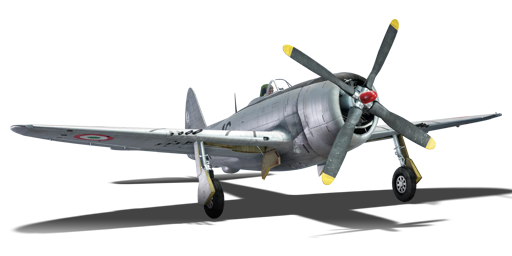
In 1949, five years after the Second World War, Italy became one of the founding members of the North Atlantic Treaty Organization (NATO). In an attempt to modernize the aging Italian Air Force, Aeronautica Militare, the United States sent outdated or surplus equipment to countries like Italy under the MDA (Mutual Defense Act). As a result, Italy received around 100 P-47s. The P-47D-30 was essentially a P-47D-28 with minor improvements and dive brakes.
Introduced in Update "Sky Guardians", the ▄P-47D-30 Thunderbolt is a very strong fighter and capable in the ground attack role. Like many American propeller aircraft in WW2, the D-30 utilized water injection to increase power for a limited amount of time. In-game, this translates to an exceptional top speed of 714 km/h (443.7 mph). Although the Thunderbolt is quite sluggish, its superior top speed and high-speed handling make it a potent aircraft for dealing with enemy fighters. The P-47D-30 also has access to a multitude of ground attack loadouts which greatly increase its capability against tanks and pillboxes. It also has a very large ammo pool which allows for 34 seconds of firing time: more than enough to attack soft ground targets like anti-air or machine gun positions.
General info
Flight performance
| Characteristics | Max speed (km/h at 7,071 m) |
Max altitude (metres) |
Turn time (seconds) |
Rate of climb (metres/second) |
Take-off run (metres) | |||
|---|---|---|---|---|---|---|---|---|
| AB | RB | AB | RB | AB | RB | |||
| Stock | 689 | 673 | 24.1 | 24.9 | 10.1 | 10.1 | 700 | |
| Upgraded | 743 | 714 | 21.9 | 23.0 | 19.2 | 14.1 | ||
Details
| Features | ||||
|---|---|---|---|---|
| Combat flaps | Take-off flaps | Landing flaps | Air brakes | Arrestor gear |
| ✓ | ✓ | ✓ | ✓ | X |
| Limits | ||||||
|---|---|---|---|---|---|---|
| Wings (km/h) | Gear (km/h) | Flaps (km/h) | Max Static G | |||
| Combat | Take-off | Landing | + | - | ||
| 498 | 469 | 320 | ~13 | ~5 | ||
| Optimal velocities (km/h) | |||
|---|---|---|---|
| Ailerons | Rudder | Elevators | Radiator |
| < 402 | < 420 | < 470 | > 335 |
Survivability and armour
Examine the survivability of the aircraft. Note how vulnerable the structure is and how secure the pilot is, whether the fuel tanks are armoured, etc. Describe the armour, if there is any, and also mention the vulnerability of other critical aircraft systems.
Modifications and economy
Armaments
Offensive armament
The P-47D-30 (Italy) is armed with:
- 8 x 12.7 mm M2 Browning machine guns, wing-mounted (425 rpg = 3,400 total)
Suspended armament
The P-47D-30 (Italy) can be outfitted with the following ordnance:
| 1 | 2 | 3 | 4 | 5 | 6 | 7 | 8 | 9 | 10 | 11 | 12 | 13 |  | |
|---|---|---|---|---|---|---|---|---|---|---|---|---|---|---|
| 250 lb AN-M57 bombs | 1 | 1 | 1 | |||||||||||
| 500 lb AN-M64A1 bombs | 1 | 1 | 1 | |||||||||||
| 1,000 lb AN-M65A1 bombs | 1 | 1 | ||||||||||||
| HVAR rockets | 1 | 1 | 1 | 1 | 1 | 1 | 1 | 1 | 1 | 1 | ||||
| Maximum permissible weight imbalance: 680 kg | ||||||||||||||
| Default weapon presets | |
|---|---|
| |
Usage in battles
Always maintain speed. The P-47 handles like a dream at about 550-650 km/h (350-400 mph), but once it gets below 350 km/h (220 mph) it handles sluggishly, like a pig dipped in mud. One great thing about the handling at high speed though, is that the P-47 responds quickly at high speeds, and this allows some impressive defensive scissoring without losing wings at terminal velocity. The high-wing loading is an issue though, as the Jug will lose most of its energy in a blackout turn. This does endow the Jug with one key feature. it is a rock-solid gun platform.
Unfortunately, zoom-climbing and dive acceleration are not the "Jug's" forte. The Bf 109 has a superior dive acceleration, and the Fw 190 can zoom-climb far faster. Still, the energy retention of the P-47 is great, along with the fact that it flies far faster than both the Würger and Messerschmitt. The P-47 is not a turnfighter. Although it is possible to out-turn a heavy fighter like the Bf 110 C or Do 217, it is not recommended - the acceleration is mediocre, and once a P-47 is a sitting duck, it will be swarmed like flies to fruit in a compost pile. Acrobatic pilots will not be impressed by the P-47 as well, because it performs Immelmanns very sluggishly and the roll rate is not magnificent as well.
Durability, as mentioned above, is pretty good. As in World War II itself, the P-47 was renowned for its rugged construction. In War Thunder, the biggest weak points of the P-47 are its engine and wings. The wings can break fairly easily in manoeuvres at speeds around ~675 km/h or so. They also tend to break after a well-placed cannon burst (from planes like the Fw 190, A6M2/3). The engine though is also fairly susceptible to catching fire while chasing a bomber, but this is not due to its durability but to its size. Speaking of fire, the P-47D will be heavily damaged by the time it pulls itself out of a fire. One should immediately try to limp home if set aflame.
The performance of the P-47 at altitude is very good, but once you go above about 9,000 m (~30,000 ft), its critical altitude, any energy lost will have to be regained by diving and losing altitude. Even though the D-28 now gets 70 seconds boost (which is significantly more than the D-25), it still will have some troubles accelerating and climbing. Keep in mind that this boost is only achieved on WEP, although on military power it still has 65" of boost.
Turnfighting should never be the combat tactic in a P-47. The immense engine power, decent wing-loading, and good flaps of the D-30 variant can allow it to turn surprisingly well against some of its opposition, namely German, American, and Soviet props with poor power-to-weight ratios at high speeds (typically in a dive). This can be used to keep track of an opponent trying to evade your fire but do not enter a prolonged dogfight or you'll lose too much energy.
When used skillfully, the tracer rounds can be used to scare the opponent as due to the high calibre (for a machine gun) and rate of fire, tracers from the .50 cal machine guns can be absolutely terrifying to anyone attacked by them. However, besides to the scare effect and low takedown capabilities, the tracers have limited practical use.
Manual Engine Control
| MEC elements | ||||||
|---|---|---|---|---|---|---|
| Mixer | Pitch | Radiator | Supercharger | Turbocharger | ||
| Oil | Water | Type | ||||
| Controllable | Controllable Auto control available |
Controllable Not auto controlled |
Controllable Not auto controlled |
Separate | Controllable 1 gear |
Auto controlled |
Pros and cons
Pros:
- Great bomber destroyer against a lone bomber
- Excellent high altitude performance
- If taken care of, can easily fly with one wing
- Muscle car with wings, excellent at Boom and Zoom tactics
- 8 M2 Browning machine guns are more accurate at a longer range than most cannons at its BR
- High speed, even while stock
- Very durable which semi-compensates with its lacklustre turn rate
- Plenty of ammo
- Can easily escape enemies with its high speed for its rank
- Great multirole aircraft, can carry various bombs and rockets, acting as an interceptor or ground-attack aircraft
Cons:
- Frontal armour can easily be penetrated by 20 mm rounds
- Can easily snap a wing when even the slightest gunfire hits it
- Poor stall characteristics
- Mediocre climb performance (side climbing recommended)
- Slow and hard to manoeuvre at low altitudes
- Larger than average fighter
- Poor overall performance when mounting payloads
- After attacking ground targets, the P-47 lacks the altitude to Boom & Zoom enemy fighters
- Big engine easily hit during a head-on attack
- Worse cockpit visibility than in the other bubble canopy P-47s
- No armour protection for pilot from behind
History
The Italian Air Force operated some 100 P-47s between December 1950 and March 1954. After the Second World War, the 1947 Paris Peace Treaties placed severe restrictions on all of the Italian armed forces, but due to their actions towards the end of the war and Italy becoming one of the founding members of NATO in 1949, there was an immediate need for the modernization of all sections of the Italian armed forces, which included the Italian Air Force. As such, the West would begin to send additional aid, mostly surplus equipment that no longer had a use to Italy. Italy already had experience in using American aircraft as the Italian Co-Belligerent Airforce during the end stages of the Second World War, equipped with aircraft such as the P-39 aircobra. Thus American military aid sent by the Mutual Defense Assistance Program brought about the introduction of America's premiere piston-powered fighters, being the P-47D-30 Thunderbolt, P-38 Lightning, and P-51 Mustang, into Italian service. The 5th Stormo would primarily use the P-47s. They aren't known to have taken part in any conflict but were likely part of several NATO exercises during the era they were in service.
Media
- Skins
See also
- Related development
External links
- https://forum.warthunder.com/index.php?/topic/527988-republic-f-47d/
- https://www.airhistory.net/photo/453449/MM4653
| Republic Aviation Corporation | |
|---|---|
| Fighters | P-43A-1 |
| P-47D-22-RE · P-47D-25 · P-47D-28 · P-47M-1-RE · ⋠P-47M-1-RE · P-47N-15 | |
| Jet Aircraft | F-84B-26 · F-84F · F-84G-21-RE |
| F-105D | |
| Export | J9 Early* |
| ␗P-43A-1 | |
| ▄Thunderbolt Mk.1 · ▄P-47D-22-RE · ␗P-47D-23-RA · ▂P-47D-27 · ␗P-47D-30 · ▄P-47D-30 · ␗F-47N-25-RE | |
| ◄F-84F · ▄F-84F (Italy) · ▄F-84F (France) · F-84F IAF · F-84F | |
| ␗F-84G-21-RE · ▄F-84G-21-RE · ▄F-84G-26-RE · ␗F-84G-31-RE | |
| Captured | ▀P-47D-16-RE · ▀P-47D |
| *The company was named "Seversky Aircraft Company" before being renamed in 1939 | |
| Italy fighters | |
|---|---|
| Fiat | CR.32 · CR.32 bis · CR.32 quater · CR.42 · Marcolin's C.R.42 CN |
| G.50 serie 2 · G.50 AS serie 7 | |
| G.55 sottoserie 0 · G.55 serie 1 · G.55S · G.56 | |
| Reggiane | Re.2000 G.A. · Re.2000 serie 1 |
| Re.2001 serie 1 · Re.2001 gruppo 22 · Re.2001 CB · Re.2001 CN | |
| Re.2002 Early | |
| Re.2005 serie 0 | |
| Macchi | C. 200 serie 3 · C. 200 serie 7 |
| C. 202 · C. 202D · C. 202EC | |
| C. 205 serie 1 · C. 205 serie 3 · C. 205N2 | |
| IMAM | Ro.44 |
| Foreign: | |
| Germany | ▄Bf 109 G-14/AS |
| USA | ▄P-47D-30 |
| Britain | ▄Spitfire Mk Vb/trop |
| Hungary | ◐Bf 109 F-4 · ◐Bf 109 G-2 · ◔Yak-9P |
| Romania | He 112 B-1/U2 · IAR-81C |