Difference between revisions of "AV-8B (NA)"
(→Description) |
(Created AV-8B (NA) page) |
||
| (20 intermediate revisions by 7 users not shown) | |||
| Line 6: | Line 6: | ||
{{Specs-Card | {{Specs-Card | ||
|code=av_8b_na | |code=av_8b_na | ||
| − | |images={{Specs-Card-Image|GarageImage_{{PAGENAME}}.jpg}} | + | |images={{Specs-Card-Image|GarageImage_{{PAGENAME}}.jpg|StoreImage AV-8A 001.jpg}} |
| − | |||
}} | }} | ||
== Description == | == Description == | ||
<!-- ''In the description, the first part should be about the history of and the creation and combat usage of the aircraft, as well as its key features. In the second part, tell the reader about the aircraft in the game. Insert a screenshot of the vehicle, so that if the novice player does not remember the vehicle by name, he will immediately understand what kind of vehicle the article is talking about.'' --> | <!-- ''In the description, the first part should be about the history of and the creation and combat usage of the aircraft, as well as its key features. In the second part, tell the reader about the aircraft in the game. Insert a screenshot of the vehicle, so that if the novice player does not remember the vehicle by name, he will immediately understand what kind of vehicle the article is talking about.'' --> | ||
| − | |||
| − | |||
== General info == | == General info == | ||
| Line 20: | Line 17: | ||
{{Specs-Avia-Flight}} | {{Specs-Avia-Flight}} | ||
<!-- ''Describe how the aircraft behaves in the air. Speed, manoeuvrability, acceleration and allowable loads - these are the most important characteristics of the vehicle.'' --> | <!-- ''Describe how the aircraft behaves in the air. Speed, manoeuvrability, acceleration and allowable loads - these are the most important characteristics of the vehicle.'' --> | ||
| − | |||
{| class="wikitable" style="text-align:center" width="70%" | {| class="wikitable" style="text-align:center" width="70%" | ||
! rowspan="2" | Characteristics | ! rowspan="2" | Characteristics | ||
| − | ! colspan="2" | Max | + | ! colspan="2" | Max Speed<br>(km/h at 0 m - sea level) |
! rowspan="2" | Max altitude<br>(metres) | ! rowspan="2" | Max altitude<br>(metres) | ||
! colspan="2" | Turn time<br>(seconds) | ! colspan="2" | Turn time<br>(seconds) | ||
| Line 33: | Line 29: | ||
|- | |- | ||
! Stock | ! Stock | ||
| − | | | + | | 1,151 || 1,145 || rowspan="2" | {{Specs|ceiling}} || 32.2 || 33.1 || 81.7 || 75.2 || rowspan="2" | 550 |
|- | |- | ||
! Upgraded | ! Upgraded | ||
| − | | 1, | + | | 1,164 || 1,156 || 31.7 || 32.0 || 102.7 || 87.0 |
|- | |- | ||
|} | |} | ||
| Line 62: | Line 58: | ||
! Combat !! Take-off !! Landing !! + !! - | ! Combat !! Take-off !! Landing !! + !! - | ||
|- | |- | ||
| − | | | + | | {{Specs|destruction|body}} || {{Specs|destruction|gear}} || N/A || 828 || 556 || ~14 || ~6 |
|- | |- | ||
|} | |} | ||
| Line 72: | Line 68: | ||
! Ailerons !! Rudder !! Elevators !! Radiator | ! Ailerons !! Rudder !! Elevators !! Radiator | ||
|- | |- | ||
| − | | < | + | | < 648 || < 950 || < 790 || N/A |
|- | |- | ||
|} | |} | ||
| Line 80: | Line 76: | ||
|- | |- | ||
! colspan="3" | Engine | ! colspan="3" | Engine | ||
| − | ! colspan=" | + | ! colspan="5" | Aircraft mass |
|- | |- | ||
! colspan="2" | Engine name || Number | ! colspan="2" | Engine name || Number | ||
| − | ! colspan="2" | {{Annotation|Basic mass|Mass of the aircraft with pilot | + | ! colspan="2" | {{Annotation|Basic mass|Mass of the aircraft with pilot, engine oil, and full water tank; but no fuel or weapons load}} || colspan="3" | Wing loading (full fuel) |
|- | |- | ||
| − | | colspan="2" | Rolls-Royce | + | | colspan="2" | Rolls-Royce F402-RR-401 || 1 |
| − | | colspan="2" | | + | | colspan="2" | 5,918 kg || colspan="3" | 439 kg/m<sup>2</sup> |
|- | |- | ||
! colspan="3" | Engine characteristics | ! colspan="3" | Engine characteristics | ||
| − | ! colspan=" | + | ! colspan="4" | Mass with fuel (no weapons load) || rowspan="2" | Max Takeoff<br>Weight |
|- | |- | ||
! Weight (each) || colspan="2" | Type | ! Weight (each) || colspan="2" | Type | ||
| − | ! | + | ! 10m fuel || 20m fuel || 30m fuel || 34m fuel |
|- | |- | ||
| − | | | + | | 1,687 kg || colspan="2" | Vectored-thrust low-bypass turbofan |
| − | | | + | | 6,605 kg || 7,292 kg || 7,978 kg || 8,253 kg || 12,679 kg |
|- | |- | ||
! colspan="3" | {{Annotation|Maximum engine thrust @ 0 m (RB/SB)|The maximum thrust produced by each engine, while mounted in the aircraft. NOTE: Thrust varies significantly depending on speed & altitude.}} | ! colspan="3" | {{Annotation|Maximum engine thrust @ 0 m (RB/SB)|The maximum thrust produced by each engine, while mounted in the aircraft. NOTE: Thrust varies significantly depending on speed & altitude.}} | ||
| − | ! colspan=" | + | ! colspan="5" | Thrust to weight ratio @ 0 m (WEP) |
|- | |- | ||
| − | ! Condition || 100% || | + | ! Condition || 100% || WEP |
| − | ! | + | ! 10m fuel || 20m fuel || 30m fuel || 34m fuel || MTOW |
|- | |- | ||
| − | | ''Stationary'' || | + | | ''Stationary'' || 9,071 kgf || 9,625 kgf |
| − | | | + | | 1.46 || 1.32 || 1.21 || 1.17 || 0.76 |
|- | |- | ||
| − | | ''Optimal'' || | + | | ''Optimal'' || 9,071 kgf<br>(0 km/h) || 9,625 kgf<br>(0 km/h) |
| − | | | + | | 1.46 || 1.32 || 1.21 || 1.17 || 0.76 |
|- | |- | ||
|} | |} | ||
| + | {{Notice|The F402-RR-401 engine loses a significant amount of thrust as your speed increases}} | ||
=== Survivability and armour === | === Survivability and armour === | ||
{{Specs-Avia-Armour}} | {{Specs-Avia-Armour}} | ||
<!-- ''Examine the survivability of the aircraft. Note how vulnerable the structure is and how secure the pilot is, whether the fuel tanks are armoured, etc. Describe the armour, if there is any, and also mention the vulnerability of other critical aircraft systems.'' --> | <!-- ''Examine the survivability of the aircraft. Note how vulnerable the structure is and how secure the pilot is, whether the fuel tanks are armoured, etc. Describe the armour, if there is any, and also mention the vulnerability of other critical aircraft systems.'' --> | ||
| − | |||
=== Modifications and economy === | === Modifications and economy === | ||
| Line 123: | Line 119: | ||
{| class="wikitable" style="text-align:center" | {| class="wikitable" style="text-align:center" | ||
|- | |- | ||
| − | ! colspan=" | + | ! colspan="4" | [[Ballistic Computer]] |
|- | |- | ||
| − | ! CCIP (Guns) !! CCIP (Rockets) !! CCIP (Bombs) !! CCRP (Bombs) | + | ! CCIP (Guns) !! CCIP (Rockets) !! CCIP (Bombs) !! CCRP (Bombs) |
|- | |- | ||
| − | + | | {{Tick}} || {{Tick}} || {{Tick}} || {{Tick}} | |
|- | |- | ||
|} | |} | ||
| Line 133: | Line 129: | ||
{{Specs-Avia-Offensive}} | {{Specs-Avia-Offensive}} | ||
<!-- ''Describe the offensive armament of the aircraft, if any. Describe how effective the cannons and machine guns are in a battle, and also what belts or drums are better to use. If there is no offensive weaponry, delete this subsection.'' --> | <!-- ''Describe the offensive armament of the aircraft, if any. Describe how effective the cannons and machine guns are in a battle, and also what belts or drums are better to use. If there is no offensive weaponry, delete this subsection.'' --> | ||
| + | {{main|ADEN Mk.4 (30 mm)}} | ||
The '''''{{PAGENAME}}''''' is armed with: | The '''''{{PAGENAME}}''''' is armed with: | ||
| − | * | + | * 2 x 30 mm ADEN Mk.4 cannons, belly-mounted (130 rpg = 260 total) |
=== Suspended armament === | === Suspended armament === | ||
| Line 146: | Line 143: | ||
{| class="wikitable" style="text-align:center" width="100%" | {| class="wikitable" style="text-align:center" width="100%" | ||
|- | |- | ||
| − | ! !! width=" | + | ! !! width="9%" | 1 !! width="9%" | 2 !! width="9%" | 3 !! width="9%" | 4 !! width="9%" | 5 |
| − | | rowspan=" | + | | rowspan="11" width="30%" | <div class="ttx-image">[[File:Hardpoints_Harrier_GR.3.png]]</div> |
| − | |||
| − | |||
| − | |||
|- | |- | ||
! [[LDGP Mk 81 (250 lb)|250 lb LDGP Mk 81]] bombs | ! [[LDGP Mk 81 (250 lb)|250 lb LDGP Mk 81]] bombs | ||
| − | | 1 || | + | | 1 || 1 || 1 || 1 || 1 |
|- | |- | ||
! [[Mk 81 Snakeye (250 lb)|250 lb Mk 81 Snakeye]] bombs | ! [[Mk 81 Snakeye (250 lb)|250 lb Mk 81 Snakeye]] bombs | ||
| − | | 1 || | + | | 1 || 1 || 1 || 1 || 1 |
|- | |- | ||
! [[LDGP Mk 82 (500 lb)|500 lb LDGP Mk 82]] bombs | ! [[LDGP Mk 82 (500 lb)|500 lb LDGP Mk 82]] bombs | ||
| − | | 1 || | + | | 1 || 1 || 1 || 1 || 1 |
|- | |- | ||
! [[Mk 82 Snakeye (500 lb)|500 lb Mk 82 Snakeye]] bombs | ! [[Mk 82 Snakeye (500 lb)|500 lb Mk 82 Snakeye]] bombs | ||
| − | | 1 || | + | | 1 || 1 || 1 || 1 || 1 |
|- | |- | ||
! [[LDGP Mk 83 (1,000 lb)|1,000 lb LDGP Mk 83]] bombs | ! [[LDGP Mk 83 (1,000 lb)|1,000 lb LDGP Mk 83]] bombs | ||
| − | | || 1 || | + | | || 1 || || 1 || |
| − | |||
| − | |||
| − | |||
| − | |||
| − | |||
| − | |||
| − | |||
| − | |||
| − | |||
|- | |- | ||
! [[Mk 77 mod 4 incendiary]] bombs | ! [[Mk 77 mod 4 incendiary]] bombs | ||
| − | | 1 || | + | | 1 || 1 || 1 || 1 || 1 |
|- | |- | ||
! [[FFAR Mighty Mouse]] rockets | ! [[FFAR Mighty Mouse]] rockets | ||
| − | | || | + | | 7, 19 || 7, 19 || || 7, 19 || 7, 19 |
|- | |- | ||
! [[Zuni Mk32 Mod 0 ATAP]] rockets | ! [[Zuni Mk32 Mod 0 ATAP]] rockets | ||
| − | | || | + | | 4 || 4 || || 4 || 4 |
| − | |||
| − | |||
| − | |||
| − | |||
| − | |||
| − | |||
| − | |||
| − | |||
| − | |||
|- | |- | ||
| − | ! | + | ! [[AIM-9G Sidewinder]] missiles |
| − | + | | 1 || || || || 1 | |
|- | |- | ||
| − | | | + | ! Countermeasures |
| + | | || || 240 || || | ||
|- | |- | ||
|} | |} | ||
| Line 204: | Line 181: | ||
{{Navigation-First-Simple-Line}} | {{Navigation-First-Simple-Line}} | ||
| − | * | + | * Without load |
| − | * | + | * 2 x AIM-9G Sidewinder missiles |
| − | * | + | * 28 x FFAR Mighty Mouse rockets |
| − | * | + | * 76 x FFAR Mighty Mouse rockets |
| − | * | + | * 16 x Zuni Mk32 Mod 0 ATAP rockets |
| − | * | + | * 5 x 250 lb LDGP Mk 81 bombs (1,250 lb total) |
| − | * | + | * 5 x 250 lb Mk 81 Snakeye bombs (1,250 lb total) |
| − | * | + | * 5 x 500 lb LDGP Mk 82 bombs (2,500 lb total) |
| − | * | + | * 5 x 500 lb Mk 82 Snakeye bombs (2,500 lb total) |
| − | * | + | * 2 x 1,000 lb LDGP Mk 83 bombs (2,000 lb total) |
| − | + | * 5 x Mk 77 mod 4 incendiary bombs | |
| − | + | * 240 x countermeasures | |
| − | |||
| − | |||
| − | * | ||
{{Navigation-End}} | {{Navigation-End}} | ||
== Usage in battles == | == Usage in battles == | ||
<!-- ''Describe the tactics of playing in the aircraft, the features of using aircraft in a team and advice on tactics. Refrain from creating a "guide" - do not impose a single point of view, but instead, give the reader food for thought. Examine the most dangerous enemies and give recommendations on fighting them. If necessary, note the specifics of the game in different modes (AB, RB, SB).'' --> | <!-- ''Describe the tactics of playing in the aircraft, the features of using aircraft in a team and advice on tactics. Refrain from creating a "guide" - do not impose a single point of view, but instead, give the reader food for thought. Examine the most dangerous enemies and give recommendations on fighting them. If necessary, note the specifics of the game in different modes (AB, RB, SB).'' --> | ||
| − | + | ||
=== Pros and cons === | === Pros and cons === | ||
| Line 230: | Line 204: | ||
'''Pros:''' | '''Pros:''' | ||
| − | * | + | * Thrust vectoring capabilities |
| − | * | + | ** Can be used during combat to temporarily boost turn rate |
| − | * | + | ** Can land and rearm on the helicopter bases in combined battles |
| − | |||
| − | * | ||
| − | * | ||
'''Cons:''' | '''Cons:''' | ||
| − | * | + | * Heavy airframe loses significant speed in turns |
| − | * | + | * Limited WEP and lack of afterburner |
| − | * | + | * Engine overheats very quickly above 90% throttle |
| − | * | + | * Using thrust vectoring in combat bleeds speed and leaves you vulnerable |
| + | * Stiffens up in dives; this can be fatal during ground attack missions | ||
== History == | == History == | ||
<!-- ''Describe the history of the creation and combat usage of the aircraft in more detail than in the introduction. If the historical reference turns out to be too long, take it to a separate article, taking a link to the article about the vehicle and adding a block "/History" (example: <nowiki>https://wiki.warthunder.com/(Vehicle-name)/History</nowiki>) and add a link to it here using the <code>main</code> template. Be sure to reference text and sources by using <code><nowiki><ref></ref></nowiki></code>, as well as adding them at the end of the article with <code><nowiki><references /></nowiki></code>. This section may also include the vehicle's dev blog entry (if applicable) and the in-game encyclopedia description (under <code><nowiki>=== In-game description ===</nowiki></code>, also if applicable).'' --> | <!-- ''Describe the history of the creation and combat usage of the aircraft in more detail than in the introduction. If the historical reference turns out to be too long, take it to a separate article, taking a link to the article about the vehicle and adding a block "/History" (example: <nowiki>https://wiki.warthunder.com/(Vehicle-name)/History</nowiki>) and add a link to it here using the <code>main</code> template. Be sure to reference text and sources by using <code><nowiki><ref></ref></nowiki></code>, as well as adding them at the end of the article with <code><nowiki><references /></nowiki></code>. This section may also include the vehicle's dev blog entry (if applicable) and the in-game encyclopedia description (under <code><nowiki>=== In-game description ===</nowiki></code>, also if applicable).'' --> | ||
| − | + | The US military had been paying close attention to the development of British VTOL aircraft through the 1950s / 60s, taking part in the testing and evaluation of the Hawker Siddeley P.1127 / Kestrel FGA.1 (prototypes that would eventually develop into the Harrier) in the mid-1960s. At the 1968 Farnborough air show two United States Marine Corps (USMC) pilots, Col. Thomas H. Miller (eventually promoted to Lieutenant General) and Lt. Col. Bud Baker unexpectedly arrived at the Hawker Siddeley Aviation (HSA) chalet and announced they had been sent to test fly the new Harrier GR.1 aircraft. Within 2 weeks of the show both pilots had flown the Harrier and shortly after returned to the US with a very positive report of the aircraft.<ref name="HarrierCaseStudy">Fozard 1978</ref> | |
| − | + | Within three months of the report a team of US test pilots were in the UK evaluating the Harrier and within a further five months the US had declared its intention to buy 110 Harriers by the mid 1970s. The US congress originally insisted that the Harriers should be built in the US, leading to HSA signing a 15 year agreement with McDonnell-Douglas, where McDonnell-Douglas would build the aircraft in the US and both parties would share data and designs of any aircraft related to the Harrier.<ref name="HarrierCaseStudy" /> However later, after realizing the cost increase that would come from shifting production to the US, it was instead decided all 110 aircraft would be built by HSA in the UK. The aircraft would be purchased as "off the shelf" products with only limited modifications made from the Harrier GR.1. The US Harriers would have the more powerful Pegasus Mk 103 engine, the ability to carry two Sidewinder missiles, and other minor changes such as US radio equipment.<ref name="HarrierCaseStudy" /> | |
| − | The AV- | + | The Harrier entered service with the USMC in 1971, under the designation AV-8A.<ref name="HarrierCaseStudy" />Marine Attack Squadron 513 (VMA-513) was the first squadron to receive its Harriers with VMA-231 and VMA-542 following. Shortly after it entered service the US decided to replace the British Ferranti FE 541 Inertial Navigation and Attack System (INAS) system with an American system known as "baseline". The FE 541 was an advanced system, it was able to use inertial navigation to plot the Harrier's location on a moving map in the cockpit and had various weapons aiming modes to allow for accurate bombing. The US however did not like the FE 541 finding it too complicated and difficult to maintain. In addition the FE 541 required a calibration process to be carried out before use, which could not be completed onboard a ship, severely limiting it's usefulness to the USMC. The baseline system was far simpler than the FE 541 and did not provide navigation functionality; with the removal of the large moving map display the USMC took the opportunity to change the layout of the AV-8A's cockpit making it different to that in British Harriers.<ref name="HarrierCaseStudy" /> |
== Media == | == Media == | ||
<!-- ''Excellent additions to the article would be video guides, screenshots from the game, and photos.'' --> | <!-- ''Excellent additions to the article would be video guides, screenshots from the game, and photos.'' --> | ||
| − | + | ||
| + | ;Skins | ||
| + | |||
| + | * [https://live.warthunder.com/feed/camouflages/?vehicle=av_8ab_na Skins and camouflages for the {{PAGENAME}} from live.warthunder.com.] | ||
== See also == | == See also == | ||
| − | |||
| − | |||
| − | |||
''Links to the articles on the War Thunder Wiki that you think will be useful for the reader, for example:'' | ''Links to the articles on the War Thunder Wiki that you think will be useful for the reader, for example:'' | ||
| Line 270: | Line 242: | ||
* ''other literature.'' --> | * ''other literature.'' --> | ||
| − | * [[wt:en/news/9067-shop-development-pre-order-av-8b-night-attack-en| | + | * [[wt:en/news/9067-shop-development-pre-order-av-8b-night-attack-en|Pre-order: AV-8B Night Attack]] |
| + | * [http://www.alternatewars.com/SAC/AV-8A_Harrier_SAC_-_November_1972.pdf Standard Aircraft Characteristics of the AV-8A] | ||
| + | |||
| + | ===References=== | ||
| + | |||
| + | ;Citations | ||
| + | <references /> | ||
| + | |||
| + | ;Bibliography | ||
| + | |||
| + | * Fozard, J. (1978). The British Aerospace Harrier Case Study in Aircraft Design. American Institute of Aeronautics & Astronautics. | ||
| − | {{AirManufacturer | + | {{AirManufacturer Hawker}} |
{{USA jet aircraft}} | {{USA jet aircraft}} | ||
{{USA premium aircraft}} | {{USA premium aircraft}} | ||
Revision as of 08:30, 11 September 2024
| This page is about the American jet fighter AV-8B (NA). For other versions, see Harrier (Family). |
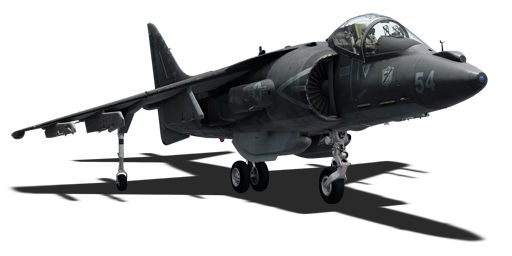
.jpg)

Contents
Description
General info
Flight performance
| Characteristics | Max Speed (km/h at 0 m - sea level) |
Max altitude (metres) |
Turn time (seconds) |
Rate of climb (metres/second) |
Take-off run (metres) | |||
|---|---|---|---|---|---|---|---|---|
| AB | RB | AB | RB | AB | RB | |||
| Stock | 1,151 | 1,145 | 32.2 | 33.1 | 81.7 | 75.2 | 550 | |
| Upgraded | 1,164 | 1,156 | 31.7 | 32.0 | 102.7 | 87.0 | ||
Details
| Features | |||||
|---|---|---|---|---|---|
| Combat flaps | Take-off flaps | Landing flaps | Air brakes | Arrestor gear | Drogue chute |
| X | ✓ | ✓ | ✓ | X | X |
| Limits | ||||||
|---|---|---|---|---|---|---|
| Wings (km/h) | Gear (km/h) | Flaps (km/h) | Max Static G | |||
| Combat | Take-off | Landing | + | - | ||
| N/A | 828 | 556 | ~14 | ~6 | ||
| Optimal velocities (km/h) | |||
|---|---|---|---|
| Ailerons | Rudder | Elevators | Radiator |
| < 648 | < 950 | < 790 | N/A |
Engine performance
| Engine | Aircraft mass | ||||||
|---|---|---|---|---|---|---|---|
| Engine name | Number | Basic mass | Wing loading (full fuel) | ||||
| Rolls-Royce F402-RR-401 | 1 | 5,918 kg | 439 kg/m2 | ||||
| Engine characteristics | Mass with fuel (no weapons load) | Max Takeoff Weight | |||||
| Weight (each) | Type | 10m fuel | 20m fuel | 30m fuel | 34m fuel | ||
| 1,687 kg | Vectored-thrust low-bypass turbofan | 6,605 kg | 7,292 kg | 7,978 kg | 8,253 kg | 12,679 kg | |
| Maximum engine thrust @ 0 m (RB/SB) | Thrust to weight ratio @ 0 m (WEP) | ||||||
| Condition | 100% | WEP | 10m fuel | 20m fuel | 30m fuel | 34m fuel | MTOW |
| Stationary | 9,071 kgf | 9,625 kgf | 1.46 | 1.32 | 1.21 | 1.17 | 0.76 |
| Optimal | 9,071 kgf (0 km/h) |
9,625 kgf (0 km/h) |
1.46 | 1.32 | 1.21 | 1.17 | 0.76 |

|
The F402-RR-401 engine loses a significant amount of thrust as your speed increases |
Survivability and armour
Modifications and economy
Armaments
| Ballistic Computer | |||
|---|---|---|---|
| CCIP (Guns) | CCIP (Rockets) | CCIP (Bombs) | CCRP (Bombs) |
 |
|
|
|
Offensive armament
The AV-8B (NA) is armed with:
- 2 x 30 mm ADEN Mk.4 cannons, belly-mounted (130 rpg = 260 total)
Suspended armament
The AV-8B (NA) can be outfitted with the following ordnance:
| 1 | 2 | 3 | 4 | 5 |  | |
|---|---|---|---|---|---|---|
| 250 lb LDGP Mk 81 bombs | 1 | 1 | 1 | 1 | 1 | |
| 250 lb Mk 81 Snakeye bombs | 1 | 1 | 1 | 1 | 1 | |
| 500 lb LDGP Mk 82 bombs | 1 | 1 | 1 | 1 | 1 | |
| 500 lb Mk 82 Snakeye bombs | 1 | 1 | 1 | 1 | 1 | |
| 1,000 lb LDGP Mk 83 bombs | 1 | 1 | ||||
| Mk 77 mod 4 incendiary bombs | 1 | 1 | 1 | 1 | 1 | |
| FFAR Mighty Mouse rockets | 7, 19 | 7, 19 | 7, 19 | 7, 19 | ||
| Zuni Mk32 Mod 0 ATAP rockets | 4 | 4 | 4 | 4 | ||
| AIM-9G Sidewinder missiles | 1 | 1 | ||||
| Countermeasures | 240 |
| Default weapon presets | |
|---|---|
| |
Usage in battles
Pros and cons
Pros:
- Thrust vectoring capabilities
- Can be used during combat to temporarily boost turn rate
- Can land and rearm on the helicopter bases in combined battles
Cons:
- Heavy airframe loses significant speed in turns
- Limited WEP and lack of afterburner
- Engine overheats very quickly above 90% throttle
- Using thrust vectoring in combat bleeds speed and leaves you vulnerable
- Stiffens up in dives; this can be fatal during ground attack missions
History
The US military had been paying close attention to the development of British VTOL aircraft through the 1950s / 60s, taking part in the testing and evaluation of the Hawker Siddeley P.1127 / Kestrel FGA.1 (prototypes that would eventually develop into the Harrier) in the mid-1960s. At the 1968 Farnborough air show two United States Marine Corps (USMC) pilots, Col. Thomas H. Miller (eventually promoted to Lieutenant General) and Lt. Col. Bud Baker unexpectedly arrived at the Hawker Siddeley Aviation (HSA) chalet and announced they had been sent to test fly the new Harrier GR.1 aircraft. Within 2 weeks of the show both pilots had flown the Harrier and shortly after returned to the US with a very positive report of the aircraft.[1]
Within three months of the report a team of US test pilots were in the UK evaluating the Harrier and within a further five months the US had declared its intention to buy 110 Harriers by the mid 1970s. The US congress originally insisted that the Harriers should be built in the US, leading to HSA signing a 15 year agreement with McDonnell-Douglas, where McDonnell-Douglas would build the aircraft in the US and both parties would share data and designs of any aircraft related to the Harrier.[1] However later, after realizing the cost increase that would come from shifting production to the US, it was instead decided all 110 aircraft would be built by HSA in the UK. The aircraft would be purchased as "off the shelf" products with only limited modifications made from the Harrier GR.1. The US Harriers would have the more powerful Pegasus Mk 103 engine, the ability to carry two Sidewinder missiles, and other minor changes such as US radio equipment.[1]
The Harrier entered service with the USMC in 1971, under the designation AV-8A.[1]Marine Attack Squadron 513 (VMA-513) was the first squadron to receive its Harriers with VMA-231 and VMA-542 following. Shortly after it entered service the US decided to replace the British Ferranti FE 541 Inertial Navigation and Attack System (INAS) system with an American system known as "baseline". The FE 541 was an advanced system, it was able to use inertial navigation to plot the Harrier's location on a moving map in the cockpit and had various weapons aiming modes to allow for accurate bombing. The US however did not like the FE 541 finding it too complicated and difficult to maintain. In addition the FE 541 required a calibration process to be carried out before use, which could not be completed onboard a ship, severely limiting it's usefulness to the USMC. The baseline system was far simpler than the FE 541 and did not provide navigation functionality; with the removal of the large moving map display the USMC took the opportunity to change the layout of the AV-8A's cockpit making it different to that in British Harriers.[1]
Media
- Skins
See also
Links to the articles on the War Thunder Wiki that you think will be useful for the reader, for example:
- reference to the series of the aircraft;
- links to approximate analogues of other nations and research trees.
External links
References
- Citations
- Bibliography
- Fozard, J. (1978). The British Aerospace Harrier Case Study in Aircraft Design. American Institute of Aeronautics & Astronautics.
| Hawker Aircraft Limited | |
|---|---|
| Biplane fighters | |
| Fury | Fury Mk I · Fury Mk II |
| Nimrod | Nimrod Mk I · Nimrod Mk II |
| Scout plane | Osprey Mk IV |
| Piston fighters | |
| Hurricane | Hurricane Mk I/L · Hurricane Mk.I/L FAA M · Sea Hurricane Mk IB · Sea Hurricane Mk IC · Hurricane Mk IIB/Trop · Hurricane Mk IV |
| Typhoon | Typhoon Mk Ia · Typhoon Mk Ib · Typhoon Mk Ib/L |
| Tempest | Tempest Mk V · Tempest Mk V (Vickers P) · Tempest Mk II |
| Fury | Sea Fury FB 11 |
| Jet fighters | |
| Hunter | Hunter F.1 · Hunter F.6 · Hunter FGA.9 |
| Sea Hawk | Sea Hawk FGA.6 |
| Harrier | Harrier GR.1 · Harrier GR.3 |
| Export | ▄Hurricane Mk I/L · ▂Hurricane Mk IIB · ◘Sea Fury FB 51 |
| ◘Sea Hawk Mk.50 · ◄Sea Hawk Mk.100 · ◘Hunter F.6 · ◌Hunter F.58 · J34 · AV-8A · AV-8C · ▄AV-8S | |
| Captured | ▀Tempest Mk V |
| See Also | Fokker |
| USA jet aircraft | |
|---|---|
| Fighters | |
| F9F | F9F-2 · F9F-5 · F9F-8 |
| F-80 | F-80A-5 · F-80C-10 |
| F-84 | F-84B-26 · F-84F · F-84G-21-RE |
| F-86 | F-86A-5 · F-86F-25 · F-86F-2 · F-86F-35 |
| F-89 | F-89B · F-89D |
| F-100 | F-100D |
| F-104 | F-104A · F-104C |
| F-4 | F-4C Phantom II · F-4E Phantom II · F-4J Phantom II · F-4S Phantom II |
| F-5 | F-5A · F-5C · F-5E · F-20A |
| F-8 | F8U-2 · F-8E |
| F-14 | F-14A Early · ▄F-14A IRIAF · F-14B |
| F-15 | F-15A · F-15C MSIP II · F-15E |
| F-16 | F-16A · F-16A ADF · F-16C |
| Other | P-59A · F2H-2 · F3D-1 · F3H-2 · F4D-1 · F11F-1 |
| Strike Aircraft | |
| FJ-4 | FJ-4B · FJ-4B VMF-232 |
| A-4 | A-4B · A-4E Early |
| A-7 | A-7D · A-7E · A-7K |
| AV-8 | AV-8A · AV-8C · AV-8B Plus · AV-8B (NA) |
| A-10 | A-10A · A-10A Late · A-10C |
| F-111 | F-111A · F-111F |
| Other | A-6E TRAM · F-105D · F-117 |
| Bombers | |
| B-57 | B-57A · B-57B |
| USA premium aircraft | |
|---|---|
| Fighters | Thach's F2A-1 · Galer's F3F-2 · F2G-1 · F4U-4B VMF-214 · P-26A-34 · Rasmussen's P-36A · P-40C · P-43A-1 |
| P-47M-1-RE · ⋠P-47M-1-RE · P-51A · P-51D-10 · P-51D-20-NA · ␠Kingcobra · XP-55 | |
| ▃A6M2 · ▃Ki-43-II · ▃Ki-61-Ib · ▃Bf 109 F-4 · ▃Fw 190 A-8 · ▃Spitfire LF Mk IXc | |
| Twin-engine fighters | XP-38G · Bong's P-38J-15 · P-38K · YP-38 · P-61A-11 · XF5F · XP-50 · F7F-3 |
| Jet fighters | P-59A · F-86F-35 · F-89B · F-89D · F-4S Phantom II · F-5C · F-20A |
| Strike aircraft | A-1H · A2D-1 · AU-1 · XA-38 · AV-8A · AV-8B (NA) · A-6E TRAM · A-10A |
| Bombers | A-26C-45DT · B-10B · BTD-1 · PBM-3 "Mariner" · PBM-5A "Mariner" · PV-2D |