Difference between pages "P-40F-5 Lafayette (France)" and "USS Atlanta"
(→Suspended armament) (Tag: Visual edit) |
(New Specs-Card Artimage. Old picture moved to Media: Images) |
||
| Line 1: | Line 1: | ||
| − | |||
| − | |||
| − | |||
| − | |||
| − | |||
{{Specs-Card | {{Specs-Card | ||
| − | |code= | + | |code=us_cruiser_atlanta_class_atlanta |
| − | |images={{Specs-Card-Image|GarageImage_{{PAGENAME}}.jpg| | + | |images={{Specs-Card-Image|GarageImage_{{PAGENAME}}.jpg|ArtImage2_{{PAGENAME}}.png}} |
| − | |||
}} | }} | ||
== Description == | == Description == | ||
| − | <!-- ''In the description, | + | <!-- ''In the first part of the description, cover the history of the ship's creation and military application. In the second part, tell the reader about using this ship in the game. Add a screenshot: if a beginner player has a hard time remembering vehicles by name, a picture will help them identify the ship in question.'' --> |
| − | + | Laid down in April 1940, the Atlanta-class light cruisers were designed by the United States Navy as a return to the concept of a destroyer flotilla leader from before the First World War. This essentially created an overgrown destroyer with extra room for equipment and lots of {{Annotation|5-inch|127 mm}}/38 mounts similar to those found on the destroyers she was expected to lead. Although exceptionally powerful against destroyers and thinly armoured light cruisers, this left her vulnerable to more well-armoured cruisers. USS Atlanta would only serve in 3 battles (Midway, the Eastern Solomans, and Guadalcanal) and would be sunk in the naval battle for Guadalcanal. After being struck by at least one torpedo, she was then hit by the friendly heavy cruiser San Francisco. The damage inflicted would later cause the rest of the Atlanta class to be mostly relegated to anti-air duties throughout the rest of the war. | |
| − | + | The '''{{Specs|name}}''' was introduced in [[Update 1.91 "Night Vision"]], and boasts an impressive main battery of 8 double mount {{Annotation|5-inch|127 mm}} guns, the same found on destroyers of the US Navy. With their impressive fire rate and good damage output, captains of USS Atlanta can expect to be able to easily dispatch all destroyers and many light cruisers, though the more well-armoured light cruisers and especially heavy cruisers will resist fire. Compared to other cruisers of the rank, Atlanta has a very weak anti-aircraft battery as she is in her 1941 refit, but the main battery can easily compensate for this when in battle. | |
== General info == | == General info == | ||
| − | === | + | === Survivability and armour === |
| − | {{Specs- | + | {{Specs-Fleet-Armour}} |
| − | <!-- '' | + | <!-- ''Talk about the vehicle's armour. Note the most well-defended and most vulnerable zones, e.g. the ammo magazine. Evaluate the composition of components and assemblies responsible for movement and manoeuvrability. Evaluate the survivability of the primary and secondary armaments separately. Don't forget to mention the size of the crew, which plays an important role in fleet mechanics. Save tips on preserving survivability for the "Usage in battles" section. If necessary, use a graphical template to show the most well-protected or most vulnerable points in the armour.'' --> |
| + | The Atlanta's protection is quite poor. While the ship is clad with with layers of anti-fragmentation armour (especially on the bow) and reasonable armour around the ship's internal modules, this is offset by low crew count, poor turret protection, and highly vulnerable ammunition storage. | ||
| + | |||
| + | Although the ammunition storage forward of the bridge does benefit from a layer of fuel storage in-between it and an incoming salvo, detonation of ammunition is commonplace thanks to the numerous fragile main turrets with highly vulnerable ready racks. The stern section of the Atlanta is especially vulnerable, as it has five main turrets cramped together and the rear magazine sits barely below the waterline. | ||
| − | + | Fire resistant characteristic is a mixed bag, as the Atlanta can endure prolonged fire damage with minimal crew loss, yet a fire in the vicinity of a turret has a high chance to cause a fatal ready rack detonation. | |
| − | |||
| − | |||
| − | |||
| − | |||
| − | |||
| − | |||
| − | |||
| − | |||
| − | |||
| − | |||
| − | |||
| − | |||
| − | |||
| − | |||
| − | |||
| − | |||
| − | + | {| class="wikitable" | |
| − | {| class="wikitable | + | ! Armour !! Front !! Side !! Rear !! Deck/Roof |
| − | |||
| − | ! | ||
|- | |- | ||
| − | + | | Turret || 31.75 mm || 31.75 mm || 31.75 mm || 31.75 mm | |
|- | |- | ||
| − | | | + | | Magazine (Front) || 95.25 mm || 27.94 mm || 95.25 mm || 31.75 mm + 12.7 mm |
|- | |- | ||
| − | | | + | | Citadel || 95.25 mm || 95.25 mm central part <br> 19.05 mm almost covering all the hull <br> 16 mm in the foredeck and in the aft || 95.25 mm || 31.75 mm + 12.7 mm |
| − | |||
| − | |||
|- | |- | ||
| − | + | | Magazine (Rear) || 95.25 mm || 95.25 mm in upper part <br> 45.72 mm in the lower part || 95.25 mm || 31.75 mm + 12.7 mm | |
|- | |- | ||
| − | + | | Barbette || colspan="4" | 31.75 mm | |
| − | |||
| − | |||
| − | |||
| − | |||
| − | |||
| − | |||
| − | |||
|- | |- | ||
| + | | Bridge || colspan="4" | 63.5 mm | ||
|} | |} | ||
| − | + | === Mobility === | |
| − | + | {{Specs-Fleet-Mobility}} | |
| − | ! | + | <!-- ''Write about the ship's mobility. Evaluate its power and manoeuvrability, rudder rerouting speed, stopping speed at full tilt, with its maximum forward and reverse speed.'' --> |
| − | |||
| − | |||
| − | |||
| − | |||
| − | |||
| − | |||
| − | + | The Atlanta's handling is surprisingly sluggish when stock. Once upgraded, Atlanta is similar in manoeuvrability to other small light cruisers, though slightly more so than the Trenton-class light cruisers also found in the American tree. Atlanta has a top speed of {{Annotation|32 kn|60 km/h;37 mph}}, but this falls to {{Annotation|23 kn|42 km/h;26 mph}} when in a sustained turn. This is similar to the later Brooklyn-class cruisers, as is the rudder response time. At flank speed, the ship responds to rudder commands within two seconds, and in general USS Atlanta behaves like a larger destroyer, which makes sense as she was designed as a destroyer flotilla leader. | |
| − | {{ | ||
| − | |||
| − | + | {{NavalMobility}} | |
| − | |||
| − | |||
| − | |||
=== Modifications and economy === | === Modifications and economy === | ||
{{Specs-Economy}} | {{Specs-Economy}} | ||
| − | == | + | == Armament == |
| − | {{Specs- | + | {{Specs-Fleet-Armaments}} |
| − | === | + | === Primary armament === |
| − | {{Specs- | + | {{Specs-Fleet-Primary}} |
| − | <!-- '' | + | <!-- ''Provide information about the characteristics of the primary armament. Evaluate their efficacy in battle based on their reload speed, ballistics and the capacity of their shells. Add a link to the main article about the weapon: <code><nowiki>{{main|Weapon name (calibre)}}</nowiki></code>. Broadly describe the ammunition available for the primary armament, and provide recommendations on how to use it and which ammunition to choose.'' --> |
| − | {{main| | + | {{main|5 inch/38 Mk.12 (127 mm)}} |
| − | The | + | The primary armament of the Atlanta is 16 x {{Annotation|5-inch|127mm}}/38 Mk.12 guns in eight twin mounts, of which a maximum broadside of 14 barrels can be brought to bear on one target. These guns have a high rate of fire (up to 22 rounds per minute with maxed crew and first-stage ammo stowage) even with an untrained crew and have an reasonably high explosive mass for the calibre. The downside is a comparatively poor shell trajectory when compared to other cruisers; especially in fights over 8 km, the five-inch guns require more precise distance input compared to larger diameter guns. |
| − | + | The Atlanta gets access to four shell types - Mk.34 AAC, Mk. 32 Common, Mk.46 Common SP, and Mk.31 AAVT. The Common SP (essentially a common shell with slightly less explosive mass but better penetration) is typically the best pick for heavily-armoured targets such as cruisers. The Mk.31 AAVT is the only other recommended shell for use, as it contains the same filler as the AAC round while also of course being proximity-fused. This round serves as a dual-purpose round, perfect for lightly armoured destroyers and cruisers and any and all aircraft in the vicinity. The round can also be used to splash anti-aircraft guns and set fires in the superstructure when engaging more heavily-armoured ships, though the common shells will still be the main rounds to knock out the ship. | |
| − | + | {{:5 inch/38 Mk.12 (127 mm)/Ammunition|5 inch AAC Mk.34, 5 inch Common Mk.32, 5 inch SP Common Mk.46, 5 inch AAVT Mk.31}} | |
| − | === | + | === Secondary armament === |
| − | {{Specs- | + | {{Specs-Fleet-Secondary}} |
| − | <!-- ''Describe the | + | <!-- ''Some ships are fitted with weapons of various calibres. Secondary armaments are defined as weapons chosen with the control <code>Select secondary weapon</code>. Evaluate the secondary armaments and give advice on how to use them. Describe the ammunition available for the secondary armament. Provide recommendations on how to use them and which ammunition to choose. Remember that any anti-air armament, even heavy calibre weapons, belong in the next section. If there is no secondary armament, remove this section.'' --> |
| − | {{main| | + | {{main|1.1 inch/75 Mk.1 (28 mm)}} |
| − | + | As designed, USS Atlanta was fitted with 8 twin {{Annotation|5-inch|127 mm}}/38 mounts; as dual purpose guns, these would serve as the long range anti-aircraft battery, but for closer engagements she was fitted with 3 quad {{Annotation|1.1-inch|28 mm}} gun mounts, two positioned port and starboard of the bridge and superstructure and one mounted forward and slightly above the aft three turrets. | |
| − | + | The {{Annotation|1.1-inch|28 mm}}/75 Mk.1 Gun, otherwise known as the "Chicago Piano" (because it was the size of a baby grand piano), was the standard anti-aircraft armament for most American ships prior to the adoption and widespread introduction of the [[Bofors L/60 Mark 1 (40 mm)|40 mm Bofors]] and [[20 mm/70 Oerlikon Mk.II (20 mm)|20 mm Oerlikon]]. Though they have a good traverse and elevation rate, as well as a quick fire rate, the shells lack stopping power. This means that gunners will need some time on target to eliminate any threats, and in most cases it is recommended to supplement the AA fire with volleys of AAVT from the main battery instead of relying solely on the gunners. Also note that the only available option for the guns is the default HEF-T belt. | |
| − | |||
| − | |||
| − | |||
| − | + | {{:1.1 inch/75 Mk.1 (28 mm)/Ammunition|1.1 inch Mk.1 HE-T}} | |
| − | == | + | === Additional armament === |
| − | <!-- ''Describe the | + | {{Specs-Fleet-Additional}} |
| + | <!-- ''Describe the available additional armaments of the ship: depth charges, mines, torpedoes. Talk about their positions, available ammunition and launch features such as dead zones of torpedoes. If there is no additional armament, remove this section.'' --> | ||
| + | {{main|Mk.15 (533 mm)}} | ||
| − | + | The USS Atlanta, designed as a destroyer escort leader, also received torpedo launchers like the ships she was designed to lead. Being finally classed as a light cruiser, this makes her and her class a rare exception as an American cruiser with torpedoes. She has two quad torpedo launchers, mounted port and starboard aft of the second funnel and before the two wing turrets. These carry the Mk.15 torpedo, with {{Annotation|5.5 km|3.4 miles}} of range stock, and motors along at {{Annotation|45 kn|83 km/h,52 mph}}. With the "Torpedo mode" modification, the range increases to {{Annotation|9.15 km|5.7 miles}}, but the speed drops sharply to {{Annotation|33 kn|62 km/h,39 mph}}. It is up to captains of Atlanta whether to use the extra range or extra speed, though with the lacklustre range of US torpedoes either way, the extra speed may be preferred. | |
| − | + | == Usage in battles == | |
| + | <!-- ''Describe the technique of using this ship, the characteristics of her use in a team and tips on strategy. Abstain from writing an entire guide – don't try to provide a single point of view, but give the reader food for thought. Talk about the most dangerous opponents for this vehicle and provide recommendations on fighting them. If necessary, note the specifics of playing with this vehicle in various modes (AB, RB, SB).'' --> | ||
| − | + | USS Atlanta will serve her captains extremely well in her original role as a destroyer flotilla leader. Her prodigious quantities of {{Annotation|5-inch|127 mm}}/38 will dispatch any enemy destroyer quickly, especially considering she has twice or thrice the broadside of many of the destroyers she will be fighting. Captains are recommended to attempt to rake the enemy ships bow to stern with fire, as the extremely fast fire rate of Atlanta will decimate any smaller vessels in short order, destroying crew compartments and setting off ammo racks. Captains should play her like a slightly slower, but better armoured and armed destroyer, not as a cruiser as she is classed. She will do exceptionally well brawling with enemy destroyers, though captains should be wary of quickly extinguishing fires, as turret fires have a tendency to spread and do lethal damage quickly. She is also vulnerable to enemy torpedoes, as her displacement is not enough to easily cushion blasts as some larger ships are capable of. | |
| − | + | When engaging enemy cruisers the outlook is not so rosy. USS Atlanta is still very effective against most light cruisers, as their armour is incapable of stopping the shells at anything except extreme range. Against well armoured light cruisers like [[HMS Belfast]] and of course heavy cruisers, Atlanta will have a difficult time doing any more than superficial damage. Captains can use the massive volume of shells to destroy superstructure, AA guns, rangefinders, and other important and lightly armoured components of heavier ships however, and if the enemy captain has to repair the damage, eventually USS Atlanta may be able to bleed the enemies dry of crew. | |
| − | + | === Pros and cons === | |
| + | <!-- ''Summarise and briefly evaluate the vehicle in terms of its characteristics and combat effectiveness. Mark its pros and cons in the bulleted list. Try not to use more than 6 points for each of the characteristics. Avoid using categorical definitions such as "bad", "good" and the like - use substitutions with softer forms such as "inadequate" and "effective".'' --> | ||
| − | ''' | + | '''Pros:''' |
| − | + | * Huge amount of dual-purposes 5 inch guns provides excellent close to medium range firepower | |
| + | * Due to its high rate of fire, it can quickly suppress rushing enemies attempting to close the distance | ||
| + | * Great gun coverage, can utilize most guns while heavily angled | ||
| + | * Effective at long-range anti-air defence when used correctly | ||
| − | + | '''Cons:''' | |
| − | + | * Poor survivability due to lack of armour and low crew count | |
| + | * Lots of turrets means a lot of ammo racks being scattered around the ship | ||
| + | * Mediocre manoeuvrability | ||
| + | * Poor accuracy and weapon trajectory at longer range | ||
| + | * Unreliable anti-air armaments, have to rely on dual-purpose guns that is quite tricky to use at times | ||
| − | + | == History == | |
| − | + | <!-- ''Describe the history of the creation and combat usage of the ship in more detail than in the introduction. If the historical reference turns out to be too long, take it to a separate article, taking a link to the article about the ship and adding a block "/History" (example: <nowiki>https://wiki.warthunder.com/(Ship-name)/History</nowiki>) and add a link to it here using the <code>main</code> template. Be sure to reference text and sources by using <code><nowiki><ref></ref></nowiki></code>, as well as adding them at the end of the article with <code><nowiki><references /></nowiki></code>. This section may also include the ship's dev blog entry (if applicable) and the in-game encyclopedia description (under <code><nowiki>=== In-game description ===</nowiki></code>, also if applicable).'' --> | |
| − | + | [[File:USS Atlanta 1941.jpg|thumb|450x450px|The U.S. Navy light cruiser USS Atlanta steaming at high speed, probably during her trials, circa in November 1941.]] | |
| − | + | USS Atlanta was the lead ship of her class of light cruisers built for the United States Navy during the Second World War. Designed as light anti-aircraft cruisers similar to the British [[HMS Dido|Dido]]-class, the Atlanta was commissioned in December of 1941 just after the American entry into the Second World War. She went on to see combat action in the Pacific Theatre, and participated in the Midway and Eastern Solomons conflicts. She was later abandoned and sunk after being hit by Japanese torpedoes and friendly fire at the Naval Battle of Guadalcanal. | |
| − | |||
| − | |||
| − | |||
| − | |||
| − | |||
| − | |||
| − | |||
| − | |||
| − | |||
| − | |||
| − | ==== | ||
| − | |||
| − | |||
| − | |||
| − | |||
| − | |||
| − | |||
| − | |||
| − | |||
| − | |||
| − | |||
| − | |||
| − | |||
| − | |||
| − | |||
| − | |||
| − | |||
| − | |||
| − | |||
| − | |||
| − | |||
| − | |||
| − | |||
| − | |||
| − | |||
| − | |||
| − | |||
| − | |||
| − | === | + | === Design and development === |
| − | + | The Atlanta class were designed as specialized anti-aircraft ships with armament specialized for anti-aircraft defence, similar to the British Dido-class. The ships were armed with a formidable main armament of sixteen 5-inch (127 mm) guns in eight dual mounts, with six on the centreline in two superfiring pairs and two more mounted on the beam. Despite their role, the ship's secondary anti-aircraft armament was scarce, being limited to just three quadruple 28 mm 'Chicago Piano' mounts. As well, Atlanta carried two quadruple 533 mm torpedo tubes, which was unusual among American cruisers due to the doctrine of not fitting torpedo tubes to cruisers. Being a small cruiser, Atlanta displaced just 6718 tons standard and had a crew of 673. Her anti-aircraft design meant that she was an ineffective surface combatant, which would later become a fatal flaw when she was severely damaged at the Battle of Guadalcanal. Atlanta was laid down in April of 1940, and commissioned on Christmas Eve, 1941, days after the United States declared war on the Axis powers. | |
| − | |||
| − | |||
| − | |||
| − | |||
| − | |||
| − | |||
| − | |||
| − | |||
| − | |||
| − | |||
| − | |||
| − | |||
| − | |||
| − | |||
| − | === | + | === Operational history === |
| − | + | After her shakedown cruise in Chesapeake bay, the Atlanta was immediately sent to the Pacific theatre, where ships of her role were badly needed. After stopping at Pearl harbour, she joined Task Force 16, under the command of Vice Admiral William 'Bull' Halsey, as they sailed to counter the imminent attack on Midway Atoll. At the Battle of Midway, she provided air cover for the carrier USS Hornet, while aircraft of the American force decimated the Japanese carrier group and sank all four Japanese fleet carriers. | |
| − | + | Soon after the Midway conflict, Atlanta participated in the Battle of the Eastern Solomons, where she covered the carrier USS Enterprise as she launched her airgroup against the Japanese carriers Shokaku and Zuikaku. Soon after, she proceeded to embark Rear Admiral Norman Scott, as she became the flagship of a convoy responsible for transporting troops to Guadalcanal. They were extensively attacked by enemy aircraft during the trip, but luckily, all three troop transports emerged without severe damage. Once the transports started unloading, Atlanta provided air cover as part of the larger TF 67, covered by several other cruisers. | |
| − | |||
| − | |||
| − | |||
| − | + | Soon after, the Japanese aircraft broke off, and the cruiser force enjoyed a short period of inactivity before Japanese surface units were detected. TF 67 regrouped, now being composed of the heavy cruisers San Francisco (with commanding officer RAdm Daniel Callaghan onboard), Portland and Pensacola, the light cruisers [[USS Helena]], Juneau, and Atlanta, along with several destroyers. They soon engaged the Japanese force in a night engagement that resulted in the sinking of the destroyer Akatsuki and crippling of [[IJN Yuudachi|Yuudachi]]. However, midway into the engagement, Atlanta was hit by a Japanese [[Long Lance]] torpedo that destroyed her engine room and knocked out most functions. Just minutes after, she was mistaken for a Japanese vessel and was hit by at least 19 8-inch shells fired by the USS San Francisco, which destroyed her superstructure and killed most of her officers including her commanding officer, RAdm Scott. The next morning, the surviving crew were disembarked by crew transports, and the ship was scuttled. The naval battle of Guadalcanal would eventually result in the sinking of her sister ship Juneau, and heavy damage to multiple other ships. For her service, Atlanta received 5 battle stars, as well as a presidential unit citation for her bravery during the Battle of Guadalcanal. | |
| − | + | === [[wt:en/news/6334-development-uss-atlanta-the-explosive-air-traffic-controller-en|Devblog]] === | |
| + | Atlanta-class light cruisers came to being in the late 1930s, during which the US Navy was considering a multitude of different design proposals for new light cruisers, which would be in accordance with the limitations set by the Second London Naval Treaty of 1936. | ||
| − | + | Having realized that all outstanding requirements couldn't be met with a limited displacement design, the decision was eventually made to adopt a smaller light cruiser design to act as a destroyer leader. As a result, the proposed design of what would become the Atlanta-class was selected for construction, with an initial order for four ships being issued in April 1939, followed by a second order for four further vessels in September 1940. | |
| − | |||
| − | |||
| − | |||
| − | + | USS Atlanta, the lead ship of the class, was laid down on 22 April 1940 in Kearny, New Jersey and was subsequently commissioned into service in December of the following year, shortly after the US' entry into WWII. Atlanta would soon receive its baptism by fire, taking part in the Battle of Midway in June 1942 while on screening duty for American aircraft carriers. | |
| − | + | USS Atlanta also took part in heavy fighting during the Battle of the Eastern Solomons, as well as the subsequent Naval Battle of Guadalcanal. During the latter, USS Atlanta received mortal damage during a Japanese night attack, both from enemy as well as friendly fire. Although the USS Atlanta made it through the night, it became clear the next morning that the damage was too severe to deal with and the order for scuttling was issued on 13 November 1942. Atlanta was subsequently struck from the Naval Register in January of the following year. | |
| − | |||
| − | |||
== Media == | == Media == | ||
<!-- ''Excellent additions to the article would be video guides, screenshots from the game, and photos.'' --> | <!-- ''Excellent additions to the article would be video guides, screenshots from the game, and photos.'' --> | ||
| + | |||
| + | ;Images | ||
| + | <gallery mode="packed-hover" heights="200"> | ||
| + | File:ArtImage USS Atlanta.png | ||
| + | </gallery> | ||
;Skins | ;Skins | ||
| − | + | * [https://live.warthunder.com/feed/camouflages/?vehicle=us_cruiser_atlanta_class_atlanta Skins and camouflages for the {{PAGENAME}} from live.warthunder.com.] | |
| − | * [https://live.warthunder.com/feed/camouflages/?vehicle= | ||
== See also == | == See also == | ||
| − | <!-- ''Links to | + | <!-- ''Links to articles on the War Thunder Wiki that you think will be useful for the reader, for example:'' |
| − | * ''reference to the series of the | + | * ''reference to the series of the ship;'' |
* ''links to approximate analogues of other nations and research trees.'' --> | * ''links to approximate analogues of other nations and research trees.'' --> | ||
| − | |||
| − | * | + | ;Other anti-aircraft cruisers |
| − | * | + | |
| + | * [[HMS Dido]] | ||
| + | * [[IJN Isuzu]] | ||
| + | * [[RN Etna]] | ||
== External links == | == External links == | ||
| Line 239: | Line 154: | ||
* ''other literature.'' --> | * ''other literature.'' --> | ||
| − | * [https:// | + | * [[wt:en/news/6334-development-uss-atlanta-the-explosive-air-traffic-controller-en|[Devblog] USS Atlanta: The Explosive Air Traffic Controller]] |
| + | |||
| + | === References === | ||
| + | |||
| + | * Helgason, G. (1995). USS Atlanta. Retrieved January 26, 2021, from <nowiki>https://uboat.net/allies/warships/ship/2575.html</nowiki> | ||
| + | * Navy History and Heritage Command. (2019, August 20). Atlanta III (CL-51). Retrieved January 26, 2021, from <nowiki>https://www.history.navy.mil/research/histories/ship-histories/danfs/a/atlanta-cl-51-iii.html</nowiki> | ||
| − | {{ | + | {{ShipManufacturer Federal Shipbuilding and Drydock Co.}} |
| − | {{ | + | {{USA light cruisers}} |
| − | |||
Latest revision as of 01:10, 22 August 2024


Contents
Description
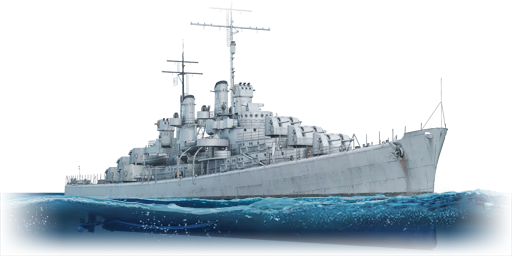
Laid down in April 1940, the Atlanta-class light cruisers were designed by the United States Navy as a return to the concept of a destroyer flotilla leader from before the First World War. This essentially created an overgrown destroyer with extra room for equipment and lots of 5-inch/38 mounts similar to those found on the destroyers she was expected to lead. Although exceptionally powerful against destroyers and thinly armoured light cruisers, this left her vulnerable to more well-armoured cruisers. USS Atlanta would only serve in 3 battles (Midway, the Eastern Solomans, and Guadalcanal) and would be sunk in the naval battle for Guadalcanal. After being struck by at least one torpedo, she was then hit by the friendly heavy cruiser San Francisco. The damage inflicted would later cause the rest of the Atlanta class to be mostly relegated to anti-air duties throughout the rest of the war.
The Atlanta-class, USS Atlanta (CL-51), 1941 was introduced in Update 1.91 "Night Vision", and boasts an impressive main battery of 8 double mount 5-inch guns, the same found on destroyers of the US Navy. With their impressive fire rate and good damage output, captains of USS Atlanta can expect to be able to easily dispatch all destroyers and many light cruisers, though the more well-armoured light cruisers and especially heavy cruisers will resist fire. Compared to other cruisers of the rank, Atlanta has a very weak anti-aircraft battery as she is in her 1941 refit, but the main battery can easily compensate for this when in battle.
General info
Survivability and armour
The Atlanta's protection is quite poor. While the ship is clad with with layers of anti-fragmentation armour (especially on the bow) and reasonable armour around the ship's internal modules, this is offset by low crew count, poor turret protection, and highly vulnerable ammunition storage.
Although the ammunition storage forward of the bridge does benefit from a layer of fuel storage in-between it and an incoming salvo, detonation of ammunition is commonplace thanks to the numerous fragile main turrets with highly vulnerable ready racks. The stern section of the Atlanta is especially vulnerable, as it has five main turrets cramped together and the rear magazine sits barely below the waterline.
Fire resistant characteristic is a mixed bag, as the Atlanta can endure prolonged fire damage with minimal crew loss, yet a fire in the vicinity of a turret has a high chance to cause a fatal ready rack detonation.
| Armour | Front | Side | Rear | Deck/Roof |
|---|---|---|---|---|
| Turret | 31.75 mm | 31.75 mm | 31.75 mm | 31.75 mm |
| Magazine (Front) | 95.25 mm | 27.94 mm | 95.25 mm | 31.75 mm + 12.7 mm |
| Citadel | 95.25 mm | 95.25 mm central part 19.05 mm almost covering all the hull 16 mm in the foredeck and in the aft |
95.25 mm | 31.75 mm + 12.7 mm |
| Magazine (Rear) | 95.25 mm | 95.25 mm in upper part 45.72 mm in the lower part |
95.25 mm | 31.75 mm + 12.7 mm |
| Barbette | 31.75 mm | |||
| Bridge | 63.5 mm | |||
Mobility
The Atlanta's handling is surprisingly sluggish when stock. Once upgraded, Atlanta is similar in manoeuvrability to other small light cruisers, though slightly more so than the Trenton-class light cruisers also found in the American tree. Atlanta has a top speed of 32 kn, but this falls to 23 kn when in a sustained turn. This is similar to the later Brooklyn-class cruisers, as is the rudder response time. At flank speed, the ship responds to rudder commands within two seconds, and in general USS Atlanta behaves like a larger destroyer, which makes sense as she was designed as a destroyer flotilla leader.
| Mobility Characteristics | |||
|---|---|---|---|
| Game Mode | Upgrade Status | Maximum Speed (km/h) | |
| Forward | Reverse | ||
| AB | |||
| Upgraded | |||
| RB/SB | |||
| Upgraded | |||
Modifications and economy
Armament
Primary armament
The primary armament of the Atlanta is 16 x 5-inch/38 Mk.12 guns in eight twin mounts, of which a maximum broadside of 14 barrels can be brought to bear on one target. These guns have a high rate of fire (up to 22 rounds per minute with maxed crew and first-stage ammo stowage) even with an untrained crew and have an reasonably high explosive mass for the calibre. The downside is a comparatively poor shell trajectory when compared to other cruisers; especially in fights over 8 km, the five-inch guns require more precise distance input compared to larger diameter guns.
The Atlanta gets access to four shell types - Mk.34 AAC, Mk. 32 Common, Mk.46 Common SP, and Mk.31 AAVT. The Common SP (essentially a common shell with slightly less explosive mass but better penetration) is typically the best pick for heavily-armoured targets such as cruisers. The Mk.31 AAVT is the only other recommended shell for use, as it contains the same filler as the AAC round while also of course being proximity-fused. This round serves as a dual-purpose round, perfect for lightly armoured destroyers and cruisers and any and all aircraft in the vicinity. The round can also be used to splash anti-aircraft guns and set fires in the superstructure when engaging more heavily-armoured ships, though the common shells will still be the main rounds to knock out the ship.
| Penetration statistics | |||||||
|---|---|---|---|---|---|---|---|
| Ammunition | Type of warhead |
Penetration @ 0° Angle of Attack (mm) | |||||
| 1,000 m | 2,500 m | 5,000 m | 7,500 m | 10,000 m | 15,000 m | ||
| AAC Mk.34 | HE | 36 | 36 | 36 | 36 | 36 | 36 |
| Common Mk.32 | Common | 124 | 103 | 77 | 58 | 46 | 37 |
| SP Common Mk.46 | SP Common | 150 | 125 | 93 | 71 | 56 | 45 |
| AAVT Mk.31 | HE-VT | 36 | 36 | 36 | 36 | 36 | 36 |
| Shell details | ||||||||||||
|---|---|---|---|---|---|---|---|---|---|---|---|---|
| Ammunition | Type of warhead |
Velocity (m/s) |
Projectile mass (kg) |
Fuse delay (s) |
Fuse sensitivity (mm) |
Explosive mass (TNT equivalent) (g) |
Ricochet | |||||
| 0% | 50% | 100% | ||||||||||
| AAC Mk.34 | HE | 792 | 25 | 0 | 0.1 | 3,220 | 79° | 80° | 81° | |||
| Common Mk.32 | Common | 792 | 24.49 | 0.01 | 6 | 1,150 | 47° | 60° | 65° | |||
| SP Common Mk.46 | SP Common | 792 | 25 | 0.01 | 6 | 906.5 | 48° | 63° | 71° | |||
| Proximity-fused shell details | ||||||||||||
|---|---|---|---|---|---|---|---|---|---|---|---|---|
| Ammunition | Type of warhead |
Velocity (m/s) |
Projectile mass (kg) |
Fuse delay (s) |
Fuse sensitivity (mm) |
Arming distance (m) |
Trigger radius (m) |
Explosive mass (TNT equivalent) (g) |
Ricochet | |||
| 0% | 50% | 100% | ||||||||||
| AAVT Mk.31 | HE-VT | 792 | 25 | 0 | 0.1 | 457 | 23 | 3,220 | 79° | 80° | 81° | |
Secondary armament
As designed, USS Atlanta was fitted with 8 twin 5-inch/38 mounts; as dual purpose guns, these would serve as the long range anti-aircraft battery, but for closer engagements she was fitted with 3 quad 1.1-inch gun mounts, two positioned port and starboard of the bridge and superstructure and one mounted forward and slightly above the aft three turrets.
The 1.1-inch/75 Mk.1 Gun, otherwise known as the "Chicago Piano" (because it was the size of a baby grand piano), was the standard anti-aircraft armament for most American ships prior to the adoption and widespread introduction of the 40 mm Bofors and 20 mm Oerlikon. Though they have a good traverse and elevation rate, as well as a quick fire rate, the shells lack stopping power. This means that gunners will need some time on target to eliminate any threats, and in most cases it is recommended to supplement the AA fire with volleys of AAVT from the main battery instead of relying solely on the gunners. Also note that the only available option for the guns is the default HEF-T belt.
| Penetration statistics | |||||||
|---|---|---|---|---|---|---|---|
| Ammunition | Type of warhead |
Penetration @ 0° Angle of Attack (mm) | |||||
| 10 m | 100 m | 500 m | 1,000 m | 1,500 m | 2,000 m | ||
| Mk.1 HE-T | HEF-T* | 2 | 2 | 2 | 2 | 2 | 2 |
| Shell details | ||||||||||||
|---|---|---|---|---|---|---|---|---|---|---|---|---|
| Ammunition | Type of warhead |
Velocity (m/s) |
Projectile mass (kg) |
Fuse delay (m) |
Fuse sensitivity (mm) |
Explosive mass (TNT equivalent) (g) |
Ricochet | |||||
| 0% | 50% | 100% | ||||||||||
| Mk.1 HE-T | HEF-T* | 823 | 0.42 | 0 | 0.1 | 14.7 | 79° | 80° | 81° | |||
Additional armament
The USS Atlanta, designed as a destroyer escort leader, also received torpedo launchers like the ships she was designed to lead. Being finally classed as a light cruiser, this makes her and her class a rare exception as an American cruiser with torpedoes. She has two quad torpedo launchers, mounted port and starboard aft of the second funnel and before the two wing turrets. These carry the Mk.15 torpedo, with 5.5 km of range stock, and motors along at 45 kn. With the "Torpedo mode" modification, the range increases to 9.15 km, but the speed drops sharply to 33 kn. It is up to captains of Atlanta whether to use the extra range or extra speed, though with the lacklustre range of US torpedoes either way, the extra speed may be preferred.
Usage in battles
USS Atlanta will serve her captains extremely well in her original role as a destroyer flotilla leader. Her prodigious quantities of 5-inch/38 will dispatch any enemy destroyer quickly, especially considering she has twice or thrice the broadside of many of the destroyers she will be fighting. Captains are recommended to attempt to rake the enemy ships bow to stern with fire, as the extremely fast fire rate of Atlanta will decimate any smaller vessels in short order, destroying crew compartments and setting off ammo racks. Captains should play her like a slightly slower, but better armoured and armed destroyer, not as a cruiser as she is classed. She will do exceptionally well brawling with enemy destroyers, though captains should be wary of quickly extinguishing fires, as turret fires have a tendency to spread and do lethal damage quickly. She is also vulnerable to enemy torpedoes, as her displacement is not enough to easily cushion blasts as some larger ships are capable of.
When engaging enemy cruisers the outlook is not so rosy. USS Atlanta is still very effective against most light cruisers, as their armour is incapable of stopping the shells at anything except extreme range. Against well armoured light cruisers like HMS Belfast and of course heavy cruisers, Atlanta will have a difficult time doing any more than superficial damage. Captains can use the massive volume of shells to destroy superstructure, AA guns, rangefinders, and other important and lightly armoured components of heavier ships however, and if the enemy captain has to repair the damage, eventually USS Atlanta may be able to bleed the enemies dry of crew.
Pros and cons
Pros:
- Huge amount of dual-purposes 5 inch guns provides excellent close to medium range firepower
- Due to its high rate of fire, it can quickly suppress rushing enemies attempting to close the distance
- Great gun coverage, can utilize most guns while heavily angled
- Effective at long-range anti-air defence when used correctly
Cons:
- Poor survivability due to lack of armour and low crew count
- Lots of turrets means a lot of ammo racks being scattered around the ship
- Mediocre manoeuvrability
- Poor accuracy and weapon trajectory at longer range
- Unreliable anti-air armaments, have to rely on dual-purpose guns that is quite tricky to use at times
History

USS Atlanta was the lead ship of her class of light cruisers built for the United States Navy during the Second World War. Designed as light anti-aircraft cruisers similar to the British Dido-class, the Atlanta was commissioned in December of 1941 just after the American entry into the Second World War. She went on to see combat action in the Pacific Theatre, and participated in the Midway and Eastern Solomons conflicts. She was later abandoned and sunk after being hit by Japanese torpedoes and friendly fire at the Naval Battle of Guadalcanal.
Design and development
The Atlanta class were designed as specialized anti-aircraft ships with armament specialized for anti-aircraft defence, similar to the British Dido-class. The ships were armed with a formidable main armament of sixteen 5-inch (127 mm) guns in eight dual mounts, with six on the centreline in two superfiring pairs and two more mounted on the beam. Despite their role, the ship's secondary anti-aircraft armament was scarce, being limited to just three quadruple 28 mm 'Chicago Piano' mounts. As well, Atlanta carried two quadruple 533 mm torpedo tubes, which was unusual among American cruisers due to the doctrine of not fitting torpedo tubes to cruisers. Being a small cruiser, Atlanta displaced just 6718 tons standard and had a crew of 673. Her anti-aircraft design meant that she was an ineffective surface combatant, which would later become a fatal flaw when she was severely damaged at the Battle of Guadalcanal. Atlanta was laid down in April of 1940, and commissioned on Christmas Eve, 1941, days after the United States declared war on the Axis powers.
Operational history
After her shakedown cruise in Chesapeake bay, the Atlanta was immediately sent to the Pacific theatre, where ships of her role were badly needed. After stopping at Pearl harbour, she joined Task Force 16, under the command of Vice Admiral William 'Bull' Halsey, as they sailed to counter the imminent attack on Midway Atoll. At the Battle of Midway, she provided air cover for the carrier USS Hornet, while aircraft of the American force decimated the Japanese carrier group and sank all four Japanese fleet carriers.
Soon after the Midway conflict, Atlanta participated in the Battle of the Eastern Solomons, where she covered the carrier USS Enterprise as she launched her airgroup against the Japanese carriers Shokaku and Zuikaku. Soon after, she proceeded to embark Rear Admiral Norman Scott, as she became the flagship of a convoy responsible for transporting troops to Guadalcanal. They were extensively attacked by enemy aircraft during the trip, but luckily, all three troop transports emerged without severe damage. Once the transports started unloading, Atlanta provided air cover as part of the larger TF 67, covered by several other cruisers.
Soon after, the Japanese aircraft broke off, and the cruiser force enjoyed a short period of inactivity before Japanese surface units were detected. TF 67 regrouped, now being composed of the heavy cruisers San Francisco (with commanding officer RAdm Daniel Callaghan onboard), Portland and Pensacola, the light cruisers USS Helena, Juneau, and Atlanta, along with several destroyers. They soon engaged the Japanese force in a night engagement that resulted in the sinking of the destroyer Akatsuki and crippling of Yuudachi. However, midway into the engagement, Atlanta was hit by a Japanese Long Lance torpedo that destroyed her engine room and knocked out most functions. Just minutes after, she was mistaken for a Japanese vessel and was hit by at least 19 8-inch shells fired by the USS San Francisco, which destroyed her superstructure and killed most of her officers including her commanding officer, RAdm Scott. The next morning, the surviving crew were disembarked by crew transports, and the ship was scuttled. The naval battle of Guadalcanal would eventually result in the sinking of her sister ship Juneau, and heavy damage to multiple other ships. For her service, Atlanta received 5 battle stars, as well as a presidential unit citation for her bravery during the Battle of Guadalcanal.
Devblog
Atlanta-class light cruisers came to being in the late 1930s, during which the US Navy was considering a multitude of different design proposals for new light cruisers, which would be in accordance with the limitations set by the Second London Naval Treaty of 1936.
Having realized that all outstanding requirements couldn't be met with a limited displacement design, the decision was eventually made to adopt a smaller light cruiser design to act as a destroyer leader. As a result, the proposed design of what would become the Atlanta-class was selected for construction, with an initial order for four ships being issued in April 1939, followed by a second order for four further vessels in September 1940.
USS Atlanta, the lead ship of the class, was laid down on 22 April 1940 in Kearny, New Jersey and was subsequently commissioned into service in December of the following year, shortly after the US' entry into WWII. Atlanta would soon receive its baptism by fire, taking part in the Battle of Midway in June 1942 while on screening duty for American aircraft carriers.
USS Atlanta also took part in heavy fighting during the Battle of the Eastern Solomons, as well as the subsequent Naval Battle of Guadalcanal. During the latter, USS Atlanta received mortal damage during a Japanese night attack, both from enemy as well as friendly fire. Although the USS Atlanta made it through the night, it became clear the next morning that the damage was too severe to deal with and the order for scuttling was issued on 13 November 1942. Atlanta was subsequently struck from the Naval Register in January of the following year.
Media
- Images

- Skins
See also
- Other anti-aircraft cruisers
External links
References
- Helgason, G. (1995). USS Atlanta. Retrieved January 26, 2021, from https://uboat.net/allies/warships/ship/2575.html
- Navy History and Heritage Command. (2019, August 20). Atlanta III (CL-51). Retrieved January 26, 2021, from https://www.history.navy.mil/research/histories/ship-histories/danfs/a/atlanta-cl-51-iii.html
| Federal Shipbuilding and Drydock Company | |
|---|---|
| Gun Destroyers (DD) | |
| Somers-class | USS Somers |
| Fletcher-class | USS Fletcher |
| Allen M. Sumner-class | USS Sumner |
| Gearing-class | USS Gearing |
| Cruiser, Light (CL) | |
| Atlanta-class | USS Atlanta |
| USA light cruisers | |
|---|---|
| Omaha-class | USS Detroit · USS Raleigh · USS Trenton |
| Atlanta-class | USS Atlanta |
| Brooklyn-class | USS Brooklyn · USS Helena |
| Cleveland-class | USS Cleveland |
| Fargo-class | USS Fargo |
| Worcester-class | USS Roanoke |