Difference between revisions of "Churchill AVRE Petard"
(Specs-card artimage added.) |
(→General info) (Tag: Visual edit) |
||
| (9 intermediate revisions by 5 users not shown) | |||
| Line 6: | Line 6: | ||
{{Specs-Card | {{Specs-Card | ||
|code=uk_churchill_avre | |code=uk_churchill_avre | ||
| − | |images={{Specs-Card-Image|GarageImage_{{PAGENAME}}.jpg | + | |images={{Specs-Card-Image|GarageImage_{{PAGENAME}}.jpg}} |
| − | |||
}} | }} | ||
== Description == | == Description == | ||
<!-- ''In the description, the first part should be about the history of the creation and combat usage of the vehicle, as well as its key features. In the second part, tell the reader about the ground vehicle in the game. Insert a screenshot of the vehicle, so that if the novice player does not remember the vehicle by name, he will immediately understand what kind of vehicle the article is talking about.'' --> | <!-- ''In the description, the first part should be about the history of the creation and combat usage of the vehicle, as well as its key features. In the second part, tell the reader about the ground vehicle in the game. Insert a screenshot of the vehicle, so that if the novice player does not remember the vehicle by name, he will immediately understand what kind of vehicle the article is talking about.'' --> | ||
| − | The {{Specs|name}}, officially the "Mortar, Recoiling, Spigot, 29mm, Mk I", was the first vehicle to bear the name "AVRE" ( | + | The '''{{Specs|name}}''' , officially the "'''Mortar, Recoiling, Spigot, 29mm, Mk I'''", was the first vehicle to bear the name "AVRE" ('''A'''rmored '''V'''ehicle '''R'''oyal '''E'''ngineer) as a breakthrough tank for British Army's Royal Engineers. By 1942, after the dreadful Dieppe raid at very high man cost due to the lack of means for beachhead breakthrough, especially beachheads with extensive bunker/pillbox and during explosive works on breaching obstacles. This led to a program to develop a vehicle specifically for this purpose and serving as a mobile cover for royal engineers while operating in the battlefield; after the evaluations done on different tanks, the Churchill infantry tank became the chosen vehicle for this mission. Aside from some components were replaced by engineering supplies and having larger side doors for infantry operation, a new 290 mm spigot motor dubbed "flying dustbin" was also installed in the turret as the ranged demolition charge without having to leave the vehicle during crossfire. After trials in 1943, the new vehicle now known as the AVRE was ready for service and proved very successful during the breakthrough stage on the Normandy Landings on June 1944, where the 79th Armored Division with their "Hobart's Funnies" vehicles successfully provided reliable support for the first wave of assault groups. The AVRE name would also be retained for all new vehicles designed for these purposes, including the [[Centurion Mk.5 AVRE]] which was still in service in Gulf War of 1990s. |
| − | Introduced during [[Update "Alpha Strike"]] as a reward for the [[wt:en/news/8912-event-earn-the-churchill-avre-in-the-operation-overlord-event-en|2024 Operation Overlord event]], the Churchill | + | Introduced during [[Update "Alpha Strike"]] as a reward for the [[wt:en/news/8912-event-earn-the-churchill-avre-in-the-operation-overlord-event-en|2024 Operation Overlord event]], the vehicle retains most features from a conventional Churchill Mk.III tank with sufficient protection, but when players see the oddly short yet high caliber spigot motor at very close range, the "flying dustbin" will be the very last thing they ever see before the vehicle is blasted into pieces. |
== General info == | == General info == | ||
| Line 20: | Line 19: | ||
{{Specs-Tank-Armour}} | {{Specs-Tank-Armour}} | ||
<!-- ''Describe armour protection. Note the most well protected and key weak areas. Appreciate the layout of modules as well as the number and location of crew members. Is the level of armour protection sufficient, is the placement of modules helpful for survival in combat? If necessary use a visual template to indicate the most secure and weak zones of the armour.'' --> | <!-- ''Describe armour protection. Note the most well protected and key weak areas. Appreciate the layout of modules as well as the number and location of crew members. Is the level of armour protection sufficient, is the placement of modules helpful for survival in combat? If necessary use a visual template to indicate the most secure and weak zones of the armour.'' --> | ||
| − | + | To conclude the protection of AVRE in one simple sentence: identical to a baseline Churchill III. By its tier, Churchill has a relatively reliable protection thanks to its true identity - a heavy tank (although officially an infantry tank); before jumping straight into a game, the "reliable" protection is not equal to invincible as there are still some cannons that can penetrate the III series i.e Soviet F-34 and German Kwk 42, as well as US 3 inch guns. In most cases, if their shot falls onto sloped parts of the hull, AVRE will very unlikely be harmed at all; be sure to keep the flanks clear and not as aggressive as on standard Churchill series since it takes more than 15 seconds to reload the petard, any missed shot is the worst decision players can ever made. | |
| − | As for the crew and internal compartments, the overall layout is mostly identical to a | + | As for the crew and internal compartments, the overall layout is mostly identical to a III, but the major difference goes to the remaining demolition charges stored inside the vehicle, while the sufficiently spacious interior might migrate some damage, a direct hit on those charges will certainly blow the turret into the height of Big Ben. So pointing the hull at oncoming fire is very essential for the service of Churchill AVRE. |
'''Armour type:''' <!-- The types of armour present on the vehicle and their general locations --> | '''Armour type:''' <!-- The types of armour present on the vehicle and their general locations --> | ||
| Line 32: | Line 31: | ||
! Armour !! Front (Slope angle) !! Sides !! Rear !! Roof | ! Armour !! Front (Slope angle) !! Sides !! Rear !! Roof | ||
|- | |- | ||
| − | |Hull||89 | + | |Hull||89 mm ''Front plate'' |
| − | |63.5 | + | 89 + 89 mm ''Front plate (MG Port)'' |
| − | |50.8 mm | + | 38 mm (63°) ''Front glacis'' |
| − | |19.05 | + | 76.2 mm (19°) ''Lower glacis'' |
| + | |63.5 mm ''Overall side armour'' | ||
| + | 76.2 mm ''Side hatch'' | ||
| + | |||
| + | 38.1 mm ''Side edge'' | ||
| + | |50.8 mm | ||
| + | 25.4 mm (60-69°) ''Bottom'' | ||
| + | |19.05 mm ''Front'' | ||
| + | 15.87 mm ''Rear'' | ||
|- | |- | ||
| − | |Turret||89 mm (0-49°) ''Turret front'' | + | |Turret||89 mm (0-49°) ''Turret front'' |
| + | 89 mm (0-30°) ''Gun mantlet'' | ||
| + | |||
| + | 19.05 mm (77°) ''Roof area'' | ||
|76.2 mm (0-47°)||76.2 + 7 mm||19.05 mm | |76.2 mm (0-47°)||76.2 + 7 mm||19.05 mm | ||
|- | |- | ||
| Line 48: | Line 58: | ||
{{Specs-Tank-Mobility}} | {{Specs-Tank-Mobility}} | ||
<!-- ''Write about the mobility of the ground vehicle. Estimate the specific power and manoeuvrability, as well as the maximum speed forwards and backwards.'' --> | <!-- ''Write about the mobility of the ground vehicle. Estimate the specific power and manoeuvrability, as well as the maximum speed forwards and backwards.'' --> | ||
| − | + | Churchill Mk.III uses identical engine to any previous or later production of Churchill series, namely the Belford "Flat Twelve" 12 cylinder, horizontal petrol engine; maxed at 350 hp, although it can drive the vehicle, but this also means it would never be the first to hit the frontline due to its rather slow acceleration and topped at 24 km/h. | |
| − | {{tankMobility | + | {{tankMobility}} |
=== Modifications and economy === | === Modifications and economy === | ||
| Line 62: | Line 72: | ||
{{main|Petard (230 mm)}} | {{main|Petard (230 mm)}} | ||
| − | + | Players might have some confusion with the official name of the tank and its true caliber; the 29 mm is in fact referring to the spigot (the tube that the ammunition inserted onto), the ammunition itself is 230 mm and known as the Petard or commonly as the "flying dustbin" referring to its dustbin like appearance. With around 17.8 kg TNTe of demolition charge, a single hit can literary demolish most, if not all targets AVRE will face at its tier; be careful of its rather long reload time (reloaded by driver from a overhead hatch into the barrel) and damages to the ammunition itself even from machine gun fire. | |
{| class="wikitable" style="text-align:center" width="100%" | {| class="wikitable" style="text-align:center" width="100%" | ||
| Line 73: | Line 83: | ||
|- | |- | ||
! ''Arcade'' | ! ''Arcade'' | ||
| − | | rowspan="2" | 16 || rowspan="2" | -3°/+15° || rowspan="2" | ±180° || rowspan="2" | - || | + | | rowspan="2" | 16 || rowspan="2" | -3°/+15° || rowspan="2" | ±180° || rowspan="2" | - || __._ || __._ || __._ || __._ || __._ || rowspan="2" | _.__ || rowspan="2" | _.__ || rowspan="2" | _.__ || rowspan="2" | _.__ |
|- | |- | ||
! ''Realistic'' | ! ''Realistic'' | ||
| − | | | + | | __._ || __._ || __._ || __._ || __._ |
|- | |- | ||
|} | |} | ||
| Line 106: | Line 116: | ||
{{main|BESA (7.92 mm)}} | {{main|BESA (7.92 mm)}} | ||
| − | All British-built tanks in WWII | + | All British-built tanks in WWII retains a .303 BESA machine gun; in this case, the machine gun is retained in the turret for taking out exposed crews of enemy vehicles. |
{| class="wikitable" style="text-align:center" width="50%" | {| class="wikitable" style="text-align:center" width="50%" | ||
| Line 114: | Line 124: | ||
! Mount !! Capacity (Belt) !! Fire rate !! Vertical !! Horizontal | ! Mount !! Capacity (Belt) !! Fire rate !! Vertical !! Horizontal | ||
|- | |- | ||
| − | | | + | | || ___ (___) || ___ || __° || __° |
|- | |- | ||
|} | |} | ||
| Line 120: | Line 130: | ||
== Usage in battles == | == Usage in battles == | ||
<!-- ''Describe the tactics of playing in the vehicle, the features of using vehicles in the team and advice on tactics. Refrain from creating a "guide" - do not impose a single point of view but instead give the reader food for thought. Describe the most dangerous enemies and give recommendations on fighting them. If necessary, note the specifics of the game in different modes (AB, RB, SB).'' --> | <!-- ''Describe the tactics of playing in the vehicle, the features of using vehicles in the team and advice on tactics. Refrain from creating a "guide" - do not impose a single point of view but instead give the reader food for thought. Describe the most dangerous enemies and give recommendations on fighting them. If necessary, note the specifics of the game in different modes (AB, RB, SB).'' --> | ||
| − | + | ''Describe the tactics of playing in the vehicle, the features of using vehicles in the team and advice on tactics. Refrain from creating a "guide" - do not impose a single point of view but instead give the reader food for thought. Describe the most dangerous enemies and give recommendations on fighting them. If necessary, note the specifics of the game in different modes (AB, RB, SB).'' | |
| − | |||
| − | |||
| − | |||
| − | |||
=== Pros and cons === | === Pros and cons === | ||
| − | <!-- ''Summarise and briefly evaluate the vehicle in terms of its characteristics and combat effectiveness. Mark its pros and cons in a bulleted list. Try not to use more than 6 points for each of the characteristics. Avoid using categorical definitions such as "bad", "good" and the like - use substitutions with softer forms such as "inadequate" and "effective".'' --> | + | <!-- ''Summarise and briefly evaluate the vehicle in terms of its characteristics and combat effectiveness. Mark its pros and cons in a bulleted list. Try not to use more than 6 points for each of the characteristics. Avoid using categorical definitions such as "bad", "good" and the like - use substitutions with softer forms such as "inadequate" and "effective".'' -->'''Pros:''' |
| − | |||
| − | '''Pros:''' | ||
* Huge explosive filler in mortar shell can obliterate anything it touches, even above its BR | * Huge explosive filler in mortar shell can obliterate anything it touches, even above its BR | ||
| Line 138: | Line 142: | ||
* Extremely terrible shell velocity; cannot shoot further than 10 meters in a straight line, and has a maximum range of only 150 meters | * Extremely terrible shell velocity; cannot shoot further than 10 meters in a straight line, and has a maximum range of only 150 meters | ||
| − | * Being a mortar shell, the shell takes very long time to lob and descend onto the target if shooting at range, making it | + | * Being a mortar shell, the shell takes very long time to lob and descend onto the target if shooting at range, making it nearly impossible to hit moving targets |
| − | * Due to very limited range of the mortar, the tank struggle to perform in open terrain where virtually all | + | * Due to very limited range of the mortar, the tank struggle to perform in open terrain where virtually all of the enemy can outrange it |
* Mortar shell can be detonated inside the barrel, potentially causing lethal damage | * Mortar shell can be detonated inside the barrel, potentially causing lethal damage | ||
* Very poor top speed and mobility, highly vulnerable to airstrike | * Very poor top speed and mobility, highly vulnerable to airstrike | ||
| Line 155: | Line 159: | ||
* ''reference to the series of the vehicles;'' | * ''reference to the series of the vehicles;'' | ||
* ''links to approximate analogues of other nations and research trees.'' --> | * ''links to approximate analogues of other nations and research trees.'' --> | ||
| − | + | ''Links to the articles on the War Thunder Wiki that you think will be useful for the reader, for example:'' | |
| − | * | + | |
| − | * | + | * ''reference to the series of the vehicles;'' |
| + | * ''links to approximate analogues of other nations and research trees.'' | ||
== External links == | == External links == | ||
Revision as of 18:55, 3 July 2024
| This page is about the British heavy tank Churchill AVRE Petard. For other variants, see Churchill (Family). |

Contents
Description
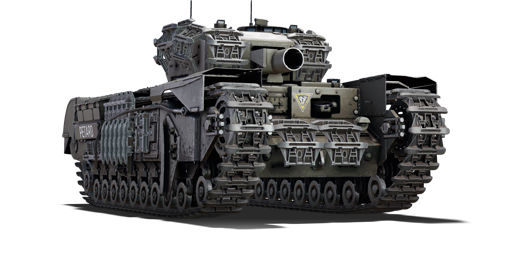
The Churchill Mk.III AVRE Petard , officially the "Mortar, Recoiling, Spigot, 29mm, Mk I", was the first vehicle to bear the name "AVRE" (Armored Vehicle Royal Engineer) as a breakthrough tank for British Army's Royal Engineers. By 1942, after the dreadful Dieppe raid at very high man cost due to the lack of means for beachhead breakthrough, especially beachheads with extensive bunker/pillbox and during explosive works on breaching obstacles. This led to a program to develop a vehicle specifically for this purpose and serving as a mobile cover for royal engineers while operating in the battlefield; after the evaluations done on different tanks, the Churchill infantry tank became the chosen vehicle for this mission. Aside from some components were replaced by engineering supplies and having larger side doors for infantry operation, a new 290 mm spigot motor dubbed "flying dustbin" was also installed in the turret as the ranged demolition charge without having to leave the vehicle during crossfire. After trials in 1943, the new vehicle now known as the AVRE was ready for service and proved very successful during the breakthrough stage on the Normandy Landings on June 1944, where the 79th Armored Division with their "Hobart's Funnies" vehicles successfully provided reliable support for the first wave of assault groups. The AVRE name would also be retained for all new vehicles designed for these purposes, including the Centurion Mk.5 AVRE which was still in service in Gulf War of 1990s.
Introduced during Update "Alpha Strike" as a reward for the 2024 Operation Overlord event, the vehicle retains most features from a conventional Churchill Mk.III tank with sufficient protection, but when players see the oddly short yet high caliber spigot motor at very close range, the "flying dustbin" will be the very last thing they ever see before the vehicle is blasted into pieces.
General info
Survivability and armour
To conclude the protection of AVRE in one simple sentence: identical to a baseline Churchill III. By its tier, Churchill has a relatively reliable protection thanks to its true identity - a heavy tank (although officially an infantry tank); before jumping straight into a game, the "reliable" protection is not equal to invincible as there are still some cannons that can penetrate the III series i.e Soviet F-34 and German Kwk 42, as well as US 3 inch guns. In most cases, if their shot falls onto sloped parts of the hull, AVRE will very unlikely be harmed at all; be sure to keep the flanks clear and not as aggressive as on standard Churchill series since it takes more than 15 seconds to reload the petard, any missed shot is the worst decision players can ever made.
As for the crew and internal compartments, the overall layout is mostly identical to a III, but the major difference goes to the remaining demolition charges stored inside the vehicle, while the sufficiently spacious interior might migrate some damage, a direct hit on those charges will certainly blow the turret into the height of Big Ben. So pointing the hull at oncoming fire is very essential for the service of Churchill AVRE.
Armour type:
| Armour | Front (Slope angle) | Sides | Rear | Roof |
|---|---|---|---|---|
| Hull | 89 mm Front plate
89 + 89 mm Front plate (MG Port) 38 mm (63°) Front glacis 76.2 mm (19°) Lower glacis |
63.5 mm Overall side armour
76.2 mm Side hatch 38.1 mm Side edge |
50.8 mm
25.4 mm (60-69°) Bottom |
19.05 mm Front
15.87 mm Rear |
| Turret | 89 mm (0-49°) Turret front
89 mm (0-30°) Gun mantlet 19.05 mm (77°) Roof area |
76.2 mm (0-47°) | 76.2 + 7 mm | 19.05 mm |
Notes:
Mobility
Churchill Mk.III uses identical engine to any previous or later production of Churchill series, namely the Belford "Flat Twelve" 12 cylinder, horizontal petrol engine; maxed at 350 hp, although it can drive the vehicle, but this also means it would never be the first to hit the frontline due to its rather slow acceleration and topped at 24 km/h.
| Game Mode | Max Speed (km/h) | Weight (tons) | Engine power (horsepower) | Power-to-weight ratio (hp/ton) | |||
|---|---|---|---|---|---|---|---|
| Forward | Reverse | Stock | Upgraded | Stock | Upgraded | ||
| Arcade | Expression error: Unexpected * operator. | _,___ | __.__ | __.__ | |||
| Realistic | _,___ | __.__ | __.__ | ||||
Modifications and economy
Armaments
Main armament
Players might have some confusion with the official name of the tank and its true caliber; the 29 mm is in fact referring to the spigot (the tube that the ammunition inserted onto), the ammunition itself is 230 mm and known as the Petard or commonly as the "flying dustbin" referring to its dustbin like appearance. With around 17.8 kg TNTe of demolition charge, a single hit can literary demolish most, if not all targets AVRE will face at its tier; be careful of its rather long reload time (reloaded by driver from a overhead hatch into the barrel) and damages to the ammunition itself even from machine gun fire.
| 230 mm Petard | Turret rotation speed (°/s) | Reloading rate (seconds) | |||||||||||
|---|---|---|---|---|---|---|---|---|---|---|---|---|---|
| Mode | Capacity | Vertical | Horizontal | Stabilizer | Stock | Upgraded | Full | Expert | Aced | Stock | Full | Expert | Aced |
| Arcade | 16 | -3°/+15° | ±180° | - | __._ | __._ | __._ | __._ | __._ | _.__ | _.__ | _.__ | _.__ |
| Realistic | __._ | __._ | __._ | __._ | __._ | ||||||||
Ammunition
| Penetration statistics | |||||||
|---|---|---|---|---|---|---|---|
| Ammunition | Type of warhead |
Penetration @ 0° Angle of Attack (mm) | |||||
| 10 m | 100 m | 500 m | 1,000 m | 1,500 m | 2,000 m | ||
| No.1 Demolition Bomb | Rocket | 64 | 64 | 64 | 64 | 64 | 64 |
| Shell details | ||||||||||||
|---|---|---|---|---|---|---|---|---|---|---|---|---|
| Ammunition | Type of warhead |
Velocity (m/s) |
Projectile mass (kg) |
Fuse delay (m) |
Fuse sensitivity (mm) |
Explosive mass (TNT equivalent) (kg) |
Ricochet | |||||
| 0% | 50% | 100% | ||||||||||
| No.1 Demolition Bomb | Rocket | 50 | 18.14 | 0 | 0.1 | 17.73 | 79° | 80° | 81° | |||
Ammo racks
| Full ammo |
1st rack empty |
2nd rack empty |
3rd rack empty |
4th rack empty |
5th rack empty |
6th rack empty |
Visual discrepancy |
|---|---|---|---|---|---|---|---|
| 16 | __ (+__) | __ (+__) | __ (+__) | __ (+__) | __ (+__) | __ (+__) | __ |
Machine guns
All British-built tanks in WWII retains a .303 BESA machine gun; in this case, the machine gun is retained in the turret for taking out exposed crews of enemy vehicles.
| 7.92 mm BESA | ||||
|---|---|---|---|---|
| Mount | Capacity (Belt) | Fire rate | Vertical | Horizontal |
| ___ (___) | ___ | __° | __° | |
Usage in battles
Describe the tactics of playing in the vehicle, the features of using vehicles in the team and advice on tactics. Refrain from creating a "guide" - do not impose a single point of view but instead give the reader food for thought. Describe the most dangerous enemies and give recommendations on fighting them. If necessary, note the specifics of the game in different modes (AB, RB, SB).
Pros and cons
Pros:
- Huge explosive filler in mortar shell can obliterate anything it touches, even above its BR
- Due to curved arc of the mortar, it can be easily lobbed over obstacles or terrain to hit target hiding behind them
- Extremely thick armour, especially for its BR
Cons:
- Extremely terrible shell velocity; cannot shoot further than 10 meters in a straight line, and has a maximum range of only 150 meters
- Being a mortar shell, the shell takes very long time to lob and descend onto the target if shooting at range, making it nearly impossible to hit moving targets
- Due to very limited range of the mortar, the tank struggle to perform in open terrain where virtually all of the enemy can outrange it
- Mortar shell can be detonated inside the barrel, potentially causing lethal damage
- Very poor top speed and mobility, highly vulnerable to airstrike
History
Describe the history of the creation and combat usage of the vehicle in more detail than in the introduction. If the historical reference turns out to be too long, take it to a separate article, taking a link to the article about the vehicle and adding a block "/History" (example: https://wiki.warthunder.com/(Vehicle-name)/History) and add a link to it here using the main template. Be sure to reference text and sources by using <ref></ref>, as well as adding them at the end of the article with <references />. This section may also include the vehicle's dev blog entry (if applicable) and the in-game encyclopedia description (under === In-game description ===, also if applicable).
Media
Excellent additions to the article would be video guides, screenshots from the game, and photos.
See also
Links to the articles on the War Thunder Wiki that you think will be useful for the reader, for example:
- reference to the series of the vehicles;
- links to approximate analogues of other nations and research trees.
External links
Paste links to sources and external resources, such as:
- topic on the official game forum;
- other literature.
| Britain heavy tanks | |
|---|---|
| Matilda | Matilda III · Matilda Hedgehog |
| Churchill | Churchill I · Churchill III · Churchill VII · Churchill Crocodile · Churchill NA75 · Black Prince |
| Post-war | Caernarvon · Conqueror |
| Other | Independent · Excelsior · TOG II |
| Britain premium ground vehicles | |
|---|---|
| Light tanks | A13 Mk I (3rd R.T.R.) · A13 Mk II 1939 · AEC Mk II · Crusader "The Saint" · Rooikat 105 |
| Medium tanks | A.C.I · Grant I · Cromwell V (RP-3) · Sherman IC "Trzyniec" · A.C.IV · Comet I "Iron Duke IV" |
| Centurion Mk.2 · ▄Strv 81 (RB 52) · Centurion Mk.5 AVRE · Centurion Mk.5/1 · ▄Sho't Kal Dalet · Centurion Action X | |
| Vijayanta · Khalid · Challenger DS · Challenger 2 OES | |
| Heavy tanks | Independent · Matilda Hedgehog · Excelsior · TOG II · Churchill Crocodile · Black Prince |
| Tank destroyers | Alecto I · Achilles (65 Rg.) · QF 3.7 Ram |