Difference between pages "PTL02" and "Type 69"
(→Main armament: revision of shell names of earlier 100mm calibers) (Tag: Visual edit) |
(→Pros and cons) (Tag: Visual edit) |
||
| Line 1: | Line 1: | ||
| + | {{About | ||
| + | | about = Chinese medium tank '''{{PAGENAME}}''' | ||
| + | | usage = other versions | ||
| + | | link = Type 69 (Family) | ||
| + | }} | ||
{{Specs-Card | {{Specs-Card | ||
| − | |code= | + | |code=cn_type_69 |
| − | |images={{Specs-Card-Image|GarageImage_ | + | |images={{Specs-Card-Image|GarageImage_{{PAGENAME}}.jpg}} |
}} | }} | ||
== Description == | == Description == | ||
<!-- ''In the description, the first part should be about the history of the creation and combat usage of the vehicle, as well as its key features. In the second part, tell the reader about the ground vehicle in the game. Insert a screenshot of the vehicle, so that if the novice player does not remember the vehicle by name, he will immediately understand what kind of vehicle the article is talking about.'' --> | <!-- ''In the description, the first part should be about the history of the creation and combat usage of the vehicle, as well as its key features. In the second part, tell the reader about the ground vehicle in the game. Insert a screenshot of the vehicle, so that if the novice player does not remember the vehicle by name, he will immediately understand what kind of vehicle the article is talking about.'' --> | ||
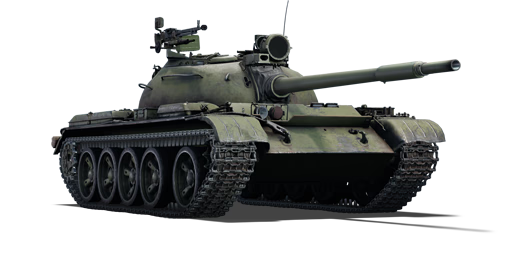
| − | The '''{{Specs|name}}''' ( | + | The '''{{Specs|name}}'''(Chinese: 69式中型坦克; industry code WZ121) was the first batch of 100 tanks manufactured as the domestic replacement of the previous Type 59 tanks with some parts of the domestic upgrades inspired from [[T-62 545 (China)|Soviet T-62]]. The plans to built a completely domestic tank rose after the worsen Sino-Soviet relationship, in fact the new tank was proposed in 1963 to replace the aforementioned [[Type 59]] and the development started in 1965; while the later Cultural Revolution hindered the development severely, Chinese engineers eventually acquired the No. 545 T-62 from Soviet Border Troops and many parts of the most advanced Soviet tank known to Chinese inspired the engineers to revise their designs. The WZ121 eventually passed for certification in 1974 with new diesel engine, FCS and the infamous 100 mm smoothbore cannon; due to the rather disappointing performance of the cannon and flaws found during trials, these 100 tanks were soon returned to Factory 617 with the only known surviving tank stored in China Tank Museum (now closed), where the new Type 69-II with rifled 100 mm cannon passed as the true Type 69 in service, as well as the bestseller of Chinese medium tanks during 1980s as the [[Type 69-IIa]]. |
| − | + | It was introduced in [[Update 1.91 "Night Vision"]] alongside with the Chinese tech-tree. At first glance, the Type 69 looks a lot like the previous Type 59. Closer inspection reveals some interesting features. It can be visually differentiated from similar vehicles by the placement of the IR spotlight directly above the gun mantlet (Soviet tanks place the spotlight off to the side), a laser rangefinder next to it, and a unique fume extractor located near the tip of the barrel. It can be thought of as a cross between the Soviet [[T-55A]] and [[T-62]]. Like the former, it boasts improved mobility and gun handling from the original Type 59, and like the latter, it has a smoothbore gun firing HEATFS and APFSDS rounds. Incorporating some of the PRC's first indigenous technologies, it also boasts night vision, two-plane stabilizer, and a laser rangefinder which both the T-62 and T-55A lack. Players coming from the [[Type 59]] will appreciate many of the Type 69's improvements, no longer having to deal with a glacial turret rotation speed, single plane stabilizer, and lack of night vision. The firepower is a sidegrade at best and a downgrade at worst. Both tanks can use HEATFS, but while the Type 59 could use APHE rounds for instant knockouts against lightly armoured tanks like the [[Leopard 1]], the Type 69 has a poor-quality APFSDS round instead. No miracles should be expected from its gun. | |
| + | |||
| + | Succeeding the Type 69 is the [[ZTZ59D1]], which has much improved firepower and protection but reverts back to the Type 59's poor gun handling and weaker engine. | ||
== General info == | == General info == | ||
| Line 15: | Line 22: | ||
<!-- ''Describe armour protection. Note the most well protected and key weak areas. Appreciate the layout of modules as well as the number and location of crew members. Is the level of armour protection sufficient, is the placement of modules helpful for survival in combat? If necessary use a visual template to indicate the most secure and weak zones of the armour.'' --> | <!-- ''Describe armour protection. Note the most well protected and key weak areas. Appreciate the layout of modules as well as the number and location of crew members. Is the level of armour protection sufficient, is the placement of modules helpful for survival in combat? If necessary use a visual template to indicate the most secure and weak zones of the armour.'' --> | ||
| − | + | The armour layout of the Type 69 is identical to the [[T-54 (1951)]], with a rounded turret made of cast homogeneous armour and a highly sloped front glacis. While the frontal protection is good in terms of raw values, the Type 69 will face many tanks with powerful sub-calibre and HEAT rounds that can penetrate its armour with ease. That said, it is resistant to the APHE rounds used by Soviet light/medium tanks and the US [[T32]]/[[T32E1]]. | |
| − | |||
| − | |||
| − | + | Post-penetration survivability is not optimal as the interior of the tank is cramped and plenty of loose ammunition is stored in the turret and fighting compartment. However, the Type 69 has a "wet" ammo rack next to the driver, which is more resistant to detonation by HEAT rounds. | |
'''Armour type:''' | '''Armour type:''' | ||
| − | * Rolled homogeneous armour | + | * Rolled homogeneous armour (Hull, Turret roof) |
| − | * Cast homogeneous armour | + | * Cast homogeneous armour (Turret, Gun mantlet) |
{| class="wikitable" | {| class="wikitable" | ||
| Line 30: | Line 35: | ||
! Armour !! Front (Slope angle) !! Sides !! Rear !! Roof | ! Armour !! Front (Slope angle) !! Sides !! Rear !! Roof | ||
|- | |- | ||
| − | | Hull || | + | | Hull || 100 mm (60°) ''Front glacis'' <br> 100 mm (54°) ''Lower glacis'' || 80 mm || 45 mm (16°) ''Upper'' <br> 30 mm (72°) ''Lower'' || 30 mm ''Front''<br> 20 mm ''Back'' |
| − | |||
| − | |||
|- | |- | ||
| − | | | + | | Turret || 160 mm (14-39°) ''Turret front'' <br> 200 mm (4-78°) ''Gun mantlet'' || 115 mm (45-50°) ''Upper''<br> 155 mm (10-30°) ''Lower'' || 65 mm (0-35°) || 30 mm |
|- | |- | ||
|} | |} | ||
'''Notes:''' | '''Notes:''' | ||
| − | * | + | * Suspensions wheels and tracks are 20 mm thick |
| − | |||
| − | |||
=== Mobility === | === Mobility === | ||
| Line 47: | Line 48: | ||
<!-- ''Write about the mobility of the ground vehicle. Estimate the specific power and manoeuvrability, as well as the maximum speed forwards and backwards.'' --> | <!-- ''Write about the mobility of the ground vehicle. Estimate the specific power and manoeuvrability, as well as the maximum speed forwards and backwards.'' --> | ||
| − | {{tankMobility|abMinHp= | + | {{tankMobility|abMinHp=899|rbMinHp=513}} |
| − | |||
| − | |||
| − | |||
| − | |||
=== Modifications and economy === | === Modifications and economy === | ||
| Line 61: | Line 58: | ||
{{Specs-Tank-Weapon|1}} | {{Specs-Tank-Weapon|1}} | ||
<!-- ''Give the reader information about the characteristics of the main gun. Assess its effectiveness in a battle based on the reloading speed, ballistics and the power of shells. Do not forget about the flexibility of the fire, that is how quickly the cannon can be aimed at the target, open fire on it and aim at another enemy. Add a link to the main article on the gun: <code><nowiki>{{main|Name of the weapon}}</nowiki></code>. Describe in general terms the ammunition available for the main gun. Give advice on how to use them and how to fill the ammunition storage.'' --> | <!-- ''Give the reader information about the characteristics of the main gun. Assess its effectiveness in a battle based on the reloading speed, ballistics and the power of shells. Do not forget about the flexibility of the fire, that is how quickly the cannon can be aimed at the target, open fire on it and aim at another enemy. Add a link to the main article on the gun: <code><nowiki>{{main|Name of the weapon}}</nowiki></code>. Describe in general terms the ammunition available for the main gun. Give advice on how to use them and how to fill the ammunition storage.'' --> | ||
| − | {{main| | + | {{main|Type 69 (100 mm)}} |
| − | The 100 mm | + | The Type 69 is armed with a 100 mm Type 69 smoothbore cannon equipped with a two-plane stabilizer, capable of firing APFSDS, HEATFS, and HE rounds. It reloads 0.1 seconds quicker than the Type 59's rifled gun but this is a negligible improvement. The turret traverse is on par with the T-55A and is 50% better than the Type 59. The ability to automatically range the gun using the laser rangefinder helps offset the lower velocity of the HEATFS round, and makes sniping extremely easy. As a whole, the Type 69 significantly rectifies the Type 59's gun handling problems, but it still lags behind most Western MBTs. It also retains the T-54/Type 59's poor gun depression of 4 degrees, which is 1 degree worse than the T-55A. |
{| class="wikitable" style="text-align:center" width="100%" | {| class="wikitable" style="text-align:center" width="100%" | ||
|- | |- | ||
| − | ! colspan="5" | [[ | + | ! colspan="5" | [[Type 69 (100 mm)|100 mm Type 69]] || colspan="5" | Turret rotation speed (°/s) || colspan="4" | Reloading rate (seconds) |
|- | |- | ||
! Mode !! Capacity !! Vertical !! Horizontal !! Stabilizer | ! Mode !! Capacity !! Vertical !! Horizontal !! Stabilizer | ||
| Line 74: | Line 71: | ||
|- | |- | ||
! ''Arcade'' | ! ''Arcade'' | ||
| − | | rowspan="2" | | + | | rowspan="2" | 44 || rowspan="2" | -5°/+18° || rowspan="2" | ±180° || rowspan="2" | Two-plane || 14.3 || 19.8 || 24.0 || 26.5 || 28.2 || rowspan="2" | 9.75 || rowspan="2" | 8.63 || rowspan="2" | 7.95 || rowspan="2" | 7.50 |
|- | |- | ||
! ''Realistic'' | ! ''Realistic'' | ||
| − | | | + | | 8.9 || 10.5 || 12.8 || 14.1 || 15.0 |
|- | |- | ||
|} | |} | ||
==== Ammunition ==== | ==== Ammunition ==== | ||
| − | + | The Type 69's stock rounds are the Type 71 APDS-FS and the Type 71 HE. The Type 71 APDS-FS with only 219 mm of flat penetration at 10 m is worse than many AP/APHE rounds at its BR. The [[AUBL/74 HVG]]'s 60 mm APFSDS penetrates more despite having a much lower calibre! It also suffers noticeable drop-off at long distances. However the angled penetration is decent, topping out at 125 mm @ 60 degrees. For comparison, the T-55A's 3BM25 APFSDS round has far superior flat penetration (up to 335 mm) but only has slightly higher angled penetration (up to 128 mm @ 60 degrees) than the Type 71 APDS-FS. Penetration aside, it has a high muzzle velocity of 1,505 m/s. The post-penetration damage is nothing to write home about, generally comparable to the Type 1959 APDS used by the Type 59. Be sure to aim for crew members and ammo racks. | |
| − | The | + | The Type 71 HE shell is weak and should be ignored. It has a low explosive content and might be able to cause overpressure damage to light targets, but not consistently. Any vehicle with more than paper-thin armour will be immune to it. |
| − | The Type | + | The unlockable Type 1973 HEATFS is a Tier I modification. Familiar to Type 59 users, it has the same penetration performance as the T-55A's 3BK17M HEATFS with a lower TNT equivalent and a slightly lower muzzle velocity. 390 mm of flat penetration at any distance is impressive and will slice through almost all tanks lacking special armour types (spaced, reactive, composite). While it lacks the high velocity of the APFSDS and can be detonated by bushes or fences, the HEATFS is still good for dealing with heavy targets that the APFSDS can't penetrate. Post-penetration damage is somewhat inconsistent, so again, aim for crew members and ammo racks. It is capable of knocking out very lightly-armoured vehicles with overpressure damage, but this is not guaranteed. Still, it is much more practical than the HE shell and is the best accompaniment to the APFSDS. |
| − | + | {{:Type 69 (100 mm)/Ammunition|1-72-85 APDS-FS, 1-71-74 HE, Type 1973 HEAT-FS}} | |
| − | |||
| − | |||
==== [[Ammo racks]] ==== | ==== [[Ammo racks]] ==== | ||
[[File:Ammoracks_{{PAGENAME}}.png|right|thumb|x250px|[[Ammo racks]] of the {{PAGENAME}}]] | [[File:Ammoracks_{{PAGENAME}}.png|right|thumb|x250px|[[Ammo racks]] of the {{PAGENAME}}]] | ||
| − | <!-- '''Last updated: 2. | + | <!-- '''Last updated: 2.1.0.94''' --> |
{| class="wikitable" style="text-align:center" | {| class="wikitable" style="text-align:center" | ||
|- | |- | ||
| Line 103: | Line 98: | ||
! 4th<br>rack empty | ! 4th<br>rack empty | ||
! 5th<br>rack empty | ! 5th<br>rack empty | ||
| − | ! 6th<br>rack empty | + | ! 6th<br>rack empty* |
| − | |||
| − | |||
! Visual<br>discrepancy | ! Visual<br>discrepancy | ||
|- | |- | ||
| − | | ''' | + | | '''44''' || 43 ''(+1)'' || 38 ''(+6)'' || 34 ''(+10)'' || 22 ''(+22)'' || 20 ''(+24)'' || 1 ''(+43)'' || No |
|- | |- | ||
|} | |} | ||
| + | '''Notes''': | ||
| + | |||
| + | * Shells are modeled individually and disappear after having been shot or loaded. | ||
| + | * The 6th rack serves as first-stage ammo stowage (19 shells total). | ||
=== Machine guns === | === Machine guns === | ||
| Line 116: | Line 113: | ||
{{Specs-Tank-Weapon|3}} | {{Specs-Tank-Weapon|3}} | ||
<!-- ''Offensive and anti-aircraft machine guns not only allow you to fight some aircraft but also are effective against lightly armoured vehicles. Evaluate machine guns and give recommendations on its use.'' --> | <!-- ''Offensive and anti-aircraft machine guns not only allow you to fight some aircraft but also are effective against lightly armoured vehicles. Evaluate machine guns and give recommendations on its use.'' --> | ||
| − | {{main| | + | {{main|Type 54 (12.7 mm)|Type 59 (7.62 mm)}} |
| − | The | + | The Type 54 is useful against enemy helicopters if they get too close. It can also penetrate lightly-armoured targets like certain SPAAs or light tanks. |
| − | |||
| − | |||
{| class="wikitable" style="text-align:center" width="50%" | {| class="wikitable" style="text-align:center" width="50%" | ||
|- | |- | ||
| − | ! colspan="5" | [[ | + | ! colspan="5" | [[Type 54 (12.7 mm)|12.7 mm Type 54]] |
|- | |- | ||
! Mount !! Capacity (Belt) !! Fire rate !! Vertical !! Horizontal | ! Mount !! Capacity (Belt) !! Fire rate !! Vertical !! Horizontal | ||
|- | |- | ||
| − | | Pintle || | + | | Pintle || 500 (50) || 600 || -4°/+82° || ±180° |
|- | |- | ||
|} | |} | ||
{| class="wikitable" style="text-align:center" width="50%" | {| class="wikitable" style="text-align:center" width="50%" | ||
|- | |- | ||
| − | ! colspan="5" | [[Type | + | ! colspan="5" | [[Type 59 (7.62 mm)|7.62 mm Type 59]] |
|- | |- | ||
! Mount !! Capacity (Belt) !! Fire rate !! Vertical !! Horizontal | ! Mount !! Capacity (Belt) !! Fire rate !! Vertical !! Horizontal | ||
|- | |- | ||
| − | | Coaxial || | + | | Coaxial || 3,500 (250) || 600 || - || - |
|- | |- | ||
|} | |} | ||
| Line 143: | Line 138: | ||
== Usage in battles == | == Usage in battles == | ||
<!-- ''Describe the tactics of playing in the vehicle, the features of using vehicles in the team and advice on tactics. Refrain from creating a "guide" - do not impose a single point of view but instead give the reader food for thought. Describe the most dangerous enemies and give recommendations on fighting them. If necessary, note the specifics of the game in different modes (AB, RB, SB).'' --> | <!-- ''Describe the tactics of playing in the vehicle, the features of using vehicles in the team and advice on tactics. Refrain from creating a "guide" - do not impose a single point of view but instead give the reader food for thought. Describe the most dangerous enemies and give recommendations on fighting them. If necessary, note the specifics of the game in different modes (AB, RB, SB).'' --> | ||
| − | |||
| − | |||
| − | |||
| − | |||
| − | |||
| − | |||
| − | |||
| − | |||
| − | |||
| − | |||
| − | |||
| − | |||
| − | |||
| − | + | The Type 69 is somewhat paradoxical. Its laser rangefinder and smoothbore cannon may suggest that it is a good sniper, but the poor penetration of its Type 71 APDS-FS makes it difficult to pick off well-protected targets from afar. Meanwhile its two-plane stabilizer, improved engine, and faster turret rotation speed are more suitable for an offensive role, though it lacks the APHE enjoyed by the comparable [[T-55A]] for instant knockouts. New tankers can try using it as a second-line midfielder to support pushes and quickly react to targets from a comfortable distance. It can brawl quite well against tanks that lack stabilizers. Take advantage of the laser rangefinder to shoot accurately at long distances, as the ability to automatically range the gun helps a lot. | |
| − | ; | + | Terrible APFSDS is still APFSDS, and it does the job against against lightly armoured opponents like the [[Leopard I]] and [[AMX-30]]. US medium tanks tend to have better frontal protection and may be able to shrug off the APFSDS in certain zones; the [[M48A1]] has a tough gun mantlet, the [[M60]]'s lower glacis is immune, and the [[T95E1]] is mostly immune on the turret and upper portions of the glacis. When fighting more resilient targets like the [[M103]], [[T32E1]], and [[M60A1 (AOS)]], the Type 1973 HEATFS is a much better choice and will penetrate any target with conventional armour. The Type 69 may encounter some tanks that boast ERA and good base armour. Look out for the [[Centurion Mk.5 AVRE]], [[M60A1 RISE (P)]], and [[Sho't Kal Dalet (Great Britain)|Sho't Kal Dalet]], which will need repeated hits with HEATFS and are more easily dealt with by flanking. |
| − | + | The APFSDS and HEATFS are not very likely to destroy targets in one shot, especially those with large volumes and well-spaced crew members, so stay close to cover and have a backup plan if a target survives. This is especially important since the Type 69's reload is rather sluggish and a damaged target could retreat or retaliate before a follow up shot is ready. | |
| − | + | Mobility wise, the Type 69 is about the same as the [[T-55A]]. While not agonizing, it most likely won't be the first tank to arrive on the battlefield. Note that the reverse speed of -7 km/h is rather poor and it lacks neutral steering, so be careful about overextending. It is easier to get into a bad position than out of it. | |
| − | + | Overall, the Type 69 is versatile, having tools for most situations at hand and no major weaknesses, though conversely it is not exceptional in any regard. It is best used as a flexible combatant, capable of flanking, pushing aggressively, or sniping as the situation demands. Stay close to teammates and avoid engaging multiple opponents at the same time. Caution should be paid to its substandard mobility, slow reload, and finicky ammunition. | |
| − | |||
| − | |||
| − | |||
| − | |||
=== Pros and cons === | === Pros and cons === | ||
| Line 176: | Line 154: | ||
'''Pros:''' | '''Pros:''' | ||
| − | * | + | * One of the earliest tanks in the game with APFSDS rounds |
| − | + | * APFSDS comes stock | |
| − | * | + | * Has a two-plane stabilizer |
| − | * | + | * Access to night vision and a laser rangefinder |
| − | * | + | * Laser rangefinder can automatically range the gun to fire at long distances |
| − | * Laser rangefinder | + | * Improved engine, turret rotation speed, and ammunition capacity compared to the Type 59 |
| − | * | + | * Top mounted heavy machine gun is useful against aircraft |
| − | * | + | * Wet ammo storage |
'''Cons:''' | '''Cons:''' | ||
| − | * | + | * APFSDS has abysmal flat penetration for its calibre and all-around penetration values drop severely at longer ranges |
| − | * | + | * APFSDS struggles to destroy heavy tanks such as [[M103]] |
| − | * | + | * Does not have access to APHE |
| − | * | + | * Armour is identical to the Type 59, does not hold up very well at its rank |
| − | * | + | * Not particularly mobile |
| − | * | + | * Somewhat long reload |
| − | * No thermal | + | * No thermal sights |
| − | * | + | * No sources of smoke available |
| − | |||
| − | |||
== History == | == History == | ||
<!-- ''Describe the history of the creation and combat usage of the vehicle in more detail than in the introduction. If the historical reference turns out to be too long, take it to a separate article, taking a link to the article about the vehicle and adding a block "/History" (example: <nowiki>https://wiki.warthunder.com/(Vehicle-name)/History</nowiki>) and add a link to it here using the <code>main</code> template. Be sure to reference text and sources by using <code><nowiki><ref></ref></nowiki></code>, as well as adding them at the end of the article with <code><nowiki><references /></nowiki></code>. This section may also include the vehicle's dev blog entry (if applicable) and the in-game encyclopedia description (under <code><nowiki>=== In-game description ===</nowiki></code>, also if applicable).'' --> | <!-- ''Describe the history of the creation and combat usage of the vehicle in more detail than in the introduction. If the historical reference turns out to be too long, take it to a separate article, taking a link to the article about the vehicle and adding a block "/History" (example: <nowiki>https://wiki.warthunder.com/(Vehicle-name)/History</nowiki>) and add a link to it here using the <code>main</code> template. Be sure to reference text and sources by using <code><nowiki><ref></ref></nowiki></code>, as well as adding them at the end of the article with <code><nowiki><references /></nowiki></code>. This section may also include the vehicle's dev blog entry (if applicable) and the in-game encyclopedia description (under <code><nowiki>=== In-game description ===</nowiki></code>, also if applicable).'' --> | ||
| − | |||
| − | + | After the Sino-Soviet split, the People's Republic of China was no longer able to receive military technical help from the Soviet Union. The [[Type 59]], a licensed copy of the T-54A, was the most advanced medium tank available to the PLA, but after a few years it became apparent that upgrades were necessary to keep up with the rapidly advancing technology of the time. The PLA ordered the development of a new "Type 69" tank in 1963 and the first prototype was manufactured in 1966; however, the beginning of the Cultural Revolution in 1966 and the ensuing purges impeded further development of the tank. The early Type 69 featured a smoothbore cannon, IR searchlight, laser rangefinder, and a new engine. | |
| − | + | After the capture of [[Т-62 545 (China)| a Soviet T-62]], the latest Soviet technology was examined, copied, and implemented into the Type 69, creating the Type 69-I variant. During this time the smoothbore gun was found to be rather unsatisfactory, and Type 69 tanks in Chinese service were often refitted with the same 100 mm rifled gun as the Type 59. Further development continued through the 1980s, culminating in the Type 79 series, which incorporated a new 105 mm gun and numerous Western technologies. | |
| − | |||
| − | The | + | The Type 69 series saw relatively limited service with the PLA but were more popular on the export market, purchased by countries such as Thailand, [[T-69 II G|Bangladesh]], and Myanmar. Modified Type 69 tanks were still in the inventory of the Iraqi Army during the 2003 invasion of Iraq, though by this point they were no match for modern MBTs. That being said, the Iraqi division equipped with the {{PAGENAME}} tanks, though outgunned, fought more valiantly than the elite Republican Guard who had access to more modern equipment. |
| − | |||
| − | |||
== Media == | == Media == | ||
| Line 216: | Line 188: | ||
;Skins | ;Skins | ||
| − | * [https://live.warthunder.com/feed/camouflages/?vehicle= | + | * [https://live.warthunder.com/feed/camouflages/?vehicle=cn_type_69 Skins and camouflages for the {{PAGENAME}} from live.warthunder.com.] |
| − | |||
| − | |||
| − | |||
| − | |||
| − | |||
| − | |||
| − | |||
| − | |||
| − | |||
| − | |||
;Videos | ;Videos | ||
| − | {{Youtube-gallery| | + | {{Youtube-gallery|cZBlT1J2cVU|'''A Complicated Copy - Type 69''' - ''JustinPlaysYT''|B6ZsuPjSuNo|'''T-54/T-55 family''' discusses the {{PAGENAME}} at 6:24 - ''War Thunder Official Channel''|ro6fFFWqdJ8|'''Aggressive {{PAGENAME}}''' - ''TheEuropeanCanadian''}} |
== See also == | == See also == | ||
| Line 236: | Line 198: | ||
* ''links to approximate analogues of other nations and research trees.'' --> | * ''links to approximate analogues of other nations and research trees.'' --> | ||
| − | + | * [[T-69 II G]] - Upgraded export variant for Bangladesh | |
| − | |||
| − | * [[ | ||
| − | |||
| − | |||
| − | |||
| − | |||
| − | |||
| − | |||
| − | |||
== External links == | == External links == | ||
| Line 252: | Line 205: | ||
* ''other literature.'' --> | * ''other literature.'' --> | ||
| − | * [[ | + | * [[wikipedia:Type_69_tank|[Wikipedia] Type 69 tank]] |
{{TankManufacturer Norinco}} | {{TankManufacturer Norinco}} | ||
| − | {{China | + | {{China medium tanks}} |
| − | |||
Latest revision as of 23:55, 25 June 2024
| This page is about the Chinese medium tank Type 69. For other versions, see Type 69 (Family). |

Contents
Description
The Type 69(Chinese: 69式中型坦克; industry code WZ121) was the first batch of 100 tanks manufactured as the domestic replacement of the previous Type 59 tanks with some parts of the domestic upgrades inspired from Soviet T-62. The plans to built a completely domestic tank rose after the worsen Sino-Soviet relationship, in fact the new tank was proposed in 1963 to replace the aforementioned Type 59 and the development started in 1965; while the later Cultural Revolution hindered the development severely, Chinese engineers eventually acquired the No. 545 T-62 from Soviet Border Troops and many parts of the most advanced Soviet tank known to Chinese inspired the engineers to revise their designs. The WZ121 eventually passed for certification in 1974 with new diesel engine, FCS and the infamous 100 mm smoothbore cannon; due to the rather disappointing performance of the cannon and flaws found during trials, these 100 tanks were soon returned to Factory 617 with the only known surviving tank stored in China Tank Museum (now closed), where the new Type 69-II with rifled 100 mm cannon passed as the true Type 69 in service, as well as the bestseller of Chinese medium tanks during 1980s as the Type 69-IIa.
It was introduced in Update 1.91 "Night Vision" alongside with the Chinese tech-tree. At first glance, the Type 69 looks a lot like the previous Type 59. Closer inspection reveals some interesting features. It can be visually differentiated from similar vehicles by the placement of the IR spotlight directly above the gun mantlet (Soviet tanks place the spotlight off to the side), a laser rangefinder next to it, and a unique fume extractor located near the tip of the barrel. It can be thought of as a cross between the Soviet T-55A and T-62. Like the former, it boasts improved mobility and gun handling from the original Type 59, and like the latter, it has a smoothbore gun firing HEATFS and APFSDS rounds. Incorporating some of the PRC's first indigenous technologies, it also boasts night vision, two-plane stabilizer, and a laser rangefinder which both the T-62 and T-55A lack. Players coming from the Type 59 will appreciate many of the Type 69's improvements, no longer having to deal with a glacial turret rotation speed, single plane stabilizer, and lack of night vision. The firepower is a sidegrade at best and a downgrade at worst. Both tanks can use HEATFS, but while the Type 59 could use APHE rounds for instant knockouts against lightly armoured tanks like the Leopard 1, the Type 69 has a poor-quality APFSDS round instead. No miracles should be expected from its gun.
Succeeding the Type 69 is the ZTZ59D1, which has much improved firepower and protection but reverts back to the Type 59's poor gun handling and weaker engine.
General info
Survivability and armour
The armour layout of the Type 69 is identical to the T-54 (1951), with a rounded turret made of cast homogeneous armour and a highly sloped front glacis. While the frontal protection is good in terms of raw values, the Type 69 will face many tanks with powerful sub-calibre and HEAT rounds that can penetrate its armour with ease. That said, it is resistant to the APHE rounds used by Soviet light/medium tanks and the US T32/T32E1.
Post-penetration survivability is not optimal as the interior of the tank is cramped and plenty of loose ammunition is stored in the turret and fighting compartment. However, the Type 69 has a "wet" ammo rack next to the driver, which is more resistant to detonation by HEAT rounds.
Armour type:
- Rolled homogeneous armour (Hull, Turret roof)
- Cast homogeneous armour (Turret, Gun mantlet)
| Armour | Front (Slope angle) | Sides | Rear | Roof |
|---|---|---|---|---|
| Hull | 100 mm (60°) Front glacis 100 mm (54°) Lower glacis |
80 mm | 45 mm (16°) Upper 30 mm (72°) Lower |
30 mm Front 20 mm Back |
| Turret | 160 mm (14-39°) Turret front 200 mm (4-78°) Gun mantlet |
115 mm (45-50°) Upper 155 mm (10-30°) Lower |
65 mm (0-35°) | 30 mm |
Notes:
- Suspensions wheels and tracks are 20 mm thick
Mobility
| Game Mode | Max Speed (km/h) | Weight (tons) | Engine power (horsepower) | Power-to-weight ratio (hp/ton) | |||
|---|---|---|---|---|---|---|---|
| Forward | Reverse | Stock | Upgraded | Stock | Upgraded | ||
| Arcade | Expression error: Unexpected * operator. | 899 | Expression error: Unexpected round operator. | __.__ | |||
| Realistic | 513 | Expression error: Unexpected round operator. | __.__ | ||||
Modifications and economy
Armaments
Main armament
The Type 69 is armed with a 100 mm Type 69 smoothbore cannon equipped with a two-plane stabilizer, capable of firing APFSDS, HEATFS, and HE rounds. It reloads 0.1 seconds quicker than the Type 59's rifled gun but this is a negligible improvement. The turret traverse is on par with the T-55A and is 50% better than the Type 59. The ability to automatically range the gun using the laser rangefinder helps offset the lower velocity of the HEATFS round, and makes sniping extremely easy. As a whole, the Type 69 significantly rectifies the Type 59's gun handling problems, but it still lags behind most Western MBTs. It also retains the T-54/Type 59's poor gun depression of 4 degrees, which is 1 degree worse than the T-55A.
| 100 mm Type 69 | Turret rotation speed (°/s) | Reloading rate (seconds) | |||||||||||
|---|---|---|---|---|---|---|---|---|---|---|---|---|---|
| Mode | Capacity | Vertical | Horizontal | Stabilizer | Stock | Upgraded | Full | Expert | Aced | Stock | Full | Expert | Aced |
| Arcade | 44 | -5°/+18° | ±180° | Two-plane | 14.3 | 19.8 | 24.0 | 26.5 | 28.2 | 9.75 | 8.63 | 7.95 | 7.50 |
| Realistic | 8.9 | 10.5 | 12.8 | 14.1 | 15.0 | ||||||||
Ammunition
The Type 69's stock rounds are the Type 71 APDS-FS and the Type 71 HE. The Type 71 APDS-FS with only 219 mm of flat penetration at 10 m is worse than many AP/APHE rounds at its BR. The AUBL/74 HVG's 60 mm APFSDS penetrates more despite having a much lower calibre! It also suffers noticeable drop-off at long distances. However the angled penetration is decent, topping out at 125 mm @ 60 degrees. For comparison, the T-55A's 3BM25 APFSDS round has far superior flat penetration (up to 335 mm) but only has slightly higher angled penetration (up to 128 mm @ 60 degrees) than the Type 71 APDS-FS. Penetration aside, it has a high muzzle velocity of 1,505 m/s. The post-penetration damage is nothing to write home about, generally comparable to the Type 1959 APDS used by the Type 59. Be sure to aim for crew members and ammo racks.
The Type 71 HE shell is weak and should be ignored. It has a low explosive content and might be able to cause overpressure damage to light targets, but not consistently. Any vehicle with more than paper-thin armour will be immune to it.
The unlockable Type 1973 HEATFS is a Tier I modification. Familiar to Type 59 users, it has the same penetration performance as the T-55A's 3BK17M HEATFS with a lower TNT equivalent and a slightly lower muzzle velocity. 390 mm of flat penetration at any distance is impressive and will slice through almost all tanks lacking special armour types (spaced, reactive, composite). While it lacks the high velocity of the APFSDS and can be detonated by bushes or fences, the HEATFS is still good for dealing with heavy targets that the APFSDS can't penetrate. Post-penetration damage is somewhat inconsistent, so again, aim for crew members and ammo racks. It is capable of knocking out very lightly-armoured vehicles with overpressure damage, but this is not guaranteed. Still, it is much more practical than the HE shell and is the best accompaniment to the APFSDS.
| Penetration statistics | |||||||
|---|---|---|---|---|---|---|---|
| Ammunition | Type of warhead |
Penetration @ 0° Angle of Attack (mm) | |||||
| 10 m | 100 m | 500 m | 1,000 m | 1,500 m | 2,000 m | ||
| Type 71 APDS-FS | APFSDS | 219 | 213 | 194 | 170 | 147 | 126 |
| Type 71 HE | HE | 26 | 26 | 23 | 19 | 17 | 17 |
| Type 1973 HEAT-FS | HEATFS | 390 | 390 | 390 | 390 | 390 | 390 |
| Shell details | ||||||||||||
|---|---|---|---|---|---|---|---|---|---|---|---|---|
| Ammunition | Type of warhead |
Velocity (m/s) |
Projectile mass (kg) |
Fuse delay (m) |
Fuse sensitivity (mm) |
Explosive mass (TNT equivalent) (kg) |
Ricochet | |||||
| 0% | 50% | 100% | ||||||||||
| Type 71 APDS-FS | APFSDS | 1,505 | 3.05 | - | - | - | 72° | 76° | 78° | |||
| Type 71 HE | HE | 900 | 15 | 0.2 | 0.1 | 1.3 | 79° | 80° | 81° | |||
| Type 1973 HEAT-FS | HEATFS | 1,000 | 10.05 | 0.05 | 0.1 | 1.18 | 65° | 72° | 77° | |||
Ammo racks

| Full ammo |
1st rack empty |
2nd rack empty |
3rd rack empty |
4th rack empty |
5th rack empty |
6th rack empty* |
Visual discrepancy |
|---|---|---|---|---|---|---|---|
| 44 | 43 (+1) | 38 (+6) | 34 (+10) | 22 (+22) | 20 (+24) | 1 (+43) | No |
Notes:
- Shells are modeled individually and disappear after having been shot or loaded.
- The 6th rack serves as first-stage ammo stowage (19 shells total).
Machine guns
The Type 54 is useful against enemy helicopters if they get too close. It can also penetrate lightly-armoured targets like certain SPAAs or light tanks.
| 12.7 mm Type 54 | ||||
|---|---|---|---|---|
| Mount | Capacity (Belt) | Fire rate | Vertical | Horizontal |
| Pintle | 500 (50) | 600 | -4°/+82° | ±180° |
| 7.62 mm Type 59 | ||||
|---|---|---|---|---|
| Mount | Capacity (Belt) | Fire rate | Vertical | Horizontal |
| Coaxial | 3,500 (250) | 600 | - | - |
Usage in battles
The Type 69 is somewhat paradoxical. Its laser rangefinder and smoothbore cannon may suggest that it is a good sniper, but the poor penetration of its Type 71 APDS-FS makes it difficult to pick off well-protected targets from afar. Meanwhile its two-plane stabilizer, improved engine, and faster turret rotation speed are more suitable for an offensive role, though it lacks the APHE enjoyed by the comparable T-55A for instant knockouts. New tankers can try using it as a second-line midfielder to support pushes and quickly react to targets from a comfortable distance. It can brawl quite well against tanks that lack stabilizers. Take advantage of the laser rangefinder to shoot accurately at long distances, as the ability to automatically range the gun helps a lot.
Terrible APFSDS is still APFSDS, and it does the job against against lightly armoured opponents like the Leopard I and AMX-30. US medium tanks tend to have better frontal protection and may be able to shrug off the APFSDS in certain zones; the M48A1 has a tough gun mantlet, the M60's lower glacis is immune, and the T95E1 is mostly immune on the turret and upper portions of the glacis. When fighting more resilient targets like the M103, T32E1, and M60A1 (AOS), the Type 1973 HEATFS is a much better choice and will penetrate any target with conventional armour. The Type 69 may encounter some tanks that boast ERA and good base armour. Look out for the Centurion Mk.5 AVRE, M60A1 RISE (P), and Sho't Kal Dalet, which will need repeated hits with HEATFS and are more easily dealt with by flanking.
The APFSDS and HEATFS are not very likely to destroy targets in one shot, especially those with large volumes and well-spaced crew members, so stay close to cover and have a backup plan if a target survives. This is especially important since the Type 69's reload is rather sluggish and a damaged target could retreat or retaliate before a follow up shot is ready.
Mobility wise, the Type 69 is about the same as the T-55A. While not agonizing, it most likely won't be the first tank to arrive on the battlefield. Note that the reverse speed of -7 km/h is rather poor and it lacks neutral steering, so be careful about overextending. It is easier to get into a bad position than out of it.
Overall, the Type 69 is versatile, having tools for most situations at hand and no major weaknesses, though conversely it is not exceptional in any regard. It is best used as a flexible combatant, capable of flanking, pushing aggressively, or sniping as the situation demands. Stay close to teammates and avoid engaging multiple opponents at the same time. Caution should be paid to its substandard mobility, slow reload, and finicky ammunition.
Pros and cons
Pros:
- One of the earliest tanks in the game with APFSDS rounds
- APFSDS comes stock
- Has a two-plane stabilizer
- Access to night vision and a laser rangefinder
- Laser rangefinder can automatically range the gun to fire at long distances
- Improved engine, turret rotation speed, and ammunition capacity compared to the Type 59
- Top mounted heavy machine gun is useful against aircraft
- Wet ammo storage
Cons:
- APFSDS has abysmal flat penetration for its calibre and all-around penetration values drop severely at longer ranges
- APFSDS struggles to destroy heavy tanks such as M103
- Does not have access to APHE
- Armour is identical to the Type 59, does not hold up very well at its rank
- Not particularly mobile
- Somewhat long reload
- No thermal sights
- No sources of smoke available
History
After the Sino-Soviet split, the People's Republic of China was no longer able to receive military technical help from the Soviet Union. The Type 59, a licensed copy of the T-54A, was the most advanced medium tank available to the PLA, but after a few years it became apparent that upgrades were necessary to keep up with the rapidly advancing technology of the time. The PLA ordered the development of a new "Type 69" tank in 1963 and the first prototype was manufactured in 1966; however, the beginning of the Cultural Revolution in 1966 and the ensuing purges impeded further development of the tank. The early Type 69 featured a smoothbore cannon, IR searchlight, laser rangefinder, and a new engine.
After the capture of a Soviet T-62, the latest Soviet technology was examined, copied, and implemented into the Type 69, creating the Type 69-I variant. During this time the smoothbore gun was found to be rather unsatisfactory, and Type 69 tanks in Chinese service were often refitted with the same 100 mm rifled gun as the Type 59. Further development continued through the 1980s, culminating in the Type 79 series, which incorporated a new 105 mm gun and numerous Western technologies.
The Type 69 series saw relatively limited service with the PLA but were more popular on the export market, purchased by countries such as Thailand, Bangladesh, and Myanmar. Modified Type 69 tanks were still in the inventory of the Iraqi Army during the 2003 invasion of Iraq, though by this point they were no match for modern MBTs. That being said, the Iraqi division equipped with the Type 69 tanks, though outgunned, fought more valiantly than the elite Republican Guard who had access to more modern equipment.
Media
- Skins
- Videos
See also
- T-69 II G - Upgraded export variant for Bangladesh
External links
| Norinco (China North Industries Corporation) | |
|---|---|
| Light AFV/IFV | |
| WZ501 | ZBD86¹ |
| WZ131 | ▂Type 62 · Type 62 |
| WZ211 | Type 63 · ZTS63 |
| WZ502 | ZBD04A |
| MBT | |
| WZ120 | Type 59¹ · ZTZ59A · ZTZ59D1 |
| WZ121 | Type 69 |
| WZ122 | ZTZ88B · ZTZ88A · ZTZ96 · ZTZ96A · ZTZ96A (P) |
| WZ123 | ZTZ99-II · ZTZ99-III |
| WZ1001 | WZ1001(E) LCT · ZTZ99A |
| Tank Destroyers | AFT09 · PTL02 · PTZ89 · ZLT11 |
| SPH | PLZ83 |
| SPAA | ZSD63/PG87² · PGZ09 · PGZ04A |
| Export | |
| WZ121 | Type 69-IIa · T-69 II G |
| MBT2000 | MBT-2000 · Al-Khalid-I |
| MBT3000 | VT4A1 |
| Other | WMA301 · WZ305 |
| ¹ License production / Reverse engineered · ² Field modifications | |
| China medium tanks | |
|---|---|
| ZTZ59 | Type 59 · ZTZ59A · ZTZ59D1 |
| ZTZ69 | Type 69 · Type 69-IIa |
| ZTZ88/96 | ZTZ88A · ZTZ88B |
| ZTZ96 · ZTZ96A · ZTZ96A (P) | |
| ZTZ99 | ZTZ99-II · ZTZ99-III |
| ZTZ99A | ZTZ99A · WZ1001(E) LCT |
| Export series | MBT-2000 · VT4A1 |
| ROC | CM11 |
| Other | Т-34-85 Gai · Object 122MT "MC" |
| Bangladesh | T-69 II G |
| Japan | ␗Chi-Ha · ␗Chi-Ha Kai |
| Pakistan | Al-Khalid-I |
| USA | ␗M4A4 · ␗M4A4 (1st PTG) · ␗M4A1 (75) W · ␗M48A1 · ␗M60A3 TTS |
| USSR | ␗T-34 (1943) · ␗Т-34-85 (S-53) · T-34-85 No.215 · Т-62 №545 |