Difference between pages "I-Go Ko" and "Ha-Go"
(11Feb2019 Update - Updated pen stats) |
m (→See also) |
||
| Line 1: | Line 1: | ||
| − | {{Specs-Card|code= | + | {{About |
| + | |about=Japanese light tank '''{{PAGENAME}}''' | ||
| + | |other | ||
| + | |usage-1 = other versions | ||
| + | |link-1 = Ha-Go (Family) | ||
| + | |usage-2 = other uses | ||
| + | |link-2 = Ha-Go (Disambiguation) | ||
| + | }} | ||
| + | {{Specs-Card | ||
| + | |code=jp_type_95_ha_go | ||
| + | |images={{Specs-Card-Image|GarageImage_{{PAGENAME}}.jpg|ArtImage_{{PAGENAME}}.png}} | ||
| + | }} | ||
== Description == | == Description == | ||
| − | <!--''In the description, the first part | + | <!-- ''In the description, the first part should be about the history of the creation and combat usage of the vehicle, as well as its key features. In the second part, tell the reader about the ground vehicle in the game. Insert a screenshot of the vehicle, so that if the novice player does not remember the vehicle by name, he will immediately understand what kind of vehicle the article is talking about.'' --> |
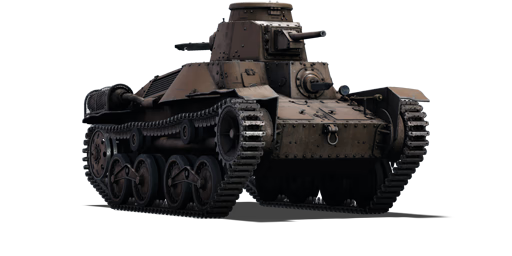
| − | + | The '''{{Specs|name}}''' ({{Annotation|九五式軽戦車「ハ号」|Kyūgo-Shiki Kei-Sensha [Ha-Gō]}}) was developed in response to the limitations of the [[I-Go Ko|Type 89 I-Go]], which became evident as it could not keep pace with motorized infantry moving at 40 km/h. Consequently, it failed to fulfil its role as a "light tank," as it had to cover long distances separately by train, akin to other heavy equipment. The primary goal was to ensure that the new tank could match the speed of motorized infantry, facilitating their combined mobility. By 1935, when the design was finalized, the Ha-Go would assume the role of the Army's primary tank until the development of the Chi-Ha. Due to its lightweight and cost-effective design, the Ha-Go became Japan's most numerous tank built during the war. | |
| − | {{ | + | |
| − | + | Introduced in [[Update 1.65 "Way of the Samurai"]] along with the initial Japanese Ground Forces Tree, the Ha-Go is a small yet nimble tank, serving as a primary flanking support vehicle to assist larger tanks in advancing. However, due to its limited armour, typical of early Japanese tanks, it can be easily penetrated by cannons and autocannons. To make the most of the Ha-Go's capabilities, it is recommended to use its gun depression by hiding the hull behind terrain and obstacles while exposing only the turret to the enemy. | |
| + | |||
| + | The {{PAGENAME}} was removed from its reserve status and hidden from the main tech tree during [[Update 1.85 "Supersonic"]] after the ammo update, but becomes unlockable after reaching rank II Japanese ground vehicles. | ||
== General info == | == General info == | ||
=== Survivability and armour === | === Survivability and armour === | ||
| − | <!--''Describe armour protection. Note the most well protected and key weak areas. Appreciate the layout of modules as well as the number and location of crew members. Is the level of armour protection sufficient, is the placement of modules | + | {{Specs-Tank-Armour}} |
| + | <!-- ''Describe armour protection. Note the most well protected and key weak areas. Appreciate the layout of modules as well as the number and location of crew members. Is the level of armour protection sufficient, is the placement of modules helpful for survival in combat? If necessary use a visual template to indicate the most secure and weak zones of the armour.'' --> | ||
| + | [[File:Ha-Go first prototype under public domain .jpg|right|300px|thumb|3/4 front view and 3/4 rear view of the '''{{PAGENAME}}''' light tank.]] | ||
| − | + | '''Armour type:''' | |
| − | '''Armour | ||
* Rolled homogeneous armour | * Rolled homogeneous armour | ||
| Line 20: | Line 34: | ||
! Armour !! Front !! Sides !! Rear !! Roof | ! Armour !! Front !! Sides !! Rear !! Roof | ||
|- | |- | ||
| − | | Hull || | + | | Hull || 12 mm ''Front plate'' <br> 9 mm (73°) ''Front glacis'' <br> 12 mm (17°) ''Joint plate'' <br> 9 mm (69°) ''Lower glacis'' || 12 mm || 10 mm || 9 mm ''Front'' <br> 6 mm ''Rear'' |
|- | |- | ||
| − | | Turret || | + | | Turret || 12 mm ''Turret front'' <br> 30 mm ''Gun mantlet'' || 12 mm || 12 mm || 12 mm |
|- | |- | ||
| − | ! Armour !! Sides !! Roof | + | ! Armour !! Sides !! Roof |
|- | |- | ||
| − | | Cupola || | + | | Cupola || 12 mm || 6 mm |
|} | |} | ||
'''Notes:''' | '''Notes:''' | ||
| − | *Suspension wheels and tracks are both 15 mm thick. | + | * Suspension wheels and tracks are both 15 mm thick. |
=== Mobility === | === Mobility === | ||
| − | <!--''Write about the mobility of the ground vehicle. Estimate the specific power and | + | {{Specs-Tank-Mobility}} |
| − | {| | + | <!-- ''Write about the mobility of the ground vehicle. Estimate the specific power and manoeuvrability, as well as the maximum speed forwards and backwards.'' --> |
| − | | | + | |
| − | + | {{tankMobility|abMinHp=130|rbMinHp=106}} | |
| − | + | ||
| − | + | === Modifications and economy === | |
| − | + | {{Specs-Economy}} | |
| − | |||
| − | |||
| − | |||
| − | |||
| − | |||
| − | |||
| − | |||
| − | |||
| − | |||
| − | |||
| − | |||
| − | |||
| − | |||
| − | |||
| − | |||
| − | |||
| − | |||
| − | |||
| − | |||
| − | |||
| − | |||
| − | |||
| − | |||
| − | |||
| − | |||
| − | |||
| − | |||
| − | |||
| − | |||
| − | |||
| − | |||
| − | |||
| − | |||
| − | |||
| − | |||
== Armaments == | == Armaments == | ||
| + | {{Specs-Tank-Armaments}} | ||
=== Main armament === | === Main armament === | ||
| − | <!--''Give the reader information about the characteristics of the main gun. Assess its effectiveness in a battle based on the reloading speed, ballistics and the power of shells. Do not forget about the | + | {{Specs-Tank-Weapon|1}} |
| − | {{main|Type | + | <!-- ''Give the reader information about the characteristics of the main gun. Assess its effectiveness in a battle based on the reloading speed, ballistics and the power of shells. Do not forget about the flexibility of the fire, that is how quickly the cannon can be aimed at the target, open fire on it and aim at another enemy. Add a link to the main article on the gun: <code><nowiki>{{main|Name of the weapon}}</nowiki></code>. Describe in general terms the ammunition available for the main gun. Give advice on how to use them and how to fill the ammunition storage.'' --> |
| + | {{main|Type 94 (37 mm)}} | ||
| − | {| class="wikitable" style="text-align:center" | + | {| class="wikitable" style="text-align:center" width="100%" |
|- | |- | ||
| − | ! colspan=" | + | ! colspan="5" | [[Type 94 (37 mm)|37 mm Type 94]] || colspan="5" | Turret rotation speed (°/s) || colspan="4" | Reloading rate (seconds) |
|- | |- | ||
| − | ! | + | ! Mode !! Capacity !! Vertical !! Horizontal !! Stabilizer |
| − | ! | + | ! Stock !! Upgraded !! Full !! Expert !! Aced |
| − | ! | + | ! Stock !! Full !! Expert !! Aced |
| − | ! | ||
|- | |- | ||
| − | | | + | ! ''Arcade'' |
| + | | rowspan="2" | 119 || rowspan="2" | -15°/+20° || rowspan="2" | ±180° || rowspan="2" | {{Annotation|Shoulder|up to 10 km/h}} || 14.9 || 20.7 || 25.1 || 27.8 || 29.6 || rowspan="2" | 4.29 || rowspan="2" | 3.80 || rowspan="2" | 3.50 || rowspan="2" | 3.30 | ||
|- | |- | ||
| − | ! | + | ! ''Realistic'' |
| − | + | | 9.3 || 11.0 || 13.3 || 14.8 || 15.7 | |
| − | |||
| − | |||
| − | |||
| − | |||
| − | |||
| − | |||
| − | |||
| − | |||
| − | |||
| − | |||
| − | |||
| − | |||
| − | |||
| − | |||
| − | |||
| − | |||
| − | |||
| − | |||
| − | |||
|- | |- | ||
|} | |} | ||
| − | + | ==== Ammunition ==== | |
| − | { | + | {{:Type 94 (37 mm)/Ammunition|Type 94 APHE}} |
| − | |||
| − | |||
| − | |||
| − | |||
| − | |||
| − | |||
| − | |||
| − | |||
| − | |||
| − | |||
| − | |||
| − | |||
| − | |||
| − | |||
| − | |||
| − | |||
| − | |||
| − | |||
| − | { | ||
| − | |||
| − | |||
| − | |||
| − | |||
| − | |||
| − | |||
| − | |||
| − | |||
| − | |||
| − | |||
| − | |||
| − | |||
| − | |||
| − | |||
| − | |||
| − | |||
| − | |||
| − | |||
| − | | Type | ||
| − | |||
| − | |||
| − | |||
| − | |||
| − | + | ==== [[Ammo racks]] ==== | |
| − | [[File: | + | [[File:Ammoracks_{{PAGENAME}}.png|right|thumb|x250px|[[Ammo racks]] of the {{PAGENAME}}]] |
| − | {| class="wikitable | + | <!-- '''Last updated: 2.15.1.70''' --> |
| + | {| class="wikitable" style="text-align:center" | ||
|- | |- | ||
| − | ! | + | ! Full<br>ammo |
| − | ! | + | ! 1st<br>rack empty |
| − | ! | + | ! 2nd<br>rack empty |
| − | ! | + | ! 3rd<br>rack empty |
| − | ! | + | ! 4th<br>rack empty |
| − | ! | + | ! 5th<br>rack empty |
| − | ! | + | ! 6th<br>rack empty |
| + | ! 7th<br>rack empty | ||
| + | ! Visual<br>discrepancy | ||
|- | |- | ||
| − | || ''' | + | | '''119''' || 116 ''(+3)'' || 107 ''(+12)'' || 94 ''(+25)'' || 89 ''(+30)'' || 81 ''(+38)'' || 49 ''(+70)'' || 1 ''(+118)'' || No |
|- | |- | ||
|} | |} | ||
| − | + | Turret & Left empty: 89 ''(+30)'' | |
=== Machine guns === | === Machine guns === | ||
| − | <!--''Offensive and anti-aircraft machine guns not only allow you to fight some aircraft | + | {{Specs-Tank-Weapon|2}} |
| − | {{main|Type | + | <!-- ''Offensive and anti-aircraft machine guns not only allow you to fight some aircraft but also are effective against lightly armoured vehicles. Evaluate machine guns and give recommendations on its use.'' --> |
| + | {{main|Type 97 (7.7 mm)}} | ||
| − | {| class="wikitable" style="text-align:center" | + | {| class="wikitable" style="text-align:center" width="50%" |
|- | |- | ||
| − | ! colspan=" | + | ! colspan="5" | [[Type 97 (7.7 mm)|7.7 mm Type 97]] |
|- | |- | ||
| − | ! | + | ! Mount !! Capacity (Belt) !! Fire rate !! Vertical !! Horizontal |
|- | |- | ||
| − | + | | Hull || 3,000 (20) || 499 || ±22° || ±22° | |
| − | |||
| − | |||
| − | |||
| − | |||
| − | | | ||
|- | |- | ||
|} | |} | ||
| − | == Usage in | + | == Usage in battles == |
| − | <!--''Describe the tactics of playing in the vehicle, the features of using vehicles in the team and advice on tactics. Refrain from creating a "guide" - do not impose a single point of view but give the reader food for thought. Describe the most dangerous enemies and give recommendations on fighting them. If necessary, note the specifics of the game in different modes (AB, RB, SB).''--> | + | <!-- ''Describe the tactics of playing in the vehicle, the features of using vehicles in the team and advice on tactics. Refrain from creating a "guide" - do not impose a single point of view but instead give the reader food for thought. Describe the most dangerous enemies and give recommendations on fighting them. If necessary, note the specifics of the game in different modes (AB, RB, SB).'' --> |
| − | |||
| − | + | As a light tank in a Rank I battle, the best overall tactic is to get the first jump on an enemy since the Ha-Go's gun is able to penetrate most tank's armour, yet everyone else's can also penetrate the Ha-Go. In an offensive, try to attack the enemy from a direction not covered to catch them by surprise, then exploit it by using the Ha-Go's mobility to keep moving around the enemy once it gets close so the enemy could not get an accurate bead on it. In a defensive, hold back and try to cover a single area of contact so the Ha-Go could dispel its fire on any enemy approaching. | |
=== Pros and cons === | === Pros and cons === | ||
| − | <!--'' | + | <!-- ''Summarise and briefly evaluate the vehicle in terms of its characteristics and combat effectiveness. Mark its pros and cons in a bulleted list. Try not to use more than 6 points for each of the characteristics. Avoid using categorical definitions such as "bad", "good" and the like - use substitutions with softer forms such as "inadequate" and "effective".'' --> |
| + | |||
'''Pros:''' | '''Pros:''' | ||
| − | * | + | * Excellent gun depression and elevation |
| − | * | + | * APHE shell with good post-penetration damage |
| − | * | + | * Good top speed (50 km/h on flat surface) |
| − | * | + | * Small silhouette like the [[Panzer II]], easy to hide behind cover |
'''Cons:''' | '''Cons:''' | ||
| − | * | + | * Outdated 37 mm cannon with mediocre penetration, making a lot of tanks impervious to your shells |
| − | * | + | * Weak armour (12.7 mm machine guns are able to knock out the Ha-Go easily) |
| − | * | + | * Reverse speed is 5 km/h on any terrain |
| − | * | + | * Three-man crew which means that the Ha-Go can be destroyed by a single shot, maybe two if lucky |
| − | * | + | * Turns are sluggish at any speed. |
== History == | == History == | ||
| − | <!--''Describe the history of the creation and combat usage of the | + | <!-- ''Describe the history of the creation and combat usage of the vehicle in more detail than in the introduction. If the historical reference turns out to be too long, take it to a separate article, taking a link to the article about the vehicle and adding a block "/History" (example: <nowiki>https://wiki.warthunder.com/(Vehicle-name)/History</nowiki>) and add a link to it here using the <code>main</code> template. Be sure to reference text and sources by using <code><nowiki><ref></ref></nowiki></code>, as well as adding them at the end of the article with <code><nowiki><references /></nowiki></code>. This section may also include the vehicle's dev blog entry (if applicable) and the in-game encyclopedia description (under <code><nowiki>=== In-game description ===</nowiki></code>, also if applicable).'' --> |
===Development=== | ===Development=== | ||
| − | + | The deployment of the first Japanese domestic tank design, the [[I-Go Ko|Type 89 I-Go]], gave the Japanese good insight on the improvement of their armoured force. One of the pressing issues of the Type 89 was that the tank was too slow to keep up with motorized infantry, restricting the operational range or advance of a combined-arm unit to only 40 kilometers. Another tank design being fielded by the Type 89, the Type 92 cavalry tank, had the speed that fixes this problem, but its armour was too thin and only had a heavy machine gun armament. Thus, development started in July 1933 on a tank able to fix these problem, with the specifications that the tank should weigh only 7.7 tons and armed with a 37 mm gun. With the same engine as the Type 89, but half of its weight, the new tank would have a faster road speed.<ref name="ZalogaJapaneseTank">Zaloga Steven. ''Japanese Tanks 1939-1945'' Great Britain: Osprey Publishing Ltd., 2007</ref> | |
| − | The | + | The production of the designs was given to Mitsubishi, with a prototype produced and ready for trials in June 1934. The design was sent to Manchuria and performed cold weather trials in the Independent Mixed Brigade. These trials were positive and the second prototype design was built in June 1935 with improvements based on the trials. With a well-received performance of the design, it was accepted for service in the Imperial Japanese Army as the '''Type 95 Ha-Go''' light tank (Accepted in 1935, Imperial year 2595. 'Ha-Go' name given by Mitsubishi).<ref name="ZalogaJapaneseTank">Zaloga Steven. ''Japanese Tanks 1939-1945'' Great Britain: Osprey Publishing Ltd., 2007</ref> Production lasted from 1936 to 1943, with up to 2,300 tanks produced in the time period, making it the most produced Japanese tank design in World War II. |
===Design=== | ===Design=== | ||
| − | The Type | + | The Type 95 Ha-Go was a light tank weighing roughly 7.7 tons. It had a three-man crew with a turret that only held one person inside. The turret was armed with a 37 mm gun, as well as a machine gun mount on the rear of the turret just like the Type 89. The machine gun armament on the back allowed the commander to simply traverse the turret to use a certain armament for the situation desired. Despite that, the one-man turret meant the commander was overworked. |
| − | The Type | + | The tank used the same engine on the Type 89B, the 120 hp Mitsubishi diesel engine. The suspension on the tank was quite simple, two bogies with wheels suspended on a bell crank with a front sprocket and two return rollers on each side. The two bogies were attached to a brace, connecting the two to fix problems with the pitching that inhibited the tank's driving ability, but the suspension still gave the crew a rough ride when driving on uneven ground. A unique feature on the Type 95 design was that there was an asbestos padding area separating the interior area from the hull armour to protect the crew from burning on hot metal armour and from injury on hitting the hull from the tank's rough driving experience. |
| − | The Type | + | ===Combat usage=== |
| + | The Type 95 was first deployed in the Second Sino-Japanese War. The Type 95s in the theater were generally well-received due to the inferiority of China's anti-tank defenses and their tank forces usually consist of machine gun-armed tanks like the Panzer I and CV33. The Type 95 Ha-Go's first major combat was during the border conflicts between Japan and the Soviet Union during the battles at Khalkhin Gol. The Type 95 made up a good portion of the 4th Tank Regiment in the 1st Tank Corps, alongside [[I-Go Ko|Type 89]]s and Type 94 tankettes. These tanks generally fought against the Soviet [[BT-5]] and [[BT-7]] tanks, which were in the same class as the Ha-Gos, though the Japanese took special note on the 45 mm cannon on the Soviet tanks, which they deemed superior to the Ha-Go 37 mm cannon. The two side exchanged multiple battles and territories, eventually resulting in a ceasefire between the two nations in August 1939. | ||
| − | + | The next major usage of the Type 95 Ha-Go would be in opening stages of World War II when Japan invades the Allied territory after their surprise attack on Pearl Harbor on 7 December 1941. Their first usage was in the Malaya campaign, then Singapore, then the Burma campaign. Despite the British technological superiority over the Japanese with their tank designs in Europe, their self-created concept that tanks were next-to-useless in the Pacific jungles caused them to have a severe shortage of armour in the Pacific in the early stages of the war. The Japanese however, with no experience in jungle warfare, managed to invade with Type 95 alongside [[Chi-Ha|Type 97 mediums]] as their spearhead. The Type 95 would also be involved with America's first tank-to-tank battle during the Battle of the Philippines. Type 95s from the 4th Tank Regiment came across U.S. [[M3 Stuart|M3 Stuarts]] from the 192nd Tank Battalion. Despite the Stuarts being five years newer than the Type 95, the two tanks were deemed very similar performance-wise. In this engagement, the Type 95 managed to spot the U.S. tanks first and open fired, destroying one of the Stuarts in the platoon and the west withdrew under fire. | |
| − | The Type | ||
| − | The | + | The Japanese continued using their Ha-Go in the Pacific Theater all the way until the end of the war. Even when outmatched by the newer American tanks like the [[M4|M4 Shermans]], the lack of any better equipment forced the Japanese Army to play with what they've got left. This led to costly defeats in the Japanese tank units on Tarawa, Saipan, Guam, Peleliu, and Okinawa as the tank units were used in reckless charges or static pillboxes as they were destroyed via tank, cannon, or bazooka fire. |
| − | + | After the war, the remnants of the Japanese Army left behind a huge number of Type 95 Ha-Go in their depot at the occupied territory. This led to a massive amount of tanks being captured and used by the opposing sides of the Chinese Civil War. Another curious user of the captured Japanese tanks were the French, which captured them from Japanese-occupied area in French Indochina. The French used the Japanese tanks alongside French tanks to hastily make units called 'Commando Blindé du Cambodge' to fight in the First Indochina War. | |
| − | + | == Media == | |
| + | <!-- ''Excellent additions to the article would be video guides, screenshots from the game, and photos.'' --> | ||
| − | + | ;Skins | |
| + | * [https://live.warthunder.com/feed/camouflages/?vehicle=jp_type_95_ha_go Skins and camouflages for the {{PAGENAME}} from live.warthunder.com.] | ||
| − | + | ;Videos | |
| − | + | {{Youtube-gallery|jXtjy0Sqgz0|'''Type 95 {{PAGENAME}}, Japanese, Tier-1, Reserve Light Tank''' - ''Angry Nerd Gaming''|LhCsc_rYgA4|'''Tank Chats #50 Ha-Go''' - ''The Tank Museum''}} | |
| − | {{Youtube-gallery| | ||
| − | == | + | == See also == |
| − | < | + | <!--''Links to the articles on the War Thunder Wiki that you think will be useful for the reader, for example:'' |
| + | * ''reference to the series of the vehicles;'' | ||
| + | * ''links to approximate analogues of other nations and research trees.''--> | ||
| − | + | ;Related Development | |
| − | + | * [[Ha-Go Commander]] | |
| − | |||
| − | * | ||
| − | |||
| − | [ | ||
| − | == | + | ;Tanks of comparable role, configuration, and era |
| − | + | * [[File:France flag.png|30px|link=]] [[H.39]] | |
| + | * [[File:Britain flag.png|30px|link=]] [[File:Finland flag.png|30px|link=]] [[Vickers Mk.E]] | ||
| + | * [[File:USSR flag.png|30px|link=]] [[T-26 (Family)]] | ||
| + | * [[File:USA flag.png|30px|link=]] [[M2A4]] / [[M3 Stuart (Family)]] | ||
| + | * [[File:Italy flag.png|30px|link=]] [[M13/40 (Family)]] | ||
| + | * [[File:Germany flag.png|30px|link=]] [[Pz.35(t)]] | ||
| + | == External links == | ||
| + | <!-- ''Paste links to sources and external resources, such as:'' | ||
* ''topic on the official game forum;'' | * ''topic on the official game forum;'' | ||
| − | * ''other literature.'' | + | * ''other literature.'' --> |
| + | |||
| + | * [[wt:en/news/4272-development-newsflash-from-igromir-2016-new-ships-and-first-look-at-japanese-ground-forces-en/|[News] Newsflash from IgroMir 2016! New ships and first look at Japanese Ground Forces! (Type 95 & Type 97 Chi-Ha Kai)]] | ||
| + | * [[wikipedia:Type_95_Ha-Go_light_tank|[Wikipedia] Type 95 Ha-Go light tank]] | ||
| + | * [https://tanks-encyclopedia.com/ww2/jap/Type_95_Ha-Go.php <nowiki>[Tanks Encyclopedia]</nowiki> Type 95 Ha-Go] | ||
| + | * [https://www.militaryfactory.com/armor/detail.asp?armor_id=334 <nowiki>[Military Factory]</nowiki> Type 95 Ha-Go (Ke-Go / Kyu-Go)] | ||
| + | |||
| + | === References === | ||
| + | <references /> | ||
| + | |||
| + | {{TankManufacturer Mitsubishi}} | ||
| + | {{Japan light tanks}} | ||
Latest revision as of 23:50, 25 June 2024
| This page is about the Japanese light tank Ha-Go. For other versions, see Ha-Go (Family). For other uses, see Ha-Go (Disambiguation). |


Contents
Description
The Type 95 Ha-Go (九五式軽戦車「ハ号」) was developed in response to the limitations of the Type 89 I-Go, which became evident as it could not keep pace with motorized infantry moving at 40 km/h. Consequently, it failed to fulfil its role as a "light tank," as it had to cover long distances separately by train, akin to other heavy equipment. The primary goal was to ensure that the new tank could match the speed of motorized infantry, facilitating their combined mobility. By 1935, when the design was finalized, the Ha-Go would assume the role of the Army's primary tank until the development of the Chi-Ha. Due to its lightweight and cost-effective design, the Ha-Go became Japan's most numerous tank built during the war.
Introduced in Update 1.65 "Way of the Samurai" along with the initial Japanese Ground Forces Tree, the Ha-Go is a small yet nimble tank, serving as a primary flanking support vehicle to assist larger tanks in advancing. However, due to its limited armour, typical of early Japanese tanks, it can be easily penetrated by cannons and autocannons. To make the most of the Ha-Go's capabilities, it is recommended to use its gun depression by hiding the hull behind terrain and obstacles while exposing only the turret to the enemy.
The Ha-Go was removed from its reserve status and hidden from the main tech tree during Update 1.85 "Supersonic" after the ammo update, but becomes unlockable after reaching rank II Japanese ground vehicles.
General info
Survivability and armour

Armour type:
- Rolled homogeneous armour
| Armour | Front | Sides | Rear | Roof |
|---|---|---|---|---|
| Hull | 12 mm Front plate 9 mm (73°) Front glacis 12 mm (17°) Joint plate 9 mm (69°) Lower glacis |
12 mm | 10 mm | 9 mm Front 6 mm Rear |
| Turret | 12 mm Turret front 30 mm Gun mantlet |
12 mm | 12 mm | 12 mm |
| Armour | Sides | Roof | ||
| Cupola | 12 mm | 6 mm |
Notes:
- Suspension wheels and tracks are both 15 mm thick.
Mobility
| Game Mode | Max Speed (km/h) | Weight (tons) | Engine power (horsepower) | Power-to-weight ratio (hp/ton) | |||
|---|---|---|---|---|---|---|---|
| Forward | Reverse | Stock | Upgraded | Stock | Upgraded | ||
| Arcade | Expression error: Unexpected * operator. | 130 | Expression error: Unexpected round operator. | __.__ | |||
| Realistic | 106 | Expression error: Unexpected round operator. | __.__ | ||||
Modifications and economy
Armaments
Main armament
| 37 mm Type 94 | Turret rotation speed (°/s) | Reloading rate (seconds) | |||||||||||
|---|---|---|---|---|---|---|---|---|---|---|---|---|---|
| Mode | Capacity | Vertical | Horizontal | Stabilizer | Stock | Upgraded | Full | Expert | Aced | Stock | Full | Expert | Aced |
| Arcade | 119 | -15°/+20° | ±180° | Shoulder | 14.9 | 20.7 | 25.1 | 27.8 | 29.6 | 4.29 | 3.80 | 3.50 | 3.30 |
| Realistic | 9.3 | 11.0 | 13.3 | 14.8 | 15.7 | ||||||||
Ammunition
| Penetration statistics | |||||||
|---|---|---|---|---|---|---|---|
| Ammunition | Type of warhead |
Penetration @ 0° Angle of Attack (mm) | |||||
| 10 m | 100 m | 500 m | 1,000 m | 1,500 m | 2,000 m | ||
| Type 94 APHE | APHE | 34 | 33 | 27 | 22 | 17 | 14 |
| Shell details | ||||||||||||
|---|---|---|---|---|---|---|---|---|---|---|---|---|
| Ammunition | Type of warhead |
Velocity (m/s) |
Projectile mass (kg) |
Fuse delay (m) |
Fuse sensitivity (mm) |
Explosive mass (TNT equivalent) (g) |
Ricochet | |||||
| 0% | 50% | 100% | ||||||||||
| Type 94 APHE | APHE | 575 | 0.7 | 1.2 | 9 | 11 | 47° | 60° | 65° | |||
Ammo racks

| Full ammo |
1st rack empty |
2nd rack empty |
3rd rack empty |
4th rack empty |
5th rack empty |
6th rack empty |
7th rack empty |
Visual discrepancy |
|---|---|---|---|---|---|---|---|---|
| 119 | 116 (+3) | 107 (+12) | 94 (+25) | 89 (+30) | 81 (+38) | 49 (+70) | 1 (+118) | No |
Turret & Left empty: 89 (+30)
Machine guns
| 7.7 mm Type 97 | ||||
|---|---|---|---|---|
| Mount | Capacity (Belt) | Fire rate | Vertical | Horizontal |
| Hull | 3,000 (20) | 499 | ±22° | ±22° |
Usage in battles
As a light tank in a Rank I battle, the best overall tactic is to get the first jump on an enemy since the Ha-Go's gun is able to penetrate most tank's armour, yet everyone else's can also penetrate the Ha-Go. In an offensive, try to attack the enemy from a direction not covered to catch them by surprise, then exploit it by using the Ha-Go's mobility to keep moving around the enemy once it gets close so the enemy could not get an accurate bead on it. In a defensive, hold back and try to cover a single area of contact so the Ha-Go could dispel its fire on any enemy approaching.
Pros and cons
Pros:
- Excellent gun depression and elevation
- APHE shell with good post-penetration damage
- Good top speed (50 km/h on flat surface)
- Small silhouette like the Panzer II, easy to hide behind cover
Cons:
- Outdated 37 mm cannon with mediocre penetration, making a lot of tanks impervious to your shells
- Weak armour (12.7 mm machine guns are able to knock out the Ha-Go easily)
- Reverse speed is 5 km/h on any terrain
- Three-man crew which means that the Ha-Go can be destroyed by a single shot, maybe two if lucky
- Turns are sluggish at any speed.
History
Development
The deployment of the first Japanese domestic tank design, the Type 89 I-Go, gave the Japanese good insight on the improvement of their armoured force. One of the pressing issues of the Type 89 was that the tank was too slow to keep up with motorized infantry, restricting the operational range or advance of a combined-arm unit to only 40 kilometers. Another tank design being fielded by the Type 89, the Type 92 cavalry tank, had the speed that fixes this problem, but its armour was too thin and only had a heavy machine gun armament. Thus, development started in July 1933 on a tank able to fix these problem, with the specifications that the tank should weigh only 7.7 tons and armed with a 37 mm gun. With the same engine as the Type 89, but half of its weight, the new tank would have a faster road speed.[1]
The production of the designs was given to Mitsubishi, with a prototype produced and ready for trials in June 1934. The design was sent to Manchuria and performed cold weather trials in the Independent Mixed Brigade. These trials were positive and the second prototype design was built in June 1935 with improvements based on the trials. With a well-received performance of the design, it was accepted for service in the Imperial Japanese Army as the Type 95 Ha-Go light tank (Accepted in 1935, Imperial year 2595. 'Ha-Go' name given by Mitsubishi).[1] Production lasted from 1936 to 1943, with up to 2,300 tanks produced in the time period, making it the most produced Japanese tank design in World War II.
Design
The Type 95 Ha-Go was a light tank weighing roughly 7.7 tons. It had a three-man crew with a turret that only held one person inside. The turret was armed with a 37 mm gun, as well as a machine gun mount on the rear of the turret just like the Type 89. The machine gun armament on the back allowed the commander to simply traverse the turret to use a certain armament for the situation desired. Despite that, the one-man turret meant the commander was overworked.
The tank used the same engine on the Type 89B, the 120 hp Mitsubishi diesel engine. The suspension on the tank was quite simple, two bogies with wheels suspended on a bell crank with a front sprocket and two return rollers on each side. The two bogies were attached to a brace, connecting the two to fix problems with the pitching that inhibited the tank's driving ability, but the suspension still gave the crew a rough ride when driving on uneven ground. A unique feature on the Type 95 design was that there was an asbestos padding area separating the interior area from the hull armour to protect the crew from burning on hot metal armour and from injury on hitting the hull from the tank's rough driving experience.
Combat usage
The Type 95 was first deployed in the Second Sino-Japanese War. The Type 95s in the theater were generally well-received due to the inferiority of China's anti-tank defenses and their tank forces usually consist of machine gun-armed tanks like the Panzer I and CV33. The Type 95 Ha-Go's first major combat was during the border conflicts between Japan and the Soviet Union during the battles at Khalkhin Gol. The Type 95 made up a good portion of the 4th Tank Regiment in the 1st Tank Corps, alongside Type 89s and Type 94 tankettes. These tanks generally fought against the Soviet BT-5 and BT-7 tanks, which were in the same class as the Ha-Gos, though the Japanese took special note on the 45 mm cannon on the Soviet tanks, which they deemed superior to the Ha-Go 37 mm cannon. The two side exchanged multiple battles and territories, eventually resulting in a ceasefire between the two nations in August 1939.
The next major usage of the Type 95 Ha-Go would be in opening stages of World War II when Japan invades the Allied territory after their surprise attack on Pearl Harbor on 7 December 1941. Their first usage was in the Malaya campaign, then Singapore, then the Burma campaign. Despite the British technological superiority over the Japanese with their tank designs in Europe, their self-created concept that tanks were next-to-useless in the Pacific jungles caused them to have a severe shortage of armour in the Pacific in the early stages of the war. The Japanese however, with no experience in jungle warfare, managed to invade with Type 95 alongside Type 97 mediums as their spearhead. The Type 95 would also be involved with America's first tank-to-tank battle during the Battle of the Philippines. Type 95s from the 4th Tank Regiment came across U.S. M3 Stuarts from the 192nd Tank Battalion. Despite the Stuarts being five years newer than the Type 95, the two tanks were deemed very similar performance-wise. In this engagement, the Type 95 managed to spot the U.S. tanks first and open fired, destroying one of the Stuarts in the platoon and the west withdrew under fire.
The Japanese continued using their Ha-Go in the Pacific Theater all the way until the end of the war. Even when outmatched by the newer American tanks like the M4 Shermans, the lack of any better equipment forced the Japanese Army to play with what they've got left. This led to costly defeats in the Japanese tank units on Tarawa, Saipan, Guam, Peleliu, and Okinawa as the tank units were used in reckless charges or static pillboxes as they were destroyed via tank, cannon, or bazooka fire.
After the war, the remnants of the Japanese Army left behind a huge number of Type 95 Ha-Go in their depot at the occupied territory. This led to a massive amount of tanks being captured and used by the opposing sides of the Chinese Civil War. Another curious user of the captured Japanese tanks were the French, which captured them from Japanese-occupied area in French Indochina. The French used the Japanese tanks alongside French tanks to hastily make units called 'Commando Blindé du Cambodge' to fight in the First Indochina War.
Media
- Skins
- Videos
See also
- Related Development
- Tanks of comparable role, configuration, and era


External links
- [News] Newsflash from IgroMir 2016! New ships and first look at Japanese Ground Forces! (Type 95 & Type 97 Chi-Ha Kai)
- [Wikipedia] Type 95 Ha-Go light tank
- [Tanks Encyclopedia] Type 95 Ha-Go
- [Military Factory] Type 95 Ha-Go (Ke-Go / Kyu-Go)
References
| Mitsubishi Heavy Industries (三菱重工業株式会社) | |
|---|---|
| Light Tanks | |
| Type 95 | Ha-Go · Ha-Go Commander |
| Medium Tanks | |
| Type 89 | I-Go Ko |
| Type 97 | Chi-Ha · Chi-Ha Kai |
| Type 1 | Chi-He · Chi-He (5th Regiment) |
| Type 3 | Chi-Nu · Chi-Nu II |
| Type 4 | Chi-To · Chi-To Late |
| Type 5 | Chi-Ri II |
| SPGs | |
| Chi-Ha Derived | Ho-Ro |
| Chi-He Derived | Ho-I |
| Chi-Ri Derived | Ho-Ri Prototype · Ho-Ri Production |
| Other | Na-To · Ro-Go Exp. |
| Captured | ␗Chi-Ha · ␗Chi-Ha Kai |
| Note | Most tank designs would be contracted by the Army Technical Bureau to Mitsubishi |
| See also | Mitsubishi Heavy Industries Ltd. (Post-War) |
| Japan light tanks | |
|---|---|
| Type 89 | I-Go Ko |
| Type 95 | Ha-Go · Ha-Go Commander |
| Type 98 | Ke-Ni |
| Other | Ka-Mi |
| IFV | Type 89 |
| RCV | Type 87 RCV (P) · Type 87 RCV · RCV (P) |
| MCV | Type 16 (P) · Type 16 (FPS) · Type 16 |
| USA | ▅M24 · ▅M41A1 |