Difference between pages "P-47D-27 (USSR)" and "LaGG-3-34"
(Edits) |
(→Description) |
||
| Line 1: | Line 1: | ||
{{About | {{About | ||
| − | | about = | + | | about = gift Soviet fighter '''{{PAGENAME}}''' |
| usage = other versions | | usage = other versions | ||
| − | | link = | + | | link = LaGG-3 (Family) |
}} | }} | ||
{{Specs-Card | {{Specs-Card | ||
| − | |code= | + | |code=lagg-3-34 |
|images={{Specs-Card-Image|GarageImage_{{PAGENAME}}.jpg}} | |images={{Specs-Card-Image|GarageImage_{{PAGENAME}}.jpg}} | ||
| + | |market=LaGG-3-34 (USSR) | ||
}} | }} | ||
== Description == | == Description == | ||
<!-- ''In the description, the first part should be about the history of and the creation and combat usage of the aircraft, as well as its key features. In the second part, tell the reader about the aircraft in the game. Insert a screenshot of the vehicle, so that if the novice player does not remember the vehicle by name, he will immediately understand what kind of vehicle the article is talking about.'' --> | <!-- ''In the description, the first part should be about the history of and the creation and combat usage of the aircraft, as well as its key features. In the second part, tell the reader about the aircraft in the game. Insert a screenshot of the vehicle, so that if the novice player does not remember the vehicle by name, he will immediately understand what kind of vehicle the article is talking about.'' --> | ||
| − | The '''{{Specs|name}}''' | + | The '''{{Specs|name}}''' was a Soviet fighter aircraft, a variant of the LaGG-3 fighter. The 20 mm ShVAK shooting through the propeller hub was replaced by 37 mm NS-37 cannon, allowing the aircraft to be used in tank busting roles similar to the later [[Yak-9T]]. 40 of the LaGGs were sent to Stalingrad in 1942 for evaluation. However, the installation of the gun shifted center of gravity forward and caused stability issues, while the recoil from the cannon caused engine damage such as oil leaks and ruptures of piping. The aircraft was not developed further. |
| − | The | + | The LaGG-3-34 was introduced in [[Update_1.41#19.06.2014_-_1.41.27.12|Update 1.41.27]] through the [[wt:en/news/668--en|LaGG-3-34 starter pack]]. From 2014 to 2019, it was purchasable in the store as part of several premium packs but was removed at the beginning of 2019. It was also made available in parallel in the [[Warbonds]] shop as a random prize of the Vehicle battle trophy from [[wt:en/news/5738-news-how-can-you-get-premium-vehicles-warbonds-en|September 2018]] to March 2019 and from [[wt:en/news/6605-news-premium-vehicles-for-warbonds-until-the-31st-of-march-en|March 2020]] to October 2020. The LaGG-3-34 makes for perfect CAS aircraft due to its 37 mm cannon into ground battles, as well as as a fighter capable of defending itself. The LaGG fulfils the same role of the later Yak-9T although at a lower battle rating, as well as with slightly worse performance more comparable to the early Yak-9. |
== General info == | == General info == | ||
| Line 22: | Line 23: | ||
{| class="wikitable" style="text-align:center" width="70%" | {| class="wikitable" style="text-align:center" width="70%" | ||
! rowspan="2" | Characteristics | ! rowspan="2" | Characteristics | ||
| − | ! colspan="2" | Max Speed<br>(km/h at | + | ! colspan="2" | Max Speed<br>(km/h at 3,700 m) |
! rowspan="2" | Max altitude<br>(metres) | ! rowspan="2" | Max altitude<br>(metres) | ||
! colspan="2" | Turn time<br>(seconds) | ! colspan="2" | Turn time<br>(seconds) | ||
| Line 31: | Line 32: | ||
|- | |- | ||
! Stock | ! Stock | ||
| − | | | + | | 542 || 527 || rowspan="2" | {{Specs|ceiling}} || 24.1 || 25.0 || 11.5 || 11.4 || rowspan="2" | 450 |
|- | |- | ||
! Upgraded | ! Upgraded | ||
| − | | | + | | 579 || 560 || 22.0 || 23.0 || 16.3 || 13.8 |
|- | |- | ||
|} | |} | ||
| Line 60: | Line 61: | ||
! Combat !! Take-off !! Landing !! + !! - | ! Combat !! Take-off !! Landing !! + !! - | ||
|- | |- | ||
| − | | {{Specs|destruction|body}} || {{Specs|destruction|gear}} || | + | | 700 <!-- {{Specs|destruction|body}} --> || {{Specs|destruction|gear}} || 440 || 414 || 280 || ~12 || ~9 |
|- | |- | ||
|} | |} | ||
| Line 70: | Line 71: | ||
! Ailerons !! Rudder !! Elevators !! Radiator | ! Ailerons !! Rudder !! Elevators !! Radiator | ||
|- | |- | ||
| − | | < | + | | < 380 || < 380 || < 380 || > 323 |
|- | |- | ||
|} | |} | ||
| Line 76: | Line 77: | ||
=== Survivability and armour === | === Survivability and armour === | ||
{{Specs-Avia-Armour}} | {{Specs-Avia-Armour}} | ||
| − | + | ''Examine the survivability of the aircraft. Note how vulnerable the structure is and how secure the pilot is, whether the fuel tanks are armoured, etc. Describe the armour, if there is any, and also mention the vulnerability of other critical aircraft systems.'' | |
| − | |||
| − | |||
| − | |||
| − | |||
=== Modifications and economy === | === Modifications and economy === | ||
| Line 90: | Line 87: | ||
{{Specs-Avia-Offensive}} | {{Specs-Avia-Offensive}} | ||
<!-- ''Describe the offensive armament of the aircraft, if any. Describe how effective the cannons and machine guns are in a battle, and also what belts or drums are better to use. If there is no offensive weaponry, delete this subsection.'' --> | <!-- ''Describe the offensive armament of the aircraft, if any. Describe how effective the cannons and machine guns are in a battle, and also what belts or drums are better to use. If there is no offensive weaponry, delete this subsection.'' --> | ||
| − | {{main| | + | {{main|NS-37 (37 mm)|Berezin UB (12.7 mm)}} |
The '''''{{PAGENAME}}''''' is armed with: | The '''''{{PAGENAME}}''''' is armed with: | ||
| − | * | + | * 1 x 37 mm NS-37 cannon, nose-mounted (36 rpg) |
| − | + | * 1 x 12.7 mm Berezin UB machine gun, nose-mounted (200 rpg) | |
| − | |||
| − | |||
| − | |||
| − | |||
| − | |||
| − | |||
| − | |||
| − | |||
| − | * 1 x | ||
| − | |||
| − | |||
== Usage in battles == | == Usage in battles == | ||
<!-- ''Describe the tactics of playing in the aircraft, the features of using aircraft in a team and advice on tactics. Refrain from creating a "guide" - do not impose a single point of view, but instead, give the reader food for thought. Examine the most dangerous enemies and give recommendations on fighting them. If necessary, note the specifics of the game in different modes (AB, RB, SB).'' --> | <!-- ''Describe the tactics of playing in the aircraft, the features of using aircraft in a team and advice on tactics. Refrain from creating a "guide" - do not impose a single point of view, but instead, give the reader food for thought. Examine the most dangerous enemies and give recommendations on fighting them. If necessary, note the specifics of the game in different modes (AB, RB, SB).'' --> | ||
| − | |||
| − | |||
| − | |||
| − | |||
| − | |||
| − | |||
| − | |||
| − | |||
| − | |||
| − | |||
| − | |||
| − | |||
| − | |||
| − | |||
| − | |||
| − | |||
| − | |||
| − | |||
| − | |||
| − | |||
| − | |||
| − | |||
| − | |||
| − | |||
| − | |||
| − | ' | + | ;Combat tactics |
| + | The LaGG-3-34 is very powerful against attacker/bomber aircraft, and though the NS-37 isn't the most accurate, they are large targets you can usually take them out with relative ease. As such it is best to stay at high altitudes in order to dive on enemy bombers. The NS-37 is the same cannon as in the Yak-9T, so players experienced with that aircraft will feel right at home in this aircraft. The LaGG-3-34 can also provide ground support when equipped with AP rounds, although the slight inaccuracy with the cannon can make it difficult at long ranges against tanks. | ||
| − | + | The Berezin 12.7 mm machine should really always have Air target rounds since it's not very useful when attacking ground targets. Even then it's best used to line up shots for the NS-37: fire a few bursts with just the 12.7 mm until you hit the target, then shoot one or two rounds of 37 mm. This should be all you need to bring down an aircraft at your battle rating. | |
| − | + | One interesting effect of this plane is that many enemies will try to head-on you since they will not recognize the aircraft tag and confuse it with a LaGG-3-35. These battles are easily winnable with the 37 mm cannon, as it has the ability to knock out enemy fighters with a single shot. | |
| − | + | ;Specific enemies worth noting | |
| + | Due to the added weight of the large cannon, this plane has excellent energy retention in the vertical but quickly bleeds it while turn fighting. It struggles to keep pace after it loses speed, so players must be wary of any engagements that take place in the horizontal. Many American aircraft at this tier have the ability to out-turn you with flaps, so remain vigilant and do not be lulled into lower altitudes. German and Italian fighters will outperform you at altitude, so it is best to engage them at some distance with the 37 mm. | ||
| − | + | ;Counter-tactics | |
| − | + | Many people will head-on this aircraft if you use it as a fighter instead of an interceptor. Fire off a few shots with the 37 at .6 km, and then pull up or down to avoid their fire. Any damage to your engine can be fatal, as the glide characteristics of this modification of the LaGG are not very good. Bombers are wary of all aircraft approaching them. As such, coming from directly behind is not advisable. Blasting a wingtip off of a bomber from above is an excellent way to avoid being hit by most gunners. | |
| − | |||
| − | |||
| − | |||
| − | |||
| − | |||
| − | |||
| − | |||
| − | |||
| − | |||
| − | |||
| − | |||
| − | |||
| − | |||
=== Manual Engine Control === | === Manual Engine Control === | ||
| Line 173: | Line 123: | ||
! Oil !! Water !! Type | ! Oil !! Water !! Type | ||
|- | |- | ||
| − | | Controllable || Controllable<br> | + | | Controllable || Controllable<br>Not auto controlled || Controllable<br>Auto control available || Controllable<br>Auto control available || Separate || Controllable<br>2 gears || Not controllable |
|- | |- | ||
|} | |} | ||
| Line 182: | Line 132: | ||
'''Pros:''' | '''Pros:''' | ||
| − | * | + | * Very large and powerful nose-mounted gun for rank II |
| − | * | + | * NS-37 gets HEFI-T* rounds which can take out enemy planes with a single hit |
| − | * | + | * Good manoeuvrability at its typical speeds |
| − | * | + | * Has access to 36 shells for the 37 mm gun (6 more than the [[Yak-9T]]) |
| − | * | + | * Semi-rare variation of LaGG-3 to see in the battles, a nasty surprise to the enemy |
| − | * | + | * Heavy weight allows for excellent speed gain in dives, be careful with lock up |
'''Cons:''' | '''Cons:''' | ||
| − | * | + | * NS-37 isn't very accurate when firing long bursts |
| − | + | * Low ammo count for the Berezin UB 12.7 mm heavy machine gun | |
| − | * | + | * Poor cockpit rear view, a recurring problem with LaGG-3s |
| − | * | + | * Easily outmanoeuvred by British and Japanese fighters of same rank |
| − | * | + | * Poor manoeuvrability at low speeds and suffers some locking up at high speeds |
| − | * | + | * Due to the weight it has some issues with energy retention |
| − | * | ||
== History == | == History == | ||
<!-- ''Describe the history of the creation and combat usage of the aircraft in more detail than in the introduction. If the historical reference turns out to be too long, take it to a separate article, taking a link to the article about the vehicle and adding a block "/History" (example: <nowiki>https://wiki.warthunder.com/(Vehicle-name)/History</nowiki>) and add a link to it here using the <code>main</code> template. Be sure to reference text and sources by using <code><nowiki><ref></ref></nowiki></code>, as well as adding them at the end of the article with <code><nowiki><references /></nowiki></code>. This section may also include the vehicle's dev blog entry (if applicable) and the in-game encyclopedia description (under <code><nowiki>=== In-game description ===</nowiki></code>, also if applicable).'' --> | <!-- ''Describe the history of the creation and combat usage of the aircraft in more detail than in the introduction. If the historical reference turns out to be too long, take it to a separate article, taking a link to the article about the vehicle and adding a block "/History" (example: <nowiki>https://wiki.warthunder.com/(Vehicle-name)/History</nowiki>) and add a link to it here using the <code>main</code> template. Be sure to reference text and sources by using <code><nowiki><ref></ref></nowiki></code>, as well as adding them at the end of the article with <code><nowiki><references /></nowiki></code>. This section may also include the vehicle's dev blog entry (if applicable) and the in-game encyclopedia description (under <code><nowiki>=== In-game description ===</nowiki></code>, also if applicable).'' --> | ||
| − | {{ | + | These planes were used during the battle of Stalingrad with great success against enemy bombers. However, recoil and centre of gravity issues plagued the plane, and the extra weight caused them to suffer from worse performance than other LaGG-3s, which were already somewhat underpowered. The fact that the Il-2s were considered just as effective against ground targets, and the test flight of the Yak-9T which proved a much better platform for the NS-37 gun, spelt the end to this variant of the LaGG-3 with only 40 being produced. |
| + | |||
| + | {{break}} | ||
| + | {{Navigation-Start|{{Annotation|Archive of the in-game description|An archive of the historical description of the vehicle that was presented in-game prior to Update 1.55 'Royal Armour'}}}} | ||
| + | {{Navigation-First-Simple-Line}} | ||
| + | In as early as 1940, M.I. Gudkov had the idea of installing large-calibre cannons on the LaGG-3 in order to combat enemy armoured vehicles. In the spring of 1941, Y.G. Taubin and B.G. Shpitalny began to develop a model of the fighter equipped with 37 mm cannons. | ||
| − | The | + | But development was put toward an anti-tank model of the LaGG-3 (the series 34) with the Nudelman-Suranov NS-37 engine-mounted 37 mm cannon. The NS-37 cannon was installed in the cavity between the engine cylinders instead of the 20 mm ShVAK cannon. The NS-37 cannon's barrel extended significantly beyond the propeller spinner, and was installed in place of the propeller's lengthened hollow shaft with a ratchet. |
| + | |||
| + | This meant that the plane's armament consisted of a 37 mm Nudelman-Suranov NS-37 cannon with 12 shells and a 12.7 mm synchronized Berezina UBS machine gun with 200 rounds, installed in the nose section of the fuselage above the engine and to the left. | ||
| + | |||
| + | Wing-mounted bomb racks were not installed. Automatic slats were installed on the wing panels to improve the plane's runway characteristics and manoeuvrability at low flight speeds. | ||
| + | |||
| + | The anti-tank LaGG-3 with its NS-37 cannon successfully passed state testing, but it took until 30 December 1942 for the military to adopt the cannon itself. Nonetheless, aircraft plant No. 31 in Tbilisi produced the LaGG-3 Series 34 in the autumn of 1942. According to various estimates, between 40 and 65 LaGG-3 Series 34 planes were built. | ||
| + | |||
| + | Planes of this model saw successful use in combat at Stalingrad. Firing from the 37 mm cannon did not shake the plane, and accordingly, did not affect firing accuracy, which was particularly important in battles against armoured vehicles. | ||
| + | |||
| + | But the 37 mm NS-37 cannon significantly increased the plane's weight and affected its center of gravity, which seriously reduced its flight characteristics. In addition, the plane's structure poorly withstood the cannon's strong recoil. Further production of this model was stopped in connection with the unacceptable drop in its flight characteristics. | ||
| + | {{Navigation-End}} | ||
== Media == | == Media == | ||
| Line 209: | Line 174: | ||
;Skins | ;Skins | ||
| + | * [https://live.warthunder.com/feed/camouflages/?vehicle=lagg-3-34 Skins and camouflages for the {{PAGENAME}} from live.warthunder.com.] | ||
| − | + | ;Videos | |
| + | {{Youtube-gallery|PJfDg4zfiyw|'''The Lagg-3-34''' - ''TheEuropeanCanadian''|O_12HQIrs7Q|'''Ace Game LaGG-3-34 [Rare Plane Gameplay]''' - ''BaconGaming''}} | ||
== See also == | == See also == | ||
''Links to the articles on the War Thunder Wiki that you think will be useful for the reader, for example:'' | ''Links to the articles on the War Thunder Wiki that you think will be useful for the reader, for example:'' | ||
| − | |||
* ''reference to the series of the aircraft;'' | * ''reference to the series of the aircraft;'' | ||
* ''links to approximate analogues of other nations and research trees.'' | * ''links to approximate analogues of other nations and research trees.'' | ||
== External links == | == External links == | ||
| − | ''Paste links to sources and external resources, such as:'' | + | <!-- ''Paste links to sources and external resources, such as:'' |
| + | * ''topic on the official game forum;'' | ||
| + | * ''other literature.'' --> | ||
| − | * | + | * [https://forum.warthunder.com/index.php?/topic/179340-lavochkin-gorbunov-gudkov-lagg-3-series-34/ Official data sheet - more details about the performance] |
| − | * | + | * [http://web.archive.org/web/20161217121809/http://mig3.sovietwarplanes.com/lagg3/lagg3-37/lagg3-37.htm <nowiki>[Soviet Warplanes]</nowiki> LaGG-3s with 37 mm guns] |
| + | * [http://wio.ru/tacftr/lag.htm <nowiki>[War Is Over]</nowiki> Lavochkin piston fighters] | ||
| − | {{AirManufacturer | + | {{AirManufacturer Lavochkin}} |
{{USSR fighters}} | {{USSR fighters}} | ||
{{USSR premium aircraft}} | {{USSR premium aircraft}} | ||
Latest revision as of 10:43, 25 May 2024
| This page is about the gift Soviet fighter LaGG-3-34. For other versions, see LaGG-3 (Family). |

Contents
Description
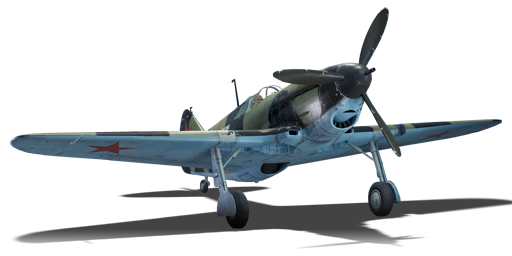
The LaGG-3-34 was a Soviet fighter aircraft, a variant of the LaGG-3 fighter. The 20 mm ShVAK shooting through the propeller hub was replaced by 37 mm NS-37 cannon, allowing the aircraft to be used in tank busting roles similar to the later Yak-9T. 40 of the LaGGs were sent to Stalingrad in 1942 for evaluation. However, the installation of the gun shifted center of gravity forward and caused stability issues, while the recoil from the cannon caused engine damage such as oil leaks and ruptures of piping. The aircraft was not developed further.
The LaGG-3-34 was introduced in Update 1.41.27 through the LaGG-3-34 starter pack. From 2014 to 2019, it was purchasable in the store as part of several premium packs but was removed at the beginning of 2019. It was also made available in parallel in the Warbonds shop as a random prize of the Vehicle battle trophy from September 2018 to March 2019 and from March 2020 to October 2020. The LaGG-3-34 makes for perfect CAS aircraft due to its 37 mm cannon into ground battles, as well as as a fighter capable of defending itself. The LaGG fulfils the same role of the later Yak-9T although at a lower battle rating, as well as with slightly worse performance more comparable to the early Yak-9.
General info
Flight performance
| Characteristics | Max Speed (km/h at 3,700 m) |
Max altitude (metres) |
Turn time (seconds) |
Rate of climb (metres/second) |
Take-off run (metres) | |||
|---|---|---|---|---|---|---|---|---|
| AB | RB | AB | RB | AB | RB | |||
| Stock | 542 | 527 | 24.1 | 25.0 | 11.5 | 11.4 | 450 | |
| Upgraded | 579 | 560 | 22.0 | 23.0 | 16.3 | 13.8 | ||
Details
| Features | ||||
|---|---|---|---|---|
| Combat flaps | Take-off flaps | Landing flaps | Air brakes | Arrestor gear |
| ✓ | ✓ | ✓ | X | X |
| Limits | ||||||
|---|---|---|---|---|---|---|
| Wings (km/h) | Gear (km/h) | Flaps (km/h) | Max Static G | |||
| Combat | Take-off | Landing | + | - | ||
| 700 | 440 | 414 | 280 | ~12 | ~9 | |
| Optimal velocities (km/h) | |||
|---|---|---|---|
| Ailerons | Rudder | Elevators | Radiator |
| < 380 | < 380 | < 380 | > 323 |
Survivability and armour
Examine the survivability of the aircraft. Note how vulnerable the structure is and how secure the pilot is, whether the fuel tanks are armoured, etc. Describe the armour, if there is any, and also mention the vulnerability of other critical aircraft systems.
Modifications and economy
Armaments
Offensive armament
The LaGG-3-34 is armed with:
- 1 x 37 mm NS-37 cannon, nose-mounted (36 rpg)
- 1 x 12.7 mm Berezin UB machine gun, nose-mounted (200 rpg)
Usage in battles
- Combat tactics
The LaGG-3-34 is very powerful against attacker/bomber aircraft, and though the NS-37 isn't the most accurate, they are large targets you can usually take them out with relative ease. As such it is best to stay at high altitudes in order to dive on enemy bombers. The NS-37 is the same cannon as in the Yak-9T, so players experienced with that aircraft will feel right at home in this aircraft. The LaGG-3-34 can also provide ground support when equipped with AP rounds, although the slight inaccuracy with the cannon can make it difficult at long ranges against tanks.
The Berezin 12.7 mm machine should really always have Air target rounds since it's not very useful when attacking ground targets. Even then it's best used to line up shots for the NS-37: fire a few bursts with just the 12.7 mm until you hit the target, then shoot one or two rounds of 37 mm. This should be all you need to bring down an aircraft at your battle rating.
One interesting effect of this plane is that many enemies will try to head-on you since they will not recognize the aircraft tag and confuse it with a LaGG-3-35. These battles are easily winnable with the 37 mm cannon, as it has the ability to knock out enemy fighters with a single shot.
- Specific enemies worth noting
Due to the added weight of the large cannon, this plane has excellent energy retention in the vertical but quickly bleeds it while turn fighting. It struggles to keep pace after it loses speed, so players must be wary of any engagements that take place in the horizontal. Many American aircraft at this tier have the ability to out-turn you with flaps, so remain vigilant and do not be lulled into lower altitudes. German and Italian fighters will outperform you at altitude, so it is best to engage them at some distance with the 37 mm.
- Counter-tactics
Many people will head-on this aircraft if you use it as a fighter instead of an interceptor. Fire off a few shots with the 37 at .6 km, and then pull up or down to avoid their fire. Any damage to your engine can be fatal, as the glide characteristics of this modification of the LaGG are not very good. Bombers are wary of all aircraft approaching them. As such, coming from directly behind is not advisable. Blasting a wingtip off of a bomber from above is an excellent way to avoid being hit by most gunners.
Manual Engine Control
| MEC elements | ||||||
|---|---|---|---|---|---|---|
| Mixer | Pitch | Radiator | Supercharger | Turbocharger | ||
| Oil | Water | Type | ||||
| Controllable | Controllable Not auto controlled |
Controllable Auto control available |
Controllable Auto control available |
Separate | Controllable 2 gears |
Not controllable |
Pros and cons
Pros:
- Very large and powerful nose-mounted gun for rank II
- NS-37 gets HEFI-T* rounds which can take out enemy planes with a single hit
- Good manoeuvrability at its typical speeds
- Has access to 36 shells for the 37 mm gun (6 more than the Yak-9T)
- Semi-rare variation of LaGG-3 to see in the battles, a nasty surprise to the enemy
- Heavy weight allows for excellent speed gain in dives, be careful with lock up
Cons:
- NS-37 isn't very accurate when firing long bursts
- Low ammo count for the Berezin UB 12.7 mm heavy machine gun
- Poor cockpit rear view, a recurring problem with LaGG-3s
- Easily outmanoeuvred by British and Japanese fighters of same rank
- Poor manoeuvrability at low speeds and suffers some locking up at high speeds
- Due to the weight it has some issues with energy retention
History
These planes were used during the battle of Stalingrad with great success against enemy bombers. However, recoil and centre of gravity issues plagued the plane, and the extra weight caused them to suffer from worse performance than other LaGG-3s, which were already somewhat underpowered. The fact that the Il-2s were considered just as effective against ground targets, and the test flight of the Yak-9T which proved a much better platform for the NS-37 gun, spelt the end to this variant of the LaGG-3 with only 40 being produced.
| Archive of the in-game description | |
|---|---|
|
In as early as 1940, M.I. Gudkov had the idea of installing large-calibre cannons on the LaGG-3 in order to combat enemy armoured vehicles. In the spring of 1941, Y.G. Taubin and B.G. Shpitalny began to develop a model of the fighter equipped with 37 mm cannons. But development was put toward an anti-tank model of the LaGG-3 (the series 34) with the Nudelman-Suranov NS-37 engine-mounted 37 mm cannon. The NS-37 cannon was installed in the cavity between the engine cylinders instead of the 20 mm ShVAK cannon. The NS-37 cannon's barrel extended significantly beyond the propeller spinner, and was installed in place of the propeller's lengthened hollow shaft with a ratchet. This meant that the plane's armament consisted of a 37 mm Nudelman-Suranov NS-37 cannon with 12 shells and a 12.7 mm synchronized Berezina UBS machine gun with 200 rounds, installed in the nose section of the fuselage above the engine and to the left. Wing-mounted bomb racks were not installed. Automatic slats were installed on the wing panels to improve the plane's runway characteristics and manoeuvrability at low flight speeds. The anti-tank LaGG-3 with its NS-37 cannon successfully passed state testing, but it took until 30 December 1942 for the military to adopt the cannon itself. Nonetheless, aircraft plant No. 31 in Tbilisi produced the LaGG-3 Series 34 in the autumn of 1942. According to various estimates, between 40 and 65 LaGG-3 Series 34 planes were built. Planes of this model saw successful use in combat at Stalingrad. Firing from the 37 mm cannon did not shake the plane, and accordingly, did not affect firing accuracy, which was particularly important in battles against armoured vehicles. But the 37 mm NS-37 cannon significantly increased the plane's weight and affected its center of gravity, which seriously reduced its flight characteristics. In addition, the plane's structure poorly withstood the cannon's strong recoil. Further production of this model was stopped in connection with the unacceptable drop in its flight characteristics. | |
Media
- Skins
- Videos
See also
Links to the articles on the War Thunder Wiki that you think will be useful for the reader, for example:
- reference to the series of the aircraft;
- links to approximate analogues of other nations and research trees.
External links
- Official data sheet - more details about the performance
- [Soviet Warplanes] LaGG-3s with 37 mm guns
- [War Is Over] Lavochkin piston fighters
| Lavochkin Design Bureau (Лавочкинa Опытное конструкторское бюро) | |
|---|---|
| LaGG-3* | I-301 · LaGG-3-4 · LaGG-3-8 · LaGG-3-11 · LaGG-3-23 · LaGG-3-34 · LaGG-3-35 · LaGG-3-66 |
| La-5/7 | La-5 · La-5F · La-5FN · La-7 · Dolgushin's La-7 · La-7B-20 |
| La-9/11 | La-9 · La-11 |
| Jet Fighters | La-15 · La-174 · La-200 |
| Export | ␗La-9 · ␗La-11 |
| Captured | ▀La-5FN |
| *Lavochkin-Gorbunov-Gudkov (Лавочкин-Горбунов-Гудков), head designer V. P. Gorbunov | |
| USSR fighters | |
|---|---|
| I-15 | I-15 WR · I-15 M-22 · I-15 M-25 · I-15bis · Krasnolutsky's I-15bis |
| I-153 M-62 · Zhukovsky's I-153-M62 · I-153P | |
| I-16 | I-16 type 5 · I-16 type 10 · I-16 type 18 · I-16 type 24 · I-16 type 27 · I-16 type 28 · I-180S |
| I-29 | I-29 |
| I-185 | I-185 (M-71) · I-185 (M-82) |
| I-225 | I-225 |
| ITP | ITP (M-1) |
| MiG-3 | MiG-3-15 · MiG-3-15 (BK) · MiG-3-34 |
| LaGG | I-301 · LaGG-3-4 · LaGG-3-8 · LaGG-3-11 · LaGG-3-23 · LaGG-3-34 · LaGG-3-35 · LaGG-3-66 |
| La | La-5 · La-5F · La-5FN · La-7 · Dolgushin's La-7 · La-7B-20 · La-9 · La-11 |
| Yak-1/7 | Yak-1 · Yak-1B · Yak-7B |
| Yak-3 | Yak-3 · Eremin's Yak-3(e) · Yak-3P · Yak-3T · Yak-3U · Yak-3 (VK-107) |
| Yak-9 | Yak-9 · Yak-9B · Golovachev's Yak-9M · Yak-9T · Yak-9K · Yak-9U · Yak-9UT · Yak-9P |
| Other countries | ▂P-40E-1 · ▂P-47D-27 · ▂Hurricane Mk IIB · ▂Fw 190 D-9 · ▂Spitfire Mk IXc |
| P-39 | ▂P-39K-1 · ▂Pokryshkin's P-39N-0 · ▂P-39Q-15 |
| P-63 | ▂P-63A-5 · ▂P-63A-10 · ▂P-63C-5 |
| USSR premium aircraft | |
|---|---|
| Fighters | Krasnolutsky's I-15bis · I-16 type 28 · Zhukovsky's I-153-M62 · I-153P · I-180S · I-301 · ITP (M-1) |
| LaGG-3-4 · LaGG-3-23 · LaGG-3-34 · Dolgushin's La-7 · La-11 | |
| Eremin's Yak-3(e) · Yak-3 (VK-107) · Yak-3T · Golovachev's Yak-9M | |
| ▂P-39K-1 · ▂Pokryshkin's P-39N-0 · ▂P-39Q-15 · ▂P-40E-1 · ▂P-47D-27 · ▂P-63A-5 · ▂P-63A-10 · ▂P-63C-5 | |
| ▂Hurricane Mk IIB · ▂Spitfire Mk IXc · ▂Fw 190 D-9 | |
| Twin-engine fighters | I-29 |
| Jet fighters | Su-11 · MiG-15bis ISh · MiG-17AS · MiG-21S (R-13-300) · MiG-23ML |
| Strike aircraft | IL-2M "Avenger" · IL-2 M-82 · IL-8 (1944) · Su-6 · Tandem MAI · TIS MA · Su-8 · Tu-1 |
| Yak-38 · Su-7BMK · Su-25K · Su-39 | |
| Bombers | Po-2M · Be-6 · MBR-2-M-34 · Pe-2-205 · TB-3M-17-32 |
| ▂PBY-5A Catalina · ▂Hampden TB Mk I · ▂A-20G-30 · ▂B-25J-30 | |