Difference between revisions of "HMS Blackpool"
(New Description Project - Great Britain Priority: HMS Blackpool) (Tag: Visual edit) |
|||
| Line 6: | Line 6: | ||
== Description == | == Description == | ||
<!-- ''In the first part of the description, cover the history of the ship's creation and military application. In the second part, tell the reader about using this ship in the game. Add a screenshot: if a beginner player has a hard time remembering vehicles by name, a picture will help them identify the ship in question.'' --> | <!-- ''In the first part of the description, cover the history of the ship's creation and military application. In the second part, tell the reader about using this ship in the game. Add a screenshot: if a beginner player has a hard time remembering vehicles by name, a picture will help them identify the ship in question.'' --> | ||
| − | The ''' | + | The '''{{Specs|name}}''' is a rank {{Specs|rank}} British frigate {{Battle-rating}}. It was introduced in [[Update "Ixwa Strike"]]. |
| − | |||
| − | |||
== General info == | == General info == | ||
Latest revision as of 04:07, 7 February 2024

Contents
Description
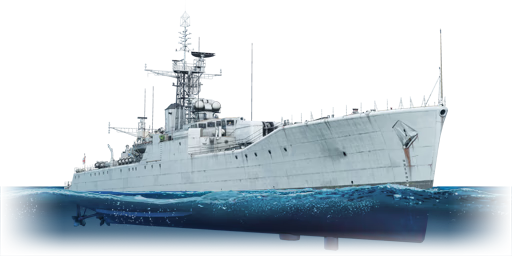
The Whitby-class, HMS Blackpool (F77) is a rank British frigate with a battle rating of (AB), (RB), and (SB). It was introduced in Update "Ixwa Strike".
General info
Survivability and armour
Talk about the vehicle's armour. Note the most well-defended and most vulnerable zones, e.g. the ammo magazine. Evaluate the composition of components and assemblies responsible for movement and manoeuvrability. Evaluate the survivability of the primary and secondary armaments separately. Don't forget to mention the size of the crew, which plays an important role in fleet mechanics. Save tips on preserving survivability for the "Usage in battles" section. If necessary, use a graphical template to show the most well-protected or most vulnerable points in the armour.
Mobility
Write about the ship's mobility. Evaluate its power and manoeuvrability, rudder rerouting speed, stopping speed at full tilt, with its maximum forward and reverse speed.
| Mobility Characteristics | |||
|---|---|---|---|
| Game Mode | Upgrade Status | Maximum Speed (km/h) | |
| Forward | Reverse | ||
| AB | |||
| Upgraded | |||
| RB/SB | |||
| Upgraded | |||
Modifications and economy
Armament
Primary armament
Provide information about the characteristics of the primary armament. Evaluate their efficacy in battle based on their reload speed, ballistics and the capacity of their shells. Add a link to the main article about the weapon: {{main|Weapon name (calibre)}}. Broadly describe the ammunition available for the primary armament, and provide recommendations on how to use it and which ammunition to choose.
| Penetration statistics | |||||||
|---|---|---|---|---|---|---|---|
| Ammunition | Type of warhead |
Penetration @ 0° Angle of Attack (mm) | |||||
| 1,000 m | 2,500 m | 5,000 m | 7,500 m | 10,000 m | 15,000 m | ||
| 4.5 inch HE | HE | 28 | 28 | 28 | 28 | 28 | 28 |
| 4.5 inch SAP | SAP | 117 | 100 | 77 | 61 | 50 | 41 |
| 4.5 inch HE-TF | HE-TF | 28 | 28 | 28 | 28 | 28 | 28 |
| 4.5 inch HE-VT | HE-VT | 28 | 28 | 28 | 28 | 28 | 28 |
| Shell details | ||||||||||||
|---|---|---|---|---|---|---|---|---|---|---|---|---|
| Ammunition | Type of warhead |
Velocity (m/s) |
Projectile mass (kg) |
Fuse delay (s) |
Fuse sensitivity (mm) |
Explosive mass (TNT equivalent) (g) |
Ricochet | |||||
| 0% | 50% | 100% | ||||||||||
| 4.5 inch HE | HE | 746 | 24.95 | 0 | 0.1 | 2,320 | 79° | 80° | 81° | |||
| 4.5 inch SAP | SAP | 746 | 23 | 0.015 | 5 | 910 | 47° | 60° | 65° | |||
| 4.5 inch HE-TF | HE-TF | 746 | 24.95 | 0 | 0.1 | 2,320 | 79° | 80° | 81° | |||
| Proximity-fused shell details | ||||||||||||
|---|---|---|---|---|---|---|---|---|---|---|---|---|
| Ammunition | Type of warhead |
Velocity (m/s) |
Projectile mass (kg) |
Fuse delay (m) |
Fuse sensitivity (mm) |
Arming distance (m) |
Trigger radius (m) |
Explosive mass (TNT equivalent) (g) |
Ricochet | |||
| 0% | 50% | 100% | ||||||||||
| 4.5 inch HE-VT | HE-VT | 746 | 24.95 | 0 | 0.1 | 244 | 23 | 2,320 | 79° | 80° | 81° | |
Secondary armament
Some ships are fitted with weapons of various calibres. Secondary armaments are defined as weapons chosen with the control Select secondary weapon. Evaluate the secondary armaments and give advice on how to use them. Describe the ammunition available for the secondary armament. Provide recommendations on how to use them and which ammunition to choose. Remember that any anti-air armament, even heavy calibre weapons, belong in the next section. If there is no secondary armament, remove this section.
- Universal: AP-T · HEFI-T
- 40 mm HE clips: HEFI-T · HEFI-T · HEFI-T · AP-T
- 40 mm AP clips: AP-T · AP-T · AP-T · HEFI-T
| Penetration statistics | |||||||
|---|---|---|---|---|---|---|---|
| Ammunition | Penetration @ 0° Angle of Attack (mm) | ||||||
| 10 m | 100 m | 500 m | 1,000 m | 1,500 m | 2,000 m | ||
| HEFI-T | 3 | 3 | 3 | 3 | 3 | 3 | |
| AP-T | 81 | 78 | 68 | 58 | 49 | 41 | |
| Shell details | ||||||||||||
|---|---|---|---|---|---|---|---|---|---|---|---|---|
| Ammunition | Velocity (m/s) |
Projectile mass (kg) |
Fuse delay (m) |
Fuse sensitivity (mm) |
Explosive mass (TNT equivalent) (g) |
Ricochet | ||||||
| 0% | 50% | 100% | ||||||||||
| HEFI-T | 874 | 0.9 | 0 | 0.1 | 67.13 | 79° | 80° | 81° | ||||
| AP-T | 874 | 0.89 | - | - | - | 47° | 60° | 65° | ||||
Additional armament
Describe the available additional armaments of the ship: depth charges, mines, torpedoes. Talk about their positions, available ammunition and launch features such as dead zones of torpedoes. If there is no additional armament, remove this section.
Usage in battles
Describe the technique of using this ship, the characteristics of her use in a team and tips on strategy. Abstain from writing an entire guide – don't try to provide a single point of view, but give the reader food for thought. Talk about the most dangerous opponents for this vehicle and provide recommendations on fighting them. If necessary, note the specifics of playing with this vehicle in various modes (AB, RB, SB).
Pros and cons
Pros:
- High survivability thanks to large crew size.
- Large amount of (forward-facing) torpedoes.
- Fast firing 4.5 inch/45 QF Mark IV main gun.
- Rear-facing twin 40 mm can cripple ships in close range.
- Good AA capabilities with HE-VT shell.
- Can hold its own against most other destroyers.
Cons:
- Main armament cannot effectively target anything closer than 4.30 km (2.67 mi) towards the bow.
- Bidder Torpedoes are capped at 37 km/h and have a small explosive warhead (89 kg TNT).
- All torpedo tubes and mortar cannot be aimed.
- Search & Tracking radar have poor scan rates.
- Large bridge: high risk of being disabled by even AA.
- Bridge, Fire Control and Radio rooms are all in close proximity to each other.
- All ammunition is stored directly below the main gun.
- Limbo mortar (currently) functions no differently to a Y-gun.
- Slightly below average speed.
History
Devblog
Development of the Type 12 frigates, or Whitby-class as they would also become known, began in the early 1950s at the very start of the Cold War. Developed to be fast, ocean-going frigates for convoy escort duties, the Whitby-class featured a novel hull design and incorporated many new features all derived from the experience gained during WWII. Subsequently, the Whitby-class was constructed with a heavy focus on anti-submarine warfare capabilities, thus being able to effectively combat some of the most modern high-speed submarines.
As a result, ships of the class resembled destroyers in their size and, due to their high construction cost, only eight ended up being built by the late 1950s. The Whitbys remained in active service with the Royal Navy up until the 1970s before they were gradually decommissioned as more modern ships began to take their place.
Among the eight Whitby-class frigates built was also HMS Blackpool. Laid down in December 1954 and commissioned in August 1958, HMS Blackpool was the last Whitby-class frigate built for the Royal Navy. For the better part of her service career, HMS Blackpool was stationed around the Suez canal and operated in the Far East until the mid 1960s.
In 1966, HMS Blackpool was leased to the Royal New Zealand Navy and continued operating under the New Zealand flag until 1971. Upon being returned to the Royal Navy, HMS Blackpool was decommissioned and ultimately sold for scrap in 1980.
Media
- Skins
- Images


See also
Links to articles on the War Thunder Wiki that you think will be useful for the reader, for example:
- reference to the series of the ship;
- links to approximate analogues of other nations and research trees.
External links
| Harland & Wolff | |
|---|---|
| Frigates | |
| Whitby-class | HMS Blackpool |
| Light Cruisers | |
| Town-class | HMS Belfast |
| Battlecruisers | |
| Courageous-class | HMS Glorious |
| Britain frigates | |
|---|---|
| Leopard-class | HMS Leopard |
| Whitby-class | HMS Blackpool · HMS Whitby |
| Restigouche-class | HMCS Terra Nova |