Difference between pages "F-84G-21-RE (Italy)" and "G.91 R/1"
m (→Details: Updated template to preferred type) |
(→Description) |
||
| Line 1: | Line 1: | ||
| − | |||
{{About | {{About | ||
| about = Italian jet fighter '''{{PAGENAME}}''' | | about = Italian jet fighter '''{{PAGENAME}}''' | ||
| − | | usage = other | + | | usage = other versions |
| − | | link = | + | | link = G.91 (Family) |
| + | }} | ||
| + | {{Specs-Card | ||
| + | |code=fiat_g91_r1 | ||
| + | |images={{Specs-Card-Image|GarageImage_G.91_R_1.jpg}} | ||
| + | |cockpit=cockpit_fiat_g91_r1.jpg | ||
}} | }} | ||
== Description == | == Description == | ||
| − | <!--''In the description, the first part | + | <!-- ''In the description, the first part should be about the history of and the creation and combat usage of the aircraft, as well as its key features. In the second part, tell the reader about the aircraft in the game. Insert a screenshot of the vehicle, so that if the novice player does not remember the vehicle by name, he will immediately understand what kind of vehicle the article is talking about.'' --> |
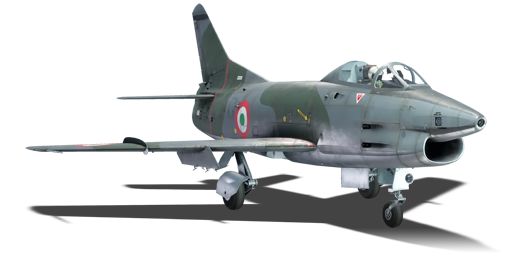
| − | + | The G.91 was a light subsonic fighter developed by Fiat in the late 1950s, it was a great success being introduced in the Italian, German, and Portuguese air force. The objective of said fighter was to create a cheap, light fighter-bomber capable of becoming the standard between all NATO nations, this was due to the experience of the US and UN forces in the Korean War, and the introduction of more capable jet engines, that pushed the NATO Command to set a competition for this role. A total of 756 aircraft were built in a span of 19 years. The '''G.91 R/1''' was the first light attack/reconnaissance version of the G.91; compared to previous versions, it featured the same armament and powerplant, but added the capability to launch MACLOS guided AA-20 and AS-20 Nord missiles, as well as three cameras mounted on the nose. | |
| − | |||
| − | |||
| − | The | ||
| − | |||
| − | |||
| − | |||
| − | |||
| − | + | It was introduced in [[Update 1.69 "Regia Aeronautica"]] along with the initial Italian aviation tree. The '''{{Specs|name}}''' is a very light and nimble aircraft, it features some decent air-to-air and air-to-ground capabilities, thanks mainly to the AA-20 and AS-20 Nord missiles and its flight performance. For air combat, the AA-20 missiles are very hard to guide, but compensate by being extremely good in last minute launches in head-ons, in situations when the enemy can't properly dodge, they are also a very good way of destroying bombers without getting too close or from awkward angles. The G.91's ground ordnance consists of AS-20 missiles as well as rockets, the AS-20 Nords are the best option and can reliably destroy most targets, but they require good aim to be used. | |
| − | |||
== General info == | == General info == | ||
| − | === Flight | + | === Flight performance === |
| − | <!--''Describe how the aircraft behaves in the air. | + | {{Specs-Avia-Flight}} |
| + | <!-- ''Describe how the aircraft behaves in the air. Speed, manoeuvrability, acceleration and allowable loads - these are the most important characteristics of the vehicle.'' --> | ||
| + | The G.91 was intended to replace the [[F-86A-5|F-86A Sabre]] in German, Portuguese and Italian service and it shows. With an empty weight of only 3,100 kg (6,800 lbs) and a takeoff weight of 5,500 kg (12,100 lbs), the Gina is in the same weight class as the [[P-51D-5|P-51D]] and [[MiG-9]], yet severely lighter than most other jets and losing about one and a half tonnes compared to the Sabre A. | ||
| + | Although only outputting a meagre 22 kN of thrust this first look disadvantage is literally outweighed by the high thrust to weight ratio of 0.73 empty (0.41 full). This makes the Gina an excellent dogfighter as jet fighters maintain both their top speed, climb and sustained turn-rate by their engine power rather than other flight characteristics. It can easily reach its own terminal speed (1,011 km/h, 921 ft/s) and self-destruct in level flight. | ||
| − | + | Lacking in straight wings and leading wing slats the stall speed for the G.91 is quite higher than the low weight lets one assume. One should hence be wary of many older jet types with said features, as after bleeding too much speed they can easily outmanoeuvre the Gina. | |
| − | + | Starting with 20 min of fuel, gaining the climb speed of 800 km/h IAS (sustainable @ 7-8°; 730 f/s) takes a mere ~80 seconds with 20 predicated for taking off at 230 km/h or 210 f/s IAS. An Immelmann at 800 km/h will gain 1,000 m and lose 300 km/h. A hard 180° turn at the same speed takes >100 km/h and may lose up to 60 m. | |
| − | + | {| class="wikitable" style="text-align:center" width="70%" | |
| − | |||
| − | {| class="wikitable" style="text-align:center" | ||
! rowspan="2" | Characteristics | ! rowspan="2" | Characteristics | ||
! colspan="2" | Max Speed<br>(km/h at 0 m - sea level) | ! colspan="2" | Max Speed<br>(km/h at 0 m - sea level) | ||
| Line 41: | Line 38: | ||
|- | |- | ||
! Stock | ! Stock | ||
| − | | | + | | 1,066 || 1,042 || rowspan="2" | {{Specs|ceiling}} || 27.3 || 27.8 || 29.8 || 28.8 || rowspan="2" | 850 |
|- | |- | ||
! Upgraded | ! Upgraded | ||
| − | | | + | | 1,096 || 1,084 || 25.1 || 26.0 || 49.6 || 39.0 |
|- | |- | ||
|} | |} | ||
| − | ====Details==== | + | ==== Details ==== |
| − | {| class="wikitable" style="text-align:center" | + | {| class="wikitable" style="text-align:center" width="50%" |
|- | |- | ||
! colspan="6" | Features | ! colspan="6" | Features | ||
| Line 55: | Line 52: | ||
! Combat flaps !! Take-off flaps !! Landing flaps !! Air brakes !! Arrestor gear !! Drogue chute | ! Combat flaps !! Take-off flaps !! Landing flaps !! Air brakes !! Arrestor gear !! Drogue chute | ||
|- | |- | ||
| − | | ✓ || ✓ || ✓ || ✓ || X || | + | | ✓ || ✓ || ✓ || ✓ || X || ✓ <!-- ✓ --> |
|- | |- | ||
|} | |} | ||
| − | {| class="wikitable" style="text-align:center" | + | {| class="wikitable" style="text-align:center" width="50%" |
|- | |- | ||
! colspan="7" | Limits | ! colspan="7" | Limits | ||
| Line 70: | Line 67: | ||
! Combat !! Take-off !! Landing !! + !! - | ! Combat !! Take-off !! Landing !! + !! - | ||
|- | |- | ||
| − | | {{Specs|destruction|body}} || {{Specs|destruction|gear}} || | + | | {{Specs|destruction|body}} || {{Specs|destruction|gear}} || 589 || 550 || 345 || ~11 || ~5 |
|- | |- | ||
|} | |} | ||
| Line 80: | Line 77: | ||
! Ailerons !! Rudder !! Elevators !! Radiator | ! Ailerons !! Rudder !! Elevators !! Radiator | ||
|- | |- | ||
| − | | < | + | | < 800 || < 650 || < 660 || N/A |
|- | |- | ||
|} | |} | ||
| Line 88: | Line 85: | ||
|- | |- | ||
! colspan="3" | Engine | ! colspan="3" | Engine | ||
| − | ! colspan=" | + | ! colspan="5" | Aircraft mass |
|- | |- | ||
! colspan="2" | Engine name || Number | ! colspan="2" | Engine name || Number | ||
| − | ! colspan="2" | Empty mass || colspan=" | + | ! colspan="2" | Empty mass || colspan="3" | Wing loading (full fuel) |
|- | |- | ||
| − | | colspan="2" | | + | | colspan="2" | Bristol Orpheus MK.803 || 1 |
| − | | colspan="2" | | + | | colspan="2" | 3,337 kg || colspan="3" | 281 kg/m<sup>2</sup> |
|- | |- | ||
! colspan="3" | Engine characteristics | ! colspan="3" | Engine characteristics | ||
| − | ! colspan=" | + | ! colspan="4" | Mass with fuel (no weapons load) || rowspan="2" | Max Takeoff<br />Weight |
|- | |- | ||
! Weight (each) || colspan="2" | Type | ! Weight (each) || colspan="2" | Type | ||
| − | ! | + | ! 9m fuel || 20m fuel || 30m fuel || 32m fuel |
|- | |- | ||
| − | | | + | | 380 kg || colspan="2" | Axial-flow turbojet |
| − | | | + | | 3,697 kg || 4,129 kg || 4,522 kg || 4,600 kg || 5,800 kg |
|- | |- | ||
! colspan="3" | {{Annotation|Maximum engine thrust @ 0 m (RB / SB)|The maximum thrust produced by each engine, while mounted in the aircraft. NOTE: Thrust varies significantly depending on speed & altitude.}} | ! colspan="3" | {{Annotation|Maximum engine thrust @ 0 m (RB / SB)|The maximum thrust produced by each engine, while mounted in the aircraft. NOTE: Thrust varies significantly depending on speed & altitude.}} | ||
| − | ! colspan=" | + | ! colspan="5" | Thrust to weight ratio @ 0 m (101%) |
|- | |- | ||
| − | ! Condition || 100% || | + | ! Condition || 100% || 101% |
| − | ! | + | ! 9m fuel || 20m fuel || 30m fuel || 32m fuel || MTOW |
|- | |- | ||
| − | | ''Stationary'' || 2, | + | | ''Stationary'' || 2,212 kgf || 2,234 kgf |
| − | | 0. | + | | 0.60 || 0.54 || 0.49 || 0.49 || 0.39 |
|- | |- | ||
| − | | ''Optimal'' || 2, | + | | ''Optimal'' || 2,212 kgf<br />(0 km/h) || 2,234 kgf<br />(0 km/h) |
| − | | 0. | + | | 0.60 || 0.54 || 0.49 || 0.49 || 0.39 |
|- | |- | ||
|} | |} | ||
=== Survivability and armour === | === Survivability and armour === | ||
| − | <!-- Examine the survivability of the aircraft. Note how vulnerable the structure is and how secure the pilot is, whether the fuel tanks are armoured, etc. Describe the armour, if there is any, and also mention the vulnerability of other critical aircraft systems. --> | + | {{Specs-Avia-Armour}} |
| − | + | <!-- ''Examine the survivability of the aircraft. Note how vulnerable the structure is and how secure the pilot is, whether the fuel tanks are armoured, etc. Describe the armour, if there is any, and also mention the vulnerability of other critical aircraft systems.'' --> | |
| − | + | At its rank there is little which cannot hurt the G.91. This is mostly due to the large calibres and fast-firing weapons found in the jet age, although the Gina does not help this issue. The armour is enough to withstand the occasional tank LMG fire but otherwise will only protect the pilot from shrapnel damage. Even though the centerline arrangement of all components proves to be quite survivable in combat, it does NOT lend itself for head-ons or prolonged chases. The former only leads to functional aircraft with a dead pilot and the latter to the reverse, which was in all likelihood the intended design in real life. | |
| − | |||
| − | |||
| − | |||
| − | + | * 6.5 mm Steel - Behind, below and in front of the pilot | |
| + | * 6.5 mm Steel - under central fuel tanks. | ||
| + | * 40 mm bulletproof glass - Armoured windshield | ||
| + | * Critical components located down the midline of aircraft (fuel, pilot, engine, controls) | ||
| + | * Fuel tanks located in the central fuselage. | ||
| − | + | === Modifications and economy === | |
| + | {{Specs-Economy}} | ||
| − | + | A focus should be done on the engine modules, as the G.91 lives by its T/W ratio. New boosters is a double-edged sword, as without the G-Suit one is just blackout earlier. This oddly makes the Bomb unlock a tantalizing choice, especially in already won matches for farming on ground units before the game ends. Airframe and cover do little, the weight savings are very minor and without them, the G.91 can still easily reach top speeds and rip off its wings... | |
== Armaments == | == Armaments == | ||
| − | + | {{Specs-Avia-Armaments}} | |
| − | |||
| − | |||
| − | |||
| − | |||
| − | |||
| − | |||
| − | |||
| − | |||
| − | |||
| − | |||
| − | |||
| − | |||
=== Suspended armament === | === Suspended armament === | ||
| − | <!--''Describe the aircraft's suspended armament: additional cannons under the wings, bombs, rockets and torpedoes. This section is especially important for bombers and attackers. If there is no suspended weaponry remove this subsection.''--> | + | {{Specs-Avia-Suspended}} |
| − | + | <!-- ''Describe the aircraft's suspended armament: additional cannons under the wings, bombs, rockets and torpedoes. This section is especially important for bombers and attackers. If there is no suspended weaponry remove this subsection.'' --> | |
| − | |||
| − | |||
| − | |||
| − | + | The '''''{{PAGENAME}}''''' can be outfitted with the following ordnance: | |
| − | |||
| − | |||
| − | |||
| − | |||
| − | |||
| − | |||
| − | |||
| − | |||
| − | |||
| − | |||
| − | + | {| class="wikitable" style="text-align:center" width="100%" | |
| + | |- | ||
| + | ! !! width="11%" | 1 !! width="11%" | 2 !! width="11%" | 3 !! width="11%" | 4 | ||
| + | | rowspan="7" width="25%" | <div class="ttx-image">[[File:Hardpoints_G.91_pre-serie.png]]</div> | ||
| + | |- | ||
| + | ! [[M3 Browning (12.7 mm)|12.7 mm M3 Browning]] machine guns (300 rpg) | ||
| + | | || 2 || 2* || | ||
| + | |- | ||
| + | ! [[AN-M64A1 (500 lb)|500 lb AN-M64A1]] bombs | ||
| + | | 1 || || || 1 | ||
| + | |- | ||
| + | ! [[Aerea 559G1 incendiary]] bombs | ||
| + | | 1 || || || 1 | ||
| + | |- | ||
| + | ! [[FFAR Mighty Mouse]] rockets | ||
| + | | 19 || || || 19 | ||
| + | |- | ||
| + | ! [[AA-20 Nord]] missiles | ||
| + | | 1* || || || 1* | ||
| + | |- | ||
| + | ! [[AS-20 Nord]] missiles | ||
| + | | 1* || || || 1* | ||
| + | |- | ||
| + | | colspan="6" | * Missiles cannot be equipped in conjunction with machine guns on hardpoint 3 | ||
| + | |} | ||
| − | + | {{Navigation-Start|Default weapon presets}} | |
| + | {{Navigation-First-Simple-Line}} | ||
| − | = | + | * 4 x 12.7 mm M3 Browning machine guns (300 rpg = 1,200 total) |
| − | + | * 4 x 12.7 mm M3 Browning machine guns + 38 x FFAR Mighty Mouse rockets | |
| − | + | * 2 x 12.7 mm M3 Browning machine gun + 2 x AS-20 Nord missiles | |
| + | * 2 x 12.7 mm M3 Browning machine gun + 2 x AA-20 Nord missiles | ||
| + | * 4 x 12.7 mm M3 Browning machine guns + 2 x 500 lb AN-M64A1 bombs (1,000 lb total) | ||
| + | * 4 x 12.7 mm M3 Browning machine guns + 2 x Aerea 559G1 incendiary bombs | ||
| + | {{Navigation-End}} | ||
| − | + | The M3 Browning is a new weapon in the Italian arsenal at this 5th tier and compared to the previous experiences a letdown. The rate of fire is phenomenal, but the small calibre and ammo size put a serious damper to the mood, that is in comparison of course. In practice and with good aim, it can easily shred four fighters. The high bullet velocity and fire rate is quite the advantage in the fast-paced world of jet combat, ensuring hits in deflection shots where the lower rate of fire found in the [[:Category:Fifth_rank_aircraft|Soviet jet fighters]] might have failed the pilot. | |
| − | + | Yet one will always look onto greener pastures, especially as the Gina only has four guns unlike all other Browning armed jets. No matter how you turn it, the armament is only manageable with skill and for a beginner outright bad. | |
| − | + | The G.91 is a fighter and it shows in the additional payloads. They should only be considered for a quick drop on the way to the combat zone, losing height/speed advantage in doing so, or once aerial dominance has already accomplished. Even then many other jets are way better suited for ground attacks. | |
| − | + | The bombs are standard fare and often not worse the hassle with their low total yield. The FFAR rockets are a far better option allowing to tackle more than one target, even though they only work well against soft target and up to medium tanks. | |
| − | + | == Usage in battles == | |
| + | <!-- ''Describe the tactics of playing in the aircraft, the features of using aircraft in a team and advice on tactics. Refrain from creating a "guide" - do not impose a single point of view, but instead, give the reader food for thought. Examine the most dangerous enemies and give recommendations on fighting them. If necessary, note the specifics of the game in different modes (AB, RB, SB).'' --> | ||
| + | Air superiority is the combat objective for the G.91 ''Gina'', anything else is secondary. In team games lure enemy fighters into extensive and excessive dogfights to allow your heavier and less nimble allies to Boom and Zoom or Boom and Run them. With their great thrust to weight ratio, the G.91 can maintain their energy superiority and in emergencies (such as non-existent teamplay) to disengage. Alternatively, standard Boom & Zoom is a considerable choice. Again the great acceleration allows for more energy-expensive manoeuvres and still disengage without much worry from the target. Such follies would be deadly in many other fighters, but the Gina is hence quite forgiving. In fact too forgiving, new pilots to the jet age need to lose old habits and the G.91 does not force one's hand. The G.91 can hold its own against several aircraft at once, but won't be able to win such a battle on its own | ||
| − | + | A few strategies for the G.91 AA-20 Nord Air-to-Air missiles: Use your Nord Air-to-Air missiles in a head-on, where you fire your missile around the 1km mark, leading to the enemy being unable to dodge the missile due to over-commitment, or it leads to them losing the killing shot as you barrel roll out of fire. You can also fire at enemies running away in a straight line, enemies that often fall for this are A-4Es and other variants of the A-4 line. Use these Nord missiles only when your enemy is predictable as aiming these missiles is difficult, aiming of which is lightened with the enormous proximity range, meaning even if you fail to be exact, it will still cause heavy damage. Do not fire missiles on stalling aircraft, unless you're certain you can't gun them down with your .50 cals or you'll stall out before you can kill them, it'll just waste your precious Nords.<br> | |
| − | + | Against bombers and ground attack craft the G.91 lacks necessary firepower, the Nords however can compensate for this with their large proximity fuse and manual guidance, if you decide however to use your primary guns, it will drain your ammo severely. The measly protection against defensive fire makes this a dangerous task anyway and should thusly be left for better-equipped allies.<br> | |
| − | + | Using the Gina as CAS is somewhat mediocre due to the payload. While being able to mount air-to-ground ordnance, the payload yield is somewhat weak. The FFAR pods and Air-to-Ground AS-20 Nords are the only worthwhile considerations but run against the G.91's intended role of Air Superiority Fighter. | |
| − | |||
| − | |||
| − | |||
| − | |||
| − | |||
| − | |||
| − | |||
| − | |||
| − | |||
| − | |||
| − | |||
| − | |||
| − | |||
| − | |||
| − | |||
| − | |||
| − | |||
| − | |||
| − | |||
| − | |||
| − | |||
| − | |||
| − | |||
| − | |||
| − | |||
| − | |||
| − | |||
| − | |||
| − | |||
| − | |||
| − | |||
| − | |||
| − | |||
| − | |||
| − | |||
| − | |||
| − | |||
| − | |||
| − | |||
| − | |||
| − | |||
| − | |||
| − | |||
| − | |||
| − | |||
| − | |||
| − | |||
| − | |||
| − | |||
| − | |||
| − | |||
| − | |||
| − | |||
| − | |||
| − | |||
| − | |||
| − | |||
| − | |||
| − | |||
| − | |||
| − | |||
| − | |||
| − | |||
| − | |||
| − | |||
| − | |||
| − | |||
| − | |||
| − | |||
=== Pros and cons === | === Pros and cons === | ||
| − | <!--'' | + | <!-- ''Summarise and briefly evaluate the vehicle in terms of its characteristics and combat effectiveness. Mark its pros and cons in the bulleted list. Try not to use more than 6 points for each of the characteristics. Avoid using categorical definitions such as "bad", "good" and the like - use substitutions with softer forms such as "inadequate" and "effective".'' --> |
'''Pros:''' | '''Pros:''' | ||
| − | * | + | * Low weight, high thrust-to-weight ratio |
| − | + | ** Great turn time for a jet; can give the MiG-15 a run for its money | |
| − | * | + | ** Great acceleration and climb rate |
| − | * | + | * 4 x M3 machine guns can be deadly if aimed correctly and used in close range |
| − | * | ||
| − | |||
| − | |||
| − | '''Cons''' | + | '''Cons:''' |
| − | * | + | * It has a slower speed relative to the jets it will encounter |
| − | * | + | * Short burst time due to low ammo count |
| − | * | + | * Limited ground attack abilities |
| − | * | + | * Bleeds off a lot of speed in a full elevator turn |
| + | * Can rip its wings off if you pull full elevator past 800 km/h | ||
== History == | == History == | ||
| − | <!--''Describe the history of the creation and combat usage of the aircraft in more detail than in the introduction. If the historical reference turns out to be too | + | <!-- ''Describe the history of the creation and combat usage of the aircraft in more detail than in the introduction. If the historical reference turns out to be too long, take it to a separate article, taking a link to the article about the vehicle and adding a block "/History" (example: <nowiki>https://wiki.warthunder.com/(Vehicle-name)/History</nowiki>) and add a link to it here using the <code>main</code> template. Be sure to reference text and sources by using <code><nowiki><ref></ref></nowiki></code>, as well as adding them at the end of the article with <code><nowiki><references /></nowiki></code>. This section may also include the vehicle's dev blog entry (if applicable) and the in-game encyclopedia description (under <code><nowiki>=== In-game description ===</nowiki></code>, also if applicable).'' --> |
| − | + | The first production version of the G.91 was the G.91 R, which was intended for both close support and photo-reconnaissance. The first production aircraft was finished in 1959, and the R/1 entered Italian Air Force service with 14th Gruppe in March 1961. In total 48 of this model would be built, all serving with Italy, while the West Germans used the more powerfully armed R/3 and R/4 variants. These would be followed by another 50 R/1B combat aircraft. | |
| − | + | Winner of the 1953 NATO light tactical support aircraft competition, the Fiat "Small Sabre" would be in production for 19 years, with 756 aircraft completed, with the last aircraft produced in 1977. It served in the Italian and West German air forces starting in 1961 and 1962 respectively. | |
| − | + | The original competition specifications called for a jet able to carry 450 kg of ordnance with an operational radius of 180 km, assuming 10 minutes over the target, with a maximum speed of at least Mach 0.95 and a takeoff distance of no more than 1,100 m, on unprepared or grass runways. Eight aircraft competed in the first round, including the French Dassault Etendard (then called the Mystere XXVI) and the British Folland Gnat. The Etendard, the G.91 and a Breguet design were selected for the second round beginning in late 1957. Fiat went ahead with pre-production ("pre-serie" in Italian) aircraft, with first flight in August 1956, seven months ahead of its competitors. The crash of the first prototype due to aeroelastic vibrations in February 1957, proved a setback, but the G.91 entered the second round as scheduled and was announced as the winner in January 1958. | |
| − | |||
| − | |||
| − | + | Critics said Fiat had just copied the F-86 Sabre, which it was manufactured under license, but these claims seem unwarranted. Operational service evaluations with the Italian air force's 103 Squadron ran from February to July 1959, leading to a West German decision to manufacture the aircraft under license. | |
| − | |||
| − | |||
| − | |||
| − | |||
| − | |||
| − | |||
== Media == | == Media == | ||
| − | <!--'' | + | <!-- ''Excellent additions to the article would be video guides, screenshots from the game, and photos.'' --> |
| − | |||
| − | |||
| − | |||
| − | |||
| − | |||
| − | |||
| − | |||
| − | + | ;Skins | |
| − | |||
| − | = | + | * [https://live.warthunder.com/feed/camouflages/?vehicle=fiat_g91_r1 Skins and camouflages for the {{PAGENAME}} from live.warthunder.com.] |
| − | |||
| − | |||
| − | |||
| − | |||
| − | + | ;Videos | |
| + | {{Youtube-gallery|k15BSV4Xx9w|'''The Shooting Range #46''' - ''Pages of History'' section at 05:29 discusses the G.91.|xnSwBP_D3aw|'''"How to fly the Fiat G.91R/1"''' - ''McChickenBites''}} | ||
| − | + | == See also == | |
| − | + | <!-- ''Links to the articles on the War Thunder Wiki that you think will be useful for the reader, for example:'' | |
| − | + | * ''reference to the series of the aircraft;'' | |
| − | * | + | * ''links to approximate analogues of other nations and research trees.'' --> |
| − | |||
| − | |||
| − | |||
| − | ; | ||
| − | |||
| − | * | ||
| − | |||
| − | |||
| − | |||
| − | |||
| − | + | * [[F-86A-5|F-86A-5 Sabre]] - combat role predecessor | |
| − | + | * [[La-15]] and [[Yak-30]] - similar flight style | |
| + | * [[G.91 (Family)]] | ||
| + | == External links == | ||
| + | <!-- ''Paste links to sources and external resources, such as:'' | ||
* ''topic on the official game forum;'' | * ''topic on the official game forum;'' | ||
| − | + | * ''other literature.'' --> | |
| − | * ''other literature.'' | ||
| − | + | * [https://forum.warthunder.com/index.php?/topic/363988-fiat-g91-discussion-thread/ <nowiki>[</nowiki>WT Forum<nowiki>]</nowiki> Fiat G.91 discussion thread] | |
| − | < | + | * [https://forum.warthunder.com/index.php?/topic/364978-fiat-g91-r1/ <nowiki>[</nowiki>WT Forum<nowiki>]</nowiki> Official data sheet - more details about the performance] |
| − | < | + | * [[wikipedia:Fiat_G.91|[Wikipedia] Fiat G.91]] |
| − | </ | ||
| − | {{AirManufacturer | + | {{AirManufacturer Fiat}} |
| − | {{Italy jet | + | {{Italy jet aircraft}} |
Latest revision as of 14:11, 4 January 2024
| This page is about the Italian jet fighter G.91 R/1. For other versions, see G.91 (Family). |

Contents
Description
The G.91 was a light subsonic fighter developed by Fiat in the late 1950s, it was a great success being introduced in the Italian, German, and Portuguese air force. The objective of said fighter was to create a cheap, light fighter-bomber capable of becoming the standard between all NATO nations, this was due to the experience of the US and UN forces in the Korean War, and the introduction of more capable jet engines, that pushed the NATO Command to set a competition for this role. A total of 756 aircraft were built in a span of 19 years. The G.91 R/1 was the first light attack/reconnaissance version of the G.91; compared to previous versions, it featured the same armament and powerplant, but added the capability to launch MACLOS guided AA-20 and AS-20 Nord missiles, as well as three cameras mounted on the nose.
It was introduced in Update 1.69 "Regia Aeronautica" along with the initial Italian aviation tree. The G.91 R/1 is a very light and nimble aircraft, it features some decent air-to-air and air-to-ground capabilities, thanks mainly to the AA-20 and AS-20 Nord missiles and its flight performance. For air combat, the AA-20 missiles are very hard to guide, but compensate by being extremely good in last minute launches in head-ons, in situations when the enemy can't properly dodge, they are also a very good way of destroying bombers without getting too close or from awkward angles. The G.91's ground ordnance consists of AS-20 missiles as well as rockets, the AS-20 Nords are the best option and can reliably destroy most targets, but they require good aim to be used.
General info
Flight performance
The G.91 was intended to replace the F-86A Sabre in German, Portuguese and Italian service and it shows. With an empty weight of only 3,100 kg (6,800 lbs) and a takeoff weight of 5,500 kg (12,100 lbs), the Gina is in the same weight class as the P-51D and MiG-9, yet severely lighter than most other jets and losing about one and a half tonnes compared to the Sabre A. Although only outputting a meagre 22 kN of thrust this first look disadvantage is literally outweighed by the high thrust to weight ratio of 0.73 empty (0.41 full). This makes the Gina an excellent dogfighter as jet fighters maintain both their top speed, climb and sustained turn-rate by their engine power rather than other flight characteristics. It can easily reach its own terminal speed (1,011 km/h, 921 ft/s) and self-destruct in level flight.
Lacking in straight wings and leading wing slats the stall speed for the G.91 is quite higher than the low weight lets one assume. One should hence be wary of many older jet types with said features, as after bleeding too much speed they can easily outmanoeuvre the Gina.
Starting with 20 min of fuel, gaining the climb speed of 800 km/h IAS (sustainable @ 7-8°; 730 f/s) takes a mere ~80 seconds with 20 predicated for taking off at 230 km/h or 210 f/s IAS. An Immelmann at 800 km/h will gain 1,000 m and lose 300 km/h. A hard 180° turn at the same speed takes >100 km/h and may lose up to 60 m.
| Characteristics | Max Speed (km/h at 0 m - sea level) |
Max altitude (metres) |
Turn time (seconds) |
Rate of climb (metres/second) |
Take-off run (metres) | |||
|---|---|---|---|---|---|---|---|---|
| AB | RB | AB | RB | AB | RB | |||
| Stock | 1,066 | 1,042 | 27.3 | 27.8 | 29.8 | 28.8 | 850 | |
| Upgraded | 1,096 | 1,084 | 25.1 | 26.0 | 49.6 | 39.0 | ||
Details
| Features | |||||
|---|---|---|---|---|---|
| Combat flaps | Take-off flaps | Landing flaps | Air brakes | Arrestor gear | Drogue chute |
| ✓ | ✓ | ✓ | ✓ | X | ✓ |
| Limits | ||||||
|---|---|---|---|---|---|---|
| Wings (km/h) | Gear (km/h) | Flaps (km/h) | Max Static G | |||
| Combat | Take-off | Landing | + | - | ||
| 589 | 550 | 345 | ~11 | ~5 | ||
| Optimal velocities (km/h) | |||
|---|---|---|---|
| Ailerons | Rudder | Elevators | Radiator |
| < 800 | < 650 | < 660 | N/A |
Engine performance
| Engine | Aircraft mass | ||||||
|---|---|---|---|---|---|---|---|
| Engine name | Number | Empty mass | Wing loading (full fuel) | ||||
| Bristol Orpheus MK.803 | 1 | 3,337 kg | 281 kg/m2 | ||||
| Engine characteristics | Mass with fuel (no weapons load) | Max Takeoff Weight | |||||
| Weight (each) | Type | 9m fuel | 20m fuel | 30m fuel | 32m fuel | ||
| 380 kg | Axial-flow turbojet | 3,697 kg | 4,129 kg | 4,522 kg | 4,600 kg | 5,800 kg | |
| Maximum engine thrust @ 0 m (RB / SB) | Thrust to weight ratio @ 0 m (101%) | ||||||
| Condition | 100% | 101% | 9m fuel | 20m fuel | 30m fuel | 32m fuel | MTOW |
| Stationary | 2,212 kgf | 2,234 kgf | 0.60 | 0.54 | 0.49 | 0.49 | 0.39 |
| Optimal | 2,212 kgf (0 km/h) |
2,234 kgf (0 km/h) |
0.60 | 0.54 | 0.49 | 0.49 | 0.39 |
Survivability and armour
At its rank there is little which cannot hurt the G.91. This is mostly due to the large calibres and fast-firing weapons found in the jet age, although the Gina does not help this issue. The armour is enough to withstand the occasional tank LMG fire but otherwise will only protect the pilot from shrapnel damage. Even though the centerline arrangement of all components proves to be quite survivable in combat, it does NOT lend itself for head-ons or prolonged chases. The former only leads to functional aircraft with a dead pilot and the latter to the reverse, which was in all likelihood the intended design in real life.
- 6.5 mm Steel - Behind, below and in front of the pilot
- 6.5 mm Steel - under central fuel tanks.
- 40 mm bulletproof glass - Armoured windshield
- Critical components located down the midline of aircraft (fuel, pilot, engine, controls)
- Fuel tanks located in the central fuselage.
Modifications and economy
A focus should be done on the engine modules, as the G.91 lives by its T/W ratio. New boosters is a double-edged sword, as without the G-Suit one is just blackout earlier. This oddly makes the Bomb unlock a tantalizing choice, especially in already won matches for farming on ground units before the game ends. Airframe and cover do little, the weight savings are very minor and without them, the G.91 can still easily reach top speeds and rip off its wings...
Armaments
Suspended armament
The G.91 R/1 can be outfitted with the following ordnance:
| 1 | 2 | 3 | 4 |  | |
|---|---|---|---|---|---|
| 12.7 mm M3 Browning machine guns (300 rpg) | 2 | 2* | |||
| 500 lb AN-M64A1 bombs | 1 | 1 | |||
| Aerea 559G1 incendiary bombs | 1 | 1 | |||
| FFAR Mighty Mouse rockets | 19 | 19 | |||
| AA-20 Nord missiles | 1* | 1* | |||
| AS-20 Nord missiles | 1* | 1* | |||
| * Missiles cannot be equipped in conjunction with machine guns on hardpoint 3 | |||||
| Default weapon presets | |
|---|---|
| |
The M3 Browning is a new weapon in the Italian arsenal at this 5th tier and compared to the previous experiences a letdown. The rate of fire is phenomenal, but the small calibre and ammo size put a serious damper to the mood, that is in comparison of course. In practice and with good aim, it can easily shred four fighters. The high bullet velocity and fire rate is quite the advantage in the fast-paced world of jet combat, ensuring hits in deflection shots where the lower rate of fire found in the Soviet jet fighters might have failed the pilot.
Yet one will always look onto greener pastures, especially as the Gina only has four guns unlike all other Browning armed jets. No matter how you turn it, the armament is only manageable with skill and for a beginner outright bad.
The G.91 is a fighter and it shows in the additional payloads. They should only be considered for a quick drop on the way to the combat zone, losing height/speed advantage in doing so, or once aerial dominance has already accomplished. Even then many other jets are way better suited for ground attacks.
The bombs are standard fare and often not worse the hassle with their low total yield. The FFAR rockets are a far better option allowing to tackle more than one target, even though they only work well against soft target and up to medium tanks.
Usage in battles
Air superiority is the combat objective for the G.91 Gina, anything else is secondary. In team games lure enemy fighters into extensive and excessive dogfights to allow your heavier and less nimble allies to Boom and Zoom or Boom and Run them. With their great thrust to weight ratio, the G.91 can maintain their energy superiority and in emergencies (such as non-existent teamplay) to disengage. Alternatively, standard Boom & Zoom is a considerable choice. Again the great acceleration allows for more energy-expensive manoeuvres and still disengage without much worry from the target. Such follies would be deadly in many other fighters, but the Gina is hence quite forgiving. In fact too forgiving, new pilots to the jet age need to lose old habits and the G.91 does not force one's hand. The G.91 can hold its own against several aircraft at once, but won't be able to win such a battle on its own
A few strategies for the G.91 AA-20 Nord Air-to-Air missiles: Use your Nord Air-to-Air missiles in a head-on, where you fire your missile around the 1km mark, leading to the enemy being unable to dodge the missile due to over-commitment, or it leads to them losing the killing shot as you barrel roll out of fire. You can also fire at enemies running away in a straight line, enemies that often fall for this are A-4Es and other variants of the A-4 line. Use these Nord missiles only when your enemy is predictable as aiming these missiles is difficult, aiming of which is lightened with the enormous proximity range, meaning even if you fail to be exact, it will still cause heavy damage. Do not fire missiles on stalling aircraft, unless you're certain you can't gun them down with your .50 cals or you'll stall out before you can kill them, it'll just waste your precious Nords.
Against bombers and ground attack craft the G.91 lacks necessary firepower, the Nords however can compensate for this with their large proximity fuse and manual guidance, if you decide however to use your primary guns, it will drain your ammo severely. The measly protection against defensive fire makes this a dangerous task anyway and should thusly be left for better-equipped allies.
Using the Gina as CAS is somewhat mediocre due to the payload. While being able to mount air-to-ground ordnance, the payload yield is somewhat weak. The FFAR pods and Air-to-Ground AS-20 Nords are the only worthwhile considerations but run against the G.91's intended role of Air Superiority Fighter.
Pros and cons
Pros:
- Low weight, high thrust-to-weight ratio
- Great turn time for a jet; can give the MiG-15 a run for its money
- Great acceleration and climb rate
- 4 x M3 machine guns can be deadly if aimed correctly and used in close range
Cons:
- It has a slower speed relative to the jets it will encounter
- Short burst time due to low ammo count
- Limited ground attack abilities
- Bleeds off a lot of speed in a full elevator turn
- Can rip its wings off if you pull full elevator past 800 km/h
History
The first production version of the G.91 was the G.91 R, which was intended for both close support and photo-reconnaissance. The first production aircraft was finished in 1959, and the R/1 entered Italian Air Force service with 14th Gruppe in March 1961. In total 48 of this model would be built, all serving with Italy, while the West Germans used the more powerfully armed R/3 and R/4 variants. These would be followed by another 50 R/1B combat aircraft.
Winner of the 1953 NATO light tactical support aircraft competition, the Fiat "Small Sabre" would be in production for 19 years, with 756 aircraft completed, with the last aircraft produced in 1977. It served in the Italian and West German air forces starting in 1961 and 1962 respectively.
The original competition specifications called for a jet able to carry 450 kg of ordnance with an operational radius of 180 km, assuming 10 minutes over the target, with a maximum speed of at least Mach 0.95 and a takeoff distance of no more than 1,100 m, on unprepared or grass runways. Eight aircraft competed in the first round, including the French Dassault Etendard (then called the Mystere XXVI) and the British Folland Gnat. The Etendard, the G.91 and a Breguet design were selected for the second round beginning in late 1957. Fiat went ahead with pre-production ("pre-serie" in Italian) aircraft, with first flight in August 1956, seven months ahead of its competitors. The crash of the first prototype due to aeroelastic vibrations in February 1957, proved a setback, but the G.91 entered the second round as scheduled and was announced as the winner in January 1958.
Critics said Fiat had just copied the F-86 Sabre, which it was manufactured under license, but these claims seem unwarranted. Operational service evaluations with the Italian air force's 103 Squadron ran from February to July 1959, leading to a West German decision to manufacture the aircraft under license.
Media
- Skins
- Videos
See also
- F-86A-5 Sabre - combat role predecessor
- La-15 and Yak-30 - similar flight style
- G.91 (Family)
External links
- [WT Forum] Fiat G.91 discussion thread
- [WT Forum] Official data sheet - more details about the performance
- [Wikipedia] Fiat G.91
| Fiat Aviation (Fiat Aviazione) | |
|---|---|
| Fighters | CR.32 · CR.32 bis · CR.32 quater |
| CR.42 · Marcolin's C.R.42 CN · ▀Marcolin's C.R.42 CN | |
| G.50 serie 2 · G.50 AS serie 7 | |
| G.55 sottoserie 0 · G.55 serie 1 · G.55S | |
| G.56 | |
| Jet fighters | G.91 pre-serie · G.91 R/1 · G.91 Y · G.91 YS |
| ▄F-86K* | |
| ▄F-104G* · F-104S* · F-104S.ASA* · ▄F-104S TAF* | |
| Strike aircraft | F.C.20 Bis |
| Bombers | B.R.20DR · B.R.20M M1 |
| Export/Captured | J11 · ▀CR.42 |
| ▀G.50 serie 2 · ▀G.50 AS serie 7 | |
| ◄G.91 R/3 · ◄G.91 R/4 · G.91 R/4 | |
| *Licensed | |
| See also | North American Aviation · Lockheed Martin |
| Italy jet aircraft | |
|---|---|
| Aerfer | Sagittario 2 · Ariete |
| Fiat | G.91 pre-serie · G.91 R/1 · G.91 R/4 (Portugal) · G.91 Y · G.91 YS |
| AMX International | AMX · AMX A-1A (Brazil) |
| Panavia | Tornado ADV · ▄Tornado IDS · ▄Tornado IDS (1995) |
| Foreign: | |
| Vampire | Vampire FB 52A |
| F-84 | ▄F-84F · ▄F-84G-21-RE |
| F-86 | CL-13 Mk.4 · ▄F-86K |
| F-104 | ▄F-104G · F-104S · ▄F-104S TAF (Turkey) · F-104S.ASA |
| F-16 | ▄F-16A ADF |
| AV-8 | ▄AV-8B Plus |
| Hungary | |
| Mikoyan-Gurevich | ◔MiG-15bis · ◔MiG-17PF · ◔MiG-21MF · ◔MiG-21bis-SAU · ◔MiG-23MF · ◔MiG-29 |
| Ilyushin | ◔IL-28 |
| Sukhoi | ◔Su-22M3 |
| Saab | ◔JAS39EBS HU C |