Difference between pages "MB.5" and "S.O.4050 Vautour IIB"
m (→Survivability and armour) (Tag: Visual edit) |
(→Pros and cons) |
||
| Line 1: | Line 1: | ||
| + | {{About | ||
| + | | about = French jet bomber '''{{PAGENAME}}''' | ||
| + | | usage = other versions | ||
| + | | link = Vautour (Family) | ||
| + | }} | ||
{{Specs-Card | {{Specs-Card | ||
| − | |code = | + | |code=so_4050_vautour_2b |
| − | | | + | |images={{Specs-Card-Image|GarageImage_{{PAGENAME}}.jpg|ArtImage_{{PAGENAME}}.jpg}} |
}} | }} | ||
== Description == | == Description == | ||
<!-- ''In the description, the first part should be about the history of and the creation and combat usage of the aircraft, as well as its key features. In the second part, tell the reader about the aircraft in the game. Insert a screenshot of the vehicle, so that if the novice player does not remember the vehicle by name, he will immediately understand what kind of vehicle the article is talking about.'' --> | <!-- ''In the description, the first part should be about the history of and the creation and combat usage of the aircraft, as well as its key features. In the second part, tell the reader about the aircraft in the game. Insert a screenshot of the vehicle, so that if the novice player does not remember the vehicle by name, he will immediately understand what kind of vehicle the article is talking about.'' --> | ||
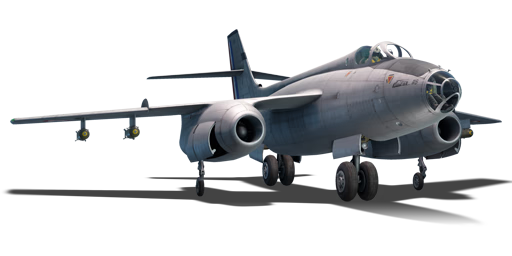
| − | + | The S.O.4050 Vautour II was a French project with the intention of creating a capable multirole twin-engined aircraft that could be used as a frontline bomber, close air support, or as an all-weather interceptor. With different variants developed, each one to fulfil a separate task, the '''Vautour IIB''' was the bomber of the family. Compared to the previous Vautour IIA, this one added an additional crew member at the front of the aircraft in a transparent nose, tasked with acquiring the target to release the bombs. A total of 40 Vautour IIBs were built, with some being sold to Israel in 1960. | |
| − | |||
| − | |||
| − | |||
| − | |||
| − | + | It was introduced in [[Update 1.73 "Vive la France"]]. The '''{{Specs|name}}''' acts as a bomber, as such, your main objective in air battles is to destroy enemy bases or destroy ground units to drain enemy tickets. Since it has a very good acceleration, it is one of the first to take off from the runway. When bombing, there are two main options: climbing to high altitudes and releasing the bombs from there works well but only in downtiers, since your lack of countermeasures makes it easy for enemy interceptors to attack you. The other option is rushing the enemy base, this works better and your acceleration makes it easier to be one of the first to reach the base, stay close to your team since you lack the agility or the countermeasures to avoid being hit by a missile or intercepted by a fighter. | |
== General info == | == General info == | ||
=== Flight performance === | === Flight performance === | ||
| − | ''Describe how the aircraft behaves in the air. Speed, manoeuvrability, acceleration and allowable loads - these are the most important characteristics of the vehicle.'' | + | {{Specs-Avia-Flight}} |
| + | <!-- ''Describe how the aircraft behaves in the air. Speed, manoeuvrability, acceleration and allowable loads - these are the most important characteristics of the vehicle.'' --> | ||
{| class="wikitable" style="text-align:center" width="70%" | {| class="wikitable" style="text-align:center" width="70%" | ||
! rowspan="2" | Characteristics | ! rowspan="2" | Characteristics | ||
| − | ! colspan="2" | Max Speed<br>(km/h at | + | ! colspan="2" | Max Speed<br>(km/h at 0 m - sea level) |
! rowspan="2" | Max altitude<br>(metres) | ! rowspan="2" | Max altitude<br>(metres) | ||
! colspan="2" | Turn time<br>(seconds) | ! colspan="2" | Turn time<br>(seconds) | ||
| Line 29: | Line 31: | ||
|- | |- | ||
! Stock | ! Stock | ||
| − | | | + | | 1,102 || 1,098 || rowspan="2" | {{Specs|ceiling}} || 32.6 || 33.2 || 43.5 || 39.6 || rowspan="2" | 900 |
|- | |- | ||
! Upgraded | ! Upgraded | ||
| − | | | + | | 1,113 || 1,107 || 31.5 || 32.0 || 68.2 || 55.0 |
|- | |- | ||
|} | |} | ||
==== Details ==== | ==== Details ==== | ||
| + | [[File:Vautour IIB Fuel Tanks.png|thumb|300x300px|Vautour IIB's self-sealing fuel tanks (fuel tanks are coloured in red)]] | ||
{| class="wikitable" style="text-align:center" width="50%" | {| class="wikitable" style="text-align:center" width="50%" | ||
|- | |- | ||
| − | ! colspan=" | + | ! colspan="6" | Features |
|- | |- | ||
| − | ! Combat flaps !! Take-off flaps !! Landing flaps !! Air brakes !! Arrestor gear | + | ! Combat flaps !! Take-off flaps !! Landing flaps !! Air brakes !! Arrestor gear !! Drogue chute |
|- | |- | ||
| − | | | + | | ✓ || ✓ || ✓ || ✓ || X || ✓ <!-- ✓ --> |
|- | |- | ||
|} | |} | ||
| Line 58: | Line 61: | ||
! Combat !! Take-off !! Landing !! + !! - | ! Combat !! Take-off !! Landing !! + !! - | ||
|- | |- | ||
| − | | {{Specs|destruction|body}} || {{Specs|destruction|gear}} || | + | | 1,166 <!-- {{Specs|destruction|body}} --> || {{Specs|destruction|gear}} || 584 || 564 || 463 || ~7 || ~3 |
|- | |- | ||
|} | |} | ||
| Line 68: | Line 71: | ||
! Ailerons !! Rudder !! Elevators !! Radiator | ! Ailerons !! Rudder !! Elevators !! Radiator | ||
|- | |- | ||
| − | | < | + | | < 480 || < 620 || < 590 || N/A |
|- | |- | ||
|} | |} | ||
| − | === | + | ==== Engine performance ==== |
| − | |||
| − | |||
| − | |||
| − | |||
| − | |||
| − | |||
| − | |||
| − | |||
| − | |||
| − | |||
| − | |||
| − | |||
| − | |||
| − | |||
| − | |||
| − | |||
| − | |||
| − | |||
| − | |||
| − | |||
| − | |||
| − | |||
| − | |||
| − | |||
| − | |||
| − | |||
| − | |||
| − | |||
| − | |||
| − | |||
| − | |||
| − | |||
| − | |||
| − | |||
| − | |||
| − | |||
| − | |||
| − | |||
| − | |||
| − | |||
| − | |||
| − | |||
| − | |||
| − | |||
| − | |||
| − | |||
| − | |||
| − | |||
| − | |||
| − | |||
| − | |||
| − | |||
| − | |||
| − | |||
| − | |||
| − | |||
| − | |||
| − | |||
{| class="wikitable" style="text-align:center" | {| class="wikitable" style="text-align:center" | ||
|- | |- | ||
| − | ! colspan=" | + | ! colspan="3" | Engine |
| + | ! colspan="4" | Aircraft mass | ||
| + | |- | ||
| + | ! colspan="2" | Engine name || Number | ||
| + | ! colspan="2" | Empty mass || colspan="2" | Wing loading (full fuel) | ||
| + | |- | ||
| + | | colspan="2" | SNECMA Atar 101E5 || 2 | ||
| + | | colspan="2" | 11,500 kg || colspan="2" | 327 kg/m<sup>2</sup> | ||
| + | |- | ||
| + | ! colspan="3" | Engine characteristics | ||
| + | ! colspan="3" | Mass with fuel (no weapons load) || rowspan="2" | Max Takeoff<br />Weight | ||
| + | |- | ||
| + | ! Weight (each) || colspan="2" | Type | ||
| + | ! 8m fuel || 20m fuel || 26m fuel | ||
| + | |- | ||
| + | | 950 kg || colspan="2" | Axial-flow turbojet | ||
| + | | 12,510 kg || 13,979 kg || 14,713 kg || 21,000 kg | ||
| + | |- | ||
| + | ! colspan="3" | {{Annotation|Maximum engine thrust @ 0 m (RB / SB)|The maximum thrust produced by each engine, while mounted in the aircraft. NOTE: Thrust varies significantly depending on speed & altitude.}} | ||
| + | ! colspan="4" | Thrust to weight ratio @ 0 m (110%) | ||
|- | |- | ||
| − | ! | + | ! Condition || 100% || 110% |
| − | ! | + | ! 8m fuel || 20m fuel || 26m fuel || MTOW |
| − | |||
| − | |||
| − | |||
|- | |- | ||
| − | + | | ''Stationary'' || 3,322 kgf || 3,787 kgf | |
| + | | 0.60 || 0.54 || 0.51 || 0.36 | ||
|- | |- | ||
| − | | | + | | ''Optimal'' || 3,627 kgf<br />(1,100 km/h) || 4,135 kgf<br />(1,100 km/h) |
| + | | 0.66 || 0.59 || 0.56 || 0.39 | ||
|- | |- | ||
|} | |} | ||
| + | [[File:Armor plates Vautour IIb.png|right|thumb|300px|Red = 50 mm Bulletproof glassYellow = 13.5 mm Steel plate Yellowish green = 6 mm Steel plate Green = 3 mm Steel plate Turquoise = 2 mm Steel plate]] | ||
| + | |||
| + | === Survivability and armour === | ||
| + | {{Specs-Avia-Armour}} | ||
| + | <!-- ''Examine the survivability of the aircraft. Note how vulnerable the structure is and how secure the pilot is, whether the fuel tanks are armoured, etc. Describe the armour, if there is any, and also mention the vulnerability of other critical aircraft systems.'' --> | ||
| + | |||
| + | * 50 mm Bulletproof glass in front of the pilot. | ||
| + | * 13.5 mm Steel plate behind the pilot's head. | ||
| + | * 6 + 13.5 mm Steel plate in nose. | ||
| + | * 3 mm Steel shell surrounding the cockpit in the fuselage. | ||
| + | * 2 mm Steel plate behind the fuel cells. | ||
| + | * 2 mm Steel plate in the tail. | ||
| + | |||
| + | === Modifications and economy === | ||
| + | {{Specs-Economy}} | ||
| + | |||
| + | == Armaments == | ||
| + | {{Specs-Avia-Armaments}} | ||
| + | === Suspended armament === | ||
| + | {{Specs-Avia-Suspended}} | ||
| + | <!-- ''Describe the aircraft's suspended armament: additional cannons under the wings, bombs, rockets and torpedoes. This section is especially important for bombers and attackers. If there is no suspended weaponry remove this subsection.'' --> | ||
| + | |||
| + | The '''''{{PAGENAME}}''''' can be outfitted with the following ordnance: | ||
| − | === | + | {| class="wikitable" style="text-align:center" width="100%" |
| − | + | |- | |
| − | ! | + | ! !! width="9%" | 1 !! width="9%" | 2 !! width="9%" | 3 !! width="9%" | 4 !! width="9%" | 5 |
| − | ! | + | | rowspan="6" width="30%" | <div class="ttx-image">[[File:Hardpoints_S.O.4050_Vautour_IIA.png]]</div> |
| − | |||
| − | |||
|- | |- | ||
| − | | | + | ! [[AN-M57 (250 lb)|250 lb AN-M57]] bombs |
| − | | | + | | 1 || 1 || 6 || 1 || 1 |
| − | | | ||
| − | | | ||
| − | | | ||
|- | |- | ||
| − | | | + | ! [[AN-M64A1 (500 lb)|500 lb AN-M64A1]] bombs |
| − | | | + | | 1 || 1 || 6 || 1 || 1 |
| − | | | ||
| − | | | ||
| − | | | ||
|- | |- | ||
| − | | | + | ! [[M117 cone 45 (750 lb)|750 lb M117 cone 45]] bombs |
| − | | | + | | 1 || 1 || 6 || 1 || 1 |
| − | | | ||
| − | | | ||
| − | | | ||
|- | |- | ||
| − | | | + | ! [[AN-M65A1 Fin M129 (1,000 lb)|1,000 lb AN-M65A1 Fin M129]] bombs |
| − | | | + | | 1 || 1 || 2 || 1 || 1 |
| − | | | ||
| − | | | ||
| − | | | ||
|- | |- | ||
| − | + | | colspan="6" | Maximum permissible weight imbalance: 1,000 kg | |
|- | |- | ||
|} | |} | ||
| + | |||
| + | {{Navigation-Start|Default weapon presets}} | ||
| + | {{Navigation-First-Simple-Line}} | ||
| + | * 10 x 250 lb AN-M57 bombs (2,500 lb total) | ||
| + | * 10 x 500 lb AN-M64A1 bombs (5,000 lb total) | ||
| + | * 10 x 750 lb M117 cone 45 bombs (7,500 lb total) | ||
| + | * 6 x 1,000 lb AN-M65A1 Fin M129 bombs (6,000 lb total) | ||
| + | {{Navigation-End}} | ||
| + | |||
| + | == Usage in battles == | ||
| + | <!-- ''Describe the tactics of playing in the aircraft, the features of using aircraft in a team and advice on tactics. Refrain from creating a "guide" - do not impose a single point of view, but instead, give the reader food for thought. Examine the most dangerous enemies and give recommendations on fighting them. If necessary, note the specifics of the game in different modes (AB, RB, SB).'' --> | ||
| + | |||
| + | Vautour IIB has very good acceleration, after takeoff side climb to 5000 m. From there you have two options, | ||
| + | |||
| + | ;'''Diving:''' | ||
| + | |||
| + | One way of playing the Vautour IIB is diving, rushing into a base bombing point and bombing it. Doing this can guaranteed a chance to drop a bomb at the base if the map is small enough to reach it. Following the bombing, the plane will still have a high speed due to the dive and so it can quickly withdraw back to the base to land and reload. However; this tactic doesn't work as well on larger maps where it would take a longer time to reach a base to bomb. Not to mention that doing so will sacrifice altitude and cause the Vautour to be below many enemy fighters, which the Vautour cannot defend itself due to lack of armaments. | ||
| + | |||
| + | ;'''Keeping your altitude:''' | ||
| + | |||
| + | The other way of using the Vautour IIB is by keeping your altitude and climbing and then using your bombsight to bomb a base. Staying at a high altitude can prove safer as it can cause the Vautour to stay atop of many enemy fighters. However, bombing can be harder due to many more variables to keep account for when using the bomb sight. Getting up to altitude at standard speed can also make reaching the base harder, and so it would take a longer time to complete a bombing run. In some cases, more well-performing fighters like the F-100s can make this tactic moot as their speed will ensure they catch up and destroy the Vautour before it has a chance to drop its payload. | ||
=== Pros and cons === | === Pros and cons === | ||
| Line 187: | Line 180: | ||
'''Pros:''' | '''Pros:''' | ||
| − | * | + | * Insane acceleration |
| − | * | + | * Climbs exceptionally well without ordnance |
| − | * | + | * Energy retention is great |
| − | * | + | * Airbrakes, you will need them to avoid compressing in a dive |
| − | + | * Possesses a bombsight | |
| − | |||
| − | * | ||
| − | |||
'''Cons:''' | '''Cons:''' | ||
| − | * | + | * Lacks the rocket payload options of the Vautour IIA |
| − | * | + | * Compresses at high speed |
| − | * | + | * Massive penalties in-flight performance when carrying full payloads |
| − | * | + | * Turns like a brick |
| − | * | + | * Roll rate is also unimpressive |
| − | * | + | * Fragile engines; a hit to an engine will make you easy prey for enemy fighters |
| + | * Relies heavily on team support even more than the Vautour IIA does | ||
| + | * Massive target | ||
| + | * No offensive armament | ||
| + | * 110% will easily overheat your engines after short use | ||
| + | * Lack countermeasures | ||
== History == | == History == | ||
<!-- ''Describe the history of the creation and combat usage of the aircraft in more detail than in the introduction. If the historical reference turns out to be too long, take it to a separate article, taking a link to the article about the vehicle and adding a block "/History" (example: <nowiki>https://wiki.warthunder.com/(Vehicle-name)/History</nowiki>) and add a link to it here using the <code>main</code> template. Be sure to reference text and sources by using <code><nowiki><ref></ref></nowiki></code>, as well as adding them at the end of the article with <code><nowiki><references /></nowiki></code>. This section may also include the vehicle's dev blog entry (if applicable) and the in-game encyclopedia description (under <code><nowiki>=== In-game description ===</nowiki></code>, also if applicable).'' --> | <!-- ''Describe the history of the creation and combat usage of the aircraft in more detail than in the introduction. If the historical reference turns out to be too long, take it to a separate article, taking a link to the article about the vehicle and adding a block "/History" (example: <nowiki>https://wiki.warthunder.com/(Vehicle-name)/History</nowiki>) and add a link to it here using the <code>main</code> template. Be sure to reference text and sources by using <code><nowiki><ref></ref></nowiki></code>, as well as adding them at the end of the article with <code><nowiki><references /></nowiki></code>. This section may also include the vehicle's dev blog entry (if applicable) and the in-game encyclopedia description (under <code><nowiki>=== In-game description ===</nowiki></code>, also if applicable).'' --> | ||
| − | |||
| − | + | The S.O.4050 Vautour IIB was developed by Sud Aviation after World War Two to meet the demand for the French Armée de l'Air. This was a challenging task, after the German occupation in France. Many aircraft design teams have scattered. France was also new to the new jet propulsion area. The requirements issued by the French government called for a jet-powered multi-role attack aircraft that can perform as a bomber, low-level attack aircraft, and an all-weather interceptor. SNCASO met those requirements with a modified version of the S.O 4000. The new plane was designated the S.O.4050 Vautour and was manufactured in three different variants. The plane would serve in the AdA for several decades before replaced the newer Dassault Mirage. The Vautour was also one of the stop-gap measures used by the AdA as a nuclear deterrent. The Vautour would later be exported to Israel and serve with the IAF to counter Egypt's IL-28 twin-engine bomber. | |
| − | + | The IIB, which differed from the previous IIA by adding a second crew member in a transparent nose, was a dedicated bomber variant. Its prototype first flew in December 1954. In total 40 of the IIB would be built. All were sold along with all of France's Vautour IIAs to Israel in 1960. | |
| − | + | == Media == | |
| − | + | <!-- ''Excellent additions to the article would be video guides, screenshots from the game, and photos.'' --> | |
| − | |||
| − | + | ;Skins | |
| − | + | * [https://live.warthunder.com/feed/camouflages/?vehicle=so_4050_vautour_2b Skins and camouflages for the {{PAGENAME}} from live.warthunder.com.] | |
| − | + | ;Images | |
| + | <gallery mode="packed-hover"> | ||
| + | Image:Damage Vautour IIb.png|<small>Damaged Vautour IIb</small> | ||
| + | </gallery> | ||
| − | + | ;Videos | |
| − | + | {{Youtube-gallery|5ybEEheCSXA|'''The S.O.4050 Vautour IIB Bomber''' - ''Orangefan''}} | |
| − | |||
| − | |||
| − | {{Youtube-gallery| | ||
== See also == | == See also == | ||
| − | ''Links to the articles on the War Thunder Wiki that you think will be useful for the reader, for example:'' | + | <!-- ''Links to the articles on the War Thunder Wiki that you think will be useful for the reader, for example:'' |
| + | * ''reference to the series of the aircraft;'' | ||
| + | * ''links to approximate analogues of other nations and research trees.'' --> | ||
| − | * | + | * [[Yak-28B]] |
| − | |||
== External links == | == External links == | ||
<!-- ''Paste links to sources and external resources, such as:'' | <!-- ''Paste links to sources and external resources, such as:'' | ||
* ''topic on the official game forum;'' | * ''topic on the official game forum;'' | ||
| − | |||
* ''other literature.'' --> | * ''other literature.'' --> | ||
| − | * [[ | + | * [[wikipedia:Sud_Aviation_Vautour|[Wikipedia] Sud Aviation Vautour]] |
| + | * [http://www.airvectors.net/avmir4.html <nowiki>[Air Vectors]</nowiki> The Sud Ouest Vautour II & Dassault Mirage IV] | ||
| + | * [https://forum.warthunder.com/index.php?/topic/385708-sud-aviation-so4050-vautour-iib/ Official data sheet - more details about the performance] | ||
| − | {{AirManufacturer | + | {{AirManufacturer SNCA SO}} |
| − | {{ | + | {{France jet aircraft}} |
| − | |||
Latest revision as of 18:41, 23 December 2023
| This page is about the French jet bomber S.O.4050 Vautour IIB. For other versions, see Vautour (Family). |


Contents
Description
The S.O.4050 Vautour II was a French project with the intention of creating a capable multirole twin-engined aircraft that could be used as a frontline bomber, close air support, or as an all-weather interceptor. With different variants developed, each one to fulfil a separate task, the Vautour IIB was the bomber of the family. Compared to the previous Vautour IIA, this one added an additional crew member at the front of the aircraft in a transparent nose, tasked with acquiring the target to release the bombs. A total of 40 Vautour IIBs were built, with some being sold to Israel in 1960.
It was introduced in Update 1.73 "Vive la France". The S.O.4050 Vautour IIB acts as a bomber, as such, your main objective in air battles is to destroy enemy bases or destroy ground units to drain enemy tickets. Since it has a very good acceleration, it is one of the first to take off from the runway. When bombing, there are two main options: climbing to high altitudes and releasing the bombs from there works well but only in downtiers, since your lack of countermeasures makes it easy for enemy interceptors to attack you. The other option is rushing the enemy base, this works better and your acceleration makes it easier to be one of the first to reach the base, stay close to your team since you lack the agility or the countermeasures to avoid being hit by a missile or intercepted by a fighter.
General info
Flight performance
| Characteristics | Max Speed (km/h at 0 m - sea level) |
Max altitude (metres) |
Turn time (seconds) |
Rate of climb (metres/second) |
Take-off run (metres) | |||
|---|---|---|---|---|---|---|---|---|
| AB | RB | AB | RB | AB | RB | |||
| Stock | 1,102 | 1,098 | 32.6 | 33.2 | 43.5 | 39.6 | 900 | |
| Upgraded | 1,113 | 1,107 | 31.5 | 32.0 | 68.2 | 55.0 | ||
Details

| Features | |||||
|---|---|---|---|---|---|
| Combat flaps | Take-off flaps | Landing flaps | Air brakes | Arrestor gear | Drogue chute |
| ✓ | ✓ | ✓ | ✓ | X | ✓ |
| Limits | ||||||
|---|---|---|---|---|---|---|
| Wings (km/h) | Gear (km/h) | Flaps (km/h) | Max Static G | |||
| Combat | Take-off | Landing | + | - | ||
| 1,166 | 584 | 564 | 463 | ~7 | ~3 | |
| Optimal velocities (km/h) | |||
|---|---|---|---|
| Ailerons | Rudder | Elevators | Radiator |
| < 480 | < 620 | < 590 | N/A |
Engine performance
| Engine | Aircraft mass | |||||
|---|---|---|---|---|---|---|
| Engine name | Number | Empty mass | Wing loading (full fuel) | |||
| SNECMA Atar 101E5 | 2 | 11,500 kg | 327 kg/m2 | |||
| Engine characteristics | Mass with fuel (no weapons load) | Max Takeoff Weight | ||||
| Weight (each) | Type | 8m fuel | 20m fuel | 26m fuel | ||
| 950 kg | Axial-flow turbojet | 12,510 kg | 13,979 kg | 14,713 kg | 21,000 kg | |
| Maximum engine thrust @ 0 m (RB / SB) | Thrust to weight ratio @ 0 m (110%) | |||||
| Condition | 100% | 110% | 8m fuel | 20m fuel | 26m fuel | MTOW |
| Stationary | 3,322 kgf | 3,787 kgf | 0.60 | 0.54 | 0.51 | 0.36 |
| Optimal | 3,627 kgf (1,100 km/h) |
4,135 kgf (1,100 km/h) |
0.66 | 0.59 | 0.56 | 0.39 |

Survivability and armour
- 50 mm Bulletproof glass in front of the pilot.
- 13.5 mm Steel plate behind the pilot's head.
- 6 + 13.5 mm Steel plate in nose.
- 3 mm Steel shell surrounding the cockpit in the fuselage.
- 2 mm Steel plate behind the fuel cells.
- 2 mm Steel plate in the tail.
Modifications and economy
Armaments
Suspended armament
The S.O.4050 Vautour IIB can be outfitted with the following ordnance:
| 1 | 2 | 3 | 4 | 5 |  | |
|---|---|---|---|---|---|---|
| 250 lb AN-M57 bombs | 1 | 1 | 6 | 1 | 1 | |
| 500 lb AN-M64A1 bombs | 1 | 1 | 6 | 1 | 1 | |
| 750 lb M117 cone 45 bombs | 1 | 1 | 6 | 1 | 1 | |
| 1,000 lb AN-M65A1 Fin M129 bombs | 1 | 1 | 2 | 1 | 1 | |
| Maximum permissible weight imbalance: 1,000 kg | ||||||
| Default weapon presets | |
|---|---|
| |
Usage in battles
Vautour IIB has very good acceleration, after takeoff side climb to 5000 m. From there you have two options,
- Diving:
One way of playing the Vautour IIB is diving, rushing into a base bombing point and bombing it. Doing this can guaranteed a chance to drop a bomb at the base if the map is small enough to reach it. Following the bombing, the plane will still have a high speed due to the dive and so it can quickly withdraw back to the base to land and reload. However; this tactic doesn't work as well on larger maps where it would take a longer time to reach a base to bomb. Not to mention that doing so will sacrifice altitude and cause the Vautour to be below many enemy fighters, which the Vautour cannot defend itself due to lack of armaments.
- Keeping your altitude:
The other way of using the Vautour IIB is by keeping your altitude and climbing and then using your bombsight to bomb a base. Staying at a high altitude can prove safer as it can cause the Vautour to stay atop of many enemy fighters. However, bombing can be harder due to many more variables to keep account for when using the bomb sight. Getting up to altitude at standard speed can also make reaching the base harder, and so it would take a longer time to complete a bombing run. In some cases, more well-performing fighters like the F-100s can make this tactic moot as their speed will ensure they catch up and destroy the Vautour before it has a chance to drop its payload.
Pros and cons
Pros:
- Insane acceleration
- Climbs exceptionally well without ordnance
- Energy retention is great
- Airbrakes, you will need them to avoid compressing in a dive
- Possesses a bombsight
Cons:
- Lacks the rocket payload options of the Vautour IIA
- Compresses at high speed
- Massive penalties in-flight performance when carrying full payloads
- Turns like a brick
- Roll rate is also unimpressive
- Fragile engines; a hit to an engine will make you easy prey for enemy fighters
- Relies heavily on team support even more than the Vautour IIA does
- Massive target
- No offensive armament
- 110% will easily overheat your engines after short use
- Lack countermeasures
History
The S.O.4050 Vautour IIB was developed by Sud Aviation after World War Two to meet the demand for the French Armée de l'Air. This was a challenging task, after the German occupation in France. Many aircraft design teams have scattered. France was also new to the new jet propulsion area. The requirements issued by the French government called for a jet-powered multi-role attack aircraft that can perform as a bomber, low-level attack aircraft, and an all-weather interceptor. SNCASO met those requirements with a modified version of the S.O 4000. The new plane was designated the S.O.4050 Vautour and was manufactured in three different variants. The plane would serve in the AdA for several decades before replaced the newer Dassault Mirage. The Vautour was also one of the stop-gap measures used by the AdA as a nuclear deterrent. The Vautour would later be exported to Israel and serve with the IAF to counter Egypt's IL-28 twin-engine bomber.
The IIB, which differed from the previous IIA by adding a second crew member in a transparent nose, was a dedicated bomber variant. Its prototype first flew in December 1954. In total 40 of the IIB would be built. All were sold along with all of France's Vautour IIAs to Israel in 1960.
Media
- Skins
- Images
Damaged Vautour IIb

- Videos
See also
External links
- [Wikipedia] Sud Aviation Vautour
- [Air Vectors] The Sud Ouest Vautour II & Dassault Mirage IV
- Official data sheet - more details about the performance
| SNCA SO (Société nationale des constructions aéronautiques du sud-ouest) | |
|---|---|
| Fighters | S.O.8000 Narval |
| Jet Fighters | S.O.4050 Vautour IIN (late) |
| Jet Bombers | S.O.4050 Vautour IIA · S.O.4050 Vautour IIB · S.O.4050 Vautour IIN |
| Export | Vautour IIA IDF/AF · Vautour IIA · Vautour IIN |
| France jet aircraft | |
|---|---|
| Fighters | M.D.450B Ouragan · M.D.450B Barougan · M.D.452 IIA · M.D.452 IIC · Mystere IVA · Super Mystere B2 |
| ▄F-86K · ▄F-100D · ▄F-8E(FN) | |
| Mirage IIIC · Mirage IIIE · Milan · Mirage 5F · Mirage 2000C-S4 · Mirage 2000C-S5 · Mirage 2000-5F · Mirage 4000 | |
| Mirage F1C · Mirage F1C-200 · Mirage F1CT | |
| Strike aircraft | ▄F-84F · F-84F IAF · ▄F-84G-26-RE |
| Etendard IVM · Super Etendard · Alpha Jet E | |
| Jaguar A · Jaguar E · Mirage 2000D-R1 · Mirage 2000D-RMV | |
| Bombers | S.O.4050 Vautour IIA · Vautour IIA IDF/AF · S.O.4050 Vautour IIB · S.O.4050 Vautour IIN · S.O.4050 Vautour IIN (late) |
| Belgium | ▄Meteor F Mk.8 · ▄Mirage 5BA · ▄F-104G · ▄F-16A · ▄F-16AM |
| Netherlands | ◘Sea Hawk Mk.50 · ◘Hunter F.6 |