Difference between pages "Pz.IV G (Italy)" and "DT (7.62 mm)"
(whole page lol) (Tag: Visual edit) |
m (→Comparison with analogues) |
||
| Line 1: | Line 1: | ||
| − | + | [[File:DT.png|550px|thumb|right|The DT on the BT-7A (F-32)]] | |
| − | + | == Description == | |
| − | + | <!-- ''Write an introduction to the article in 2-3 small paragraphs. Briefly tell us about the history of the development and combat using the weaponry and also about its features. Compile a list of air, ground, or naval vehicles that feature this weapon system in the game.'' --> | |
| − | |||
| − | + | The '''7.62 mm DT''' is a Soviet machine gun used on a variety of armoured fighting vehicles. A conversion of an infantry light machine gun for ground vehicle mounts, the DT provides a steady rate of fire to suppress or harass enemy vehicles and their crew with. | |
| − | |||
| − | The ''' | ||
| − | == | + | === Vehicles equipped with this weapon === |
| − | + | <!-- ''List out vehicles that are equipped with the weapon.'' --> | |
| − | |||
| − | <!-- '' | ||
| − | |||
| − | + | {{Navigation-Start|Vehicles equipped with this weapon}} | |
| − | ''' | + | {{Navigation-First-Line|'''Light tanks'''}} |
| − | + | {{Navigation-Line|BT-5}}{{Specs-Link|ussr_bt_5}}{{-}}{{Specs-Link|ussr_rbt_5}} | |
| − | + | {{Navigation-Line|BT-7}}{{Specs-Link|ussr_bt_7_1937}}{{-}}{{Specs-Link|ussr_bt_7_1937_td}}{{-}}{{Specs-Link|ussr_bt_7a_f32}}{{-}}{{Specs-Link|ussr_bt_7_m}} | |
| + | {{Navigation-Line|T-26}}{{Specs-Link|ussr_t_26_1940}}{{-}}{{Specs-Link|ussr_t_26_1940_1st_GvTBr}}{{-}}{{Specs-Link|cn_t_26_1940}}{{-}}{{Specs-Link|cn_t_26_no531}}{{-}}{{Specs-Link|ussr_t_26_4}}{{-}}{{Specs-Link|ussr_t_26E}}{{-}}{{Specs-Link|sw_vickers_mk_e_45}} | ||
| + | {{Navigation-Line|Other}}{{Specs-Link|ussr_ba_11}}{{-}}{{Specs-Link|ussr_t_50}}{{-}}{{Specs-Link|ussr_t_60_1941}}{{-}}{{Specs-Link|ussr_t_70_1942}}{{-}}{{Specs-Link|ussr_t_80}}{{-}}{{Specs-Link|ussr_t_126sp}} | ||
| − | { | + | {{Navigation-First-Line|'''Medium tanks'''}} |
| − | + | {{Navigation-Line|T-28}}{{Specs-Link|ussr_t_28}}{{-}}{{Specs-Link|sw_t_28}}{{-}}{{Specs-Link|ussr_t_28E}}{{-}}{{Specs-Link|ussr_t_28_1938}} | |
| − | + | {{Navigation-Line|T-34}}{{Specs-Link|ussr_t_34_1940_l_11}}{{-}}{{Specs-Link|ussr_t_34_1941}}{{-}}{{Specs-Link|sw_t_34_1941}}{{-}}{{Specs-Link|ussr_t_34_1941_57}}{{-}}{{Specs-Link|ussr_t_34_1941_cast_turret}}{{-}}{{Specs-Link|ussr_t_34_1941_l_11}}{{-}}{{Specs-Link|ussr_t_34_1942}}{{-}}{{Specs-Link|cn_t_34_1942}}{{-}}{{Specs-Link|germ_t_34_747}}{{-}}{{Specs-Link|ussr_t_34E}}{{-}}{{Specs-Link|ussr_t_34E_STZ}} | |
| − | + | {{Navigation-Line|T-34-57}}{{Specs-Link|ussr_t_34_57_1943}} | |
| − | | | + | {{Navigation-Line|T-34-85}}{{Specs-Link|ussr_t_34_85_d_5t}}{{-}}{{Specs-Link|cn_t_34_85_d_5t}}{{-}}{{Specs-Link|ussr_t_34_85_zis_53}}{{-}}{{Specs-Link|sw_t_34_85_zis_53}}{{-}}{{Specs-Link|cn_t_34_85_zis_53_no215}}{{-}}{{Specs-Link|ussr_t_34_85E}} |
| − | |- | + | {{Navigation-Line|T-34-100}}{{Specs-Link|ussr_t_34_100}} |
| − | | | + | {{Navigation-Line|T-44}}{{Specs-Link|ussr_t_44}}{{-}}{{Specs-Link|ussr_t_44_100}}{{-}}{{Specs-Link|ussr_t_44_122}} |
| − | |- | ||
| − | | | ||
| − | |- | ||
| − | |} | ||
| − | ''' | + | {{Navigation-First-Line|'''Heavy tanks'''}} |
| − | + | {{Navigation-Line|IS-2}}{{Specs-Link|ussr_is_2_1943}}{{-}}{{Specs-Link|cn_is_2_1943}}{{-}}{{Specs-Link|cn_is_2_1943_no402}}{{-}}{{Specs-Link|ussr_is_2_1944}}{{-}}{{Specs-Link|ussr_is_2_1944_revenge}}{{-}}{{Specs-Link|ussr_is_2_1944_321}}{{-}}{{Specs-Link|cn_is_2_1944}}{{-}}{{Specs-Link|ussr_object_248}} | |
| + | {{Navigation-Line|KV-1}}{{Specs-Link|ussr_kv_1_L_11}}{{-}}{{Specs-Link|ussr_kv_1_zis_5}}{{-}}{{Specs-Link|ussr_kv_1e}}{{-}}{{Specs-Link|ussr_kv_1s}}{{-}}{{Specs-Link|germ_kv_1B_finland}} | ||
| + | {{Navigation-Line|KV-2}}{{Specs-Link|ussr_kv_2_1940}}{{-}}{{Specs-Link|ussr_kv_2_zis_6}}{{-}}{{Specs-Link|germ_kv_2_754r}} | ||
| + | {{Navigation-Line|Matilda}}{{Specs-Link|ussr_a_12_mk_2_matilda_2A_F96}} | ||
| + | {{Navigation-Line|Other}}{{Specs-Link|ussr_smk}}{{-}}{{Specs-Link|ussr_is_1}}{{-}}{{Specs-Link|ussr_is_3}}{{-}}{{Specs-Link|ussr_is_6}}{{-}}{{Specs-Link|ussr_kv_85}}{{-}}{{Specs-Link|ussr_kv_122}}{{-}}{{Specs-Link|ussr_kv_220}}{{-}}{{Specs-Link|ussr_t_35}} | ||
| − | + | {{Navigation-First-Line|'''Tank destroyers'''}}{{Specs-Link|ussr_zis_30}} | |
| − | {{ | ||
| − | |||
| − | {{ | + | {{Navigation-End}} |
| − | === | + | == General info == |
| − | + | <!--''Tell us about the tactical and technical characteristics of the cannon or machine gun.''--> | |
| + | A conversion of a 1920s infantry light machine gun, the DT has lots of characteristics of an early machine gun with a rather slow rate of fire. The magazine-fed nature also means that there are frequent down time to reload the machine gun if firing discipline is not maintained. However, this reload time is short again due to the magazine feeding system. | ||
| − | + | The DT firepower is otherwise nothing special compared to other machine guns of other nations aside from its firing characteristics. | |
| − | |||
| − | |||
| − | |||
| − | |||
| − | |||
| − | {| class="wikitable" style="text-align:center" | + | {| class="wikitable" style="text-align:center" |
| + | ! colspan="2" | Gun characteristics | ||
|- | |- | ||
| − | + | | '''Mass''' || 8.6 kg (empty) | |
|- | |- | ||
| − | + | | '''Caliber''' || 7.62x54 mmR | |
| − | |||
| − | |||
|- | |- | ||
| − | + | | '''Rate of fire''' || 600 | |
| − | |||
|- | |- | ||
| − | + | | '''Overall length''' || 1138 mm | |
| − | |||
|- | |- | ||
| + | | '''Ammo feed''' || fixed 63-round drum | ||
|} | |} | ||
| − | |||
| − | + | === Available ammunition === | |
| − | + | {{:{{PAGENAME}}/Ammunition| AP-I, T, AI, API-T}} | |
| − | |||
| − | |||
| − | |||
| − | + | === Comparison with analogues === | |
| − | + | [[M1919A4 (7.62 mm)|M1919A4]] (.30-06; 7.62x63 mm) - American standard issue coaxial and anti-aircraft machine gun, has higher belt capacity than the DT while having lesser rate of fire. | |
| − | |||
| − | |||
| − | |||
| − | |||
| − | | | ||
| − | |||
| − | |||
| − | |||
| − | |||
| − | |||
| − | |||
| − | |||
| − | |||
| − | |||
| − | |||
| − | |||
| − | |||
| − | |||
| − | |||
| − | |||
| − | |||
| − | |||
| − | |||
| − | |||
| − | |||
| − | |||
| − | |||
| − | |||
| − | |||
| − | |||
| − | |||
| − | |||
| − | |||
| − | |||
| − | |||
| − | |||
| − | |||
| − | |||
| − | |||
| − | |||
| − | |||
| − | |||
| − | |||
| − | |||
| − | |||
| − | |||
| − | |||
| − | |||
| − | |||
| − | |||
| − | |||
| − | |||
| − | |||
| − | + | [[BESA (7.92 mm)|BESA]] (.303; 7.7×56 mmR) - UK standard issue coaxial machine gun, also has higher belt capacity while sharing identical rate of fire. | |
| − | |||
| − | |||
| − | |||
| − | |||
| − | |||
| − | |||
| − | |||
| − | |||
| − | |||
| − | |||
| − | |||
| − | |||
| − | |||
| − | |||
| − | |||
| − | |||
| − | |||
| − | |||
| − | |||
| − | |||
| − | |||
| − | |||
| − | |||
| − | |||
| − | |||
| − | |||
| − | |||
| − | |||
| − | |||
| − | |||
| − | + | [[MG34 (7.92 mm)|MG34]] (7.92x57 mm) - German GPMG for both infantry and armored vehicles, having much higher rate of fire and belt capacity. | |
| − | |||
| − | |||
| − | |||
| − | |||
| − | |||
| − | |||
| − | |||
| − | |||
| − | |||
| − | |||
| − | |||
| − | |||
| − | |||
== Usage in battles == | == Usage in battles == | ||
| − | <!-- ''Describe the | + | <!--''Describe the cannon/machine gun in the game - its distinctive features, tactics of usage against notable opponents. Please don't write a "guide" - do not impose a single point of view, but give the reader food for thought.''--> |
| − | + | As the primary coaxial weapon for the majority of the Soviet Union's World War II designed/produced armoured fighting vehicles, the DT machine gun is a weapon that players will need to familiarize themselves with for a good part of the Soviet tech tree. Unlike most other nation which have belt-fed weapons, the DT is magazine-fed and so cannot carelessly fire away without worrying about the magazine being emptied. Though the reload time is short, it does leave the vehicle more vulnerable to targets that may otherwise be receiving a good hail of machine gun fire at the moment like aircraft or thin-skinned open-top vehicles. | |
| − | + | That said, as a coaxial mount, the machine gun does not have great elevation and so should remain as a secondary armament against enemy ground units. | |
=== Pros and cons === | === Pros and cons === | ||
| − | <!-- ''Summarise and briefly evaluate the | + | <!--''Summarise and briefly evaluate the weaponry in terms of its characteristics and combat effectiveness. Mark pros and cons as a list.''--> |
'''Pros:''' | '''Pros:''' | ||
| + | * No worse than most other machine gun round performance | ||
| + | * Reload time between magazines is short | ||
| − | * | + | '''Cons:''' |
| − | * | + | * Slow rate of fire means fire saturation is poor |
| + | * Magazine feeding system means that ammo reserve between reloads is small compared to belt-fed weapons | ||
| − | + | == History == | |
| + | <!--''Examine the history of the creation and combat usage of the weapon in more detail than in the introduction. If the historical reference turns out to be too long, take it to a separate article, taking a link to the article about the weapon and adding a block "/History" (example: <nowiki>https://wiki.warthunder.com/(Weapon-name)/History</nowiki>) and add a link to it here using the <code>main</code> template. Be sure to reference text and sources by using <code><nowiki><ref></ref></nowiki></code>, as well as adding them at the end of the article with <code><nowiki><references /></nowiki></code>.''--> | ||
| + | After World War I, the new Soviet government and its military sought to learn from Russia's experience in World War I. The light machine guns were a particular type of weapons that were looked into, inspired by the Russian experience using the British [[Lewis (7.7 mm)|Lewis machine gun]]. The Soviet military tasked Vasily Alekseyevich Degtyaryov with the job of designing a new light machine gun for the Red Army. Degtyaryov produced a weapon with a rather simple design chambering the 7.62x54R mm cartridge, with the weapon's function composing of six working parts. The weapon was loaded by a pan-shaped magazine in a manner similar to the Lewis machine gun, a physical trait that Soviet soldiers would nickname the weapon as ''proigryvatel'' ("phonograph" or "record player").<ref name="WiB_DP">War Is Boring 2016</ref> Degtyaryov's weapon was adopted as the Red Army's newest light machine gun in 1927 under the name ''{{Annotation|DP|Degtyaryov Pechotnyi (Infantry)}}'' machine gun.<ref name="Popenker_Degtyarov">Popenker, n.d.</ref> The DP gun is also sometimes referenced as the ''DP-27'' or ''DP-28'' (1928 being the DP's general service distribution date). | ||
| − | + | The DP machine gun would serve in most Red Army conflict onward, most notably in World War II. Though well-served, the initial models had issues with bipod structural strength and lack of a manual safety (only a grip safety was present).<ref name="Popenker_Degtyarov"/> Until World War II, the only considered modification of the DP machine gun, based on the fighting experience against the Japanese and their [[Type 91 (6.5 mm)|Type 11 machine guns]] in 1938-1939, was transforming the feed mechanism from using the large pan-shaped magazine to a slimmer hopper-type system that is fed with ammunition clips. However, this design was dropped due to awkward handling and unsatisfactory reliability.<ref name="ForgottenWeapons_DPHopper">McCollum 2011a</ref> Following the experience from World War II battles, the DP machine gun underwent a modernization between 1943-1944 as the ''DPM'', which introduced a pistol grip, redesigned stock, a safe/fire selector, the repositioning of the recoil spring to the rear, and a stronger bipod.<ref name="ForgottenWeapons_DPvDT">McCollum 2011b</ref> | |
| + | [[File:Machine gun DP and DT.jpg|x250px|thumb|right|A DP (rear) and DT (front) machine gun on display.]] | ||
| − | ''' | + | The DP was also be used as vehicle mounts under the variations ''[[DA (7.62 mm)|DA]]'' for aircraft mounts, and '''DT''' for tank mounts (alongside the modernised ''DTM''). These variants were notable for their removed barrel shroud for a heavy barrel, different stock design (the DT would have a collapsible stock), and a redesigned 60-round magazine with a taller, three-layered ammunition arrangement that was smaller in width to for mounting within a constrained vehicle space.<ref name="Popenker_Degtyarov"/><ref name="ForgottenWeapons_DTM">McCollum 2011c</ref><ref name="McNab_SU_MG">McNab 2022, 18</ref> |
| − | + | After World War II, the Soviet decide to replace the cumbersome pan-magazine on the DP with a belt-fed system. The DP machine gun was modified once again in 1946 with an add-on module that converts a DP to be able to take an ammunition belt from the [[SGMT (7.62 mm)|SG-43/SGM]] machine gun.<ref name="ForgottenWeapons_RP46">McCollum 2011d</ref> This modification was adopted as the ''[[RP-46 (7.62 mm)|RP-46]]'' (''Rotnyj Pulemet'' (Company Machine Gun), 1946). The machine gun would remain in use in the Soviet military until supplemented by the universal [[PKT_(7.62_mm)|PK machine gun]].<ref name="Popenker_Degtyarov"/> | |
| − | |||
| − | + | The DP and its variations sees wide-spread use in Soviet-aligned countries such as North Korea and China,<ref name="Popenker_Degtyarov"/><ref name="ForgottenWeapons_RP46Variants">McCollum 2018</ref> the latter of which license-produced the DPM machine gun as the Type 53.<ref name="DIA_SmallArms">Kettrick 1983, p.235</ref> | |
| − | |||
| − | |||
| − | |||
| − | |||
== Media == | == Media == | ||
<!-- ''Excellent additions to the article would be video guides, screenshots from the game, and photos.'' --> | <!-- ''Excellent additions to the article would be video guides, screenshots from the game, and photos.'' --> | ||
| − | + | ||
| + | ;Images | ||
| + | <gallery mode="packed-hover" heights="150"> | ||
| + | File:Weapon DT (7.62 mm).png|<small>The hull-mounted DT on the ZiS-30</small> | ||
| + | </gallery> | ||
== See also == | == See also == | ||
| − | + | ''Links to the articles on the War Thunder Wiki that you think will be useful for the reader, for example:'' | |
| − | * ''reference to the | + | * ''reference to the article about the variant of the cannon/machine gun;'' |
| − | + | * ''references to approximate analogues by other nations and research trees.'' | |
| − | |||
| − | |||
| − | |||
| − | * '' | ||
== External links == | == External links == | ||
| − | <!-- ''Paste links to sources and external resources, such as:'' | + | <!--''Paste links to sources and external resources, such as:'' |
* ''topic on the official game forum;'' | * ''topic on the official game forum;'' | ||
| − | * ''other literature.'' --> | + | * ''other literature.''--> |
| − | < | + | |
| + | === References === | ||
| + | ;Citations | ||
| + | <references /> | ||
| + | |||
| + | ;Bibliography: | ||
| + | |||
| + | * Kettrick, James F. 1983. ''Small Arms Identification and Operation Guide - Eurasian Communist Countries (U)''. Washington D.C.: Defense Intelligence Agency. | ||
| + | * McCollum, Ian. 2011b. "DP-28 vs DPM." Forgotten Weapons. Last modified April 27, 2011. [https://www.forgottenweapons.com/dp-28-vs-dpm/ Website] ([https://web.archive.org/web/20201030050107/https://www.forgottenweapons.com/dp-28-vs-dpm/ Archive]). | ||
| + | * McCollum, Ian. 2011c. "DTM Manual." Forgotten Weapons. Last modified January 24, 2011. [https://www.forgottenweapons.com/dtm-manual/ Website] ([https://web.archive.org/web/20210116121854/https://www.forgottenweapons.com/dtm-manual/ Archive]). | ||
| + | * McCollum, Ian. 2011a "Kubynov hopper-fed DP28." Forgotten Weapons. Last modified March 16, 2011. [https://www.forgottenweapons.com/kubynov-hopper-fed-dp28/ Website] ([https://web.archive.org/web/20201030102032/https://www.forgottenweapons.com/kubynov-hopper-fed-dp28/ Archive]). | ||
| + | * McCollum, Ian. 2011d. "RP46 LMG." Forgotten Weapons, Last modified January 10, 2011. [https://www.forgottenweapons.com/rd-46-manual-and-photos/ Website] ([https://web.archive.org/web/20210402170033/https://www.forgottenweapons.com/rd-46-manual-and-photos/ Archive]). | ||
| + | * McCollum, Ian. 2018. "RP46 Variations: Russian, North Korean, and US Reproduction." Forgotten Weapons. Last modified July 04, 2018. [https://www.forgottenweapons.com/rp46-variations-russian-north-korean-and-us-reproduction/ Website] ([https://web.archive.org/web/20210402170133/https://www.forgottenweapons.com/rp46-variations-russian-north-korean-and-us-reproduction/ Archive]). | ||
| + | * McNab, Chris. ''Soviet Machine Guns of World War II''. Oxford, UK: Osprey Publishing. | ||
| + | * Popenker, Maxim. n.d. "Degtyarov DP DPM RP-46." Modern Firearms. [https://modernfirearms.net/en/machineguns/russia-machineguns/dp-dpm-rp-46-eng/ Website] ([https://web.archive.org/web/20210402170143/https://modernfirearms.net/en/machineguns/russia-machineguns/dp-dpm-rp-46-eng/ Archive]). | ||
| + | * War Is Boring. 2016 "The DP Machine Gun Looks Funny, But Spilled a Lot of Blood." ''Medium'', A Medium Corporation. Last modified February 23, 2016. [https://medium.com/war-is-boring/the-dp-machine-gun-looks-funny-but-spilled-a-lot-of-blood-f91f1cb4bf36 Website] ([https://web.archive.org/web/20210623160339/https://medium.com/war-is-boring/the-dp-machine-gun-looks-funny-but-spilled-a-lot-of-blood-f91f1cb4bf36 Archive]). | ||
| − | + | {{Tank machine guns}} | |
| − | |||
| − | + | [[Category:Tank machine guns]] | |
| − | |||
Latest revision as of 21:03, 18 December 2023

Contents
Description
The 7.62 mm DT is a Soviet machine gun used on a variety of armoured fighting vehicles. A conversion of an infantry light machine gun for ground vehicle mounts, the DT provides a steady rate of fire to suppress or harass enemy vehicles and their crew with.
Vehicles equipped with this weapon
| Vehicles equipped with this weapon | |
|---|---|
| Light tanks | |
| BT-5 | BT-5 · RBT-5 |
| BT-7 | BT-7 · BT-7 TD · BT-7A (F-32) · BT-7M |
| T-26 | T-26 · T-26 (1st Gv.T.Br.) · ␗T-26 · T-26 No.531 · T-26-4 · T-26E · ▄T-26E |
| Other | BA-11 · T-50 · T-60 · T-70 · T-80 · T-126 |
| Medium tanks | |
| T-28 | T-28 · ▄T-28 · T-28E · T-28 (1938) |
| T-34 | T-34 (Prototype) · T-34 (1941) · ▄T-34 · T-34-57 · T-34 (1st Gv.T.Br.) · T-34 (1940) · T-34 (1942) · ␗T-34 (1943) · ▀T 34 747 (r) · T-34E · T-34E STZ |
| T-34-57 | T-34-57 (1943) |
| T-34-85 | T-34-85 (D-5T) · ␗Т-34-85 (S-53) · T-34-85 · ▄T-34-85 · T-34-85 No.215 · T-34-85E |
| T-34-100 | T-34-100 |
| T-44 | T-44 · T-44-100 · T-44-122 |
| Heavy tanks | |
| IS-2 | IS-2 · ␗IS-2 · IS-2 No.402 · IS-2 (1944) · IS-2 "Revenge" · IS-2 No.321 · ␗IS-2 (1944) · Object 248 |
| KV-1 | KV-1 (L-11) · KV-1 (ZiS-5) · KV-1E · KV-1S · ▀KV-IB |
| KV-2 | KV-2 (1940) · KV-2 (ZiS-6) · ▀KW II 754 (r) |
| Matilda | ▂MK-II "Matilda" |
| Other | SMK · IS-1 · IS-3 · IS-6 · KV-85 · KV-122 · KV-220 · T-35 |
| Tank destroyers | ZiS-30 |
General info
A conversion of a 1920s infantry light machine gun, the DT has lots of characteristics of an early machine gun with a rather slow rate of fire. The magazine-fed nature also means that there are frequent down time to reload the machine gun if firing discipline is not maintained. However, this reload time is short again due to the magazine feeding system.
The DT firepower is otherwise nothing special compared to other machine guns of other nations aside from its firing characteristics.
| Gun characteristics | |
|---|---|
| Mass | 8.6 kg (empty) |
| Caliber | 7.62x54 mmR |
| Rate of fire | 600 |
| Overall length | 1138 mm |
| Ammo feed | fixed 63-round drum |
Available ammunition
| Penetration statistics | |||||||
|---|---|---|---|---|---|---|---|
| Ammunition | Penetration @ 0° Angle of Attack (mm) | ||||||
| 10 m | 100 m | 500 m | 1,000 m | 1,500 m | 2,000 m | ||
| AP-I | 13 | 12 | 7 | 3 | 2 | 0 | |
| T | 5 | 4 | 2 | 1 | 0 | 0 | |
| AI | 3 | 3 | 3 | 3 | 3 | 3 | |
| API-T | 9 | 8 | 6 | 3 | 0 | 0 | |
| Shell details | ||||||||||||
|---|---|---|---|---|---|---|---|---|---|---|---|---|
| Ammunition | Velocity (m/s) |
Projectile mass (kg) |
Fuse delay (m) |
Fuse sensitivity (mm) |
Explosive mass (TNT equivalent) (g) |
Ricochet | ||||||
| 0% | 50% | 100% | ||||||||||
| AP-I | 818 | 0.01 | - | - | - | 47° | 56° | 65° | ||||
| T | 815 | 0.01 | - | - | - | 47° | 56° | 65° | ||||
| AI | 815 | 0.01 | 0 | 3 | 0 | 47° | 56° | 65° | ||||
| API-T | 865 | 0.01 | - | - | - | 47° | 56° | 65° | ||||
Comparison with analogues
M1919A4 (.30-06; 7.62x63 mm) - American standard issue coaxial and anti-aircraft machine gun, has higher belt capacity than the DT while having lesser rate of fire.
BESA (.303; 7.7×56 mmR) - UK standard issue coaxial machine gun, also has higher belt capacity while sharing identical rate of fire.
MG34 (7.92x57 mm) - German GPMG for both infantry and armored vehicles, having much higher rate of fire and belt capacity.
Usage in battles
As the primary coaxial weapon for the majority of the Soviet Union's World War II designed/produced armoured fighting vehicles, the DT machine gun is a weapon that players will need to familiarize themselves with for a good part of the Soviet tech tree. Unlike most other nation which have belt-fed weapons, the DT is magazine-fed and so cannot carelessly fire away without worrying about the magazine being emptied. Though the reload time is short, it does leave the vehicle more vulnerable to targets that may otherwise be receiving a good hail of machine gun fire at the moment like aircraft or thin-skinned open-top vehicles.
That said, as a coaxial mount, the machine gun does not have great elevation and so should remain as a secondary armament against enemy ground units.
Pros and cons
Pros:
- No worse than most other machine gun round performance
- Reload time between magazines is short
Cons:
- Slow rate of fire means fire saturation is poor
- Magazine feeding system means that ammo reserve between reloads is small compared to belt-fed weapons
History
After World War I, the new Soviet government and its military sought to learn from Russia's experience in World War I. The light machine guns were a particular type of weapons that were looked into, inspired by the Russian experience using the British Lewis machine gun. The Soviet military tasked Vasily Alekseyevich Degtyaryov with the job of designing a new light machine gun for the Red Army. Degtyaryov produced a weapon with a rather simple design chambering the 7.62x54R mm cartridge, with the weapon's function composing of six working parts. The weapon was loaded by a pan-shaped magazine in a manner similar to the Lewis machine gun, a physical trait that Soviet soldiers would nickname the weapon as proigryvatel ("phonograph" or "record player").[1] Degtyaryov's weapon was adopted as the Red Army's newest light machine gun in 1927 under the name DP machine gun.[2] The DP gun is also sometimes referenced as the DP-27 or DP-28 (1928 being the DP's general service distribution date).
The DP machine gun would serve in most Red Army conflict onward, most notably in World War II. Though well-served, the initial models had issues with bipod structural strength and lack of a manual safety (only a grip safety was present).[2] Until World War II, the only considered modification of the DP machine gun, based on the fighting experience against the Japanese and their Type 11 machine guns in 1938-1939, was transforming the feed mechanism from using the large pan-shaped magazine to a slimmer hopper-type system that is fed with ammunition clips. However, this design was dropped due to awkward handling and unsatisfactory reliability.[3] Following the experience from World War II battles, the DP machine gun underwent a modernization between 1943-1944 as the DPM, which introduced a pistol grip, redesigned stock, a safe/fire selector, the repositioning of the recoil spring to the rear, and a stronger bipod.[4]

The DP was also be used as vehicle mounts under the variations DA for aircraft mounts, and DT for tank mounts (alongside the modernised DTM). These variants were notable for their removed barrel shroud for a heavy barrel, different stock design (the DT would have a collapsible stock), and a redesigned 60-round magazine with a taller, three-layered ammunition arrangement that was smaller in width to for mounting within a constrained vehicle space.[2][5][6]
After World War II, the Soviet decide to replace the cumbersome pan-magazine on the DP with a belt-fed system. The DP machine gun was modified once again in 1946 with an add-on module that converts a DP to be able to take an ammunition belt from the SG-43/SGM machine gun.[7] This modification was adopted as the RP-46 (Rotnyj Pulemet (Company Machine Gun), 1946). The machine gun would remain in use in the Soviet military until supplemented by the universal PK machine gun.[2]
The DP and its variations sees wide-spread use in Soviet-aligned countries such as North Korea and China,[2][8] the latter of which license-produced the DPM machine gun as the Type 53.[9]
Media
- Images
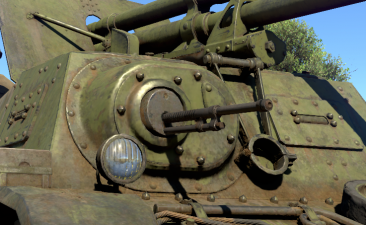
The hull-mounted DT on the ZiS-30
.png)
See also
Links to the articles on the War Thunder Wiki that you think will be useful for the reader, for example:
- reference to the article about the variant of the cannon/machine gun;
- references to approximate analogues by other nations and research trees.
External links
References
- Citations
- Bibliography
- Kettrick, James F. 1983. Small Arms Identification and Operation Guide - Eurasian Communist Countries (U). Washington D.C.: Defense Intelligence Agency.
- McCollum, Ian. 2011b. "DP-28 vs DPM." Forgotten Weapons. Last modified April 27, 2011. Website (Archive).
- McCollum, Ian. 2011c. "DTM Manual." Forgotten Weapons. Last modified January 24, 2011. Website (Archive).
- McCollum, Ian. 2011a "Kubynov hopper-fed DP28." Forgotten Weapons. Last modified March 16, 2011. Website (Archive).
- McCollum, Ian. 2011d. "RP46 LMG." Forgotten Weapons, Last modified January 10, 2011. Website (Archive).
- McCollum, Ian. 2018. "RP46 Variations: Russian, North Korean, and US Reproduction." Forgotten Weapons. Last modified July 04, 2018. Website (Archive).
- McNab, Chris. Soviet Machine Guns of World War II. Oxford, UK: Osprey Publishing.
- Popenker, Maxim. n.d. "Degtyarov DP DPM RP-46." Modern Firearms. Website (Archive).
- War Is Boring. 2016 "The DP Machine Gun Looks Funny, But Spilled a Lot of Blood." Medium, A Medium Corporation. Last modified February 23, 2016. Website (Archive).
| Tank machine guns | |
|---|---|
| USA | |
| 7.62 mm | M37 · M60D · M73 · M240 · M1919A4 · Mk.52 |
| 12.7 mm | FN M3P · M2HB · M80 · M85 |
| Germany | |
| 5.56 mm | MG4 |
| 7.62 mm | C6 · MG3A1 |
| 7.92 mm | MG13 Dreyse · MG34 · MG37(t) · MG42 |
| 12.7 mm | S.MG.50 |
| USSR | |
| 7.62 mm | DT · PKMB · PKT · PKTM · RP-46 · SGMT |
| 12.7 mm | DK · DShK · 6P49 · NSVT |
| 14.5 mm | KPVT |
| Britain | |
| 7.62 mm | Browning MG4 · L3A1 · L8A1 · L8A2 · L37A1 · L37A2 · L94A1 |
| 7.7 mm | Vickers |
| 7.92 mm | BESA |
| 12.7 mm | L21A1 |
| Japan | |
| 6.5 mm | Type 91 |
| 7.62 mm | Type 74 |
| 7.7 mm | Type 97 |
| 12.7 mm | Type 60 (B) |
| China | |
| 5.8 mm | QJT |
| 7.62 mm | Type 55 · Type 59 · Type 86 |
| 12.7 mm | QJC88A · Type 54 |
| 14.5 mm | QJG02 |
| Italy | |
| 7.62 mm | Beretta MG42/59 · FN MAG 60-40 |
| 8 mm | 34/40M · Breda Mod. 38 |
| 13.2 mm | Breda Model 31 |
| France | |
| 7.5 mm | AAT-52 · MAC 31 |
| 7.62 mm | A-A-F1N |
| 8 mm | Hotchkiss Mle 1914 |
| Sweden | |
| 6.5 mm | ksp m/14-29 |
| 7.62 mm | ksp 39 C · ksp 58 · ksp 94 |
| 8 mm | ksp m/36 · ksp m/39B |
| 12.7 mm | ksp 88 |