Difference between pages "Valentine I" and "PGZ04A"
m (→See also: driver port is no longer 17 mm thick.) (Tag: Visual edit) |
(Rewrote intro, added to armaments and usage in battles.) |
||
| Line 1: | Line 1: | ||
{{Specs-Card | {{Specs-Card | ||
| − | |code= | + | |code=cn_pgz_04a |
|images={{Specs-Card-Image|GarageImage_{{PAGENAME}}.jpg}} | |images={{Specs-Card-Image|GarageImage_{{PAGENAME}}.jpg}} | ||
}} | }} | ||
| Line 6: | Line 6: | ||
== Description == | == Description == | ||
<!-- ''In the description, the first part should be about the history of the creation and combat usage of the vehicle, as well as its key features. In the second part, tell the reader about the ground vehicle in the game. Insert a screenshot of the vehicle, so that if the novice player does not remember the vehicle by name, he will immediately understand what kind of vehicle the article is talking about.'' --> | <!-- ''In the description, the first part should be about the history of the creation and combat usage of the vehicle, as well as its key features. In the second part, tell the reader about the ground vehicle in the game. Insert a screenshot of the vehicle, so that if the novice player does not remember the vehicle by name, he will immediately understand what kind of vehicle the article is talking about.'' --> | ||
| − | The ' | + | The PGZ04A (Chinese: PGZ04(A)式25毫米弹炮结合防空武器系统; lit. 25 mm missile-gun AA system) is an upgraded version of the existing PGZ95 fleet in the PLAGF. This new version features new MANPADS, replacing the earlier QW-2 MAPNPADS, and currently serves as the close-range interception layer of the PLA's anti-air defense system. |
| + | |||
| + | The development of the PGZ95 can be traced back to the 1980s when the PLAGF was in desperate need of a new SPAA system. Earlier plans involved reverse-engineering Egyptian [[ZSU-23-4]]s, which had already been obtained by Mainland China through bi-directional arms trade. However, when an observer team arrived in Italy and discovered the [[SIDAM 25]], the PLAGF quickly abandoned the ZSU-23-4 plans and instead planned for a better SPAA system with all-weather combat capabilities. The new SPAA system was extensively tested in the 1990s and made its first appearance at the 50th National Day Parade (1999). | ||
| + | |||
| + | Introduced in [[Update "Red Skies"]] along with the PGZ09, the PGZ04A is a unique SPAA vehicle with a gun-missile armament. The layout of its turret quite resembles the Italian SIDAM 25, but unlike the radarless SIDAM it has a search radar mounted on the top that makes it much easier to acquire targets, as well as thermal optics for easier spotting. The quadruple 25 mm cannons previously seen on the [[ZSD63]] are bored-out derivatives of the Soviet Shilka's guns with a slower rate of fire, higher muzzle velocity, and greater armour penetration. Although the PGZ04A's electronics, mobility, and ground attack capability are inferior to the newer PGZ09, its main selling point comes from a quartet of HN-6 MANPADS launchers mounted right above the guns. The HN-6 is slightly better in performance than the common Stingers used by contemporary SPAA and forces enemy aircraft to stay on their toes even outside of cannon range. | ||
== General info == | == General info == | ||
| Line 12: | Line 16: | ||
{{Specs-Tank-Armour}} | {{Specs-Tank-Armour}} | ||
<!-- ''Describe armour protection. Note the most well protected and key weak areas. Appreciate the layout of modules as well as the number and location of crew members. Is the level of armour protection sufficient, is the placement of modules helpful for survival in combat? If necessary use a visual template to indicate the most secure and weak zones of the armour.'' --> | <!-- ''Describe armour protection. Note the most well protected and key weak areas. Appreciate the layout of modules as well as the number and location of crew members. Is the level of armour protection sufficient, is the placement of modules helpful for survival in combat? If necessary use a visual template to indicate the most secure and weak zones of the armour.'' --> | ||
| + | An usual characteristic of a SPAAG is their light armour, and the PGZ04A is no exception. At only 22.7 tons, its does not have any high protection and is very unlikely to survive any high-explosive and overpressure damages. | ||
| − | + | The chassis of the PGZ04A is still enough to stop 12.7 mm rounds from going through it up front while that would not be the case for the sides and the rear of the chassis so at best keep your enemies in front of you. The turret, with only 8 mm of steel on every side, barely stops shrapnel and smaller-calibre firearms, anything above 12.7 mm can penetrate the turret with ease. | |
'''Armour type:''' | '''Armour type:''' | ||
| − | * Rolled | + | * Rolled homogeneous armour (hull, turret) |
| − | |||
{| class="wikitable" | {| class="wikitable" | ||
|- | |- | ||
| − | ! Armour !! Front !! Sides !! Rear !! Roof | + | ! Armour !! Front (Slope angle) !! Sides !! Rear !! Roof |
|- | |- | ||
| − | | Hull || | + | | Hull || 10 mm (69°) ''Upper glacis'' <br> 12 mm (36°) ''Lower plate'' || 8 mm (11°) ''Top'' <br> 10 mm ''Bottom'' || 10 mm (7°) || 8 mm |
|- | |- | ||
| − | | Turret || | + | | Turret || 8 mm ''Turret front'' || 8 mm || 8 mm || 8 mm |
|- | |- | ||
|} | |} | ||
| + | |||
'''Notes:''' | '''Notes:''' | ||
| − | * Suspension wheels, | + | * Suspension wheels are 20 mm thick, tracks are 15 mm thick, and torsion bars are 22 mm thick. |
=== Mobility === | === Mobility === | ||
| Line 37: | Line 42: | ||
<!-- ''Write about the mobility of the ground vehicle. Estimate the specific power and manoeuvrability, as well as the maximum speed forwards and backwards.'' --> | <!-- ''Write about the mobility of the ground vehicle. Estimate the specific power and manoeuvrability, as well as the maximum speed forwards and backwards.'' --> | ||
| − | {{tankMobility|abMinHp= | + | {{tankMobility|abMinHp=544|rbMinHp=339}} |
| − | + | Thanks to its light weight and a 383 hp F12L412 diesel engine, the PGZ04A can drive at a surprising top speed of 53 km/h, making it a fast and nimble enough vehicle to move around the battlefield and take cover if anything is coming to cause you some trouble. Another rare advantage is the great reverse speed of -18 km/h. Being significantly faster than the majority of Chinese vehicles, this speed not only allows the PGZ04A to retreat back to safety in time but also gives it more tactical agility for repositioning and flanking. | |
=== Modifications and economy === | === Modifications and economy === | ||
| Line 47: | Line 52: | ||
{{Specs-Tank-Armaments}} | {{Specs-Tank-Armaments}} | ||
=== Main armament === | === Main armament === | ||
| − | {{Specs-Tank-Weapon| | + | {{Specs-Tank-Weapon|2}} |
<!-- ''Give the reader information about the characteristics of the main gun. Assess its effectiveness in a battle based on the reloading speed, ballistics and the power of shells. Do not forget about the flexibility of the fire, that is how quickly the cannon can be aimed at the target, open fire on it and aim at another enemy. Add a link to the main article on the gun: <code><nowiki>{{main|Name of the weapon}}</nowiki></code>. Describe in general terms the ammunition available for the main gun. Give advice on how to use them and how to fill the ammunition storage.'' --> | <!-- ''Give the reader information about the characteristics of the main gun. Assess its effectiveness in a battle based on the reloading speed, ballistics and the power of shells. Do not forget about the flexibility of the fire, that is how quickly the cannon can be aimed at the target, open fire on it and aim at another enemy. Add a link to the main article on the gun: <code><nowiki>{{main|Name of the weapon}}</nowiki></code>. Describe in general terms the ammunition available for the main gun. Give advice on how to use them and how to fill the ammunition storage.'' --> | ||
| − | {{main| | + | {{main|PG87 (25 mm)}} |
| + | The PGZ04A is equipped with 4 x 25 mm PG87 25x183B AA guns mounted on the side of the turret, which is the same gun as the [[ZSD63]] at Rank II. | ||
| + | |||
| + | With its above average velocity and high rate of fire, these 4 cannons combined can cause total annihilation of low-flying aircraft within its 2.5 km firing range and its ammunition has sufficient penetration to cause some trouble to lightly armoured vehicles. However, all this comes at a cost: you have only 1,032 rounds in total at your disposal, which is about half of the Shilka's ammunition supply. For players who are trigger-happy, this might a good chance to learn how to conserve their ammo and wait for the chance to deliver the fatal blow to enemy targets. | ||
| − | The | + | Compared to the Shilka's AZP-23 cannons, the PG87 has superior AP rounds with better penetration and post-penetration damage, making it easier to spray down ground vehicles. The FI-T rounds pack a very similar explosive punch to the Soviet HEFI-T but are less powerful than the tracerless HEFI rounds. Generally, the PGZ04A's guns are less effective than the preceding PGZ09's, because they will require multiple hits to down large aircraft and the 2.5 km self destruct range on the FI-T rounds significantly limit their effectiveness against hovering ATGM helicopters. Against ground targets there is also no contest because of the lack of API-T rounds with explosive filler and APDS rounds with enhanced penetration. Still, it is cathartic to let loose a stream of 40 rounds per second, and the closer clustering of fire compared to Gepard- or Marksman- style turrets makes it less likely for targets to slip in between the rounds. |
{| class="wikitable" style="text-align:center" width="100%" | {| class="wikitable" style="text-align:center" width="100%" | ||
|- | |- | ||
| − | ! colspan=" | + | ! colspan="6" | [[PG87 (25 mm)|25 mm PG87]] (x4) || colspan="5" | Turret rotation speed (°/s) || colspan="4" | Reloading rate (seconds) |
|- | |- | ||
| − | ! Mode !! Capacity !! Vertical !! Horizontal !! Stabilizer | + | ! Mode !! Capacity (Belt) !! Fire rate !! Vertical !! Horizontal !! Stabilizer |
! Stock !! Upgraded !! Full !! Expert !! Aced | ! Stock !! Upgraded !! Full !! Expert !! Aced | ||
! Stock !! Full !! Expert !! Aced | ! Stock !! Full !! Expert !! Aced | ||
|- | |- | ||
! ''Arcade'' | ! ''Arcade'' | ||
| − | | rowspan="2" | | + | | rowspan="2" | 1,032 (258) || rowspan="2" | 600 || rowspan="2" | -5°/+85° || rowspan="2" | ±180° || rowspan="2" | Two-plane || 70.4 || 97.5 || 118.4 || 130.9 || 139.3 || rowspan="2" | 5.20 || rowspan="2" | 4.60 || rowspan="2" | 4.24 || rowspan="2" | 4.00 |
|- | |- | ||
! ''Realistic'' | ! ''Realistic'' | ||
| − | | | + | | 47.6 || 56.0 || 68.0 || 75.2 || 80.0 |
|- | |- | ||
|} | |} | ||
==== Ammunition ==== | ==== Ammunition ==== | ||
| − | {| | + | |
| − | + | * '''Default:''' {{Annotation|AP-T|Armour-piercing tracer}}{{-}}{{Annotation|FI-T*|Fragmentation incendiary tracer (self-destroying)}} | |
| − | |- | + | * '''Type 87 HE:''' {{Annotation|FI-T*|Fragmentation incendiary tracer (self-destroying)}} |
| − | + | * '''Type 87 AP:''' {{Annotation|AP-T|Armour-piercing tracer}} | |
| − | + | ||
| − | + | {{:PG87 (25 mm)/Ammunition|FI-T*, AP-T}} | |
| − | |- | ||
| − | |||
| − | |- | ||
| − | |||
| − | |||
| − | |||
| − | |||
| − | |||
| − | |||
| − | |||
| − | |||
| − | |||
| − | { | ||
| − | |||
| − | |||
| − | |||
| − | |||
| − | |||
| − | |||
| − | |||
| − | |||
| − | |||
| − | |||
| − | |||
| − | |||
| − | |||
| − | |||
| − | |- | ||
| − | |||
| − | |||
| − | |||
| − | |||
| − | |||
| − | |||
| − | |||
==== [[Ammo racks]] ==== | ==== [[Ammo racks]] ==== | ||
| − | [[File: | + | <!-- [[File:Ammoracks_{{PAGENAME}}.png|right|thumb|x250px|[[Ammo racks]] of the {{PAGENAME}}]] --> |
<!-- '''Last updated:''' --> | <!-- '''Last updated:''' --> | ||
{| class="wikitable" style="text-align:center" | {| class="wikitable" style="text-align:center" | ||
| Line 122: | Line 95: | ||
! Visual<br>discrepancy | ! Visual<br>discrepancy | ||
|- | |- | ||
| − | | ''' | + | | '''1,032''' || 380 ''(+652)'' || 0 ''(+1,032)'' || No |
|- | |- | ||
|} | |} | ||
| − | |||
| − | + | === Additional armament === | |
| + | {{Specs-Tank-Weapon|1}} | ||
| + | <!-- ''Some tanks are armed with several guns in one or more turrets. Evaluate the additional weaponry and give advice on its use. Describe the ammunition available for additional weaponry. Give advice on about how to use them and how to fill the ammunition storage. If there is no additional weaponry remove this subsection.'' --> | ||
| + | {{main|HN-6}} | ||
| + | |||
| + | The HN-6 is a MANPADS that comes with a 6 km all-aspect locking range, which will prove useful for handling low-flying helicopters and sometimes earn a surprise kill on careless jets; but do note that smaller helicopters or those with heat-suppression would have to be within 2.5 km before the seeker can lock onto their heat signature, so only fire upon those who gets into 2.5km radius. | ||
| + | |||
| + | The HN-6 is slightly more effective than the Stinger MANPADS used by contemporary SPAA vehicles like the [[Gepard 1A2]]. It has a small proximity fuse like the FIM-92K that makes it easier to hit targets, but it also has a slightly greater 12 G overload, a 42% larger TNT equivalent, and a slightly lower maximum flight speed that actually gives the missile more time to correct its trajectory. Unfortunately, the PGZ04A carries no internal reloads and has a limited capacity of 4, so it does not have the staying power of the [[LAV-AD]] for example. | ||
| + | |||
| − | |||
{| class="wikitable" style="text-align:center" | {| class="wikitable" style="text-align:center" | ||
| − | |||
|- | |- | ||
| − | ! | + | ! colspan="4" | [[HN-6]] missile |
| − | |||
| − | |||
|- | |- | ||
| − | ! | + | ! Capacity !! Vertical !! Horizontal !! Stabilizer |
| − | |||
|- | |- | ||
| − | + | | 4 || N/A || N/A || N/A | |
| − | | | ||
|- | |- | ||
|} | |} | ||
| − | === | + | ==== Ammunition ==== |
| − | {{ | + | {{:HN-6/Ammunition|HN-6}} |
| − | |||
| − | |||
| − | |||
| − | |||
| − | |||
| − | |||
| − | |||
| − | |||
| − | |||
| − | |||
| − | |- | ||
| − | |||
== Usage in battles == | == Usage in battles == | ||
<!-- ''Describe the tactics of playing in the vehicle, the features of using vehicles in the team and advice on tactics. Refrain from creating a "guide" - do not impose a single point of view but instead give the reader food for thought. Describe the most dangerous enemies and give recommendations on fighting them. If necessary, note the specifics of the game in different modes (AB, RB, SB).'' --> | <!-- ''Describe the tactics of playing in the vehicle, the features of using vehicles in the team and advice on tactics. Refrain from creating a "guide" - do not impose a single point of view but instead give the reader food for thought. Describe the most dangerous enemies and give recommendations on fighting them. If necessary, note the specifics of the game in different modes (AB, RB, SB).'' --> | ||
| − | |||
| − | |||
| − | |||
| − | + | With its rapid-firing 25 mm guns and IR missiles, the PGZ04A does serve its purpose in close to mid-range air defense. Consider it to have two layers of defence: missiles for up to 6 km (depends on the target; it can lock onto jets at around 5 km; while helicopters is another story depending on its size and their heat signature), and the 25 mm cannons for anything within 3 km. The IR missiles have questionable tracking ability and often give up track on a target entirely if it manoeuvres to evade. However, it will help to distract incoming aircraft and bleed their speed, making them easier to be finished with the 25 mm cannons. The PGZ04A will have a tough time dealing with helicopters hovering at their maximum range launching ATGMs, as neither of the PGZ04 armaments can reach anything that's beyond 6 km. | |
| − | |||
| − | ' | + | The PGZ04A's anti-ground ability is limited, due to its smaller calibre 25 mm cannons. They have no dedicated APDS rounds that were found in its predecessor, the PGZ09 (which also has larger cannons of 35 mm). The 25 mm struggles to penetrate the sides of top-rank MBTs, with some of them completely immune (for example, Israeli MBTs which has better side protection), although exterior modules can be quickly destroyed, especially tracks. If aimed well (and some luck), you can take out gun barrels of the enemy tank, but it is better to avoid engaging with MBTs to begin with. The 25 mm rounds also have poor post-pen effects, even against thinly armoured targets, but is counteracted by the high firerate and fire density of the 4 barrels. |
| − | |||
| − | + | It is suggested to play the PGZ04A as a dedicated anti-air platform. However, due to its shorter range than its counterparts, you need to leave the spawn to be effective. The limited HN-6 capacity also necessitates moving to capture points to reload. While doing that, always have friendly tanks to screen you, as the moment you're caught alone by enemy ground targets you will have exceptionally low chance of survival. | |
| − | |||
=== Pros and cons === | === Pros and cons === | ||
| Line 180: | Line 136: | ||
'''Pros:''' | '''Pros:''' | ||
| − | * | + | * Good rate of fire (600 rpm) plus 4 x autocannons mean high fire density |
| − | * | + | * 4 x IR missiles further improve its anti-air strengths especially against helicopters like [[AH-1 (Family)|AH-1]] |
| − | + | * The tracking device is optoelectrical tracker that can hide yourself from RWR equipped aircrafts | |
| − | + | * Gunner thermal assists fighting in poor conditions | |
| − | * | + | * Great mobility with adequate reverse speed |
| − | * | + | * 2 salvos of smoke grenades provide critical concealment |
| − | * | + | * Profile is quite low |
| − | * | ||
| − | * | ||
'''Cons:''' | '''Cons:''' | ||
| − | * | + | * IR missiles are often unreliable due to its short lock-on range and worse maneuverability |
| − | + | * 25 mm shells are not as potent as 35 mm or 57 mm shells at longer ranges | |
| − | * | + | * Insufficient penetration to damage Israeli or Soviet MBTs |
| − | + | * Completely exposed autocannons and missiles mean they are easily damaged | |
| − | * | + | * Search radar antenna is tall and big; can expose the location of PGZ04A |
| − | + | * Like all SPAA, armour can only resist small calibre machine gun bullets | |
| − | * | ||
| − | * | ||
| − | * | ||
| − | |||
| − | |||
| − | |||
| − | |||
== History == | == History == | ||
<!-- ''Describe the history of the creation and combat usage of the vehicle in more detail than in the introduction. If the historical reference turns out to be too long, take it to a separate article, taking a link to the article about the vehicle and adding a block "/History" (example: <nowiki>https://wiki.warthunder.com/(Vehicle-name)/History</nowiki>) and add a link to it here using the <code>main</code> template. Be sure to reference text and sources by using <code><nowiki><ref></ref></nowiki></code>, as well as adding them at the end of the article with <code><nowiki><references /></nowiki></code>. This section may also include the vehicle's dev blog entry (if applicable) and the in-game encyclopedia description (under <code><nowiki>=== In-game description ===</nowiki></code>, also if applicable).'' --> | <!-- ''Describe the history of the creation and combat usage of the vehicle in more detail than in the introduction. If the historical reference turns out to be too long, take it to a separate article, taking a link to the article about the vehicle and adding a block "/History" (example: <nowiki>https://wiki.warthunder.com/(Vehicle-name)/History</nowiki>) and add a link to it here using the <code>main</code> template. Be sure to reference text and sources by using <code><nowiki><ref></ref></nowiki></code>, as well as adding them at the end of the article with <code><nowiki><references /></nowiki></code>. This section may also include the vehicle's dev blog entry (if applicable) and the in-game encyclopedia description (under <code><nowiki>=== In-game description ===</nowiki></code>, also if applicable).'' --> | ||
| − | + | The story of PGZ04A goes back to his predecessor, PGZ95. | |
| − | The | ||
| − | |||
| − | |||
| − | + | During the 1980s when Mainland China was seeking for modernization of PLA, one major inventory they were lacking of was a SPAAG with onboard radar. It was during that time Egypt handed in some [[ZSU-23-4]] to the Chinese, which at first decided that they would go for a reverse-engineered version of the infamous Shilka. But later, they found another major problem: Shilka's optical system wasn't designed for all-weather operations and capabilities at night would be very limited. Meanwhile, another group of PLAGF's officials often went to Europe for equipment development exchanges and weapon tests, one time during the 1980s, they saw the [[SIDAM 25]] that came with all-weather operation capabilities . | |
| − | |||
| − | + | The NORINCO Northwest Institute of Mechanical & Electrical Engineering (西北机电工程研究所 at Xianyang City, Xi'an, Shaanxi) started its development and eventually, the older brother of PGZ04A- PGZ95 was accepted into PLAGF commission and it was first shown on the parade on 1st October, 1999 (the 50th National Day of PRC) based on PZD31 chassis. Completed with a S-band ''(Note, IEEE standard)'' CLC-1 search radar and opto-electronic tracking system, as well as 2 pairs of QW-2 MANPADS mounted on its turret. Due to the new electronic system, estimations showed that a PGZ-95 was even more expensive than a brand new [[ZTZ99]]. | |
| − | |||
| − | |||
| − | |||
| − | |||
| − | |||
| − | |||
| − | |||
| − | |||
| − | |||
| − | |||
| − | + | Later in the 2000s, the PGZ95 received an overhaul upgrade on its systems and upgraded its MANPADS to 2 pairs of HN-6 (exported by CATIC as FN-6), eventually this upgraded version was named a PGZ04A. Along the [[PGZ09]], it became the cornerstone of PLAGF's field air defense with HQ (HongQi 红旗; Red banner) series SAMs. | |
| − | |||
| − | |||
| − | |||
| − | |||
| − | |||
| − | |||
| − | |||
| − | |||
| − | |||
| − | |||
== Media == | == Media == | ||
| Line 245: | Line 168: | ||
;Skins | ;Skins | ||
| − | * [https://live.warthunder.com/feed/camouflages/? | + | * [https://live.warthunder.com/feed/camouflages/?vehicle=cn_pgz_04a Skins and camouflages for the {{PAGENAME}} from live.warthunder.com.] |
| − | |||
| − | |||
| − | |||
== See also == | == See also == | ||
| Line 254: | Line 174: | ||
* ''reference to the series of the vehicles;'' | * ''reference to the series of the vehicles;'' | ||
* ''links to approximate analogues of other nations and research trees.'' --> | * ''links to approximate analogues of other nations and research trees.'' --> | ||
| + | ''Links to the articles on the War Thunder Wiki that you think will be useful for the reader, for example:'' | ||
| − | ; | + | * ''reference to the series of the vehicles;'' |
| − | + | * ''links to approximate analogues of other nations and research trees.'' | |
| − | |||
| − | |||
| − | * | ||
== External links == | == External links == | ||
| Line 266: | Line 184: | ||
* ''other literature.'' --> | * ''other literature.'' --> | ||
| − | * [[wt:en/news/ | + | * [[wt:en/news/7170-development-pgz04a-a-much-anticipated-chinese-spaa-en|[Devblog] PGZ04A: A much anticipated Chinese SPAA]] |
| − | {{ | + | {{TankManufacturer Norinco}} |
| + | {{China anti-aircraft vehicles}} | ||
Latest revision as of 20:50, 28 November 2023

Contents
Description
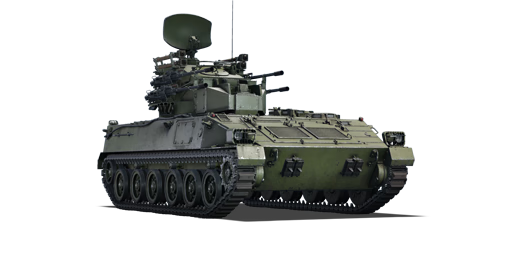
The PGZ04A (Chinese: PGZ04(A)式25毫米弹炮结合防空武器系统; lit. 25 mm missile-gun AA system) is an upgraded version of the existing PGZ95 fleet in the PLAGF. This new version features new MANPADS, replacing the earlier QW-2 MAPNPADS, and currently serves as the close-range interception layer of the PLA's anti-air defense system.
The development of the PGZ95 can be traced back to the 1980s when the PLAGF was in desperate need of a new SPAA system. Earlier plans involved reverse-engineering Egyptian ZSU-23-4s, which had already been obtained by Mainland China through bi-directional arms trade. However, when an observer team arrived in Italy and discovered the SIDAM 25, the PLAGF quickly abandoned the ZSU-23-4 plans and instead planned for a better SPAA system with all-weather combat capabilities. The new SPAA system was extensively tested in the 1990s and made its first appearance at the 50th National Day Parade (1999).
Introduced in Update "Red Skies" along with the PGZ09, the PGZ04A is a unique SPAA vehicle with a gun-missile armament. The layout of its turret quite resembles the Italian SIDAM 25, but unlike the radarless SIDAM it has a search radar mounted on the top that makes it much easier to acquire targets, as well as thermal optics for easier spotting. The quadruple 25 mm cannons previously seen on the ZSD63 are bored-out derivatives of the Soviet Shilka's guns with a slower rate of fire, higher muzzle velocity, and greater armour penetration. Although the PGZ04A's electronics, mobility, and ground attack capability are inferior to the newer PGZ09, its main selling point comes from a quartet of HN-6 MANPADS launchers mounted right above the guns. The HN-6 is slightly better in performance than the common Stingers used by contemporary SPAA and forces enemy aircraft to stay on their toes even outside of cannon range.
General info
Survivability and armour
An usual characteristic of a SPAAG is their light armour, and the PGZ04A is no exception. At only 22.7 tons, its does not have any high protection and is very unlikely to survive any high-explosive and overpressure damages.
The chassis of the PGZ04A is still enough to stop 12.7 mm rounds from going through it up front while that would not be the case for the sides and the rear of the chassis so at best keep your enemies in front of you. The turret, with only 8 mm of steel on every side, barely stops shrapnel and smaller-calibre firearms, anything above 12.7 mm can penetrate the turret with ease.
Armour type:
- Rolled homogeneous armour (hull, turret)
| Armour | Front (Slope angle) | Sides | Rear | Roof |
|---|---|---|---|---|
| Hull | 10 mm (69°) Upper glacis 12 mm (36°) Lower plate |
8 mm (11°) Top 10 mm Bottom |
10 mm (7°) | 8 mm |
| Turret | 8 mm Turret front | 8 mm | 8 mm | 8 mm |
Notes:
- Suspension wheels are 20 mm thick, tracks are 15 mm thick, and torsion bars are 22 mm thick.
Mobility
| Game Mode | Max Speed (km/h) | Weight (tons) | Engine power (horsepower) | Power-to-weight ratio (hp/ton) | |||
|---|---|---|---|---|---|---|---|
| Forward | Reverse | Stock | Upgraded | Stock | Upgraded | ||
| Arcade | Expression error: Unexpected * operator. | 544 | Expression error: Unexpected round operator. | __.__ | |||
| Realistic | 339 | Expression error: Unexpected round operator. | __.__ | ||||
Thanks to its light weight and a 383 hp F12L412 diesel engine, the PGZ04A can drive at a surprising top speed of 53 km/h, making it a fast and nimble enough vehicle to move around the battlefield and take cover if anything is coming to cause you some trouble. Another rare advantage is the great reverse speed of -18 km/h. Being significantly faster than the majority of Chinese vehicles, this speed not only allows the PGZ04A to retreat back to safety in time but also gives it more tactical agility for repositioning and flanking.
Modifications and economy
Armaments
Main armament
The PGZ04A is equipped with 4 x 25 mm PG87 25x183B AA guns mounted on the side of the turret, which is the same gun as the ZSD63 at Rank II.
With its above average velocity and high rate of fire, these 4 cannons combined can cause total annihilation of low-flying aircraft within its 2.5 km firing range and its ammunition has sufficient penetration to cause some trouble to lightly armoured vehicles. However, all this comes at a cost: you have only 1,032 rounds in total at your disposal, which is about half of the Shilka's ammunition supply. For players who are trigger-happy, this might a good chance to learn how to conserve their ammo and wait for the chance to deliver the fatal blow to enemy targets.
Compared to the Shilka's AZP-23 cannons, the PG87 has superior AP rounds with better penetration and post-penetration damage, making it easier to spray down ground vehicles. The FI-T rounds pack a very similar explosive punch to the Soviet HEFI-T but are less powerful than the tracerless HEFI rounds. Generally, the PGZ04A's guns are less effective than the preceding PGZ09's, because they will require multiple hits to down large aircraft and the 2.5 km self destruct range on the FI-T rounds significantly limit their effectiveness against hovering ATGM helicopters. Against ground targets there is also no contest because of the lack of API-T rounds with explosive filler and APDS rounds with enhanced penetration. Still, it is cathartic to let loose a stream of 40 rounds per second, and the closer clustering of fire compared to Gepard- or Marksman- style turrets makes it less likely for targets to slip in between the rounds.
| 25 mm PG87 (x4) | Turret rotation speed (°/s) | Reloading rate (seconds) | ||||||||||||
|---|---|---|---|---|---|---|---|---|---|---|---|---|---|---|
| Mode | Capacity (Belt) | Fire rate | Vertical | Horizontal | Stabilizer | Stock | Upgraded | Full | Expert | Aced | Stock | Full | Expert | Aced |
| Arcade | 1,032 (258) | 600 | -5°/+85° | ±180° | Two-plane | 70.4 | 97.5 | 118.4 | 130.9 | 139.3 | 5.20 | 4.60 | 4.24 | 4.00 |
| Realistic | 47.6 | 56.0 | 68.0 | 75.2 | 80.0 | |||||||||
Ammunition
- Default: AP-T · FI-T*
- Type 87 HE: FI-T*
- Type 87 AP: AP-T
| Penetration statistics | |||||||
|---|---|---|---|---|---|---|---|
| Ammunition | Penetration @ 0° Angle of Attack (mm) | ||||||
| 10 m | 100 m | 500 m | 1,000 m | 1,500 m | 2,000 m | ||
| FI-T* | 8 | 8 | 6 | 5 | 4 | 3 | |
| AP-T | 63 | 61 | 51 | 41 | 33 | 27 | |
| Shell details | ||||||||||||
|---|---|---|---|---|---|---|---|---|---|---|---|---|
| Ammunition | Velocity (m/s) |
Projectile mass (kg) |
Fuse delay (m) |
Fuse sensitivity (mm) |
Explosive mass (TNT equivalent) (g) |
Ricochet | ||||||
| 0% | 50% | 100% | ||||||||||
| FI-T* | 1,050 | 0.25 | 0.1 | 0.1 | 29.26 | 47° | 56° | 65° | ||||
| AP-T | 1,050 | 0.25 | - | - | - | 47° | 60° | 65° | ||||
Ammo racks
| Full ammo |
1st rack empty |
2nd rack empty |
Visual discrepancy |
|---|---|---|---|
| 1,032 | 380 (+652) | 0 (+1,032) | No |
Additional armament
The HN-6 is a MANPADS that comes with a 6 km all-aspect locking range, which will prove useful for handling low-flying helicopters and sometimes earn a surprise kill on careless jets; but do note that smaller helicopters or those with heat-suppression would have to be within 2.5 km before the seeker can lock onto their heat signature, so only fire upon those who gets into 2.5km radius.
The HN-6 is slightly more effective than the Stinger MANPADS used by contemporary SPAA vehicles like the Gepard 1A2. It has a small proximity fuse like the FIM-92K that makes it easier to hit targets, but it also has a slightly greater 12 G overload, a 42% larger TNT equivalent, and a slightly lower maximum flight speed that actually gives the missile more time to correct its trajectory. Unfortunately, the PGZ04A carries no internal reloads and has a limited capacity of 4, so it does not have the staying power of the LAV-AD for example.
| HN-6 missile | |||
|---|---|---|---|
| Capacity | Vertical | Horizontal | Stabilizer |
| 4 | N/A | N/A | N/A |
Ammunition
| Missile details | ||||||||||||
|---|---|---|---|---|---|---|---|---|---|---|---|---|
| Ammunition | Type of warhead |
Velocity (m/s) |
Range (m) |
Projectile mass (kg) |
Fuse delay (m) |
Fuse sensitivity (mm) |
Explosive mass (TNT equivalent) (g) |
Ricochet | ||||
| 0% | 50% | 100% | ||||||||||
| HN-6 | SAM | 600 | 5,000 | 10.77 | 1 | 0.1 | 924 | 79° | 80° | 81° | ||
Usage in battles
With its rapid-firing 25 mm guns and IR missiles, the PGZ04A does serve its purpose in close to mid-range air defense. Consider it to have two layers of defence: missiles for up to 6 km (depends on the target; it can lock onto jets at around 5 km; while helicopters is another story depending on its size and their heat signature), and the 25 mm cannons for anything within 3 km. The IR missiles have questionable tracking ability and often give up track on a target entirely if it manoeuvres to evade. However, it will help to distract incoming aircraft and bleed their speed, making them easier to be finished with the 25 mm cannons. The PGZ04A will have a tough time dealing with helicopters hovering at their maximum range launching ATGMs, as neither of the PGZ04 armaments can reach anything that's beyond 6 km.
The PGZ04A's anti-ground ability is limited, due to its smaller calibre 25 mm cannons. They have no dedicated APDS rounds that were found in its predecessor, the PGZ09 (which also has larger cannons of 35 mm). The 25 mm struggles to penetrate the sides of top-rank MBTs, with some of them completely immune (for example, Israeli MBTs which has better side protection), although exterior modules can be quickly destroyed, especially tracks. If aimed well (and some luck), you can take out gun barrels of the enemy tank, but it is better to avoid engaging with MBTs to begin with. The 25 mm rounds also have poor post-pen effects, even against thinly armoured targets, but is counteracted by the high firerate and fire density of the 4 barrels.
It is suggested to play the PGZ04A as a dedicated anti-air platform. However, due to its shorter range than its counterparts, you need to leave the spawn to be effective. The limited HN-6 capacity also necessitates moving to capture points to reload. While doing that, always have friendly tanks to screen you, as the moment you're caught alone by enemy ground targets you will have exceptionally low chance of survival.
Pros and cons
Pros:
- Good rate of fire (600 rpm) plus 4 x autocannons mean high fire density
- 4 x IR missiles further improve its anti-air strengths especially against helicopters like AH-1
- The tracking device is optoelectrical tracker that can hide yourself from RWR equipped aircrafts
- Gunner thermal assists fighting in poor conditions
- Great mobility with adequate reverse speed
- 2 salvos of smoke grenades provide critical concealment
- Profile is quite low
Cons:
- IR missiles are often unreliable due to its short lock-on range and worse maneuverability
- 25 mm shells are not as potent as 35 mm or 57 mm shells at longer ranges
- Insufficient penetration to damage Israeli or Soviet MBTs
- Completely exposed autocannons and missiles mean they are easily damaged
- Search radar antenna is tall and big; can expose the location of PGZ04A
- Like all SPAA, armour can only resist small calibre machine gun bullets
History
The story of PGZ04A goes back to his predecessor, PGZ95.
During the 1980s when Mainland China was seeking for modernization of PLA, one major inventory they were lacking of was a SPAAG with onboard radar. It was during that time Egypt handed in some ZSU-23-4 to the Chinese, which at first decided that they would go for a reverse-engineered version of the infamous Shilka. But later, they found another major problem: Shilka's optical system wasn't designed for all-weather operations and capabilities at night would be very limited. Meanwhile, another group of PLAGF's officials often went to Europe for equipment development exchanges and weapon tests, one time during the 1980s, they saw the SIDAM 25 that came with all-weather operation capabilities .
The NORINCO Northwest Institute of Mechanical & Electrical Engineering (西北机电工程研究所 at Xianyang City, Xi'an, Shaanxi) started its development and eventually, the older brother of PGZ04A- PGZ95 was accepted into PLAGF commission and it was first shown on the parade on 1st October, 1999 (the 50th National Day of PRC) based on PZD31 chassis. Completed with a S-band (Note, IEEE standard) CLC-1 search radar and opto-electronic tracking system, as well as 2 pairs of QW-2 MANPADS mounted on its turret. Due to the new electronic system, estimations showed that a PGZ-95 was even more expensive than a brand new ZTZ99.
Later in the 2000s, the PGZ95 received an overhaul upgrade on its systems and upgraded its MANPADS to 2 pairs of HN-6 (exported by CATIC as FN-6), eventually this upgraded version was named a PGZ04A. Along the PGZ09, it became the cornerstone of PLAGF's field air defense with HQ (HongQi 红旗; Red banner) series SAMs.
Media
- Skins
See also
Links to the articles on the War Thunder Wiki that you think will be useful for the reader, for example:
- reference to the series of the vehicles;
- links to approximate analogues of other nations and research trees.
External links
| Norinco (China North Industries Corporation) | |
|---|---|
| Light AFV/IFV | |
| WZ501 | ZBD86¹ |
| WZ131 | ▂Type 62 · Type 62 |
| WZ211 | Type 63 · ZTS63 |
| WZ502 | ZBD04A |
| MBT | |
| WZ120 | Type 59¹ · ZTZ59A · ZTZ59D1 |
| WZ121 | Type 69 |
| WZ122 | ZTZ88B · ZTZ88A · ZTZ96 · ZTZ96A · ZTZ96A (P) |
| WZ123 | ZTZ99-II · ZTZ99-III |
| WZ1001 | WZ1001(E) LCT · ZTZ99A |
| Tank Destroyers | AFT09 · PTL02 · PTZ89 · ZLT11 |
| SPH | PLZ83 |
| SPAA | ZSD63/PG87² · PGZ09 · PGZ04A |
| Export | |
| WZ121 | Type 69-IIa · T-69 II G |
| MBT2000 | MBT-2000 · Al-Khalid-I |
| MBT3000 | VT4A1 |
| Other | WMA301 · WZ305 |
| ¹ License production / Reverse engineered · ² Field modifications | |
| China anti-aircraft vehicles | |
|---|---|
| Radar SPAAG | PGZ09 |
| Gun and Missile SPAAG | PGZ04A |
| Missile SPAA | Antelope |
| Other | ZSD63/PG87 · ZSL92 · WZ305 |
| Germany | ␗Sd.Kfz.222 |
| North Vietnam | Phòng không T-34 |
| USA | CCKW 353 (M45) · ␗M42 |
| USSR | Tor-M1 |