Difference between pages "Kfir Canard" and "TBF-1C"
(Edits) |
(→Suspended armament: Updated) |
||
| Line 1: | Line 1: | ||
{{About | {{About | ||
| − | | about = | + | | about = American bomber '''{{PAGENAME}}''' |
| − | | usage = | + | | usage = the British version |
| − | | link = | + | | link = Avenger Mk II (Great Britain) |
}} | }} | ||
{{Specs-Card | {{Specs-Card | ||
| − | |code= | + | |code=tbf-1c |
| − | |images={{Specs-Card-Image|GarageImage_{{PAGENAME}} | + | |images={{Specs-Card-Image|GarageImage_{{PAGENAME}}.jpg}} |
| − | | | + | |cockpit=cockpit_tbf-1c.jpg |
}} | }} | ||
== Description == | == Description == | ||
<!-- ''In the description, the first part should be about the history of and the creation and combat usage of the aircraft, as well as its key features. In the second part, tell the reader about the aircraft in the game. Insert a screenshot of the vehicle, so that if the novice player does not remember the vehicle by name, he will immediately understand what kind of vehicle the article is talking about.'' --> | <!-- ''In the description, the first part should be about the history of and the creation and combat usage of the aircraft, as well as its key features. In the second part, tell the reader about the aircraft in the game. Insert a screenshot of the vehicle, so that if the novice player does not remember the vehicle by name, he will immediately understand what kind of vehicle the article is talking about.'' --> | ||
| − | The '''{{Specs|name}}''' | + | To replace the outdated TBD Devastator, several companies put forth their designs. Grumman's design was the TBF Avenger, a single-engine torpedo bomber. It was to be fitted with the Wright R-2600-8, a double-row 14-cylinder radial engine that produced 1,700 hp. Although it was extremely heavy, the U.S. Navy selected Grumman's design and ordered two prototypes in 1940. One special feature of the TBF Avenger was the Sto-Wings which folded the wings inwards to remedy the issue with the heights of carrier hangar decks. The TBF Avenger would be widely used by both the U.S. and Royal Navy during the war. American Avengers saw use at the Battle of Eastern Solomons and Guadalcanal; managing to sink a Japanese light carrier and a battleship. They also brought havoc against submarine crews such as I-52. |
| + | |||
| + | Introduced since the start of the Open Beta Test prior to Update 1.27, the '''{{Specs|name}}''' is a decent torpedo bomber. It has access to AN-M66A2 (2,000 lb) bombs as well as Mk. 13-6 torpedos. Defensive armament is lacking with only one single 12.7 mm turret providing fire from the top and a single 7.62 turret mounted in the underside. The Avenger does have two 12.7 mm machine guns for offensive fire but is quite lacklustre. The TBF-1C Avenger is a formidable torpedo bomber however it's very vulnerable to enemy fighters. | ||
| − | |||
== General info == | == General info == | ||
| Line 20: | Line 21: | ||
{{Specs-Avia-Flight}} | {{Specs-Avia-Flight}} | ||
<!-- ''Describe how the aircraft behaves in the air. Speed, manoeuvrability, acceleration and allowable loads - these are the most important characteristics of the vehicle.'' --> | <!-- ''Describe how the aircraft behaves in the air. Speed, manoeuvrability, acceleration and allowable loads - these are the most important characteristics of the vehicle.'' --> | ||
| − | |||
{| class="wikitable" style="text-align:center" width="70%" | {| class="wikitable" style="text-align:center" width="70%" | ||
! rowspan="2" | Characteristics | ! rowspan="2" | Characteristics | ||
| − | ! colspan="2" | Max | + | ! colspan="2" | Max Speed<br>(km/h at 3,650 m) |
! rowspan="2" | Max altitude<br>(metres) | ! rowspan="2" | Max altitude<br>(metres) | ||
! colspan="2" | Turn time<br>(seconds) | ! colspan="2" | Turn time<br>(seconds) | ||
| Line 33: | Line 33: | ||
|- | |- | ||
! Stock | ! Stock | ||
| − | | | + | | 414 || 398 || rowspan="2" | {{Specs|ceiling}} || 31.1 || 32.4 || 3.2 || 3.2 || rowspan="2" | 307 |
|- | |- | ||
! Upgraded | ! Upgraded | ||
| − | | | + | | 452 || 432 || 29.0 || 30.0 || 7.3 || 5.1 |
|- | |- | ||
|} | |} | ||
| Line 43: | Line 43: | ||
{| class="wikitable" style="text-align:center" width="50%" | {| class="wikitable" style="text-align:center" width="50%" | ||
|- | |- | ||
| − | ! colspan=" | + | ! colspan="5" | Features |
|- | |- | ||
| − | ! Combat flaps !! Take-off flaps !! Landing flaps !! Air brakes !! Arrestor gear | + | ! Combat flaps !! Take-off flaps !! Landing flaps !! Air brakes !! Arrestor gear |
|- | |- | ||
| − | + | | X || X || ✓ || X || ✓ <!-- ✓ --> | |
|- | |- | ||
|} | |} | ||
| Line 62: | Line 62: | ||
! Combat !! Take-off !! Landing !! + !! - | ! Combat !! Take-off !! Landing !! + !! - | ||
|- | |- | ||
| − | | {{Specs|destruction|body}} || {{Specs|destruction|gear}} || N/A || N/A || | + | | 612 <!-- {{Specs|destruction|body}} --> || {{Specs|destruction|gear}} || N/A || N/A || 285 || ~6 || ~2 |
|- | |- | ||
|} | |} | ||
| Line 72: | Line 72: | ||
! Ailerons !! Rudder !! Elevators !! Radiator | ! Ailerons !! Rudder !! Elevators !! Radiator | ||
|- | |- | ||
| − | | < | + | | < 300 || < 220 || < 220 || > 318 |
| − | |||
| − | |||
| − | |||
| − | |||
| − | |||
| − | |||
| − | |||
| − | |||
| − | |||
| − | |||
| − | |||
| − | |||
| − | |||
| − | |||
| − | |||
| − | |||
| − | |||
| − | |||
| − | |||
| − | |||
| − | |||
| − | |||
| − | |||
| − | |||
| − | |||
| − | |||
| − | |||
| − | |||
| − | |||
| − | |||
| − | |||
| − | |||
| − | |||
| − | |||
| − | |||
|- | |- | ||
|} | |} | ||
| Line 114: | Line 79: | ||
{{Specs-Avia-Armour}} | {{Specs-Avia-Armour}} | ||
<!-- ''Examine the survivability of the aircraft. Note how vulnerable the structure is and how secure the pilot is, whether the fuel tanks are armoured, etc. Describe the armour, if there is any, and also mention the vulnerability of other critical aircraft systems.'' --> | <!-- ''Examine the survivability of the aircraft. Note how vulnerable the structure is and how secure the pilot is, whether the fuel tanks are armoured, etc. Describe the armour, if there is any, and also mention the vulnerability of other critical aircraft systems.'' --> | ||
| − | + | ||
| + | * 6.35 mm Steel - Armour plate in the nose | ||
| + | * 12.7 mm Steel - Armour plate behind the pilot | ||
| + | * 12.7 mm Steel - Armour plate in dorsal gunner's seat | ||
| + | * 12.7 mm Steel - Armour plate in front of dorsal gunner | ||
| + | * 12.7 mm Steel - Armour plate in front of ventral gunner | ||
| + | * 6.35 mm Steel - Armour plate under the ventral gunner | ||
| + | * 40 mm Bulletproof glass in front of dorsal gunner | ||
| + | * 0.1 mm Wood - Connecting ventral gunner's armour | ||
=== Modifications and economy === | === Modifications and economy === | ||
{{Specs-Economy}} | {{Specs-Economy}} | ||
| + | |||
| + | Flight performance is often a secondary criteria for an attack bomber. Focus on improved armament, especially the Improved torpedo ([[Mk.13-1 Case (1,927 lb)|Mk.13-1 Case]]) that makes attacking ships much easier. Machine gun upgrades may not be needed initially, as the stock [[M2 Browning (12.7 mm)|M2 Browning]] does well enough. The turrets, however, profit from upgrades, gaining longer and more accurate fire. | ||
| + | |||
| + | Of course, performance upgrades don't hurt (Compressor, Engine and Engine Injection are often essential pick-ups). Airframe and Cover can be used to further bolster the durable aircraft. Other upgrades can be scheduled toward the end. | ||
== Armaments == | == Armaments == | ||
| Line 124: | Line 101: | ||
{{Specs-Avia-Offensive}} | {{Specs-Avia-Offensive}} | ||
<!-- ''Describe the offensive armament of the aircraft, if any. Describe how effective the cannons and machine guns are in a battle, and also what belts or drums are better to use. If there is no offensive weaponry, delete this subsection.'' --> | <!-- ''Describe the offensive armament of the aircraft, if any. Describe how effective the cannons and machine guns are in a battle, and also what belts or drums are better to use. If there is no offensive weaponry, delete this subsection.'' --> | ||
| − | {{main| | + | {{main|M2 Browning (12.7 mm)}} |
The '''''{{PAGENAME}}''''' is armed with: | The '''''{{PAGENAME}}''''' is armed with: | ||
| − | + | * 2 x 12.7 mm M2 Browning machine guns, wing-mounted (310 rpg = 620 total) | |
| − | |||
| − | |||
=== Suspended armament === | === Suspended armament === | ||
{{Specs-Avia-Suspended}} | {{Specs-Avia-Suspended}} | ||
| − | <!-- ''Describe the aircraft's suspended armament: additional cannons under the wings, bombs, rockets and torpedoes. This section is especially important for bombers and attackers. If there is no suspended weaponry remove this subsection.' --> | + | <!-- ''Describe the aircraft's suspended armament: additional cannons under the wings, bombs, rockets and torpedoes. This section is especially important for bombers and attackers. If there is no suspended weaponry remove this subsection.'' --> |
| − | + | {{main|AN-M64A1 (500 lb)|A.P. AN-MK 33 (1,000 lb)|AN-Mk 1 (1,600 lb)|AN-M66A2 (2,000 lb)}} | |
| + | {{main|Mk.13-6 (2,216 lb)|Mk.13-6 Case (2,216 lb)}} | ||
| + | |||
| + | The '''''{{PAGENAME}}''''' can be outfitted with the following ordnance: | ||
| + | |||
| + | * 4 x 500 lb AN-M64A1 bombs (2,000 lb total) | ||
| + | * 1 x 2,216 lb Mk.13-6 torpedo | ||
| + | * 1 x 2,216 lb Mk.13-6 Case torpedo | ||
| + | * 1 x 2,000 lb AN-M66A2 bomb (2,000 lb total) | ||
| + | * 1 x 1,600 lb AN-Mk 1 bomb (1,600 lb total) | ||
| + | * 2 x 1,000 lb A.P. AN-MK 33 bombs (2,000 lb total) | ||
| + | |||
| + | === Defensive armament === | ||
| + | {{Specs-Avia-Defensive}} | ||
| + | <!-- ''Defensive armament with turret machine guns or cannons, crewed by gunners. Examine the number of gunners and what belts or drums are better to use. If defensive weaponry is not available, remove this subsection.'' --> | ||
| + | {{main|M2 Browning (12.7 mm)|Browning (7.62 mm)}} | ||
| + | |||
| + | The '''''{{PAGENAME}}''''' is defended by: | ||
| + | |||
| + | * 1 x 12.7 mm M2 Browning machine gun, dorsal turret (400 rpg) | ||
| + | * 1 x 7.62 mm Browning machine gun, ventral turret (500 rpg) | ||
== Usage in battles == | == Usage in battles == | ||
<!-- ''Describe the tactics of playing in the aircraft, the features of using aircraft in a team and advice on tactics. Refrain from creating a "guide" - do not impose a single point of view, but instead, give the reader food for thought. Examine the most dangerous enemies and give recommendations on fighting them. If necessary, note the specifics of the game in different modes (AB, RB, SB).'' --> | <!-- ''Describe the tactics of playing in the aircraft, the features of using aircraft in a team and advice on tactics. Refrain from creating a "guide" - do not impose a single point of view, but instead, give the reader food for thought. Examine the most dangerous enemies and give recommendations on fighting them. If necessary, note the specifics of the game in different modes (AB, RB, SB).'' --> | ||
| − | + | As with all torpedo bombers, maintain low altitude, high speed, and fighter cover. The optimal distance for launching a torpedo is 1 km from the target. Engage enemy ships from directly ahead or astern which makes "leading" the target much easier. If torpedo bombing is not an option, the TBF-1C can carry bombs for attacking ground targets. | |
| − | The | + | The Avenger lacks much significant offensive armament, but in a pinch it can serve as a backup fighter. This aircraft is not particularly fast or manoeuvrable, but continuing the trend among mid-tier American aircraft, it is extremely durable. Do not attack enemy aircraft head-on as the TBF-1C's guns are wing-mounted (causing convergence issues) and the large engine or pilot can be knocked out quickly by enemy fire. |
| − | + | Fly low and fast, head towards your target, drop your ordnance and bug out. However, if there are no hostile fighters in the area, you can destroy some enemy ground installations, e.g. AA, light vehicles, landing crafts and anti-tank positions after this. | |
| − | + | Despite being a light bomber/torpedo bomber, the Avenger comes with a bombsight, just like the old TBD Devastator, albeit without the telescopic sight in the pilot's cockpit. This makes precision bombing in Realistic battles possible, as even novice pilots will be able to drop the 500 kg bombs with excellent accuracy. Once you spot a target, fly out about 1.5 km horizontally from the target (remember to keep focus on said target and its general location while being aware of any obstacles in your way), then begin to slowly fly over said target. Open the bomb bay and switch to the bombsight view, then drop your ordnance. | |
| − | + | '''Simulator mode''' | |
| − | + | Hands-off carrier take-off (Auto engine control): Start engine, flaps: raised, elevator trim: 0%, aileron trim: 0%, rudder trim: 14% right, WEP throttle, hands off controls until you lift off the carrier. | |
| + | |||
| + | Level-type carrier landing final approach (Auto engine control): Drop any secondary weapons you may still have, make sure your alignment with the carrier and heading are good for landing, use your stick to hold an altitude of 40 m (120 ft), slow down below 200 km/h (125 mph / 108 kt), elevator trim: 2%, aileron trim: 18%, rudder trim: 0%, after gently slowing down to 123 km/h (77 mph / 67 kt) set throttle to about 55% (you will have to adjust throttle a lot, though), just before the carrier (less than 1 km (0.62 mi)) cut throttle and reset all trim to 0%, landing should be easy after that. | ||
| + | |||
| + | === Manual Engine Control === | ||
| + | {| class="wikitable" style="text-align:center" | ||
| + | |- | ||
| + | ! colspan="7" | MEC elements | ||
| + | |- | ||
| + | ! rowspan="2" | Mixer | ||
| + | ! rowspan="2" | Pitch | ||
| + | ! colspan="3" | Radiator | ||
| + | ! rowspan="2" | Supercharger | ||
| + | ! rowspan="2" | Turbocharger | ||
| + | |- | ||
| + | ! Oil !! Water !! Type | ||
| + | |- | ||
| + | | Controllable || Controllable<br>Auto control available || Controllable<br>Not auto controlled || Controllable<br>Not auto controlled || Separate || Controllable<br>2 gears || Not controllable | ||
| + | |- | ||
| + | |} | ||
=== Pros and cons === | === Pros and cons === | ||
| Line 156: | Line 170: | ||
'''Pros:''' | '''Pros:''' | ||
| − | * | + | * Robust construction |
| − | * | + | * Adaptive secondary ordnance for different maps e.g. naval or ground based operations |
| − | * | + | * Very good vision from pilot's seat in cockpit |
| − | * | + | * Very stable |
| − | * | + | * Good defensive gunner coverage |
| − | * | + | * Tail hook for carrier-based missions |
| − | |||
'''Cons:''' | '''Cons:''' | ||
| − | * | + | * Limited bomb selection for a bomber |
| − | * | + | * Wing mounted 12.7 mm machine guns factoring in convergence |
| − | * | + | * Poor low altitude performance, especially when turning |
| − | * | + | * Heavy and fairly slow |
| − | * | + | * Big target at low altitude |
| + | * Ventral gunner has little protection, easily knocked out | ||
| + | * Only has landing flaps | ||
| + | * Touchy controls, tends to over-respond to small control inputs (SB) | ||
== History == | == History == | ||
<!-- ''Describe the history of the creation and combat usage of the aircraft in more detail than in the introduction. If the historical reference turns out to be too long, take it to a separate article, taking a link to the article about the vehicle and adding a block "/History" (example: <nowiki>https://wiki.warthunder.com/(Vehicle-name)/History</nowiki>) and add a link to it here using the <code>main</code> template. Be sure to reference text and sources by using <code><nowiki><ref></ref></nowiki></code>, as well as adding them at the end of the article with <code><nowiki><references /></nowiki></code>. This section may also include the vehicle's dev blog entry (if applicable) and the in-game encyclopedia description (under <code><nowiki>=== In-game description ===</nowiki></code>, also if applicable).'' --> | <!-- ''Describe the history of the creation and combat usage of the aircraft in more detail than in the introduction. If the historical reference turns out to be too long, take it to a separate article, taking a link to the article about the vehicle and adding a block "/History" (example: <nowiki>https://wiki.warthunder.com/(Vehicle-name)/History</nowiki>) and add a link to it here using the <code>main</code> template. Be sure to reference text and sources by using <code><nowiki><ref></ref></nowiki></code>, as well as adding them at the end of the article with <code><nowiki><references /></nowiki></code>. This section may also include the vehicle's dev blog entry (if applicable) and the in-game encyclopedia description (under <code><nowiki>=== In-game description ===</nowiki></code>, also if applicable).'' --> | ||
| − | + | [[File:TBF-1 Avenger dropping Mk. XIII torpedo.jpg|alt=TBF-1 Avenger dropping Mk.XIII torpedo, 1942|thumb|TBF-1 Avenger dropping a Mk.XIII torpedo, 1942]] | |
| + | {| class="wikitable" | ||
| + | |- | ||
| + | ! Typical Monthly Production !! Grumman TBF-1 | ||
| + | |- | ||
| + | | February, 1942 || 5 | ||
| + | |- | ||
| + | | June, 1942 || 60 | ||
| + | |- | ||
| + | | November, 1942 || 100 | ||
| + | |- | ||
| + | |} | ||
| − | + | '''Significant engagements involving the TBF-1''' | |
| − | The | + | '''Battle Of Midway''' - June 4, 1942 <br> |
| + | The Battle of Midway was a massive naval engagement that occurred 6 months after Pearl Harbour. Initiated by the Japanese, the attack on Midway was supposed to be a surprise attack that repeated their success at Pearl Harbor. However, due to American efforts in cracking Japanese communication codes in the days and weeks prior to the operation, the American defenders were warned about the attack far in advance. | ||
| + | |||
| + | The first combat mission of the TBF-1 was on June 4, 1942 at the battle of Midway. Only six TBF-1s were available and were initially attached to torpedo squadron VT-8. All apart from one (with significant damage) were shot down during the battle. | ||
| + | |||
| + | '''Eastern Solomons''' - August 24-25, 1942 <br> | ||
| + | IJN Admiral Yamamoto's infamous naval counter-strike against the US. The opposing naval forces met; the US Navy had only two carriers: USS Saratoga (VT-8) and USS Enterprise (VT-3). The Imperial Japanese Navy had the carriers: IJN Shōkaku, IJN Zuikaku, and light carrier IJN Ryūjō. By August, TBF Avengers had been delivered to the two US ships. Overall, 26 TBF-1s from VT-8 and VT-3 were launched during this engagement. Their torpedoes helped sink IJN Ryūjō for the loss of seven Avengers. | ||
| + | |||
| + | '''Guadalcanal''' - Nov, 12-13, 1942 <br> | ||
| + | Avengers from USS Enterprise (CV-6) crippled and assisted in the destruction of the 37,000 ton battleship IJN Hiei. Guadalcanal was the last large-scale Japanese naval attack and the Hiei was the first Japanese battleship sunk by US forces. TBF-1s were further used by Marine Scout Bombing Squadron 131 (VMSB-131). | ||
| + | |||
| + | {{break}} | ||
| + | {{Navigation-Start|{{Annotation|Archive of the in-game description|An archive of the historical description of the vehicle that was presented in-game prior to Update 1.55 'Royal Armour'}}}} | ||
| + | {{Navigation-First-Simple-Line}} | ||
| + | The TBF Torpedo Bomber was created to replace the outdated [[TBD-1|Devastators]], which suffered from insufficient speed and short range. The TBF, also known as the Avenger, had good range and load capacity and the ability to carry cargo inside the fuselage. It was an ideal solution for a carrier-based transport aircraft. During the war, the Avenger earned a reputation as a very accurate bomber. | ||
| + | |||
| + | One unique feature of the TBF-1 was its wings. After the plane landed, they were folded back onto the side of the fuselage and parallel to it. This was done to solve the problem of the insufficient height of aircraft carrier hangar decks, which conflicted with standard upward-folding wings. Thanks to hydraulic actuators, the wings could be retracted or extended by the pilot in just a few seconds, without any help from ground personnel. | ||
| + | |||
| + | The TBF was widely used during World War II by not only U.S. forces but also those of Great Britain and New Zealand. In Great Britain, the aircraft was named the Tarpon and was one of the most extensively used British torpedo-bombers. | ||
| + | {{Navigation-End}} | ||
== Media == | == Media == | ||
| Line 185: | Line 231: | ||
;Skins | ;Skins | ||
| − | * [https://live.warthunder.com/feed/camouflages/?vehicle= | + | * [https://live.warthunder.com/feed/camouflages/?vehicle=tbf-1c Skins and camouflages for the {{PAGENAME}} from live.warthunder.com.] |
== See also == | == See also == | ||
| Line 192: | Line 238: | ||
* ''links to approximate analogues of other nations and research trees.'' --> | * ''links to approximate analogues of other nations and research trees.'' --> | ||
| − | + | * [[Avenger Mk II (Great Britain)]] | |
| − | + | * [[B6N1 Model 11]] | |
| − | * [[ | ||
== External links == | == External links == | ||
| Line 201: | Line 246: | ||
* ''other literature.'' --> | * ''other literature.'' --> | ||
| − | + | * [[wt:en/news/3149/current/|[Vehicle Profile] TBF-1c / Avenger Mk 1]] | |
| − | |||
| − | {{ | + | {{AirManufacturer Grumman}} |
| − | {{ | + | {{USA bombers}} |
Latest revision as of 10:14, 4 November 2023
| This page is about the American bomber TBF-1C. For the British version, see Avenger Mk II (Great Britain). |

Contents
Description
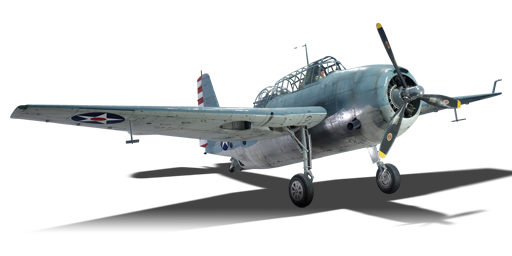
To replace the outdated TBD Devastator, several companies put forth their designs. Grumman's design was the TBF Avenger, a single-engine torpedo bomber. It was to be fitted with the Wright R-2600-8, a double-row 14-cylinder radial engine that produced 1,700 hp. Although it was extremely heavy, the U.S. Navy selected Grumman's design and ordered two prototypes in 1940. One special feature of the TBF Avenger was the Sto-Wings which folded the wings inwards to remedy the issue with the heights of carrier hangar decks. The TBF Avenger would be widely used by both the U.S. and Royal Navy during the war. American Avengers saw use at the Battle of Eastern Solomons and Guadalcanal; managing to sink a Japanese light carrier and a battleship. They also brought havoc against submarine crews such as I-52.
Introduced since the start of the Open Beta Test prior to Update 1.27, the TBF-1C Avenger is a decent torpedo bomber. It has access to AN-M66A2 (2,000 lb) bombs as well as Mk. 13-6 torpedos. Defensive armament is lacking with only one single 12.7 mm turret providing fire from the top and a single 7.62 turret mounted in the underside. The Avenger does have two 12.7 mm machine guns for offensive fire but is quite lacklustre. The TBF-1C Avenger is a formidable torpedo bomber however it's very vulnerable to enemy fighters.
General info
Flight performance
| Characteristics | Max Speed (km/h at 3,650 m) |
Max altitude (metres) |
Turn time (seconds) |
Rate of climb (metres/second) |
Take-off run (metres) | |||
|---|---|---|---|---|---|---|---|---|
| AB | RB | AB | RB | AB | RB | |||
| Stock | 414 | 398 | 31.1 | 32.4 | 3.2 | 3.2 | 307 | |
| Upgraded | 452 | 432 | 29.0 | 30.0 | 7.3 | 5.1 | ||
Details
| Features | ||||
|---|---|---|---|---|
| Combat flaps | Take-off flaps | Landing flaps | Air brakes | Arrestor gear |
| X | X | ✓ | X | ✓ |
| Limits | ||||||
|---|---|---|---|---|---|---|
| Wings (km/h) | Gear (km/h) | Flaps (km/h) | Max Static G | |||
| Combat | Take-off | Landing | + | - | ||
| 612 | N/A | N/A | 285 | ~6 | ~2 | |
| Optimal velocities (km/h) | |||
|---|---|---|---|
| Ailerons | Rudder | Elevators | Radiator |
| < 300 | < 220 | < 220 | > 318 |
Survivability and armour
- 6.35 mm Steel - Armour plate in the nose
- 12.7 mm Steel - Armour plate behind the pilot
- 12.7 mm Steel - Armour plate in dorsal gunner's seat
- 12.7 mm Steel - Armour plate in front of dorsal gunner
- 12.7 mm Steel - Armour plate in front of ventral gunner
- 6.35 mm Steel - Armour plate under the ventral gunner
- 40 mm Bulletproof glass in front of dorsal gunner
- 0.1 mm Wood - Connecting ventral gunner's armour
Modifications and economy
Flight performance is often a secondary criteria for an attack bomber. Focus on improved armament, especially the Improved torpedo (Mk.13-1 Case) that makes attacking ships much easier. Machine gun upgrades may not be needed initially, as the stock M2 Browning does well enough. The turrets, however, profit from upgrades, gaining longer and more accurate fire.
Of course, performance upgrades don't hurt (Compressor, Engine and Engine Injection are often essential pick-ups). Airframe and Cover can be used to further bolster the durable aircraft. Other upgrades can be scheduled toward the end.
Armaments
Offensive armament
The TBF-1C is armed with:
- 2 x 12.7 mm M2 Browning machine guns, wing-mounted (310 rpg = 620 total)
Suspended armament
The TBF-1C can be outfitted with the following ordnance:
- 4 x 500 lb AN-M64A1 bombs (2,000 lb total)
- 1 x 2,216 lb Mk.13-6 torpedo
- 1 x 2,216 lb Mk.13-6 Case torpedo
- 1 x 2,000 lb AN-M66A2 bomb (2,000 lb total)
- 1 x 1,600 lb AN-Mk 1 bomb (1,600 lb total)
- 2 x 1,000 lb A.P. AN-MK 33 bombs (2,000 lb total)
Defensive armament
The TBF-1C is defended by:
- 1 x 12.7 mm M2 Browning machine gun, dorsal turret (400 rpg)
- 1 x 7.62 mm Browning machine gun, ventral turret (500 rpg)
Usage in battles
As with all torpedo bombers, maintain low altitude, high speed, and fighter cover. The optimal distance for launching a torpedo is 1 km from the target. Engage enemy ships from directly ahead or astern which makes "leading" the target much easier. If torpedo bombing is not an option, the TBF-1C can carry bombs for attacking ground targets.
The Avenger lacks much significant offensive armament, but in a pinch it can serve as a backup fighter. This aircraft is not particularly fast or manoeuvrable, but continuing the trend among mid-tier American aircraft, it is extremely durable. Do not attack enemy aircraft head-on as the TBF-1C's guns are wing-mounted (causing convergence issues) and the large engine or pilot can be knocked out quickly by enemy fire.
Fly low and fast, head towards your target, drop your ordnance and bug out. However, if there are no hostile fighters in the area, you can destroy some enemy ground installations, e.g. AA, light vehicles, landing crafts and anti-tank positions after this.
Despite being a light bomber/torpedo bomber, the Avenger comes with a bombsight, just like the old TBD Devastator, albeit without the telescopic sight in the pilot's cockpit. This makes precision bombing in Realistic battles possible, as even novice pilots will be able to drop the 500 kg bombs with excellent accuracy. Once you spot a target, fly out about 1.5 km horizontally from the target (remember to keep focus on said target and its general location while being aware of any obstacles in your way), then begin to slowly fly over said target. Open the bomb bay and switch to the bombsight view, then drop your ordnance.
Simulator mode
Hands-off carrier take-off (Auto engine control): Start engine, flaps: raised, elevator trim: 0%, aileron trim: 0%, rudder trim: 14% right, WEP throttle, hands off controls until you lift off the carrier.
Level-type carrier landing final approach (Auto engine control): Drop any secondary weapons you may still have, make sure your alignment with the carrier and heading are good for landing, use your stick to hold an altitude of 40 m (120 ft), slow down below 200 km/h (125 mph / 108 kt), elevator trim: 2%, aileron trim: 18%, rudder trim: 0%, after gently slowing down to 123 km/h (77 mph / 67 kt) set throttle to about 55% (you will have to adjust throttle a lot, though), just before the carrier (less than 1 km (0.62 mi)) cut throttle and reset all trim to 0%, landing should be easy after that.
Manual Engine Control
| MEC elements | ||||||
|---|---|---|---|---|---|---|
| Mixer | Pitch | Radiator | Supercharger | Turbocharger | ||
| Oil | Water | Type | ||||
| Controllable | Controllable Auto control available |
Controllable Not auto controlled |
Controllable Not auto controlled |
Separate | Controllable 2 gears |
Not controllable |
Pros and cons
Pros:
- Robust construction
- Adaptive secondary ordnance for different maps e.g. naval or ground based operations
- Very good vision from pilot's seat in cockpit
- Very stable
- Good defensive gunner coverage
- Tail hook for carrier-based missions
Cons:
- Limited bomb selection for a bomber
- Wing mounted 12.7 mm machine guns factoring in convergence
- Poor low altitude performance, especially when turning
- Heavy and fairly slow
- Big target at low altitude
- Ventral gunner has little protection, easily knocked out
- Only has landing flaps
- Touchy controls, tends to over-respond to small control inputs (SB)
History

| Typical Monthly Production | Grumman TBF-1 |
|---|---|
| February, 1942 | 5 |
| June, 1942 | 60 |
| November, 1942 | 100 |
Significant engagements involving the TBF-1
Battle Of Midway - June 4, 1942
The Battle of Midway was a massive naval engagement that occurred 6 months after Pearl Harbour. Initiated by the Japanese, the attack on Midway was supposed to be a surprise attack that repeated their success at Pearl Harbor. However, due to American efforts in cracking Japanese communication codes in the days and weeks prior to the operation, the American defenders were warned about the attack far in advance.
The first combat mission of the TBF-1 was on June 4, 1942 at the battle of Midway. Only six TBF-1s were available and were initially attached to torpedo squadron VT-8. All apart from one (with significant damage) were shot down during the battle.
Eastern Solomons - August 24-25, 1942
IJN Admiral Yamamoto's infamous naval counter-strike against the US. The opposing naval forces met; the US Navy had only two carriers: USS Saratoga (VT-8) and USS Enterprise (VT-3). The Imperial Japanese Navy had the carriers: IJN Shōkaku, IJN Zuikaku, and light carrier IJN Ryūjō. By August, TBF Avengers had been delivered to the two US ships. Overall, 26 TBF-1s from VT-8 and VT-3 were launched during this engagement. Their torpedoes helped sink IJN Ryūjō for the loss of seven Avengers.
Guadalcanal - Nov, 12-13, 1942
Avengers from USS Enterprise (CV-6) crippled and assisted in the destruction of the 37,000 ton battleship IJN Hiei. Guadalcanal was the last large-scale Japanese naval attack and the Hiei was the first Japanese battleship sunk by US forces. TBF-1s were further used by Marine Scout Bombing Squadron 131 (VMSB-131).
| Archive of the in-game description | |
|---|---|
|
The TBF Torpedo Bomber was created to replace the outdated Devastators, which suffered from insufficient speed and short range. The TBF, also known as the Avenger, had good range and load capacity and the ability to carry cargo inside the fuselage. It was an ideal solution for a carrier-based transport aircraft. During the war, the Avenger earned a reputation as a very accurate bomber. One unique feature of the TBF-1 was its wings. After the plane landed, they were folded back onto the side of the fuselage and parallel to it. This was done to solve the problem of the insufficient height of aircraft carrier hangar decks, which conflicted with standard upward-folding wings. Thanks to hydraulic actuators, the wings could be retracted or extended by the pilot in just a few seconds, without any help from ground personnel. The TBF was widely used during World War II by not only U.S. forces but also those of Great Britain and New Zealand. In Great Britain, the aircraft was named the Tarpon and was one of the most extensively used British torpedo-bombers. | |
Media
- Skins
See also
External links
| Grumman Aircraft Engineering Corporation | |
|---|---|
| Aircraft | |
| Fighters | |
| F3F | F3F-2 · Galer's F3F-2 |
| F4F Wildcat | F4F-3 · F4F-4 |
| XF5F Skyrocket | XF5F · XP-50 |
| F6F Hellcat | F6F-5 · F6F-5N |
| F7F Tigercat | F7F-1 · F7F-3 |
| F8F Bearcat | F8F-1 · F8F-1B |
| Jet Fighters | |
| F9F Panther/Cougar | F9F-2 · F9F-5 · F9F-8 |
| F-11 Tiger | F11F-1 |
| F-14 Tomcat | F-14A Early · F-14B |
| Jet Strike Aircraft | |
| A-6 Intruder | A-6E TRAM |
| Bombers | TBF-1C |
| Export | ▄Martlet Mk IV · ▄F6F-5 · ▄F6F-5N · ▄F8F-1B · ▄Avenger Mk II · ▄Hellcat Mk II |
| ▄F-14A IRIAF | |
| Naval Vehicles | |
| Patrol Gunboat Hydrofoil (PGH) | USS Flagstaff |
| USA bombers | |
|---|---|
| Dive | SB2U-2 · SB2U-3 · SBD-3 · SB2C-1C · SB2C-4 |
| Torpedo | TBD-1 · PBY-5 Catalina · PBY-5A Catalina · TBF-1C · BTD-1 |
| Medium | B-10B · B-18A · B-34 · PV-2D · B-25J-1 · B-25J-20 · A-26C-45 · A-26C-45DT · B-26B |
| Heavy | B-17E · B-17E/L · B-17G-60-VE · PB4Y-2 · B-24D-25-CO · B-29A-BN |
| Hydroplanes | OS2U-1 · OS2U-3 · PBM-1 "Mariner" · PBM-3 "Mariner" · PBM-5A "Mariner" |