Difference between pages "M2HB (12.7 mm)" and "G.55 serie 1"
(Added OF-40 MTCA, AMX-30 Super, Leclerc, Type 16) |
m (Specs-Card ArtImage Added.) |
||
| Line 1: | Line 1: | ||
| − | {{ | + | {{About |
| − | | | + | | about = Italian fighter '''{{PAGENAME}}''' |
| − | + | | usage = other versions | |
| − | | | + | | link = G.55 (Family) |
| − | | | ||
| − | |||
| − | |||
| − | |||
}} | }} | ||
| − | {{ | + | {{Specs-Card |
| − | | | + | |code=g_55_serie1 |
| − | | | + | |images={{Specs-Card-Image|GarageImage_{{PAGENAME}}.jpg|ArtImage_{{PAGENAME}}.png}} |
| − | + | |cockpit=Cockpit g.55 serie 1.jpg | |
| − | | | ||
| − | | | ||
| − | | | ||
}} | }} | ||
== Description == | == Description == | ||
| − | <!-- '' | + | <!-- ''In the description, the first part should be about the history of and the creation and combat usage of the aircraft, as well as its key features. In the second part, tell the reader about the aircraft in the game. Insert a screenshot of the vehicle, so that if the novice player does not remember the vehicle by name, he will immediately understand what kind of vehicle the article is talking about.'' --> |
| − | + | The '''{{Specs|name}}''' is a rank {{Specs|rank}} Italian fighter {{Battle-rating}}. It was introduced in [[Update 1.69 "Regia Aeronautica"]]. | |
| − | |||
| − | |||
| − | |||
| − | |||
| − | |||
| − | |||
| − | |||
| − | |||
| − | |||
| − | |||
| − | |||
| − | |||
| − | |||
| − | |||
| − | |||
| − | |||
| − | |||
| − | |||
| − | |||
| − | |||
| − | |||
| − | |||
| − | |||
| − | |||
| − | |||
| − | |||
| − | |||
| − | |||
| − | |||
| − | |||
| − | |||
| − | |||
| − | |||
| − | |||
| − | |||
| − | |||
| − | |||
| − | |||
| − | |||
| − | |||
| − | |||
| − | |||
| − | |||
| − | |||
| − | |||
| − | |||
| − | |||
== General info == | == General info == | ||
| − | <!-- '' | + | === Flight performance === |
| − | + | {{Specs-Avia-Flight}} | |
| + | <!-- ''Describe how the aircraft behaves in the air. Speed, manoeuvrability, acceleration and allowable loads - these are the most important characteristics of the vehicle.'' --> | ||
| + | Adequate is the word that comes to mind when referring to the flight characteristics of the G.55. While not particularly good at anything, it isn't particularly bad at anything either, which makes it a solid jack-of-all-trades type plane. Overall, it is a smooth flyer that has decent acceleration, speed and climb rate while sporting a powerful triad of MG 151's which load the feared Minengeschoß round that can tear through planes like a hot knife through butter. It excels the most in medium altitude (3-5 km) as a powerful energy-based dogfighter which can take advantage of its great engine power to defeat most allied fighters it comes across. | ||
| − | === | + | {| class="wikitable" style="text-align:center" width="70%" |
| − | < | + | ! rowspan="2" | Characteristics |
| − | + | ! colspan="2" | Max Speed<br>(km/h at 6,500 m) | |
| + | ! rowspan="2" | Max altitude<br>(metres) | ||
| + | ! colspan="2" | Turn time<br>(seconds) | ||
| + | ! colspan="2" | Rate of climb<br>(metres/second) | ||
| + | ! rowspan="2" | Take-off run<br>(metres) | ||
| + | |- | ||
| + | ! AB !! RB !! AB !! RB !! AB !! RB | ||
| + | |- | ||
| + | ! Stock | ||
| + | | 623 || 607 || rowspan="2" | {{Specs|ceiling}} || 20.9 || 21.6 || 13.5 || 13.5 || rowspan="2" | 300 | ||
| + | |- | ||
| + | ! Upgraded | ||
| + | | 670 || 646 || 19.1 || 20.0 || 20.7 || 16.7 | ||
| + | |- | ||
| + | |} | ||
| − | + | ==== Details ==== | |
| − | + | {| class="wikitable" style="text-align:center" width="50%" | |
| − | + | |- | |
| − | + | ! colspan="5" | Features | |
| − | + | |- | |
| − | + | ! Combat flaps !! Take-off flaps !! Landing flaps !! Air brakes !! Arrestor gear | |
| − | + | |- | |
| − | + | | ✓ || ✓ || ✓ || X || X <!-- ✓ --> | |
| − | + | |- | |
| + | |} | ||
| − | {| class="wikitable | + | {| class="wikitable" style="text-align:center" width="50%" |
| − | |||
|- | |- | ||
| − | + | ! colspan="7" | Limits | |
| − | ! colspan=" | ||
|- | |- | ||
| − | ! | + | ! rowspan="2" | Wings (km/h) |
| + | ! rowspan="2" | Gear (km/h) | ||
| + | ! colspan="3" | Flaps (km/h) | ||
| + | ! colspan="2" | Max Static G | ||
|- | |- | ||
| − | + | ! Combat !! Take-off !! Landing !! + !! - | |
|- | |- | ||
| − | | | + | | {{Specs|destruction|body}} || {{Specs|destruction|gear}} || 437 || 408 || 260 || ~12 || ~6 |
|- | |- | ||
| − | | | + | |} |
| + | |||
| + | {| class="wikitable" style="text-align:center" | ||
|- | |- | ||
| − | | | + | ! colspan="4" | Optimal velocities (km/h) |
|- | |- | ||
| − | + | ! Ailerons !! Rudder !! Elevators !! Radiator | |
| − | |||
| − | ! | ||
|- | |- | ||
| − | + | | < 400 || < 420 || < 450 || > 715 | |
| − | |||
| − | |||
| − | |||
| − | |||
| − | |||
| − | |||
| − | |||
|- | |- | ||
| − | + | |} | |
| − | + | ||
| − | + | {| class="wikitable" style="text-align:center" | |
|- | |- | ||
| − | | | + | ! colspan="3" | Compressor (RB/SB) |
|- | |- | ||
| − | | | + | ! colspan="3" | Setting 1 |
|- | |- | ||
| − | + | ! Optimal altitude | |
| + | ! 100% Engine power | ||
| + | ! WEP Engine power | ||
|- | |- | ||
| − | | | + | | 5,700 m || 1,260 hp || 1,399 hp |
|- | |- | ||
|} | |} | ||
| − | === | + | === Survivability and armour === |
| − | <!-- '' | + | {{Specs-Avia-Armour}} |
| − | The | + | <!-- ''Examine the survivability of the aircraft. Note how vulnerable the structure is and how secure the pilot is, whether the fuel tanks are armoured, etc. Describe the armour, if there is any, and also mention the vulnerability of other critical aircraft systems.'' --> |
| + | |||
| + | * 8 mm Steel - Pilot's seat | ||
| + | * 50 mm Bulletproof glass - Armoured windscreen | ||
| + | * Critical components located at the front of aircraft (pilot, engine, controls) | ||
| + | * Fuel tanks located in wings | ||
| + | * Fuel tank in the fuselage behind the pilot | ||
| + | |||
| + | === Modifications and economy === | ||
| + | {{Specs-Economy}} | ||
| + | |||
| + | == Armaments == | ||
| + | {{Specs-Avia-Armaments}} | ||
| + | === Offensive armament === | ||
| + | {{Specs-Avia-Offensive}} | ||
| + | <!-- ''Describe the offensive armament of the aircraft, if any. Describe how effective the cannons and machine guns are in a battle, and also what belts or drums are better to use. If there is no offensive weaponry, delete this subsection.'' --> | ||
| + | {{main|MG 151 (20 mm)|Breda-SAFAT (12.7 mm)}} | ||
| + | |||
| + | The '''''{{PAGENAME}}''''' is armed with: | ||
| + | |||
| + | * 1 x 20 mm MG 151 cannons, nose-mounted (250 rpg) | ||
| + | * 2 x 20 mm MG 151 cannons, wing-mounted (200 rpg = 400 total) | ||
| + | * 2 x 12.7 mm Breda-SAFAT machine guns, nose-mounted (300 rpg = 600 total) | ||
| + | |||
| + | The two cannons are mounted in each wing. A single 20 mm cannon is mounted in the nose of the aircraft, firing through the propeller hub. The two machine guns are nose-mounted, positioned between the pilot and the engine of the aircraft. If fired continuously, the wing-mounted cannons will run out of ammunition before the nose-mounted cannon. | ||
| + | |||
| + | The twin Breda HMG's are reliable for easily taking down opponents with air targets or stealth belts, however they have fairly poor ballistics beyond 300 m. The pilot should use them as scouting weapons in order to line-up shots for the MG 151's to save ammunition, which isn't necessarily needed as the 151's have a large pool of ammunition, but it does help when trying to play more conservatively. | ||
| + | |||
| + | === Suspended armament === | ||
| + | {{Specs-Avia-Suspended}} | ||
| + | <!-- ''Describe the aircraft's suspended armament: additional cannons under the wings, bombs, rockets and torpedoes. This section is especially important for bombers and attackers. If there is no suspended weaponry remove this subsection.'' --> | ||
| + | {{main|GP 50 (50 kg)|GP 100 (100 kg)}} | ||
| + | |||
| + | The '''''{{PAGENAME}}''''' can be outfitted with the following ordnance: | ||
| + | |||
| + | * Without load | ||
| + | * 2 x 50 kg GP 50 bombs (100 kg total) | ||
| + | * 2 x 100 kg GP 100 bombs (200 kg total) | ||
== Usage in battles == | == Usage in battles == | ||
| − | <!-- ''Describe the | + | <!-- ''Describe the tactics of playing in the aircraft, the features of using aircraft in a team and advice on tactics. Refrain from creating a "guide" - do not impose a single point of view, but instead, give the reader food for thought. Examine the most dangerous enemies and give recommendations on fighting them. If necessary, note the specifics of the game in different modes (AB, RB, SB).'' --> |
| − | + | The G.55's main strong points come down to its engine power, its light construction and its wing profile, which grant it a high sustained rate of climb, a tight turning circle and the power output to endure sustained horizontal manoeuvring. It performs best up to medium altitudes around 5,000 m (16,404 feet), after which it is generally outperformed by its competition. unfortunately, its light construction and its wing profile mean that when the "Centauro" goes into the vertical, it bleeds speed very easily. Its top speed in a dive is unimpressive and it can barely catch up in a zoom climb with its competitors. The armament is very effective as well, however, the MG 151 is not very accurate at range, which should be taken into account when engaging in head-on passes. | |
| + | |||
| + | You should primarily enforce an energy fighting flying style to take advantage of the aircraft's descent energy retention and solid manoeuvrability, and also to try to cover the Centauro's weakness of mediocre speed. Try to stay above your enemy, but take care to recognize the threat your attacker poses by observing the plane they are flying. | ||
| + | |||
| + | '''Specific enemies worth noting''' | ||
| + | |||
| + | * [[P-51D-30]] - The P-51D-30 is another enemy you should take note of. It is arguably one of the best aircraft at this battle rating thanks to its excellent speed, great climb rate, relatively powerful armament and solid high-speed manoeuvrability due to its Laminar flow wings. The Packard V-1650 is basically a Merlin engine tuned for high altitude, and it can propel the D-30 to speeds the G.55 can only dream of. However, the D-30 has extremely poor manoeuvrability at low speeds due to the same Laminar flow wings that allow it to turn well at high speeds, so if you cannot engage one with an energy advantage you can turn-fight it. | ||
| + | * [[Yak-3P]] - The feared red Soviet menace is an extremely dangerous opponent that can engage you on a more than even footing. It turns well, outruns you, and has a solid climb rate while also sporting a relatively powerful set of 3 B-20 cannons, but its performance suffers above 3,000 m where its already mediocre speed becomes crippling and has slightly worse turn than G.55 when flaps are properly used. As long as you take care to engage it above 4,000 m or turnfight it properly, not a threat. | ||
| + | * Late [[Bf 109 (Family)|Bf 109]] models (G2/trop-G6) - The G-2 and G-6 outruns and outclimbs you. When they are above you and starts Boom and Zoom on you, lure them into turnfight or seek for teammates to help. | ||
| + | |||
| + | === Manual Engine Control === | ||
| + | {| class="wikitable" style="text-align:center" | ||
| + | |- | ||
| + | ! colspan="7" | MEC elements | ||
| + | |- | ||
| + | ! rowspan="2" | Mixer | ||
| + | ! rowspan="2" | Pitch | ||
| + | ! colspan="3" | Radiator | ||
| + | ! rowspan="2" | Supercharger | ||
| + | ! rowspan="2" | Turbocharger | ||
| + | |- | ||
| + | ! Oil !! Water !! Type | ||
| + | |- | ||
| + | | Not controllable || Controllable<br>Not auto controlled || Controllable<br>Auto control available || Controllable<br>Auto control available || Separate || Not controllable<br>1 gear || Not controllable | ||
| + | |- | ||
| + | |} | ||
=== Pros and cons === | === Pros and cons === | ||
| − | <!-- ''Summarise and briefly evaluate the | + | <!-- ''Summarise and briefly evaluate the vehicle in terms of its characteristics and combat effectiveness. Mark its pros and cons in the bulleted list. Try not to use more than 6 points for each of the characteristics. Avoid using categorical definitions such as "bad", "good" and the like - use substitutions with softer forms such as "inadequate" and "effective".'' --> |
'''Pros:''' | '''Pros:''' | ||
| − | * | + | |
| − | * Good | + | * Good climb rate |
| − | * | + | * Exceptional low and mid-altitude performance |
| − | * | + | * Relatively robust airframe |
| + | * Good turn and roll rate | ||
| + | * Effective armament with a large ammunition pool | ||
| + | * Multi-role fighter which can carry bombs | ||
'''Cons:''' | '''Cons:''' | ||
| − | * | + | |
| + | * Lack of armour means the pilot is more prone to being knocked out in a head-on pass | ||
| + | * Engine overheats quickly on WEP without manual engine control | ||
| + | * Roll and yaw are limited at high speeds | ||
| + | * Metal beams on canopy window obstruct the first-person view | ||
| + | * Mediocre top speed | ||
== History == | == History == | ||
| − | <!-- '' | + | <!-- ''Describe the history of the creation and combat usage of the aircraft in more detail than in the introduction. If the historical reference turns out to be too long, take it to a separate article, taking a link to the article about the vehicle and adding a block "/History" (example: <nowiki>https://wiki.warthunder.com/(Vehicle-name)/History</nowiki>) and add a link to it here using the <code>main</code> template. Be sure to reference text and sources by using <code><nowiki><ref></ref></nowiki></code>, as well as adding them at the end of the article with <code><nowiki><references /></nowiki></code>. This section may also include the vehicle's dev blog entry (if applicable) and the in-game encyclopedia description (under <code><nowiki>=== In-game description ===</nowiki></code>, also if applicable).'' --> |
| − | The | + | The Fiat G.55 serie 1 (G.55/1) was the first production aircraft series of the Fiat G.55 family. The aircraft's origins can be traced to a variant of the Fiat G.50, to be powered by a new Fiat RA.1050 inline engine (a license-built variant of the DB-605). The first G.55 prototype flew on 30 April 1942, immediately exhibiting its great flight performance and handling characteristics. Though initially equipped with a 20 mm MG151/20 cannon and four Breda SAFAT machine guns, the design was revised to include two additional cannons replacing two of the wing-mounted machine guns. This armament scheme became the standard for G.55/1 aircraft, though some had field-modified wing machine guns instead of the cannons. |
| − | The | + | The aircraft was test flown against its rivals, the C.205 and Re.2005. Of the three, the G.55 exhibited the second best characteristics. As a result, it and the C.205 were both ordered into mass production, with 1,800 G.55 aircraft ordered. The first 34 pre-production aircraft were completed identical to the prototype, and later modified to serie 1 standard, with underwing racks for a single 50 kg or 100 kg bomb. The aircraft's strong high-altitude performance and adequate armament made it well-suited for the bomber interception role it was meant to fulfil, as the Italians intended it to be used against American heavy bombers such as the B-17 and B-24. |
| − | The | + | The first G.55/1 aircraft began deliveries in summer of 1943, and soon began flying sorties against American bombers. However, the aircraft's complicated construction process meant that only 35 aircraft had been delivered before the Italian Armistice in September of that year. However, several G.55/1s went on to serve with the Northern Italian air force, still loyal to the Nazis. These aircraft served until late 1944, when they were replaced by later variants of the Bf 109. |
| − | + | In early 1942, the German and Italian air forces exchanged officers for visits to their respective aircraft production lines, to investigate ways to standardize axis aircraft production. In particular, the Germans were interested in the G.55 and its counterparts - so interested that it attracted the attention of Hermann Göring. After various flight tests, the German Air Ministry decided that the G.55 was an excellent fighter and started setting up a production line in Germany as well. As a result, various G.55 variants were produced in Germany. However, due to the relatively short production run before the Armistice, only 35 G.55/1 aircraft were built. | |
| − | + | == Media == | |
| + | <!-- ''Excellent additions to the article would be video guides, screenshots from the game, and photos.'' --> | ||
| + | |||
| + | ;Skins | ||
| + | |||
| + | * [https://live.warthunder.com/feed/camouflages/?vehicle=g_55_serie1 Skins and camouflages for the {{PAGENAME}} from live.warthunder.com.] | ||
| − | + | [[File:G.55 serie 1 Francesca Lucchini.mp4|thumb|"Francesca Lucchini" collaboration camouflage|none]] | |
| − | |||
== See also == | == See also == | ||
<!-- ''Links to the articles on the War Thunder Wiki that you think will be useful for the reader, for example:'' | <!-- ''Links to the articles on the War Thunder Wiki that you think will be useful for the reader, for example:'' | ||
| − | * ''reference to the | + | * ''reference to the series of the aircraft;'' |
| − | * '' | + | * ''links to approximate analogues of other nations and research trees.'' --> |
| − | * [[ | + | |
| − | * [[ | + | ;Aircraft of comparable role, configuration and era |
| − | * [[ | + | |
| − | * [[ | + | * [[Bf 109 G-2/trop]] |
| + | * [[Bf 109 G-6]] / {{Specs-Link|bf-109g-6_finland}} | ||
| + | * [[Ki-61-I hei]] | ||
| + | * [[C.205N2]] | ||
== External links == | == External links == | ||
<!-- ''Paste links to sources and external resources, such as:'' | <!-- ''Paste links to sources and external resources, such as:'' | ||
* ''topic on the official game forum;'' | * ''topic on the official game forum;'' | ||
| − | |||
* ''other literature.'' --> | * ''other literature.'' --> | ||
| − | |||
| − | |||
| − | |||
| − | + | * [[wt:en/news/4812-vehicle-profile-fiat-g-55-serie-1-en|[Vehicle Profile] Fiat G.55 serie 1]] | |
| − | + | * [https://forum.warthunder.com/index.php?/topic/364974-fiat-g55-serie-i-centauro/ Official data sheet - more details about the performance] | |
| − | + | {{AirManufacturer Fiat}} | |
| − | + | {{Italy fighters}} | |
Latest revision as of 22:47, 8 April 2023
| This page is about the Italian fighter G.55 serie 1. For other versions, see G.55 (Family). |


Contents
Description
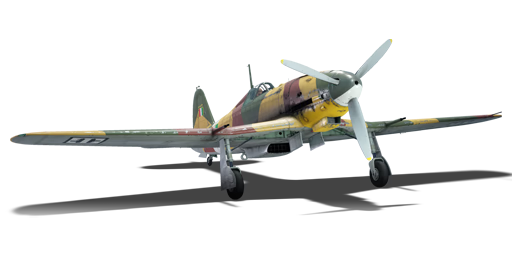
The G.55 Centauro serie 1 is a rank Italian fighter with a battle rating of (AB), (RB), and (SB). It was introduced in Update 1.69 "Regia Aeronautica".
General info
Flight performance
Adequate is the word that comes to mind when referring to the flight characteristics of the G.55. While not particularly good at anything, it isn't particularly bad at anything either, which makes it a solid jack-of-all-trades type plane. Overall, it is a smooth flyer that has decent acceleration, speed and climb rate while sporting a powerful triad of MG 151's which load the feared Minengeschoß round that can tear through planes like a hot knife through butter. It excels the most in medium altitude (3-5 km) as a powerful energy-based dogfighter which can take advantage of its great engine power to defeat most allied fighters it comes across.
| Characteristics | Max Speed (km/h at 6,500 m) |
Max altitude (metres) |
Turn time (seconds) |
Rate of climb (metres/second) |
Take-off run (metres) | |||
|---|---|---|---|---|---|---|---|---|
| AB | RB | AB | RB | AB | RB | |||
| Stock | 623 | 607 | 20.9 | 21.6 | 13.5 | 13.5 | 300 | |
| Upgraded | 670 | 646 | 19.1 | 20.0 | 20.7 | 16.7 | ||
Details
| Features | ||||
|---|---|---|---|---|
| Combat flaps | Take-off flaps | Landing flaps | Air brakes | Arrestor gear |
| ✓ | ✓ | ✓ | X | X |
| Limits | ||||||
|---|---|---|---|---|---|---|
| Wings (km/h) | Gear (km/h) | Flaps (km/h) | Max Static G | |||
| Combat | Take-off | Landing | + | - | ||
| 437 | 408 | 260 | ~12 | ~6 | ||
| Optimal velocities (km/h) | |||
|---|---|---|---|
| Ailerons | Rudder | Elevators | Radiator |
| < 400 | < 420 | < 450 | > 715 |
| Compressor (RB/SB) | ||
|---|---|---|
| Setting 1 | ||
| Optimal altitude | 100% Engine power | WEP Engine power |
| 5,700 m | 1,260 hp | 1,399 hp |
Survivability and armour
- 8 mm Steel - Pilot's seat
- 50 mm Bulletproof glass - Armoured windscreen
- Critical components located at the front of aircraft (pilot, engine, controls)
- Fuel tanks located in wings
- Fuel tank in the fuselage behind the pilot
Modifications and economy
Armaments
Offensive armament
The G.55 serie 1 is armed with:
- 1 x 20 mm MG 151 cannons, nose-mounted (250 rpg)
- 2 x 20 mm MG 151 cannons, wing-mounted (200 rpg = 400 total)
- 2 x 12.7 mm Breda-SAFAT machine guns, nose-mounted (300 rpg = 600 total)
The two cannons are mounted in each wing. A single 20 mm cannon is mounted in the nose of the aircraft, firing through the propeller hub. The two machine guns are nose-mounted, positioned between the pilot and the engine of the aircraft. If fired continuously, the wing-mounted cannons will run out of ammunition before the nose-mounted cannon.
The twin Breda HMG's are reliable for easily taking down opponents with air targets or stealth belts, however they have fairly poor ballistics beyond 300 m. The pilot should use them as scouting weapons in order to line-up shots for the MG 151's to save ammunition, which isn't necessarily needed as the 151's have a large pool of ammunition, but it does help when trying to play more conservatively.
Suspended armament
The G.55 serie 1 can be outfitted with the following ordnance:
- Without load
- 2 x 50 kg GP 50 bombs (100 kg total)
- 2 x 100 kg GP 100 bombs (200 kg total)
Usage in battles
The G.55's main strong points come down to its engine power, its light construction and its wing profile, which grant it a high sustained rate of climb, a tight turning circle and the power output to endure sustained horizontal manoeuvring. It performs best up to medium altitudes around 5,000 m (16,404 feet), after which it is generally outperformed by its competition. unfortunately, its light construction and its wing profile mean that when the "Centauro" goes into the vertical, it bleeds speed very easily. Its top speed in a dive is unimpressive and it can barely catch up in a zoom climb with its competitors. The armament is very effective as well, however, the MG 151 is not very accurate at range, which should be taken into account when engaging in head-on passes.
You should primarily enforce an energy fighting flying style to take advantage of the aircraft's descent energy retention and solid manoeuvrability, and also to try to cover the Centauro's weakness of mediocre speed. Try to stay above your enemy, but take care to recognize the threat your attacker poses by observing the plane they are flying.
Specific enemies worth noting
- P-51D-30 - The P-51D-30 is another enemy you should take note of. It is arguably one of the best aircraft at this battle rating thanks to its excellent speed, great climb rate, relatively powerful armament and solid high-speed manoeuvrability due to its Laminar flow wings. The Packard V-1650 is basically a Merlin engine tuned for high altitude, and it can propel the D-30 to speeds the G.55 can only dream of. However, the D-30 has extremely poor manoeuvrability at low speeds due to the same Laminar flow wings that allow it to turn well at high speeds, so if you cannot engage one with an energy advantage you can turn-fight it.
- Yak-3P - The feared red Soviet menace is an extremely dangerous opponent that can engage you on a more than even footing. It turns well, outruns you, and has a solid climb rate while also sporting a relatively powerful set of 3 B-20 cannons, but its performance suffers above 3,000 m where its already mediocre speed becomes crippling and has slightly worse turn than G.55 when flaps are properly used. As long as you take care to engage it above 4,000 m or turnfight it properly, not a threat.
- Late Bf 109 models (G2/trop-G6) - The G-2 and G-6 outruns and outclimbs you. When they are above you and starts Boom and Zoom on you, lure them into turnfight or seek for teammates to help.
Manual Engine Control
| MEC elements | ||||||
|---|---|---|---|---|---|---|
| Mixer | Pitch | Radiator | Supercharger | Turbocharger | ||
| Oil | Water | Type | ||||
| Not controllable | Controllable Not auto controlled |
Controllable Auto control available |
Controllable Auto control available |
Separate | Not controllable 1 gear |
Not controllable |
Pros and cons
Pros:
- Good climb rate
- Exceptional low and mid-altitude performance
- Relatively robust airframe
- Good turn and roll rate
- Effective armament with a large ammunition pool
- Multi-role fighter which can carry bombs
Cons:
- Lack of armour means the pilot is more prone to being knocked out in a head-on pass
- Engine overheats quickly on WEP without manual engine control
- Roll and yaw are limited at high speeds
- Metal beams on canopy window obstruct the first-person view
- Mediocre top speed
History
The Fiat G.55 serie 1 (G.55/1) was the first production aircraft series of the Fiat G.55 family. The aircraft's origins can be traced to a variant of the Fiat G.50, to be powered by a new Fiat RA.1050 inline engine (a license-built variant of the DB-605). The first G.55 prototype flew on 30 April 1942, immediately exhibiting its great flight performance and handling characteristics. Though initially equipped with a 20 mm MG151/20 cannon and four Breda SAFAT machine guns, the design was revised to include two additional cannons replacing two of the wing-mounted machine guns. This armament scheme became the standard for G.55/1 aircraft, though some had field-modified wing machine guns instead of the cannons.
The aircraft was test flown against its rivals, the C.205 and Re.2005. Of the three, the G.55 exhibited the second best characteristics. As a result, it and the C.205 were both ordered into mass production, with 1,800 G.55 aircraft ordered. The first 34 pre-production aircraft were completed identical to the prototype, and later modified to serie 1 standard, with underwing racks for a single 50 kg or 100 kg bomb. The aircraft's strong high-altitude performance and adequate armament made it well-suited for the bomber interception role it was meant to fulfil, as the Italians intended it to be used against American heavy bombers such as the B-17 and B-24.
The first G.55/1 aircraft began deliveries in summer of 1943, and soon began flying sorties against American bombers. However, the aircraft's complicated construction process meant that only 35 aircraft had been delivered before the Italian Armistice in September of that year. However, several G.55/1s went on to serve with the Northern Italian air force, still loyal to the Nazis. These aircraft served until late 1944, when they were replaced by later variants of the Bf 109.
In early 1942, the German and Italian air forces exchanged officers for visits to their respective aircraft production lines, to investigate ways to standardize axis aircraft production. In particular, the Germans were interested in the G.55 and its counterparts - so interested that it attracted the attention of Hermann Göring. After various flight tests, the German Air Ministry decided that the G.55 was an excellent fighter and started setting up a production line in Germany as well. As a result, various G.55 variants were produced in Germany. However, due to the relatively short production run before the Armistice, only 35 G.55/1 aircraft were built.
Media
- Skins
See also
- Aircraft of comparable role, configuration and era
External links
| Fiat Aviation (Fiat Aviazione) | |
|---|---|
| Fighters | CR.32 · CR.32 bis · CR.32 quater |
| CR.42 · Marcolin's C.R.42 CN · ▀Marcolin's C.R.42 CN | |
| G.50 serie 2 · G.50 AS serie 7 | |
| G.55 sottoserie 0 · G.55 serie 1 · G.55S | |
| G.56 | |
| Jet fighters | G.91 pre-serie · G.91 R/1 · G.91 Y · G.91 YS |
| ▄F-86K* | |
| ▄F-104G* · F-104S* · F-104S.ASA* · ▄F-104S TAF* | |
| Strike aircraft | F.C.20 Bis |
| Bombers | B.R.20DR · B.R.20M M1 |
| Export/Captured | J11 · ▀CR.42 |
| ▀G.50 serie 2 · ▀G.50 AS serie 7 | |
| ◄G.91 R/3 · ◄G.91 R/4 · G.91 R/4 | |
| *Licensed | |
| See also | North American Aviation · Lockheed Martin |
| Italy fighters | |
|---|---|
| Fiat | CR.32 · CR.32 bis · CR.32 quater · CR.42 · Marcolin's C.R.42 CN |
| G.50 serie 2 · G.50 AS serie 7 | |
| G.55 sottoserie 0 · G.55 serie 1 · G.55S · G.56 | |
| Reggiane | Re.2000 G.A. · Re.2000 serie 1 |
| Re.2001 serie 1 · Re.2001 gruppo 22 · Re.2001 CB · Re.2001 CN | |
| Re.2002 Early | |
| Re.2005 serie 0 | |
| Macchi | C. 200 serie 3 · C. 200 serie 7 |
| C. 202 · C. 202D · C. 202EC | |
| C. 205 serie 1 · C. 205 serie 3 · C. 205N2 | |
| IMAM | Ro.44 |
| Foreign: | |
| Germany | ▄Bf 109 G-14/AS |
| USA | ▄P-47D-30 |
| Britain | ▄Spitfire Mk Vb/trop |
| Hungary | ◐Bf 109 F-4 · ◐Bf 109 G-2 · ◔Yak-9P |
| Romania | He 112 B-1/U2 · IAR-81C |