Difference between revisions of "HMS Diana"
m |
(added armament section) |
||
| Line 37: | Line 37: | ||
{{main|4.5 inch/45 QF Mark V (114 mm)}} | {{main|4.5 inch/45 QF Mark V (114 mm)}} | ||
| − | + | The Diana features six 4.5 inch QF Mark V guns as her main armament, mounted in three twin turret arranged in A-Bs-X position. These were the same weapon system from the [[HMAS Tobruk]] and thus shared the same automatic ramming system and shell choice from its Australian counterpart, providing great and consistent rate of fire at 20 rpm with no first-stage ammo rack. | |
| + | The gun has four shell choices; a HE shell with 2.32 kg of TNT equivalent, enough to cause damage to any unarmoured ship, a HE-TF and a HE-VT shell for anti-air purposes with the same filler as regular HE shell, and a SAP shell with largely the same performance as the one from British 5-inch guns. | ||
| + | |||
| + | As mentioned in the "Survivability and armour" section. While it is tempting to do boardsides to exploit the Diana's additional firepower at the rear, in doing so will expose her unprotected magazines at her bow and stern to the enemy. Thus, while in firefight, it is recommended to face her bow to the enemy at all times only use her frontal armanent to minimize the risk of detonation. | ||
{| class="wikitable sortable" style="text-align:center" width="100%" | {| class="wikitable sortable" style="text-align:center" width="100%" | ||
! colspan="8" | Penetration statistics | ! colspan="8" | Penetration statistics | ||
| Line 102: | Line 105: | ||
<!-- ''Some ships are fitted with weapons of various calibres. Secondary armaments are defined as weapons chosen with the control <code>Select secondary weapon</code>. Evaluate the secondary armaments and give advice on how to use them. Describe the ammunition available for the secondary armament. Provide recommendations on how to use them and which ammunition to choose. Remember that any anti-air armament, even heavy calibre weapons, belong in the next section. If there is no secondary armament, remove this section.'' --> | <!-- ''Some ships are fitted with weapons of various calibres. Secondary armaments are defined as weapons chosen with the control <code>Select secondary weapon</code>. Evaluate the secondary armaments and give advice on how to use them. Describe the ammunition available for the secondary armament. Provide recommendations on how to use them and which ammunition to choose. Remember that any anti-air armament, even heavy calibre weapons, belong in the next section. If there is no secondary armament, remove this section.'' --> | ||
{{main|QF Mark V (40 mm)|QF STAAG Mark II (40 mm)}} | {{main|QF Mark V (40 mm)|QF STAAG Mark II (40 mm)}} | ||
| + | |||
| + | For delicated anti-air defense, the Diana features six 40 mm Bofors autocannon in two STAAG dual mounts flanking the bridge and one Mk V mount located behind her second funnel. | ||
| + | |||
| + | Compared to the Battle-class destroyers, the Diana's AA defense is somewhat of a downgrade due to the lower gun count and less coverage. Nevertheless, they still provide great defense against enemy aircraft, especially when used in tandem with the 4.5 inch guns. | ||
{| class="wikitable sortable" style="text-align:center" width="100%" | {| class="wikitable sortable" style="text-align:center" width="100%" | ||
| Line 154: | Line 161: | ||
'''Pros:''' | '''Pros:''' | ||
| − | * Six fast-firing and powerful 4.5 inch guns | + | * Six fast-firing and powerful 4.5 inch guns with no first-stage ammoracks |
* Turret has good traverse speed and coverage | * Turret has good traverse speed and coverage | ||
* Survivable against destroyers due to high crew count | * Survivable against destroyers due to high crew count | ||
Revision as of 16:54, 29 January 2023

Contents
Description
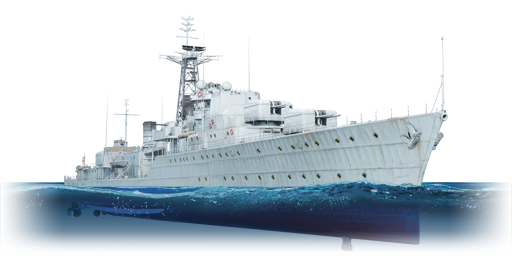
The Daring-class, HMS Diana (D126), 1958 is a rank British destroyer with a battle rating of (AB), (RB), and (SB). It was introduced in Update "Fire and Ice".
Designed in the immediate aftermath of World War II, the Daring-class destroyers incorporated lessons learned during the war and reflect change of doctrine of the post-war Royal Navy. The class features an emphasis on operation range and armaments, intended to supplement and eventually supersede cruisers which were deemed too expensive to operate.
Because of her unusually large size for a destroyer at that time, the class were initially called "Darings" in a similar manner to various battleship built after the HMS Dreadnought. Though they were not as revolutionary as its Great War counterparts, they represented the final evolution of the British "gun destroyer" before the advent of guided missile destroyers in the 60s.
General info
Survivability and armour
When compared to her real life predecessor, the Battle-class destroyer, HMS Diana features similar characteristics along with some noticeable changes. She retains two forward-facing 4.5 inch turret of the Battle-class, but receives also an additional turret at the stern. Being designed for operation range and survivability, she is also considerably more resilient to enemy fire thanks to the compact crew compartment.
However, the Diana still shares the common weakness with other British WWII destroyers in terms of armour (or lack thereof). Her hull is almost devoid of any armour save for a thin layer of anti-fragmentation armour around the bridge and turrets. In addition, her anti-air and rear turret's shell room were located way above the waterline, both of them were fatal weak spot that will be exposed when doing broadsides and can be somewhat counterintuitive to the ship's additional firepower improvement.
Mobility
Being optimized for operation range, the Diana's top speed is below average for a destroyer. In addition, the ship's displacement will also affect her mobility, making her a bit less manoeuvrable.
| Mobility Characteristics | |||
|---|---|---|---|
| Game Mode | Upgrade Status | Maximum Speed (km/h) | |
| Forward | Reverse | ||
| AB | |||
| Upgraded | |||
| RB/SB | |||
| Upgraded | |||
Modifications and economy
Armament
Primary armament
The Diana features six 4.5 inch QF Mark V guns as her main armament, mounted in three twin turret arranged in A-Bs-X position. These were the same weapon system from the HMAS Tobruk and thus shared the same automatic ramming system and shell choice from its Australian counterpart, providing great and consistent rate of fire at 20 rpm with no first-stage ammo rack.
The gun has four shell choices; a HE shell with 2.32 kg of TNT equivalent, enough to cause damage to any unarmoured ship, a HE-TF and a HE-VT shell for anti-air purposes with the same filler as regular HE shell, and a SAP shell with largely the same performance as the one from British 5-inch guns.
As mentioned in the "Survivability and armour" section. While it is tempting to do boardsides to exploit the Diana's additional firepower at the rear, in doing so will expose her unprotected magazines at her bow and stern to the enemy. Thus, while in firefight, it is recommended to face her bow to the enemy at all times only use her frontal armanent to minimize the risk of detonation.
| Penetration statistics | |||||||
|---|---|---|---|---|---|---|---|
| Ammunition | Type of warhead |
Penetration @ 0° Angle of Attack (mm) | |||||
| 1,000 m | 2,500 m | 5,000 m | 7,500 m | 10,000 m | 15,000 m | ||
| 4.5 inch HE | HE | 28 | 28 | 28 | 28 | 28 | 28 |
| 4.5 inch SAP | SAP | 117 | 100 | 77 | 61 | 50 | 41 |
| 4.5 inch HE-TF | HE-TF | 28 | 28 | 28 | 28 | 28 | 28 |
| 4.5 inch HE-VT | HE-VT | 28 | 28 | 28 | 28 | 28 | 28 |
| Shell details | |||||||||
|---|---|---|---|---|---|---|---|---|---|
| Ammunition | Type of warhead |
Velocity (m/s) |
Projectile mass (kg) |
Fuse delay (s) |
Fuse sensitivity (mm) |
Explosive mass (TNT equivalent) (g) |
Ricochet | ||
| 0% | 50% | 100% | |||||||
| 4.5 inch HE | HE | 746 | 24.95 | 0 | 0.1 | 2,320 | 79° | 80° | 81° |
| 4.5 inch SAP | SAP | 746 | 23 | 0.015 | 5 | 910 | 47° | 60° | 65° |
| 4.5 inch HE-TF | HE-TF | 746 | 24.95 | 0 | 0.1 | 2,320 | 79° | 80° | 81° |
| Proximity-fused shell details | |||||||||||
|---|---|---|---|---|---|---|---|---|---|---|---|
| Ammunition | Type of warhead |
Velocity (m/s) |
Projectile mass (kg) |
Fuse delay (m) |
Fuse sensitivity (mm) |
Arming distance (m) |
Trigger radius (m) |
Explosive mass (TNT equivalent) (g) |
Ricochet | ||
| 0% | 50% | 100% | |||||||||
| 4.5 inch HE-VT | HE-VT | 746 | 24.95 | 0 | 0.1 | 244 | 23 | 2,320 | 79° | 80° | 81° |
Secondary armament
For delicated anti-air defense, the Diana features six 40 mm Bofors autocannon in two STAAG dual mounts flanking the bridge and one Mk V mount located behind her second funnel.
Compared to the Battle-class destroyers, the Diana's AA defense is somewhat of a downgrade due to the lower gun count and less coverage. Nevertheless, they still provide great defense against enemy aircraft, especially when used in tandem with the 4.5 inch guns.
| Penetration statistics | |||||||
|---|---|---|---|---|---|---|---|
| Ammunition | Type of warhead |
Penetration @ 0° Angle of Attack (mm) | |||||
| 10 m | 100 m | 500 m | 1,000 m | 1,500 m | 2,000 m | ||
| 40 mm HEF-I | HEF-I | 3 | 3 | 3 | 3 | 3 | 3 |
| 40 mm AP-T | AP-T | 81 | 78 | 68 | 58 | 49 | 41 |
| Shell details | |||||||||
|---|---|---|---|---|---|---|---|---|---|
| Ammunition | Type of warhead |
Velocity (m/s) |
Projectile mass (kg) |
Fuse delay (m) |
Fuse sensitivity (mm) |
Explosive mass (TNT equivalent) (g) |
Ricochet | ||
| 0% | 50% | 100% | |||||||
| 40 mm HEF-I | HEF-I | 0.9 | 874 | 0 | 0.1 | 67.13 | 79° | 80° | 81° |
| 40 mm AP-T | AP-T | 0.89 | 874 | N/A | N/A | N/A | 47° | 60° | 65° |
Additional armament
Describe the available additional armaments of the ship: depth charges, mines, torpedoes. Talk about their positions, available ammunition and launch features such as dead zones of torpedoes. If there is no additional armament, remove this section.
Usage in battles
Describe the technique of using this ship, the characteristics of her use in a team and tips on strategy. Abstain from writing an entire guide – don't try to provide a single point of view, but give the reader food for thought. Talk about the most dangerous opponents for this vehicle and provide recommendations on fighting them. If necessary, note the specifics of playing with this vehicle in various modes (AB, RB, SB).
Pros and cons
Summarise and briefly evaluate the vehicle in terms of its characteristics and combat effectiveness. Mark its pros and cons in the bulleted list. Try not to use more than 6 points for each of the characteristics. Avoid using categorical definitions such as "bad", "good" and the like - use substitutions with softer forms such as "inadequate" and "effective".
Pros:
- Six fast-firing and powerful 4.5 inch guns with no first-stage ammoracks
- Turret has good traverse speed and coverage
- Survivable against destroyers due to high crew count
- Good anti-air coverage
Cons:
- Critical modules were largely unarmoured, vulnerable to armour-piercing shells
- Auxillary shell room at the bow and rear magazine is above the waterline, making it a fatal weakspot
- Relatively sluggish for a destroyer due to high displacement
- Carries only five torpedoes with restrictive firing arc
History
HMS Diana was laid down at Clydebank, Glasgow on 3rd April 1947, launched on 8th May 1952, and was commissioned on 29th March 1954. Originally planned to be named Druid, this was changed to Diana during construction. HMS Diana was considered a large destroyer, with the design coming from lessons of the Pacific War where long endurance was very important.
With a main armament of six 4.5 inch (114 mm) dual-purpose guns in 3 fully enclosed twin turrets and being fully radar-controlled, the fire control system was considered the most advanced in the Royal Navy at the time. The guns were regarded as highly accurate with a high rate of fire. Completing the armament were 2 x 40 mm Bofors, 5 torpedo tubes and a triple "Squid" anti-submarine mortar.
Seeing combat in the Suez Crisis, HMS Diana was involved with the sinking of Egyptian frigate Domiat, which was engaged in a gun duel with the cruiser HMS Newfoundland. This engagement marked the last time in conflict a ship was sunk by another by gunfire only.
In 1968, Diana was diverted from her route to assist in the search for the British-made, Israeli-ordered submarine Dakar. During this search, Diana diverted again to assist Spanish tanker MV Bahia Blanca which was on fire.
In 1969, HMS Diana was sold to the Peruvian navy, renamed BAP Palacios, and refitted at Cammell Laird with new radar and 8 Exocet missiles.
Media
Excellent additions to the article would be video guides, screenshots from the game, and photos.
See also
Links to articles on the War Thunder Wiki that you think will be useful for the reader, for example:
- reference to the series of the ship;
- links to approximate analogues of other nations and research trees.
External links
Paste links to sources and external resources, such as:
- topic on the official game forum;
- other literature.
| Britain destroyers | |
|---|---|
| Town-class | HMS Churchill · HMS Montgomery |
| V-class | HMS Valhalla · HMS Vega · HMS Verdun |
| G-class | HMS Grafton · ORP Garland |
| Hunt-class | HMS Calpe · HMS Brissenden |
| Tribal-class | HMCS Haida · HMS Eskimo · HMS Mohawk |
| J-class | HMS Jervis |
| K-class | HMS Kelvin |
| N-class | HMAS Nepal |
| Battle-class | HMS Armada · HMS Cadiz · HMAS Tobruk |
| Daring-class | HMS Daring · HMS Diamond · HMS Diana |