Difference between pages "Yak-7B" and "Yak-9P"
(→Details) (Tag: Visual edit) |
(Edits) |
||
| Line 1: | Line 1: | ||
| + | {{About | ||
| + | | about = Soviet fighter '''{{PAGENAME}}''' | ||
| + | | usage = other versions | ||
| + | | link = Yak-9 (Family) | ||
| + | }} | ||
{{Specs-Card | {{Specs-Card | ||
| − | |code=yak- | + | |code=yak-9p |
| − | | | + | |images={{Specs-Card-Image|GarageImage_{{PAGENAME}}.jpg}} |
}} | }} | ||
== Description == | == Description == | ||
<!-- ''In the description, the first part should be about the history of and the creation and combat usage of the aircraft, as well as its key features. In the second part, tell the reader about the aircraft in the game. Insert a screenshot of the vehicle, so that if the novice player does not remember the vehicle by name, he will immediately understand what kind of vehicle the article is talking about.'' --> | <!-- ''In the description, the first part should be about the history of and the creation and combat usage of the aircraft, as well as its key features. In the second part, tell the reader about the aircraft in the game. Insert a screenshot of the vehicle, so that if the novice player does not remember the vehicle by name, he will immediately understand what kind of vehicle the article is talking about.'' --> | ||
| − | + | The '''{{Specs|name}}''' is a rank {{Specs|rank}} Soviet fighter {{Battle-rating}}. It was introduced in [[Update 1.31]]. | |
| − | + | ||
| − | The '''{{Specs|name}}''' is a rank {{Specs|rank}} | + | The sleek and shining silver Yak-9P has the appearance of a Soviet counterpart to the US [[P-51 (Family)|P-51D Mustang]]. This refined postwar variant of the Yak-9 boasts an all-metal airframe, additional fuel tanks, and customizable armament. The flight performance is generally similar or in some cases somewhat worse than the previous [[Yak-9U]] due to its increased weight, but it still retains a good combination of speed and manoeuvrability. When flown by a cautious pilot, its balanced performance and hefty firepower make it a formidable opponent. |
== General info == | == General info == | ||
=== Flight performance === | === Flight performance === | ||
| − | <!--''Describe how the aircraft behaves in the air. Speed, manoeuvrability, acceleration and allowable loads - these are the most important characteristics of the vehicle.''--> | + | {{Specs-Avia-Flight}} |
| − | + | <!-- ''Describe how the aircraft behaves in the air. Speed, manoeuvrability, acceleration and allowable loads - these are the most important characteristics of the vehicle.'' --> | |
| − | {| class="wikitable" style="text-align:center" | + | The {{PAGENAME}}'s performance can be compared to the Yak-9U. The M-107A engine is the same model as as the 9U's, but it generates slightly less horsepower on the 9P for reliability reasons. The weight of the aircraft has also increased in large part due to the expanded fuel capacity. The minimum fuel load of 23 minutes is larger than the 9U's 16 minutes, for example. These factors negatively affect the 9P's climb rate and power-to-weight ratio, but these factors still remain quite decent. As is the case for members of the Yak fighter family, the Yak-9P has crisp controls, good manoeuvring energy retention, and a good turn rate at medium speeds, making it a good dogfighter. Control stiffening in the roll rate starts early at around 500 km/h IAS. The control surfaces start to compress significantly at 650-700 km/h. The handling at extremely low speeds is not exceptional, in these cases consider using the takeoff flaps. |
| − | + | ||
| − | + | The Yak-9P's metal airframe gives it a higher rip speed and slightly less control compression than the Yak-9U, a welcome improvement. High speed dogfighting and prolonged dives should still be avoided since the Yak-9P is still not designed for these tactics compared to Mustangs or Thunderbolts, but it should be able to give chase to other fleeing aircraft. | |
| − | + | ||
| − | ! | + | The M-107A engine is among the most powerful of the Soviet inline engines, contributing to the good energy fighting capabilities of the late Yaks, but has a number of quirks. It loves to overheat on WEP and even opening the radiators all the way does not eliminate the problem. If using Manual Engine Controls, try to keep the radiators fairly or entirely open under normal circumstances when maximum speed is not critical. Bumping up the propeller pitch to high percentages will help bring out as much thrust from the engine as possible, which helps to compensate for the Yak-9P's weight at the cost of overheating the engine slightly more quickly. To cool the engine quickly when out of combat, open the radiators, drop the propeller pitch, and dial back the throttle. |
| − | + | ||
| − | ! colspan="2" | Max Speed<br>(km/h at | + | Engine performance and flight characteristics are good up to 4 km of altitude and decent at 5 km, but going to 6 km and above is not recommended. Medium to low altitude dogfights are the Yak-9P's forte. |
| − | ! rowspan="2" | Max altitude<br>( | + | |
| + | {| class="wikitable" style="text-align:center" width="70%" | ||
| + | ! rowspan="2" | Characteristics | ||
| + | ! colspan="2" | Max Speed<br>(km/h at 5,000 m) | ||
| + | ! rowspan="2" | Max altitude<br>(metres) | ||
! colspan="2" | Turn time<br>(seconds) | ! colspan="2" | Turn time<br>(seconds) | ||
| − | ! colspan="2" | Rate of climb<br>( | + | ! colspan="2" | Rate of climb<br>(metres/second) |
| − | ! rowspan="2" | Take-off run<br>( | + | ! rowspan="2" | Take-off run<br>(metres) |
|- | |- | ||
| − | ! AB | + | ! AB !! RB !! AB !! RB !! AB !! RB |
| − | ! RB | ||
| − | ! AB | ||
| − | ! RB | ||
| − | ! AB | ||
| − | ! RB | ||
|- | |- | ||
| − | | | + | ! Stock |
| + | | 639 || 620 || rowspan="2" | {{Specs|ceiling}} || 22.3 || 23.0 || 15.1 || 15.1 || rowspan="2" | 540 | ||
|- | |- | ||
| − | ! | + | ! Upgraded |
| − | | | + | | 687 || 660 || 20.6 || 21.4 || 22.1 || 18.3 |
| − | |||
| − | |||
| − | |||
| − | |||
| − | |||
| − | |||
| − | |||
| − | |||
| − | |||
| − | |||
| − | |||
| − | |||
| − | |||
| − | |||
|- | |- | ||
|} | |} | ||
==== Details ==== | ==== Details ==== | ||
| − | {| class="wikitable" style="text-align:center" | + | {| class="wikitable" style="text-align:center" width="50%" |
|- | |- | ||
! colspan="5" | Features | ! colspan="5" | Features | ||
|- | |- | ||
| − | ! Combat flaps | + | ! Combat flaps !! Take-off flaps !! Landing flaps !! Air brakes !! Arrestor gear |
| − | ! Take-off flaps | ||
| − | ! Landing flaps | ||
| − | ! Air brakes | ||
| − | ! Arrestor gear | ||
|- | |- | ||
| X || X || ✓ || X || X <!-- ✓ --> | | X || X || ✓ || X || X <!-- ✓ --> | ||
| Line 70: | Line 57: | ||
|} | |} | ||
| − | {| class="wikitable" style="text-align:center" | + | {| class="wikitable" style="text-align:center" width="50%" |
|- | |- | ||
| − | ! colspan=" | + | ! colspan="7" | Limits |
|- | |- | ||
| − | ! rowspan="2" | | + | ! rowspan="2" | Wings (km/h) |
| − | ! rowspan="2" | Gear | + | ! rowspan="2" | Gear (km/h) |
| − | ! | + | ! colspan="3" | Flaps (km/h) |
! colspan="2" | Max Static G | ! colspan="2" | Max Static G | ||
|- | |- | ||
| − | ! + | + | ! Combat !! Take-off !! Landing !! + !! - |
| − | ! - | ||
|- | |- | ||
| − | |{{Specs| | + | | 756 <!-- {{Specs|destruction|body}} --> || {{Specs|destruction|gear}} || N/A || N/A || 280 || ~11 || ~8 |
|- | |- | ||
|} | |} | ||
| Line 88: | Line 74: | ||
{| class="wikitable" style="text-align:center" | {| class="wikitable" style="text-align:center" | ||
|- | |- | ||
| − | ! colspan="4" | Optimal velocities | + | ! colspan="4" | Optimal velocities (km/h) |
|- | |- | ||
| − | ! Ailerons | + | ! Ailerons !! Rudder !! Elevators !! Radiator |
| − | ! Rudder | ||
| − | ! Elevators | ||
| − | ! Radiator | ||
|- | |- | ||
| − | | < 380 || < 420 || < 490 || > | + | | < 380 || < 420 || < 490 || > 270 |
|- | |- | ||
|} | |} | ||
| − | + | === Survivability and armour === | |
| − | + | {{Specs-Avia-Armour}} | |
| − | + | <!-- ''Examine the survivability of the aircraft. Note how vulnerable the structure is and how secure the pilot is, whether the fuel tanks are armoured, etc. Describe the armour, if there is any, and also mention the vulnerability of other critical aircraft systems.'' --> | |
| − | + | ||
| − | ! | + | * 8 mm Steel - Plate behind pilot's seat |
| − | + | * 64 mm Bulletproof glass - Pilot's head rest | |
| − | + | * 64 mm Bulletproof glass - Front canopy window | |
| − | + | ||
| − | + | The Yak-9P's all metal construction contributes to somewhat more survivability than the previous Yaks, but it is still not an exceptionally durable plane. The pilot has enough protection from the rear to survive stray machine gun shots. The frontal bulletproof glass is nice and thick and can resist machine guns and weaker cannons. The main issues in terms of durability are the numerous fuel tanks in the wing roots and the vulnerable liquid-cooled engine in the front. Use the Yak-9P's manoeuvrability to dodge fire as much as possible, the temperamental M-107A engine and large fuel capacity make engine damage and fires hard to deal with. | |
| − | + | ||
| − | + | === Modifications and economy === | |
| − | + | {{Specs-Economy}} | |
| − | |||
| − | |||
| − | |||
| − | |||
| − | |||
| − | |||
| − | |||
| − | |||
| − | |||
| − | + | Four upgrades are of importance: ''Offensive 20 mm'', ''Compressor'', ''Engine'' and ''Engine Injection''. During this grind the second weapons profile (NS-23) can be easily be obtained without wasting time or XP. | |
| − | |||
| − | + | Note that equipping the "NS-23 cannon" or "N-37 cannon" modifications by themselves will also decrease the accuracy of the B-20S cannons to stock values. The "New 23 mm cannons" and "New 37 mm cannons" modifications should be equipped to restore their accuracy and reliability. | |
== Armaments == | == Armaments == | ||
| + | {{Specs-Avia-Armaments}} | ||
=== Offensive armament === | === Offensive armament === | ||
| + | {{Specs-Avia-Offensive}} | ||
<!-- ''Describe the offensive armament of the aircraft, if any. Describe how effective the cannons and machine guns are in a battle, and also what belts or drums are better to use. If there is no offensive weaponry, delete this subsection.'' --> | <!-- ''Describe the offensive armament of the aircraft, if any. Describe how effective the cannons and machine guns are in a battle, and also what belts or drums are better to use. If there is no offensive weaponry, delete this subsection.'' --> | ||
| − | {{main| | + | {{main|B-20M (20 mm)|B-20S (20 mm)|NS-23 (23 mm)|N-37 (37 mm)}} |
The '''''{{PAGENAME}}''''' is armed with: | The '''''{{PAGENAME}}''''' is armed with: | ||
| − | * 1 x 20 mm | + | * A choice between three different cannons, the 20 mm B-20M, 23 mm NS-23, or the 37 mm N-37: |
| − | * 2 x | + | ** 1 x 20 mm B-20M cannon, nose-mounted (115 rpg) |
| + | ** 1 x 23 mm NS-23 cannon, nose-mounted (75 rpg) | ||
| + | ** 1 x 37 mm N-37 cannon, nose-mounted (28 rpg) | ||
| + | * 2 x 20 mm B-20S cannon, nose-mounted (120 rpg = 240 total) | ||
| + | |||
| + | The Yak-9P is the first Soviet single-engine fighter with a customizable armament in the form of the centreline cannon firing through the propeller hub. All cannon loadouts have two synchronized 20 mm B-20S cannons in the nose; these are effectively ShVAKs with a slightly higher rate of fire and retain the same belts. The Default belt is quite good as it has AP-I rounds for starting fires and FI-T rounds for ease of aiming and some mild explosive damage. Those confident in their aim can use Armoured Targets for higher AP-I content. Avoid belts containing HE-F rounds since they have less explosive content than the FI-T rounds and deal very little damage. | ||
| + | |||
| + | The default option for the centreline cannon is a B-20M cannon with 115 rounds, and the overall setup of three B-20 cannons is the same as the [[Yak-3P]]. This loadout is not much to write home about from a damage perspective; compared to the Yak-9U's single ShVAK and twin Berezin UB combination, it has higher kinetic damage but less efficacy at starting fires. On the bright side, this homogeneous armament is very accurate and easy to use. Note that the centreline cannon will run out of ammunition about 1 second before the synchronized cannons. | ||
| − | + | The 23 mm NS-23 cannon with 75 rounds packs a greater punch than the B-20M. The FI-T rounds contain significantly more explosive filler and the AP-I rounds have greater kinetic damage, capable of knocking out inline engines in a single shot. The main downsides are the slightly worse ballistics (710 m/s vs 800 m/s for B-20s) and more limited firing time (7.5 seconds). The Default belt again has an even mix of AP-I and FI-T rounds for a good balance of kinetic damage and explosive damage. | |
| − | |||
| − | |||
| − | The ' | + | The 37 mm N-37 cannon with 28 rounds may remind pilots of the [[Yak-9T]]'s deadly NS-37 cannon. The N-37 is lighter, more accurate, and fires more quickly but suffers from a lower muzzle velocity (610 m/s) and is not very effective against ground vehicles. Its HE rounds actually behave more like APHE rounds, exploding shortly after penetrating a target instead of on impact. This means that the rounds could overpenetrate an aircraft on occasion and explode outside for less damage; follow-up shots should be expected. When it does work right, the N-37 can dispatch large planes quickly. It has the least firing time (4.2 seconds) of all the Yak-9P's cannons and trigger discipline is important. |
| − | + | During the Yak-9P's stock grind, players who want to focus on flight performance upgrades first should consider sticking with the triple B-20 setup, which can be easily brought to a usable standard by going straight for the New 20 mm Cannons upgrade. It is a convenient and reliable option that is sufficient against fighters and other smaller aircraft. The N-37 is a good option for bomber hunting but may be tricky to use against small targets due to the muzzle velocity and quirks of the HE rounds. The NS-23 is a good compromise of firepower and ease of use. All loadouts suffer from limited ammunition, so an average pilot may be able to score 1-2 kills before needing to rearm. | |
| − | |||
| − | |||
| − | |||
== Usage in battles == | == Usage in battles == | ||
| − | <!--''Describe the tactics of playing in | + | <!-- ''Describe the tactics of playing in the aircraft, the features of using aircraft in a team and advice on tactics. Refrain from creating a "guide" - do not impose a single point of view, but instead, give the reader food for thought. Examine the most dangerous enemies and give recommendations on fighting them. If necessary, note the specifics of the game in different modes (AB, RB, SB).'' --> |
| + | |||
| + | Though the Yak-9P is similar to the Yak-9U in terms of design, handling, and performance, its places more emphasis on armament than performance. The Yak-9U could match or exceed most of its opponents in climb and speed and easily engage in energy fights. The Yak-9P faces tougher opposition and it is difficult to argue that the performance has improved, so it is important to pick your battles carefully and make good use of the powerful guns to destroy opponents quickly. | ||
| − | The Yak- | + | In Air AB, it's best to stick to moderately low altitude (below 5,000 m), as is typical with Soviet piston-engine aircraft. Though the VK-107 engine in the Yak-9P is significantly more powerful than the VK-105 engine used in most previous inline-engine Soviet fighters, its performance keeps getting worse as the plane goes higher, though the Yak-9P's maximum effective altitude is slightly higher than VK-105 Yaks. The Yak-9P's significantly better armament compared to the Yak-9U allows it to take down even heavily armoured foes, and with the 23 or 37 mm cannon upgrades, the Yak-9P can be a devastating interceptor against bombers that haven't climbed. It can be played somewhat like a heavy version of the Yak-3P - faster and with better armament options, but not as manoeuvrable overall. |
| − | + | In Air RB, the Yak-9P is best used cautiously by new pilots. The climb rate is not exceptional for its battle rating, so it may be better to hang back slightly, reach medium altitudes, and wait for teammates to start combat. If you can successfully jump on an enemy's tail at medium speeds, the Yak's balanced performance makes it hard for them to pull a reversal. Turning engagements often end in the Yak's favor since it has a good turn rate and does not lose much speed in horizontal manoeuvres, though this is not advised against very manoeuvrable aircraft like Spitfires and Zeros. Vertical manoeuvres and loops can be used to energy-trap heavier opponents but keep in mind that the Yak-9P's handling at stall speeds is not impressive. Try to avoid combat at high speeds; though the Yak-9P is more structurally durable than other Yaks and Lavochkins, it still rips earlier than many other fighters and the control stiffening makes it easy for enemies to dodge fire or pull a reversal. | |
| − | + | Keep an eye on the engine temperature. MEC helps greatly for managing the radiators and propeller pitch as discussed earlier. Heated combat routinely results in orange and sometimes red engine temperatures. Do not let the engine cook itself and give it a break when out of combat. If things get dire or the engine has been worn down to the point where the overheat threshold is uncomfortably low, consider returning to base, as rearming and repairing will also reset the engine. | |
=== Manual Engine Control === | === Manual Engine Control === | ||
| Line 167: | Line 146: | ||
! rowspan="2" | Turbocharger | ! rowspan="2" | Turbocharger | ||
|- | |- | ||
| − | ! Oil | + | ! Oil !! Water !! Type |
| − | ! Water | ||
| − | ! Type | ||
| − | |||
| − | |||
| − | |||
| − | |||
| − | |||
| − | |||
| − | |||
| − | |||
| − | |||
| − | |||
| − | |||
| − | |||
| − | |||
| − | |||
| − | |||
| − | |||
| − | |||
| − | |||
| − | |||
| − | |||
| − | |||
| − | |||
| − | |||
| − | |||
| − | |||
|- | |- | ||
| − | | | + | | Controllable || Controllable<br>Not auto controlled || Controllable<br>Not auto controlled || Controllable<br>Auto control available || Separate || Controllable<br>2 gears || Not controllable |
| − | | | ||
| − | | | ||
| − | | | ||
| − | | | ||
| − | | | ||
| − | | | ||
| − | | | ||
| − | | | ||
| − | | | ||
| − | | | ||
| − | | | ||
| − | | | ||
|- | |- | ||
|} | |} | ||
| Line 217: | Line 157: | ||
'''Pros:''' | '''Pros:''' | ||
| − | * | + | * Very fast when flying below 4,000 m (13,000 ft) |
| − | * | + | * Powerful armament |
| + | * Good energy retention, vertical & horizontal | ||
| + | * Decent rate of climb and turn | ||
| + | * Nose-mounted cannons are very accurate | ||
'''Cons:''' | '''Cons:''' | ||
| − | * | + | * Slower acceleration as an all-metal aircraft compared to lighter Yaks also utilizing the Klimov M-107 engine |
| − | * | + | * Cannot reach speeds higher like other aircraft during dives, such as Fw 190, P-51 and F4U variants |
| − | * | + | * Not very nimble at speeds slower than 300 km/h (186 mph) |
| − | * | + | * Control stiffening when flying above 500 km/h (310 mph) and the roll rate is significantly decreased |
| − | * | + | * Engine power suffers when flying above 4,000 m |
| + | * Engine overheats easily | ||
| + | * Low ammo capacity | ||
== History == | == History == | ||
| − | <!-- ''Describe the history of the creation and combat usage of the aircraft in more detail than in the introduction. If the historical reference turns out to be too long, take it to a separate article, taking a link to the article about the vehicle and adding a block "/ History" (example: <nowiki>https://wiki.warthunder.com/(Vehicle-name)/History</nowiki>) and add a link to it here using the <code>main</code> template. Be sure to reference text and sources by using <code><nowiki><ref></ref></nowiki></code>, as well as adding them at the end of the article with <code><nowiki><references /></nowiki></code>. This section may also include the vehicle's dev blog entry (if applicable) and the in-game encyclopedia description (under <code><nowiki>=== In-game description ===</nowiki></code>, also if applicable).'' --> | + | <!-- ''Describe the history of the creation and combat usage of the aircraft in more detail than in the introduction. If the historical reference turns out to be too long, take it to a separate article, taking a link to the article about the vehicle and adding a block "/History" (example: <nowiki>https://wiki.warthunder.com/(Vehicle-name)/History</nowiki>) and add a link to it here using the <code>main</code> template. Be sure to reference text and sources by using <code><nowiki><ref></ref></nowiki></code>, as well as adding them at the end of the article with <code><nowiki><references /></nowiki></code>. This section may also include the vehicle's dev blog entry (if applicable) and the in-game encyclopedia description (under <code><nowiki>=== In-game description ===</nowiki></code>, also if applicable).'' --> |
| − | + | ||
| + | {{break}} | ||
| + | {{Navigation-Start|{{Annotation|Archive of the in-game description|An archive of the historical description of the vehicle that was presented in-game prior to Update 1.55 'Royal Armour'}}|expand=true}} | ||
| + | {{Navigation-First-Simple-Line}} | ||
| + | This aircraft was the last and the most advanced version of the Yak-9 fighter, which became the pinnacle of development among A. S. Yakovlev's piston-engined fighters. The Yak-9P (Product P) that appeared in 1946 was a modification of the Yak-9U fighter of composite construction. Unlike its predecessor, it had all-metal wings with elliptical tips. By this time, the manufacture of high-strength aluminum alloys was established in the Soviet Union, simplifying aircraft operation and increasing aircraft service life. | ||
| + | |||
| + | The first production aircraft were released with all-metal wings and plywood fuselage coverings, but from 1947 on these fighters were all-metal. The plywood covering over the rear fuselage was replaced with riveted duralumin. | ||
| + | |||
| + | The Yak-9P was fitted with various state-of-the-art instruments and radio communication equipment, including a radio compass and an identification friend or foe transponder, which was upgraded and improved as the aircraft's production continued. Fuel quantity in the wing-mounted tanks was significantly increased. In late 1947, the airplane's builders began installing reversible pitch propellers on some Yak-9Ps, cutting the plane's rolling distance in half and eliminating the risk of the aircraft nosing over in case it decelerated abruptly. | ||
| + | |||
| + | The fighter's armament consisted only of cannons: two synchronized 20 mm Berezin B-20 cannons and a uniform central cannon mount comprising a 37 mm Nudelman-Suranov NS-37 engine cannon with 28 rounds. The NS-37 could be replaced with a 20 mm B-20 cannon (115 rounds), a 23 mm NS-23 cannon (75 rounds), or a 45 mm N-45 cannon (26 rounds). | ||
| − | + | The Yak-9P's production continued until December 1948. By that time, 29 aircraft had been built with metal wings and a plywood-covered fuselage, and 772 planes with an all-metal construction. The Yak-9Ps were withdrawn from service with the USSR in the early 1950s. | |
| − | |||
| − | The Yak- | + | The Yak-9P fighter was in service not only with the Soviet Union, but also with China, North Korea, Hungary, Albania, Poland, and Yugoslavia. North Korean Yaks were used during the initial stage of the Korean War, fighting against both piston-engined and turbojet enemy fighters. |
| + | {{Navigation-End}} | ||
== Media == | == Media == | ||
<!-- ''Excellent additions to the article would be video guides, screenshots from the game, and photos.'' --> | <!-- ''Excellent additions to the article would be video guides, screenshots from the game, and photos.'' --> | ||
| − | * [https://live.warthunder.com/feed/ | + | ;Skins |
| + | * [https://live.warthunder.com/feed/camouflages/?vehicle=yak-9p Skins and camouflages for the {{PAGENAME}} from live.warthunder.com.] | ||
| + | |||
| + | ;Videos | ||
| + | {{Youtube-gallery|nrC6G4kSLBg|'''{{PAGENAME}} Spade Review. A Balanced Bird!''' - ''Joseph 2000''|6YhVb4afCtk|'''Arcade: {{PAGENAME}} [Squad Gameplay]"''' - ''Jengar''}} | ||
== See also == | == See also == | ||
| Line 247: | Line 206: | ||
* ''links to approximate analogues of other nations and research trees.'' --> | * ''links to approximate analogues of other nations and research trees.'' --> | ||
| − | * [[Yak- | + | ;Related development |
| − | + | * [[Yak-9 (Family)]] | |
| − | * [[Yak- | + | |
| − | + | ;Aircraft of comparable role, configuration and era | |
| + | * [[Yak-3P]] | ||
== External links == | == External links == | ||
<!-- ''Paste links to sources and external resources, such as:'' | <!-- ''Paste links to sources and external resources, such as:'' | ||
* ''topic on the official game forum;'' | * ''topic on the official game forum;'' | ||
| − | |||
* ''other literature.'' --> | * ''other literature.'' --> | ||
| − | * [ | + | * [[wt:en/news/3426--en|[Profile] USSR's most produced: The Yak-9]] |
| − | * [ | + | * [https://forum.warthunder.com/index.php?/topic/312316-yakovlev-yak-9p/ Official data sheet - more details about the performance] |
| + | * [[wikipedia:Yakovlev_Yak-9|[Wikipedia] Yakovlev Yak-9]] | ||
| + | * [http://www.airvectors.net/avyak1.html#m5 <nowiki>[Air Vectors]</nowiki> Yak Piston Fighters - Yak-9] | ||
{{AirManufacturer Yakovlev}} | {{AirManufacturer Yakovlev}} | ||
{{USSR fighters}} | {{USSR fighters}} | ||
Latest revision as of 09:48, 6 December 2022
| This page is about the Soviet fighter Yak-9P. For other versions, see Yak-9 (Family). |

Contents
Description
The Yak-9P is a rank Soviet fighter with a battle rating of (AB), (RB), and (SB). It was introduced in Update 1.31.
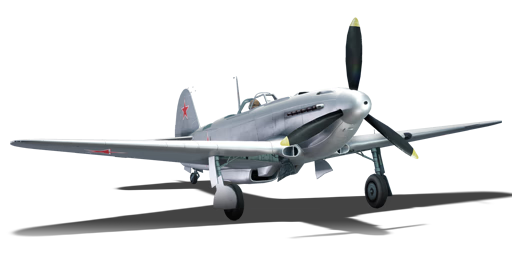
The sleek and shining silver Yak-9P has the appearance of a Soviet counterpart to the US P-51D Mustang. This refined postwar variant of the Yak-9 boasts an all-metal airframe, additional fuel tanks, and customizable armament. The flight performance is generally similar or in some cases somewhat worse than the previous Yak-9U due to its increased weight, but it still retains a good combination of speed and manoeuvrability. When flown by a cautious pilot, its balanced performance and hefty firepower make it a formidable opponent.
General info
Flight performance
The Yak-9P's performance can be compared to the Yak-9U. The M-107A engine is the same model as as the 9U's, but it generates slightly less horsepower on the 9P for reliability reasons. The weight of the aircraft has also increased in large part due to the expanded fuel capacity. The minimum fuel load of 23 minutes is larger than the 9U's 16 minutes, for example. These factors negatively affect the 9P's climb rate and power-to-weight ratio, but these factors still remain quite decent. As is the case for members of the Yak fighter family, the Yak-9P has crisp controls, good manoeuvring energy retention, and a good turn rate at medium speeds, making it a good dogfighter. Control stiffening in the roll rate starts early at around 500 km/h IAS. The control surfaces start to compress significantly at 650-700 km/h. The handling at extremely low speeds is not exceptional, in these cases consider using the takeoff flaps.
The Yak-9P's metal airframe gives it a higher rip speed and slightly less control compression than the Yak-9U, a welcome improvement. High speed dogfighting and prolonged dives should still be avoided since the Yak-9P is still not designed for these tactics compared to Mustangs or Thunderbolts, but it should be able to give chase to other fleeing aircraft.
The M-107A engine is among the most powerful of the Soviet inline engines, contributing to the good energy fighting capabilities of the late Yaks, but has a number of quirks. It loves to overheat on WEP and even opening the radiators all the way does not eliminate the problem. If using Manual Engine Controls, try to keep the radiators fairly or entirely open under normal circumstances when maximum speed is not critical. Bumping up the propeller pitch to high percentages will help bring out as much thrust from the engine as possible, which helps to compensate for the Yak-9P's weight at the cost of overheating the engine slightly more quickly. To cool the engine quickly when out of combat, open the radiators, drop the propeller pitch, and dial back the throttle.
Engine performance and flight characteristics are good up to 4 km of altitude and decent at 5 km, but going to 6 km and above is not recommended. Medium to low altitude dogfights are the Yak-9P's forte.
| Characteristics | Max Speed (km/h at 5,000 m) |
Max altitude (metres) |
Turn time (seconds) |
Rate of climb (metres/second) |
Take-off run (metres) | |||
|---|---|---|---|---|---|---|---|---|
| AB | RB | AB | RB | AB | RB | |||
| Stock | 639 | 620 | 22.3 | 23.0 | 15.1 | 15.1 | 540 | |
| Upgraded | 687 | 660 | 20.6 | 21.4 | 22.1 | 18.3 | ||
Details
| Features | ||||
|---|---|---|---|---|
| Combat flaps | Take-off flaps | Landing flaps | Air brakes | Arrestor gear |
| X | X | ✓ | X | X |
| Limits | ||||||
|---|---|---|---|---|---|---|
| Wings (km/h) | Gear (km/h) | Flaps (km/h) | Max Static G | |||
| Combat | Take-off | Landing | + | - | ||
| 756 | N/A | N/A | 280 | ~11 | ~8 | |
| Optimal velocities (km/h) | |||
|---|---|---|---|
| Ailerons | Rudder | Elevators | Radiator |
| < 380 | < 420 | < 490 | > 270 |
Survivability and armour
- 8 mm Steel - Plate behind pilot's seat
- 64 mm Bulletproof glass - Pilot's head rest
- 64 mm Bulletproof glass - Front canopy window
The Yak-9P's all metal construction contributes to somewhat more survivability than the previous Yaks, but it is still not an exceptionally durable plane. The pilot has enough protection from the rear to survive stray machine gun shots. The frontal bulletproof glass is nice and thick and can resist machine guns and weaker cannons. The main issues in terms of durability are the numerous fuel tanks in the wing roots and the vulnerable liquid-cooled engine in the front. Use the Yak-9P's manoeuvrability to dodge fire as much as possible, the temperamental M-107A engine and large fuel capacity make engine damage and fires hard to deal with.
Modifications and economy
Four upgrades are of importance: Offensive 20 mm, Compressor, Engine and Engine Injection. During this grind the second weapons profile (NS-23) can be easily be obtained without wasting time or XP.
Note that equipping the "NS-23 cannon" or "N-37 cannon" modifications by themselves will also decrease the accuracy of the B-20S cannons to stock values. The "New 23 mm cannons" and "New 37 mm cannons" modifications should be equipped to restore their accuracy and reliability.
Armaments
Offensive armament
The Yak-9P is armed with:
- A choice between three different cannons, the 20 mm B-20M, 23 mm NS-23, or the 37 mm N-37:
- 1 x 20 mm B-20M cannon, nose-mounted (115 rpg)
- 1 x 23 mm NS-23 cannon, nose-mounted (75 rpg)
- 1 x 37 mm N-37 cannon, nose-mounted (28 rpg)
- 2 x 20 mm B-20S cannon, nose-mounted (120 rpg = 240 total)
The Yak-9P is the first Soviet single-engine fighter with a customizable armament in the form of the centreline cannon firing through the propeller hub. All cannon loadouts have two synchronized 20 mm B-20S cannons in the nose; these are effectively ShVAKs with a slightly higher rate of fire and retain the same belts. The Default belt is quite good as it has AP-I rounds for starting fires and FI-T rounds for ease of aiming and some mild explosive damage. Those confident in their aim can use Armoured Targets for higher AP-I content. Avoid belts containing HE-F rounds since they have less explosive content than the FI-T rounds and deal very little damage.
The default option for the centreline cannon is a B-20M cannon with 115 rounds, and the overall setup of three B-20 cannons is the same as the Yak-3P. This loadout is not much to write home about from a damage perspective; compared to the Yak-9U's single ShVAK and twin Berezin UB combination, it has higher kinetic damage but less efficacy at starting fires. On the bright side, this homogeneous armament is very accurate and easy to use. Note that the centreline cannon will run out of ammunition about 1 second before the synchronized cannons.
The 23 mm NS-23 cannon with 75 rounds packs a greater punch than the B-20M. The FI-T rounds contain significantly more explosive filler and the AP-I rounds have greater kinetic damage, capable of knocking out inline engines in a single shot. The main downsides are the slightly worse ballistics (710 m/s vs 800 m/s for B-20s) and more limited firing time (7.5 seconds). The Default belt again has an even mix of AP-I and FI-T rounds for a good balance of kinetic damage and explosive damage.
The 37 mm N-37 cannon with 28 rounds may remind pilots of the Yak-9T's deadly NS-37 cannon. The N-37 is lighter, more accurate, and fires more quickly but suffers from a lower muzzle velocity (610 m/s) and is not very effective against ground vehicles. Its HE rounds actually behave more like APHE rounds, exploding shortly after penetrating a target instead of on impact. This means that the rounds could overpenetrate an aircraft on occasion and explode outside for less damage; follow-up shots should be expected. When it does work right, the N-37 can dispatch large planes quickly. It has the least firing time (4.2 seconds) of all the Yak-9P's cannons and trigger discipline is important.
During the Yak-9P's stock grind, players who want to focus on flight performance upgrades first should consider sticking with the triple B-20 setup, which can be easily brought to a usable standard by going straight for the New 20 mm Cannons upgrade. It is a convenient and reliable option that is sufficient against fighters and other smaller aircraft. The N-37 is a good option for bomber hunting but may be tricky to use against small targets due to the muzzle velocity and quirks of the HE rounds. The NS-23 is a good compromise of firepower and ease of use. All loadouts suffer from limited ammunition, so an average pilot may be able to score 1-2 kills before needing to rearm.
Usage in battles
Though the Yak-9P is similar to the Yak-9U in terms of design, handling, and performance, its places more emphasis on armament than performance. The Yak-9U could match or exceed most of its opponents in climb and speed and easily engage in energy fights. The Yak-9P faces tougher opposition and it is difficult to argue that the performance has improved, so it is important to pick your battles carefully and make good use of the powerful guns to destroy opponents quickly.
In Air AB, it's best to stick to moderately low altitude (below 5,000 m), as is typical with Soviet piston-engine aircraft. Though the VK-107 engine in the Yak-9P is significantly more powerful than the VK-105 engine used in most previous inline-engine Soviet fighters, its performance keeps getting worse as the plane goes higher, though the Yak-9P's maximum effective altitude is slightly higher than VK-105 Yaks. The Yak-9P's significantly better armament compared to the Yak-9U allows it to take down even heavily armoured foes, and with the 23 or 37 mm cannon upgrades, the Yak-9P can be a devastating interceptor against bombers that haven't climbed. It can be played somewhat like a heavy version of the Yak-3P - faster and with better armament options, but not as manoeuvrable overall.
In Air RB, the Yak-9P is best used cautiously by new pilots. The climb rate is not exceptional for its battle rating, so it may be better to hang back slightly, reach medium altitudes, and wait for teammates to start combat. If you can successfully jump on an enemy's tail at medium speeds, the Yak's balanced performance makes it hard for them to pull a reversal. Turning engagements often end in the Yak's favor since it has a good turn rate and does not lose much speed in horizontal manoeuvres, though this is not advised against very manoeuvrable aircraft like Spitfires and Zeros. Vertical manoeuvres and loops can be used to energy-trap heavier opponents but keep in mind that the Yak-9P's handling at stall speeds is not impressive. Try to avoid combat at high speeds; though the Yak-9P is more structurally durable than other Yaks and Lavochkins, it still rips earlier than many other fighters and the control stiffening makes it easy for enemies to dodge fire or pull a reversal.
Keep an eye on the engine temperature. MEC helps greatly for managing the radiators and propeller pitch as discussed earlier. Heated combat routinely results in orange and sometimes red engine temperatures. Do not let the engine cook itself and give it a break when out of combat. If things get dire or the engine has been worn down to the point where the overheat threshold is uncomfortably low, consider returning to base, as rearming and repairing will also reset the engine.
Manual Engine Control
| MEC elements | ||||||
|---|---|---|---|---|---|---|
| Mixer | Pitch | Radiator | Supercharger | Turbocharger | ||
| Oil | Water | Type | ||||
| Controllable | Controllable Not auto controlled |
Controllable Not auto controlled |
Controllable Auto control available |
Separate | Controllable 2 gears |
Not controllable |
Pros and cons
Pros:
- Very fast when flying below 4,000 m (13,000 ft)
- Powerful armament
- Good energy retention, vertical & horizontal
- Decent rate of climb and turn
- Nose-mounted cannons are very accurate
Cons:
- Slower acceleration as an all-metal aircraft compared to lighter Yaks also utilizing the Klimov M-107 engine
- Cannot reach speeds higher like other aircraft during dives, such as Fw 190, P-51 and F4U variants
- Not very nimble at speeds slower than 300 km/h (186 mph)
- Control stiffening when flying above 500 km/h (310 mph) and the roll rate is significantly decreased
- Engine power suffers when flying above 4,000 m
- Engine overheats easily
- Low ammo capacity
History
| Archive of the in-game description | |
|---|---|
|
This aircraft was the last and the most advanced version of the Yak-9 fighter, which became the pinnacle of development among A. S. Yakovlev's piston-engined fighters. The Yak-9P (Product P) that appeared in 1946 was a modification of the Yak-9U fighter of composite construction. Unlike its predecessor, it had all-metal wings with elliptical tips. By this time, the manufacture of high-strength aluminum alloys was established in the Soviet Union, simplifying aircraft operation and increasing aircraft service life. The first production aircraft were released with all-metal wings and plywood fuselage coverings, but from 1947 on these fighters were all-metal. The plywood covering over the rear fuselage was replaced with riveted duralumin. The Yak-9P was fitted with various state-of-the-art instruments and radio communication equipment, including a radio compass and an identification friend or foe transponder, which was upgraded and improved as the aircraft's production continued. Fuel quantity in the wing-mounted tanks was significantly increased. In late 1947, the airplane's builders began installing reversible pitch propellers on some Yak-9Ps, cutting the plane's rolling distance in half and eliminating the risk of the aircraft nosing over in case it decelerated abruptly. The fighter's armament consisted only of cannons: two synchronized 20 mm Berezin B-20 cannons and a uniform central cannon mount comprising a 37 mm Nudelman-Suranov NS-37 engine cannon with 28 rounds. The NS-37 could be replaced with a 20 mm B-20 cannon (115 rounds), a 23 mm NS-23 cannon (75 rounds), or a 45 mm N-45 cannon (26 rounds). The Yak-9P's production continued until December 1948. By that time, 29 aircraft had been built with metal wings and a plywood-covered fuselage, and 772 planes with an all-metal construction. The Yak-9Ps were withdrawn from service with the USSR in the early 1950s. The Yak-9P fighter was in service not only with the Soviet Union, but also with China, North Korea, Hungary, Albania, Poland, and Yugoslavia. North Korean Yaks were used during the initial stage of the Korean War, fighting against both piston-engined and turbojet enemy fighters. | |
Media
- Skins
- Videos
See also
- Related development
- Aircraft of comparable role, configuration and era
External links
- [Profile] USSR's most produced: The Yak-9
- Official data sheet - more details about the performance
- [Wikipedia] Yakovlev Yak-9
- [Air Vectors] Yak Piston Fighters - Yak-9
| A.S. Yakovlev Design Bureau (Яковлев Опытное конструкторское бюро) | |
|---|---|
| Fighters | |
| Yak-1 | Yak-1 · Yak-1B |
| Yak-3 | Yak-3 · Eremin's Yak-3(e) · Yak-3 (VK-107) · Yak-3P · Yak-3T · Yak-3U |
| Yak-7 | Yak-7B |
| Yak-9 | Yak-9 · Yak-9B · Yak-9K · Golovachev's Yak-9M · Yak-9P · Yak-9T · Yak-9U · Yak-9UT |
| Twin-engine fighters | I-29 |
| Jet fighters | |
| Yak-15 | Yak-15P · Yak-15 |
| Yak-17 | Yak-17 |
| Yak-23 | Yak-23 |
| Yak-30 | Yak-30D |
| Yak-141 | Yak-141 |
| Strike aircraft | |
| Yak-2 | Yak-2 KABB |
| Yak-38 | Yak-38 · Yak-38M |
| Bombers | Yak-4 |
| Jet bombers | Yak-28B |
| Foreign use | ▄Yak-3 · Challe's ▄Yak-9T · ◔Yak-9P |
| Captured | ▀Yak-1B |
| USSR fighters | |
|---|---|
| I-15 | I-15 WR · I-15 M-22 · I-15 M-25 · I-15bis · Krasnolutsky's I-15bis |
| I-153 M-62 · Zhukovsky's I-153-M62 · I-153P | |
| I-16 | I-16 type 5 · I-16 type 10 · I-16 type 18 · I-16 type 24 · I-16 type 27 · I-16 type 28 · I-180S |
| I-29 | I-29 |
| I-185 | I-185 (M-71) · I-185 (M-82) |
| I-225 | I-225 |
| ITP | ITP (M-1) |
| MiG-3 | MiG-3-15 · MiG-3-15 (BK) · MiG-3-34 |
| LaGG | I-301 · LaGG-3-4 · LaGG-3-8 · LaGG-3-11 · LaGG-3-23 · LaGG-3-34 · LaGG-3-35 · LaGG-3-66 |
| La | La-5 · La-5F · La-5FN · La-7 · Dolgushin's La-7 · La-7B-20 · La-9 · La-11 |
| Yak-1/7 | Yak-1 · Yak-1B · Yak-7B |
| Yak-3 | Yak-3 · Eremin's Yak-3(e) · Yak-3P · Yak-3T · Yak-3U · Yak-3 (VK-107) |
| Yak-9 | Yak-9 · Yak-9B · Golovachev's Yak-9M · Yak-9T · Yak-9K · Yak-9U · Yak-9UT · Yak-9P |
| Other countries | ▂P-40E-1 · ▂P-47D-27 · ▂Hurricane Mk IIB · ▂Fw 190 D-9 · ▂Spitfire Mk IXc |
| P-39 | ▂P-39K-1 · ▂Pokryshkin's P-39N-0 · ▂P-39Q-15 |
| P-63 | ▂P-63A-5 · ▂P-63A-10 · ▂P-63C-5 |