Difference between revisions of "Z22 Anton Schmitt"
m (added Wikipedia DE link) |
(Edits) |
||
| Line 152: | Line 152: | ||
== History == | == History == | ||
| + | <!-- ''Describe the history of the creation and combat usage of the ship in more detail than in the introduction. If the historical reference turns out to be too long, take it to a separate article, taking a link to the article about the ship and adding a block "/History" (example: <nowiki>https://wiki.warthunder.com/(Ship-name)/History</nowiki>) and add a link to it here using the <code>main</code> template. Be sure to reference text and sources by using <code><nowiki><ref></ref></nowiki></code>, as well as adding them at the end of the article with <code><nowiki><references /></nowiki></code>. This section may also include the ship's dev blog entry (if applicable) and the in-game encyclopedia description (under <code><nowiki>=== In-game description ===</nowiki></code>, also if applicable).'' --> | ||
Z22 ''Anton Schmitt'' was one of the six Type 1936 destroyers built for the Kriegsmarine (German Navy). Ordered from the AG Weser (Deschimag) shipyard in Bremen in 1936, she was laid down on 6 January 1938, launched on 20 September, and commissioned on 24 September 1939. | Z22 ''Anton Schmitt'' was one of the six Type 1936 destroyers built for the Kriegsmarine (German Navy). Ordered from the AG Weser (Deschimag) shipyard in Bremen in 1936, she was laid down on 6 January 1938, launched on 20 September, and commissioned on 24 September 1939. | ||
| − | During the opening stage of the war, | + | During the opening stage of the war, between the 10th and 11th January 1940, Z22 along with her sister ships was sent out for a minelaying operation around Newcastle, of which the minefield only claimed one small fishing trawler. On 26 January, Z22 caught fire in her boiling room due to leaking oil, which forced her to be sent back to Germany for repairs until the end of March 1940. |
In April 1940, Z22 was assigned to Group 1 of the Norwegian portion of the Operation Operation Weserübung in a German campaign to seize Denmark and Norway. The group was tasked to transport the 139th Mountain Infantry Regiment and the 3rd Mountain Division to attack Narvik. The task group consisted of 10 destroyers set sail on 6 April 1940. On 7 April, the task group was spotted by British reconnaissance planes and were subsequently attacked by air formations, though the raid failed to damage any ships. | In April 1940, Z22 was assigned to Group 1 of the Norwegian portion of the Operation Operation Weserübung in a German campaign to seize Denmark and Norway. The group was tasked to transport the 139th Mountain Infantry Regiment and the 3rd Mountain Division to attack Narvik. The task group consisted of 10 destroyers set sail on 6 April 1940. On 7 April, the task group was spotted by British reconnaissance planes and were subsequently attacked by air formations, though the raid failed to damage any ships. | ||
| − | The task group arrived off the Ofotfjord close to Narvik on the dawn of 9 April. During this time, Z22 encountered the Norwegian coast guard boat Senja, of which she forced the latter to surrender. At 9:00 the ship disembarked their troops after mistakenly believed that a coastal artillery was guarding the mouth of the fjord and the troop was sent to capture them. Around 11:00 the troop was ordered to reboard and begin the attack on Narvik. However, | + | The task group arrived off the Ofotfjord close to Narvik on the dawn of 9 April. During this time, Z22 encountered the Norwegian coast guard boat Senja, of which she forced the latter to surrender. At 9:00 the ship disembarked their troops after mistakenly believed that a coastal artillery was guarding the mouth of the fjord and the troop was sent to capture them. Around 11:00 the troop was ordered to reboard and begin the attack on Narvik. However, as the ship was running low on fuel, Z22 was forced to stay behind while the rest of the task group retreated as planned. |
On the dawn of 10 April, five destroyers of the British 2nd Destroyer Flotilla made a surprise attack on the Germans at Narvik who did not anticipated their appearance. Z22's engine room was hit by a single 120 mm shell and a torpedo from the HMS Hunter, then the ship was finished off by a torpedo froom the HMS Havock that broke her in half. The sinking killed 52 crewmen. The surviving crews then joined together with the 139th regiment as an ad-hoc infantry unit and continued their assault on Narvik. | On the dawn of 10 April, five destroyers of the British 2nd Destroyer Flotilla made a surprise attack on the Germans at Narvik who did not anticipated their appearance. Z22's engine room was hit by a single 120 mm shell and a torpedo from the HMS Hunter, then the ship was finished off by a torpedo froom the HMS Havock that broke her in half. The sinking killed 52 crewmen. The surviving crews then joined together with the 139th regiment as an ad-hoc infantry unit and continued their assault on Narvik. | ||
| Line 187: | Line 188: | ||
* [[wt:en/news/4867-development-type-1936-class-destroyer-en|[Devblog] Type 1936 Class Destroyer]] | * [[wt:en/news/4867-development-type-1936-class-destroyer-en|[Devblog] Type 1936 Class Destroyer]] | ||
| − | * [ | + | * [[Wikipedia:German_destroyer_Z22_Anton_Schmitt|[Wikipedia] German destroyer Z22 Anton Schmitt]] |
| + | * [[Wikipedia:de:Z_22_Anton_Schmitt|[Wikipedia.de] Z 22 Anton Schmitt]] (in German) | ||
| + | |||
{{ShipManufacturer DeSchiMAG}} | {{ShipManufacturer DeSchiMAG}} | ||
{{Germany destroyers}} | {{Germany destroyers}} | ||
Revision as of 16:31, 7 November 2022

Contents
Description
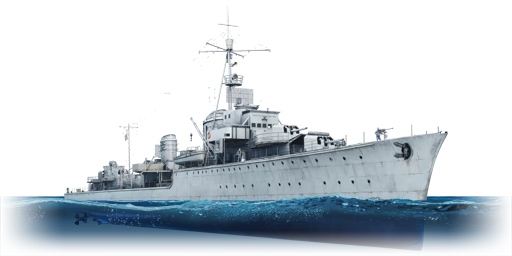
The Type 1936-class, Z22 Anton Schmitt, 1940 is a rank German destroyer with a battle rating of (AB), (RB), and (SB). It was introduced in Update 1.79 "Project X" as part of the fleet closed beta test.
The Z22 Anton Schmitt is one of the 6 Type 1936 destroyers built for the German Kriegsmarine between 1936 and 1938. Out of the six ships in the class, only the Z20 Karl Galster survived until the end of the war, all remaining units were lost during the Invasion of Norway in 1940.
General info
Survivability and armour
The Z22 Anton Schmitt does not possess any armour except its 16 mm thick steel hull protecting it from small calibre machine gun fire. The main gun mounts are protected from the front, top, and sides by 8 mm thick anti-fragmentation armour shields protecting them from shrapnel. The beam main gun ammunition storage is relatively safe as it's located on the waterline, while the secondary ammunition storage is well above the waterline, leaving it vulnerable to detonation. The stern main gun ammunition storage can be found above the waterline, directly under turret No.3 and in between No.3 and No.4, sharing a similar issue of vulnerable magazines with ships such as the T22.
All the Z22's machinery is located above the waterline, which exposes it to damage by autocannons and high-calibre machine guns.
The crew complement is large, consisting of 323 sailors.
Mobility
The Z22 is quite an agile ship, but it suffers from poor acceleration past 40 km/h and takes a while to reach max speed.
| Mobility Characteristics | |||
|---|---|---|---|
| Game Mode | Upgrade Status | Maximum Speed (km/h) | |
| Forward | Reverse | ||
| AB | |||
| Upgraded | |||
| RB/SB | |||
| Upgraded | |||
Modifications and economy
Armament
Primary armament
The Z22 Anton Schmitt is armed with a five 12.7 cm SK C/34 cannons in single mounts, with two located at beam, and three at stern. All the turrets have ready-use ammo consisting of 10 rounds with a rate of fire of 18 rounds per minute, decreasing to 15 rounds per minute after depleting the ready-use ammo. Three different rounds are available, HE, HE with base fuse and HE-TF against aerial threat. It is advised to use the HE shell with base fuse to cause some serious damage to your opponents by aiming at their weak spots such as magazines above waterline or turrets. The HE-TF shell can be used against incoming aircraft at long ranges as the guns have good elevation.
| Penetration statistics | |||||||
|---|---|---|---|---|---|---|---|
| Ammunition | Type of warhead |
Penetration @ 0° Angle of Attack (mm) | |||||
| 1,000 m | 2,500 m | 5,000 m | 7,500 m | 10,000 m | 15,000 m | ||
| Sprgr. L/4.4 Kpf.Z | HE | 24 | 24 | 24 | 24 | 24 | 24 |
| Sprgr. L/4.4 Bd.Z | HE | 59 | 50 | 38 | 30 | 24 | 18 |
| Sprgr. L/4.4 Zt.Z | HE-TF | 24 | 24 | 24 | 24 | 24 | 24 |
| Shell details | |||||||||
|---|---|---|---|---|---|---|---|---|---|
| Ammunition | Type of warhead |
Velocity (m/s) |
Projectile mass (kg) |
Fuse delay (s) |
Fuse sensitivity (mm) |
Explosive mass (TNT equivalent) (kg) |
Ricochet | ||
| 0% | 50% | 100% | |||||||
| Sprgr. L/4.4 Kpf.Z | HE | 830 | 28 | 0 | 0.1 | 1.91 | 79° | 80° | 81° |
| Sprgr. L/4.4 Bd.Z | HE | 830 | 28 | 0.015 | 5 | 1.4 | 79° | 80° | 81° |
| Sprgr. L/4.4 Zt.Z | HE-TF | 830 | 28 | 0 | 0.1 | 1.91 | 79° | 80° | 81° |
Secondary armament
The secondary armament consists of two 3.7 cm SK C/30 cannons in dual mounts located amidship on a platform near the second funnel. The cannons have a very low rate of fire of only 30 rounds per minute, making them very hard to use. Thanks to their high muzzle velocity and armour-piercing rounds, they can be used instead to engage coastal vessels at longer distances before they get within range of your 20 mm cannons.
| Penetration statistics | |||||||
|---|---|---|---|---|---|---|---|
| Ammunition | Type of warhead |
Penetration @ 0° Angle of Attack (mm) | |||||
| 10 m | 100 m | 500 m | 1,000 m | 1,500 m | 2,000 m | ||
| Spgr L/4.1 Lh 37 | HE | 2 | 2 | 2 | 2 | 2 | 2 |
| Psgr L'spur Zerl | APCBC | 87 | 84 | 71 | 58 | 48 | 39 |
| Shell details | |||||||||
|---|---|---|---|---|---|---|---|---|---|
| Ammunition | Type of warhead |
Velocity (m/s) |
Projectile mass (kg) |
Fuse delay (m) |
Fuse sensitivity (mm) |
Explosive mass (TNT equivalent) (g) |
Ricochet | ||
| 0% | 50% | 100% | |||||||
| Spgr L/4.1 Lh 37 | HE | 1,000 | 0.75 | 0 | 0.1 | 27.4 | 79° | 80° | 81° |
| Psgr L'spur Zerl | APCBC | 1,000 | 0.82 | 1.3 | 15 | 37.4 | 48° | 63° | 71° |
Anti-aircraft armament
The anti-aircraft protection of the Z22 Anton Schmitt is quite weak when compared to its contemporaries. It consists of a single 2 cm/65 Flakvierling automatic cannon in quadruple mount located amidship between turrets No.3 and No.4 and of five 2 cm/65 C/38 automatic cannons in single mounts with one located directly at the beam in front of turret No.1, two on each side of a hull next to turret No.2 and last two located directly behind the 3.7 cm gun mounts. The cannons, while not numerous, are still a quite strong short range anti-aircraft and anti-shipping defence.
Additional armament
The Z22 is equipped with two quadruple 533 mm G7a torpedo launchers located amidship between funnels and between the second funnel and turret No.3. The torpedoes used are the standard G7a found on nearly all German bluewater ships. With a base speed of 81 km/h, a range of 6 km and a payload of 358.4 kg TNTeq, these are powerful torpedoes in terms of explosive mass. When upgraded with a torpedo mode, the speed decreases to 56 km/h while boosting the range to 14 km.
Usage in battles
The Z22 Anton Schmitt can be played as a brawler utilizing its superior rate of fire and large crew complement, crippling enemy ships and utilizing its fast torpedoes at close range. It can also be used as a support ship from behind, shelling enemies with constant rain of shells. Zigzagging is advised due to the vulnerable magazines on the stern when utilizing a full broadside. Two out of five main guns can be fire at the enemy when sailing head-on.
Pros and cons
Pros:
- High rate of fire
- High crew complement
- Potent torpedoes
- Good agility
Cons:
- Vulnerable magazines
- Poor AA protection
- Weak main gun shells
- Low ammo count for main guns
History
Z22 Anton Schmitt was one of the six Type 1936 destroyers built for the Kriegsmarine (German Navy). Ordered from the AG Weser (Deschimag) shipyard in Bremen in 1936, she was laid down on 6 January 1938, launched on 20 September, and commissioned on 24 September 1939.
During the opening stage of the war, between the 10th and 11th January 1940, Z22 along with her sister ships was sent out for a minelaying operation around Newcastle, of which the minefield only claimed one small fishing trawler. On 26 January, Z22 caught fire in her boiling room due to leaking oil, which forced her to be sent back to Germany for repairs until the end of March 1940.
In April 1940, Z22 was assigned to Group 1 of the Norwegian portion of the Operation Operation Weserübung in a German campaign to seize Denmark and Norway. The group was tasked to transport the 139th Mountain Infantry Regiment and the 3rd Mountain Division to attack Narvik. The task group consisted of 10 destroyers set sail on 6 April 1940. On 7 April, the task group was spotted by British reconnaissance planes and were subsequently attacked by air formations, though the raid failed to damage any ships.
The task group arrived off the Ofotfjord close to Narvik on the dawn of 9 April. During this time, Z22 encountered the Norwegian coast guard boat Senja, of which she forced the latter to surrender. At 9:00 the ship disembarked their troops after mistakenly believed that a coastal artillery was guarding the mouth of the fjord and the troop was sent to capture them. Around 11:00 the troop was ordered to reboard and begin the attack on Narvik. However, as the ship was running low on fuel, Z22 was forced to stay behind while the rest of the task group retreated as planned.
On the dawn of 10 April, five destroyers of the British 2nd Destroyer Flotilla made a surprise attack on the Germans at Narvik who did not anticipated their appearance. Z22's engine room was hit by a single 120 mm shell and a torpedo from the HMS Hunter, then the ship was finished off by a torpedo froom the HMS Havock that broke her in half. The sinking killed 52 crewmen. The surviving crews then joined together with the 139th regiment as an ad-hoc infantry unit and continued their assault on Narvik.
Media
- Skins
- Videos
See also
- Related development
External links
- [Devblog] Type 1936 Class Destroyer
- [Wikipedia] German destroyer Z22 Anton Schmitt
- [Wikipedia.de] Z 22 Anton Schmitt (in German)
| Deutsche Schiff- und Maschinenbau Aktiengesellschaft | |
|---|---|
| Destroyers | |
| Type 1934A | Kleber** |
| Type 1936 | Z20 Karl Galster · Z22 Anton Schmitt |
| Type 1936A | Z25 · Marceau*** · Z32 |
| Type 1936B | Z43 |
| Type 1936C | Z46 · Z47 |
| Battleships | |
| Nassau-class | SMS Westfalen* |
| *Previously Aktien-Gesellschaft „Weser" | |
| **Z6 Theodor Riedel before war reparation to France | |
| ***Z31 before war reparation to France | |
| Germany destroyers | |
|---|---|
| Torpedo boats | |
| Type 1924 | Jaguar · Leopard · Luchs |
| Type 1939 | T22 · T31 |
| Destoyers | |
| Type 1934A | Z12 Erich Giese · Z15 Erich Steinbrinck |
| Type 1936 | Z20 Karl Galster · Z22 Anton Schmitt |
| Type 1936A | Z25 · Z32 |
| Type 1936B | Z43 |
| Type 1936C | Z46 · Z47 |