Difference between pages "P-47D-22-RE" and "P-47D-25"
U115170711 (talk | contribs) (→Flight performance) (Tag: Visual edit) |
(Undo revision 108361 by U115170711 (talk)) |
||
| Line 5: | Line 5: | ||
}} | }} | ||
{{Specs-Card | {{Specs-Card | ||
| − | |code=p- | + | |code=p-47d |
|images={{Specs-Card-Image|GarageImage_{{PAGENAME}}.jpg}} | |images={{Specs-Card-Image|GarageImage_{{PAGENAME}}.jpg}} | ||
| + | |cockpit=cockpit_p-47d.jpg | ||
}} | }} | ||
== Description == | == Description == | ||
<!-- ''In the description, the first part should be about the history of and the creation and combat usage of the aircraft, as well as its key features. In the second part, tell the reader about the aircraft in the game. Insert a screenshot of the vehicle, so that if the novice player does not remember the vehicle by name, he will immediately understand what kind of vehicle the article is talking about.'' --> | <!-- ''In the description, the first part should be about the history of and the creation and combat usage of the aircraft, as well as its key features. In the second part, tell the reader about the aircraft in the game. Insert a screenshot of the vehicle, so that if the novice player does not remember the vehicle by name, he will immediately understand what kind of vehicle the article is talking about.'' --> | ||
| − | The '''{{Specs|name}}''' is a rank {{Specs|rank}} American fighter {{Battle-rating}}. It | + | The '''{{Specs|name}}''' is a rank {{Specs|rank}} American fighter {{Battle-rating}}. It has been in the game since the start of the Open Beta Test prior to Update 1.27. |
| + | |||
| + | Like the [[P-51D-5|P-51D Mustang]], the P-47D-25 is one of the iconic fighters of the USAAF and also one of the most powerful. The wing of the British Spitfire melded with the iconic Pratt and Whitney R-2800 and bulky body, the P-47 is truly a force to be reckoned with, possessing very good performance, weaponry, and loadout. The ''"Jug"'' is thus one of the best [[:Category:Fighters|fighters]] in the USAAF line; possessing the hallmarks of a great fighter and the capability of a fast attacker. | ||
== General info == | == General info == | ||
| Line 17: | Line 20: | ||
{{Specs-Avia-Flight}} | {{Specs-Avia-Flight}} | ||
<!-- ''Describe how the aircraft behaves in the air. Speed, manoeuvrability, acceleration and allowable loads - these are the most important characteristics of the vehicle.'' --> | <!-- ''Describe how the aircraft behaves in the air. Speed, manoeuvrability, acceleration and allowable loads - these are the most important characteristics of the vehicle.'' --> | ||
| − | + | In Arcade battles, the P-47 can be pushed to its limits. Climb rate, turn rate, and responsiveness are all dramatically increased. Still, tactics used in RB also apply very well in Arcade- this fighter is great for practising Boom & Zoom in Arcade due to the impressive climb rate in this mode. However, the skill will not be built nearly as well in this mode, as rolling scissors and "skidding" manoeuvres will not really be needed. | |
| − | In Arcade battles, the P-47 can be pushed to its limits. Climb rate, turn rate, and responsiveness are all dramatically increased. Still, tactics used in RB also apply very well in Arcade- this fighter is great for | ||
Overall, the P-47 is a very pleasurable plane to fly for a quick jaunt in arcade battles. | Overall, the P-47 is a very pleasurable plane to fly for a quick jaunt in arcade battles. | ||
| Line 33: | Line 35: | ||
|- | |- | ||
! Stock | ! Stock | ||
| − | | | + | | 676 || 657 || rowspan="2" | {{Specs|ceiling}} || 26.2 || 27.2 || 7.3 || 7.3 || rowspan="2" | 600 |
|- | |- | ||
! Upgraded | ! Upgraded | ||
| − | | | + | | 729 || 700 || 23.8 || 25.0 || 15.0 || 10.6 |
|- | |- | ||
|} | |} | ||
| Line 79: | Line 81: | ||
{{Specs-Avia-Armour}} | {{Specs-Avia-Armour}} | ||
<!-- ''Examine the survivability of the aircraft. Note how vulnerable the structure is and how secure the pilot is, whether the fuel tanks are armoured, etc. Describe the armour, if there is any, and also mention the vulnerability of other critical aircraft systems.'' --> | <!-- ''Examine the survivability of the aircraft. Note how vulnerable the structure is and how secure the pilot is, whether the fuel tanks are armoured, etc. Describe the armour, if there is any, and also mention the vulnerability of other critical aircraft systems.'' --> | ||
| − | + | *9.5 mm Steel - Fore cockpit plate | |
| − | + | *9.5 mm Steel - Armour plate behind Pilot's seat | |
| − | + | *38 mm Bulletproof glass - Windshield | |
| − | |||
| − | * 9.5 mm Steel - | ||
| − | * 9.5 mm Steel - | ||
| − | * | ||
=== Modifications and economy === | === Modifications and economy === | ||
{{Specs-Economy}} | {{Specs-Economy}} | ||
| + | |||
| + | Climb rate and acceleration is a big issue for the stock P-47D. Focus on ''Compressor'', ''Engine'', ''Wing repairs'' and ''Engine Injection'' first. During this ''performance'' focused grind, you can additionally research ''New 12.7 mm MGs'' and the various payload modules to unlock the higher tiers for the better performance upgrades. | ||
== Armaments == | == Armaments == | ||
| Line 104: | Line 104: | ||
{{Specs-Avia-Suspended}} | {{Specs-Avia-Suspended}} | ||
<!-- ''Describe the aircraft's suspended armament: additional cannons under the wings, bombs, rockets and torpedoes. This section is especially important for bombers and attackers. If there is no suspended weaponry remove this subsection.'' --> | <!-- ''Describe the aircraft's suspended armament: additional cannons under the wings, bombs, rockets and torpedoes. This section is especially important for bombers and attackers. If there is no suspended weaponry remove this subsection.'' --> | ||
| − | {{main|AN-M64A1 (500 lb)|AN-M65A1 (1,000 lb)| | + | {{main|AN-M64A1 (500 lb)|AN-M65A1 (1,000 lb)|HVAR}} |
The '''''{{PAGENAME}}''''' can be outfitted with the following ordnance: | The '''''{{PAGENAME}}''''' can be outfitted with the following ordnance: | ||
| Line 112: | Line 112: | ||
* 2 x 1,000 lb AN-M65A1 bombs (2,000 lb total) | * 2 x 1,000 lb AN-M65A1 bombs (2,000 lb total) | ||
* 2 x 1,000 lb AN-M65A1 bombs + 1 x 500 lb AN-M64A1 bomb (2,500 lb total) | * 2 x 1,000 lb AN-M65A1 bombs + 1 x 500 lb AN-M64A1 bomb (2,500 lb total) | ||
| − | * | + | * 10 x HVAR rockets |
| − | * | + | * 10 x HVAR rockets + 1 x 500 lb AN-M64A1 bomb (500 lb total) |
| + | * 10 x HVAR rockets + 2 x 1,000 lb AN-M65A1 bombs (2,000 lb total) | ||
| + | * 10 x HVAR rockets + 2 x 1,000 lb AN-M65A1 bombs + 1 x 500 lb AN-M64A1 bomb (2,500 lb total) | ||
== Usage in battles == | == Usage in battles == | ||
<!-- ''Describe the tactics of playing in the aircraft, the features of using aircraft in a team and advice on tactics. Refrain from creating a "guide" - do not impose a single point of view, but instead, give the reader food for thought. Examine the most dangerous enemies and give recommendations on fighting them. If necessary, note the specifics of the game in different modes (AB, RB, SB).'' --> | <!-- ''Describe the tactics of playing in the aircraft, the features of using aircraft in a team and advice on tactics. Refrain from creating a "guide" - do not impose a single point of view, but instead, give the reader food for thought. Examine the most dangerous enemies and give recommendations on fighting them. If necessary, note the specifics of the game in different modes (AB, RB, SB).'' --> | ||
| − | |||
| − | + | ;Realistic | |
| − | + | The Thunderbolt was used as a high altitude bomber escort and excels at fighter roles in the game, but it can also be used as a very effective ground attack aircraft, thanks to its impressive bomb load. With the equivalent of 3,000 lbs of ordnance under its wings with munitions such as 1,000 lb bombs and 10 HVAR rockets, it is an excellent fighter-bomber. In this role, its performance is often superior to even dedicated ground attack aircraft such as IL-2 Sturmoviks. Its eight fifty-calibre guns are effective against soft targets which aren't worth rockets or bombs. With good aim, they can destroy light pillboxes at distances less than 400 m if using the "Ground targets" belt. When engaging against enemy aircraft, Boom & Zoom tactics are a must, never try to dogfight with the 'Jug'. When diving on a target, if you don't down the enemy, don't try to turn and finish him, use the speed you built in the dive and extend away, climb up, Immelmann and do it all again. | |
| − | + | Two main skill modes present themselves: strike fighter (fighter-bomber), taken by going low with a full payload, ravaging the countryside, or just as a standard fighter by first gaining altitude to hunt for bombers, or using the height to dive on enemies who do not have the patience to climb. For the former, "ground targets" belt is obviously advised, it will easily pierce armoured cars and light pillboxes, but they do work well on aircraft too. | |
| − | + | When using the "Jug" as a fighter remember that speed and altitude are your lifelines. Never give these up unless you must to stay alive. Also, remember that in Arcade planes accelerate very quickly so you need a huge speed advantage to make sure you can make a getaway in a boom and zoom attack. With this is mind, dive in on enemies that are engaging a teammate or that are at least 1 km below you. If you do not shoot down the enemy, remember to go into a shallow climb to extend, not a steep climb | |
| − | + | A wonderful Boom & Zoom fighter in every respect, therefore fly it accordingly! As in real life, the performance advantage will drastically shift in favour of the P-47D above 3,000 m (Soviet opponents) or 6,000 m (most German and Japanese aircraft). The climb rate of this plane is not the best as such it is a good idea to side climb and wait for the first engagement. In Realistic battles it is wise to wait until after the first engagements with enemies, then if your team has a numerical advantage land on the airstrip, bailout and then load the ground attack ordnance. Remember to not bail out until fully repaired and rearmed! | |
| − | + | Its bubble canopy makes spotting enemies much easier than most other planes even when you are above the enemy. Remember that firing at an enemy plane at convergence range will be devastating, choosing a comfortable targeting distance is crucial in the Thunderbolt. In many cases don't be afraid to dive away from an enemy and then pull-up drastically since you have a heavy and very tough airframe, this makes altitude a very important asset, and thus side climbing is always beneficial. | |
| − | + | ;Simulator | |
| − | + | In air Simulator, bulkier planes that suffer in AB & RB shine and that of course includes the P-47. Sitting at BR 3.7, the lowest BR for rank 3 EC, it can respawn infinitely without needing any spawn points which makes it a great learning platform for new EC players. In Sim, the P-47 has smooth handling, all-round unobstructed vision and fast speed, and it offers a wide range of additional loadouts like bombs and rockets, plus the original 8 x .50 cals with plenty of ammo each, meaning it is an excellent multi-role aircraft. It can perform ground pounding, bomber intercepting, traditional BnZ fighting, and, if there is an unfinished base, base bombing. | |
| − | + | For attacking ground targets, choose wisely between the various payload options according to your target. Use the bombs and rockets to take out pillboxes and tanks, then the MG for soft targets like AAA, howitzers and trucks. When approaching the target, dive at a medium angle to gain speed and momentum for the bombs, try to drop as close as possible but avoid crashing into the ground. When the gunsight slices through and just above the target, drop the 1,000 lbs. When the target is at the center of the gunsight and fills up around 1/3 of it, release the 500 lbs. The 8 MGs are perfect for killing trucks, AA guns and artilleries as they have plenty of ammo. However, constantly watch your surrounding, especially your high 6 for any incoming enemies. | |
| − | + | When intercepting a player-controlled bomber, it is always better to attack from a higher altitude. The more altitude you have over the target, the easier it is for you to lead which maximises your damage output. The American armament style of having numerous machine guns require the player to land plenty of hits on the target in order to cripple/destroy it, meaning that the player must control the lead well and maintain it throughout the pass, which is different and maybe harder than German/Russian armament styles, where a few hits from their large cannons get the job done. Luckily the P-47D is a very smooth gun platform at high speeds. Dive at the target from above with lead pursuit, and you can start firing once the target is about to fill up the reticle circle. Given the great velocity and trajectory of .50 cal bullets, this far distance can still cause damage to the target. Depending on your speed, you will have a ~3-5 second shooting window where the burst should last throughout. If your fire is accurate the target is very likely to get shredded to pieces, but if it is not, pull up for another pass. As you start to dive down again, the P-47 will wobble around a bit due to the low airspeed, so take your time to smooth down the plane. At an adequate speed of above ~420 km/h, the P-47's reticle can stay exactly where you aim at. Thanks to this firepower and stability the P-47D shines at dueling single targets. | |
| − | + | However, for missions like "destroy enemy bombers" where there are around 10 AI bombers to destroy, the P-47 may struggle a bit due to its rather low one-second burst mass comparing to some dedicated heavy fighters/interceptors, and its big size. Once the player closes in on the AI formation it will immediately be targeted by countless gunners, and even with the Jug's ruggedness the skin will still get hit, causing aerodynamic efficiency loss. Plus its huge radial engine will usually get damaged. Amid the rain of bullets the player has to dodge some fire while also leading and firing long bursts, increasing the chance of getting hit. Though it is definitely possible to deal with such AI planes, there are still better candidates for this role. Heavy interceptor like the P-61 will make short work of any target with a short burst of its powerful cannons and can take more hits, while the P-47 must stay in the danger for longer to deal the same damage. | |
| − | + | As for dogfighting, because most aerial battles in Sim occur at around 3,000 m, the P-47 can easily climb to this altitude and gather up lots of speed before engaging a battle. The tactic is similar to the RB one above. If, unfortunately, you find yourself being chased at your 6 and you don't know how to do any defensive manoeuvres, do a large, smooth turn towards the nearest friendly airfield to avoid bleeding too much speed. Then shallow-dive towards your airfield. The P-47 can quite easily outrun opponents like the A6M or Bf-109 E, but struggles to outrun Bf-109 F/G, FW-190 A or other P-47. Another way of disengaging is to do a sudden split-S to dodge under the chaser. Average Sim players will now try and see where you went, if not immediately losing track of you. You can then run for your airfield or shallow climb for another attack. | |
| − | * [[Bf 110 (Family)|Bf 110]], [[Ki-45 (Family)|Ki-45]], [[A-26 (Family)|A-26]]: As mentioned before, those twin engine aircraft are a big threat since their lack of manoeuvrability comparing to single engine fighters are minimised in Sim. They are usually armed with heavy guns & cannons in the nose, so an accurate burst will tear any plane apart, including the P-47. The P-47 manoeuvres rather sluggishly and | + | ;Enemies worth noting (sim) |
| + | |||
| + | * [[Me 264]]: This giant is one of the few bombers who get air spawns in Sim, so it usually flies higher than you think. On top of this, the Me 264 is armed with large calibre MG and cannons all over it, therefore tailing a 264 is basically suicide unless all of their gunners are knocked out. You can treat the 264 almost like a B-29 or B-17 as they are very similar in both design and defensive capabilities. It is best to head-on the 264 if you can as you can easily knock out the pilots due to its glazed nose while also taking minimal damage. However the bomber lacks a ventral turret on its belly, making it easy to deal damage from below, but be wary of the downwards facing rear 20 mm cannon near the tail. The safest way to attack is from a higher altitude, dive at an oblique angle and focus fire on the wings and nose. Never engage if you have no altitude advantage. | ||
| + | * [[Bf 110 (Family)|Bf 110]], [[Ki-45 (Family)|Ki-45]], [[A-26 (Family)|A-26]]: As mentioned before, those twin engine aircraft are a big threat since their lack of manoeuvrability comparing to single engine fighters are minimised in Sim. They are usually armed with heavy guns & cannons in the nose, so an accurate burst will tear any plane apart, including the P-47. The P-47 manoeuvres rather sluggishly and you might get out-turned from even those heavy fighters, so engage them with either altitude or speed advantage to avoid being targeted. If they are not manoeuvring aggressively, aim for their wings or engines. If the fight is intense and you cannot smooth the aim, just burst anywhere as long as you hit them, the 12.7 mm bullets will damage their flight models quite a bit. | ||
| + | * [[ZSD63]]: A dangerous SPAA to go up against in Tank Realistic Battles. Though it is hard to identify specific SPAA vehicles on the ground (especially when they are shooting tracers at the plane), if a ZSD63 is identified, avoid it at all costs and '''do not''' attempt head-ons with it, ever. It can easily snap a wing off by casually putting a short burst in the {{PAGENAME}}'s flight path. Don't even get close to it unless it is busy shooting someone else or if the {{PAGENAME}} has a bomb ready for use. Some identifying features of the ZSD63 is its rather boxy and tall hull with a geometric turret sitting at the back, slightly similar to a Wirbelwind's. The firing manner is also distinctive: the sound and green tracers are very rapid, much like a buzz saw, but then it will remain silent for half a minute reloading. Note that an experienced ZSD player will hold its fire or shoot in single salvos with long halts between, making it look like it's reloading. Armour-piercing belt is recommended since their high penetration can tear through the ZSD's armour with ease and knock out its crews. | ||
* [[Yak-2 KABB]]: Do not think that the {{PAGENAME}} can confidently outmanoeuvre this plane just because it is twin-engined. The Yak-2 has an amazing turn rate for a heavy fighter, thus the {{PAGENAME}} must avoid turning with it, if not dogfighting with it in general. It bears a pair of ShVAK cannons that can easily damage vital parts like engine or cooling systems. It has green camo, greatly resembling an Me 410 but with an H-tail like a Bf 110's. | * [[Yak-2 KABB]]: Do not think that the {{PAGENAME}} can confidently outmanoeuvre this plane just because it is twin-engined. The Yak-2 has an amazing turn rate for a heavy fighter, thus the {{PAGENAME}} must avoid turning with it, if not dogfighting with it in general. It bears a pair of ShVAK cannons that can easily damage vital parts like engine or cooling systems. It has green camo, greatly resembling an Me 410 but with an H-tail like a Bf 110's. | ||
| − | |||
=== Manual Engine Control === | === Manual Engine Control === | ||
| Line 169: | Line 173: | ||
'''Pros:''' | '''Pros:''' | ||
| − | * Great | + | * Great at diving and Boom & Zoom |
| − | * | + | * Great multirole aircraft, acting as an interceptor or ground-attack aircraft |
| − | * | + | * Impressive speed, great engine performance above 6,000 m |
| − | * | + | * Very rugged construction can keep the plane flying despite damages |
| − | * 8 M2 Browning machine guns | + | * Impressive firepower of 8 x 12.7 mm M2 Browning machine guns with also impressive ammunition pool |
| − | * | + | * First plane in the U.S tech tree to gain access to pure API-T ammo belts |
| − | |||
| − | |||
* Can easily escape enemies with its high speed for its rank | * Can easily escape enemies with its high speed for its rank | ||
| − | * | + | * One of the few fighters that can carry both bombs and rockets at the same time, making it excellent for ground attack |
| + | * More manoeuvrable than other aircraft in the P-47 family | ||
| + | * By using opposite rudder and aileron controls, for example, left rudder and right aileron, the Thunderbolt can "skid" quickly in the direction the rudder - very useful to dodge shots, works for both the D-25 and D-28 | ||
| + | * Can carry up to 2 x 1,000 lb bombs, 1 x 500 lb bomb, and 10 HVARs | ||
'''Cons:''' | '''Cons:''' | ||
| − | * | + | * Terrible turning time at low altitude/low speed |
| − | |||
| − | |||
* Mediocre climb performance (side climbing recommended) | * Mediocre climb performance (side climbing recommended) | ||
| − | + | * Larger than average fighters | |
| − | * Larger than average | ||
* Poor overall performance when mounting payloads | * Poor overall performance when mounting payloads | ||
* After attacking ground targets, the P-47 lacks the altitude to Boom & Zoom enemy fighters | * After attacking ground targets, the P-47 lacks the altitude to Boom & Zoom enemy fighters | ||
| − | * | + | * Engine easily hit during a head-on attack |
| − | |||
| − | |||
== History == | == History == | ||
<!-- ''Describe the history of the creation and combat usage of the aircraft in more detail than in the introduction. If the historical reference turns out to be too long, take it to a separate article, taking a link to the article about the vehicle and adding a block "/History" (example: <nowiki>https://wiki.warthunder.com/(Vehicle-name)/History</nowiki>) and add a link to it here using the <code>main</code> template. Be sure to reference text and sources by using <code><nowiki><ref></ref></nowiki></code>, as well as adding them at the end of the article with <code><nowiki><references /></nowiki></code>. This section may also include the vehicle's dev blog entry (if applicable) and the in-game encyclopedia description (under <code><nowiki>=== In-game description ===</nowiki></code>, also if applicable).'' --> | <!-- ''Describe the history of the creation and combat usage of the aircraft in more detail than in the introduction. If the historical reference turns out to be too long, take it to a separate article, taking a link to the article about the vehicle and adding a block "/History" (example: <nowiki>https://wiki.warthunder.com/(Vehicle-name)/History</nowiki>) and add a link to it here using the <code>main</code> template. Be sure to reference text and sources by using <code><nowiki><ref></ref></nowiki></code>, as well as adding them at the end of the article with <code><nowiki><references /></nowiki></code>. This section may also include the vehicle's dev blog entry (if applicable) and the in-game encyclopedia description (under <code><nowiki>=== In-game description ===</nowiki></code>, also if applicable).'' --> | ||
| − | '' | + | Developed by North Republic Aviation, the main role of the P-47 Thunderbolt was Bomber Escort, at high altitude the 'Jug' could contend with the latest from the Luftwaffe. The design was to also include much better protection for the pilot by having increased armour around the cockpit, however, this increased its weight substantially. It was the first American fighter to receive more than the standard 6 x .50 calibre M2 Browning Machine guns, a total of 8 all together, making it the most powerful Allied aircraft in terms of firepower at the time. Thanks to its rugged design, the Thunderbolt was able to take a considerable beating, more so than other allied aircraft, also with its sturdy airframe and reliable radial engine, the 'Jug' quickly took on the role of ground attack, able to arm itself with 2,500 lbs of bombs and rockets. All in all the Thunderbolt was one of the most successful allied aircraft during the war, even with the introduction of the faster and more nimble P-51 Mustang, later modifications of the Thunderbolt would go on to see action in the later part of the Pacific Campaign against the Imperial Japanese Navy. |
| + | |||
| + | A total of 385 D-25 models of the P-47 were constructed. This model was the first to receive the teardrop canopy. It was also fitted with an increased supply of oxygen and some systems were repositioned for higher fuel capacity. | ||
| + | |||
| + | === In-game description === | ||
| + | The Republic P-47 Thunderbolt was an American fighter-bomber of the WWII era. It was one of the main USAAF fighters of WWII, especially effective as a fighter-bomber. The P-47 was also sent to the USSR via the lend-lease program. It was designed at Republic Aviation by two emigrants from the Russian Empire, Alexander Seversky and Alexander Kartveli. | ||
| + | |||
| + | The official designation of the P-47, like that of many other Republic aircraft, is related to the word Thunder. However, the P-47's unmatched dimensions and weight led to the P-47 being nicknamed the Jug. Another informal nickname, more common during WWII, is Bolt or T-Bolt. The most mass-produced variant of the P-47 was the P-47D with a teardrop canopy. The variant was in development as early as 1941 and the first order for 850 P-47Ds was placed in late 1941. Many more Thunderbolts would be built during the war, making it the most mass-produced US fighter of WWII by 1945. | ||
| + | |||
| + | === Notable pilots === | ||
| + | [[File:Ray_S_Wetmore_portrait.jpg|thumb|none|200px|link=User:U64962917#Wetmore,_Ray_S.|United States ace pilot [[User:U64962917#Wetmore,_Ray_S.|Ray S. Wetmore]], four times ace, once with a P-47 and thrice with a P-51.]] | ||
== Media == | == Media == | ||
| Line 202: | Line 212: | ||
;Skins | ;Skins | ||
| − | + | * [https://live.warthunder.com/feed/camouflages/?vehicle=p-47d Skins and camouflages for the {{PAGENAME}} from live.warthunder.com.] | |
| − | * [https://live.warthunder.com/feed/camouflages/?vehicle=p- | ||
| − | |||
| − | |||
| − | |||
| − | |||
| − | |||
| − | |||
| − | |||
;Videos | ;Videos | ||
| − | {{Youtube-gallery| | + | {{Youtube-gallery|fjGiFAvuX64|'''Why ground realistic sky is always filled with thunderbolts? - P-47D-25 Thunderbolt''' - ''HowToPlay1337''|78Mc0CYv568|'''P47 D25 - War Thunder review (Nerf verified)''' - ''Virus''}} |
== See also == | == See also == | ||
''Links to the articles on the War Thunder Wiki that you think will be useful for the reader, for example:'' | ''Links to the articles on the War Thunder Wiki that you think will be useful for the reader, for example:'' | ||
| − | |||
* ''reference to the series of the aircraft;'' | * ''reference to the series of the aircraft;'' | ||
* ''links to approximate analogues of other nations and research trees.'' | * ''links to approximate analogues of other nations and research trees.'' | ||
| Line 226: | Line 227: | ||
* ''other literature.'' --> | * ''other literature.'' --> | ||
| − | * [[wt:en/news/ | + | * [[wt:en/news/3557-profile-p-47d-25-the-all-american-juggernaut-en|[Profile] P-47D-25 - The All American Juggernaut]] |
| − | |||
* [[wikipedia:Republic_P-47_Thunderbolt|[Wikipedia] Republic P-47 Thunderbolt]] | * [[wikipedia:Republic_P-47_Thunderbolt|[Wikipedia] Republic P-47 Thunderbolt]] | ||
* [http://www.airvectors.net/avp47.html#m5 <nowiki>[Air Vectors]</nowiki> The Republic P-47 Thunderbolt - P-47D / P-47G / XP-47K / XP-47L] | * [http://www.airvectors.net/avp47.html#m5 <nowiki>[Air Vectors]</nowiki> The Republic P-47 Thunderbolt - P-47D / P-47G / XP-47K / XP-47L] | ||
Revision as of 19:59, 5 August 2021
| This page is about the American fighter P-47D-25. For other versions, see P-47 (Family). |

Contents
Description
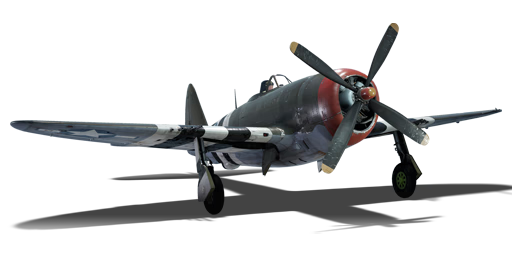
The P-47D-25 Thunderbolt is a rank American fighter with a battle rating of (AB), (RB), and (SB). It has been in the game since the start of the Open Beta Test prior to Update 1.27.
Like the P-51D Mustang, the P-47D-25 is one of the iconic fighters of the USAAF and also one of the most powerful. The wing of the British Spitfire melded with the iconic Pratt and Whitney R-2800 and bulky body, the P-47 is truly a force to be reckoned with, possessing very good performance, weaponry, and loadout. The "Jug" is thus one of the best fighters in the USAAF line; possessing the hallmarks of a great fighter and the capability of a fast attacker.
General info
Flight performance
In Arcade battles, the P-47 can be pushed to its limits. Climb rate, turn rate, and responsiveness are all dramatically increased. Still, tactics used in RB also apply very well in Arcade- this fighter is great for practising Boom & Zoom in Arcade due to the impressive climb rate in this mode. However, the skill will not be built nearly as well in this mode, as rolling scissors and "skidding" manoeuvres will not really be needed.
Overall, the P-47 is a very pleasurable plane to fly for a quick jaunt in arcade battles.
| Characteristics | Max Speed (km/h at 9,144 m) |
Max altitude (metres) |
Turn time (seconds) |
Rate of climb (metres/second) |
Take-off run (metres) | |||
|---|---|---|---|---|---|---|---|---|
| AB | RB | AB | RB | AB | RB | |||
| Stock | 676 | 657 | 26.2 | 27.2 | 7.3 | 7.3 | 600 | |
| Upgraded | 729 | 700 | 23.8 | 25.0 | 15.0 | 10.6 | ||
Details
| Features | ||||
|---|---|---|---|---|
| Combat flaps | Take-off flaps | Landing flaps | Air brakes | Arrestor gear |
| ✓ | ✓ | ✓ | X | X |
| Limits | ||||||
|---|---|---|---|---|---|---|
| Wings (km/h) | Gear (km/h) | Flaps (km/h) | Max Static G | |||
| Combat | Take-off | Landing | + | - | ||
| 498 | 469 | 320 | ~13 | ~5 | ||
| Optimal velocities (km/h) | |||
|---|---|---|---|
| Ailerons | Rudder | Elevators | Radiator |
| < 402 | < 420 | < 470 | > 335 |
Survivability and armour
- 9.5 mm Steel - Fore cockpit plate
- 9.5 mm Steel - Armour plate behind Pilot's seat
- 38 mm Bulletproof glass - Windshield
Modifications and economy
Climb rate and acceleration is a big issue for the stock P-47D. Focus on Compressor, Engine, Wing repairs and Engine Injection first. During this performance focused grind, you can additionally research New 12.7 mm MGs and the various payload modules to unlock the higher tiers for the better performance upgrades.
Armaments
Offensive armament
The P-47D-25 is armed with:
- 8 x 12.7 mm M2 Browning machine guns, wing-mounted (425 rpg = 3,400 total)
Suspended armament
The P-47D-25 can be outfitted with the following ordnance:
- Without load
- 1 x 500 lb AN-M64A1 bomb (500 lb total)
- 2 x 1,000 lb AN-M65A1 bombs (2,000 lb total)
- 2 x 1,000 lb AN-M65A1 bombs + 1 x 500 lb AN-M64A1 bomb (2,500 lb total)
- 10 x HVAR rockets
- 10 x HVAR rockets + 1 x 500 lb AN-M64A1 bomb (500 lb total)
- 10 x HVAR rockets + 2 x 1,000 lb AN-M65A1 bombs (2,000 lb total)
- 10 x HVAR rockets + 2 x 1,000 lb AN-M65A1 bombs + 1 x 500 lb AN-M64A1 bomb (2,500 lb total)
Usage in battles
- Realistic
The Thunderbolt was used as a high altitude bomber escort and excels at fighter roles in the game, but it can also be used as a very effective ground attack aircraft, thanks to its impressive bomb load. With the equivalent of 3,000 lbs of ordnance under its wings with munitions such as 1,000 lb bombs and 10 HVAR rockets, it is an excellent fighter-bomber. In this role, its performance is often superior to even dedicated ground attack aircraft such as IL-2 Sturmoviks. Its eight fifty-calibre guns are effective against soft targets which aren't worth rockets or bombs. With good aim, they can destroy light pillboxes at distances less than 400 m if using the "Ground targets" belt. When engaging against enemy aircraft, Boom & Zoom tactics are a must, never try to dogfight with the 'Jug'. When diving on a target, if you don't down the enemy, don't try to turn and finish him, use the speed you built in the dive and extend away, climb up, Immelmann and do it all again.
Two main skill modes present themselves: strike fighter (fighter-bomber), taken by going low with a full payload, ravaging the countryside, or just as a standard fighter by first gaining altitude to hunt for bombers, or using the height to dive on enemies who do not have the patience to climb. For the former, "ground targets" belt is obviously advised, it will easily pierce armoured cars and light pillboxes, but they do work well on aircraft too.
When using the "Jug" as a fighter remember that speed and altitude are your lifelines. Never give these up unless you must to stay alive. Also, remember that in Arcade planes accelerate very quickly so you need a huge speed advantage to make sure you can make a getaway in a boom and zoom attack. With this is mind, dive in on enemies that are engaging a teammate or that are at least 1 km below you. If you do not shoot down the enemy, remember to go into a shallow climb to extend, not a steep climb
A wonderful Boom & Zoom fighter in every respect, therefore fly it accordingly! As in real life, the performance advantage will drastically shift in favour of the P-47D above 3,000 m (Soviet opponents) or 6,000 m (most German and Japanese aircraft). The climb rate of this plane is not the best as such it is a good idea to side climb and wait for the first engagement. In Realistic battles it is wise to wait until after the first engagements with enemies, then if your team has a numerical advantage land on the airstrip, bailout and then load the ground attack ordnance. Remember to not bail out until fully repaired and rearmed!
Its bubble canopy makes spotting enemies much easier than most other planes even when you are above the enemy. Remember that firing at an enemy plane at convergence range will be devastating, choosing a comfortable targeting distance is crucial in the Thunderbolt. In many cases don't be afraid to dive away from an enemy and then pull-up drastically since you have a heavy and very tough airframe, this makes altitude a very important asset, and thus side climbing is always beneficial.
- Simulator
In air Simulator, bulkier planes that suffer in AB & RB shine and that of course includes the P-47. Sitting at BR 3.7, the lowest BR for rank 3 EC, it can respawn infinitely without needing any spawn points which makes it a great learning platform for new EC players. In Sim, the P-47 has smooth handling, all-round unobstructed vision and fast speed, and it offers a wide range of additional loadouts like bombs and rockets, plus the original 8 x .50 cals with plenty of ammo each, meaning it is an excellent multi-role aircraft. It can perform ground pounding, bomber intercepting, traditional BnZ fighting, and, if there is an unfinished base, base bombing.
For attacking ground targets, choose wisely between the various payload options according to your target. Use the bombs and rockets to take out pillboxes and tanks, then the MG for soft targets like AAA, howitzers and trucks. When approaching the target, dive at a medium angle to gain speed and momentum for the bombs, try to drop as close as possible but avoid crashing into the ground. When the gunsight slices through and just above the target, drop the 1,000 lbs. When the target is at the center of the gunsight and fills up around 1/3 of it, release the 500 lbs. The 8 MGs are perfect for killing trucks, AA guns and artilleries as they have plenty of ammo. However, constantly watch your surrounding, especially your high 6 for any incoming enemies.
When intercepting a player-controlled bomber, it is always better to attack from a higher altitude. The more altitude you have over the target, the easier it is for you to lead which maximises your damage output. The American armament style of having numerous machine guns require the player to land plenty of hits on the target in order to cripple/destroy it, meaning that the player must control the lead well and maintain it throughout the pass, which is different and maybe harder than German/Russian armament styles, where a few hits from their large cannons get the job done. Luckily the P-47D is a very smooth gun platform at high speeds. Dive at the target from above with lead pursuit, and you can start firing once the target is about to fill up the reticle circle. Given the great velocity and trajectory of .50 cal bullets, this far distance can still cause damage to the target. Depending on your speed, you will have a ~3-5 second shooting window where the burst should last throughout. If your fire is accurate the target is very likely to get shredded to pieces, but if it is not, pull up for another pass. As you start to dive down again, the P-47 will wobble around a bit due to the low airspeed, so take your time to smooth down the plane. At an adequate speed of above ~420 km/h, the P-47's reticle can stay exactly where you aim at. Thanks to this firepower and stability the P-47D shines at dueling single targets.
However, for missions like "destroy enemy bombers" where there are around 10 AI bombers to destroy, the P-47 may struggle a bit due to its rather low one-second burst mass comparing to some dedicated heavy fighters/interceptors, and its big size. Once the player closes in on the AI formation it will immediately be targeted by countless gunners, and even with the Jug's ruggedness the skin will still get hit, causing aerodynamic efficiency loss. Plus its huge radial engine will usually get damaged. Amid the rain of bullets the player has to dodge some fire while also leading and firing long bursts, increasing the chance of getting hit. Though it is definitely possible to deal with such AI planes, there are still better candidates for this role. Heavy interceptor like the P-61 will make short work of any target with a short burst of its powerful cannons and can take more hits, while the P-47 must stay in the danger for longer to deal the same damage.
As for dogfighting, because most aerial battles in Sim occur at around 3,000 m, the P-47 can easily climb to this altitude and gather up lots of speed before engaging a battle. The tactic is similar to the RB one above. If, unfortunately, you find yourself being chased at your 6 and you don't know how to do any defensive manoeuvres, do a large, smooth turn towards the nearest friendly airfield to avoid bleeding too much speed. Then shallow-dive towards your airfield. The P-47 can quite easily outrun opponents like the A6M or Bf-109 E, but struggles to outrun Bf-109 F/G, FW-190 A or other P-47. Another way of disengaging is to do a sudden split-S to dodge under the chaser. Average Sim players will now try and see where you went, if not immediately losing track of you. You can then run for your airfield or shallow climb for another attack.
- Enemies worth noting (sim)
- Me 264: This giant is one of the few bombers who get air spawns in Sim, so it usually flies higher than you think. On top of this, the Me 264 is armed with large calibre MG and cannons all over it, therefore tailing a 264 is basically suicide unless all of their gunners are knocked out. You can treat the 264 almost like a B-29 or B-17 as they are very similar in both design and defensive capabilities. It is best to head-on the 264 if you can as you can easily knock out the pilots due to its glazed nose while also taking minimal damage. However the bomber lacks a ventral turret on its belly, making it easy to deal damage from below, but be wary of the downwards facing rear 20 mm cannon near the tail. The safest way to attack is from a higher altitude, dive at an oblique angle and focus fire on the wings and nose. Never engage if you have no altitude advantage.
- Bf 110, Ki-45, A-26: As mentioned before, those twin engine aircraft are a big threat since their lack of manoeuvrability comparing to single engine fighters are minimised in Sim. They are usually armed with heavy guns & cannons in the nose, so an accurate burst will tear any plane apart, including the P-47. The P-47 manoeuvres rather sluggishly and you might get out-turned from even those heavy fighters, so engage them with either altitude or speed advantage to avoid being targeted. If they are not manoeuvring aggressively, aim for their wings or engines. If the fight is intense and you cannot smooth the aim, just burst anywhere as long as you hit them, the 12.7 mm bullets will damage their flight models quite a bit.
- ZSD63: A dangerous SPAA to go up against in Tank Realistic Battles. Though it is hard to identify specific SPAA vehicles on the ground (especially when they are shooting tracers at the plane), if a ZSD63 is identified, avoid it at all costs and do not attempt head-ons with it, ever. It can easily snap a wing off by casually putting a short burst in the P-47D-25's flight path. Don't even get close to it unless it is busy shooting someone else or if the P-47D-25 has a bomb ready for use. Some identifying features of the ZSD63 is its rather boxy and tall hull with a geometric turret sitting at the back, slightly similar to a Wirbelwind's. The firing manner is also distinctive: the sound and green tracers are very rapid, much like a buzz saw, but then it will remain silent for half a minute reloading. Note that an experienced ZSD player will hold its fire or shoot in single salvos with long halts between, making it look like it's reloading. Armour-piercing belt is recommended since their high penetration can tear through the ZSD's armour with ease and knock out its crews.
- Yak-2 KABB: Do not think that the P-47D-25 can confidently outmanoeuvre this plane just because it is twin-engined. The Yak-2 has an amazing turn rate for a heavy fighter, thus the P-47D-25 must avoid turning with it, if not dogfighting with it in general. It bears a pair of ShVAK cannons that can easily damage vital parts like engine or cooling systems. It has green camo, greatly resembling an Me 410 but with an H-tail like a Bf 110's.
Manual Engine Control
| MEC elements | ||||||
|---|---|---|---|---|---|---|
| Mixer | Pitch | Radiator | Supercharger | Turbocharger | ||
| Oil | Water | Type | ||||
| Controllable | Controllable Auto control available |
Controllable Not auto controlled |
Controllable Not auto controlled |
Separate | Controllable 1 gear |
Auto controlled |
Pros and cons
Pros:
- Great at diving and Boom & Zoom
- Great multirole aircraft, acting as an interceptor or ground-attack aircraft
- Impressive speed, great engine performance above 6,000 m
- Very rugged construction can keep the plane flying despite damages
- Impressive firepower of 8 x 12.7 mm M2 Browning machine guns with also impressive ammunition pool
- First plane in the U.S tech tree to gain access to pure API-T ammo belts
- Can easily escape enemies with its high speed for its rank
- One of the few fighters that can carry both bombs and rockets at the same time, making it excellent for ground attack
- More manoeuvrable than other aircraft in the P-47 family
- By using opposite rudder and aileron controls, for example, left rudder and right aileron, the Thunderbolt can "skid" quickly in the direction the rudder - very useful to dodge shots, works for both the D-25 and D-28
- Can carry up to 2 x 1,000 lb bombs, 1 x 500 lb bomb, and 10 HVARs
Cons:
- Terrible turning time at low altitude/low speed
- Mediocre climb performance (side climbing recommended)
- Larger than average fighters
- Poor overall performance when mounting payloads
- After attacking ground targets, the P-47 lacks the altitude to Boom & Zoom enemy fighters
- Engine easily hit during a head-on attack
History
Developed by North Republic Aviation, the main role of the P-47 Thunderbolt was Bomber Escort, at high altitude the 'Jug' could contend with the latest from the Luftwaffe. The design was to also include much better protection for the pilot by having increased armour around the cockpit, however, this increased its weight substantially. It was the first American fighter to receive more than the standard 6 x .50 calibre M2 Browning Machine guns, a total of 8 all together, making it the most powerful Allied aircraft in terms of firepower at the time. Thanks to its rugged design, the Thunderbolt was able to take a considerable beating, more so than other allied aircraft, also with its sturdy airframe and reliable radial engine, the 'Jug' quickly took on the role of ground attack, able to arm itself with 2,500 lbs of bombs and rockets. All in all the Thunderbolt was one of the most successful allied aircraft during the war, even with the introduction of the faster and more nimble P-51 Mustang, later modifications of the Thunderbolt would go on to see action in the later part of the Pacific Campaign against the Imperial Japanese Navy.
A total of 385 D-25 models of the P-47 were constructed. This model was the first to receive the teardrop canopy. It was also fitted with an increased supply of oxygen and some systems were repositioned for higher fuel capacity.
In-game description
The Republic P-47 Thunderbolt was an American fighter-bomber of the WWII era. It was one of the main USAAF fighters of WWII, especially effective as a fighter-bomber. The P-47 was also sent to the USSR via the lend-lease program. It was designed at Republic Aviation by two emigrants from the Russian Empire, Alexander Seversky and Alexander Kartveli.
The official designation of the P-47, like that of many other Republic aircraft, is related to the word Thunder. However, the P-47's unmatched dimensions and weight led to the P-47 being nicknamed the Jug. Another informal nickname, more common during WWII, is Bolt or T-Bolt. The most mass-produced variant of the P-47 was the P-47D with a teardrop canopy. The variant was in development as early as 1941 and the first order for 850 P-47Ds was placed in late 1941. Many more Thunderbolts would be built during the war, making it the most mass-produced US fighter of WWII by 1945.
Notable pilots

Media
- Skins
- Videos
See also
Links to the articles on the War Thunder Wiki that you think will be useful for the reader, for example:
- reference to the series of the aircraft;
- links to approximate analogues of other nations and research trees.
External links
- [Profile] P-47D-25 - The All American Juggernaut
- [Wikipedia] Republic P-47 Thunderbolt
- [Air Vectors] The Republic P-47 Thunderbolt - P-47D / P-47G / XP-47K / XP-47L
| Republic Aviation Corporation | |
|---|---|
| Fighters | P-43A-1 |
| P-47D-22-RE · P-47D-25 · P-47D-28 · P-47M-1-RE · ⋠P-47M-1-RE · P-47N-15 | |
| Jet Aircraft | F-84B-26 · F-84F · F-84G-21-RE |
| F-105D | |
| Export | J9 Early* |
| ␗P-43A-1 | |
| ▄Thunderbolt Mk.1 · ▄P-47D-22-RE · ␗P-47D-23-RA · ▂P-47D-27 · ␗P-47D-30 · ▄P-47D-30 · ␗F-47N-25-RE | |
| ◄F-84F · ▄F-84F (Italy) · ▄F-84F (France) · F-84F IAF · F-84F | |
| ␗F-84G-21-RE · ▄F-84G-21-RE · ▄F-84G-26-RE · ␗F-84G-31-RE | |
| Captured | ▀P-47D-16-RE · ▀P-47D |
| *The company was named "Seversky Aircraft Company" before being renamed in 1939 | |
| USA fighters | |
|---|---|
| P-26 Peashooter | P-26A-33 · P-26A-34 · P-26A-34 M2 · P-26B-35 |
| P-36 Hawk | P-36A · Rasmussen's P-36A · P-36C · ○P-36C · P-36G |
| P-39 Airacobra | P-400 · P-39N-0 · P-39Q-5 |
| P-40 | P-40C · P-40E-1 · P-40E-1 TD · P-40F-10 |
| P-43 Lancer | P-43A-1 |
| P-47 Thunderbolt | P-47D-22-RE · P-47D-25 · P-47D-28 · P-47M-1-RE · ⋠P-47M-1-RE · P-47N-15 |
| P-51 Mustang | P-51 · P-51A (Thunder League) · P-51C-10 · P-51D-5 · P-51D-10 · P-51D-20-NA · P-51D-30 · P-51H-5-NA |
| P-63 Kingcobra | P-63A-5 · P-63A-10 · P-63C-5 · ␠Kingcobra |
| Prototypes | XP-55 |
| F2A Buffalo | F2A-1 · Thach's F2A-1 · F2A-3 |
| BF2C | BF2C-1 |
| F3F | F3F-2 · Galer's F3F-2 |
| F4F Wildcat | F4F-3 · F4F-4 |
| F4U Corsair | F4U-1A · F4U-1A (USMC) · F4U-1D · F4U-1C · F4U-4 · F4U-4B · F4U-4B VMF-214 · F2G-1 |
| F6F Hellcat | F6F-5 · F6F-5N |
| F8F Bearcat | F8F-1 · F8F-1B |
| Other countries | ▃Ki-43-II · ▃Ki-61-Ib · ▃A6M2 · ▃Bf 109 F-4 · ▃Fw 190 A-8 · ▃Spitfire LF Mk IXc |