Difference between revisions of "Eland 90 Mk.7"
(New Specs-Card Artimage. Old picture moved to Media: Images) |
(→Pros and cons: Increased detail) (Tag: Visual edit) |
||
| (13 intermediate revisions by 6 users not shown) | |||
| Line 1: | Line 1: | ||
{{Specs-Card | {{Specs-Card | ||
|code=uk_eland_90_mk_7 | |code=uk_eland_90_mk_7 | ||
| − | |images={{Specs-Card-Image|GarageImage_{{PAGENAME}}.jpg | + | |images={{Specs-Card-Image|GarageImage_{{PAGENAME}}.jpg}} |
}} | }} | ||
| Line 18: | Line 18: | ||
{{Specs-Tank-Armour}} | {{Specs-Tank-Armour}} | ||
<!-- ''Describe armour protection. Note the most well protected and key weak areas. Appreciate the layout of modules as well as the number and location of crew members. Is the level of armour protection sufficient, is the placement of modules helpful for survival in combat? If necessary use a visual template to indicate the most secure and weak zones of the armour.'' --> | <!-- ''Describe armour protection. Note the most well protected and key weak areas. Appreciate the layout of modules as well as the number and location of crew members. Is the level of armour protection sufficient, is the placement of modules helpful for survival in combat? If necessary use a visual template to indicate the most secure and weak zones of the armour.'' --> | ||
| − | + | ''Describe armour protection. Note the most well protected and key weak areas. Appreciate the layout of modules as well as the number and location of crew members. Is the level of armour protection sufficient, is the placement of modules helpful for survival in combat? If necessary use a visual template to indicate the most secure and weak zones of the armour.'' | |
| − | '''Armour type:''' | + | '''Armour type:''' <!-- The types of armour present on the vehicle and their general locations --> |
| − | + | <!-- Example: * Rolled homogeneous armour (Front, Side, Rear, Hull roof) | |
| − | *Rolled homogeneous armour ( | + | * Cast homogeneous armour (Turret, Transmission area) --> |
| − | * | ||
| − | |||
{| class="wikitable" | {| class="wikitable" | ||
|- | |- | ||
| − | !Armour!!Front (Slope angle)!!Sides!!Rear!!Roof | + | ! Armour !! Front (Slope angle) !! Sides !! Rear !! Roof |
|- | |- | ||
| − | |Hull|| | + | | Hull || ___ mm || ___ mm ''Top'' <br> ___ mm ''Bottom'' || ___ mm || ___ - ___ mm |
| − | | | ||
| − | | | ||
| − | | | ||
|- | |- | ||
| − | |Turret|| | + | | Turret || ___ - ___ mm ''Turret front'' <br> ___ mm ''Gun mantlet'' || ___ - ___ mm || ___ - ___ mm || ___ - ___ mm |
| − | | | ||
| − | | | ||
|- | |- | ||
| − | |Cupola|| | + | | Cupola || ___ mm || ___ mm || ___ mm || ___ mm |
|- | |- | ||
|} | |} | ||
| − | '''Notes:''' | + | '''Notes:''' <!-- Any additional notes which the user needs to be aware of --> |
| − | + | <!-- Example: * Suspension wheels are 20 mm thick, tracks are 30 mm thick, and torsion bars are 60 mm thick. --> | |
| − | * | ||
| − | |||
| − | |||
| − | |||
=== Mobility === | === Mobility === | ||
| Line 55: | Line 44: | ||
{{tankMobility|abMinHp=139|rbMinHp=80}} | {{tankMobility|abMinHp=139|rbMinHp=80}} | ||
| − | |||
| − | |||
=== Modifications and economy === | === Modifications and economy === | ||
| Line 67: | Line 54: | ||
<!-- ''Give the reader information about the characteristics of the main gun. Assess its effectiveness in a battle based on the reloading speed, ballistics and the power of shells. Do not forget about the flexibility of the fire, that is how quickly the cannon can be aimed at the target, open fire on it and aim at another enemy. Add a link to the main article on the gun: <code><nowiki>{{main|Name of the weapon}}</nowiki></code>. Describe in general terms the ammunition available for the main gun. Give advice on how to use them and how to fill the ammunition storage.'' --> | <!-- ''Give the reader information about the characteristics of the main gun. Assess its effectiveness in a battle based on the reloading speed, ballistics and the power of shells. Do not forget about the flexibility of the fire, that is how quickly the cannon can be aimed at the target, open fire on it and aim at another enemy. Add a link to the main article on the gun: <code><nowiki>{{main|Name of the weapon}}</nowiki></code>. Describe in general terms the ammunition available for the main gun. Give advice on how to use them and how to fill the ammunition storage.'' --> | ||
{{main|GT-2 (90 mm)}} | {{main|GT-2 (90 mm)}} | ||
| − | |||
| − | |||
{| class="wikitable" style="text-align:center" width="100%" | {| class="wikitable" style="text-align:center" width="100%" | ||
| Line 87: | Line 72: | ||
==== Ammunition ==== | ==== Ammunition ==== | ||
| − | {{: | + | {| class="wikitable sortable" style="text-align:center" width="100%" |
| + | ! colspan="8" | Penetration statistics | ||
| + | |- | ||
| + | ! rowspan="2" data-sort-type="text" | Ammunition | ||
| + | ! rowspan="2" | Type of<br>warhead | ||
| + | ! colspan="6" | Penetration @ 0° Angle of Attack (mm) | ||
| + | |- | ||
| + | ! 10 m !! 100 m !! 500 m !! 1,000 m !! 1,500 m !! 2,000 m | ||
| + | |- | ||
| + | | OCC 60-62 || HEATFS || 320 || 320 || 320 || 320 || 320 || 320 | ||
| + | |- | ||
| + | | OE 90 F1 || HE || 13 || 13 || 13 || 13 || 13 || 13 | ||
| + | |- | ||
| + | |} | ||
| + | {| class="wikitable sortable" style="text-align:center" width="100%" | ||
| + | ! colspan="10" | Shell details | ||
| + | |- | ||
| + | ! rowspan="2" data-sort-type="text" | Ammunition | ||
| + | ! rowspan="2" | Type of<br>warhead | ||
| + | ! rowspan="2" | Velocity<br>(m/s) | ||
| + | ! rowspan="2" | Projectile<br>Mass (kg) | ||
| + | ! rowspan="2" | Fuse delay<br>(m) | ||
| + | ! rowspan="2" | Fuse sensitivity<br>(mm) | ||
| + | ! rowspan="2" | Explosive Mass<br>(TNT equivalent) (g) | ||
| + | ! colspan="3" | Ricochet | ||
| + | |- | ||
| + | ! 0% !! 50% !! 100% | ||
| + | |- | ||
| + | | OCC 60-62 || HEATFS || 750 || 8.95 || 0.05 || 0.1 || 877.7 || 65° || 72° || 77° | ||
| + | |- | ||
| + | | OE 90 F1 || HE || 640 || 10.45 || 0 || 0.1 || 945 || 79° || 80° || 81° | ||
| + | |- | ||
| + | |} | ||
| + | {| class="wikitable" style="text-align:center" | ||
| + | ! colspan="7" | Smoke shell characteristics | ||
| + | |- | ||
| + | ! Ammunition | ||
| + | ! Velocity<br>(m/s) | ||
| + | ! Projectile<br>Mass (kg) | ||
| + | ! Screen radius<br>(m) | ||
| + | ! Screen deploy time<br>(s) | ||
| + | ! Screen hold time<br>(s) | ||
| + | ! Explosive Mass<br>(TNT equivalent) (g) | ||
| + | |- | ||
| + | | OFUM PH90-F2 || 640 || 10.2 || 13 || 5 || 20 || 50 | ||
| + | |- | ||
| + | |} | ||
==== [[Ammo racks]] ==== | ==== [[Ammo racks]] ==== | ||
| − | [[File:Ammoracks_{{PAGENAME}}.png|right|thumb|x250px|[[Ammo racks]] of the {{PAGENAME}}]] | + | <!-- [[File:Ammoracks_{{PAGENAME}}.png|right|thumb|x250px|[[Ammo racks]] of the {{PAGENAME}}]] --> |
| − | <!-- '''Last updated: | + | <!-- '''Last updated:''' --> |
{| class="wikitable" style="text-align:center" | {| class="wikitable" style="text-align:center" | ||
|- | |- | ||
| Line 103: | Line 134: | ||
! Visual<br>discrepancy | ! Visual<br>discrepancy | ||
|- | |- | ||
| − | | '''29''' || | + | | '''29''' || __ ''(+__)'' || __ ''(+__)'' || __ ''(+__)'' || __ ''(+__)'' || __ ''(+__)'' || __ ''(+__)'' || __ |
|- | |- | ||
|} | |} | ||
| − | |||
| − | |||
| − | |||
| − | |||
| − | |||
| − | |||
=== Machine guns === | === Machine guns === | ||
| Line 125: | Line 150: | ||
! Mount !! Capacity (Belt) !! Fire rate !! Vertical !! Horizontal | ! Mount !! Capacity (Belt) !! Fire rate !! Vertical !! Horizontal | ||
|- | |- | ||
| − | | Coaxial || 3, | + | | Coaxial || 3,600 (250) || 500 || N/A || N/A |
|- | |- | ||
| Pintle || 2,000 (250) || 500 || -10°/+17° || ±120° | | Pintle || 2,000 (250) || 500 || -10°/+17° || ±120° | ||
| Line 133: | Line 158: | ||
== Usage in battles == | == Usage in battles == | ||
<!-- ''Describe the tactics of playing in the vehicle, the features of using vehicles in the team and advice on tactics. Refrain from creating a "guide" - do not impose a single point of view but instead give the reader food for thought. Describe the most dangerous enemies and give recommendations on fighting them. If necessary, note the specifics of the game in different modes (AB, RB, SB).'' --> | <!-- ''Describe the tactics of playing in the vehicle, the features of using vehicles in the team and advice on tactics. Refrain from creating a "guide" - do not impose a single point of view but instead give the reader food for thought. Describe the most dangerous enemies and give recommendations on fighting them. If necessary, note the specifics of the game in different modes (AB, RB, SB).'' --> | ||
| − | + | ''Describe the tactics of playing in the vehicle, the features of using vehicles in the team and advice on tactics. Refrain from creating a "guide" - do not impose a single point of view but instead give the reader food for thought. Describe the most dangerous enemies and give recommendations on fighting them. If necessary, note the specifics of the game in different modes (AB, RB, SB).'' | |
| − | |||
| − | |||
| − | |||
| − | |||
| − | |||
| − | |||
| − | |||
| − | |||
| − | |||
| − | |||
| − | |||
| − | |||
=== Pros and cons === | === Pros and cons === | ||
| Line 157: | Line 170: | ||
* Smoke shells and smoke grenades to enhanced protection and support role | * Smoke shells and smoke grenades to enhanced protection and support role | ||
* More lenient playstyle than the previous Ratel IFVs, thanks to reduced size while conserving firepower and mobility | * More lenient playstyle than the previous Ratel IFVs, thanks to reduced size while conserving firepower and mobility | ||
| − | * Small size significantly reduces probability of death via [[Artillery Support|artillery]] (unlike on the [[Ratel 90]] and [[Ratel 20|20]]) | + | * Small size significantly reduces probability of overpressure death via [[Artillery Support|artillery]] (unlike on the [[Ratel 90]] and [[Ratel 20|20]]) |
| + | * APHE(C/BC/CBC) rounds often do not meet the threshold for fuse sensitivity, often leading to over-penetration | ||
* It is essentially a slightly better [[AML-90]] - it has hydraulic brakes which allow for much needed reduction to braking distance | * It is essentially a slightly better [[AML-90]] - it has hydraulic brakes which allow for much needed reduction to braking distance | ||
| Line 163: | Line 177: | ||
* As a light wheeled vehicle, it has an unstable handling at high speed | * As a light wheeled vehicle, it has an unstable handling at high speed | ||
| − | * | + | * Its thin armour means it is easily destroyed by any calibre bigger than a heavy machine gun, making it particularly vulnerable to aircraft |
* No stabilizer; the vehicle cannot effectively use the speed and firepower at the same time | * No stabilizer; the vehicle cannot effectively use the speed and firepower at the same time | ||
* HEATFS damage is unreliable in some situations; the sensitivity of the fuse is the main concern | * HEATFS damage is unreliable in some situations; the sensitivity of the fuse is the main concern | ||
| Line 177: | Line 191: | ||
== Media == | == Media == | ||
<!-- ''Excellent additions to the article would be video guides, screenshots from the game, and photos.'' --> | <!-- ''Excellent additions to the article would be video guides, screenshots from the game, and photos.'' --> | ||
| − | + | ''Excellent additions to the article would be video guides, screenshots from the game, and photos.'' | |
| − | |||
| − | |||
| − | |||
| − | |||
| − | |||
| − | |||
| − | |||
| − | |||
| − | |||
== See also == | == See also == | ||
| Line 195: | Line 200: | ||
;Vehicles with similar chassis | ;Vehicles with similar chassis | ||
| − | * [[AML-90 | + | * [[AML-90]] |
;Related service history | ;Related service history | ||
| Line 209: | Line 214: | ||
* [[AEC Mk II]] | * [[AEC Mk II]] | ||
* [[Crusader III]] | * [[Crusader III]] | ||
| + | * [[M3/M5 Stuart (Family)]] | ||
* [[T18E2]] | * [[T18E2]] | ||
| Line 220: | Line 226: | ||
* ''other literature.'' | * ''other literature.'' | ||
| − | |||
{{Britain light tanks}} | {{Britain light tanks}} | ||
[[Category:Wheeled ground vehicles]] | [[Category:Wheeled ground vehicles]] | ||
Revision as of 22:35, 26 May 2021

Contents
Description
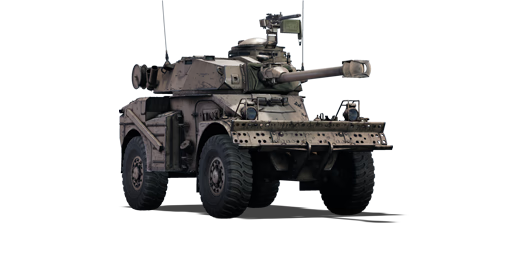
The Eland 90 Mk.7 is a rank British light tank with a battle rating of (AB), (RB), and (SB). It was introduced in Update "Ixwa Strike".
The Eland 90 Mk.7 is a light reconnaissance armoured car, built in 1962 by South Africa as a domestic variant of the French armoured car, the Panhard AML-90.
While the diminutive size and unpretentious look can be deceiving, this armoured car is sure to be one of the most agreeable light vehicles in the British ground forces. This combination of a remarkably mobile and small chassis plus satisfactory firepower is otherwise rarely found in British light vehicles; similarly to the reliable Crusader III and equal to the uncommon AEC Mk.II.
Meanwhile, Eland's weak armour is a problem for survival thus players will have to rely on flanking, scouting or ambushing tactics when engaging heavier armour.
General info
Survivability and armour
Describe armour protection. Note the most well protected and key weak areas. Appreciate the layout of modules as well as the number and location of crew members. Is the level of armour protection sufficient, is the placement of modules helpful for survival in combat? If necessary use a visual template to indicate the most secure and weak zones of the armour.
Armour type:
| Armour | Front (Slope angle) | Sides | Rear | Roof |
|---|---|---|---|---|
| Hull | ___ mm | ___ mm Top ___ mm Bottom |
___ mm | ___ - ___ mm |
| Turret | ___ - ___ mm Turret front ___ mm Gun mantlet |
___ - ___ mm | ___ - ___ mm | ___ - ___ mm |
| Cupola | ___ mm | ___ mm | ___ mm | ___ mm |
Notes:
Mobility
| Game Mode | Max Speed (km/h) | Weight (tons) | Engine power (horsepower) | Power-to-weight ratio (hp/ton) | |||
|---|---|---|---|---|---|---|---|
| Forward | Reverse | Stock | Upgraded | Stock | Upgraded | ||
| Arcade | Expression error: Unexpected * operator. | 139 | Expression error: Unexpected round operator. | __.__ | |||
| Realistic | 80 | Expression error: Unexpected round operator. | __.__ | ||||
Modifications and economy
Armaments
Main armament
| 90 mm GT-2 | Turret rotation speed (°/s) | Reloading rate (seconds) | |||||||||||
|---|---|---|---|---|---|---|---|---|---|---|---|---|---|
| Mode | Capacity | Vertical | Horizontal | Stabilizer | Stock | Upgraded | Full | Expert | Aced | Stock | Full | Expert | Aced |
| Arcade | 29 | -8°/+15° | ±180° | N/A | 23.8 | 32.9 | 40.0 | 44.2 | 47.1 | 8.71 | 7.70 | 7.10 | 6.70 |
| Realistic | 14.9 | 17.5 | 21.3 | 23.5 | 25.0 | ||||||||
Ammunition
| Penetration statistics | |||||||
|---|---|---|---|---|---|---|---|
| Ammunition | Type of warhead |
Penetration @ 0° Angle of Attack (mm) | |||||
| 10 m | 100 m | 500 m | 1,000 m | 1,500 m | 2,000 m | ||
| OCC 60-62 | HEATFS | 320 | 320 | 320 | 320 | 320 | 320 |
| OE 90 F1 | HE | 13 | 13 | 13 | 13 | 13 | 13 |
| Shell details | |||||||||
|---|---|---|---|---|---|---|---|---|---|
| Ammunition | Type of warhead |
Velocity (m/s) |
Projectile Mass (kg) |
Fuse delay (m) |
Fuse sensitivity (mm) |
Explosive Mass (TNT equivalent) (g) |
Ricochet | ||
| 0% | 50% | 100% | |||||||
| OCC 60-62 | HEATFS | 750 | 8.95 | 0.05 | 0.1 | 877.7 | 65° | 72° | 77° |
| OE 90 F1 | HE | 640 | 10.45 | 0 | 0.1 | 945 | 79° | 80° | 81° |
| Smoke shell characteristics | ||||||
|---|---|---|---|---|---|---|
| Ammunition | Velocity (m/s) |
Projectile Mass (kg) |
Screen radius (m) |
Screen deploy time (s) |
Screen hold time (s) |
Explosive Mass (TNT equivalent) (g) |
| OFUM PH90-F2 | 640 | 10.2 | 13 | 5 | 20 | 50 |
Ammo racks
| Full ammo |
1st rack empty |
2nd rack empty |
3rd rack empty |
4th rack empty |
5th rack empty |
6th rack empty |
Visual discrepancy |
|---|---|---|---|---|---|---|---|
| 29 | __ (+__) | __ (+__) | __ (+__) | __ (+__) | __ (+__) | __ (+__) | __ |
Machine guns
| 7.62 mm Browning MG4 | ||||
|---|---|---|---|---|
| Mount | Capacity (Belt) | Fire rate | Vertical | Horizontal |
| Coaxial | 3,600 (250) | 500 | N/A | N/A |
| Pintle | 2,000 (250) | 500 | -10°/+17° | ±120° |
Usage in battles
Describe the tactics of playing in the vehicle, the features of using vehicles in the team and advice on tactics. Refrain from creating a "guide" - do not impose a single point of view but instead give the reader food for thought. Describe the most dangerous enemies and give recommendations on fighting them. If necessary, note the specifics of the game in different modes (AB, RB, SB).
Pros and cons
Pros:
- Good mobility and acceleration with a dynamic reverse speed, even when stock
- Small size; perfect for ambushes
- 90 mm HEATFS provides great penetration; even more than the APDS found on the similarly ranked FV4202
- Smoke shells and smoke grenades to enhanced protection and support role
- More lenient playstyle than the previous Ratel IFVs, thanks to reduced size while conserving firepower and mobility
- Small size significantly reduces probability of overpressure death via artillery (unlike on the Ratel 90 and 20)
- APHE(C/BC/CBC) rounds often do not meet the threshold for fuse sensitivity, often leading to over-penetration
- It is essentially a slightly better AML-90 - it has hydraulic brakes which allow for much needed reduction to braking distance
Cons:
- As a light wheeled vehicle, it has an unstable handling at high speed
- Its thin armour means it is easily destroyed by any calibre bigger than a heavy machine gun, making it particularly vulnerable to aircraft
- No stabilizer; the vehicle cannot effectively use the speed and firepower at the same time
- HEATFS damage is unreliable in some situations; the sensitivity of the fuse is the main concern
- Only 3 crew members and ammo tightly storage within, likely to be disabled in a single hit
- Wide turning radius (cannot turn on the spot due to lack of tracks)
- Awful handling off-road, especially on snow and desert maps like Tunisia or Finland
- Prior to researching "Brake System" modification it suffers insufficient braking power, amplified by the high power-to-weight ratio
History
Describe the history of the creation and combat usage of the vehicle in more detail than in the introduction. If the historical reference turns out to be too long, take it to a separate article, taking a link to the article about the vehicle and adding a block "/History" (example: https://wiki.warthunder.com/(Vehicle-name)/History) and add a link to it here using the main template. Be sure to reference text and sources by using <ref></ref>, as well as adding them at the end of the article with <references />. This section may also include the vehicle's dev blog entry (if applicable) and the in-game encyclopedia description (under === In-game description ===, also if applicable).
Media
Excellent additions to the article would be video guides, screenshots from the game, and photos.
See also
- Vehicles with similar chassis
- Related service history
- Similar playstyle and role
External links
Paste links to sources and external resources, such as:
- topic on the official game forum;
- other literature.
| Britain light tanks | |
|---|---|
| A13 | A13 Mk I · A13 Mk I (3rd R.T.R.) · A13 Mk II · A13 Mk II 1939 |
| A15 | Crusader II · Crusader "The Saint" · Crusader III |
| A17 | Tetrarch I |
| IFV | Warrior · Desert Warrior (Kuwait) |
| Wheeled | Daimler Mk II · AEC Mk II · Fox · Vickers Mk.11 |
| Other | VFM5 |
| South Africa | |
| SARC | SARC MkIVa · SARC MkVI (2pdr) · SARC MkVI (6pdr) |
| Ratel | Ratel 90 · Ratel 20 |
| Rooikat | Rooikat Mk.1D · Rooikat 105 · Rooikat MTTD |
| Other | Concept 3 · Eland 90 Mk.7 |
| USA | Stuart I · Stuart III |