Lorraine

Contents
Description
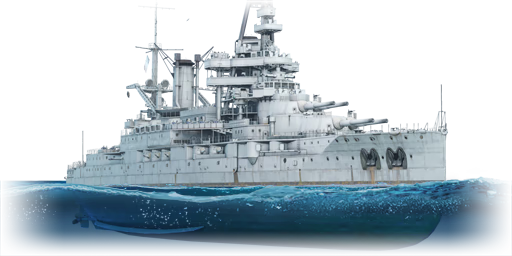
Lorraine was a Bretagne-class battleship of the French fleet, launched in 1913 and named after the French region of Lorraine. She was considered, like her sister ships, a super-dreadnought, but only thanks to the calibre of her guns. Due to the constraints of French shipyards, her length and displacement remained almost unchanged compared to her predecessors of the Courbet class.
She spent most of her service in the Mediterranean. In World War I, she was stationed in the port of Corfu, successfully preventing the Austro-Hungarian fleet from leaving the Adriatic Sea without firing a shot. In the 1920s and 1930s, she underwent a number of refits, one of which removed her central battery, replacing it with additional anti-air armament. With the outbreak of World War II, she carried a shipment of French gold to Bermuda, then returned to the Mediterranean. With the French surrender, she was interned by the British in the port of Alexandria. By the end of 1942, she was transferred to the Free French Navy, and participated in the Allied invasion of Provence and the siege of La Rochelle. After the war, she was used as a stationary gunnery training ship, then barracks ship, and finally was sold to a shipbreaking company in 1954.
The Lorraine was introduced in Update "La Royale" in her 1944 refit. She is characterised by low mobility and mediocre protection, but has good anti-air defence and powerful main guns.
General info
Survivability and armour
Talk about the vehicle's armour. Note the most well-defended and most vulnerable zones, e.g. the ammo magazine. Evaluate the composition of components and assemblies responsible for movement and manoeuvrability. Evaluate the survivability of the primary and secondary armaments separately. Don't forget to mention the size of the crew, which plays an important role in fleet mechanics. Save tips on preserving survivability for the "Usage in battles" section. If necessary, use a graphical template to show the most well-protected or most vulnerable points in the armour.
Mobility
Write about the ship's mobility. Evaluate its power and manoeuvrability, rudder rerouting speed, stopping speed at full tilt, with its maximum forward and reverse speed.
| Mobility Characteristics | |||
|---|---|---|---|
| Game Mode | Upgrade Status | Maximum Speed (km/h) | |
| Forward | Reverse | ||
| AB | |||
| Upgraded | |||
| RB/SB | |||
| Upgraded | |||
Modifications and economy
Armament
Primary armament
Provide information about the characteristics of the primary armament. Evaluate their efficacy in battle based on their reload speed, ballistics and the capacity of their shells. Add a link to the main article about the weapon: {{main|Weapon name (calibre)}}. Broadly describe the ammunition available for the primary armament, and provide recommendations on how to use it and which ammunition to choose.
| Penetration statistics | |||||||
|---|---|---|---|---|---|---|---|
| Ammunition | Type of warhead |
Penetration @ 0° Angle of Attack (mm) | |||||
| 1,000 m | 2,500 m | 5,000 m | 7,500 m | 10,000 m | 15,000 m | ||
| OEA Mle 1926 HE | HE | 68 | 68 | 68 | 68 | 68 | 68 |
| OPF Mle 1912 APC | APC | 472 | 424 | 355 | 301 | 258 | 203 |
| OPF Mle 1921 APCBC | APCBC | 493 | 457 | 403 | 359 | 321 | 267 |
| Shell details | ||||||||||||
|---|---|---|---|---|---|---|---|---|---|---|---|---|
| Ammunition | Type of warhead |
Velocity (m/s) |
Projectile mass (kg) |
Fuse delay (s) |
Fuse sensitivity (mm) |
Explosive mass (TNT equivalent) (kg) |
Ricochet | |||||
| 0% | 50% | 100% | ||||||||||
| OEA Mle 1926 HE | HE | 855 | 382 | 0 | 0.1 | 34.4 | 79° | 80° | 81° | |||
| OPF Mle 1912 APC | APC | 795 | 540 | 0.025 | 20 | 24.18 | 48° | 63° | 71° | |||
| OPF Mle 1921 APCBC | APCBC | 794 | 555 | 0.025 | 20 | 24.18 | 48° | 63° | 71° | |||
Secondary armament
Some ships are fitted with weapons of various calibres. Secondary armaments are defined as weapons chosen with the control Select secondary weapon. Evaluate the secondary armaments and give advice on how to use them. Describe the ammunition available for the secondary armament. Provide recommendations on how to use them and which ammunition to choose. Remember that any anti-air armament, even heavy calibre weapons, belong in the next section. If there is no secondary armament, remove this section.
| Penetration statistics | |||||||
|---|---|---|---|---|---|---|---|
| Ammunition | Type of warhead |
Penetration @ 0° Angle of Attack (mm) | |||||
| 1,000 m | 2,500 m | 5,000 m | 7,500 m | 10,000 m | 15,000 m | ||
| OEA Mle 1919 HE | HE | 36 | 36 | 36 | 36 | 36 | 36 |
| OPF Mle 1910 SAP | Common | 67 | 49 | 34 | 34 | 34 | 34 |
| OPF Mle 1921 SAPBC | SAPBC | 73 | 62 | 47 | 35 | 34 | 34 |
| Shell details | ||||||||||||
|---|---|---|---|---|---|---|---|---|---|---|---|---|
| Ammunition | Type of warhead |
Velocity (m/s) |
Projectile mass (kg) |
Fuse delay (s) |
Fuse sensitivity (mm) |
Explosive mass (TNT equivalent) (kg) |
Ricochet | |||||
| 0% | 50% | 100% | ||||||||||
| OEA Mle 1919 HE | HE | 840 | 31.5 | 0 | 0.1 | 3.41 | 79° | 80° | 81° | |||
| OPF Mle 1910 SAP | Common | 830 | 36.5 | 0.05 | 6 | 2.93 | 47° | 60° | 65° | |||
| OPF Mle 1921 SAPBC | SAPBC | 790 | 39.5 | 0.05 | 6 | 2.93 | 48° | 63° | 71° | |||
Anti-aircraft armament
An important part of the ship's armament responsible for air defence. Anti-aircraft armament is defined by the weapon chosen with the control Select anti-aircraft weapons. Talk about the ship's anti-air cannons and machine guns, the number of guns and their positions, their effective range, and about their overall effectiveness – including against surface targets. If there are no anti-aircraft armaments, remove this section.
Usage in battles
Describe the technique of using this ship, the characteristics of her use in a team and tips on strategy. Abstain from writing an entire guide – don't try to provide a single point of view, but give the reader food for thought. Talk about the most dangerous opponents for this vehicle and provide recommendations on fighting them. If necessary, note the specifics of playing with this vehicle in various modes (AB, RB, SB).
Pros and cons
Summarise and briefly evaluate the vehicle in terms of its characteristics and combat effectiveness. Mark its pros and cons in the bulleted list. Try not to use more than 6 points for each of the characteristics. Avoid using categorical definitions such as "bad", "good" and the like - use substitutions with softer forms such as "inadequate" and "effective".
Pros:
Cons:
History
Describe the history of the creation and combat usage of the ship in more detail than in the introduction. If the historical reference turns out to be too long, take it to a separate article, taking a link to the article about the ship and adding a block "/History" (example: https://wiki.warthunder.com/(Ship-name)/History) and add a link to it here using the main template. Be sure to reference text and sources by using <ref></ref>, as well as adding them at the end of the article with <references />. This section may also include the ship's dev blog entry (if applicable) and the in-game encyclopedia description (under === In-game description ===, also if applicable).
Media
- Skins
See also
Links to articles on the War Thunder Wiki that you think will be useful for the reader, for example:
- reference to the series of the ship;
- links to approximate analogues of other nations and research trees.
External links
| Ateliers et Chantiers de la Loire (ACL) | |
|---|---|
| Motor Torpedo Boats | |
| VTB-8-class | VTB-8 · VTB-9 |
| VTB-11-class | VTB-11 · VTB-13 · VTB-14 |
| Destroyers | |
| Jaguar-class | Leopard |
| Battleships | |
| Bretagne-class | Lorraine |
| See also | Loire Aviation |
| France battleships | |
|---|---|
| Courbet-class | Courbet · Paris |
| Bretagne-class | Bretagne · Lorraine |
| Dunkerque-class | Dunkerque |